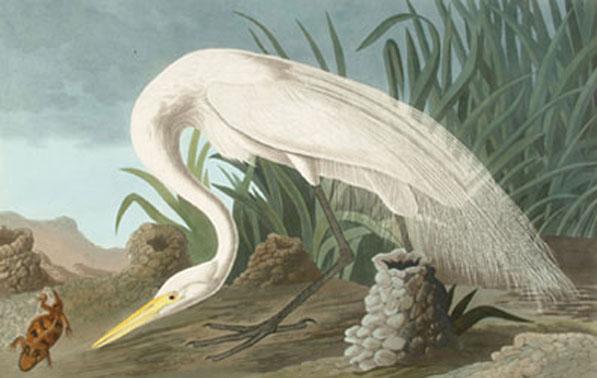
If you’re familiar with the artwork of John James Audubon, you know that he put birds in creative positions. Part of this was that he shot the birds and then put them in a position to paint them. Like this great blue heron:
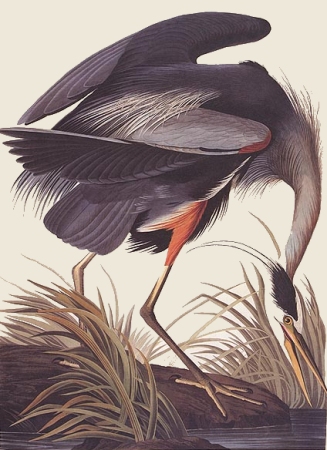
I’ve never seen a great blue heron in that exact position to get a fish or frog. I’m sure it’s possible, but this isn’t the typical heron posture.
Check out this egret. We love Audubon for his early documentation of birds in North America, and we look back and say, “Well, he did the best he could.”
Well, he may have been on to something. Check out this National Geographic photo of a great egret–very Audubon. Apologies, Audubon, for ever insinuating that your bird poses were outlandish.


I thought the main reason for the strange posing of the bigger herons and cranes was not so much error/awkward posing of dead birds as Audubon’s desire to reproduce each bird at life-size (within the restrictions of the enormous double-elephant folio paper he used for his original production).
Doh! Forgot my main point which was that egret photo is awesome.
Thanks for that post.
Being a nature artist, I’ve studied Audubon a bit. I believe he killed the birds, then posed them in a way he THOUGHT looked natural, and finally painted them. Ahhh I love “naive” wildlife art. If it wasn’t so expensive/hard to find prints, I’d have them all over my walls!
Thanks for this post and all of your terrific work on the blog. These contorted postures are common in Audubon’s drawings of very large birds — the reason they look that way is not because Audubon didn’t understand bird habits but rather because he insisted on drawing all of his birds at actual size. The large birds simply wouldn’t fit on the paper (which was “double elephant” sized, the largest made) without being folded over. Audubon’s pages are like standard containers into which variously sized birds – s, m, l, xl, had to be made to fit.
*gasp of awe* what a photo! and I can only imagine how that bird will swallow that enormous fish!
I’ve been reading about Audubon recently, and his method for painting may have had as much to do with selling his art to a buying public as anything. This was the style of the day. He really had to work hard at it just to make a living. In his day there were no book deals or signing bonuses, no government bail-out if he couldn’t make it. I’ve come to appreciate the difficult work that went into producing all these bird paintings. It’s something we take for granted today when we see an Audubon painting.
Wow. That’s crazy!
I saw this link today and thought of you:
http://www.cnn.com/2009/TECH/science/03/26/pp.bird.usgs/index.html
“Ninety years of birdwatchers’ notes going online”
Mel
Wow! That shot is FANTASTIC! Those white wing/shoulder feathers look solid and creamy; the angle of the neck is wicked & the fish scales glittering are amazing. Let’s not forget that eye! Wow again! Once again, those NG photographers showing us why they are professionals! Amazing!
I think the awkwardness is visible in some of his paintings of smaller birds too, so maybe it’s a combination of factors. They’re still amazing of course!
Awesome National Geography photo and kudos to Audubon to capture it so well.
Awesome photo that of National Geographic. Audubon got it!
Sharon, I have added your blog to my Google Reader.
If you want to add my blog to your reader (I do recommend Google Reader , but you probably already know what great resource that is in order follow a large number of blogs) here is my blog.
http://www.kolibriexpeditions.com/birdingperu/blog
I blog about birding, mostly from Peru, but also elsewhere; and I blog about social media for birders. Hope you like it.
I am also adding you to my blog roll. Will appreciate reciprocal link, if possible.
Saludos
Gunnar