Albino Black-capped Chickadee

This fluffy white cuteness comes to us from Deb Pflueger of Avon, Minnesota. It's a recently fledged albino black-capped chickadee! If you look closely at the photo, you can almost see a hint of the lightest beige where the black cap and beard should be. It was in her yard on June 9, 2007 but she has not seen it since.

Thanks, Deb, for taking such a great shot of this unusual bird.

Bird in the Hand

I'm fairly certain I've said this before in the blog, but I'm going to say it again.

I get that hummingbirds are incredible birds, but I don't get it in photos. I will look at magazines with incredible photos and I'll glance at them and think, "Yes, that's a pretty bird." But I don't get the wow factor until I see one in front of me at a feeder or flower and then it hits me, "How is that a bird and not a bug?"

Unfortunately, today I got to experience one in the hand. We get hummingbirds from time to time in the nets at Carpenter, but the more experienced banders are the ones that get them out--which is fine with me. Today, I heard a loud thump on the windows at Mr. Neil's (a bird hit the glass)--a problem we've been trying to fix. It's hard to stop Cooper's hawks and sharp-shinned hawks from driving birds into the windows. When I first heard the thump, I thought is was finch. I poked my head out the window and found a female ruby-throated hummingbird splayed on the grass. I dashed out and picked her up.

She was breathing and there was no visible blood from her beak. The hummingbirds have been fighting over feeders and territory, so I wonder if she flew into the window after being chased away from the feeder. No other bird species were in a panic when she flew like when the hawks are around. Several finches continued at the finch feeder oblivious to what happened.

You could see around her bill that she had little traces of spider webs--she has been gathering nesting material. Ruby-throated hummingbirds use spider webs to bind the nesting material together.

I took a moment to photograph her feet. Ruby-throated hummingbirds are unable to walk with their feet. They are pretty much there just for perching. If she is sitting on a branch and wants to turn around, she will have to use her wings to fly up, turn around and then land back on the perch facing the other way. Dear me, I'm looking at my finger tip in this photo and realizing I need to exfoliate.

Right as I took this photo, her eyes started to ope nand you could see her tongue slipping out at the tip of her bill. I quit taking photos and tried to keep her perched on my hand, facing away from me, so she wouldn't see me behind her--I thought that might help keep her calm. I had some nectar with me and set a drop of nectar on her bill, she licked it up. I did that a couple more times and then she straightened up, buzzed her wings and before I knew it she was hovering above my hand and then headed for the cover of a nearby pine tree.

It was an honor to have a hummer in hand, but I really do wish it had been under much different circumstances. There was something kind of surreal holding something so seemingly fragile yet has the ability to survive and nest outdoors and migrate single handedly across the Gulf of Mexico.

After a few minutes in the tree of preening and rest, she flew back over to one of the hummingbird feeders and I was able to digiscope a photo. She's the one on the left--you can see a couple of feathers on the back of her head are still out of place. It was interesting that this time a second female came in to feed and not chase her off. We have three nectar feeders going, but at the moment this Hummzinger is the most popular with the hummingbirds.

This photo isn't the best. But I love it. I had turned off the camera accidentally while I was digiscoping the hummingbirds. I turned it back on and as I was zooming in, I took a photo--that's why you can see the vignetting around the image. Anyway, as I shot the photo, a goldfinch flew in front of the feeder. Just cracked me up.

Everything BUT An Oriole

So, part of my goal on Saturday was to get some photos of orioles--I really don't have any recent ones. A pair had finally shown up at Mr. Neil's so I thought I would go out, play with his new dog, and put together our comb honey supers (yes, I'm being optimistic for later this summer). I set myself up near the feeding stations to try and get some photos of orioles on the jelly feeder. The rose-breasted grosbeaks were incredibly accommodating. They were not in the least bit shy about all the hammering Non Birding Bill and I were doing. One pair even engaged in some..."marital relations" right on the tray of the copper Aspects feeder--daring!

The goldfinches were very easy shoot as well. This male kept cracking me up--he kept raising his little "crest". I'm not sure what was getting the finches so excited, it's a bit early for them to be nesting, but it was cute.

I have a hummingbird feeder called a HummZinger set up right next to the jelly feeder for the orioles. I decided to just aim the scope on those feeders just in case the orioles finally decided to make an appearance. A male ruby-throated hummingbird came in and lurked at the feeder. He took sips of nectar in between curious glances my way.

It was a glorious day to be outside. Look how the sun hit that hummingbird's ruby throat above--nice! The chorus of birds was unbelievable. A male scarlet tanager flew in and sang above me in an oak tree. I played my birdJam and he flew down, gave me once over and then stayed in the tops of the trees. It was interesting to see how quickly he figured out the song was nothing to be alarmed about--a fake. I wonder if they pick up on recordings being the same timing and phrasing every time?

I played the oriole call, and they didn't respond at all.

In the afternoon I heard one of my all time favorite songs--bobolink! Poor Non Birding Bill was dozing in the grass when I first heard the song. I gasped loudly and yelled at Bill, "Do you hear that?!" He jerked awake and said, "Huh? What's wrong? Where?" He was not as excited as I hoped he'd be at the idea of seeing a bobolink. I snuck over to the field where the song was coming from (and near the beehives) where at least four male bobolinks were singing out a territory battle (almost as choreographed as West Side Story). I managed to get a few photos--nothing great--but proof of the bobolink. I thought to myself, "How is it that I can get a bobolink photo today, but no oriole?" But, I still had time.

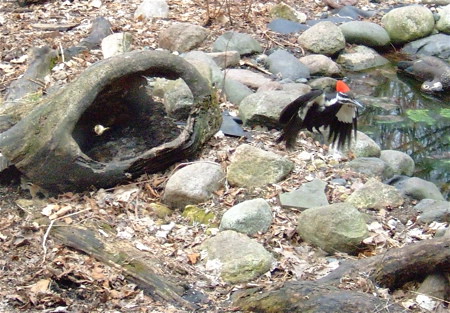
When I walked back to my supers, a male pileated woodpecker was on the suet log. I managed to trip over a frame and not scare him off and get a photo. Okay, a pileated photo and no oriole? Mother Nature has GOT to be toying with me.

I set the scope back towards the nectar and jelly feeders and managed to get a few more fun ones of the hummingbird. I love the above shot. He's on his way to chase out another male who wanted a chance at the feeder. I thought that while I was hammering away that I should brush up on my warbler calls. I'm one of the field trip leaders at next week's Detroit Lakes Bird Festival and need to be on my game. I like how the birdJam has a warbler playlist with no narration so I can just let that go and test myself. I had my iPod on my portable speaker and was going through the calls: song--black-throated green, song--blackburnian, song--blackpoll, song--blue-winged...when the next warbler came on, I noticed I could still hear the blue-winged. I turned off the iPod...

...and ten feet above my head was a blue-winged warbler! Let me tell you, it took some pretty fancy maneuvering just to get this shot as I tried to angle the scope straight up. The blue-winged sat there for at least five minutes, completely aloof to my straining below (and I kept the birdJam off the whole time). He was pretty mellow and even tucked up one of his feet in a relaxed position. He eventually flew away and then continued singing his buzzy "bluuuuuu wiiiiiiiiiiiiiiing" call below.

So, did I get the oriole photo?

No, just another grosbeak shot. But hey, if I have to miss an oriole, I appreciate the pallet of colors I got from all the other birds on Saturday.

A Spike In Sparrows

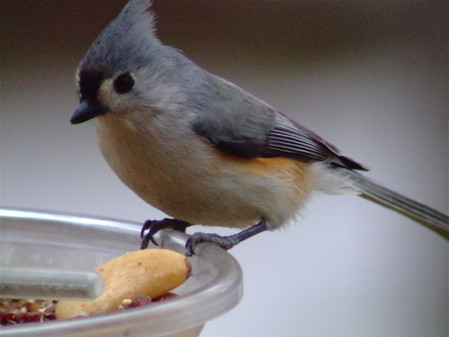
And now, a cool titmouse shot:

We are now in the lovely town of Cleveland, OH. We have to go to bed early tonight, someone from the North Coast Nature Festival is picking us up at 4:30 am for two tv segments on WKYC. We're doing two, one at 5:15 am and one at 6:15 am. Oy.

First up, there's been a comment and a couple of private emails that people still had trouble seeing the queen bee, so I added a photo and circled the queen to that entry. Hopefully you can see her in the middle of my wiggly squiggle.

One of the fun things about being out at Mr. Neil's while hiving our colony was watching all the migrants pour in. When I arrived on Tuesday, there were several of the usual suspects singing. The only sparrow I noticed was the song sparrow (above) eating sunflower chips below the feeders.

Wednesday morning, sparrows were everywhere!

Chipping sparrows were flitting around to all the feeders. For the record, I did not fill this feeder. When I'm not around, other people fill them and it makes me chuckle to see where the seeds end up. The blue jays were going crazy trying to figure out how to get access to all the peanuts. The chipping sparrow was more interested in the sunflower chips still available at the bottom feeder port.

This little chipping sparrow kept erecting his cap. His hormones must be in overdrive.

White-throated sparrows had arrived over night. I can never control myself around these guys. I always start whistling they're "oh sweet Canada, Canada Canada" or according to Kaufman "oh sweet, Kimberly, Kimberly, Kimberly" song. I started whistling and then many more in the surrounding bushes started singing. Love those guys.

I did find a lone Lincoln's sparrow mixed in. These are always such a pleasant surprise when they show up at the feeders. I put out some extra millet and sunflower chips for the migrating sparrows, they always put a little more fun in the sea of brown that seems to take over the feeding stations.

Back to the feeder with all the peanuts. As the chipping sparrows moved the sunflower chips out of the way, the titmice came in for the peanuts. This one worked for a good three minutes trying to get that nut out. It flew away and I wondered how long it would take it to chip it away into edible pieces.

Some mixed nuts had been put in some of the other feeders and the red-bellied woodpeckers were working those out. This one managed to pry out a hazelnut. If you closely at this photo, you can almost see the spear that is at the tip of his tongue.

One Of These Things Is Not Like The Other

This morning I was sipping my coffee and watching the cars in the drive way. I was (and am) exhausted from the week. I was formulating my plan for the day when I noticed what looked like a female goldfinch flitting around my car. At first glance, it looked like she was fighting her reflection going from window to window, but I thought, "Why would a female be fighting her reflection? Isn't it early for goldfinches to be this territorial?" Something did not seem right. The finch moved on to Lorraine's car and she walked in and asked, "Why is that finch on my car?"

Then the coffee kicked in. The "finch " flew over to the finch feeder with the other goldfinches (above). "That's not a finch." I said. Look at the top photo, can you see the "finch imposter" feeding on Nyjer and sunflower chips?

I dashed to get the scope:

The feeder was almost too close for the spotting scope to focus on the bird. Here is the face. It was a pine warbler! I can't believe it, I digiscoped a warbler--barely. I think with the cool weather, this migrant was working extra hard to find insects. My guess is that the warbler was gleaning smashed insects off of our cars and when that wasn't enough decided to go for the sunflower chips--something warblers will eat if they have to.

I tried to get a better shot, but got a butt shot instead. The warbler flitted around from feeder to feeder, someone had mixed in some suet nuggets in some of the feeders and it went for those as well.

I looked over at the suet log and a second pine warbler had flown in. This one went right for the fat. When a downy woodpecker flew in, the warbler flew away and waited for another turn. Mr. Neil's suet log has an arm that sticks out that makes a great perch for waiting birds. This digiscoped shot turned out much better. I thought digiscoping warblers was going to be impossible this spring (I'm no artist like Mike McDowell) but this gives me hope.

Coolest Pileated Woodpecker Post In The History Of This Blog

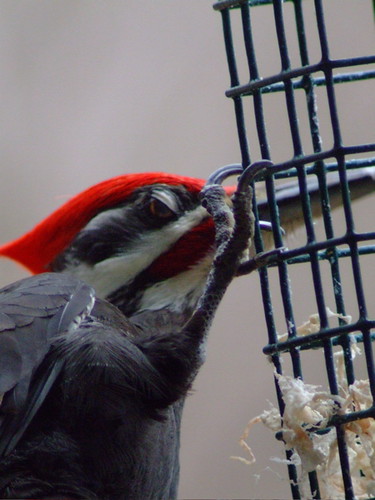
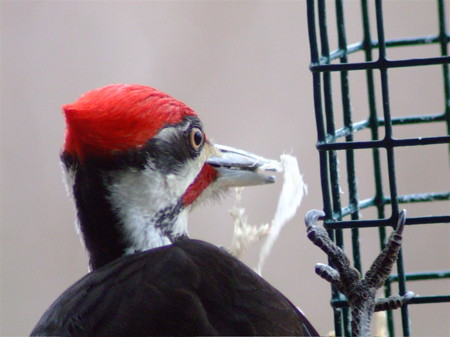
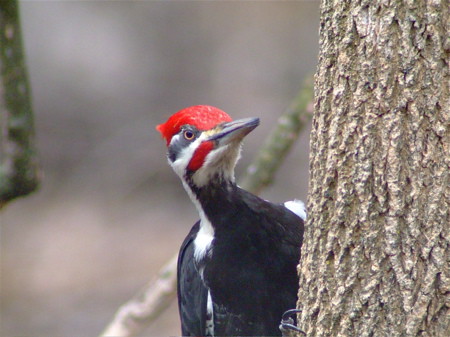
Holy crap, this is going to be a super cool post! Warning: Gratuitous photos of pileated woodpeckers ahead.

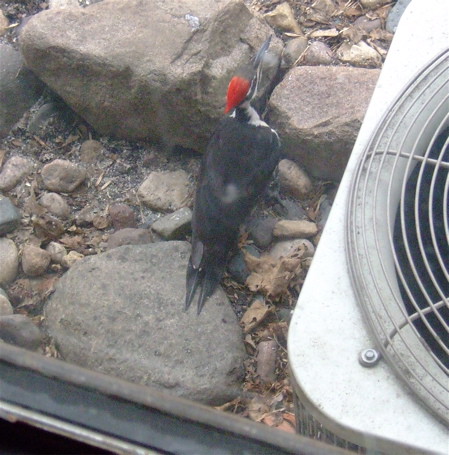
So, today I had a meeting with the Explore Minnesota Tourism folks at Eastman Nature Center in Elm Creek Park (cool stuff that generated from that meeting will pop up in the next few weeks). During a break in the meeting, I went to check their feeders for some digiscoping. At first I just saw the usual suspects: nuthatches, downy woodpeckers, chickadees, etc. The feeders were spread between two rooms. When I walked into the second room, I saw this:

<span class=

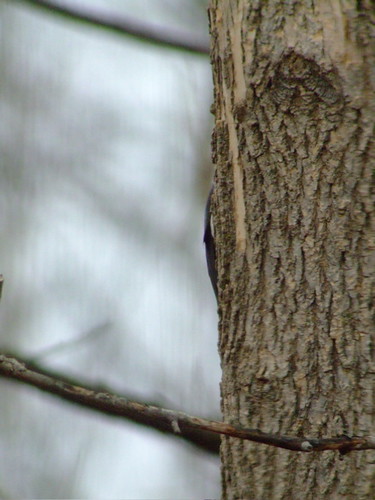
Okay, it may be hard to get an idea of scale with this tree, but that is a large sliver of a lump up there. I knew instantly: a pileated woodpecker. Knowing how cagey these guys can be, I just set the scope up and started to photograph hoping I might get a shot of the head.

<span class=

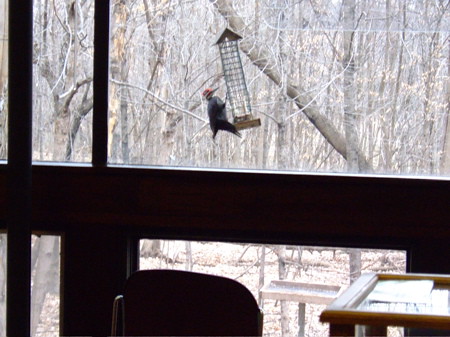
Then, the pileated flew over to the window feeders! I was way too close to digiscope, so I took a photo old school style--just through the point and shoot. I went to the back of the room and tried to digiscope.

<span class=

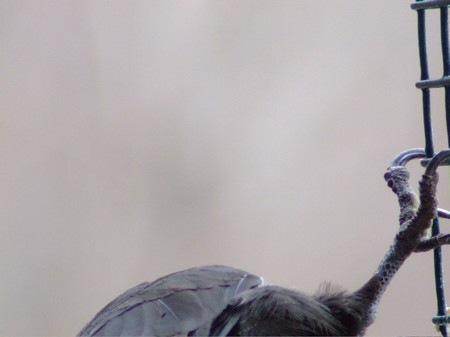
However, the feeder was swinging violently due to the bird's weight. It was a tall order trying to get the head in the frame and in focus at the same time. I have about 50 blurry and blank photos.

<span class=

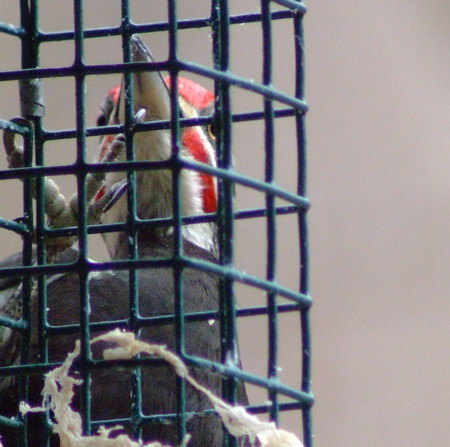
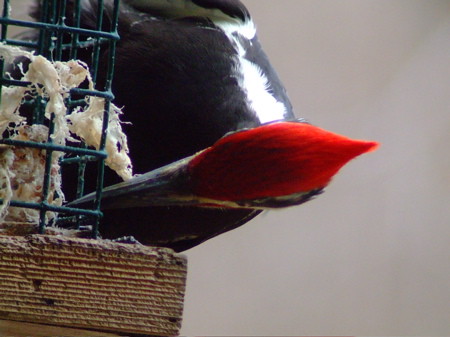
Okay, there's the head, and it's kind of in focus...but the suet feeder is in the way! Although, I did like this shot because if you look at the bottom of the lower mandible you can see it's white. I have never had the opportunity to see that part of pileated, who knew it was white?

<span class=

Okay, still not quite in focus but I love this because the woodpecker was in mid peck and had its eyelid lowered to protect its eyes. This looks thicker than a nictitating membrane (extra eyelid birds have that is transparent--they use it to protect pupils in flight so dust won't damage it). I'm sure they have some sort of eyelid protection since they chip off such large chunks of bark when pecking.

<span class=

Whoot! It's in focus, it's not head on, but you can still see the face very well. I like how you can see the crest feathers come together in the back. Kind of reminds me of a kewpie doll.

<span class=

I couldn't believe how accommodating this bird was. The whole group had gathered in the room to watch at this point. I asked one of the naturalists if the windows were tinted and she said that they are not, these birds are just that used to people. There was also a female flying around, she was eating at the tray feeder. She tried to bump the male from the feeder, but he always won.

<span class=

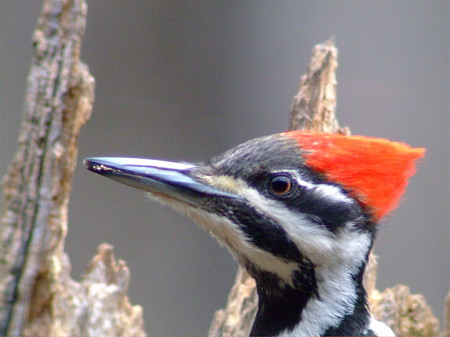
She was fairly close to and I was able to get a head shot of her. For those who can't tell the difference between male and female pileated woodpeckers, here is what you need to look for: the female lacks the red mustache and her red crest starts halfway up her head as opposed to right at the bill. I was pretty jazzed about this photo. Finally, a crisp head shot! Double whoot!!

<span class=

The female started working her way around towards another empty suet feeder. However, instead of flying up to the empty feeder...

<span class=

She went right underneath us to forage for all the fallen suet chunks! What a treat to look right down on a pileated woodpecker only five feet away! I was so excited, I almost peed my pants. There were still about ten of us in the room and we call crowded around the window.

<span class=

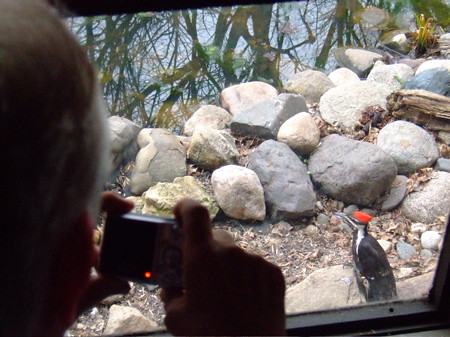
Here's my buddy Carrol Henderson taking a photo of her. It's not uncommon to see pileateds on the ground, they do forage a bit, not quite as much as northern flickers, but they do know how to dig around old fallen snags for juicy bugs.

<span class=

The male didn't stray too far away. When he was finished at the other suet feeder, he flew to a tree to keep an eye on the female. My goodness, were we watching a pileated lunch date? Boy, if things keep going this well, he'll be at third base in no time.

Eventually, the birds flew off and we had to finish the rest of the meeting. Sigh.

<span class=

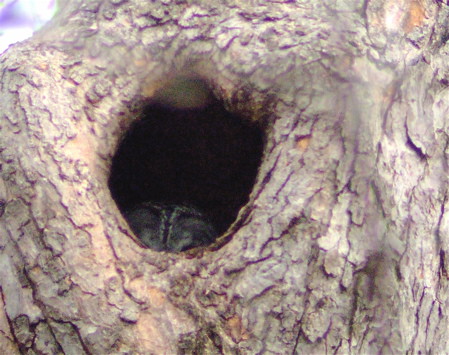
The naturalists told us about a barred owl nest right along one of the trails. While we were finishing our meeting, I saw Sue who volunteers with me at The Raptor Center walk by the outside window. I flagged her down to say hi. She was going to look for the nest, so I told her to let me know if she found it on her way back. Five minutes later she walked past the window and gave a thumbs up--she saw the owl. Afterwards we went to look for it, we found the nest hole, but she was hunkered down for the day doing some hard incubating. Now quite what I was hoping for, but after the pileated show how can I really complain?

nope

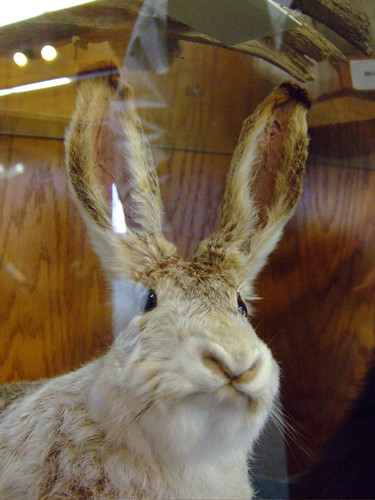
One last thing, we did find a disapproving jack rabbit at Eastman Nature Center. Apparently, he didn't approve of being stuffed.

Assembling the Hives

titmouse

I'm starting this entry with the tufted titmouse photo above. Non Birding Bill really liked it (that's sayin' something). I set some mixed nuts in a tray of one of Mr. Neil's feeders and EVERYBODY flew in right away. The titmouse is contemplating the large Brazil nut. Look at the size of that food morsel! Alas, it is way to heavy for this mere titmouse to carry away in flight.

start

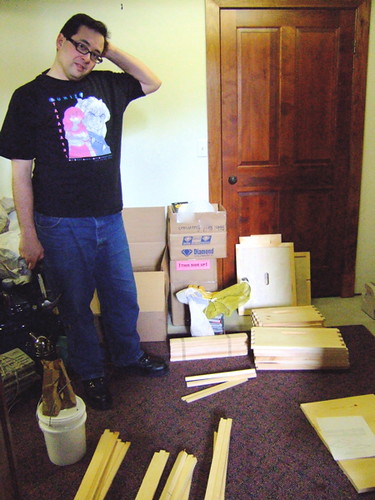
Today we decided to assemble our bee hives. The bees won't ship until late next month but that gives us plenty of time to prepare for their arrival. This gives me time to order anything that I discover is missing after assembly.

<span class=

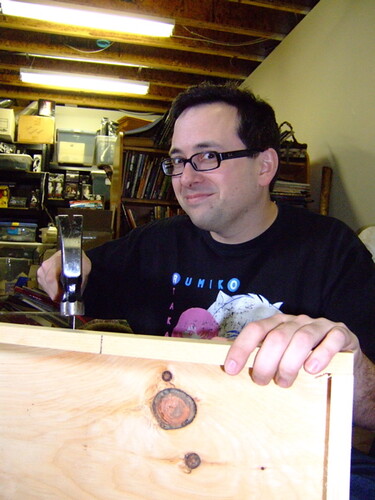
We were told that we are supposed to name our hives (with women's names) so NBB put together Olga...

helper

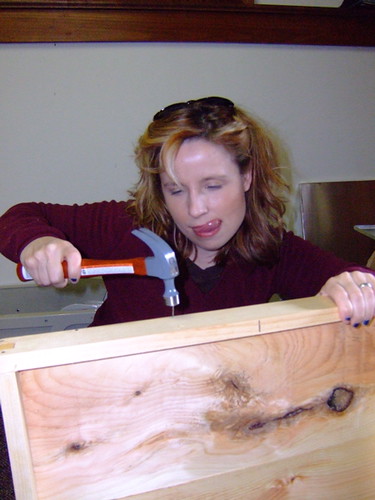
While I put together Miss Kitty. Some readers my recall that I was thinking of using screws, but thanks to Old Drone's assurances we went with nailing the hives together and he was right, it was easy. The wood was soft and many of the nails were small so I didn't have much chance to smash my fingers.

<span class=

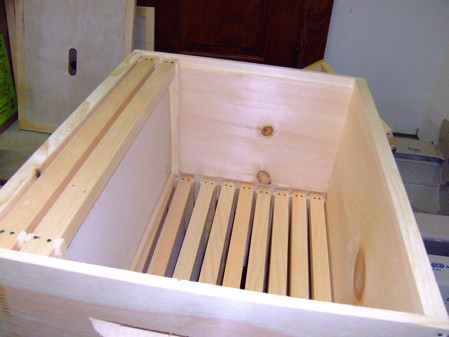
We had to put everything together: the boxes, the floor, the top, the individual frames where the bees will build the comb for larvae and honey--ten frames for each box! It was tiring. The wax in each frame is there to encourage the bees to build their comb in an easy to access form so I can check the hive and partake of the honey.

Between frames I did sneak away to watch the birds...

standoff

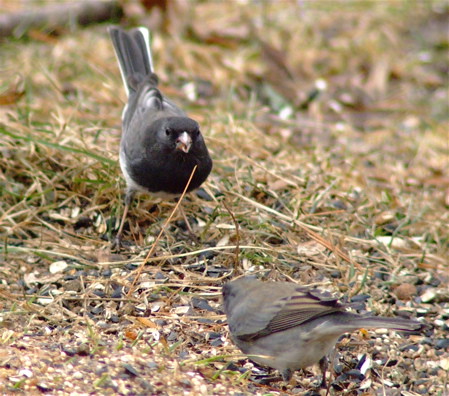
The juncos sure were frisky. Lots of chirping and chasing while feeding. You could see pin feathers on some of them, I'm sure molting in fresh feathers for the breeding season was bringing on a surge of hormones in them. I enjoy their mechanical twitters in early, early spring.

chickadee

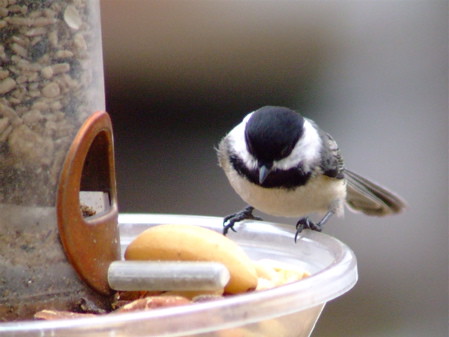
"Ugh, I don't know if I'm in the mood for that much nut."

Another bird flies in to contemplate the Brazil nut. This black-capped chickadee gave it some serious thought, but instead went for half a pecan. A hairy woodpecker ended up flying away with the large prize nut.

hives

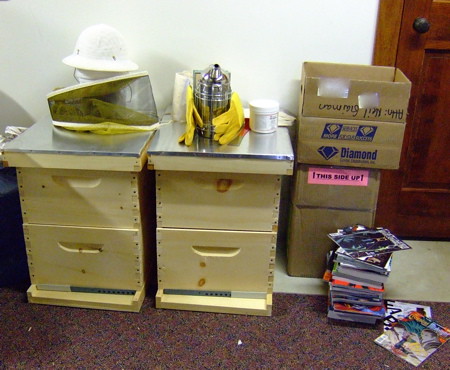
We did finish both of our hives, and after assembly I realized that our starter kit only came with two brood boxes for each hive. The class that I took recommended that for over wintering bees in northern states that I should have a third brood box for each hive, so looks like I'll be doing a little ordering this week.

I have to admit, I was really not looking forward to assembling these, fearing it would be really complicated. I think this stems from having to assemble aluminum purple martin houses at the bird store. I hated those things! Don't get me wrong, I think aluminum martin houses can work well to attract martins, but assembling them is about as fun as stubbing all ten toes. You have to follow the directions EXACTLY and if you get something wrong at step five, you won't notice until step 487 when the roof won't line up with the box--and you have to take it apart and start over. Whereas with a bee hive, if you make a mistake or split the wood--the bees will just fill it with propolis.

Ah, martin house assembly is coming back to me now...ahhhh....I would always try to tell customers that it was important for them to assemble their own martin house so they could truly understand it and I also would lie and say how much fun it is to put together on a rainy Saturday afternoon.

Putting the hive together was much more simple and quite pleasant and I'm looking forward to assembling the third brood boxes.

Incidentally, if you're thinking of getting a purple martin house, get the plastic gourds, they are usually cheaper, are easy to snap together (if not already assembled at purchase), are more resistant to predators and save bird store employees (and you) hours of assembly grief.

Me Want Spring Now!

"Dude, hold your horses, I'm molting as fast as I can!"

Note all the little pin feathers on this goldfinch's head--it's going full force for the breeding plumage--sign of spring.

Holy Mackerel! When I came home from beekeeping class followed by a Hera concert (loves me some Icelandic folk music) I found tons of messages on the Minnesota bird listserv on signs of spring--especially early migrants. People are seeing meadowlarks, killdeer, bluebirds and...brace yourself...grackles! Yo, if you are not keen on grackles and you want to try and avoid them, now is a good time to start switching one of your feeders to all safflower to give the other birds a chance to acclimate to it.

Today we learned about honey and wax extraction in beekeeping class. Yum. I also learned that among the beekeeping community "raw" is a four letter word when used in advertised honey. I have mentioned before that I am a fan of Really Raw Honey. Many in the bee keeping world aren't too pleased with honey being called advertised as raw, because all honey is raw. Also, there is some resentment that honey with visible wax, propolis, bee parts, etc. being advertised as raw and charged a premium is selling poorly filtered honey at an outrageous price. I don't care about the "raw" issue, I just really like the way Really Raw Honey tastes--it doesn't have that weird after taste that you find with liquid honey. I also really like the thick, creamy consistency of Really Raw Honey and wanted to know how to encourage my bees to create a thick honey. Apparently, it has to do more with the types of flowers than any kind of processing. One of the instructors told me that the bottom line is that the honey that comes from my own hives will taste better than any other honey I ever purchase because I helped create it. Makes sense.
This whole bee thing is fascinating. They are not native to North America, they were introduced. They evolved for pollinating Europe and Africa. We have hummingbirds in North and South America for our pollinating which they don't have in Europe in Africa. Honey bees really like to pollinate exotic plants (plants geared and evolved for attracting insect pollinators like bees) and that can be a problem. I actually found places on the Internet advertising Loosestrife Honey. If you don't know the woes of Purple Loosestrife, read about it here. We go to great lengths to cultivate the non native honey bee because it is an important part of our economy--it is illegal to set up a hive without arranging the frames in just the right way in order to prevent the spread of diseases. Coming from a birding background where non natives tend to be bad news, this whole bee attitude kind of throws me for a small loop. Imagine of house sparrows and starlings produced some kind of sweet edible liquid...
At any rate, I have my certificate and feel ready for the challenge of beekeeping this spring and summer. If you are remotely interested in beekeeping, I highly recommend the University of Minnesota's short course on beekeeping. The class had about 100 people and they were from as far as Vermont to take part. They do a good job of walking you through your first year and give you some great literature to get you started. I can't wait until the end of April when we get our two packages of bees!

Sunny Day

The roads were moderately clear today and the sun was out! I headed back to the Minnesota Valley NWR. It's right off the highway and easily accessible. A turkey spent most of her day at the feeding station. She kicked up quite a bit of snow under the feeder to get at the spilled sunflower seeds.
This was to the absolute delight of the juncos and trees sparrows. The turkey also kicked up quite a bit of spilled Nyjer which these birds love to eat.

There were a TON of woodpeckers--mostly downy (above), hairy, and red-bellied. These two just cracked me up. They were eating on either side of the peanut feeder and if they noticed each other would get in a fight. While two woodpeckers would be on the peanut feeder, two more would be on the suet feeders. Then you would see at least a half dozen more woodpeckers waiting in the trees for their turn at the food.

All of a sudden, all of the birds flew off except for this one female downy woodpecker. She remained frozen where she was. I noticed some snow shoers taking off their gear outside the nature center and wondered that were it. No, her attention was elsewhere. There must have been a hawk nearby. Then someone in the building spotted it.

An adult sharp-shinned hawk had flown in. In the above photo are both birds. The female downy is in the yellow circle, the hawk is in the red circle. Both sat still waiting for the other to move. Finally, the hawk relaxed, and tucked in one of its feet (something birds do when they are totally relaxed or about to sleep). The downy saw her chance and flew to safety.

That allowed me to digiscope LOTS of photos of the sharp-shin! You could see those bright red eyes! I took about 120 photos, entranced by those deep red eyes. More snow shoers passed and this hawk didn't pay them any attention. Even a chickadee was brave enough to mob and scream a warning within a few feet of her. I learned from one of the staff that this bird hunted this area quite often, which confirmed my suspicion (on Wednesday I wondered about some curious cardinal feeding behavior and I wondered if it was because of a hawk). Eventually, some small birds flushed and the chickadee that had been mobbing her got nailed and became sharp-shin dinner.

About five minutes after she flew off with her prey the birds returned to the feeder and the original feeding frenzy continued as before--see hawks don't keep birds away from a feeder permanently. Just for the time they are present in the yard. Prey knows that as soon as the hunter gets its fill they are safe for the moment.

It was a different experience being at the nature center on a Saturday instead of a week day. I spent a good chunk of the afternoon giving a digiscoping presentation. It's strange to me that being on the road and going to bird festivals, I get the sense that EVERYBODY knows about digiscoping and it's sweeping that nation. However, to most at the nature center it was very new and different. I had quite a few people ask what I was doing with a "telescope"--was that really for watching birds?

Perhaps I will set myself up there more on the weekends with all my bells and whistles: binos, spotting scope, Handheld Birds, birdJam with speaker...yes, step into my parlour little flies...let me show you how cool birding can be...mwa ha ha ha ha ha.

What Crazy People Do For Fun

I got a bird report from my family in Indiana: My sister Monica sent this photo of a Cooper's hawk her husband Dave took in their yard. Look at that flat head! Textbook Cooper's hawk.

In this weather I would just prefer to hole up and hibernate sampling various tea concoctions, toddies, soups, and stews. Non Birding Bill still wants to go out. Since it was his birthday he got to choose where we were to go and what to do so we headed for the Maul of America. It actually isn't too bad an idea, walking its halls as quickly as possible is remarkably good exercise. As we were leaving he thanked me for spending the afternoon with him at the MOA and asked where I wanted to go for my birthday. "Firing range." I responded. He smiled, nervously.

Meanwhile, the WingScapes Camera captured the freezing birds on the ledge. The nice thing about that camera is that if I can't be home to watch the birds it will watch them for me. The batteries didn't last too long since the temps never made it above -7, but I got a few fun and strange shots. Of course the starlings armada was the first to move in. A cardinal is actually the first bird to show up on our ledge, but they come while it's still dark out and the camera is off. One morning I found a cardinal feeding in the dark on one side of the ledge and a flying squirrel on the other side. Just two strangers passing in the night...or at least the early dawn hours.

After the starling armada has conquered the ledge the pigeons decide that they want a piece of the action and stage an overthrow.

Eventually, the pigeons realize that no matter how much they lunge at the starlings, it's a waste of energy to keep at them. The starlings are small enough to maneuver around the larger lumbering bodies of the pigeons. As a pigeon is pushing one starling away, two more will sneak behind the pigeon and get in a few mouthfuls. The pigeons eventually start snapping up what precious seed they can before the starlings get it all and peace is reached momentarily.

When the ledge quiets down the woodpeckers move in for the suet on the wall. This poor downy got one piece of suet stuck to his breast. He eventually got it off. Nice to know that I'm not the only one who has that problem.

Last night was the Luminary Loppet:

Blocks of ice are hollowed out and filled with a candle. Then the blocks lined up in a path on the frozen Lake of the Isles and around the islands. Cross country skiers can go around the trail in a race but along the way are stops for hot cider, snow shoeing, etc.

Above is a press photo from the website of what the blocks lined up on part of the trail look like. It would be a gorgeous trail to take at night with all the candles and the view of downtown Minneapolis. Some of the homes along Lake of Isles keep their holiday lights out, so it's kind of a romantic view. With the wind chill at -31, NBB an I thought we would just drive around the lake to see the luminaries and the people crazy enough to ski on the lake. Then something caught our eye:

Someone had built a fire right on the lake itself. NBB and I looked at each other and we could see the same thought crossing our minds. We can't pass a fire built on ice on a lake and not go check it out. Plus, we wanted to get an up close photo of one of the blocks of ice. We ran from the car out onto the ice to the fire--surely we would get some warmth from the fire? The wind was fierce and only two people were tending the fire. They seemed both sad and relieved not to have a larger crowd for their efforts. Sad because it's such a cool event, relieved that with a small crowd they wouldn't be tending the fire in this ass freezing wind for long. A few skiers passed and we cheered them on. NBB snapped a photo of the fire and the above photo of the ice block and after three minutes we were sprinting back to the car. My fingers got so frozen so fast they already had the pre frostbite ache, which was worsened when I realized that I couldn't fish the car key out of my coat pocket with my glove on. I removed my glove, retrieved the car key shouting copious amounts of profanity with every step. I hadn't planned on being outside so I didn't even have some Hot Hands with me. Arrrgh. I'm fine with cold, until it's below zero, then I earn my husband given nickname of Sharon Q. Whinypants.

We laughed our way all the way home at the crazy things people do for entertainment in February. Then had some much earned birthday cake and scotch. Good times in a marriage.

And now, it's Super Bowl Sunday and I have to watch--the Indianapolis Colts are actually in the Super Bowl--my mind is blown. I remember when they were brought to Indy from Baltimore and all the arguing about what a waste of money that was--now look at 'em playing in the Big Show.