Showcase MN and Juvenile Hawk Story

That's Rob Hudson of Showcase Minnesota doing a bird segment with me at the State Fair today. I brought Juneau, a female peregrine falcon from The Raptor Center. We talked about the Bald Eagle Recovery Day Celebration that's going on Friday at 10:30am at the DNR Building at the fair. Okay, I know what you're thinking, "Geez, Sharon, why didn't you bring an eagle with you instead of mere peregrine if you're talking about eagles?" Number 1, it's easier to work with a smaller bird in the cramped spaces at the fair and number 2, I don't handle anything that has a wingspan that's longer than me. Besides, the peregrine falcon was just delisted a few years ago like the bald eagle was this year. It's all good.

We then talked general birds and I took some audience questions. It's so much more fun doing the show in front of a live audience than in the quiet of the studios. The fair crowd has such a happy energy, you can say cheesy bird jokes and everyone laughs. The best part is that when you are doing a bird program for the fair, you get picked up by the fair transport system from The Raptor Center and then they drive you to whatever booth you are going to be in. Thousands of people are milling about and you get to ride in a van right through the ocean of people. You get curb side drop off and pick up, just like a rock star. I don't kid myself, it's not for me, it's just that I'm lucky enough to be in the bird's entourage.

And I came across a fun story about a hawk that flew into a screened in porch to get a cat. Don't worry, all involved survived. There's a photo of the bird and it looks like a young red-tailed hawk to me. Those wacky juveniles, they'll try to hunt anything.

Working The Minnesota State Fair

Man, this week has just turned nutty. I thought I had more time than I really did but between Non Birding Bill and myself, we have an action-packed schedule.

I forgot to mention that NBB is doing some children's theater at local Twin Cities parks. Cinnamon and I went out last Saturday night to watch the show. Kids in the audience loved it. Cinnamon on the other hand...If you're looking for some free entertainment for your kids, here's the remaining performance dates.

We did do the State Fair with just the two of us. I tried one of the new MN State Fair foods. Can you tell what I'm eating? Here's a clue:

That's right, SPAM. And not just SPAM bites. I was trying the deep fried SPAM curds. If you love SPAM, you'll love the curds. If you're not a huge fan, well it's just weird. It's cheese flavored SPAM, battered, deep fried and served with ranch dressing. I'll stick with elephant ears. I don't know if you can see it on the SPAM menu, but there's a big note that all of the menu items do not have trans fats. Yeah, because when you think diet and healthy, you think fair food.

We got lots of disapproving rabbit photos in the bunny barn, but we'll save those for the daily dose of disapproval. But above is a sampling.

And of course, no State Fair experience is complete for me without a visit to the crop art room. The big winner this year? A portrait of Dolly Parton!

And it was nice to see someone using their art to communicate an important conservation issue: Cats Indoors!

Al Franken was a popular subject for the crop art since he's now running for the US Senate. My personal favorite was the top portrait with the reason he's running being Franken's Staurt Smalley mantra, "I'm Good Enough, I'm Smart Enough, and Doggone It, People Like Me!"

Today, I did my first of three shifts at for the Minnesota Ornithologists' Union. I had so much fun, I ended up staying for part of the shift after mine. We're seeing lots of birds flying over the state fair. I watched a big old honkin' Cooper's hawk flying just above the trees and landing near the midway. We've also seen merlins, red-tailed hawks, common yellowthroats, and chickadees. It's fun to catch up with old friends--and I have some cool friends.

My friend, Kelly Larson showed up with a huge pile of sulphur shelf. Kelly's been a longtime mushroom hunter and we used to work at the Wild Bird Store together. One of my favorite memories was when she sent me some oyster mushrooms that she had found through the inter-office mail system.

This is a little different than the sulphur shelf we found in Mr. Neil's yard. That one was bright yellow and was growing on the trunk of an oak tree. The stuff Kelly brought is a subspecies that grows on the ground near an oak tree, you'll note it isn't as bright yellow on the bottom as the other stuff. Kelly rocks and as I'm typing this entry, I'm cooking the sulphur shelf in some chicken stock right now It always pays to keep some chicken stock on hand.

wAZ!@@@@@@@@@@@@@@^YHHHHHHHHHHHHHHHT!

That little bit up there was Cinnamon hopping on my keyboard to let me know that she would like some attention. I can't believe she actually ended it win an explanation point--seriously, that was her, not me. Anyway, I have to wrap this up.

Blogger Video--Gr

So, Sunday I noticed a new feature on my blog dashboard. I can upload video directly to blogger instead of google video. So, I took a little video of Cinnamon to check it out. I can't upload it and have heard nothing from blogger for three days so I just went to google video myself to load it up. Now, I'm off to one of my MANY state fair shift. I took some bunny photos on Saturday when Non Birding Bill and I went as a date, but Cinnamon insists that I put them in her blog, not mine...

Here's my MN State Fair schedule this week. MOU stands for the Minnesota Ornithologists' Union. If you're at the fair, stop by and ask us about birds.

Tuesday, August 28

9am - 12pm - The Raptor Center
12pm - 3pm - MOU Booth at DNR Building

Wednesday, August 29
9:15am - 11am - KARE 11 Booth (tv segment)

Thursday, August 30
9am - 12pm - MOU Booth at DNR Building

Saturday, September 1
9am - 12pm - MOU Booth at DNR Building

Start Saving Your Pennies and check the Frequent Flyer Miles

Hey, want to go San Francisco with me and (brace yourself) Non Birding Bill?

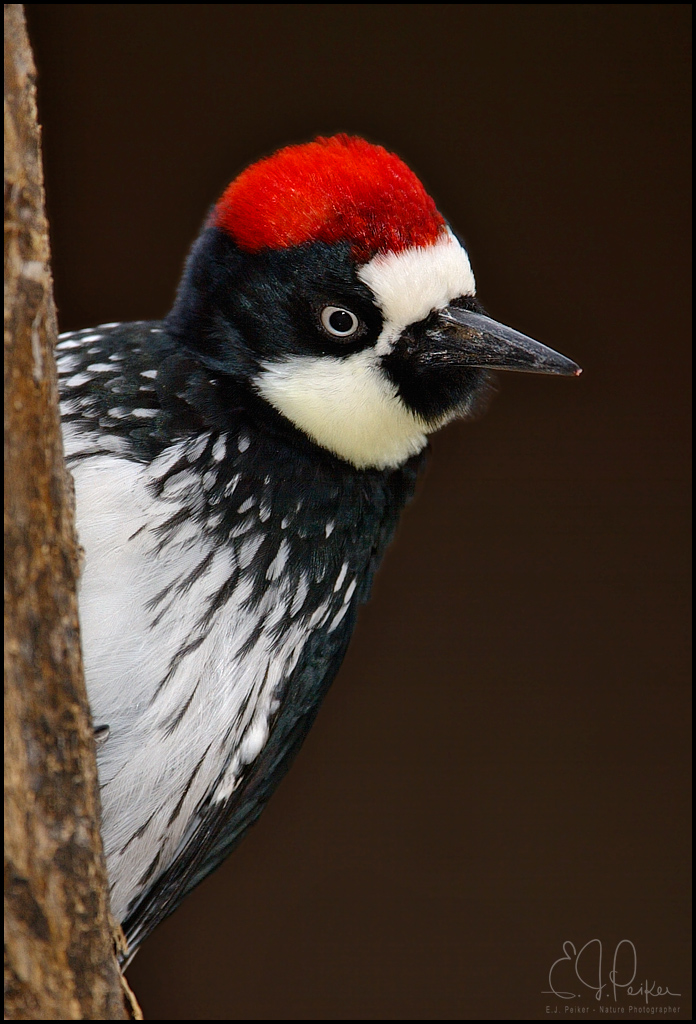
That's right, we are leading a trip to San Francisco for some birding and sightseeing--imagine it pygmy nuthatches, acorn woodpeckers, Heerman's gulls, the wild parrots of Telegraph Hill by day and China Town by night! We're even going to go to a restaurant that features "gender illusioninsts." Oooo. Ahhh.

We've had great times in San Francisco and we want to take you with us, and the beauty is that if you bring your non birding significant other, that's okay--it's not all birds and if you want to do something else while we enjoy the birds of San Francisco--you can! The trip is January 31 - February 4, 2008--a perfect balmy getaway for winter.

Details can be found here or you can call Sunshine Travel Company 1-800-926-7185.

Busy Day Of Banding

This is a photo that Larry Sirvio took of Tennessee warbler at Carpenter Nature Center--one of the 47 some odd birds that we banded this morning. Oy.

It was just nuts at banding today--I barely had any time to get photos. I arrived a little late and noticed some of the parking lot was getting ready to be repaved. I thought to myself, "With all this construction activity, I bet it will be slow." As I walked towards the building, I noticed one of the nets hadn't been put up yet. I thought it strange, but figured with the construction, maybe they weren't putting all the nets up.

Larry passed me and said, "They just radioed, there are eight birds in the orchard nets. There's one over there too." I said I would put my stuff down and start helping. Inside, the other volunteers were furiously looking up small flycatcher identifications, and there were already about six bags with birds hanging waiting their turn to be processed (from a quick glance the bags had warblers, vireos, a red-breasted nuthatch, and some sort of small flycatchers). Yikes!

From there it was just a blur. At one point I was at a net with one of the Carpenter naturalists. There were four birds in the net. While we were trying to get them out, four more flew in, and then another two. We decided that it was so backed up in processing that we would close up the nets until we were caught up. By the time we got to the last net, eight birds had flown in. We were running out of bags, but fortunately, they were all mostly goldfinches and we could put more than one in a bag.

This is one of the juvenile chipping sparrows we got in--they don't quite look like the adults, about the only thing that really gives them away is the eye stripe and the chipping noise that the make as you untangle them from the nets. We did get in a rather exciting adult--it had a band and turns out that it was banded for the first time on June 17, 2005 and at the time of banding it was already an after hatch year bird, which means that by now it is well over three years old!

This young catbird looks like it is off to a rough start. First, notice all the pin feathers--it's just growing in its cap. But towards the back of the head, its missing some feather and skin--something poked it, hard. Was it a nest mate? Was it a blue jay trying to attach the young in the nest? Who can say. It reminded me of the red-headed woodpecker we got in last year.

And it's interesting to note how different birds feel in the hand. Above is a male Wilson's warbler that I got out of the net. He felt so tiny, like I would break him. The easiest way to get birds out is to grab the feet and untangle those. Most of the time, if you can get the feet out, you can get the rest of the bird fairly easily. Most of the time.

Volunteer Dennis Donath go this photo of a female Wilson's warbler (note the lack of black cap). Today was good practice for untangling birds from the net, I just kept doing the over and over. The goal is to get birds out quickly. Usually, when a bird is REALLY tangled, I defer to the more experienced banders to get the bird out. However, everyone was so busy today, that a coupe of times I found that I was the only option and just had to muddle through. Sometimes, when I'm trying to get out a really tangled bird, I panic. My hands start to shake uncontrollably and are completely useless. When that happens, I just have to let go, take a step back, take a few deep breaths, understand that my panic is not going to help the situation and then go back to the task at hand.

Above, Jim Fox is handing a Wilson's warbler to a young girl whose family came to visit today. Sometimes, you can place a warbler on its back and it will lay there for a moment before flying away. That gives the kid holding it a chance to marvel at the magic of the the little thing in their hands. I got a five second video. Note the little girl's face.

Tell me that she's not now hooked on birds.

I'm still kind of learning the ropes at banding. I'm now to the point where I can actually band a few birds. I insisted that the first practice birds be ones like cowbirds--let me mess up on a cowbird, not a warbler. But I'm to the point that today, when I got an ovenbird out of the net, I got to band it myself--WHOOT!

First, let me say that after handling other warblers from the nets, the ovenbird is much chunkier. That is one beefy warbler--very chunky. You don't really get a chance to notice that when their flitting about in the wild. I'm happy to report that I banded it, aged it (after hatch year--at least a year old) and sexed it (unknown). We got some photos and let it continue on its southward journey.

Today was the first day of sun after six days of non stop clouds and rain. I finally noticed that migration in Minnesota is sincerely underway. If you have a chance, get out and enjoy it while you can.
Lawrence's Warbler?

As if fall warblers weren't already tricky to identify! Here comes a whopper.

All the photos in this blog entry were taken by bird bander Mary Messerli. She and Robert Fashingbauer were banding birds near Willow River State Park in Wisconsin on August 15, 2007 when they banded these two unusual warblers. Take a look at this:

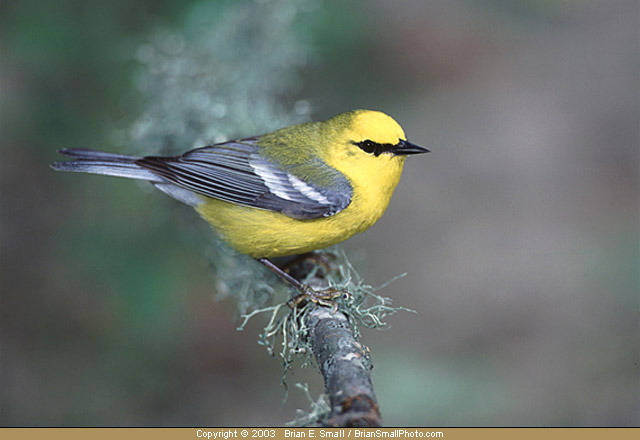
At first glance this looks like a golden-winged warbler, however it has way too much yellow. If some of you are jumping to a hybrid conclusion, you are right. Sometimes golden-winged warblers will hybridize with blue-winged warblers.

When a golden-winged warbler mates with a blue-winged warbler, you usually get a hybrid called a Brewster's warbler. This bird doesn't look anything like a Brewster's. It has the masking of a golden-winged, but the yellow wash of the blue-winged warblers. This bird is a backcross--one of it's parents was a Brewster's and the other was either a true golden-winged warbler or true blue-winged warbler. When this happens you get another type of hybrid called a Lawrence's warbler. Confused yet? Were you able to follow that? Well, hold onto your hat, it gets even trickier:

That same day, those banders caught this bird--another hybrid. Oy! The banders said that this bird had characteristics of being a hatch year bird (it came out of the egg this year) the bird above had characteristics of being an after hatch year bird (at least a year old). But really, it's hard enough to identify hybrids and even harder to age and sex them. I think this is another Lawrence's warbler backcross (a Brewster's hybrid that bred with either a true golden-winged or blue-winged warbler). The banders felt that this bird is of unknown sex, but with the pale mask, I think it is reminiscent of a female golden-winged warbler, so I'd be willing to go out on a limb and call this female.

I nipped over to BNA Online to see what they had to say about hybrids and found this:

"Molecular analyses of hybridization indicate that Blue-wing mtDNA introgresses asymmetrically and perhaps rapidly into Golden-wing phenotypes without comparable reverse introgression and footprinting of Golden-wing mtDNA into replacement Blue-wing populations."

Holy crap, I though Pyle was hard enough to read. Basically, (I think) this is saying is that all this hybridizing and backcrossing can result in fewer golden-winged warblers and more blue-winged warblers. The hybrids and the backcrosses end up in future generations breeding into blue-winged warblers.

Giant Puffball

Look what I found walking along the trail in Mr. Neil's woods...

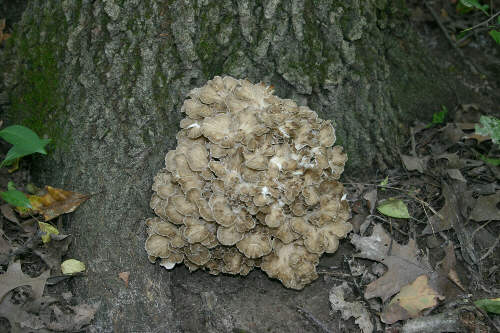
Oh no, not another edible wild mushroom post! I just realized that as of this post that I have now eaten each of the "foolproof four"--edible wild mushrooms that cannot be mistaken for anything else in North America. Not only that, I have had all four from Mr. Neil's yard, though I've had them from other places, this is the only yard I know of that has had all four at some point and time. I have eaten morels, sulphur shelf, hen of the woods, and now giant puffball--a first. This friendship is finally paying off.

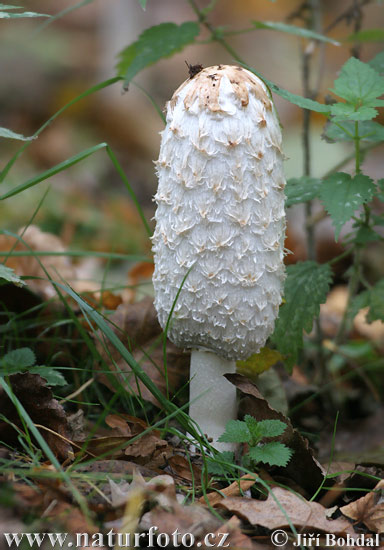
One note: I have read about edible wild mushrooms and I have friends who are knowledgeable in the field of mycology who I can talk to about my finds. Do not try for wild mushrooms based solely on me. Read up on them, talk to your local wild mushroom club and when you personally feel comfortable, go out and find them. A great starter book is Start Mushrooming (by my buddy Stan Tekiela and Karen Shanberg). That book actually talks about the "safe six" but I'm not comfortable in my identification ability with shaggy mane and oyster mushrooms, so I currently stick with the "foolproof four". Plus, I have some hesitation eating anything "shaggy".

Okay, so in the grand scheme of giant puffballs, this isn't the biggest that has ever been found, but I found it the morning Mr. Neil was leaving for a few weeks and he and I have both wanted to try puffball. We always manage to find them well past their edibility date. I decided to grab it and take it back to the house to freeze it so he could eat it when he gets back or maybe even get a bite before he hit the road for the airport. I checked Edible Wild Mushrooms of North America and found that you can either partially cook giant puffball and freeze it or just freeze it raw. I had enough, I thought I would thaw both cooked and raw slices.

I sliced it up and happily only found one millipede on the inside--there could have been much more. It had an overwhelming mushroomy smell. I can think of no other way to describe it, except that smelled like a bouquet of mushrooms.

The texture was very spongy--kind of like a firm marshmallow.

The book warned to be careful cooking the puffball slices, as they can dry out and burn quickly. After I sauteed them a bit, I cut off a piece for Mr. Neil and a piece for myself. It was an interesting taste. It's not a strong flavor at all--sulphur shelf and hen of the woods both have more personality in their flavor. The texture was surprising soft and wet, almost soggy--not nearly as firm as other wild fungus I've eaten. I think this will go well in an egg dish, maybe a summer pasta dish, or even a ratatouille. Unlike sulphur shelf, I would not eat this sauteed alone. It needs some other flavors to enhance it. However, I can see that if I were someone surviving off the land that puffball would be a hearty meal to be happily discovered.

So, after cooking and sampling, I wrapped each slice in wax paper to separate them and put the slices in freezer bags. I did the same with the raw slices (and took a few slices home for Non Birding Bill and myself--although, he's not nearly as excited as I am over my new found bounty).

Other Bugs At The Beehive

I've gotten a couple notes that some readers are grossed out by bees and by other bugs. FYI, this post is certainly not for you. We have other bugs in this post, and one photo is slightly gross.

This post is the combination of two days of beeing. Mr. Neil is leaving for a while and I wanted to make sure he got a bee experience before he left. Unsure of what his packing schedule would be, I came out the night before he was to leave so I could be up early and ready to beekeep at a moment's notice. When I arrived, I met up with a woman who is assessing the surrounding woods and will help come up with a plan to get rid of some non native plants and managing the woods for native plants, bees, and wildlife. She mentioned that the bees were very active and loud, crowding at the entrances of their hives.

I zipped up my bee suit and stoked the smoker to go see what was happening. Olga bees were all over and swarming out of the hive. When I was about 50 feet away, you could hear the buzzing--usually you can't. From that angle, when you first approach the hives you can see the bee super highway as they head up over the tops of the trees on their way to look for nectar and pollen. There was a pretty steady stream of bees coming and going. I don' think it was swarming, I think it was four days of constant rain--they wanted out and wanted to gather winter stores. I didn't open the hives, but just took some time to sit at the entrance of each hive and watch the bees coming and going.

The Kitty bees were coming back loaded with pollen of various colors. Note that almost every bee in the above photo is loaded with pollen--I love the neon yellow stuff. Goldenrod is blooming all over, so my guess is they are using that.

Now, look at this one. In the middle is a bee with the neon yellow pollen. But, look in the bottom right hand corner. That bee has pollen that is snow white--where are they getting white pollen? Wish I knew my plants better.

This bee is so loaded with pollen, she's practically dragging it in.

When I came to the Kitty hive, there were some grasshoppers (sometimes called by locusts) hanging out. There are always some on one of the hives and I always wonder what the appeal is. Do they like the buzzing? These appear to be two different species. I've been trying to id them with the Kaufman's Field Guide to Insects of North America. I think it might be a two-striped mermiria but am willing to listen to anyone who knows otherwise.

I think the larger one is a differential grasshopper, but whatever it is, I love the yellow antennae.

When I went over to the Olga hive...I didn't find any life grasshoppers. Apparently, Olga has a lower tolerance for these guys hanging around their hive. This is a dead Carolina grasshopper. When they jump/fly they resemble a mourning cloak butterfly with dark wings and a light stripe. I found this species in my Songs of Insects book (I love this book. Not only does it a beautiful picture book, but i comes with a CD that identifies the buzzy insect songs of late summer early fall--I'm paying way more attention to the number of species I'm hearing now. Sometimes I just let it loop on my iPod while I'm writing, it's great background noise).

One of the really cool things of just hanging outside of the hive was that I noticed some things I had never seen before. The dead grasshopper got my attention, and then I noticed a worker from the Olga hive dragging out another dead worker bee. She was trying to fly it away far from the hive--this is part of they hygienic behavior my bees are bred for. Here's a video of it:

This helps keep the hive clean and healthy. I wondered if the workers had been putting some of this off because of the rain or if I'd never just had a chance to sit and watch them come and go from the inside of the hive. of just I noticed something interesting. I scanned the ground just outside the entrance and found a few lethargic drones and workers. Then I found this:

This is a solitary wasp called a beewolf (some books lump it as one word, some make it two separate words) and it's attacking one of my workers. I wondered if this is a lethargic, dying worker and not one of the stronger ones. They paralyze other stinging insects and take them back as prey for their larvae. You can read more about them here.

The next day Mr. Neil and I went out to check what was going on inside the hives. It was very much the same as last week. Again, I think it's because the workers haven't had a real chance to forage and draw out more comb and produce honey. I'm not too worried about Olga, but I'm going to need to give food to Kitty if she's going to have enough food to supply the colony for the winter.

We tried putting the queen excluder in last week and I think I'm done with them. The queen excluder is supposed to prevent the larger queen from going up into your honey supers to lay eggs. However, it's very obvious that workers are having a tough time passing through the bars too. This poor girl was so wedged, I had to push her out. The beekeeping community seems to be divided on the queen excluder, but myself, I'm done with them. My other option is to do what's called a reversal--which we did do and is kind of a mess, but it's better than watching a bunch of workers stuck in a metal frame.

When we opened the Olga hive, about nine moths flew out from just under the roof. One landed on my hood. One concern you have with beekeeping are wax moths (you know the wax worms you get for fishing or sometimes to feed birds--the larvae can wreak havoc on a beehive). The larvae will eat the beeswax and make cocoons in the frames, generally making a dusty, webby mess. This moth doesn't look like a wax moth to me, I think this was more some other type of moth and they were trying to keep out of the rain. Either way, Olga is a nice strong colony and a strong, healthy colony can keep wax moths out.