New Bee Package Adventures

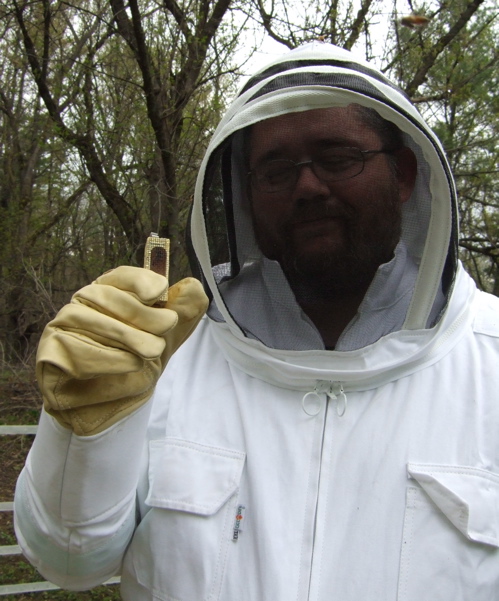
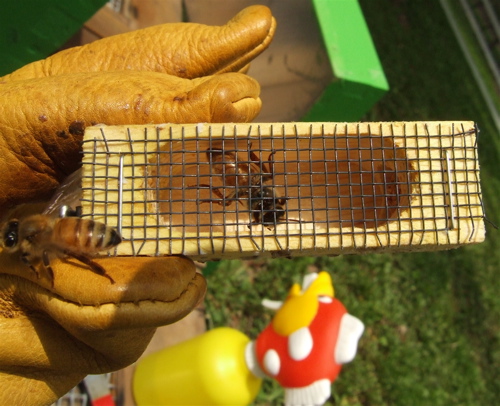
queen Our bee crew with substitutes headed out to our hives to welcome our four new packages of bees. We started with the Wendy hive, above is the Queen Wendy in her cage (with a worker on my thumb).  We we hive the packages, we spray the packages with sugar water, bonk the box so all the workers fall to the bottom, remove the feeder can, spray a bit more, take out the queen cage, make sure she is alive, put her in a pocket, dump the bees in the hive, remove the queen from your pocket, spray her, open her cage and release her into the hive, carefully put in all of the frames, put on the ceiling, put in the sugar water feeder and pollen patty, and close up the hive.

Here's a video of the newly installed Wendy hive checking out all of the new frames to build comb and raise the next generation of workers (I recommend clicking the HQ aka high quality button:

[youtube]http://www.youtube.com/watch?v=TYsckIIWLhQ[/youtube]

After successfully installing the Wendy hive, we moved on to the Juliet hive.
bee-dumping

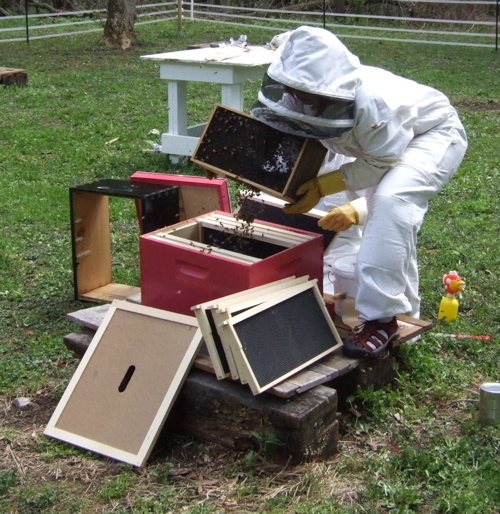
All went well with this hive, but we did notice a wee bit of bonking from these girls as we were pouring them in. Bees are supposed to be fairly docile when you get new packages.  They are in swarm mode--they have been moved from their old home with no comb or brood and they are focused on finding a new home not defending a home.
bee-sting-blurry

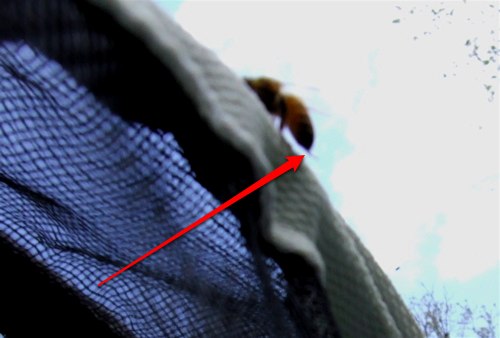
Hans took a picture of a bee angrily buzzing on his hood and even though it's blurry, you can still see the stinger coming out.  I don't want to start off on the wrong foot with a hive, but I wonder if the pretty pink Juliet hive will not be so friendly as we do our first bee inspections?
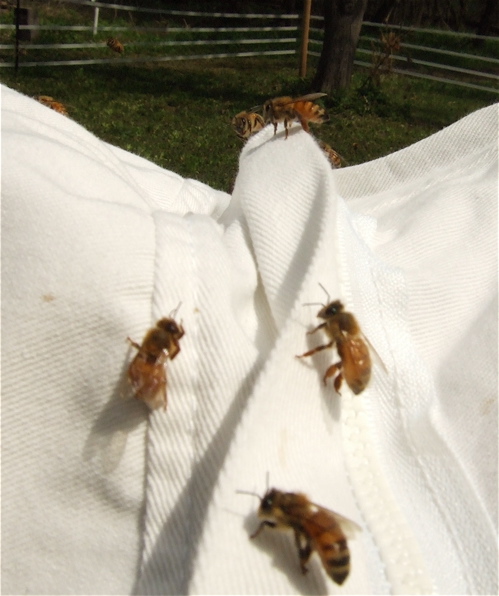
bee-suit

Most of the bees that come our bee suits are pretty low key.  These are bees on Merry's suit.  They were more after old honey residue and sugar water on our suits than actually climbing around looking for a place to sting. Although, I think Hans would disagree.  Here's a video of me pouring in the Yvaine hive bees, most go in, but you can hear Hans say, "Stop bonking me." There's also a very angry bee coming up to attack the camera:

[youtube]http://www.youtube.com/watch?v=UON395ruFwk&feature=channel[/youtube]
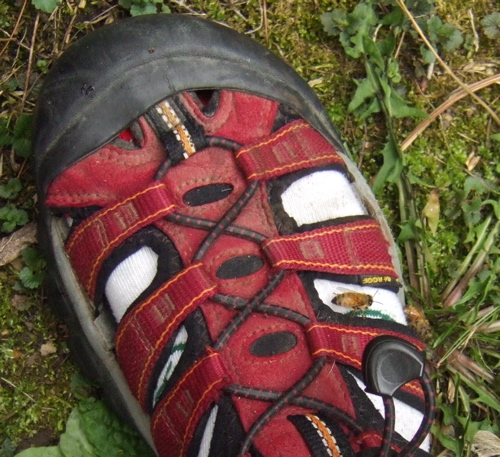
bee-keens

When I was pouring the bees into the last hive, we got a tad rushed.  It started out sunny, but then it suddenly clouded over and it started to rain, I wanted to keep our girls dry.  As I rushed, I felt something on my foot--a small clump of bees fell on my shoe. I suddenly regretted my lax attitude about the bees' mood during hiving, bees crawled over my turkey vulture socks and I decided not to walk right away so I wouldn't irritate them into stinging.  They eventually flew off and it was all good.
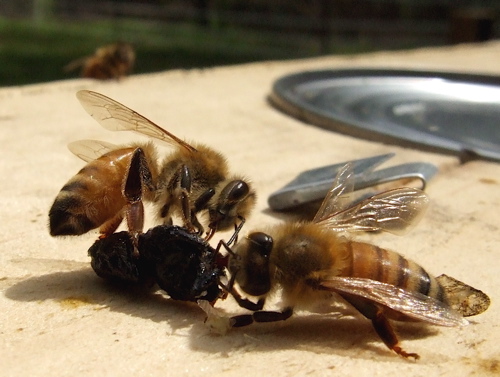
bees-licking

The bees in all hives were ravenous!  Even though there's a feeder can, they were licking anything with sugar water on it.  Here are two bees frantically licking sugar water that had coated a very dead and very old bee--yuck.  There was even a moment when we were at the Hannah hive, about to release the queen and she pointed to my gloved hand. There was a tight cluster of five bees surrounding another--I gulped hard.  Was this a queen from another hive??  No, it turned out to be just a very sugar coated worker that was getting a good lick down from the other workers.

Whew.  But there was more queen drama to follow.
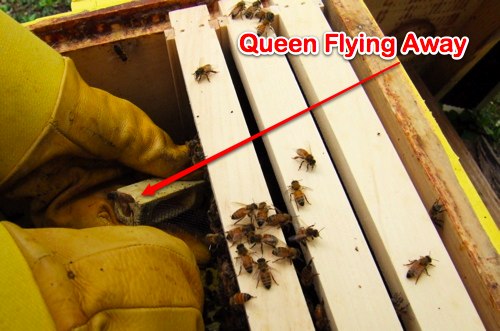
bee-queen-escape

After successfully installing the previous three queens, I didn't worry too much about the final Hannah queen. I opened her cage and instead of her crawling out onto the frame, she opted to try and fly away--Hans captured the moment.  Because she is heavy and full of eggs, she flew very slow.  I slowly followed with my hands to get her to follow me and then two other workers flew on her and she sank like a stone to the bottom of the hive.  I'm sure the workers were just attracted by her pheromones, but it looked like they were saying, "Oh no you don't  there Bessie, you're stayin'!"

We carefully put the frames back in and closed her up before too much rain got in the hive.
bees-flying

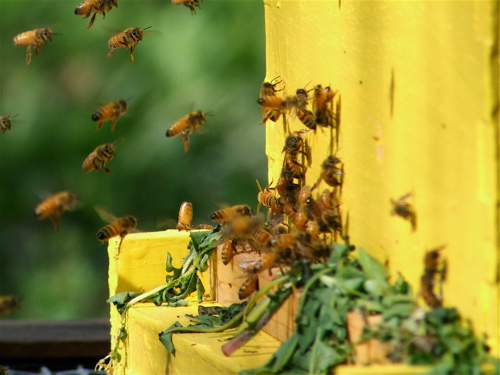
After the hiving, I waited for the rain to pass and then headed into the woods to do some birding.  As the day got later, I headed towards the hives to see what was going on.  I set up my digiscoping equipment so I could watch them from a safe distance.  Almost all of the hives had removed the leaves blocking the entrance (it's supposed to stay there the first day to encourage them to accept the hives.  Bees were coming and going from the entrance.  Watching them, it looked like quite a few workers were flying around and orienting themselves to the new home so they know where home is when they go out to forage.  Some were bees who got lost in the hiving and now have to see if they can get accepted into one of the hives, I'm sure they will work it out.

And so it begins, a fresh bee season.  Here's a video of the Yvaine hive workers milling about the entrance of their new homes:

[youtube]http://www.youtube.com/watch?v=9Yko6dEGvgU[/youtube]

Welcome girls.

Challenges Faced During Spring Bee Hiving 2009

bee-packages I got the call from Lorraine on Tuesday morning...our bees had arrived at the post office. And there were some serious challenges to start our day.  Number one: I couldn't get out the door, emails to deal with and then a radio interview that involved me using the phrase "cloaca will un-engorge."

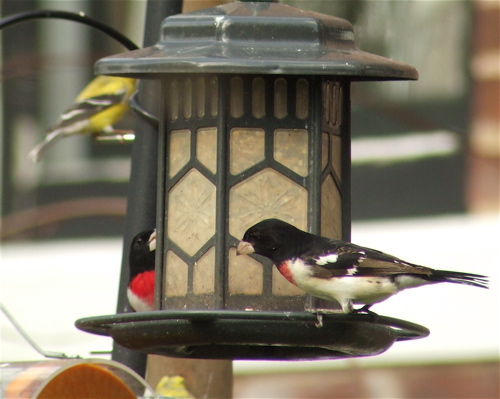
grosbeaks

The other challenge for me was that the migration floodgates had opened and birds were pouring.  Large numbers of rose-breasted grosbeaks covered Mr. Neil's yard and I could hear pine warblers all over the place.  I had to focus on bees, not birds.  It was harder than usual because I'm leaving this weekend for Kazakhstan and that is going to be way cool, but I'll miss the big migration waves while I'm away, so I need to soak up what I can.

bee-helpers

Another big challenge was that when I arrived, Lorraine was just not herself.  It was clear that she was not feeling well.  Poor thing appeared to be coming down with a migraine.  She really wanted to help, but her body was screaming, "Go to a dark place.  Rest. Don't play with a boxes containing thousands of confused bees in the bright sun."

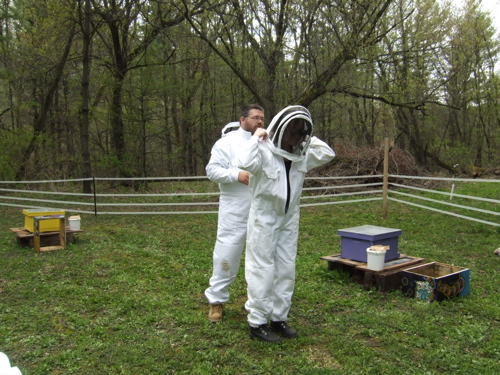
Bless her  heart, she tried to put up a brave front, but as I made nectar and pollen patties to feed our newly arrived guests, she realized her health took precedence.  We drove her home and Mr. Neil's groundskeeper Hans and housekeeper Merry offered to pitch in (above). I told Lorraine not to worry, this was just the shipment of our Minnesota Hygienic Bees, chances were good that our order of Russian Bees would arrive while I am away in Kazakhstan and she'll have to hive those without me.

bee-hans

I always assume people are like me when it comes to working with wild creatures--you want to do as much of the experience as possible.  I asked both Merry and Hans if they wanted to do any part of this, especially what I think are the fun parts like dumping the bees into the new hive or releasing the queen. Both said no and sensibly wanted to avoid killing the new queen.  But they were incredibly helpful--Hans (above in a forced pose with one of our new queens) did a majority of the heavy lifting.  He made sure to have all the hives set up before arrival and he took quite a few of the photos and videos of the hiving.

bee-hiving

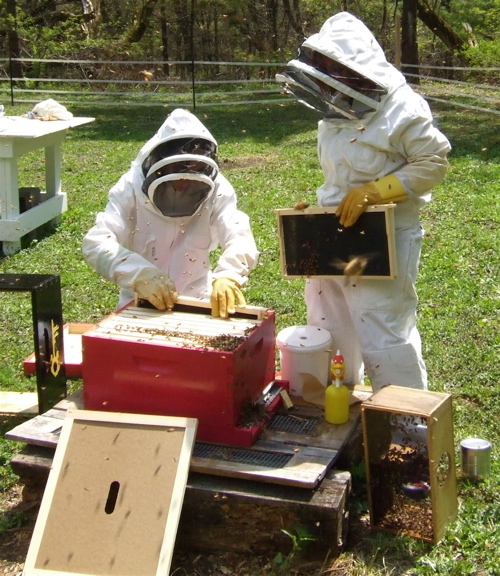
Merry (kneeling above) had the important job of keeping me on task--despite all the warblers and vireos singing overhead.  She held onto the hiving instructions and made sure I did everything in order.  She was like a skillful nurse aiding a surgeon, hand me tools when I needed them and making sure we had all of the equipment when we went to each hive.  It was a good team and we systematically installed each hive without any major snafus.

bee-hives

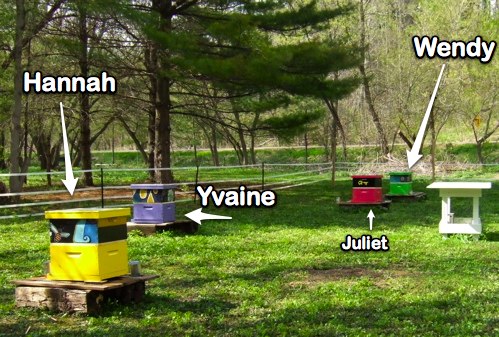
As I understand it, Non Birding Bill and Mr. Neil went through a book of baby names (and I suspect Mr. Neil's body of work) to come up with names for our hives, rather than naming them after people we know (it's too hard to deliver the news, "Hey, your hive died.").  We started naming the hives after a blog reader suggested it and it's easier to say, "Hannah hive is ready for harvest" as opposed to "yellow hive is ready for harvest."

The first hive names are Hannah, Yvaine, Juliet, and Wendy.  Of course, now that I look at the names, I can picture them from movies and books:  Hannah, will she be all Woody Allen and neurotic?  Yvaine--will she be a cranky fairy?  Juliet--will she be an impetuous teenager, ready for suicide when her love dies?  Wendy--will she pine away for a slightly efiminet flying boy who refuses to grow up?

We'll have to see...

More soon, I need to shower.

Wednesday Wren

So, I'm gathering all of the photos and videos that we took while installing four of our new hives yesterday.  I'm having such a challenge. The bird migration floodgates have opened, I want to watch birds, I want to play with bees, I have to blog, oh and there's that thing about earing a livable wage too... Crap, even as I type this, there is a large flock of cedar waxwings playing in puddles on the apartment building across the ally...in perfect light...

Focus, Sharon, focus. Here is a house wren I captured singing near our beehives yesterday:

[youtube]http://www.youtube.com/watch?v=yDALcwW9PM0[/youtube]

Bee blog soon.

Vicarious Beekeeping

This week was a tad frustrating.  We had received a note from our honey bee supplier that bees would ship sometime the week of April 27.  I kept all of my plans soft expect to dash off an hive our packages of new bees.  The calls never came and when fellow Bee Team member Lorraine called our supplier, we were informed that the bees were coming next week.  AAAAARGH! ME WANT TO PLAY WITH BEES NOW!

female-yellow-rump

But birds are always there for me when bees are not.  Friday's bird banding added in some spring migrant excitement.  While I've been reading about friends in the southern US seeing warblers, I've been practically salivating.  Well, we got in a female yellow-rumped warbler in the nets on Friday at Carpenter Nature Center, the spring migration flood gates are about to open!

As we were banding, Al, who is in charge of volunteers enthusiastically complimented my hair.  I just got colored, so initially I figured the compliment was natural, but the tone had a sense of urgency.  Sure enough, he asked if I would be willing to help out with Carpenter's beehives.

I was simultaneously incredibly honored and nervous.

hive

It's a tough economy right now and like many places that rely on grants and donations, Carpenter has had to cut back on staff and ask volunteers to help where we can.  Staff at Carpenter take care of the education animals, maintain the property, give programs, organize events, the list goes on and on. Al is the one who normally takes care of the bees.  Way before I ever had bees or even took a beekeeping class, he let me follow him out to the Carpenter hives, just to get a feel for it.  He's been beekeeping since he was a kid and knows much more than I do.  The fact that he asked if I would check on his hives was a huge honor.

It's one thing for me to make a mistake with our own hives, but to make a mistake or do things differently from the way Al would run his hives made me nervous.  But I wanted to help because Carpenter has an apple orchard and they need their bees.  I suited up and started the smoker and headed out.

bees

Oh! It was so awesome to be back at a hive and actively work it.  It was still fairly cool, and the girls were calm.  Carpenter had a different bee suit than I'm used too and I had some concerns that there might be a breach. We use what I call the space man suit, the hood is attached to the suit and when it's all zipped up, it's hard for an angry worker to get through.  Carpenter has the suit, but the hood is a pith helmet with a net over it.  I could see potential breaches all around my neck as I worked.  But the bees were calm, I took my time and forged ahead.

worker-bees

I looked all through the hive for the queen or even signs of her.  I found some capped brood and a bit of larvae, but no queen and no fresh eggs.  Al told me to do a reversal to make sure his queen was in the top box.  Bees work from the top down.  So, if your queen is in the bottom box of your hive set up, then you just move the box she's in to the top.  The youngest larvae was on the bottom, so I hoped she was there and put the bottom box on top hoped I didn't crush anyone.

hungry-bee

I also made her a container of bee nectar and a pollen patty to feed the girls.  They still had some of their winter stores left (above is a worker feeding inside a cell.  I think I spent about an hour with this hive.  Just checking the frames, going super slow to make sure I didn't crush anyone and also savoring time with the bees.  I haven't actively worked a hive since October--six months ago.  They were so calm, so furry.  The girls got a little irritated with the reversal, but nothing too bad.  It was fun to go with the groove of the hive, the contented buzzing was very soothing.

larvae

The other hive was much easier to work with and totally friendly. I found fresh eggs and larvae right at the top box in the hive.  I decided not to dig much deeper--the eggs meant the queen was right at the top, why disturb her work and risk crushing her?

black-bee

This hive looked to have mostly Italian looking bees--with a beautiful gold color, but I periodically found a black bee (a carniolan).  Wonder what kind of drones the queen mated with in this hive?

feeding

I love to watch bees feed on sugar that I've made.  It does seem for just a moment, that they are little furry pets, coming up to gently lap the nectar that you have so carefully preparedfor them.

I told Al about not finding the queen in the first hive and reversing it.  He said that he had actually reversed that one a week ago--doh!  Ah well, best laid plans.  Who knows where the queen in that hive is?

He thanked me and said that he'd appreciate any help I could volunteer this summer.  I'm happy to help, Carpenter is my favorite nature center in the Twin Cities and if any of my skills can be of use, I'm happy to offer.

Plus, it will be a chance to learn from a very experience beekeeper.  Al managed to get two hives to survive the winter, I still need to master that.

Well, I hope our bees arrive before I go to Kazakhstan this weekend.  I'd hate to miss the hiving.

Contest & Another Birds and Beers

Don't forget that there's still time to enter the Birdorable Guest Blogging Contest.  Get those blog entries in soon. Hey! We're having our May Birds and Beers at Coon Rapids Dam this Thursday, May 7, 2009.  The bonus, Mark Newstrom is going to set up his nets to see if we get any birds.  Sure it will be evening, but it's migration, so anything is possible.  For the start, my buddy Michelle Anderson (and the hottest naturalist in the Twin Cities) will give us a list of coming programs and then we can talk, bird and have a beverage--alcohol is allowed in this park if you would like to bring your own.  We'll start at 6pm.

Birds and Beers is usually an informal gathering at a pub for birders of all abilities to get together, have a beverage, and talk some birds.  However, we had so much fun at the tailgating birds and beers, we thought we would do some more outdoors to add in a little informal birding.

Mystery Baseball Game Bird

A reader has submitted help with id.  Since I don't live in Missouri nor attend many baseball games, I thought one of you readers could help our girl Veronica.  Here is her description: I hope you don't mind me asking you for help, but but I have been trying to identify a bird since last July.  Unfortunately I don't have a picture. I saw him at a baseball game in July 08, in Kansas City, MO at the Royals Stadium.  He waited until dusk to show up, when the big lights came on, sat on a wire above the seats and then proceeded to swoop and drop down almost touching the field to catch bugs in the air.  It was amazing.

He appeared to have yellow on his belly, and his back feather tails spread out when he flew.  He was very sleek in shape, and looked long when perched on the wire.  I never heard any song from him.   Because of the stadium lights I couldn't see any of his markings, just the yellow when he would land above us.

I went to a game last week to try to find him again, but it was so windy and sprinkling, no birds were in sight.  I have looked on line and in books and he might be one of many birds to my untrained eye.  But I thought maybe you would know of a particular type of bird that likes stadiums-ha!

Coloring wise he could be a Baltimore Oriole, Tropical Kingbird or he kinda of looked like a Scissored Tailed Flycatcher?(His tail really stood out as different/long while sitting on wire). The bird I saw appeared to have a longer beak than the Nighthawk.  I remember looking at the beak because it wasn't short and stubby like a Robin's. It was a little longer, thin/tapered-but not curved.

My husband thought I was so funny, I was watching the bird and not the game.  But it was so amazing how he was doing his thing, in the middle of this big crowd, and a ball flying around the place.  At one point he dropped so low I thought he was going to hit a player on the head.  haha  Sometimes he would go almost go to the ground.

My guess is a western kingbird. But what about you, readers?  Has anyone been out this stadium and seen this bird?

The Boreal Songbird Initiative, along with other environmental groups like Bird Studies Canada, Nature Canada, the David Suzuki Foundation, among others created a petition called “Save our Boreal Birds” a little over a year ago. This petition will be sent to the Prime Minister of Canada and many provincial leaders, and asks that vital bird habitat be kept intact despite the fact that over 30% of the Boreal Forest has already been designated for development.The Boreal Songbird Initiative is launching the petition on May 12th, and they are currently at about 60,000 signatures.  They'd like to get up to 70,000 before the launch.

Why should you care about this if it's for Canada?

20090430-j6t8ckt23ai4cp8xn574wsfbnp

Because many migratory birds that travel through the US and other countries breed in the Boreal Forest to the north, like the above American redstart...

1-variety-746276-1

And all of those pine siskins and common redpolls many of us got to see during the crazy winter finch irruption of 2008/2009...

cape-may-warbler

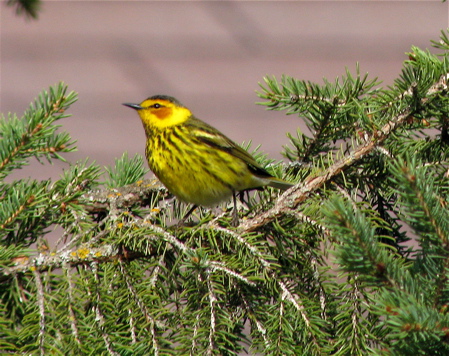
And some of those warblers passing through our yards right now like the above Cape May warbler on their way to the boreal forest to raise some chicks.  Even though this is in Canada, it affects many bird species we enjoy watching.

I have absolutely no idea if online petitions work, but I love what the Boreal Songbird Initiative is trying to do and how much will it hurt to click on a link and ad my name?  It worked with the changes to the Endanged Species Act.  Remember, the previous president relaxed the rules so that federal agencies like the highway department did not have to consult with government wildlife experts before taking actions that could have an impact on threatened or endangered species?

We signed a petition for that back  then ( and okay, so that president didn't listen) but the current president listened and on Tuesday announced that he changed it back and now the government's top biologists involved in species protection will have a say in federal action that could harm plants, animals and fish that are at risk of extinction.

boreal-chickadee-793970

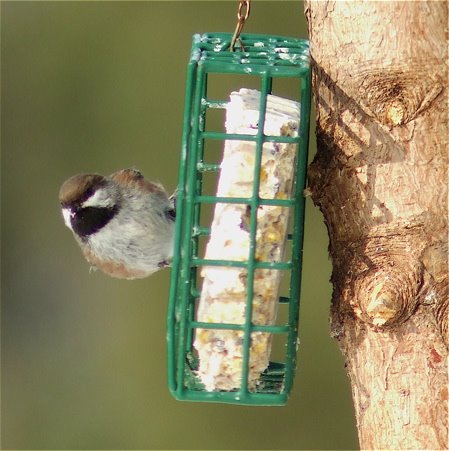
So, let's give a little love to the Boreal Songbird Initiative and birds like this boreal chickadee above (c'mon, how can you say no to a brown chickadee?).  Sign the petition--it will show you as anonymous online if you don't want the world to see.  Encourage friends to do it too.

Long-eared Owl & Short-eared Owl Hybrid?

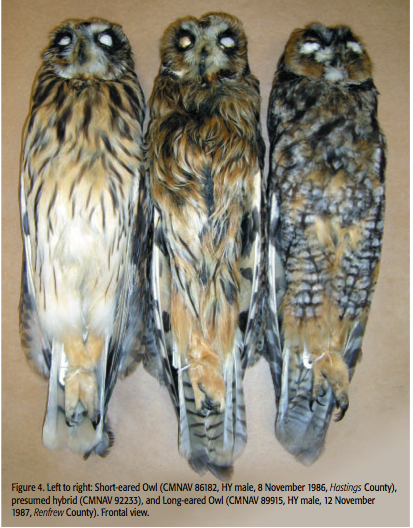
I read the coolest article today from the journal Ontario Birds by the Ontario Field Ornithologists by Kristen Keyes and Michel Gooselin and learned that sometimes you can find something really cool buried in a drawer of old museum specimens!  Keyes was doing some graduate research on short-eared owls when she came across a most unusual specimen.  Check out the bird in the middle in the photo below: picture-21

From left to right, we have a short-eared owl, Keyes discovery, and a long-eared owl. In her research, she found that the mystery owl specimen was received in 1991 from Avian Care and Research Foundation.  The bird had been found in 1990 with a broken wing.  They tried to rehabilitate it, but the bird had to be put down and then the carcass was donated to the Canadian Museum of Nature.

Everything about the bird puts it right in the middle of the two species from coloration to body part measurements.  For example, a short-eared owl's wing measurement should be between 283.5 - 307.5mm.  A long-eared owl's wing measurement should be between 269.5 - 295 mm.  The mystery owl's wing measurement is 294 mm--right in the middle. There are several other interesting features, take a look at the breast plumage compared to the other species--fascinating stuff.

How the heck did this happen?  Was a long-eared chasing a short-eared, suddenly realized they were each the opposite sex and much like a predictable sitcom, fighting turned to mating?

You can read more in the April issue of Ontario Birds, published by the Ontario Field Ornithologists (who graciously gave me permission to use a photo and reference the article in my blog).  It analyzes the hybrid's intermediate characters and uses color photos of all angles of the birds and of short-eared and long-eared for comparison.

Reference: Gosselin, M. and K. Keyes. 2009. A Long-eared Owl x Short-eared Owl (Asio otus x A. flammeus) specimen from Ontario. Ontario Birds 27(1):23-29.