Bird TV Shows

A couple of birding show are trying to come down the pike.  One is Birding Adventures hosted by James Currie.  I actually met him a few months ago and he did a video clip saying why you should watch his tv show: [youtube]http://www.youtube.com/watch?v=lRBZv_lXGAE[/youtube]

It's not available on tv where I live, but you can order it online and watch it.  I agree that Currie goes a long way to take the nerd out of birding.  If you look on the website, they have him soaring in on a parachute while he screams, "This is what it's like to be condor. I'm coming in to my carcass!  Whooo!"

Another birding guy by the name of Richard Crossley (known to many as one of the authors of The Shorebird Guide) is trying to get a birding tv show off the ground called Wild In The City. Where Currie's show appears to be more of "Hey let's go to cool places and just take in how cool these birds are," Crossley's looks more a listing tour, going from town to town and competing with teams to see who can photograph the most birds in a day.

Crossley isn't your garden variety birder either.  The first time I met him was in a bar in Cape May, NJ.  This British guy dressed as a vampire came up to our group and started talking birds and then moved on.  That vampire birder was Richard Crossley.

Crossley is trying to convice Animal Planet that his show Wild In The City has legs and lots of birders will watch it.  If you follow this link, it will take you to a preview and then a survey asking what you think.

Fun and Odd

Don't forget to vote for your favorite entry for the Birdorable Guest Blogging Contest.  Voting ends today! There's a fun article up at World Hum by Sophia Dembling about her experience as a non birder at the Oklahoma Lesser Prairie Chicken Festival.  It's a great read and I'm honored that she included my prairie chicken video.

Now that you've read that fun article, I have to show you this.

Check out this "eco-friendly" birdhouse. It's a solar powered bird house that lights up at night. Birds that nest in houses, naturally nest in tree cavities--where it's dark, they want it dark, they do not want a brightly lit perch outside the hole--they actually don't want a perch either.  A well made bird house does not have a perch on it.  If you watch birds that nest in cavities, the put their feet on the hole and push into the house.  Sitting on a perch and turning their head is an awkward position for them.

The light could serve to attract predators.  Some predators, like snakes and lizards would come to the light looking for insects attracted to it, and boy, what a delightful surprise to find eggs and chicks to eat.

I always thought the bird feeders that light up at night were silly, but it's decorative and birds aren't using it at night so it doesn't matter.  But for nesting birds, this idea appears ill-conceived.

The Steppe Family

So in some ways it was like being around one large blended family when birding the Kazakh Steppes:  What gull is that?  Steppe gull.  What eagle is that? Steppe eagle? Oh, cute! What mammal is that? Steppe marmot. steppe-eagle1

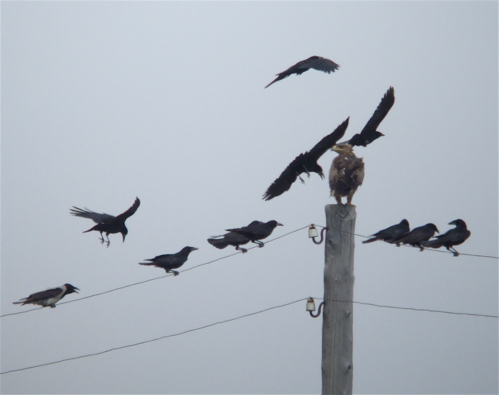
Above is a Steppe eagle being mobbed by a hooded crows, rooks, and carrion crows (apparently the crows did not get the memo that they should be Steppe crows).

Now, if you're wondering why is this area called The Steppes--is it one large stair case? No, it's basically short-grass prairie and I think the word steppe comes from a Russian word...which I don't have the keyboard to spell.  Although, I just went to Babel Fish and typed in "Steppe" and it gave me this: Степь.

alone

Quite a bit of the birding was like birding in North and South Dakota.  But unlike North Dakota where we're only seeing less than 1% of the prairie that was once there, in Kazakhstan...it goes on and on and on.  Our tour info read that there are less then 6 people per square mile in Kazakhstan.  When you got out of the cities, you could feel how that number was true.

kaz-prairie-0471

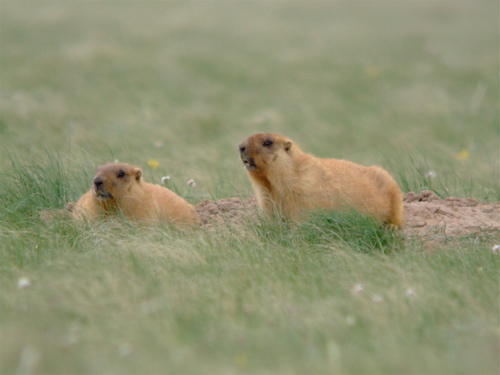
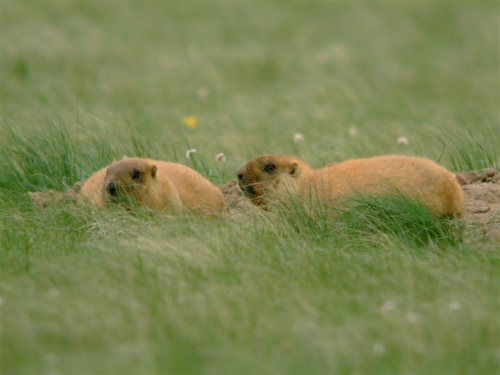
Above is a pair of Steppe marmots...kind of like groundhogs where I live.  Although, with their coloring, they kind of looked like over sized prairie dogs.

sneaky-photographers1

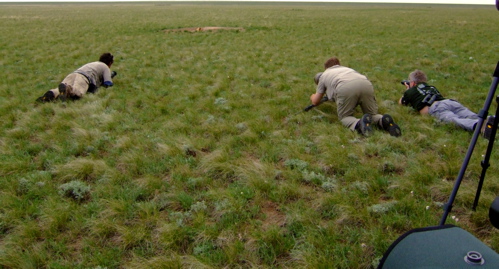
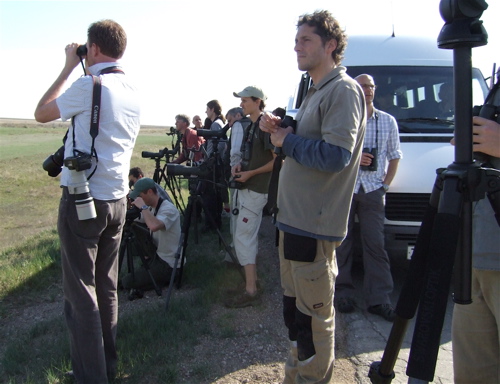
Most in our group where digiscoping our adventures--using point and shoot cameras or SLRs attached to our spotting scopes to get photos.  A few in our group would use their own cameras.  It was fun to watch them sneak up closer and closer to the marmots.  I actually have video of their movements...but I'm pretty sure I'd destroy some European relations if I posted it.  As the photographers crouched closer and closer...

kaz-prairie-0481

...the marmots crouched lower and lower in response.  One finally went down in the burrow.  The remaining marmot did not appear to buy our efforts at hiding:

steppe-marmot-1

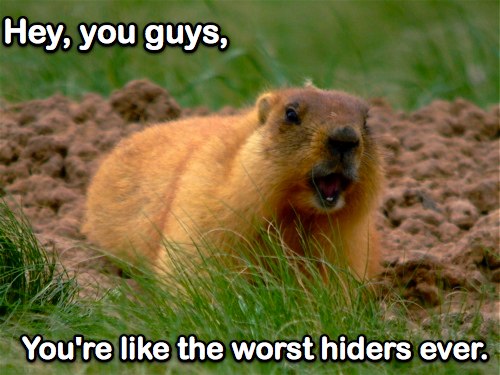
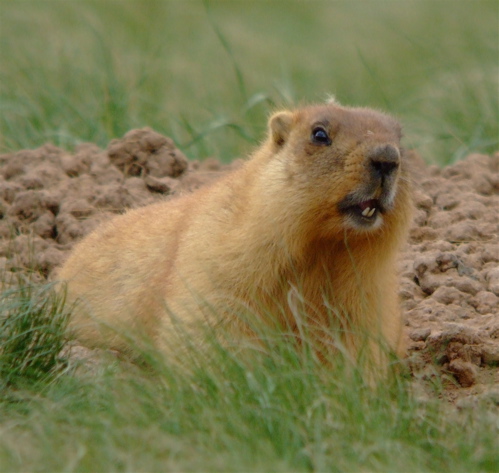
It stood guard and barked at us.  Here is a video and you can hear the high pitched barking (and lots of wind).

[youtube]http://www.youtube.com/watch?v=BUp0szhgJvg[/youtube]

We all got our shots and then left the barking marmots in peace.

step-marmot

I'm sure that marmot is feeling very macho and said to its partner,  "Did you see that?  That group of twenty humans stopped near our burrow, about a half dozen of them closed in and my mighty bark forced them to flee.  I am Macho Marmot, Terror of the Steppes!"

Just don't try that strategy with a Steppe eagle, dude.

Bee Progress

Man, all week I have had great intentions but lingering jet lag and life has gotten in the way.  Tuesday night, I thought I would do a quick bike ride, maybe bike to a restaurant with Non Birding Bill, have some quality spouse time, come home, do a wee bit of blogging, and watch a movie. Just as our bikes reached the restaurant...a screw found it's way into my tire and we had to walk home.  A big thank you to the random hippie who slowed down and tossed a temporary patch and said, "Heeeeere, maaaaan, find somebody with a pump!" The thought was appreciated.  We ended up over at my favorite bike shop--Sunrise Cyclery who quickly helped me out with a patch.  But we came home late and exhausted.

Then yesterday, I was supposed to go out to some bald eagle banding and I thought I would come home in the afternoon, catch up on some blogging (do a bee update and then a little Kaz update), have a nice walleye dinner, watch Fight Club with NBB (a favorite date movie) and just relax. Due to high winds and uncertain nest locations we were out all day, dealing with high winds on the river, hot sun, climbing one really high hill, wading through stinging nettle. I came home to find the servers down or the site so no blogging which was fine, Sleep descended on me like a shark from the sky.  I could not keep my eyes open, despite NBB, Brad Pitt and Edward Norton.

And now I have an enormous backlog (or should I say blackblog)...and in a couple of hours I'm going to be on a river boat teaching kids the wonders of the Mississippi River.

So, lets do a quick bee update.

angry-chickens-02

For the most part, the four new hives are doing swimmingly!  They are still so young and so new, they are quite friendly.  Lorraine, further conquering her bee fear demons even went without gloves for this hive inspection.  I was holding a frame looking at our hives' egg  situation when Lorraine offered to hold for me.  I said, "Dude, you forgot your gloves."

"No I didn't," she said.  At first I admit I was skeptical, but she handled them well.

angry-chickens-03

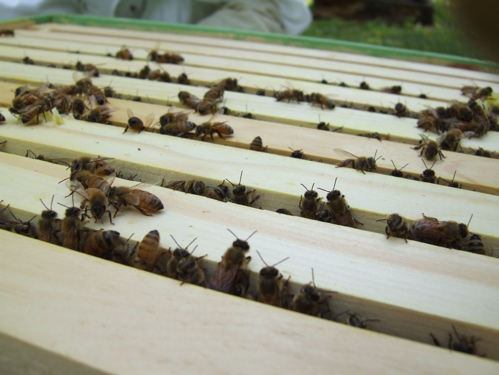
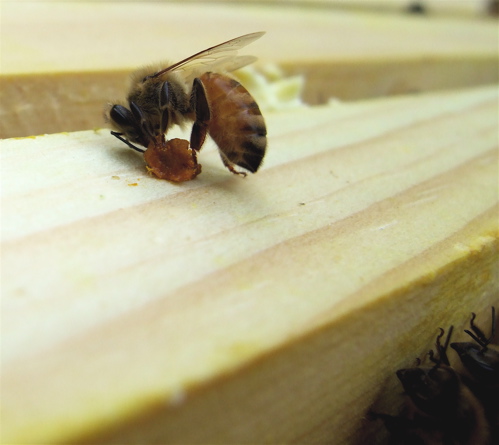
The bees themselves were more focused on eating and building up their hives.  Above is a worker chowing down on some pollen patty crumb.

angry-chickens-10

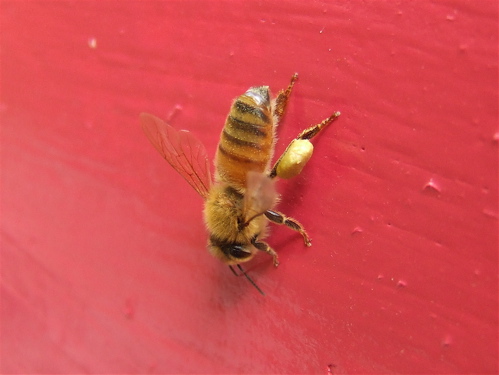
The bees eat a tiny bit of the pollen patty we make for them, but every year, new hives appear well capable of gathering their own. Check out this girl with fat baskets attached to her back legs.  Dandelions are in heavy bloom, that could very well be the pollen in her baskets.

angry-chickens-07

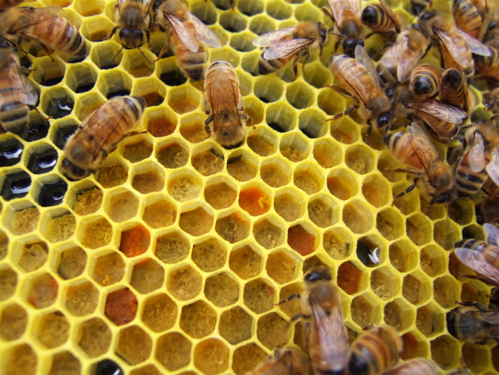
But the workers are finding other sources of pollen.  Check out the colors of the stored pollen. There's bright yellow, but also dark orange.  Where could that be from?  Bees store pollen (their protein source) in the bottom of a food cell and then store honey on top of that.

angry-chickens-12

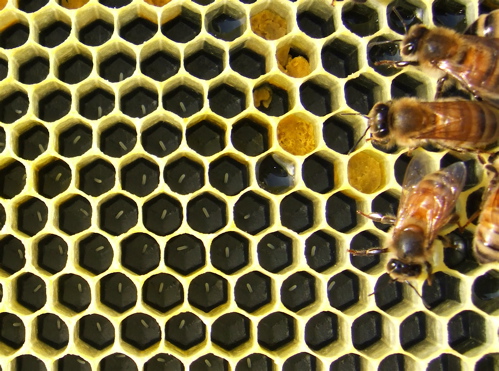
All four of our hives had brood and eggs.  You can see the eggs freshly laid by a queen in the above photo.  Both the green Wendy hive and the red Juliet hive were built up quite a bit in their boxes--seven full frames.  According to the way I was taught, when the bottom box has 8 of the ten frames built out, it's time to add a new box full of empty frames for building on top.  But our first summer, we saw a hive at seven frames and decided to wait until she added one more...but she ended up swarming, so if they had seven frames drawn, we added another box to give them room to grow.

angry-chickens-18

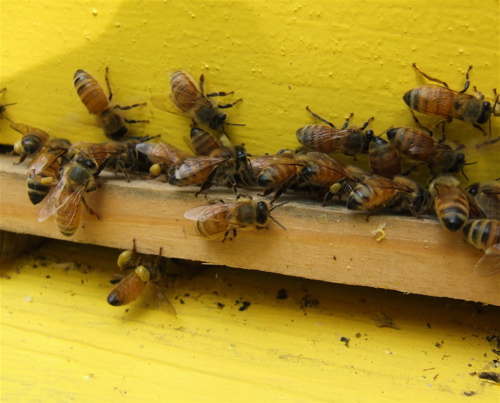
The purple Yvaine hive and the yellow Hannah hive were both a little behind in production.  They had eggs, so the queens are present in both hives, but they are not working as fast as the other two.  Check out the shot above of all the girls coming back with pollen.  I love watching bees coming and going at an entrance.  I took several photos.

angry-chickens-21

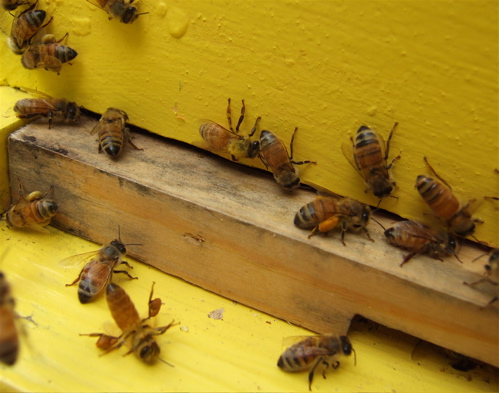
When I was going through all my entrance shots, I noticed this one.  I was going for the worker in the middle above the entrance reducer, she is very yellow (I suspect from pollen).  But then, I noticed the poor bee on the bottom who appears to be falling ass over tea kettle.  I had just adjusted the entrance reducer, so I think she wasn't ready for the change in position, flew into it, and got knocked on her back.  Bees, so organized, yet sometimes not very graceful.

angry-chickens-20

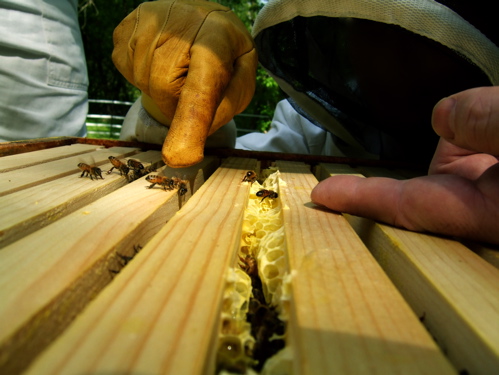
We had a friend out with us to the hives.  Above, Mr. Neil is showing her how much bees enjoy the gag, "Pull my finger."

They love it.

Landing In Kazakhstan

We departed Frankfurt, Germany for Kazakhstan.  Our flight left in early afternoon and between the long flight and time change, it was well past 11pm when we arrived in Astana, Kazakhstan. kazakhstan-airport

As we de-boarded the plane, a woman in a corner wearing a lab coat and mask aimed some kind scanner at us to see if anyone was carrying a significant fever (presumably over swine flu fears).  We got our bags, made through the above security screening and taxi drivers and were on our way to the hotel.  The taller building had these odd lights surrounding their structures which gave the illusion that they were sparkling.  We checked in and I made to my room a little after midnight.  I called my husband through Skype to let him know I was alive and what my initial impressions were.  I told him I had to meet the group at 6:30am and he told me to get to bed.  As soon as I hung up, I heard outside my hotel room door:

"Hey, Shaz, you awake?"

It was my buddy Clay Taylor.  I could hear mischief in his voice, so I said, "You betcha!"

"You gotta come out and see this!"

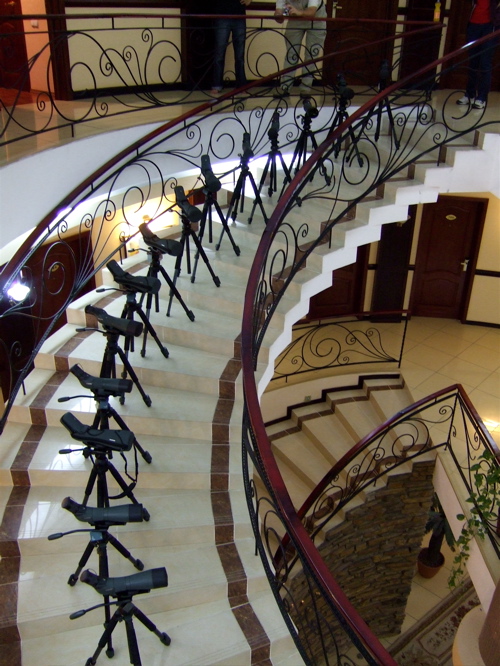
I stepped out and found on the hotel's spiral staircase:

kaz-swarovski-05

that the jet lagged and somewhat slap happy Swarovski employees had artfully displayed all of their spotting scopes onto the stairs.  Pictures were being taken at all angles and all this was going on well past 1am and we had to meet at 6:30am.

kaz-swarovski-08

When I made it back to my room to settle in for a few hours sleep, I noticed this sticker on the mini bar.  I'm not sure what the hotel was trying to tell me.  Perhaps that I should feel comfortable enough to dawn a Speedo in my room and have some ice cream.

I'm also not sure if I have officially said why I went to Kazakhstan in the blog.  Swarovski Optik is introducing some new equipment including spotting scopes, eye pieces, and digiscoping adaptor.  They invited a group from the US and Europe to not only test out this new equipment but to also witness some of the work they are funding with the sociable lapwing with BirdLife International.

swarovski-birder

When the group introduced themselves at breakfast that first morning, I was struck that only Corey Finger of 10,000 Birds and myself were the only attending from the US.  I was also the only one there remotely representing a birding publication from the US (you can find my articles in WildBird Magazine).  The rest were editors of other birding publications from England, Germany, Italy, all over Europe--I'll go more indepth later, I have a new affection for birding with Eupopeans--especially the Brits.  It's like birding with regular people who happen to have a strong interest in birds.

Anyway, with the group of people who were invited, I was honored to be included as an attendee and was constantly looking around asking myself, "How the heck did I end up here?"

Proving once again that the Talking Heads Letting The Days Go By is my theme song.

kaz-prairie-038

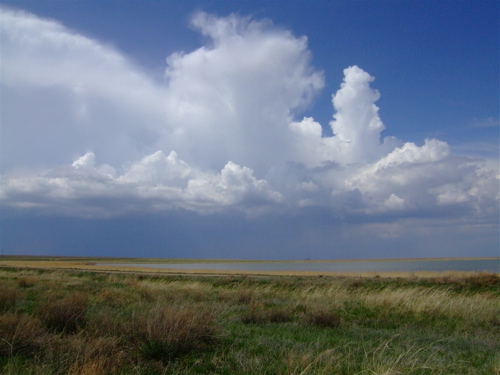
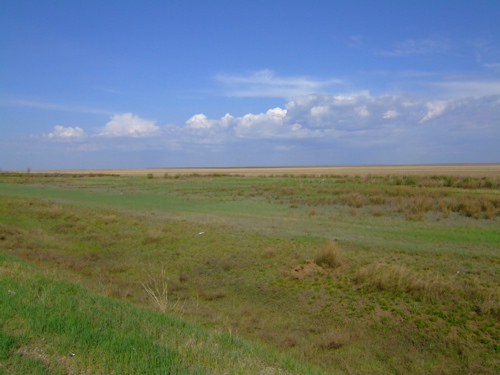
We started our birding adventure on the Steppes which was basically large tracts of short grass priaire.  So much of it reminded me of the Dakotas.  I had to contain myself as we passed common birds to make it to the assigned birding patch.  But I couldn't help but salivate as we passed dozens of red-footed falcons nesting right off the side of the road.

library-0277

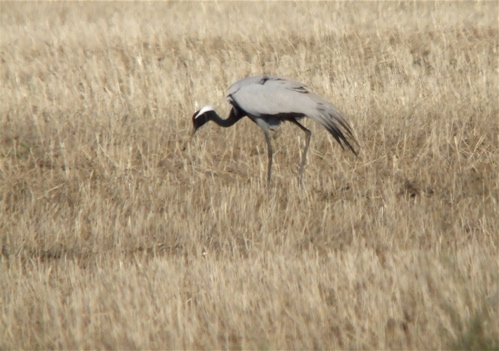
However, a pair of demoiselle cranes was enough to force our buses over before we reached our destination.  They were distant, but with the scopes we could get some souvenir shots.  My point and shoot camera isn't strong enough to catch every detail when the bird is at a distance.  When I looked through with my naked eye, I could see this birds blazing red eye--what a cool start to our birding trip.

kaz-prairie-039

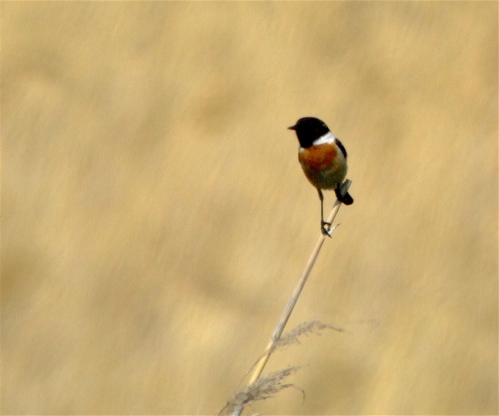
One of the common birds we saw right away was this stonechat.  As the birds popped up on the prairie, I was able to get some shots and felt a great relief that I wouldn't as challenging a time taking photos as I did under the heavy tree canopy in Guatemala.

lifer-flamingo

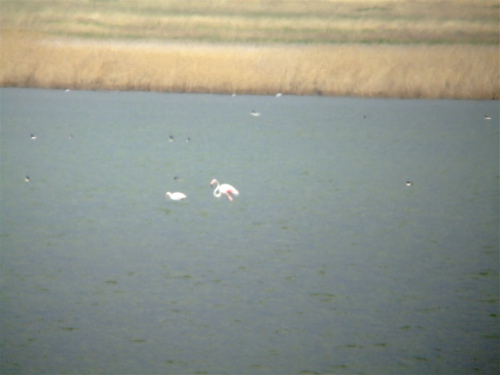
A super exciting bird that I got to see at a great distance was a wild flamingo!  I always thought that I would have to go to Africa to see one of those wild and untamed, but they also breed in Kazakhstan.  Not the best view in the world, but still I was able to make out that iconic shape in the distance.

short-eared-owl

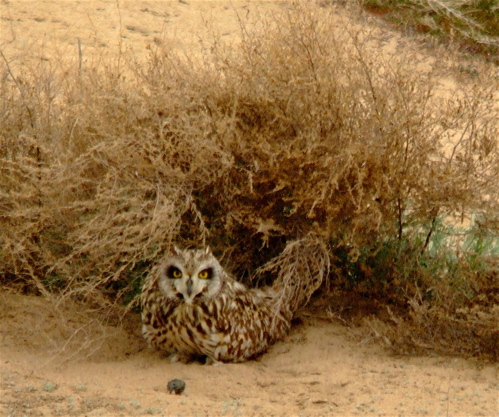
I was suprised by the overlap of species that I saw, that I could see in the US.  Above is a short-eared owl--we saw a couple of them.  I love this photo, the owl hidden in some brush, it would be hunting soon...note the big fat pellet on the ground in front of it (even its little ear tufts are up).  This was not the only bird.  At one point, I was watching some waterfowl and I heard the familiar "meep, meep, meep" of a gadwall.  I thought it was a ringtone on my phone and then remembered my phone wasn't working and saw three fly overhead.  It was nice and fun to see some familiar birds.

steppes

I have to step out to do some eagle banding, we will continue our Kazakhstan travels soon.

Birdorable Guest Blogging Contest: Voting!

125-wren Time to vote for your favorite entry in the Birdorable Guest Blogging Contest! You can view all the entries one this page. When you're done, simply pick your favorite from the drop-down list, enter your name and email address (which will not be sold, rented, given, or disclosed) before Friday, May 22nd at 5 p.m. CST. One vote per person.

Each of the ten entries has already won a Tough Titmice Magnet from Birdorable, and the grand prize winner gets a Birdorable Spotting Scope shirt! The shirt pictured a red-cockaded woodpecker perched on the scope, but they said the winner can choose the bird species. So, if you would prefer something like a Cooper’s hawk, cardinal, or shag, they’ve got you covered.

So, vote away!

From Frankfurt With Love

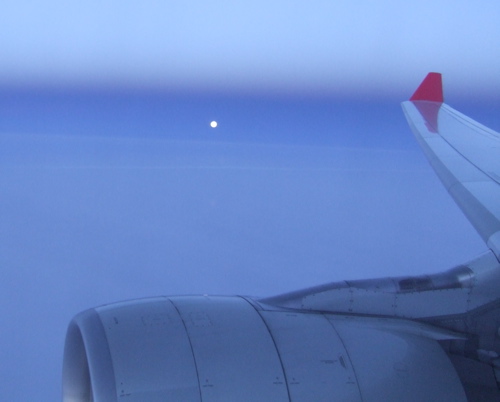
I love this shot of the full moon visible from our flight to Europe. frankfurt-01

My journey to Kazakhstan started with a trip to Frankfurt.  My flights worked out to go from the Twin Cities, to Detroit, to Frankfurt and then on to Kazakhstan.  Originally, I was supposed to do this all in one day, but for whatever reason, it saved $1000 for me to arrive a day ahead, spend the night in Frankfurt and fly to Kazakhstan the following day--which I'm  really glad happened that way.  It gave me a chance to catch up with the time change...and finally do a bit of European birding.  This was my first time across the Atlantic.

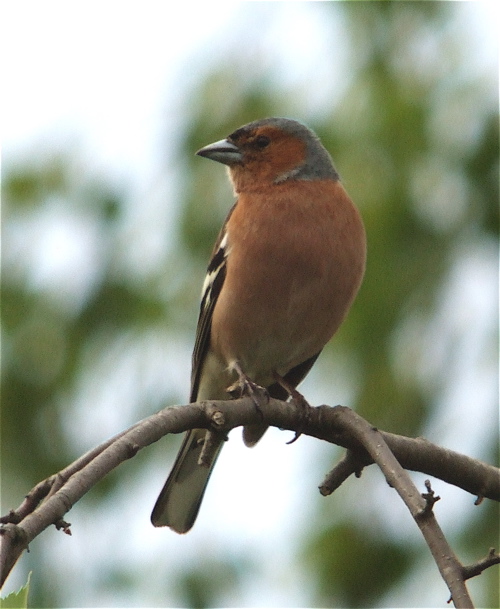
chaffinch

I was able to walk around the hotel and all the birds were new like the above chaffinch.  I also looked forward to experiencing some of the iconic birds of Europe like the nightingale which I did not see, but only heard.  This was fine with me, the song of the nightingale is written about so often, I'm not sure I would have counted it if I did not hear it (even if I saw it).  Here's a sample of the nightingale song.

black-robin

Some birds were just down right confusing to my little American brain.  Above is a blackbird--as a matter of fact, this is the very blackbird referenced in the Beatles song, Blackbird Singing In The Dead Of Night...which this bird did do...right outside my hotel room window.  However, if you look at the shape of this bird, it resembles an American robin, not something like a red-winged blackbird.  Check out the bill on this bird.

Robins that I see are in the genus Turdus, their scientific name is Turdus migratorius.  Well, the blackbird above has the scientific name Turdus merula--they are in the same genus as North American robins.  European blackbirds are not the same as North American blackbirds, they are like our robins.

It gets more confusing!

Here is what a European robin looks like. It's not shaped like a Turdus at all (did I actually type that last sentence, yes I did).  The European robin's scientific name is Erithacus rubecula, it's not in the same genus as North American robins, about all they have in common are featers, an orange breast and a love of insects for breakfast.

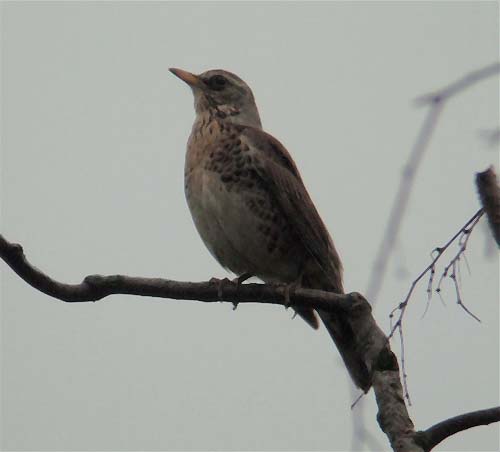
fieldfare

Anyway, here is another exciting (at least to me) Turdus that I got to see--a fieldfare.  My only regret is that when I was finally able to get my hands on my digiscoping equipment, it was softly raining and the light was terrible. But I had a great time watching something shaped like the robin I'm used to, but colored in a different way.

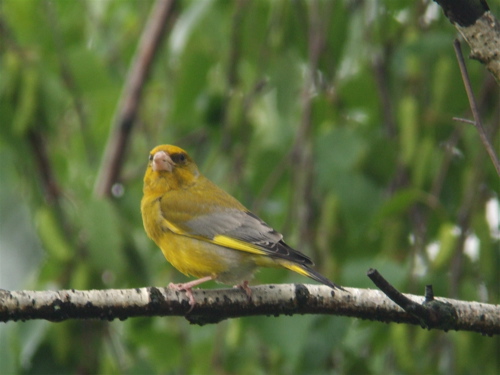
green-finch

This is a green finch.  After hearing the nightingale, seeing the blackbird, and then seeing this bird I thought, "All I need now is a linnet and I have a song from Sweeney Todd."  I didn't get one around the Frankfurt hotel, but did later in Kazakhstan.  Score!

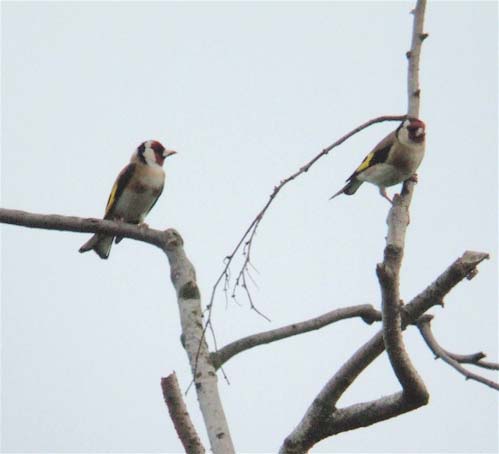
goldfinches2

Here were some European goldfinches.  This was interesting, because I periodically see these sold in pet stores in North America.  It strikes me as odd that it's illegal to own North American birds as pets, but European birds are ok.  Actually, according to this website, you can get some of the birds in this post (like the chaffinch and green finch) and some of the birds I saw in Kazakhstan as pets.  Whoa, I just did some digging on their price list and found that one of their South American species for sale is a "yellow hood blackbird" which looks remarkably like a yellow-headed blackbird...that's not legal.  And as much as I love those birds, I would not want them singing in my home on a regular basis.

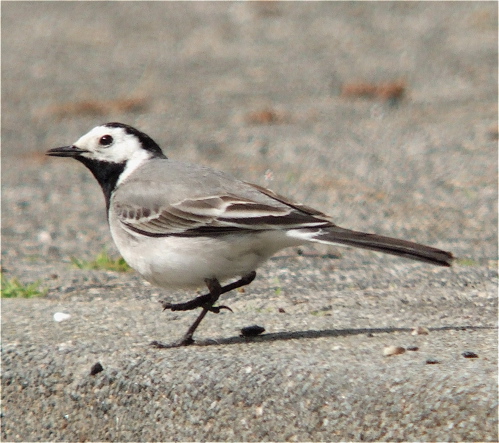
wagtail

Another fun bird to see what a white wagtails.  I ended up seeing several different versions of this bird throughout my travels and each one is very striking. I'm sure it's a common bird, but it's a striking one to see.

That is a sampling of the birds that jump started my Kazakhstan journey.  After an afternoon of birds, I met up with some of our other travelling companions, had a meal and got a good night's sleep before board a plane for parts unknown.

Birdorable Guest Blogging Contest #10: Gunnar Engblom

125-wren Time for the final entry: this one comes to us from Gunnar Engblom and details the 11 Peruvian birds you must see. Thanks to everyone who entered; we'll have the voting poll up shortly!

Why Birds?

Birdwatching is a specialized hobby. The birdwatchers aim to see hundreds of birds during a holiday in Peru. However, there are certain birds that transcend to more normal tourists. Some birds that you don't have to be a birdwatcher to appreciate. Those birds that will leave an impact on anyone who lays eyes on them. These kinds of birds become banner species and tourist attractions and could be decisive to turn a non-birder into a birder. They are also important for conserving habitat and supporting local small scale businesses which often give direct revenue to local communities. I hereby present the 11 most important birds in Peru as tourism attractions.

Condor
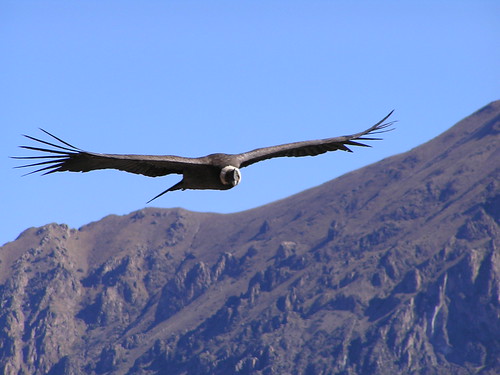
Andean Condor

Emblematic bird of the Andes. 100.000 people travel yearly to Colca Canyon near Arequipa to see the mighty Condor. Kolibri Expeditions have found a good viable population in Santa Eulalia canyon only 3 hours from Lima, which also is a good place to see this majestic bird. You'd be surprised to learn that most tourists that come Peru, and those that do not visit Colca or Santa Eulalia Canyon, will not see a condor in spite it being such a tremendously important symbol of Peru and the Andes. The closest they will get is hearing "Condor pasa" - the Peruvian song Simon and Garfunkel made world famous. At every little coffee shop to every fine restaurant in Cusco you will hear it played with panpipes and charrango. You cannot avoid it - not escape it! Strangely enough Peru has yet to raise the awareness of the importance of the species for eco-tourism in other rural areas. As such it may become an important cash cow for communities. This would change the present situation in many places where the species is persecuted and seriously threatened.

Macaw-lick
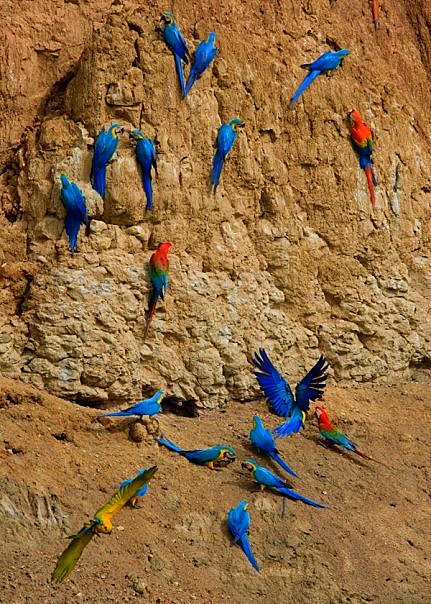
Blue-and-Yellow Macaw & Scarlet Macaw. Photo: Tim RyanThere are two major macaw-licks in SE Peru where these giant parrots descend on sunny clay river cliffs to ingest the clay with thousands of other parrots. The best one that attracts 5 species of macaws is situated in the Tambopata area near Tambopata Research Center.  There is extremely important Macaw research going on here and you can help as a participant volunteer. See Tambopata Macaw Project. The other important one is downriver from Manu at Blanquillo near in vicinity of several lodges.

Andean Cock-of-the-Rock
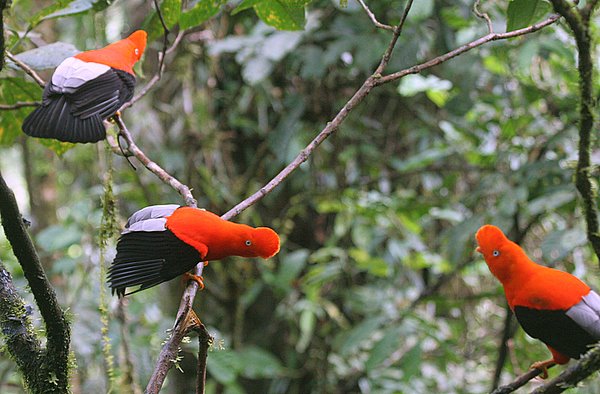
Andean Cock-of-the-RockWow! Exclamation mark is necessary! This surreal member of the Cotinga family has a wide distribution from Venezuela to Bolivia. It is one of the most colorful birds of the Andes. The males gather in "lek" - displays - where the perform ritual dances and make noisy grunts and shrieks. In many places leks have become tourism attractions. The most famous is perhaps next to Cock-of-the-Rock Lodge, but there are several places in Central and Northern Peru where leks also can be seen. Locally, it has become good incentives to conserve forest. Since the cock-of-the-rock is also un-officially national bird of Peru kids all over the country learn to appreciate it. Only five years ago, when traveling in Central Peru inquiring where I could see it, I was directed to the zoo or a man that allegedly had stuffed ones for sale! Things have changed now.

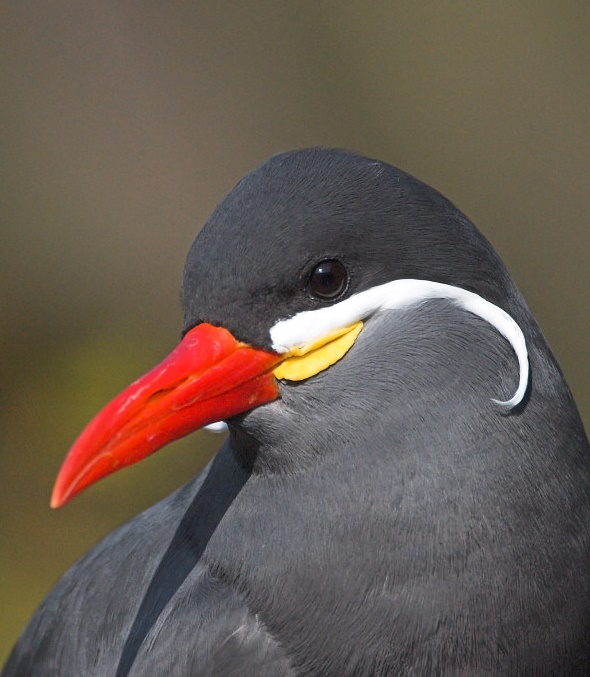
Inca Tern
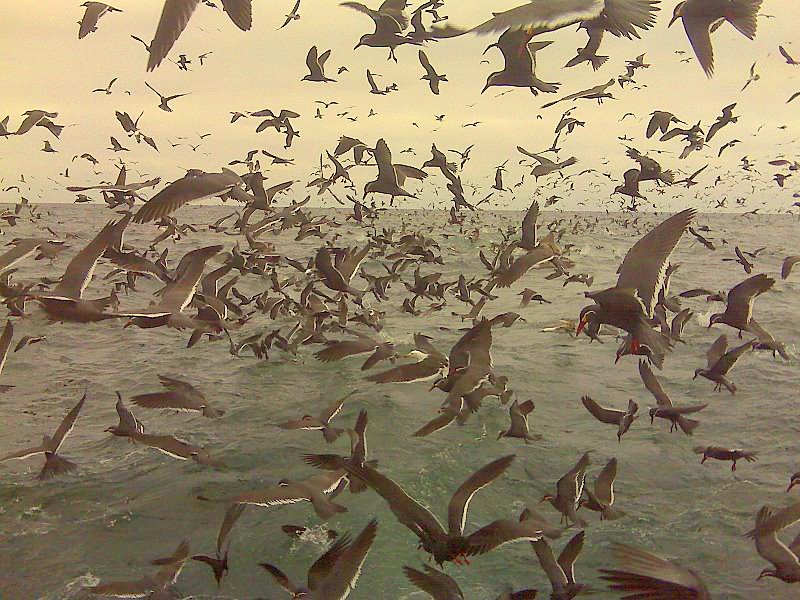
Inca Tern

Incatern

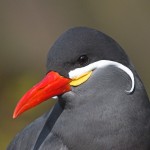
Its coral red bill and feet, and yellow and white waxy mustache on a slaty blackish body makes the Inca Tern the most beautiful Tern of the world.  This specialty of the Humboldt Current is not difficult to see in large numbers. In many places it can be approached for a photograph.  A spectacular event on the Lima pelagics is when the fish scrap leftover that is used to attract seabirds at the high sea is thrown out after the boat and up to a thousand Inca Terns come in to the stern.

Hummingbird feeders
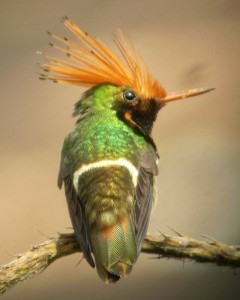
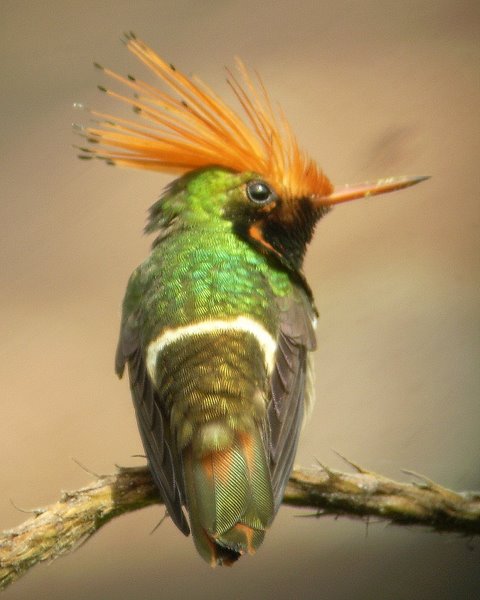
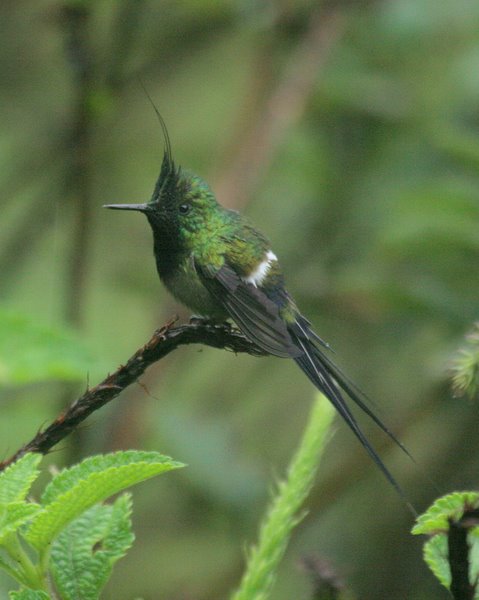
Rufous-crested Coquette. Photo: Alex DuranWire-crested Thorntail

Peru has yet to develop more places with hummingbird feeders, but the ones available are truly spectacular. My favorites are the following.

Amazonia Lodge at the bottom of Manu road, with specialties such as the rare Rufous-crested Coquette, Koepcke's Hermit and Gould's Jewelfront and another dozen of more common hummers such as White-necked Jacobin, Blue Emerald, Gray-breasted Sabrewing and Black-eared Fairy come to the garden with feeders and blue vervain in front of the ample porch of the main building..

Machu Picchu Pueblo Hotel the luxurious hotel with precious subtropical gardens decorated with orchids and bromeliads at the foot of Machu Picchu next to Aguas Calientes village. The hotel also have dozens of well maintained hummingbird feeders spread out in the compound open only to its guests. The specialties include Gould's Inca, White-bellied Hummingbird, Long-tailed Sylph, Chestnut-breasted Coronet and Booted Racket-tail.

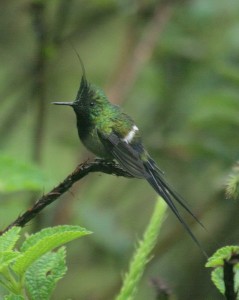
Cock-of the-Rock Lodge on the Manu road, has a open veranda dining room looking out to the garden where tanagers are fed and Blue Vervain and feeders attract the hummingbirds. The specialties include Violet-fronted Brilliant, Many-spotted Hummingbird, Wire-crested Thorn-tail, Booted Racket-tail and many more.

Marvelous Spatuletail

[youtube]http://www.youtube.com/watch?v=Df8jhng3xgQ[/youtube]

If I should choose just one hummingbird species in Peru this would be the one. It is the most spectacular Hummingbird in Peru. The male has long streamers ending in blue rackets. It may not yet be a large tourist attraction since it occurs only in Amazonas department and a bit off the beaten track for most general tourists coming to Peru, but it is certainly on the birdwatcher's radar on the Northern Birding Circuit and the principle attraction. Kolibri Expeditions has initiated a project here together with local farmer Santos Montenegro obtaining funds through our clients allowing Santos to buy some land from his neighbors. The idea is to turn the small reserve to a Hummingbird information center.

Chilean Flamingo
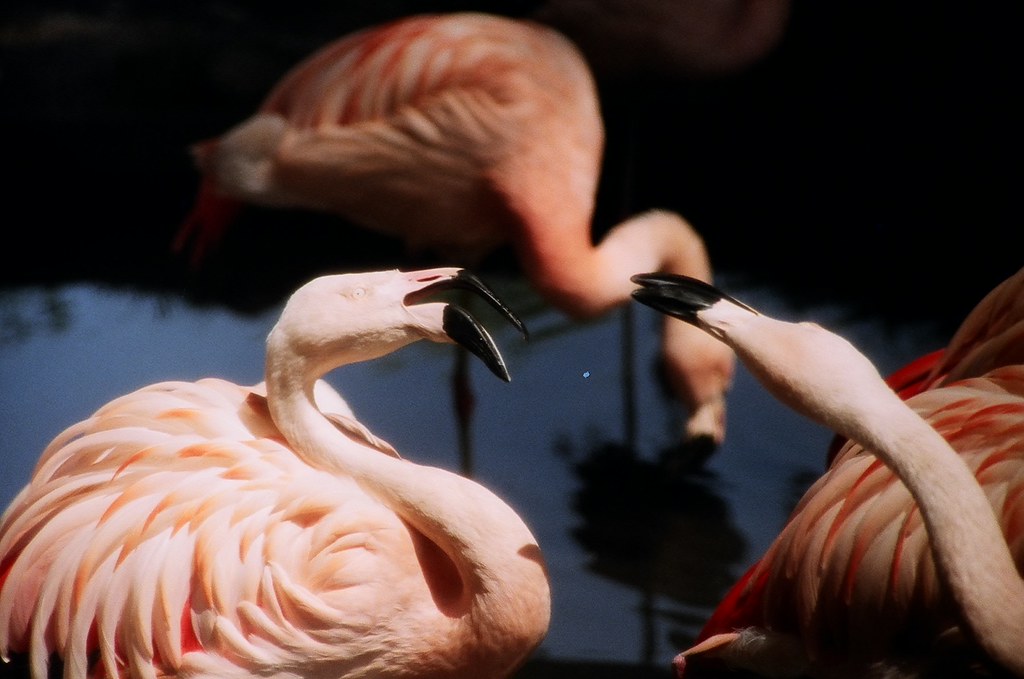
Chilean Flamingo Flamingos are big tourist attractions all over the world, and the Chilean Flamingo in Peru is not an exception, especially since legend has that the flamingos San Martin saw in Paracas before leading the liberation from Spain, inspired to the design of the Peruvian flag. There is not a person in Peru, that is not familiar with this story. Unfortunately, many flamingo colonies are well off the beaten track, except that of wintering flamingos still present at the Paracas bay. One may hope however those remote flamingo colonies could be integrated in sustainable tourism packages and this way supply income to local communities at the same time protecting the colonies. The practice common is the past to scare the colony to take flight for a photograph, is fortunately no longer carried out. It seems to me that Peruvian awareness for the well being of the natural attractions has increased in recent years.

Hoatzin
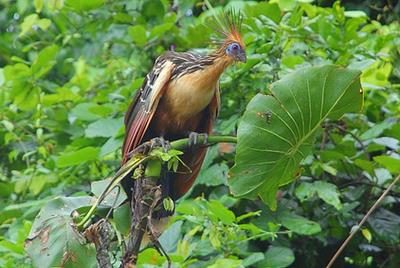
HoatzinWithout being a particularly rare bird, the Hoatzin inhabits lake sides. It prehistoric looks, similar to the Archaeopteryx and the fact that the young have claws in the wings, make it a tantalizing. The hisses it makes add to its pre-historic image. It occurs in colonies and is mostly not hunted because its meat is smelly and not good. It has constantly bad breath as its digest is completely leaves which are fermented in the crop. Hoatzin can be seen in many places in the Amazon. Most photogenic perhaps at Amazonia Lodge.

Humboldt Penguin
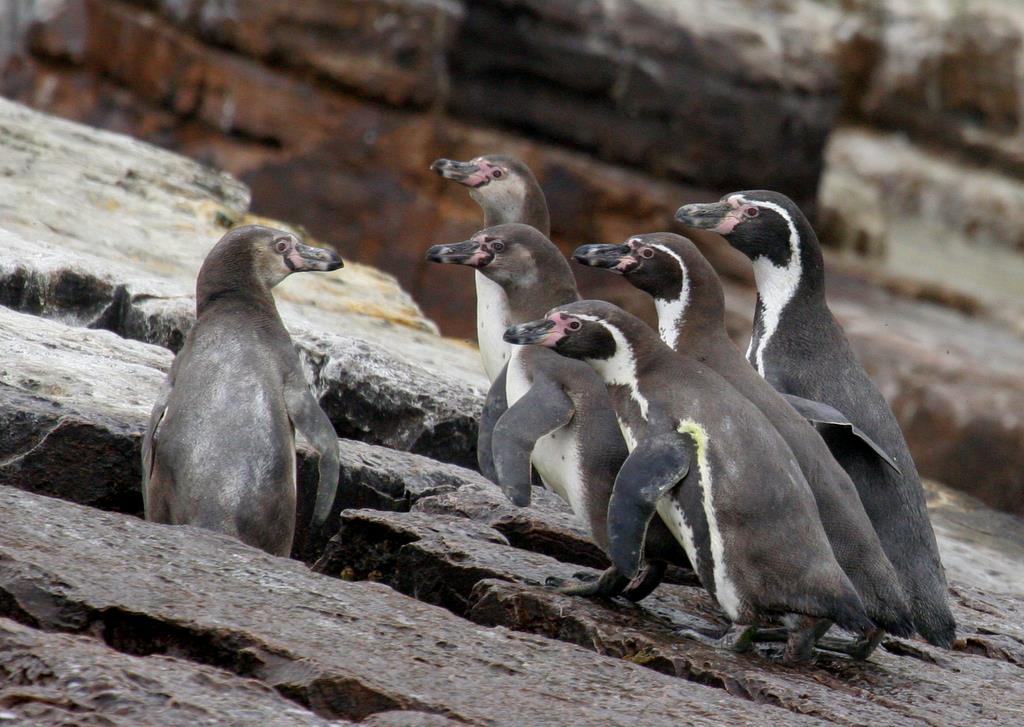
Humboldt PenguinParacas has been the traditional place where many tourists come in contact with the species for the first time while visiting the sea-lion colonies at Ballestas Islands. In recent years however trips have been arranged to sea-lion colony at Islas Palomino from Callao, Lima, where also the Penguins occur and this is a time effective alternative to Paracas. Recent studies show that Humboldt Penguins are very sensitive to disturbance - much more so - than its close relative Magellanic Penguin that occurs in Patagonia and with colonies that attracts tens of thousands of visitors. Fortunately, there are no colonies in Peru that are accessible to tourists to walk around in. The large colony at Punta San Juan near Nazca is closed to the public.

Other places where one can see Humboldt Penguin include Pucusana and the new San Fernando reserve close to Nazca.

Torrent Duck
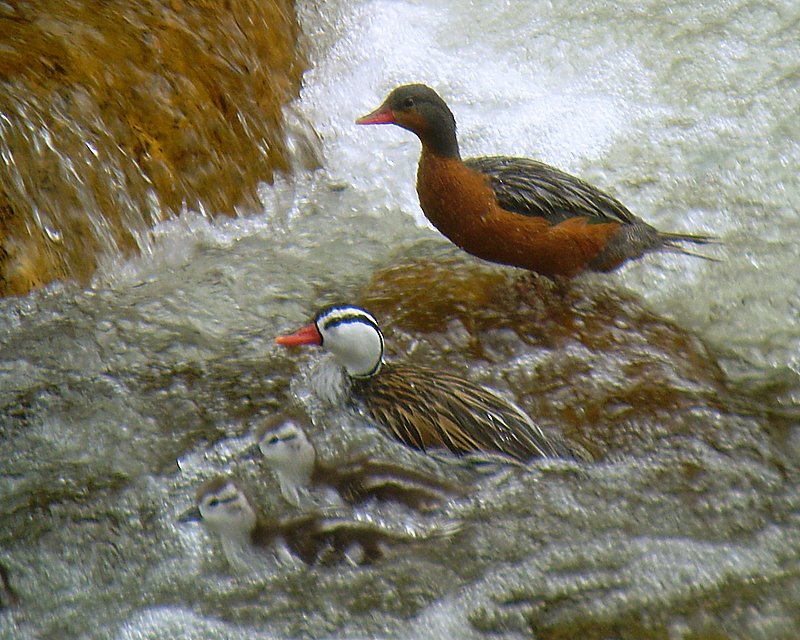
Torrent Duck. Photo: Alex DuranA highly dimorphic beautiful duck specialized living its life in streaming water and fascinating to watch. One of the best place to see them is at Aguas Calientes below Machu Picchu. In fact, they can often be seen looking out the window from the train to Machu Picchu.

Waved Albatross
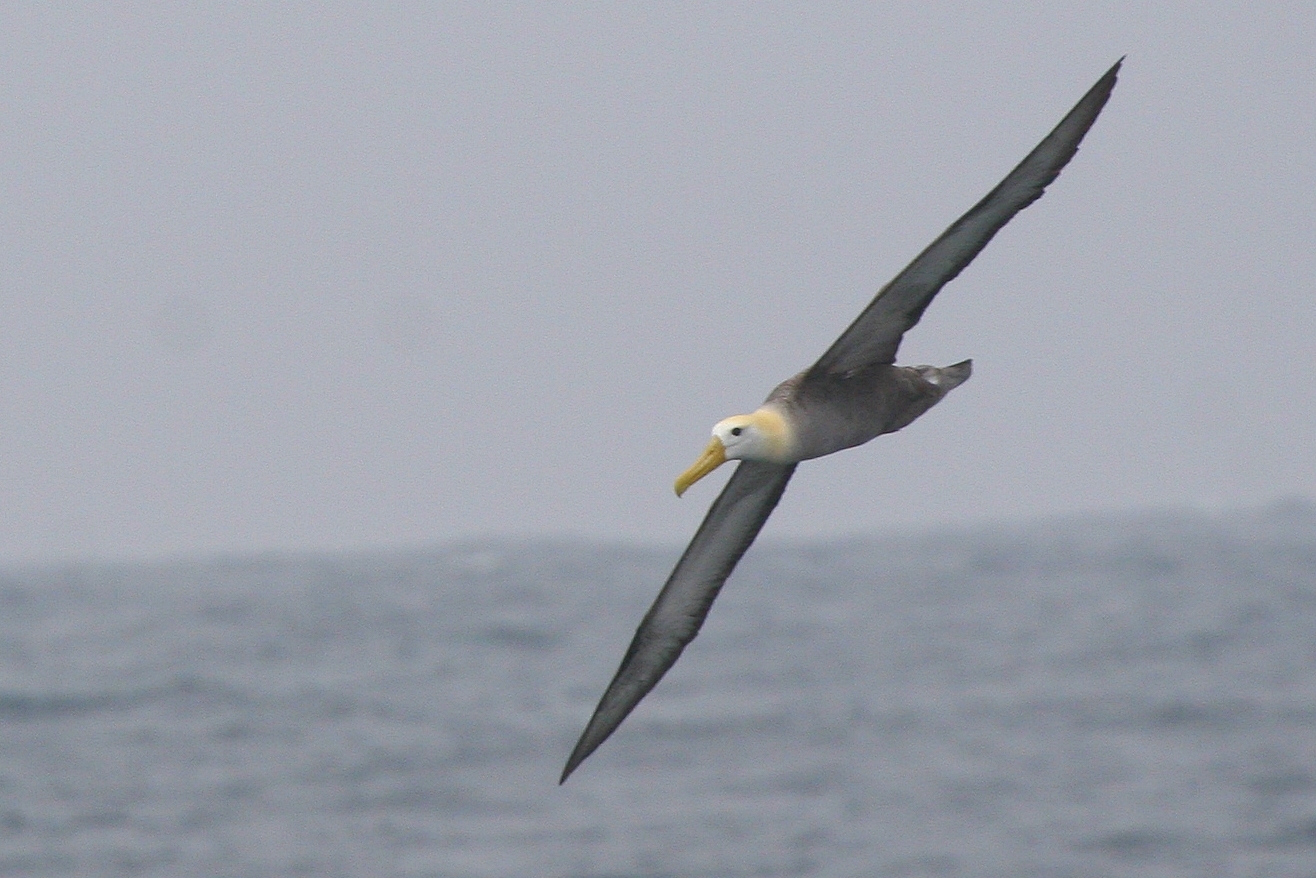
Waved AlbatrossIn spite of being a bird breeding on the Galapagos, practically all individuals of the species will spend considerable time in Peruvian Waters in its lifetime when not breeding. The pelagic birdwatching and whale-watching trips from Lima has made it possible for larger numbers of people to see an albatross at relative ease. Waved Albatross is critically threatened due to high adult mortality in recent years. In spite of being one of the smaller albatrosses, with 2.30m wingspan it is still impressive and a highlight for anyone venturing to sea to see it.

This article was brought to you by Kolibri Expeditions.  Kolibri Expeditions runs tours everywhere in Peru and can take you to all these birds, providing a full-fledged birding holiday or a holiday to culture and nature on a more general level.

Photos by license of creative commons: Ogwen (Condor), Species snob (Chilean Flamingo), OlliethebastardHoatzin), and Inca Tern close up by Suneko (

Special thanks to Tim Ryan of The faraway, nearby blog, for letting me use his Macaw pictures from Tambopata. All other pictures by Gunnar Engblom and Alex Duran (Rufous-crested Coquette and Torrent Duck). GE´s and AD´s pictures may be used under creative commons license. Link and acknowledge this page. Thanks

My Head Exploded

Hey Gang! I'm back in the country and sorting through photos and thoughts about visiting Frankfurt and Kazakhstan.  What a trip! One quick apology about the lack of contest entry yesterday.  Non Birding Bill graciously ran the contest while I was away and thought that I was only running the contest for eight entries, not 10 (because I wasn't gone for 10 days).  I wanted 10 on the off chance my jet lag was so crippling when I got home that blogging would have been a bad idea.  I've seen Mr. Neil in such states and now having experienced it myself, I'm sorry for all the times I've made fun of him when he was like that.

So, we will have the ninth and tenth entries up today and the voting begins tomorrow.  And a big thanks to my non birding husband for running the blog with all the great guest entries while I was trekking on the other side of the planet.  And a big thank you to everyone who entered!

So, some initial thoughts on Kazakhstan:

kaz-mountains-22

When I was a kid in Indiana and imagined what my life would be like as an adult, I dreamed that I would travel to remote places that not everyone would go to.  I wasn't quite sure what the country would look like, but I knew in my kid brain that it would be rugged, remote, and beyond anything I could imagine. Kazakhstan was like that or me.  Some of the landscape reminded me of Utah and some of it reminded me of Oklahoma and North Dakota. But it was a remote area, full of wind, great birds, and breathtaking landscapes.

kaz-desert-092

Everywhere you looked, you would see a vast space chock full of potential adventure and discovery. New birds were everywhere, but there were a few familiar species that can be seen in the US.

kaz-flowers-10

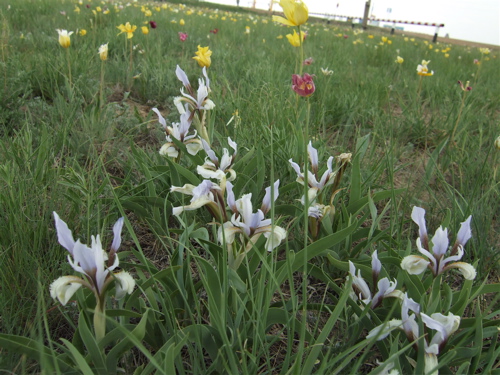
One of the biggest surprises was finding the Steppes covered in miniature blooming tulips and irises--they grew wild on the short-grass prairie!  Beauty was everywhere.

common-kestrel1

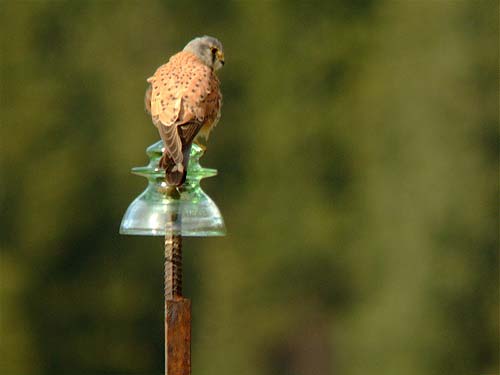
My adventure actaully started in Frankfurt.  I arrived a day early and was able to do a bit of birding outside the hotel. When I landed at the Frankfurt airport, I wondered what my first bird would be.  Would it be a house sparrow, starling or pigeon like I usually see in the US, only in Germany they would be natives and not introduced species like they are in the US?  But it wasn't!  Right there, hovering next to the runway, a saw a common kestrel--what an awesome first bird for me or Europe!

There are many more stories and photos coming, stay tuned!

Birdorable Guest Blogging Contest #9: Laura Erickson

125-wren

As we close in on the last two entries (one more today) of the Birdorable Guest Blogging Contest, we're happy to present a rather unusual entry from Laura Erickson, written from the perspective of one of our fine feathered friends.

The Original Norwegian Bachelor Farmer

Well, den, I don't know if my ancestors come from Norway, but yah, my mother always said we chickadees are the original Norwegian bachelor farmers. We're very sociable, ya sure, you betcha, but it makes us uncomfortable getting too close to one another. She said we're just naturally reserved.

Well, that leads to pretty peaceable flock relations since no one oversteps their bounds, but like my mother told me, every now and then we have to get VERY close to at least one other chickadee to do what birds and bees and educated fleas do, or there won't be any baby chickadees anymore. Think of the children!

So we have to overcome our inhibitions every spring. But to do that takes a lot of buildup, literally. Our gym teacher told us that every autumn our gonads were going to atrophy. That sounded pretty impressive to me, but my dad said no, we weren't going to get trophies--that's just the technical way of saying that our sex organs would shrink every year. I thought that seemed pretty yucky, but Dad said they're just excess baggage that make us heavier and waste body energy to maintain, which we can't afford in the dead of winter.

But even though they're all shrunken right now, they do need to swell up and be full sized by April or May. To get revved up, we males start singing every January. We try to make it sound as romantic as possible, singing, "Hey, sweetie!" Every time we sing, we feel just a little bit-- well, empowered. And every time our sweetie hears it (and if we sing a whole lot, even some other guys' sweeties!) her heart gets a-thumpin.'

It starts out slow, but by Valentine's Day we're singing quite a bit. With the days getting longer, and sometimes warmer, we have plenty of time for finding food with time left over for romance. By March we'll be singing twice as much as we're doing now, and by April we'll be singing twice as much as we were in March, and by May--well, we'll be so revved up that we won't even need Powdermilk Biscuits to be able to get up and do what needs to be done.

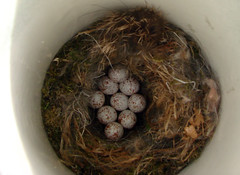
My mate will lay lots of eggs--last year she produced nine! We want to be sure there are plenty of little chickadees to maintain our traditions, but more important, producing such a large clutch all at once ensures that we won't have to go through all that rigmarole again for another year. Black-capped Chickadee nest