
Birdchick Blog
File This Under Cats & Dogs Living Together
We're talking mass hysteria here. A photographer by the name of Steve Creek got some interesting photos of a female red-winged blackbird and a scissor-tailed flycatcher. The female red-winged blackbird is incubating the brood, tolerating the flycatcher, feeding the chicks...but then the flycatcher goes to feed the chicks!
Now, I'm a lover and not a hater, but I have my doubts if this pairing can work long term or if it's a true pairing. What could be going on?
1. Did these bird truly engage in a love so taboo I dare not speak it's name? Doubtful.
2. Is there really a male red-winged blackbird nearby but is so busy wooing the ladies in the neighboring territory he doesn't pay attention to how broken his pair bond seems to be? Doubtful, you would think that if he saw that flycatcher near the nest he would dive bomb the crap out of it.
3. Has this female mated with a male red-wing and then he got nailed by a Cooper's hawk and she's left to raise the brood on her own and the flycatcher has also lost a mate but the urge to feed young is so strong that its happy to feed red-winged blackbird brood (this is speculation why some birds respond strongly to pishing certain times of year). Who knows?
Regardless, it's a cool observation.
Holy Crap! There's A Puffin Cam
Okay, if you followed the link to last night's photos and are trying to the horrific frog images out of your head, I have the antidote! Are you ready for this? It's Puffin Cam!
'nuff said.
The Upcoming Minnesota Bioblitz
This year's Minnesota Bioblitz is at my National Park (The Mississippi National River and Recreation Area) in the Crosby Farm Park area. The Bioblitz is a 24-hour survey where the public can help scientists find different plants and animals. The event is coordinated by the University of Minnesota Bell Museum of Natural History, is free (except for the river boat ride) and open to the public. Here is the current schedule of events--All events are free of change and open to the public until otherwise noted:
Friday, June 12 5 p.m. BioBlitz Kick Off 8:30 p.m. Night Creatures Ramble 9:30 p.m. Insect Survey*
Saturday, June 13 6 to 8 a.m. Bird Hike (I will be leading this) 8:30 to10 a.m. Bird Cruise/Bird Survey on the Jonathan Padelford. Tickets are $15; regist ration is required. 8 to 11 a.m. Bird Banding (led by Mark Newstrom & I'll help) 8 to 9 a.m. Mammal/”Herp” Survey* 9 to 10 a.m. Floodplain Forest Foray 10:30 a.m. Fun with Fish—Electro-fishing Demonstration* 10 to 11 a.m. Disappearing Waterfall Walk 10:30 a.m. Fun with Fish—Electro-fishing Demonstration* 11 a.m. to noon Mussel Madness
* These programs include special activities for children involved in the National Park Service’s Junior Ranger program.
Every year BioBlitz attracts hundreds of families and scientists from around the state who use sonar detectors, bug lights, live traps and laptops to count and chronicle an area’s floral and fauna. Volunteers of all ages work alongside biologists to collect plants and insects and live-trap animals, which are identified before being released back into the wild. Collection stations and inventory “leader boards” will be set up inside the Padelford which will be docked at Crosby Farm Park, the BioBliz base-camp.
This year’s BioBlitz will feature a Saturday morning birding cruise aboard the Padelford as it makes its way to dock at base-camp. The cruise leaves St. Paul’s Harriet Island at 8:30 a.m. and arrives at Crosby Farm Park two hours later. Tickets are $15 and shuttle service is included, click here to make reservations.
I noticed Padelford offers a Sunset Dinner Cruise and a Margaritas on the Mississippi Cruise...maybe we should do that for a Birds and Beers this summer?
The Bioblitz should be a great time, Mark and I scouted the park for net locations and I think we saw at least six male indigo bunting on different territories and heard broad-winged hawks calling. This is also the park where I suspect a pileated woodpecker is nesting.
Stunning Gannet Video
One of my favorite things to watch is gannets diving after fish, they can change their whole body into these little daggers, it's incredible. There was a show on the BBC called Nature's Great Events and one of the things they covered was The Great Tide, a feeding frenzy of predators going after sardines off the coast of Africa. You can find some footage of it on YouTube. Here's an excerpt of schools of sardines being pursued by gannets, dolphins, sharks, and even a whale. The gannets move as well under water as they do in the air: [youtube]http://www.youtube.com/watch?v=dBd4sNHBnYc[/youtube]
Adventures In Female Urination
This post maybe TMI for some people. Take note of the title and if that is not your favorite subject or something you don't like imagine other people doing, I would recommend you stop reading and maybe check out this cool post by my buddy Amber about some gannet rescue she did while on vacation in Florida. When I travel, I'm periodically asked by friends to take along a stuffed animal or a Flat Stanley for photos. I almost always decline. Number one--suitcase space is an issue and number two--I always lose something when I travel, whether it be accidental or confiscated by airport staff. Stuff just goes missing. If I lost a friend's treasured critter that's been photographed all over the planet, I'd feel terrible.

So, I got a request from an online rabbit name Audrey from All About You asking if I could take a stunt Audrey with me overseas. She has a blog and it would be a reciprocal blogging thing. I thought, "Okay, they have stunt rabbits, this isn't a treasured animal, I can do this."
So, Audrey came with me and we had a lovely time in Frankfurt. Above she is hanging out with a rather large snail outside our Frankfurt hotel.

We shared a beer in a Frankfurt bar (although, I had to chuckle at her choice of fruity beer--grapefruit beer? Really?).

And then this is the last known photo of Audrey. After getting her photo next to a Frankfurt sign warning that you are being watched, she nestled into my checked luggage for our flight to Kazakhstan...and hasn't been seen since.
ARRRGH! I feel terrible!
And she wasn't the only thing missing from my checked luggage. I had also recently won a female urinary device known as GoGirl at an outdoor convention. I was anxious to try this out. But like Audrey, it was missing from my checked luggage. I don't know why, don't want to know why.

And there were several times I missed my GoGirl. For example, above is one of our restroom stops. Our birding guide in Kazakhstan was more of an ornithologist than tour leader, so his bathroom breaks were stops like this with girls on one side boys on the other. I can go outdoors, but with short legs, there are some challenges, and I have a shy bladder. This was not ideal for me...I like a bush, a shrub for the illusion of privacy. Also, I like something to lean on or prop up against.

If we did have restrooms, they were like this. Let's take a closer look.

I really missed my GoGirl here.

I was excited at this birding spot--if you look in the distance towards the center left, there's an old wall--a perfect spot for female privacy. I went around the wall, away from the birding group, I got in a good leaning position and started to go. All was running smoothly until a slight movement in my peripheral vision caught my attention. I looked and focused on the critter that was the same color as the wall and about to crawl on my exposed area...and that was the moment I got my lifer scorpion. Didn't know they had those in Kazakhstan.
I lept up, there was spray, and a little tumbling. After a moment's recovery, I got my camera out for a photo.

Apparently, my chosen leaning location was a little nook that the scorpion liked to crawl into. All I got was a photo of its tail. It was only about four inches long, but still freaked out this Midwestern girl. I also have a new appreciation for the quick dry material on REI's convertible pants.

On our final day in Kazakhstan we hit a storm and it got very rainy. I asked our guide if we could stop some place for a toilet. He looked around and said, "This place is good," and pointed to the surrounding shrubbery.
I said, "I really need someplace dry and maybe we could go to a gas station, I'll buy the vehicle some gas. A cafe? I'll buy some food, any place but I just want it dry."
He looked skeptical but said he would find me some place dry. Our vehicle stopped and I didn't see any buildings, the terrain was as remote as the above photo. He pointed to a blue railing along the road and said, "See that blue pipe? That is bridge, you go under road, it be dry there."
And it was dry and I appreciated it.
So, Audrey and GoGirl, where ever you two are, I hope you are being put to good use.
Taking Interpretation To The Streets
I work part time as a ranger for the National Park Service at the Mississippi River Visitor Center. The visitor center is located in the lobby of the Science Museum in downtown St. Paul, but it's right on the Mississippi River. Yesterday, I was working the closing shift and things were rather quiet. I was working on some promotion for the upcoming Minnesota Bioblitz (which is going to be loads of fun, if you are in the Twin Cities, you should try to come for part of it--bird banding, river boat rides, electro fishing, reptile finding--something for everyone!). I noticed that it was getting cloudy, I turned to face the window to see what the weather was doing and as soon as I did, a peregrine flew low right along Kellogg over the library. I watched it corner and waited or it to pop up over the building. It never popped. I knew it must have landed and would be perched fairly low. Since I had been out birding before I came into work, I just happened to have my scope and camera with me and made the decision to interpret the falcon on the streets.

That dark spot in the middle of the red circle is the peregrine. It was very visible to the naked eye.
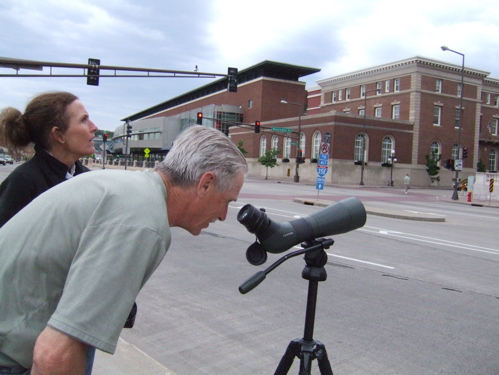
A woman with a badge and big scope is quite the attention getter and many people came over to see what I was watching, which I happily shared with them through the scope. A cab driver even made one heck of a U-turn to pull over to see what the bird was. With the Mississippi River right behind us, it was easy to talk about why the bird was here.
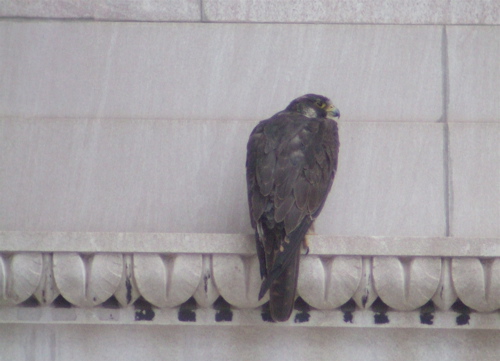
Looking through they scope, you could see the bird was in immature plumage. I think she was hatched last year and probably was perched low (for a peregrine) because the resident pair would be nesting and don't take kindly to other peregrines sharing their hunting territory. She preened and relaxed or awhile and ended up staying after dark. She was still there when I closed for the night.
When people weren't on the sidewalks, I would go back into the Science Museum and wait for families who looked like they were leaving and say, "Psst, hey kids, want to see a wild peregrine falcon?" No one said no. My favorite group of kids wouldn't leave. Their mom kept saying, "C'mon kids, it's time to go eat." However, the kids would take turns and say, "Hey, mom, just one more look, one more look."
Unlike the programs at The Raptor Center where most kids already know so much about birds they could practically give the program for you, the people just randomly walking by knew very little about peregrines or birds in general and it was fun to just say, "Hey, check it out, that's the fastest bird on the planet right there." And they seemed genuinely surprised. I even helped a few people take photos with their iPhones.
I took a quick video of the bird...it's also kind of a fun way to demonstrate digiscoping. And, I know I call the bird a "guy" in the video, but based on size, this has to be a female:
[youtube]http://www.youtube.com/watch?v=BX8pxHU_rJU&feature=channel_page[/youtube]
American Bird Conservancy Calls Cat Trap Neuter Release A Fail
The American Bird Conservancy has released a 9 minute video on YouTube coming out against Trap, Neuter and Release programs for feral cat colonies. Watch out at a minute and forty seconds, there's some really cool footage of three different warbler species bathing. [youtube]http://www.youtube.com/watch?v=-fvN7FNUPas[/youtube]
I have to say that I am having trouble getting on board with this message. I do agree that feral cat colonies are not good for birds, wildlife, cats, and humans. I don't think cats should be free roaming, they have a shorter lifespan, they spread disease, and birds that are facing challenges at every turn from windows, cell phone towers, pollution, the added pressure of a non native predator doesn't help.
I know some pro feral colony groups say that cats aren't the reason for bird species decline, it's habitat loss. Cats are habitat loss. If you have an introduced predator--especially one that is chasing birds for play and not a source of food, that is a loss of habitat. These birds did not evolve with this predator so there is no balance for evading them. Cats are not the sole source of bird species decline, but they certainly do contribute to it in a significant way.
But here's the issue I have. The video profiles a Key Largo feral cat colony that peaked with over 2000 feral cats. The home owners association put together a trap, neuter and release program and they now have less than 500 cats--and that's even with idiots still dumping cats into the colony...yet ABC calls this ineffective.
What? I'm sorry, how is reducing a colony by over 1500 not effective?
Okay, they haven't eliminated the cats entirely, but the cat issue is not going to be solved overnight. I think this makes the ABC look a little fanatical and a little off base.
Heroic Mistle Thrush & Humiliated Goshawk
The Telegraph has a great photo and story of a pair of mistle thrushes. They built their nest on a drain pipe, right where the water goes down. When it rained, the position of the nest, prevented the water going down, and the gutter would flood. So, one parent took over feeding duties, while the other blocked the water, preventing it from reaching the nest! Check out the photo and story here.
The Telegraph also has another story about a live goshawk nest cam (how did I miss my favorite raptor having a nest cam) and the fearsome female ended up having a rather embarrassing moment caught on the web cam. A strong wind came in and the terror of the forest went ass over teakettle out of the nest. Don't worry, being an accipiter--she can corner really well and made it back to the nest safe...albeit a little less frightening. The live cam is still going (with sound) if you would like to continue watching the nesting goshawks.
Kids Feeding Eagles
Found this on YouTube. Some parents take their kids out to feed bread to geese, this guy takes his kids out to feed fish to bald eagles. It must have been taken in Alaska: [youtube]http://www.youtube.com/watch?v=UZJKmPa42PM&feature=related[/youtube]
Birding Korgalzhyn State Nature Reserve
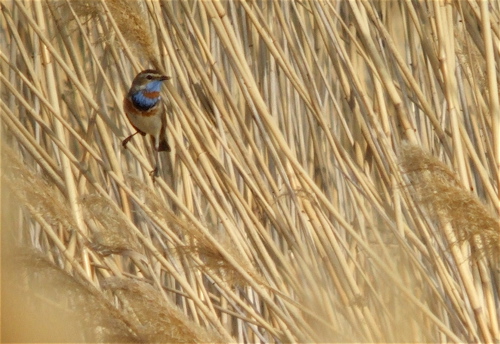
Below is one of my favorite shots from Kazakhstan. It makes me wish I could paint. I would love to spend an entire day lost in creating this shot of a brown bird, with a stunning sky blue and rust patch on his throat, surrounded by golden reeds:
It's a bluethroat, these are actually possible to see in Alaska during the breeding season, then they head to Asia for the winter. However, it is a common bird in Europe and Asia. I love it, in my neck of the woods I have a common yellowthroat in the reeds, over there, it's a bluethroat. Although, it's not a warbler, it's actually in the family turdidae...same as American robin.
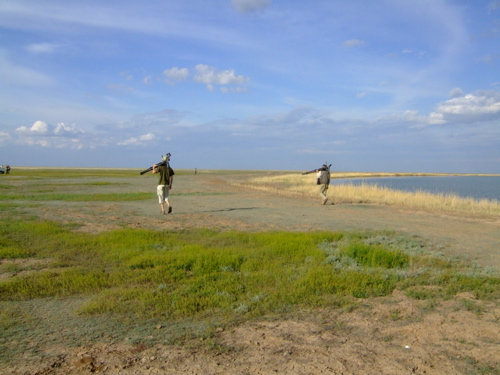
We birded our way through Korgalzhyn State Nature Reserve on our way to our evening accommodations. I hope you're not tired of the long range shots of Kazakhstan. Our information about the country said that there are fewer than six people per square mile...when you are out of the major cities, you could feel it. What a treat to be out in the middle of nowhere and at times not hear the sound of human or machinery.
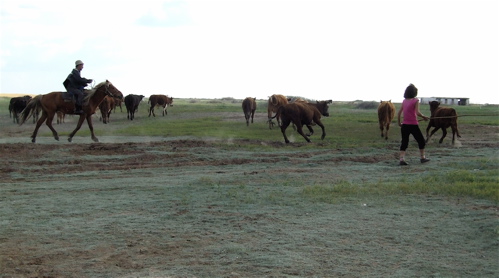
When we did encounter locals while we were birding, it was almost always Kazak cowboys--sometimes it was a joint effort of husband and wife and at other times, a lone cowboy on a horse with his trusty canine companion beside him.
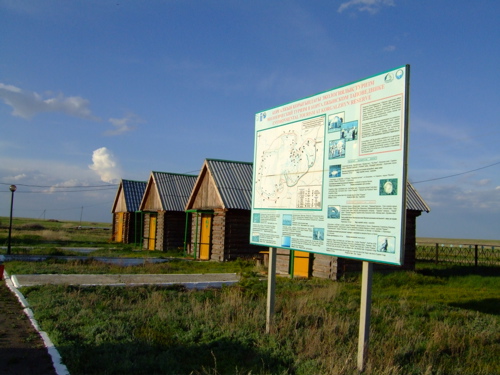
One of the items that was noticeable in my itinerary for Kazakhstan was the note that we would be going to Korgalzhyn State Nature Reserve and "small huts provide simple accommodation. We recommend a sleeping bag for this overnight stay." The photo included with the brochure showed the small huts surrounded by snow. I was fortunate that our visit was late enough in the spring that they snow had melted.
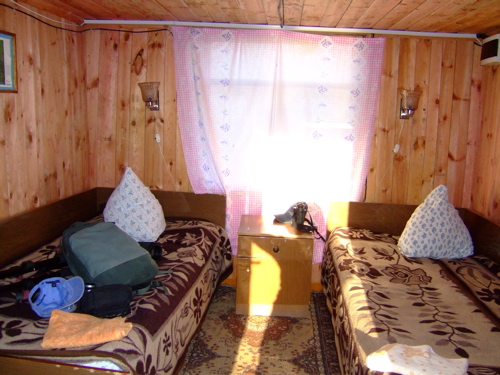
The huts were indeed simple accommodations that included two beds, a night stand, and a tv (it barely got one channel and was intended for searching out severe weather reports)--the shower was outdoors and the toilet was an outhouse (more on using the adventures of going outdoors later).
Before I left, I wondered how I could pack my sleeping bag--it's huge and easily takes up half a large suitcase. Fortunately, Mr. Neil (being a well experienced traveller) loaned me a tiny yet oh so warm silk sleeping bag. I was grateful for the toasty sleeping bag, the sleeping quarters were sparse and meant for researchers working the nature reserve and the extra warmth was much appreciated as the temps felt like they got down into the 40 degree Fahrenheit range.
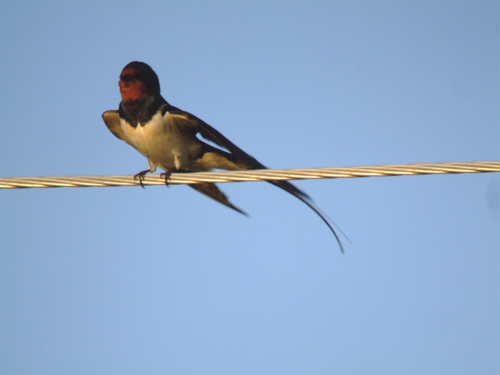
Check it out, one of the most common birds in the world--the barn swallow! I think even though this is the same species as the one I see in North American, it seemed to have a longer tail--must be a regional difference. We had already done a full day's birding on our way to the research station with the huts. The plan was to spend the night, try out some new Swarovski equipment in the morning and then head off to see the sociable lapwing. It was a delight around the research station for anyone remotely into photography--we arrived last in the afternoon and the light was perfect. We were cut loose from the formal part of the tour and given time to explore the area while our evening meal was prepared for us. An excited group of birders at a remote research station, surrounded by new birds in perfect light while food and beer was being gathered for us when the sun went down--how could it not be more perfect than that?
There were some bugs. None of my photos do the bugs justice. I even got a video of my buddy Clay walking up through the grass to kicking them up, but YouTube just does not have the quality to convey the quantity. Here's a link to a photo of a hatch of mayflies...this sort of conveys it. They didn't really bite, but every time we took a step in the grass, a swarm flew up and they just kind of floated and would hang near your hears, or accidentally get inhaled into your nose. Corey and I both remarked at how miserable our respective spouses would be having all these bugs all over the place.
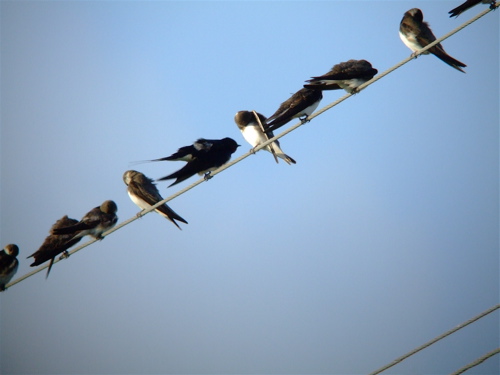
It also explained why there were so many swallows around the research station.
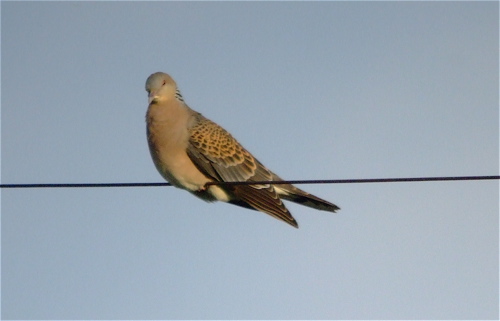
But the birding was just grand! I think the above is now one of my all time favorite does. It's called an Oriental turtle dove and the coloration reminded me of a kestrel--heck the birds have pointed wings, so when flying they look very much like a kestrel.

I was very excited to see one of these--this is a Eurasian tree sparrow. There's actually a small introduced population of these birds in St. Louis, MO. But it's more fun to see a bird in its natural habitat. Quite a few hung around the research station, very similar in habit to the house sparrow.
As I was walking along, I heard a very familiar sound...it took a moment to register...what was that sound...I know I should know it...then it hit me:
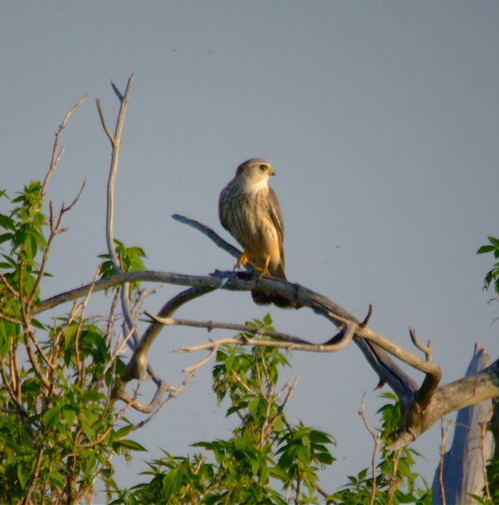
It was a merlin--just like the one's we see in Minnesota. Merlins can have different color variations, some are dark and some are light. In the US, usually the prairie merlins are lighter in color. Well, here we were in the short-grass prairie area of the Steppes and this was hands down one of the lightest merlins I had ever seen in my life. Merlins are a falcon like a kestrel or a peregrine. One of the things that all falcons of the world have in common is a malar stripe. That stripe that goes vertically down under each eye. Click on the photo links to some falcons: peregrine, kestrel, hobby, lanner--note that they all have that stripe? Merlins have a lighter malar stripe in general, but this bird was so pale, he looked like he had no stripe at all.

Speaking of familiar birds, we also saw several magpies. Here we call them black-billed magpies, there they are just magpies--both have the same latin name: Pica pica. Yes, I choose you.

Quite a few of the birds were out and about eating the insects we were kicking up. Above is a tree pipit that would fly off the wire and go for them.
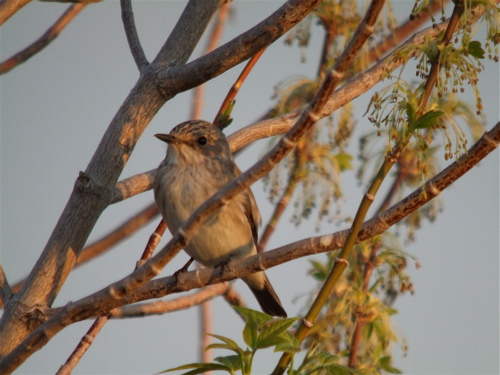
Here is a spotted flycatcher that was also going after the insects. This bird was actually perched near a bird banding station. Some nets were out, but they were closed and tied up--easy for the birds to see and difficult or them to become trapped. The flimsy insects did get caught in them and the flycatcher took full advantage of the situation, flying down get the bugs trapped in the nets. This bird was not the brightest bulb on the tree...the next morning, one of the researchers unfurled the nets and withing moments...
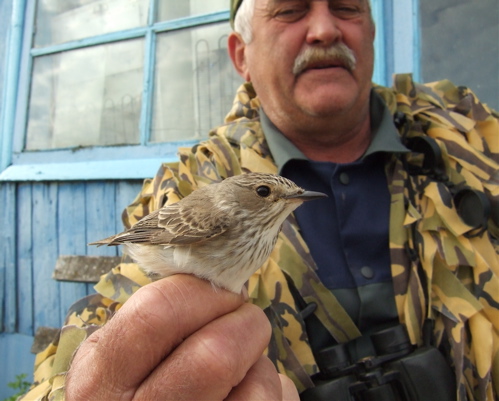
The spotted flycatcher was caught in the nets and banded (or ringed as they call it over there).

As the light became too dim to photograph, all of us made our way back to the station for nourishment. I avoided tap water on this trip (and for those curious, I did not get any shots before I left, my tetnus was updated, and I opted to not get any of the Hepatitus or Typhiod vaccines). I stuck with bottled water, Fanta, beer, vodka, wine, and aquavit.
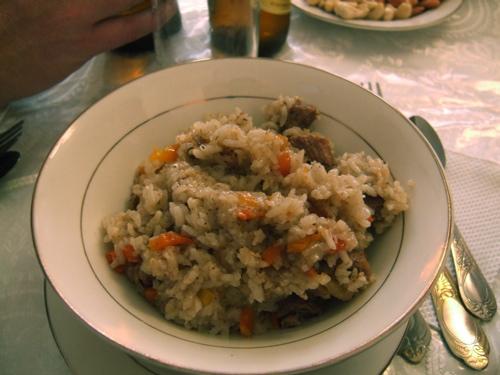
Meals were interesting, you would get something like the rice and meat dish seen above and you would think, "OK, we're near China, this is going to have an Asian flavor to it." It did not, it was quite bland and refused to make any kind of flavor statement. It was good filling food, but not a taste sensation. I would say that the one constant with all our meals was tomatoes and cucumbers. Those were served with breakfast, lunch, and dinner. Often in the form of a salad with a light dill vinagerette or as in the case of our packed lunches--just raw. Bread was also a constant--we either had very dry crusty bread or a fried dough ball...kind of like a donut without the sugar.
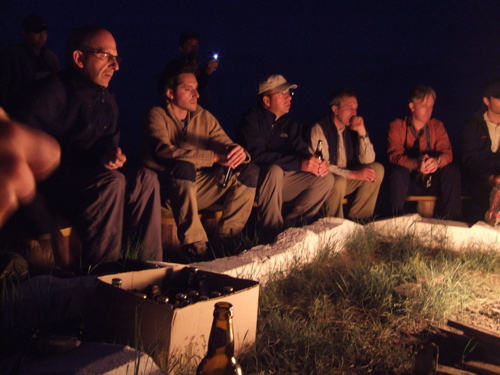
After dinner we sat around a bonfire with our box beer. The fire was no small feet--trees are few and far between on the Steppes, so it was made with wood from old crates or collapsing building near the station.
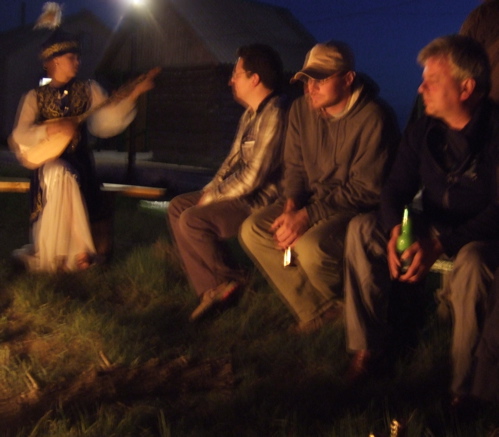



We were treated to the music styling of a young woman not only dressed in traditional costume, but also played a small guitar of Kazak folk tunes. It started with her and later her father played a few tunes on the instrument. The small guitar looking instrument only had two strings, but both players got incredible harmonies out of it. I caught a little on my camera--and do listen, it's incredible for how simple and instrument it looks:
A lovely way to end a day of amazing birding and it was exciting to know that more adventures awaited us.
Digiscoped Images
Fresh Tweets
Would you like to hire me as a speaker for your event?
Email sharon@birdchick.com