Ranger River Walks

a peregrine We have a new activity we're offering this summer at the Mississippi National River and Recreation Area called Ranger River Walks.  We meet at different parts of our park and show whoever is there around.  There's an asterisk next to the list of parks that denotes if it's a specific birding ranger walk, but if I'm leading any of them, they will automatically be a birding walk, I can't help it.  I did one yesterday at Lock and Dam 1 to see the peregrine nest box (above).  Unfortunately, the nest failed, but the adults are still hanging out.

a heron

The lock and dam is a fun place for some light birding anyway.  There are usually herons and waterfowl hanging out right under the platform and it's fun to look right down on them, it's your chance to see those great long heron toes.  The dam is a great spot for them to go fishing, you'll also see cormorants hanging out around the dame too.
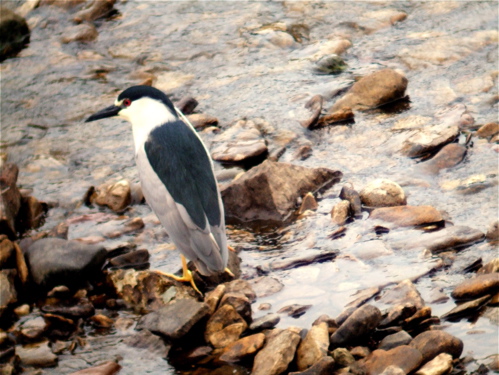
a night heron

This poor black-crowned night-heron was trying to fish but the great blue herons kept chasing him off.  It finally found a spot around some rocks to fish in peace, but just another fun bird that you can find in our very urban park.

I think the next ranger walk I lead is on June 24 at Minnehaha Falls if you would like to come along.  Maybe we'll find a merlin, they've been around there in the past.

a bunting

After the Ranger Walk, I headed over to Crosby Park to help get things ready for the bird banding that we'll do this Saturday at the BioBlitz.  There were indigo buntings all over the place, if you've never seen one or had a good look at one, you'll get it this weekend if you show up.  Above is the same bird that I got the video of yesterday.

While I was there at about noon, I head some barred owls hooting and a black-billed cuckoo.  I doubt we'll get those in the nets, but still there are some great birds to be found in that park.

And I leave you with a video of that peregrine falcon preening:

[youtube]http://www.youtube.com/watch?v=SXVj6TuEXR8[/youtube]
This Weekend's BioBlitz

If you heard about the MN Bioblitz mentioned on Ian and Margery on m107, here is the link to info about the BioBlitz.  You can also find info on our FaceBook Page too (the Facebook page includes some of the possible wildlife and a video about electro fishing). Hope you can come, I'll be leading a bird walk at 6am on Saturday and we'll band birds from 8am - 12pm.

Here's the current schedule of events:

BioBlitz 2009 Schedule of Events All events are free of change and open to the public until otherwise noted.

Friday 5 p.m.                     BioBlitz Kick Off 8:30 p.m.               Night Creatures Ramble 9:30 p.m.               Insect Survey*

Saturday 6 to 8 a.m.             Bird Hike 8:30 to10 a.m.      Bird Cruise/Bird Survey on the Jonathan Padelford. Tickets are  $15; registration is required. Click here for ticket info. 8 to 11 a.m.           Bird Banding 8 to 9 a.m.             Mammal/”Herp” Survey* 9 to 10 a.m.           Floodplain Forest Foray 10:30 a.m.             Fun with Fish—Electro-fishing Demonstration* 10 to 11 a.m.         Disappearing Waterfall Walk 11 a.m. to noon    Mussel Madness 11 a.m. to 2 p.m.  Aquatic Invertebrates Station Noon to 1 p.m.      Insect Sweeping 1 to 2 p.m.             Dragonfly Challenge

*  These programs include special activities for children involved in the  National Park Service’s Junior Ranger program.

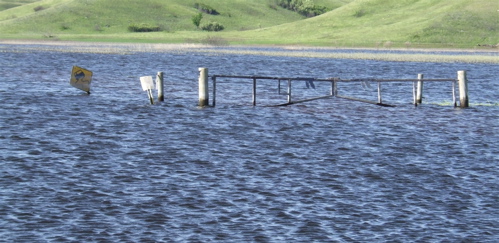
road-closed I spent the day birding around Arrowwood NWR while in North Dakota with my buddy Kate Fitzmeier.  And when I say "around," I literally mean around--it was completely flooded, note the the flooded road above.

slippery-when-wet

Some roads were more flooded than others.  Check out the Slippery When Wet sign above--I'll say! I was sad we couldn't take this road, last year it led to the refuge's bison heard.  I was also sad for the refuge itself, just about every building experienced severe flooding.

blog-potential-081

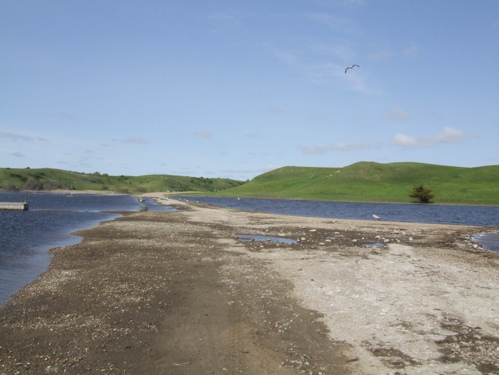
Though many roads were closed, some like this road did make for a nice path for birding.  Kate stayed with the vehicle, she was on a mission for some badger.  We found some holes in the hills that looked very badger-worthy.

pelicans1

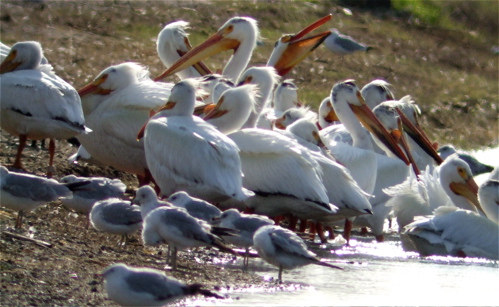
When we arrived, some pelicans and gulls were loafing on the road.  You might notice that some of the pelicans have little horns on the top of their beaks.  They get those during mating season and then after they mate, it comes off (So does that growth on the bill signify that they are horny?--insert bad joke grown here).  When I've been out to pelican rookeries for banding, we could sometimes find horns on ground that had been shed...they looked like old nasty toe nails.  As I walked down the road, the pelicans assessed my movement, "Is she really coming this way? Do we really need to move?'

pelican

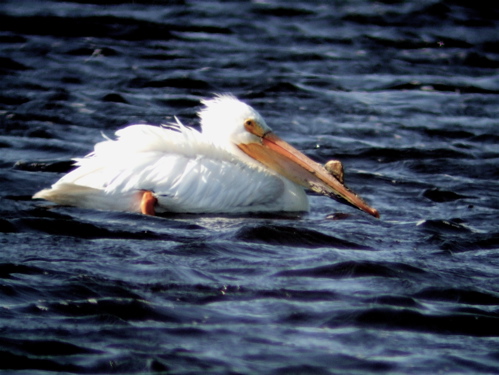
Once out on the water, I felt as though I was getting disdainful looks, I had disturbed their valuable loafing time.

western-grebes1

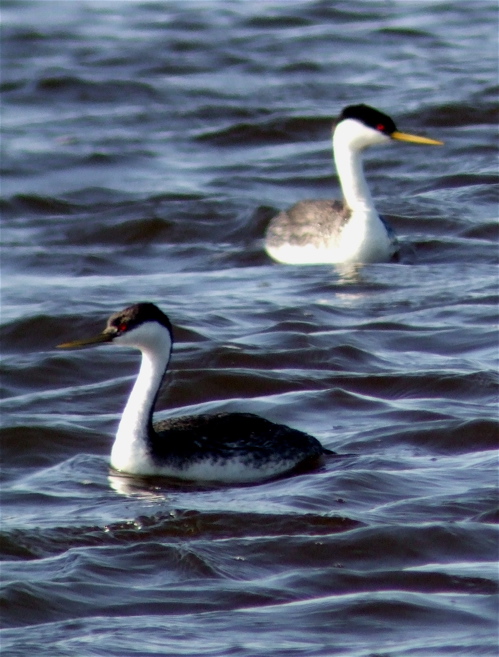
There were quite a few western grebes out on the water. Some were at the very beginnings of their courtship ritual.  We didn't see any actual dancing, but there was some head bobbing and pre-dancing stops going on.

peeps1

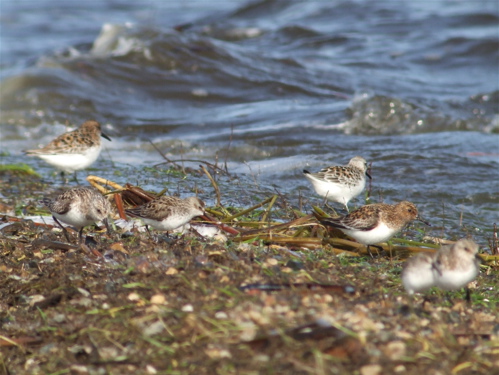
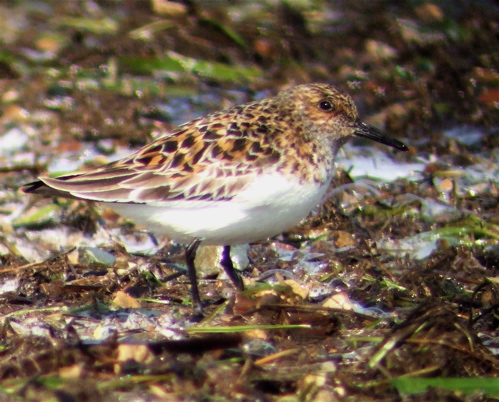
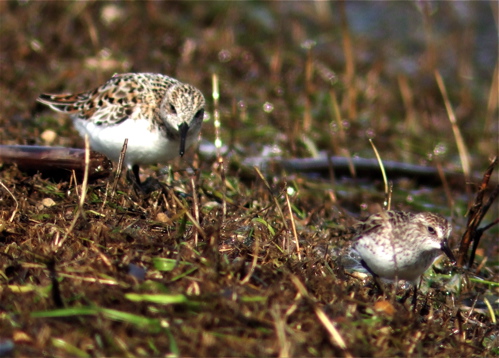
Quite a few shorebirds were running around.  We saw a ruddy turnstone (not pictured above) and then several of the above peeps who didn't seem to care about people one bit.  I was confused by one of them and had to enlist the help of South Dakota shorebird guru Doug Buri.  I've gone on one of his shorebird workshops which are great and I highly recommend him, one year I need to do his sparrow workshops.  He told me long ago when I lamented about shorebird id that my problem was that I looked at shorebirds from too far away, when you have them close, it's easier to identify them and it certainly is true that it's easier to get an id if they are close.

shorebirds

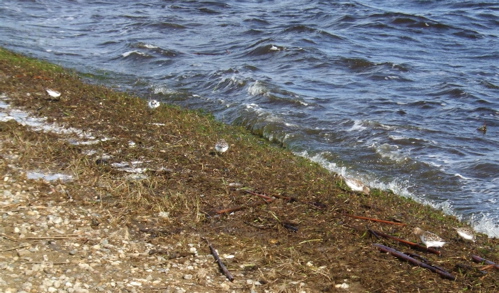
This day, my challenge was that the peeps kept running towards me as I was trying to take a photo.  I kept having to back up to be able to focus them in the scope because the kept running towards me.  I took the above photo without the scope, at one point the sanderings were barely six feet from me.  I left my shorebird guide at home and was not having much luck deciding on an id of the larger peeps with internet searches, so I emailed Doug some photos.

blog-potential-079

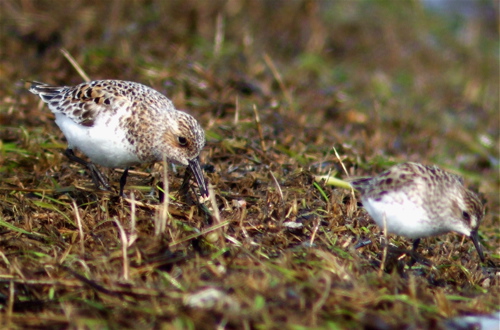
Fortunately, I was able to get some size comparison shots.  The smaller peep on the right was so tiny, I was convinced it was a least sandpiper, but then noticed that the bill and the feet were the same color...that can't be a least sandpiper.  Doug confirmed it when I sent him the photo that it was a semi-palmated sandpiper.  Now, what could the larger bird on the left be?

sanderling-11

The larger peep ended up being a sanderling and I needed Doug's help to figure that out.  He said the reason was that I was probably not used to seeing them in variable breeding plumage, but I think my confusion was habitat.  When I see sanderlings on the coast, they are fairly easy to id since they constantly run back and forth with the surf.  Not so much surf on the North Dakota prairie.  There is another way to tell them apart rom other shorebirds--they don't have a back toe, but trying to see that when they are darting around in grass, it a bit hard to see.

ABC's Wife Swap Show Wants Birders

They are probably looking for the khaki-vest-and-tilley-hat-wearing-poindexter type, but here you go if you want to do some reality tv: ABC’s WIFE SWAP IS CASTING BIRDING FAMILIES FOR PRIMETIME!

ABC’s prime time series “Wife Swap” is currently casting its fifth season and looking for unique families with plenty of personality to take part in the show. Specifically, we're looking for families who are passionate about birding! If yours is a unique, out-going family who loves studying, calling and/or watching birds together as a family, we want to hear from you! Families who participate in this documentary-style program are given a unique opportunity to share their beliefs and lifestyles with another family. It is truly a once in a lifetime experience that can be life-changing for everyone. Please feel free to pass this posting along to any families who are interested in learning more!

Each week on Wife Swap, the mothers from two families with different values and belief systems will exchange lives. It’s an amazing family experience and opportunity to learn how others lead their lives. Half of the week, mom lives the life of the family she is staying with. After making her observations, she introduces several "rule changes," where she implements rules and activities that are important to her family. It's a positive experience for people to not only learn but teach about other families and other ways of life. Wife Swap airs on Disney owned ABC television on Fridays at 8 pm- the family hour!

If you are a two-parent family with at least one child over the age of 5 living at home, and you think your family would make terrific TV, contact us to be a part of this groundbreaking show!

To apply or get information about the show Please contact:

Danielle Gervais (Casting Producer) Call: 646-747-7956 Email: Casting.DanielleGervais@gmail.com or Danielle.Gervais@castingrdf.com

A Piece Of Rail

Warning!  The photos in this post might be gross for some for some readers.  It's about a piece of bird (most likely a rail) that I found on a barb wire fence. One of the things that really surprised me about this year's Potholes and Prairie Bird Festival was the amount of flooding that occurred around Jamestown and is still causing trouble for the area.  All we heard in the news was about the Fargo flooding but there was still much more flooding going on in central North Dakota. It's all the more impressive to me that organizers were able to get the festival going this year despite the flooding making lodging difficult (not to mention what the flooding did to the organizers' personal residences) and the economy causing more people to tighten their belts in regards to travel.

But the flooding made for some great birding.  For example, American bitterns were seen all over by many festival participants.  Zeiss rep Steve Ingraham got some fun video of an attempted mating ritual between two bitterns (check out the males white shoulder patch action going on).

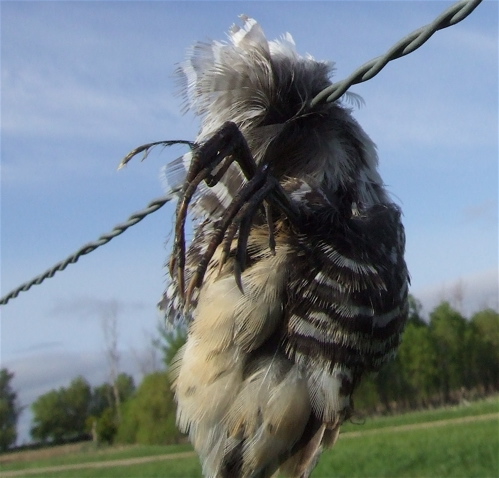
I went out with my buddy Katie for some birding and I noticed some fluff on a barb wire fence.  We pulled over and walked/hopped over the water filled ditch to get a closer look to see what it was.  It was a piece of bird.

rail-feet

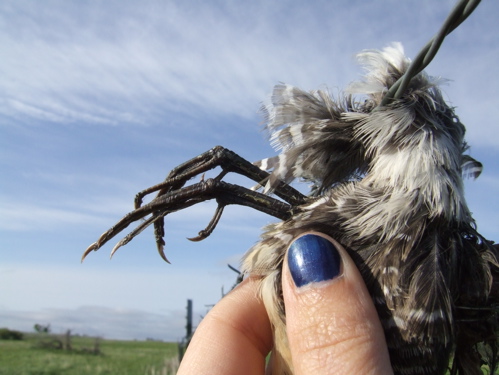
I tried to pull it off to get a bitter look, but it was really hooked into the barb.  The general shape and size read "rail" to me.  I wondered what happened.  There was a marsh across the road, had the rail flown across and hit the top line and got stuck and died?  Then perhaps some predator or scavenger came by and ate part of the bird?  Barb wires can kill low flying birds as I learned at the Leks, Treks and More festival when we did the marking for the lesser prairie chickens.

rail-tail

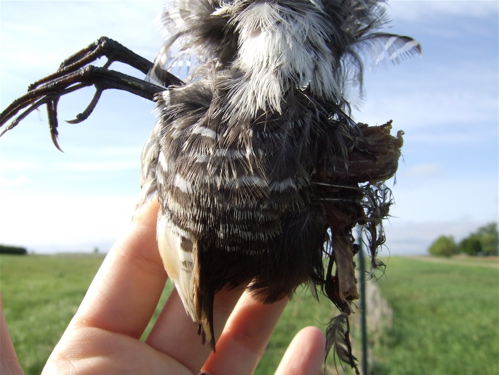
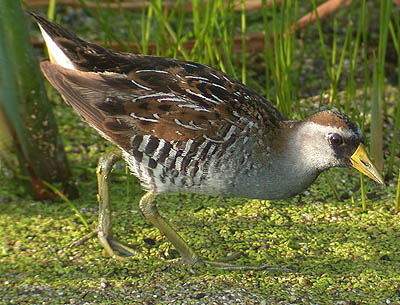
The feet, the tail tip, the brown striping, and the state the bird piece was found in have narrowed it down for me to either Virginia rail or sora.  However, I just can't decide on which.

piece-of-rail

At first, I thought I had it figured out with the feet, I know that sora's have green toes and what was left of this bird had black toes.  However, if you check Virginia rail toes, those are pink.  The decomposition could have caused the toes to turn black.

I tried to see if I could find any images of rail vents to see if that would help my id, but could not.  This one may have end with "back half of rail."

Let's Give Some Love to Turbo T Double: The Rapping Birder

And when I say "Rapping Birder" I don't mean some sad white dude in a vest and Tilly hat making a funny rap song about cloacas, I mean this is music I would actually put on my iPod. [youtube]http://www.youtube.com/watch?v=MGJFyDRojng&eurl=http%3A%2F%2Fwww.gowherehiphop.com%2F2009%2F05%2F21%2Fturbo-birds-eye-view%2F&feature=player_embedded[/youtube]

I love this guy: he's young, he loves birds and he's using his favorite forms of art--rap and drawing to express his passion for birding.  Check him out, we need to start booking him at bird festivals.

Odd Baird's Sparrow Song

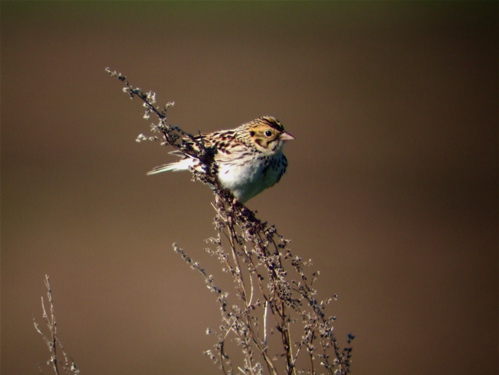
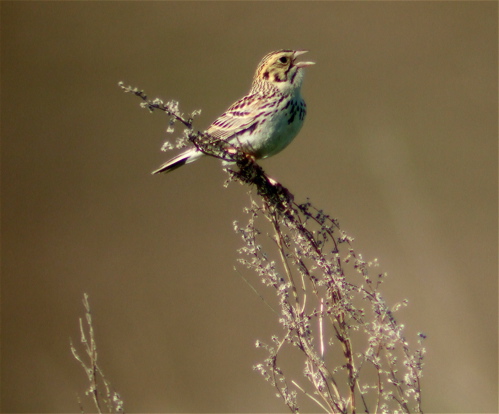
basp I just returned from the Potholes and Prairie Bird Festival in North Dakota where I go to see some of my favorite songbirds like the above Baird's sparrow.  There was one particular Baird's who did not get the memo on his life history. First, this bird had staked out territory on this tiny patch of grass next to a cultivated field, not desirably Baird's habitat.  What's interesting is that where you find Baird's sparrow, you usually find Sprague's pipits and there were no Sprague's hanging out with this guy.

bairds-sparrow1

Second his song was just weird. Baird's sparrow should sound like this.  I felt kind of bad, he had little chance of attracting the mate with inferior territory and an odd song.  Last year, I got a great video of Biard's sparrow and you can hear what their song should sound like:

[youtube]http://www.youtube.com/watch?v=AFLHwAZ601U&eurl=http%3A%2F%2Fwww.birdchick.com%2Fwp%2F2008%2F06%2Fbrown-birds-at-potholes-prairie-bird-festival%2F&feature=player_embedded[/youtube]

Below is a video of the odd Baird's sparro that we heard over the weekend (sorry about the sound, as you can see by the way the bird is whipped around, it was a tad windy on the prairie):

[youtube]http://www.youtube.com/watch?v=mVAF3kwzhUI[/youtube]

You can still hear the basic beautiful tone of the Baird's but the cadence is off.  I'm not sure if he was hatched last year and hasn't honed his song or if he is just an odd little misfit trying to break new ground on strange territory.

File This Under Cats & Dogs Living Together

We're talking mass hysteria here. A photographer by the name of Steve Creek got some interesting photos of a female red-winged blackbird and a scissor-tailed flycatcher.  The female red-winged blackbird is incubating the brood, tolerating the flycatcher, feeding the chicks...but then the flycatcher goes to feed the chicks!

Now, I'm a lover and not a hater, but I have my doubts if this pairing can work long term or if it's a true pairing.  What could be going on?

1.  Did these bird truly engage in a love so taboo I dare not speak it's name?  Doubtful.

2. Is there really a male red-winged blackbird nearby but is so busy wooing the ladies in the neighboring territory he doesn't pay attention to how broken his pair bond seems to be? Doubtful, you would think that if he saw that flycatcher near the nest he would dive bomb the crap out of it.

3.  Has this female mated with a male red-wing and then he got nailed by a Cooper's hawk and she's left to raise the brood on her own and the flycatcher has also lost a mate but the urge to feed young is so strong that its happy to feed red-winged blackbird brood (this is speculation why some birds respond strongly to pishing certain times of year).  Who knows?

Regardless, it's a cool observation.