
Want to practice some of your digiscoping skills this Saturday? Come out to Carpenter Nature Center in Hastings, MN from 9am to 11am for a digiscoping workshop. I'll start showing some of my images and video, show some techniques and then we'll practice. We'll perch out the education raptors so you have a chance to practice technique on birds that won't move around too much, maybe you will get some great shots with your camera and scopes. If there is time, we'll get some shots of birds at the feeders and trails. This will be a great time to practice and maybe get some shots for the Swarovski Digiscoper of the Year Contest. Call 651-437-4359 to reserve your spot.
Goldfinhes On The Grill
I'm going to link to a graphic photo. If you love goldfinches and if you have a tough time with dead animals or are just a softy, please believe when I say to not follow the link. I have a few deadlines and I was tucked away at a coffee shop on Friday when I received this image as a text on my phone from an unrecognizable phone number asking if it was for real. At first, I was a tad taken aback. Why would someone send me dead birds to my phone...and in such a gross manner (and on my birthday too). Then I realized that it very well may have been a legit question.
One thing that has always amazed me is that when someone finds out that I'm a birder or have a rabbit as a pet, that is their cue to tell me the most horrific experience they have had with a bird or rabbit. I'm not sure what it is with rabbits--is it some kind of odd confession and they need you to clear their conscience? I really don't care that you went on vacation for a week, forgot to get a pet sitter and found your rabbit dead, or that you wanted to see what would happen if your rabbit met the neighbor's dog and then give a blow by blow description of the carnage, or of the awful tumors and growths they had--really, I don't want to hear it.
So, I wondered if this was someone I actually knew who found this grisly scene and had a question. So, I texted back, "Who is this?"
Turns out that the image came from a co-worker, Abby who was at Coon Rapids Dam and noticed the scene in the parking lot. At first, she thought it was some kind of odd grill ornament on the truck. It's not out of the realm of possibility, has anyone else seen those testicles that hang off the back of trucks? She asked if they were real. I told her that yes, that person had probably hit that pair of male and female goldfinches and probably had no idea the birds were wedged in their grill.
It is mating season for goldfinches and they are flying erratically. I'm sure this male was in hot pursuit of this female and both flew in front of the fast moving truck with a tragic end. When I was driving back from the beehives last week, I had several pairs of goldfinches pass in front of me on the country roads which I could have hit had I been going faster. All the more reason to keep our heads up and pay attention when on the road.
Interviewed By MPR At The Beehives
 Yesterday was an interesting day. A couple of people from Minnesota Public Radio accompanied Lorraine and I out to the hives. We've had Euan Kerr out before, but he was interviewing Mr. Neil. For some reason, it really didn't register to me what we would be doing when they asked to come out. I love to show off our bees and I love to take people who have never been to a beehive out to our hives, but it didn't register to me that Lorraine and I would be interviewed. In my brain, they were out to interview the bees not me and I did not prepare for it the way I would prepare for a bird segment. There were two people, Jessica Mador who took the audio and asked most of the questions (and was apparently a bit scared at the hives) and Tom Weber who came along to get video footage to go along with the story on the website.

Our hives were on their best bee-havior. All four of our new Italian hives have been so mellow this bee season, they were perfect to introduce to newbies. They pretty much just let Lorraine and I talk while they asked questions that most people ask the first time they visit our hives. As I understand it, the gist of the segment is about the recent change in the law that allows beekeeping in Minneapolis. One of the reasons that I started with bees at Mr. Neil's was because it's illegal to keep bees in Minneapolis when we started. Since our operation is going well out there and my building manager doesn't want anyone on the roof of the building, we will not bee keeping any hives on top of the roof of my home.

One theme of questioning that we seemed to get over and over again was something along the lines of, "How dangerous will this be for people if hives are in their neighborhood" and "what should you be worried about." As I said, Jessica did not seem comfortable around the hives--and that is totally understandable. She kept her distance from the hives and even had Tom put her mic in front of the hive entrance for her. Lorraine and I totally freaked the first time we worked with our bees, so I could understand her nervousness. Plus, I'm sure Euan had told her how he got stung right through the beesuit (the suit was a hair to small on him and the bee found the breach where his bicep was flexed...and we also made the mistake of taking him out to a very angry hive.
But I wondered if this was an article more along the lines of--are bees something really scary that people need to worry about in their neighborhood and I hope we conveyed the answer of, "Not really." Bees are kind of like the big scary guy at the bar. If you go about your business, stay polite, you'll be fine and if you play close attention, might learn a thing or two. However, if you go up, punch and kick him, he's going to get defensive and quite possibly hurt you.

The bees were so chill, Lorraine demonstrated how to hand feed the girls. I asked if Jess and Tom wanted to feed them. Jess politely declined but Tom was all over it. We also had another friend out named Beth (she was visiting from out of town and it was her first time at a hive too) and she was ready to hand feed the bees. I got a photo of it here. Tom is the one filming his hand and Beth is the one in back. Incidentally, Beth was a natural at the beehive. Lorraine and I would be busy showing frames and larvae that when we'd ask for some puffs from the smoker or an extra hand--she was right there ready to help.
We did get into this whole weird conversation about talking to our bees and I really hope I don't come off sounding like a hippie. I was talking about all the times I have found comfort in our bees. One of the awesome things about being a freelancer is that you can set your own schedule, the downside is that so can the people who pay you. There have been times when we've been financially strapped because of waiting for a check or wondering what the next project will be. Going out to the hives, watching the girls go about their work really comforts me. I think it's getting wrapped up in watching the live natural science right in front of me. We also talked about the different personalities of all the hives and sometimes I even talk to the bees. But for the record, I want everyone to know: I do not expect the bees to talk back to me. I'm more of a Clint Eastwood type singing, "I talk to my beeeeeeeeeeeeees, but they never listen to me."

I love this shot! Beth is tasting honey freshly scraped right off the frame, I think she likes it. She's enjoying the flavor and her fabulous hair color works with the bucolic palette of our bee yard. I think my favorite food period is honey freshly scraped off of an active hive in summer. The wax is soft and warm. Right now, our honey has a delicate sweet flavor with a hint of something peppery and surprise flavor of mint. Earlier this summer, it totally tasted like lilacs.
All in all, it was fun to take people out and both Jess and Tom said we made them feel at ease visiting their first hives. Which is good. The last thing I want to be is the snarky and judgemental beekeeper screaming at a nervous newbie, "Get your butt over here and stick you hand in the hive. Why are you crying? There's no crying at the beehive! Wuss!"
I know they're going to interview some other beekeepers too and I can't wait to hear how it's all going to come together...I just hope I don't sound like the hippie beekeeper and I hope more people will be excited to take up beekeeping. One thing is for sure, they will get a lot of different opinions. Talk to three different beekeepers and ask them the same question, you're likely to end up with seven different answers. This should be up sometime next week and I'll put up a notice.
Fledglings Crashing The Feeders
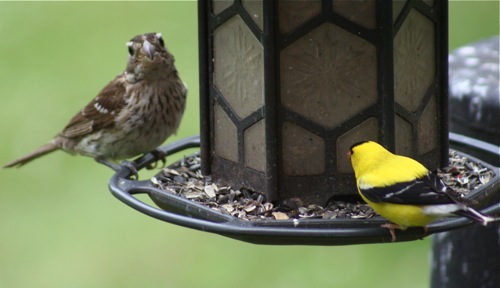 Like rambunctious kids at a restaurant, young birds are learning the ropes at Mr. Neil's feeders. Above is a female rose-breasted grosbeak who I thought was an adult female, but she engaged in some begging behavior with a male and sat for awhile on the pole above the feeder watching the other birds feed, working out how to do it. Most of the adult females know how to feed--they are all business when they come to the feeder. They perch on a branch, make sure the coast is clear of predators, land on the pole, take another look and then jump right down to the feeders. This one seemed unsure of how the food came out of the feeder or what to make of the smaller birds around her.
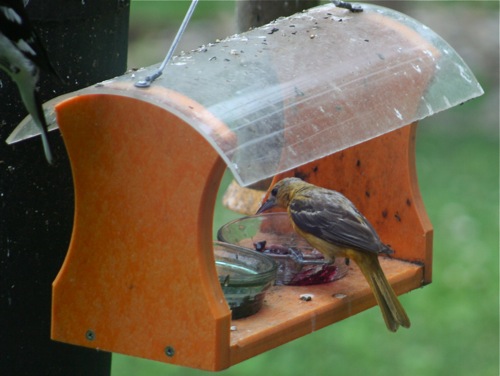
This young oriole ate some of the grape jelly, but also made a haphazard landing on the thistle feeder and took a few pecks at the feeding port. I'm sure it had been watching the goldfinches and thought, "Well, if those dudes are getting food out of there, I'm sure I can too."
And much the same way I felt about catfish, thought to itself, "Seriously? You think this is good? Bleh!"
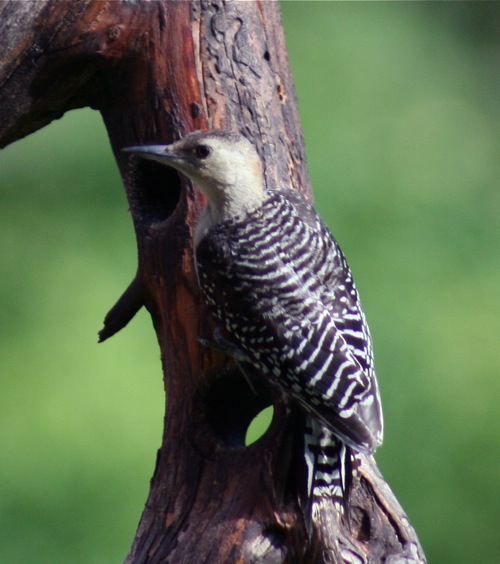
Here's a recently fledged red-bellied woodpecker. They're just so awkward and bald (bald in the sense that they have no read on their heads, not that they are missing feathers). The suet log was empty and he was watching another red-belly perched on a peanut feeder and wondering if it has the landing skills necessary to be able to land on the nut feeder too. This young bird was very nervous and seemed a poster child for hawk bait. It was continually begging in the trees, following the parent birds (who were over feeding it at this point) and then made all kinds of strange loud squawks as it flew. I'm sure it's saying, "I don't know what I'm doing, why is this happening to me? How to I move, I'm hungary, aaaaaaaaaaaaaaaaah!"
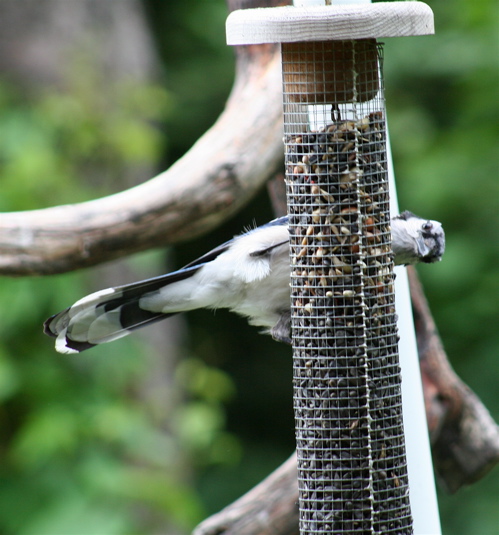
Of all the boisterous youngsters visiting the feeders, the blue jays were the most refined diner. I love this photo, I was shooting from the kitchen window and the young blue eyed me warily wonder what that sound was (and why my lens was aimed at it).
I have mixed feelings going through the woods right now. Some birds have finished their territory songs for the season, others are going for a second brood, some are just getting started, but six months from now, the sounds at the feeder and in the wood will be softer, occasional caws of crows, sweet contact notes of chickadees, a few laughs of nuthatches.
I wonder if the winter birds enjoy the quiet of winter without having young birds crashing around at the feeders...the rowdy college kids leave the woods leaving all who stay with a peaceful neighborhood until the next breeding season.
Goldfinch Variations
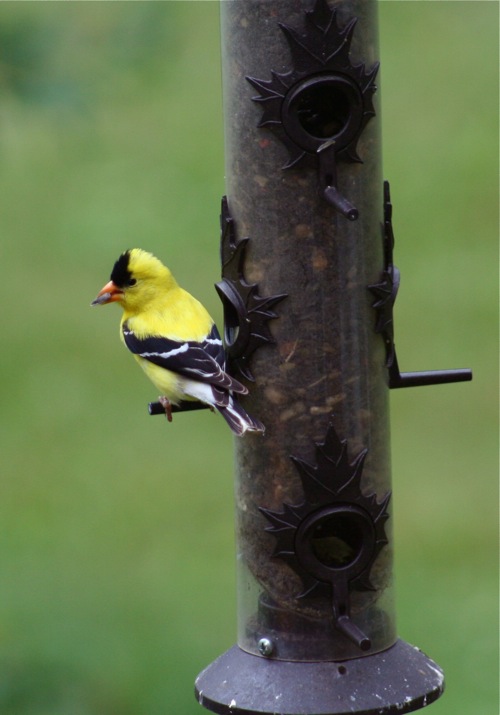 Ah, the goldfinch nesting season is underway. They are numerous and feisty at the feeders. There are so many that I'm able to see some interesting variations. Above is a typical goldfinch, note how the black cap goes from the base of his beak to his eye. Check out this dude:
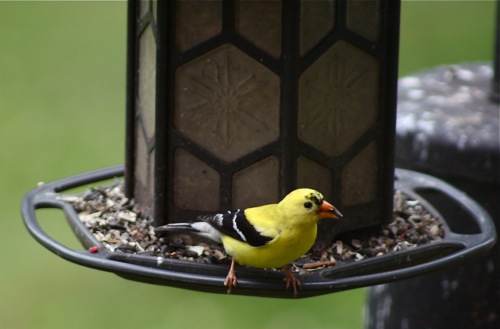
He's been like this for a few weeks. At first, I thought he was molting weird. But his breeding plumage seems to be firmly in place, he has some kind of odd pigment issues that's causing the yellow to blend into his cap. He sticks out as soon as he hits the feeder ever without binoculars. I'll be curious to see if he finds a mate.
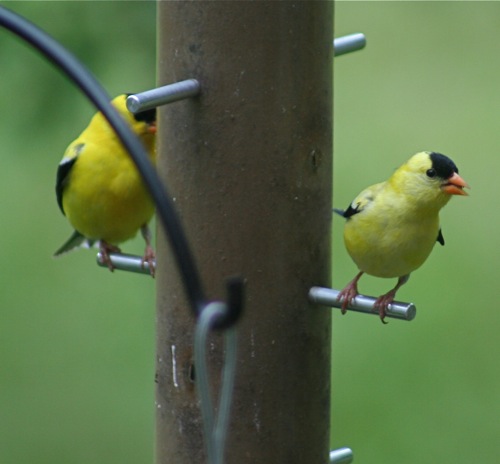
Another interesting goldfinch is the male above on the right, he's a bit lighter than the other males--at least where he's yellow. His black parts all appear to be the same. I'm not sure if he's a little light or if it's a dietary issue.
Learn To Band Birds In Peru
Want to learn how to band birds in Peru?? I just got this notice for volunteers in my inbox today: FALL 2009 BIRD-BANDING WORKSHOP in the Peruvian Amazon
There are still some spaces available (26 Sep - 8 Oct 2009) for ten days of bird surveying and bird-banding to document the avifauna of a private reserve on the Tambopata River, Madre de Dios Peru.
The workshop will include training in bird survey and capture techniques (ground and canopy mist nets and bal-chatri traps). It will also offer a rare opportunity to examine plumage variation by species, age and sex up-close on rainforest birds in the hand. Birds will be individually marked for long-term monitoring and research.
Work in different habitat types around the reserve and will leave plenty of time for birding and independent explorations of the surroundings. A field trip to the nearby Lago Sandoval is also included. The workshop will take place at the Centro de Education, Ciencia y Conservacion Tambopata (CECCOT), a young conservation, education and research center dedicated to promote the knowledge and conservation of the region’s natural history with a minimal human footprint. The center is rustic with thatch-covered cabins, a large and comfortable common area, shared cabins, composting toilets and cold water camping showers, limited solar-powered electricity available. Requirements: serious interest in birds, research and conservation (although previous experience not required) and willingness to stay in very rustic/shared conditions in the rainforest. Good mobility, yellow fever shot, immunizations and your own travel insurance.
Cost: US$2200 includes: Roundtrip air-fare to Lima (either from Los Angeles or Miami), in-country transportation and airport taxes, lodging and meals, field trip costs, materials and instructional fees. Group size 9-14. For detailed information and to determine availability contact DANIEL FROEHLICH before 21 Jul 2009: (EM: dan AT ceccot.org, PH: 206-595-2305) or URSULA VALDEZ (EM: uvaldez AT ceccot.org, PH: 206-219-9924).
Cardinal Differences
 People seemed interested in the difference between adult and young cardinals, so I have a few more photos. Above is an adult female cardinal perched on a feeder with a tufted titmouse. You can tell from this photo that she is female because she has brown on her body as well as some red. But note the orange bill--that's how you can tell she is an adult.

Here is a young cardinal. Even though the bill is slightly obscured, you can still see that it is dark and not bright orange, which is a sign that this bird was hatched this summer. There's an even better example of it here. I love that above photo, see how that young bird is watching the nuthatch on the feeder, she's trying to work out in her head how she can access that food source, she's wondering how she can perch on that feeder.

She was part of a family group of four. Above, she's on the ground with what I presume is her nest mate since they were feeding without squabbling.

He's still in that awkward phase, growing in his red feathers, you can even see the hint of a beard. Kind of like those 13 year old boys you knew in school who could grow those peach fuzz mustaches when puberty hits.
Birds Be Stealin' Mr. Neil's Cherries
 People often ask how I became a beekeeper. It was a conversation in Mr. Neil's office a few years ago. He said off hand while working on his computer, "I've always wanted to have bees on my property to pollinate my trees. My plum tree never has plums because we don't have bees."
I was surfing the net on my laptop and said, "I've always wanted to keep bees, but can't in my apartment in Minneapolis."
There was a pause, we turned and looked at each other and a plan was hatched (amid much protestation from both my husband and Mr. Neil's personal assistant).
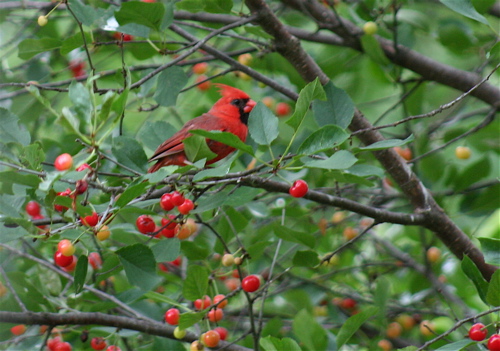
But now we have bees and happy trees with branches laden with fruit. Like the above cherry tree with a male cardinal lurking behind some leaves.
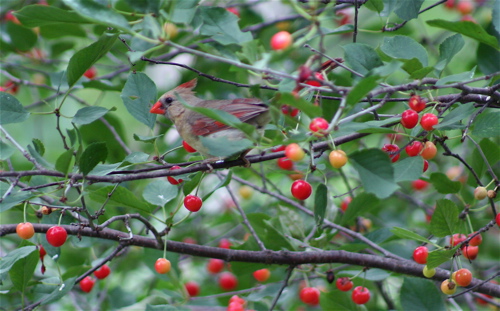
When the cherries are ripe, it's a race to gather as many on the bottom as possible before the birds swoop in. They are welcome to cherries at the top of the tree, but the ones within human reach would be nice for everyone else. Of course, it doesn't help that the cherry trees are located in the bird feeding area, but ah well. Above is a female cardinal. She and the male arrived with their young and were teaching them to each the cherries.
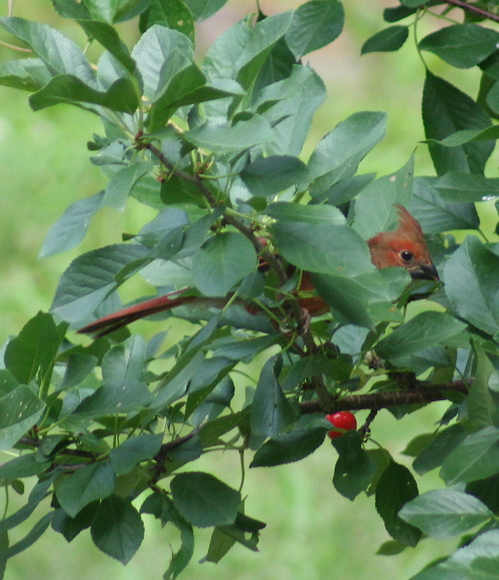
Here's a young male cardinal--note the black beak, that indicates he was hatched this summer. Poor guys, they just barely master landing on a bird feeder perch and feeding, now they have to figure out how to get at the juicy food hanging on the branch under him.
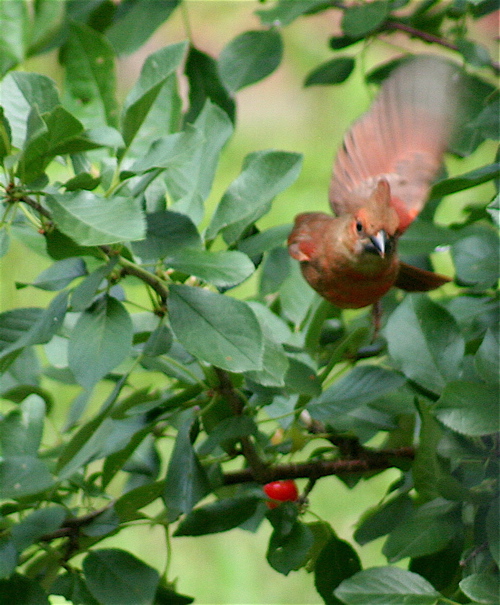
He was too wary of trying it while I had a camera lens aimed him and he awkwardly flew away. Pardon me, young cardinal. Oh, and piece of advice: I know I'm human and can't fly, but I think you might hone your awkward flight ability if you flap both wings at the same time. Just a suggestion.
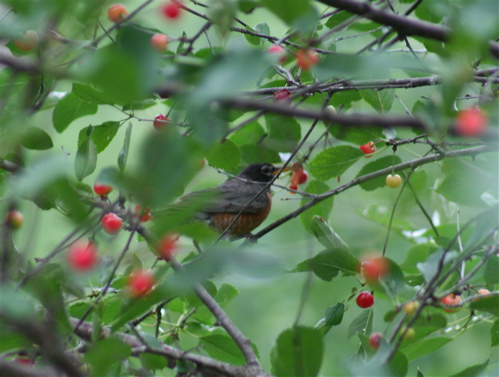
Robins were especially cagey in the cherry trees. In some ways they were the easiest to find in the tree, being larger and flapping their wings as they tried to pull the cherries off the branch. Robins typically feed on the ground, so it must be a bit awkward for them to feed in the tree. They must know they are somewhat vulnerable as they are surrounded by leaves and unable to see aerial predators coming as easily. Plus, they are using their concentration to feed in a different way, and cannot focus their attention on predator watch. But I sampled some of the cherries under the tree as I was taking photos, they were tasty, I don't blame the robin for risking it to get at the juicy summer fruit. Poor robins, they eat quite a few worms, no wonder they are willing to risk their lives for these tart fruits.
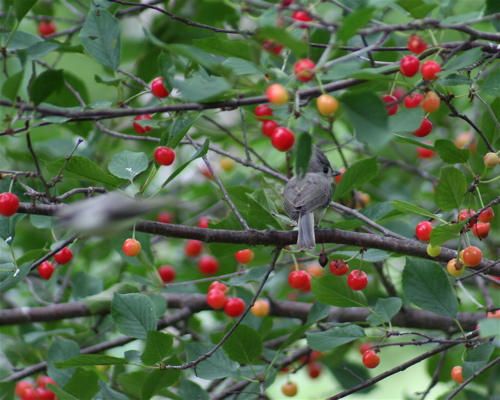
The titmice were all over the cherries, above is one tufted titmouse perched on a branch and on the left, is a titmouse blur as that bird is flying to another branch.
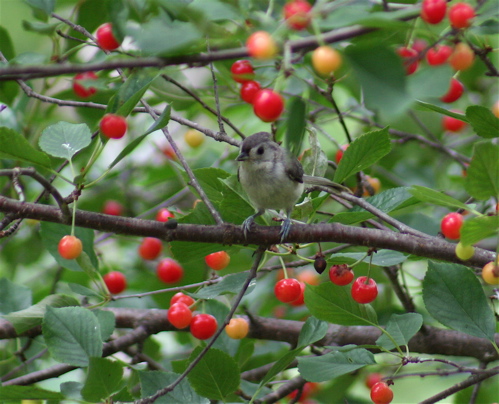
They had a much easier time going for the cherries, they can easily hang upside down to get at nuts, so it was nothing for a titmouse to locate the cherry of their choice, flip under and start pecking away.
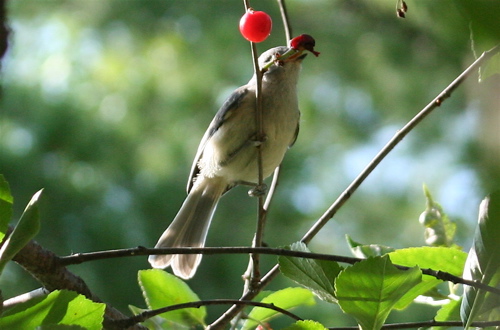
They could also go on the thinnest branches and not have to worry about their weight bending the branches like the robins and cardinals. Don't worry, Mr. Neil has had some of his cherries harvested, but it takes a quick eye to note when they are ripe to grab them before the birds do. They were lucky this year to have grabbed a few before the cedar waxwings found them.
So, if you are wondering what trees to plant or birds to attract them in your yard in summer--consider a cherry tree.
Rose-breasted Grosbeak Shenanigans
I've been without my tripod for my scope for a few days while it's getting a bit tweaked and haven't been able to do any digiscoping. Non Birding Bill and went out to Mr. Neil's to check on our bees and I found his digital camera with a zoom lens unattended and thought I'd see how the other half lived.

The feeders were bursting with bird activity--especially with rose-breasted grosbeaks. I've never seen any yard like this one that gets such steady activity of grosbeaks all summer long. The love the black-oil sunflower seeds and we also offer them a fancier mix of sunflowers, mixed nuts, fruit and safflower. Above are two male grosbeaks on either side of a female goldfinch.

The best was watching an interaction with a rose-breasted grosbeak on a suet feeder. A downy woodpecker was hanging on the bottom, getting what was left of a suet cake. The grosbeaks and finches would use the top of the feeder has a waiting perch to get to the crowded feeders. I'm not sure if either was at first aware of the other bird's presence.

As the feeder would spin, the downy would crane her head out to see what was going on above. The grosbeak would look around the bottom, detecting some sort of movement, but not sure what exactly what it was.

Finally, they see each other.

And the grosbeak gets freaked out and takes off. The downy flapped her wings to keep her grip and then resumed eating her suet.
Singing Himalayan Rubythroat
Here is a video so you can hear the sweet song of the Himalayan rubythroat. You'll hear some talking in the background and a man calls it an accentor, but it's not. He was just looking at it without binoculars, as soon as he saw it in the scope, he said, "Oh! Rubythroat!" [youtube]http://www.youtube.com/watch?v=VBXockSe1oo[/youtube]