Next Birds And Beers

The next Birds and Beers will be August 15, 2009 at 6pm at Merlin’s Rest.  This will be a special Birds and Beers held in conjunction with a group called Birders Who Blog, Tweet, and Chirp (aka birders who write a blog, have a Twitter account, or ChirpTracker account) run by Dawn’s Bloggy Blog. As always, Birds and Beers is an open event to anyone remotely interested in birds, so if you do not have a blog, Twitter account or ChirpTracker account, you are of course welcome to Birds and Beers, the only requirement is that you have an interest in birds. The first part of the day will be spent at Carver Park banding birds with my buddies (and Birds and Beers regulars Mark Newstrom and Roger Everhart). You'll have your choice of watching the banding are checking out the fabulous trails at the park and meet some fun bird bloggers. Keep an eye open to Hasty Brook for details on the BWBTC end of things.

That night at 6pm will be a Birds and Beers is an informal gathering of birders of all abilities–if you’re interested in birds, you’re invited. You can meet other birders–maybe find a carpool buddy, ask about where to find target birds, share cool research projects you might be working on, ask a bird feeding question, share life lists, share some digiscoping tips, promote your blog–the sky is the limit. It’s low key and it’s fun.

I alas will not be able to attend which I'm sad to miss a birder gathering.  I've had a most unexpected opportunity come up and it's a gamble, but it all pans out, it will be pretty cool.  It's still somewhat up in the air though, so I don't want to jinx it by talking about it.

Aberrant Plumaged Goldfinch

[youtube]http://www.youtube.com/watch?v=QzESPoTl_LU[/youtube] That odd little American goldfinch is still hanging around, he showed up this morning on my sunflower feeder while I was making breakfast and I tried to grab a quick video (apologize for the Wayne Newton in the background).  I don't think that cap is ever going to grow in, it's almost time for the male goldfinches to return to their winter plumage.  I wonder if he will stick out in his winter plumage?

Filling The Feeders

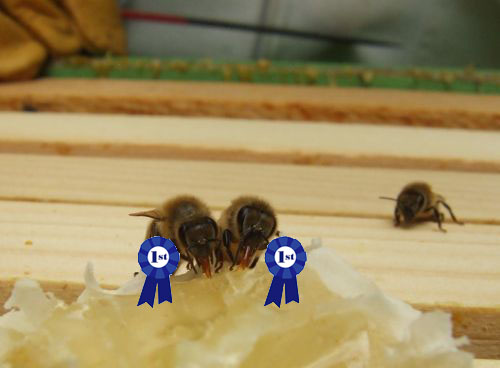
This is the one time of year that my oh so trendy neighborhood goes insane. I live in an area of Minneapolis where people go for funky restaurants or to get pierced and tattooed.  It's a fun place to live...apart from this weekend--we have there's a huge art fair and a local pizza joint closes down our street for a block party. Fun events...unless they are in your backyard. It's even worse this year because one of the main streets is under construction so parking is already next to impossible. So, rather than sitting at home fuming about how the hippies and their late night drum circles are giving me writer's block, I am keeping Cabal company this weekend and Saturday Lorraine and I will head out to the fair to admire our blue ribbons on our honey. 1 ruby throated

When I arrived, I filled some of the feeders--the hummingbird activity has really increased in the last week, August is the best time to feed hummingbirds up here. The young are fledging and the adults need to bulk up for the coming migration.  As I crouched on the ground filling the HummZinger with home made nectar, I could hear impatient buzzing above my head, they were circling me like coked up vultures, anxious for fresh nectar in the feeder.

cabal

As I was topping off the feeders, Cabal was having a stare down with the gutter. Something inside was taunting him and it was his duty to rid the metal tubing of the small furry creature inside. As he would focus and salivate, occasional chitters echoed from inside, causing him to twitch with excitement. He slapped the metal a few times but the creature would not budge.

chipmunk

It set my camera at the opening of the the gutter and got a shot of Cabal's tormentor--a chipmunk.  All it took was for Cabal to be momentarily distracted by some other aroma carried on the wind and the chipmunk beat a hasty escape, ready to baffle the pooch another day.

Award Winning Bees

award winning bees I am just so giddy!  Our bees won the county fair for the second year in a row!  And this time, we took both the honey ribbons--one for extracted honey and the other for cut comb honey.  It's official, our cured bee vomit is the best bee vomit!

It's the oddest sensation, the bees essentially did the work, we just took it out of the hive and presented it to the fair officials and they judged it to be what we already suspected--super tasty.  However, I still feel a deep satisfaction in it.  And no, we are not the only entrants in the county fair--there were others and the local bee club does have a booth at the fair, we are certainly not the only beekeepers in the area.

Beekeeping is the coolest thing and I love that I do it, I love watching my bees. I don't know what the secret to our hive flavor is. I've never been a fan of honey.  When we started our beekeeping operation and Mr. Neil said that we would split the honey down the middle, I didn't care.  I was strictly interested in beekeeping from a natural history point of view.  Honey had always had an odd after taste that I never cared for.  I did like Really Raw Honey brand, that was the first time I found honey a pleasure to eat.  We were warned that in our beekeeping class that our honey that our own bees produce would be the best tasting honey ever and we would be spoiled for any other kind.

I've always kept that in the back of my head. Even the first time when we ate honey from our hives and the four of us on our bee team literally devoured a frame in twenty minutes.  I had never tasted anything like it.  The honey was warm from the summer sun, the wax was fresh and chewy.  The honey was light in flavor, that tasted the way the local wildflower smelled, with just a hint of a peppery bite in the finish.  I thought it was the best, but still in the back of my mind, I thought it was because they were our bees. Even if friends told me it was the best honey ever, I was still suspicious.  Who well tell a beekeeper that their bees make "ok honey" or just "edible honey" or even "sucky honey?" No one is going to say that (at the very least to be polite but also because the beekeeper could send bees to sting them). I was cautiously optimistic about how great our honey is.

So, for a lark we entered a jar in the county fair last year and we won.

I was shocked--was our honey really that good?  Was it just a fluke, were we just new entrants and judges thought, "Oh, here's somebody new, let's give it to them!"  We entered again this year and I tried to keep my hopes low--we might not win this year, our honey tastes a bit different with a hint of mint, maybe someone has an all basswood honey that would blow the judges out of the water, or maybe someone else has a turn to win this year--and our extracted honey won again!  We must have talented bees with a knack for producing great honey.

We also thought we would enter in our comb honey, but Lorraine noticed that the entry rules read, "cut comb honey" and worried that our use of Ross Rounds may not count.  Cut comb honey comes from the type of supers where you literally cut the wax comb into squares and put them in either plastic boxes or in a jar with more honey--you can eat the wax along with they honey.  Ross Rounds are the best way that I have found to do comb honey.  There are plastic circles that fit into the frames of the Ross Round.  The bees build out the foundation inside the white circle.  When they cap over the honey, you remove the frames, easily pop out the white circle and put a lid on either side--badda bing, badda boom, you're done.  There's no cutting (apart from trimming away excess frame foundation).  Here is a blog entry on how to extract you comb from Ross Rounds.  The holders and lids make for a great presentation, especially if you found on where every single cell is capped.  But I wondered if that would be considered cheating--you essentially are putting the container for holding the comb in the hive for the bees to build in.  I told Lorraine that we should be rebels and to enter it anyway...and we won!

I find comb honey far easier to harvest and I enjoy it the most--I love chewing the wax. It's also the more valuable honey--you tend to pay more for it. However, when I give comb honey to friends, many are kind of wierded out about the wax.  I found out through a friend on Facebook that Mr. Neil had gifted him some comb honey and he confessed he hadn't eaten it because he wasn't too keen to eat wax.  So we have extracted honey.

Perhaps Lorraine's method of extracting our honey helps with the flavor?  We have a big fancy extractor, but she prefers to strain our honey through cheesecloth. We do not heat our honey (some beekeepers do to make it stay in a liquid state for a longer period of time--which also affects the flavor of the honey and causes that weird after taste ). If you do not heat your honey, it can "granulate" over time, which is fine, it's just a tad thicker.  It's safe and works fine in tea, but some people think granulated honey is inferior and will not buy it, that's why many commercial honeys are heated, so it will stay liquid and consumers will purchase it. If you wish to turn granulated honey into liquid honey, just put the jar in warm water for a few minutes.

We are all now warming in the afterglow of our second consecutive win and our clean sweep of all the honey awards at the county fair.  I'll try to head out this weekend to get photos.

A Little Honey Harvest

exit ramp I saw this red-tailed perched on the exit ramp on my way out to the bees on Sunday. The fuzz is very serious in their enforcement of no parking on the exit ramp!

bees

I tell you, the type of summer we are having with our hives, is the type of summer I would wish for any new beekeeper.  Well, apart from the fact that the people we ordered our Russian bees from have taken the money and not delivered the bees...and seem to feel that when we say we would rather have the money back, that we mean we want to be on a list for Russian bees from them next year.  I'm not too keen to order any bees from Long Creek Apiaries again.  They apparently had a bad spring, which is understandable, but rather than telling us, "Hey, we shouldn't have taken your order, we can't deliver those bees, we apologize, would you be willing to carry your order over to next year," they didn't answer the phone, or if they did they would say, "uh next week, for sure," or at one point, just hung up on us. I found out through Twitter that if you went to their website, they had a message reading, "If you ordered bees from us and didn't get them yet, you won't be getting them this year. We apologize."

I would have been more sympathetic had they told us that during one of our many calls and I'm curious to see if we will get a refund.

But apart from that, our four little Minnesota Hygienic Italian beehives are going very well and are just so friendly when we visit. Even when they do get irritated with us and we can hear their buzzing become impatient, it's nothing like the anger felt at the now defunct Kitty Hive.

propolis

They are going propolis crazy (propolis is bee duct tape). See the yellowish stalagmites? That's propolis that the girls had used to seal the roof of the hive to the walls.  It smells wonderful, but once it gets on your hands, it's next to impossible to get off. I have washed my hands several times, and now almost 48 hours later, I can still see some propolis on my hand.

honey super

We did a wee bit of harvesting to prepare an entry for the county fair.  Last year, our extracted honey got the blue ribbon--we are defending champions.  Here is a look at a full frame of honey from one our supers. This is from the former stoner hive, Hannah. She's already working on filling a second honey super.  When the cells are capped, that is when we know the bees have converted the flower nectar into true honey and it's ready for harvest.  When bees bring nectar to the hive, it is about 60% water. The bees fan it with their wings to evaporate some of the moisture until it is about 18 -19% water and then they cap it.  At this point, it has a very long shelf last and could literally for centuries. You can harvest honey before it's capped, but it is more likely to ferment over time.

ross rounds

We also thought we would try our hand at entering some comb honey this year. Our green Wendy hive is a natural at producing comb honey. And again, I say to all who have been told that first year bee colonies will not do comb honey, this is the third year we have done it successfully with new hives. It's usually the girls who have a knack for making feral comb, they seem to be the ones who like to try something funky and will give Ross Round honey supers a go.  We also smear some honey on top of the new super and wedge in a small piece of comb on the top of the super to encourage them to build up.  We removed one frame of our rounds to enter one of the rounds in the fair. Wendy was doing so well and had completely filled up one comb honey super that we added a second and she's already drawing out comb--go girls, go!

bat hive

Mr. Neil is conducting an experiment on our hives--the bell jar (and a little more about it here).  We're hoping to get some funky comb built inside the glass jar. We did not want to disturb our honey makers (Hannah and Wendy) and our little purple Yvaine hive is doing well, but really needs to focus on getting her honey stores together for winter, we don't want to bother them with the bell jar. The red Juliet hive is about full and had one honey super, so we thought we would try there (the bell jar is in the box with the bat symbol on it).  After a few days there had been no activity in the bell jar.  We decided that since Wendy is all for making strange comb, we would move the bell jar on top of her comb honey supers and see if Juliet will make some proper comb.

drone cells

I forgot that we had put in a honey super in the Juliet brood box.  I do that so the girls will start to build on it, then I add to the honey super.  The smell of fresh comb seems to draw the bees up in the super so they will fill it up.  They did do some comb on it, but really went to town adding drone cells (boy bees) to the bottom of the frame.  We scraped it off and put the frame back in the super.  Some of the drone larvae fell in the hive and it was amazing to watch a worker swiftly scoop him up, presumably to try and fit him a cell else where.

hey girl honey

So, here we are with our frame of comb honey and our frame to extract into a jar.  Lorraine will take it to the judges today for judging.  Will our girls win again?  We started the extraction process in the kitchen, the comb didn't take much time to put together, just pop it out of the frames and put some lids on it...we did have one challenge, you want the comb honey to be filled and completely capped and for some reason, our girls built a tunnel for traveling through most of the rounds, but we found at least one perfect one for judging.

Mr. Neil held the frame for the extracted honey over a bucket with cheese cloth, while Lorraine scraped away the wax and honey. He received an important phone call, so I gave him the phone and took his place holding the frame. When Lorraine finished, we saw a bit of honey residue still on the frame and like our first year with a frame full of honey, began licking it...let me tell you, Hell hath no fury like Mr. Neil missing out on a hive,s first honey!  He yelled at us to stop and save some for him.  We paused, waited for him to leave the room and gave the frame a few more licks.

The honey tastes like mint.
Snowy Plover At A Bird Feeder?

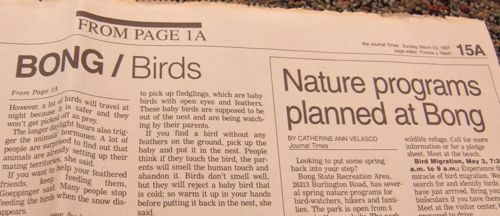
One of the banders brought in an old newspaper from Wisconsin that has one heck of a front page story.  Check it out (and be sure to read the caption): oops

Who knew so many of us had them coming to our feeder already!

Since the photo was taken at Bong State Recreation Area, I guess we can understand how the misidentification happened (giggle).  For readers who are not familiar with a snowy plover, this is what one looks like the above bird is a male house sparrow...it's understandable, they look so similar (not).

bong

The article continues inside the paper...causing teenagers across the country to giggle at wacky birders.  What kind of nature programs would be planned at Bong?  I'm not sure, but they better make sure to have plenty of snacks.

Waxwings and Bird Handling

I have been making so many changes this summer. Some have been evident with the blog and will be more evident in the coming weeks. Some have been in my day to day routine. For example, I've been learning how to band birds at Carpenter Nature Center and usually spend my Fridays (when I'm in town) there. cedar waxwing

Check out this cedar waxwing that came in to the nets today at Carpenter. It's an adult (not tell tale streaking on the breast that would make it a juvenile).

waxwing back

What a gorgeous bird this is and beautiful study of powerful highlights--love that yellow tail tip.  Oh, and get this, I was reading Cornell's All About Birds website (which makes a handy online field guide) and it says that waxwings with orange instead of yellow tail tips began appearing in the northeastern U.S. and southeastern Canada in the 1960s. The orange color is the result of a red pigment picked up from the berries of an introduced species of honeysuckle--crazy.  Non-native plants can cause a slight color change in our native birds.

waxtips

Check out the little wax tips on the secondary wing feathers of this birds. What a treat to see them up close!  These are the reason this bird is called a waxwing.  To the best of my knowledge, researchers have not figured out the purpose or function of them, but much like the yellow tail tip, if a waxwing eats enough of the above mentioned honeysuckle berries while it is growing a tail feather, the tip of the feather will be orange too.

mouthful

However, recently I haven't been doing as much with the banding end of things are Carpenter. That's because I started volunteering my time with their education birds. I have volunteered at the University of Minnesota's Raptor Center since 1997, mostly working with their educational birds. However, with the economy, Carpenter has had to lose some of their staffing and asked for volunteers with bird handling skills to help them out.  The Raptor Center is very well known, has over 400 volunteers and is a great place for a person to learn how to handle birds.  Since Carpenter is in need and (much like Liam Neeson) I have a certain set of skills that can be of use, I took a leave of absence from TRC to help out Carpenter.

peregrine

They have three education birds at Carpenter: a great horned owl, a red-tailed hawk, and a peregrine falcon who is still being trained in. Today, I got to help with that a little bit. He's getting used to being perched on a gloved hand (thanks to some great trainers volunteering their time), but he's still uncertain about people coming into his mew (falconry term for his cage) and gets frightened easily.  He has an injured wing and cannot fly, so all of his perches have to be low enough for him to reach by a good leap.

I stepped into his mew with some fresh quail and he started running around all over. You train birds with positive reinforcement, so I crouched in a corner, did not make eye contact, watched in my peripheral vision and waited for him to settle.  Unfortunately, that was on the ground on the other side of his mew. I waited until his posture relaxed a bit, and slowly set a piece of quail on one of his perches. He slowly made his way over to the perch. I made sure it was a dark red and juicy piece. He couldn't resist. He hopped up and began eating.  I slowly moved my gloved hand with another piece of quail to the perch.  He paused and stared at it, then continued to munch what he had. When he finished, he hopped up to my gloved hand.

IMG00182

I secured his jesses (the leather straps on his feet that are usually tied to leash) and stood up.  I fed him the rest of the quail and he at ravenously. I had another quail for him in the kitchen, so when he finished, I put him back to the perch, stepped out of his mew and went to get it.  This time when I returned, I approached slowly, he remained on his perch and stepped up beautifully.  He's gradually learning that stepping up to the glove is a safe thing and he might even get some tasty food out of it.  It was honor to be part of his training process and it felt good to know that I have the skills to help out with it (and a relief that I didn't undo any of the training he has received thus far).

So, in this tough economic time when so many organizations are hurting for funds (as are some of us) don't forget that your time can always be just as valuable.

Speaking of hurting for funds, did you hear about the nasty deal going down with Sportsman's Warehouse?  According to a report at a Wall Street Journal blog, they have filed for Chapter 11. They have been selling the Duck Stamp which can be used as a waterfowl hunting license but more importantly, 98% of the $15 paid to get a stamp goes to habitat acquisition--it's a great purchase for hunters and non-hunters.

Sportsman's Warehouse is now refusing to turn over $629,415 it raised through the sale of federal duck hunting licenses and want to use it to pay back their creditors. As a result, the Department of the Interior is objecting to the company’s plan of reorganization, urging a judge to reject the plan until it makes it clear that the money will end up where it belongs with the Migratory Bird Fund and not the company or its creditors.

I'm sorry that a business is in trouble and trying to stay afloat, but using money from a fundraiser to bail your sorry butt out is wrong, wrong, wrong.  Certainly will make me be a bit more choosy when I'm purchasing my outdoor gear.

Wisconsin Kirtland's Warbler Video

Hey, this is pretty cool, the first video footage released of Kirtland's warblers in Wisconsin! The video was put together by Natural Resources Foundation of Wisconsin. The Kirtland's is endangered and was only found in a small area of Michigan's jack pine forests, but about three years ago, a pair of Kirtland's nested in an undisclosed location in Wisconsin. The area is kept quiet so the fragile bird population can increase without disturbance but here's a peak into the success story of an endangered bird increasing in number (nice to get some good news). [youtube]http://www.youtube.com/watch?v=PeRmdYj2QJs[/youtube]