Diversity In Outdoor Recreation

There is a very interesting conference coming up and I'm so irritated that I just found out about it today when it's too late for me to plan a way to get there (note to organizers PROMOTE YOUR EVENTS MORE THAN 3 WEEKS AHEAD OF TIME, especially if you want people from around the country to attend). The really frustrating thing is that it's being offered a week after the Midwest Birding Symposium and it's happening the same state.  Gr.  Seriously, organizers, what went wrong here? So, here it is, if you are in and around the Ohio area towards the end of the month, you should attend this: Black Swamp Bird Observatory is holding a Diversity in Outdoor Recreation, The Many Faces of Conservation Conference on Sunday, September 26, 2009.  It's no secret that when you attend a bird festival or birding event, if a person of color attends--they stand out.  That should not be the case.  But there must be something, some kind of vibe that keeps people of color away or there must be someway birders can reach out reach to people of all races and share the coolness of birds.

The speakers are John C. Robinson, Dudley Edmondson, Tamberly Conway, and Maricruz Flores.  This should be an interesting conference and one that many birders could learn from. It's just too bad that the timing and promotion was poor.

.
Friday At Carpenter Nature Center

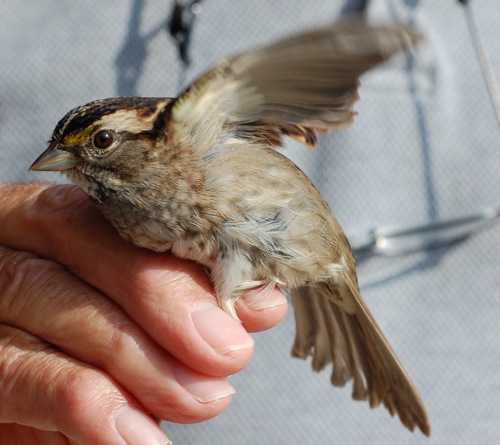
White-throated Sparrow Not that I could deny before, but migration is totally on.  We got in our first fall white-throated sparrow in the banding nets at Carpenter Nature Center on Friday.  I think this is the earliest we've ever had one.  I'm very curious about this fall's migration.  Will our cold summer cause changes?  It's been too cool for backyard gardeners to get their tomatoes to ripen...what effects has there been on seeds and insects birds use to fatten up for the journey south?

Green Frog

Signs of summer are still around, check out this apparently well fed green frog that was lurking in Carpenter's new pond.  It was hiding in the grasses waiting for some unsuspecting insects to land nearby.  I love these frogs, they make a sound kind of like a banjo string being plucked.  Here's a link to a great video of green frogs calling.  At first I worried that this was a young bullfrog ( a non native frog that could cause problems in the pond) and so Jen and I looked up how to tell green frog from bullfrog.  Green frogs have a dorsolateral fold from their eye to their hips.  This frog had that fold, so that made it a green frog--whew.  You can read more about the differences over at the Hilton Pond site

Carpenter Prairie

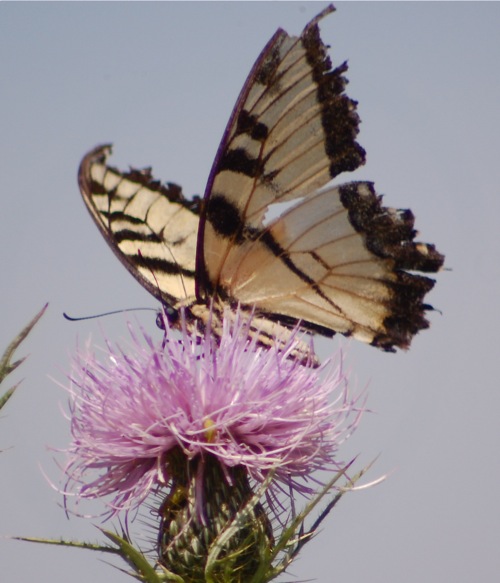
Incidentally this is the best time of year to visit Carpenter Nature Center, the scenery is outstanding with the blooming goldenrod and asters.  It gets even better as the leaves begin to change color.  They have some great programs this fall from The Raptor Release to even a watercolor class in October (I might sign up for that). Note that swallowtail butterfly in the above photo?  Take a closer look at it below:

swallowtail

Some will look at this butterfly and think "Aw, poor thing!"  I look at it and think, "Man, that is one badass butterfly!"  How long has it survived to have such a ragged look.  That chunk missing out of its wing looks like the telltale patter of a bird beak.  Has it evaded numerous attempts to be eaten by flycatchers and swallows? Perhaps this is the oldest swallowtail of the summer.  It even bullied the honeybees and bumblebees trying to nectar along with it.

Are You Aware Of Vultures?

Did you know that September 5 is International Vulture Awareness Day? Turkey Vulutre

Vultures like the above turkey vulture may seem to be in good shape in the United States, but vultures in other countries face some daunting challenges that include habitat loss, poisoning, and poaching.  The IVA started  as Vulture Awareness Days run by the Birds of Prey Working Group in South Africa and the Hawk Conservancy Trust in England.  They came together to highlight the important work being carried out by the world’s vulture conservationists.

On September 5th, many bird clubs and organizations around the world will be doing something to raise awareness of vultures all over the world.  So, make people aware of vultures this weekend.  Heck, go out for some sushi and pretend to be vultures.  If you're out with friends, ask what they know about vultures here in the US and around the world. Here are some fun facts you can share:

Turkey vultures and black vultures are "new world vultures" and are different than the "old world vultures" in Europe, Asia, and Africa. They may resemble old world vultures, they are not very closely related.

Turkey vultures have a highly developed sense of smell and studies suggest that they can smell carrion from one to five miles away.

Black Vulture

Black vultures (like the one in the photo above) follow turkey vultures to find food.

When vultures are frightened or startled, they will vomit as a defense mechanism (nothing is more distracting than vulture vomit and it's a great way to drop a lot of weight and fly off faster).

An anti-inflammatory drug used on farm animals in South Asia poisons vultures that feed on the dead animals with diclofenac in their system.  It has caused a decline of about 95% of the vulture population in India and Pakistan. The decline in old world vultures has led to hygiene problems in India as carcasses of dead animals now tend to rot, or be eaten by rats and wild dogs leading to an increase in rabies.

If you have a vulture fun fact, share it in the comments below!

Turkey Vulture

If you have photos of vultures, consider sharing them on the IVA Flickr group (or just browse all the photos of these great looking birds).  And now I leave you with a video of Nero, the education turkey vulture at The Raptor Center (who is the same age I am, he was hatched in the summer of 1974 too) and a demonstration of how he recycles phone books:

[youtube]http://www.youtube.com/watch?v=ZNWmItiXnto[/youtube]

Cornhatch?

nuthatch staredown Usually, it is the hummingbird that is the best at communicating when the feeders are empty.  If you have a nectar feeder and it goes empty, one of the best clues is a hummingbird flying up to the window as if to let you know the nectar is bad or empty.  If you have studied bird behavior or worked with birds as an education animal, it's not a far stretch for bird--even a hummingbird with an incomprehensibly small brain to figure out that the large creatures in the building come out and fill the feeders.  The above white-breasted nuthatch has appeared to figure out the same strategy.  The other day, it was hanging around the suet sandwich (a great feeder if you are having raccoon problems, they can't seem to crack it).

ahem

I was out taking photos around this feeder still had a little bit of suet left in the center of it.  I was in deep inside, a woodpecker with a long tongue would have problem getting at the food, but a wee nuthatch with a short tongue would be SOL.  So, while I was out taking photos, this white-breasted nuthatch kept hanging out and just sitting on the feeder.  A nuthatch sitting still is immediate cause for suspicion.  At first I wonder if it sees a hawk, but no other birds at the surrounding feeders appear alarmed.  The nuthatch then worked around the feeder pecking the fake bark, the screw, any little crevice it could and then it would look at me as if to communicate, "I'd like to eat here, but there appears to be no fatty bounty on which for me to forage."

I filled the feeder.

cornhatch

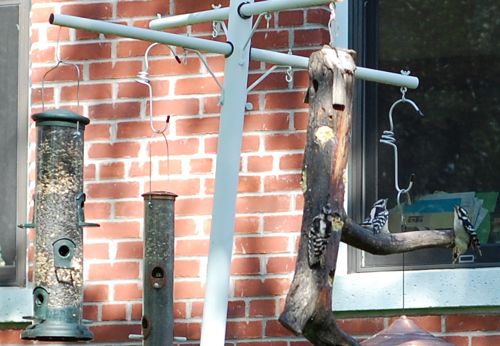
I had some of what I would call "emergency suet."  Not the best stuff, it read "peanut suet" but had a ton of corn inside.  I filled both the suet sandwich and the suet log with the same stuff.  The nuthatch (and the downy and hairy woodpeckers) went for it.  I was really surprised at how they devoured it...especially when I think of all the times I have splurged on fancier cashew suets (that I made sure did not have corn).

nuthatch taste test

The nuthatch did appear to be perplexed with the corn.  I love the above shot.  It set the corn kernal down on the log, repositioned it, picked it up, set it down and repeat.  I think the nuthatch was expecting the usual nut chips and the corn texture surprised it. As I watched teh nuthatches comeing in for the suet, they didn't eat it right at the feeder.  All of them (both white-breasted and red-breasted) would take a hunk and cache it in a nearby tree.  I'm not sure if they will eat it later this winter or not, but it's interesting to watch their reaction to corn.

Anyone else have nuthatches eating corn?

Downy Smack Down On The Suet Log

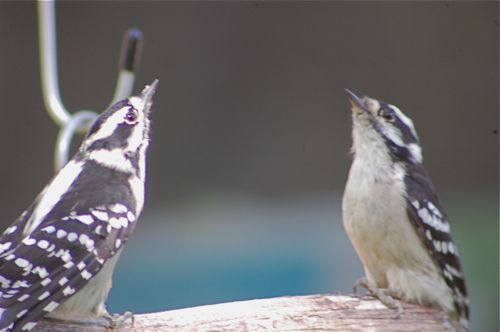
downies Believe it or not, that large suet log is not big enough for those three downy woodpeckers.  What's even crazier is that the suet that is currently in there is not the best suet on the planet.  The label read "high energy peanut" but when I was mashing it into the holes on the log, it was chock full of cracked corn and white millet.  All part of the unregulated world of bird food--there are no requirements for bird seed manufacturers to list ingredients in any particular order.

downy fight

I love these two females trying to raise raise their beaks higher to prove dominance.  Periodically, one would flare out her wings, not unlike a hawk mantling it's wings over a fresh kill to look to more intimidating.  They resulted in an impasse, and fluttered off chasing each other, leaving the feeder open to other woodpeckers.

Birdjam Twitch Application For iTouch & iPhone

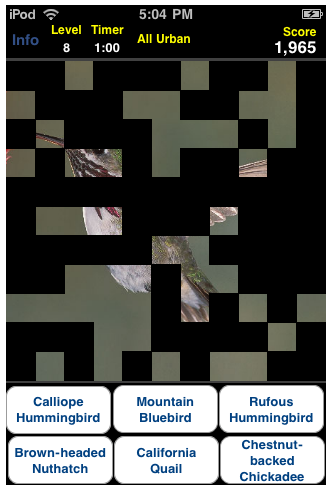
I had to go the DMV yesterday to replace a lost license.  Fortunately, I downloaded a fun app for my iTouch to pass the wait called birdJam Twitch. Picture 5

The game takes 660+ North American bird species photographs on the birdjam software and organizes them into 31 "flocks" for the East, West and all of North America. Flocks may be grouped by habitat such as forests and marshes, or families such as ducks, sparrows and warblers.  You can even choose a difficult level from 1 to 10.  Then you shake your iPod Touch or iPhone to start a game--if you are not down with the shaking of your iTouch in public like I am, you can simply touch the screen. During play, squares turn over randomly to gradually reveal a photo of a bird in their natural habitats. Select your answers using the buttons at the bottom of the screen.

I will say that in the All Species Game at a middle level, if there were 2 of the same species listed, it would usually be that species--but which of the two will it be kept it a challenge.  I played with the sparrows flock and found that it can be a useful tool for noting subtle field marks and incredibly challenging at a low level of play.  For some indoor birding, it was a lot of fun.  And if I'm going to have a game on my iTouch, might as well be one that his subtly helping with id?

If you want to practice foreign bird names, you can choose to play in Spanish or English.

Birds and Beers and A Book Party?

Jan Dunlap who wrote the Boreal Owl Murder has a second book coming out in the Bob White mystery series called Murder On Warbler Weekend.  Turns out that there is a book release party at Once Upon A Crime book store on Lyndale Avenue South and 26th Street in Minneapolis at 7pm on September 10. There will be refreshments and quite possibly wine so it sounds like a perfect impromtu Birds and Beers.  Afterwards, there are several bars in the area to carry on the festivities. So, let's meet up at 7pm on September 10 and support local author writing bird murder mysteries.  Half the fun is trying to figure out which Minnesota birders she's killing off.

Young Finches Learning The Ropes At The Feeders

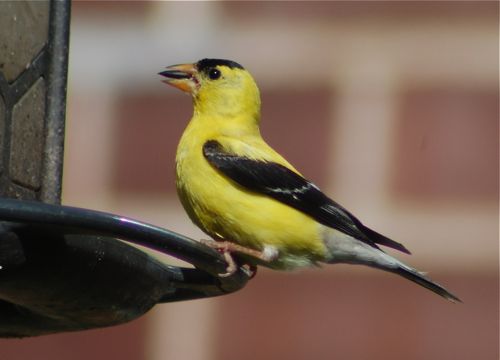
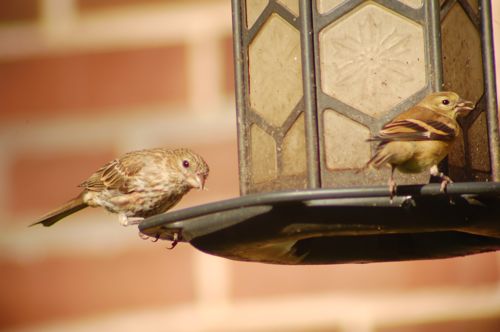
goldfinch male As signs of fall migration make themselves achingly apparent, many of the goldfinches in my area are still holding on strong to breeding plumage.  As I was digiscoping this male yesterday, I noticed differences in the bird calls around me.  No indigo bunting singing on territory or red-eyed vireo--that was first this month.  There were contact calls of warblers.  I did hear a scarlet tanager giving the old "chick-burr" behind me and noted that while the tanager was here, all the orioles were gone.  I know most people in my neck of the woods have lamented our cold summer.  Wearing a jacket in August is crazy, even by Minnesota standards, but I have loved it.  Although, as much as I enjoy cool nights and several days without turning on the air conditioner, I look at all my friends who cannot get a tomato to turn red in their gardens this summer and wonder how this affects the seed crops and insects fall migrants need to head south.  I also wonder if this means an exceptionally long winter as well.

goldfinch molt

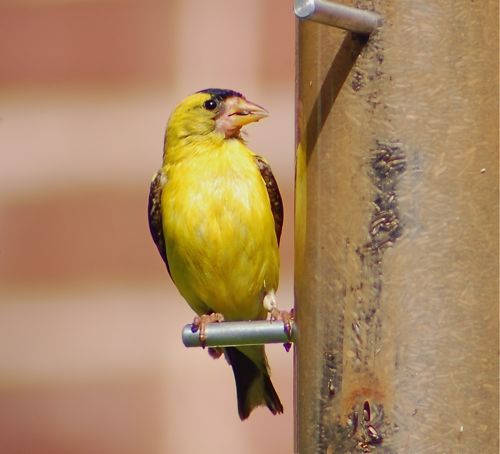
I did notice this male goldfinch on the long tube with kind of a reverse goatee.  He's bald around his beak.  I seem to recall seeing this before in a goldfinch either last year or two years ago.  I wonder if it's an odd molt or some sort of mites (not unlike the bald cardinals we see this time of year).  This particular male had at least one recently fledged chick following him around to the feeders begging to be fed.

goldfinch begging

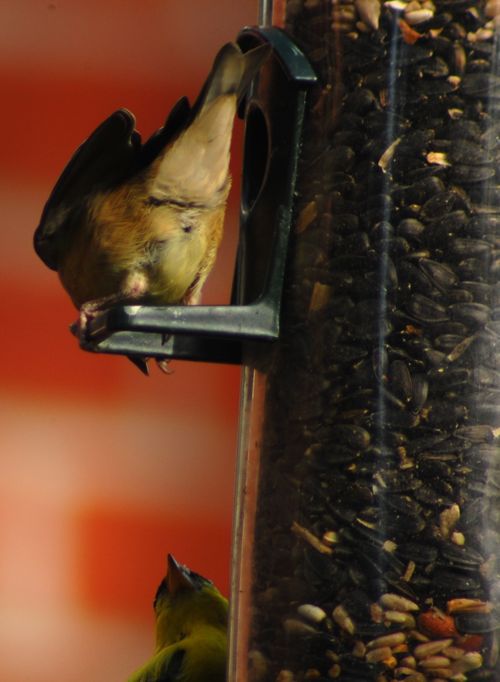
The adult male is on the bottom of the sunflower tube feeder and the begging chick is on the upper perch.  The adult would dutifully demonstrate how to get seed out of the port, while the younger bird above continued to beg.  Eventually, the young bird left the adult alone and tried pecking around the feeder.  It ignored the gaping opening of the feeding port, and pecked at the plexiglass tube.  It could see the seed and couldn't understand why it couldn't get at the food.

goldfinch eating

Eventually, the adult male flew to a different feeder and what does the young finch do? Continue to ignore the open port with food and hang upside down towards where the adult had been feeding and unsuccessfully pecking at the tube around the port.  Not the brightest bulb on the tree.

goldfinches

The young finch followed the adult male over to the Nyjer feeder and begrudgingly began to eat the seed out of that port.  All the while, continuing to flutter its wings in a food begging behavior.

finches

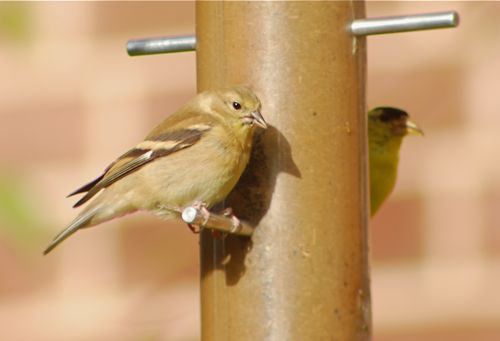
The young bird finally left the Nyjer feeder and flew over to a black oil sunflower feeder.  Soon afterwards, it was joined by a young house finch (who had just a hint of pink show up along his flanks).  Both birds fed in peace, but periodically the larger house finch would lunge toward the goldfinch if it got too close.  I wonder if these will be the last of the fledglings I will see for the year?

Bees and Edible Fungus

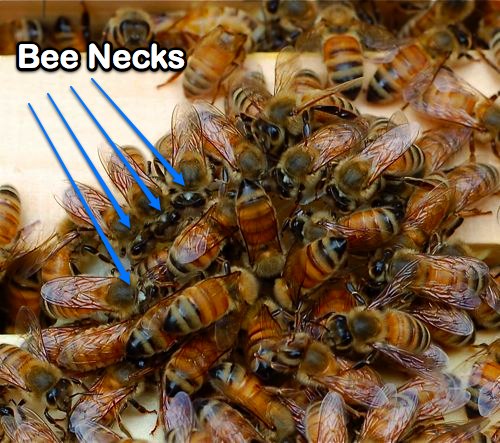
bee necks Look at all the little white bee necks!  Cute!  I love it when you see bees craning their heads.

Lorraine and I checked the hives on Wednesday and most is going very well.  The yellow Hannah hive and the green Wendy hive are still working their honey supers.  We removed the bell jar from the Wendy hive, the bees weren't really building in it and we also noticed that the honey right cells right below the bell jar was not capped.  Groundskeeper Hans check the hives last weekend and thought he saw condensation inside the jar too.  I decided to remove it, fearing that the recent heat and humidity was affecting the hive.

queen cell

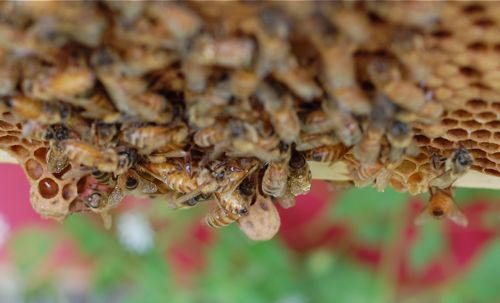
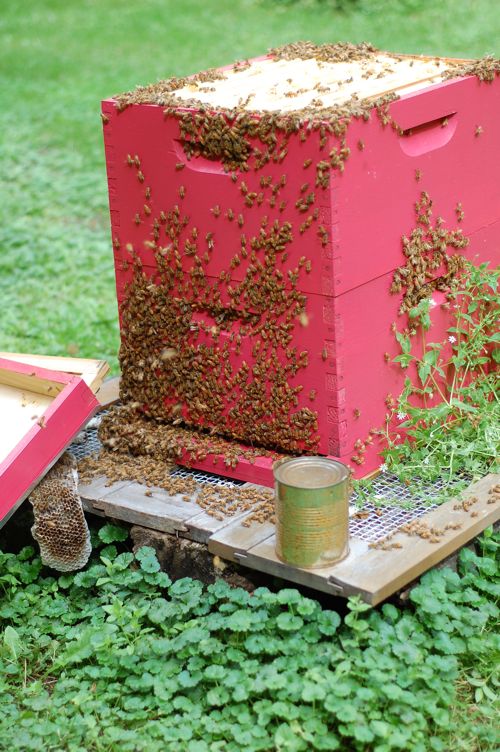
The red Juliet hive appears to have swarmed.  It was quieter in the front and there did not seem to be as many workers in the hive.  We took out a frame and found some in progress queen cells...and now I just noticed an egg in that empty cell on the left, maybe she hasn't swarmed yet?  This hive is behaving very much like our very first Kitty hive.  I remember Kitty was a little behind and still had some space in her hive, but still went into swarm mode.  The red Juliet hive had plenty of room, I added a third brood box early and both the middle and top boxes were not completely filled and this hive apparently still feels crowded and swarming is a good idea.  I'm concerned about this hive filling out her box enough for winter, but not so much about the swarm.

swarm

If she wants to swarm, I'm not going to stop her.  We have set up an empty hive in our bee yard in the hopes that a swarm will move in, but that's has far as I want to go.  Bees do what they want to do sometimes.

After the bee inspection, I went around to take photos.  I was just about to leave when I thought that it's been kind of humid, I should check the oak for sulphur shelf. Alas, no sulphur shelf and I thought, "I should check the other oak for Hen of the Woods, but it seems early."  I almost turned around to leave but thought that I walked that far, I might as well check.

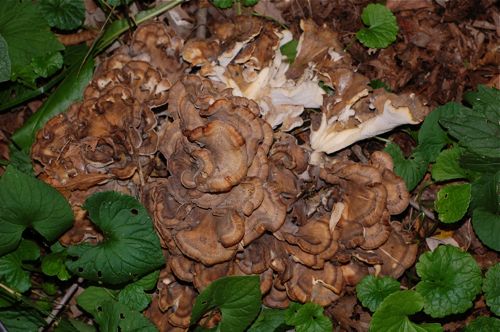
hen of the woods

Boy, am I glad I did!  I found Hen of the Woods!  A whole month earlier than I normally do thanks to our very cool summer weather--this is my FAVORITE edible mushroom.  I ran back to the house grabbed Lorraine and Groundskeeper Hans to show them.  As I was harvesting the tasty edible fungus, I marveled at how we almost missed it and found some start up of more Hen of the Woods next to this large clump, so hopefully more will come.  This was a bit older than what I normally harvest, but I was able to get all the bugs out before I froze it.

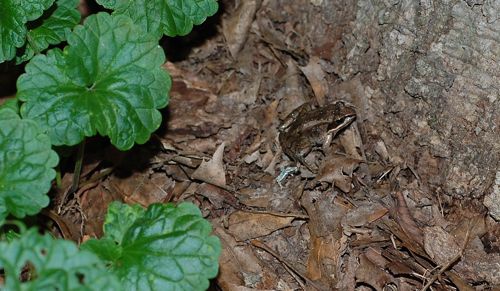
wood frog

This wood frog hopped out of the clump as I cut off the brackets.  I'm sure it was after all the bugs crawling around it.  I left some behind in the hopes that spores would grow more fungus and so the frog could have some bugs since I disturbed his bug buffet.

Chickadee At The Hummingbird Feeder

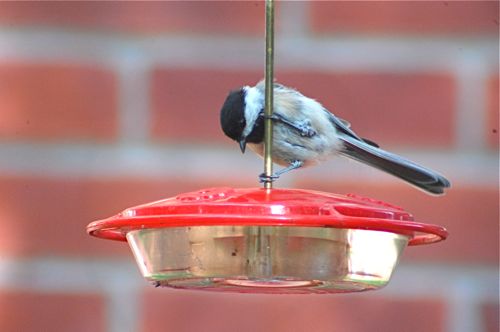
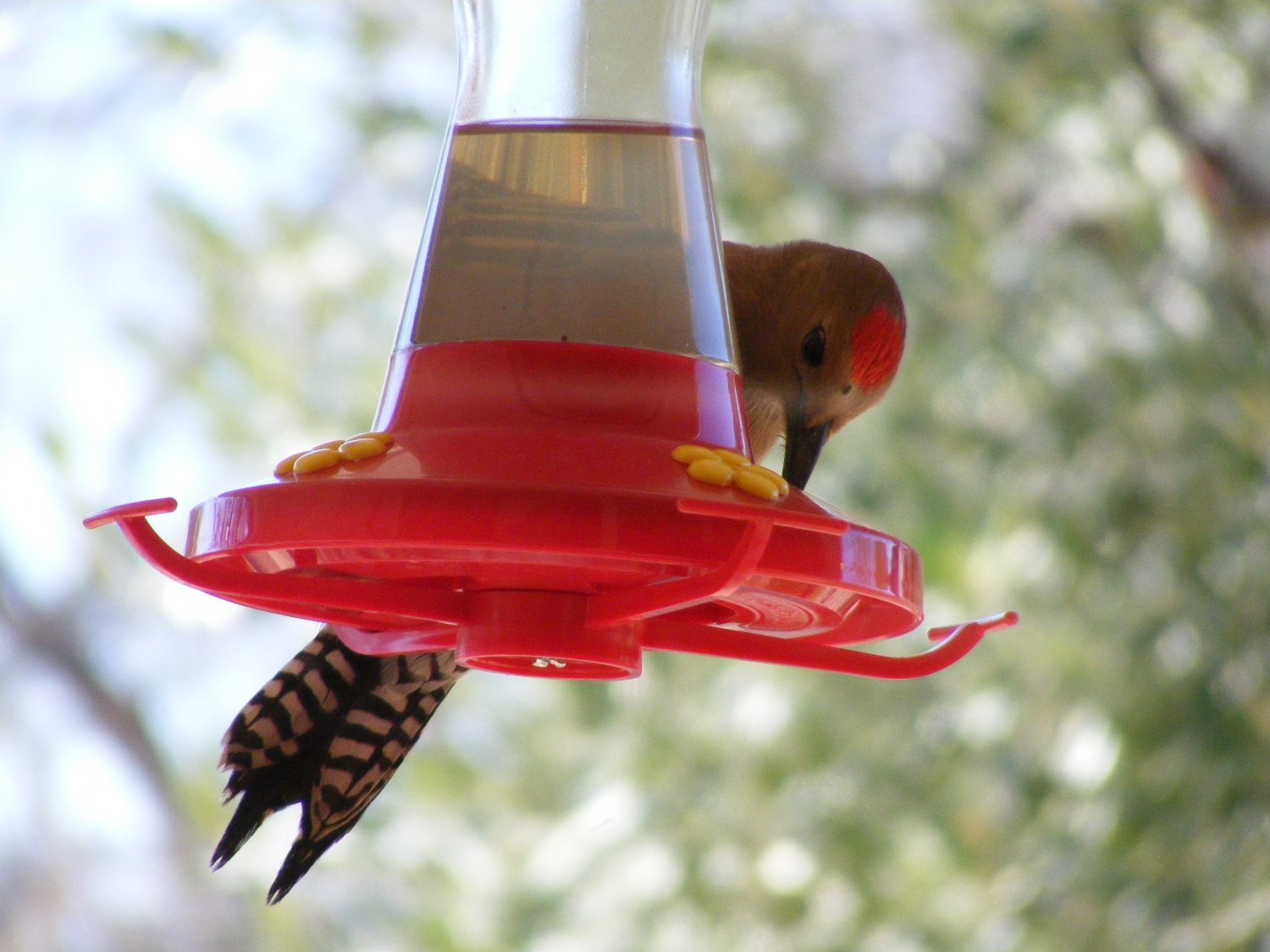
chickadee hummer For some reason this black-capped chickadee kept flying down to the hummingbird feeder today.  I don't think it was after the nectar. Unusual visitors like house finches, verdins, woodpeckers and even fruit bats are known to partake of the nectar, but I think this chickadee was going for either the water in the ant moat or insects hanging around.

mine

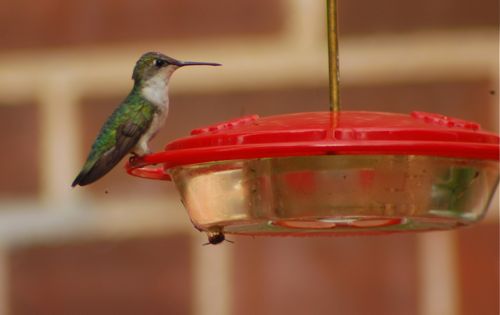
The ruby-throated hummingbirds were not happy about it.  It was funny to see a hummer zoom in right after it and then hear the chickadee sputter in irritation.