
Birdchick Blog
Harlequin Duck Again At Point Douglas
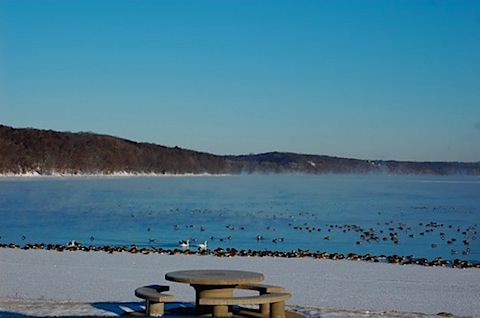
Winter got a tad aggressive last week. It's been weird, we had snow in early October, so I was prepared for six months of cold and snow. Then it got strangely warm for the rest of October and November and thought, "Terrific, maybe winter won't be so bad!"
Then out of nowhere, we went from 40 degree weather to below zero and single digits in one night--no build up, just blammo: booger freezing cold. On the upside, all the area lakes froze up in a hurry making places where water stays open popular with the remaining waterfowl. One particular hot spot this time of year is Douglas Point Park. This is where the Mississippi River meets with the St. Croix River on the Minnesota and Wisconsin border. I love it for a couple of reasons. One--it's in the boundaries of the National Park I work for and two--it's a hop, skip and a jump away from Carpenter Nature Center. The water here stays open and it corrals some of the waterfowl. I headed out there on Friday.
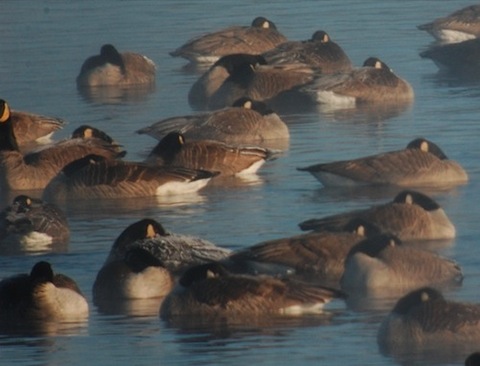
When I arrived, there was still a bit of a mist on the river and some of the Canada geese were covered in frost on the back. See the guy towards the bottom of the photo just covered in frosty white on the back? I always do wonder about ducks and geese in cold water. Yeah, I get that feathers are a terrific insulator and that birds have a different circulatory system and metabolism than humans so they handle cold in a way that I simply cannot understand--but damn, thats incredible to witness.
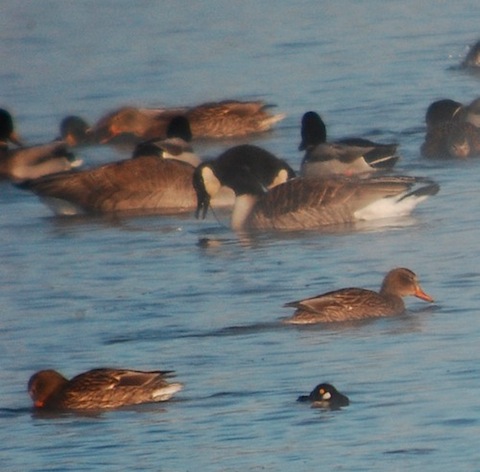
The mix was mostly Canada geese and goldeneye. The goldeneye crack me up, as soon as they realize a scope is on them, they dive or take off. I love this shot above of Canada geese and mallards and one lone lurking male common goldeneye coming up after diving under. Isn't he just a little Mr. Lurky McLurk Lurk!
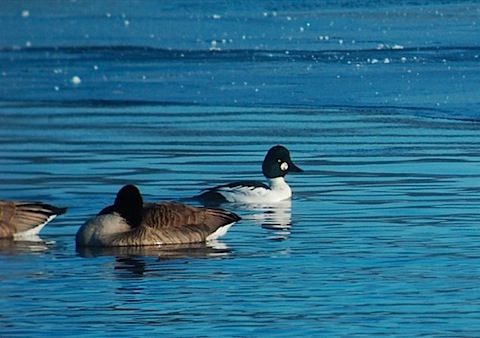
Goldeneyes are just awesome little diving ducks. We'd seen a ton of them on our waterfowl surveys this fall. It was a treat just to hang out and watch a big section of waterfowl and not have to worry about counting them or identifying them in a hurry. But I had plenty of time scan and got a kick out what I found:
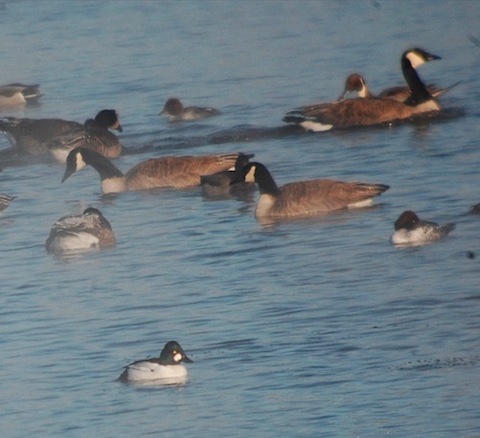
Like the stealthy pintail male behind the Canada goose in the upper right hand corner. It's fun to find a big stretch of waterfowl which on the surface look like a ton of Canada geese only to scan and find a few different guys mixed in.
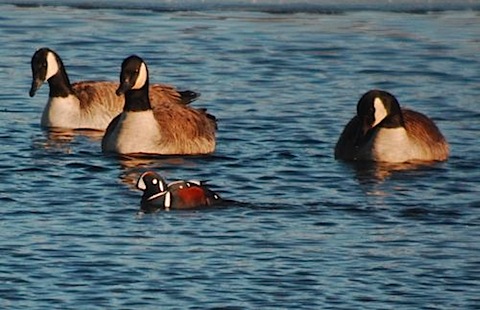
But the big excitement of the day was the above male harlequin duck that was floating around the area--even the Canada geese seem to look like, "What the duck is that??"
This duck is exciting on several levels. Number one: it's a cool looking duck--a male in full on adult plumage. When I tell my non birding friends about this exciting bird, I say, "It's blue and white duck!" They seem to understand. As a matter of fact, I'm typing this blog entry backstage during our Golden Girls Christmas Carol and the other actors agree that he is very, very sweet.
The second thing that makes this a cool bird is that a male harlequin duck, is not even supposed to be here any time of year and one has been spending the last three winters at this spot--this is quite possibly the same bird. If it is, I got a photo of him last winter.
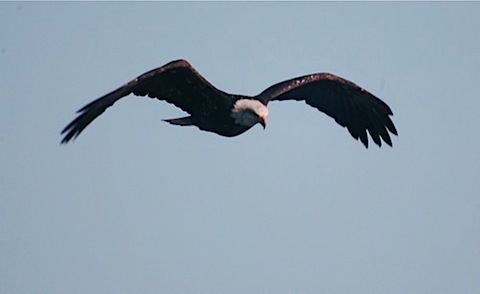
Just because the water stays open doesn't mean this is the safest place there is. Bald eagles patrol this spot regularly and both adults and immature eagles take pot shots at the waterfowl. I digiscoped the above bird actively hunting and it was zeroing in on some goldeneye. I've not seen an eagle take a dive at the harlequin. I wonder if Minnesota and Wisconsin eagles think blue ducks "just aren't right" and avoid diving for it? Nah, I've seen them eat dead chickens mixed in with chicken manure, I don't think their standards are that high. Must be one evasive harlequin duck.
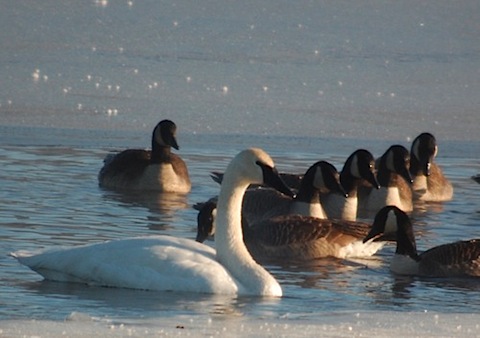
For some reason, this photo reminds me of a Huey Lewis and the News album cover. There were quite a few trumpeters mixed in with all the other waterfowl. It was fun to hear their trumpet calls rise above the over a thousand or so Canada geese. Since this spot was part of the Mississippi National River and Recreation Area, I asked my boss if I could work some of the day today at Point Douglas to help people watch the waterfowl. He bought it or...I should say, he agreed that it would be a great idea. I thought I would interact with mostly with birders from Minnesota and Wisconsin, but a vast majority of the people I spoke to just happened to be driving along the river and stopping for photos of the swans, completely unaware of the harlequin duck or other waterfowl. The harlequin didn't show up to Point Douglas while I was there in the morning, but there are still quite a few open spots around Prescott, WI. As the ice closes in further, people should have a better chance of seeing him this winter.
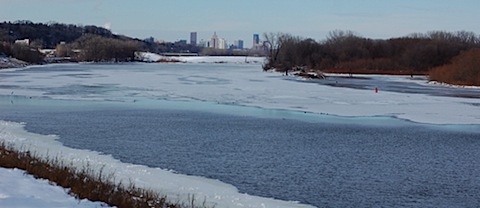
Word spread from some other birders that a long-tailed duck was seen along the Mississippi River in South St Paul on the corners of Grand Avenue and Hardman so on my way back to the visitor center, I stopped by to look for it. There were quite a few common mergansers working the shrinking patches of open water.
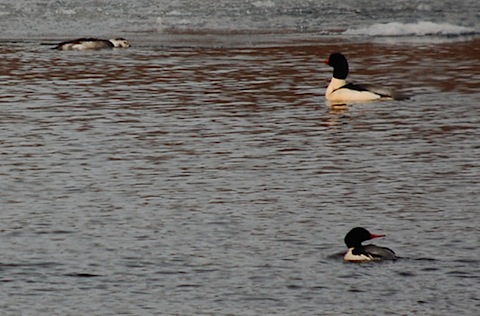
Sure enough, you could see it--she's the bird laying flat on the water. The other two are male common mergansers.
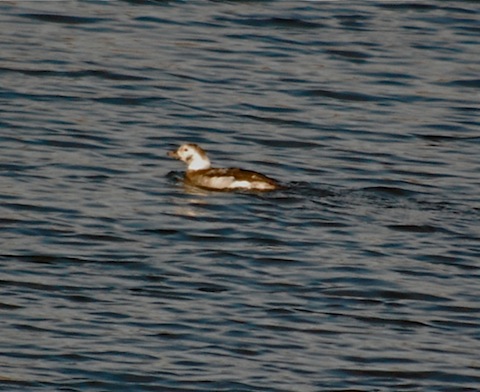
She's the opposite of the male harlequin, this is a female long-tailed duck. Still cool to see a rare bird, but not as striking as the male. This is a bird that I have a tough time convincing my non birding friends is a cool find. Word spread on the birding trail that a white-winged scoter was seen here earlier in the morning. I wanted to walk along the trail and look for it, but I had to get back to the visitor center--all in all, not a bad weekend for waterfowl.
Christmas Bird Count & Birds and Beers
The next Birds and Beers is December 17, 2009 at 6:00 pm at Merlin’s Rest.
Birds and Beers is an informal gathering of birders of all abilities–if you’re interested in birds, you’re invited. You can meet other birders–maybe find a carpool buddy, ask about where to find target birds, share cool research projects you might be working on, ask a bird feeding question, share life lists, share some digiscoping tips, promote your blog–the sky is the limit. It’s low key and it’s fun. I'll have to head out early that night. We added a performance to our A Christmas Carol: The Golden Girls Remix and I'll have a show at 9:30pm that night.
To get updates on when the next Birds and Beers will be, become a fan of Birds and Beers on Facebook and when a new event it planned, you’ll get a notification. Or check back here.

I imagine that we will be talking quite a bit about Christmas Bird Counts. And, hey, if anyone in the Twin Cities would like to try out a Christmas Bird Count, I'm looking for volunteers. We'll count any bird we see like the cardinal above to house sparrows to eagles to ducks to hopefully something really cool like maybe a Thayer's gull.
The Christmas Bird Count started in reaction to the 19th century tradition of people going out to shoot as many birds as they could on Christmas Day. In 1900 a group went out and counted birds rather than shoot at them and the tradition as grown to the big December event now. The data collected is used to document winter bird population trends in North America.
I've always wanted to participate, but for many years I worked retail and getting time off on a weekend in December is next to impossible. This year, I'm helping out with St Paul Audubon and their Christmas Bird Count area, specifically the Lilydale Area on December 19, 2009. I'm looking for people to help with the count!

This is my count area. If you live in this area, have some feeders (or not) and want to track what birds you see and turn those in, that would be great! If you want to bird Lilydale Park, we should have a great time. If you're thinking, I don't want to watch birds outside of the warmth of my vehicle and want to cruise some neighborhoods for birds, I can use you. Let me know in either the comments or drop me an email: sharon at birdchick dot com.
If you don't live near the Twin Cities but want to participate, find out what Christmas Bird Counts are in your area and see if you can help them.
New BirdsEye App
There is a very cool new application out for the iTouch/iPhone called BirdsEye and I love it!
The application was developed by Birds in the Hand, LLC, of Virginia, and brings together content from the Cornell Lab of Ornithology, eBird, the Academy of Natural Sciences, and Kaufman. It's available on the App Store in iTunes.
This is not a field guide, this is a bird finding guide. There are photos and some information, but if you were expecting a Kaufman Guide for your iPhone this is not it. But what it is, is incredibly useful and solves a few problems for me.
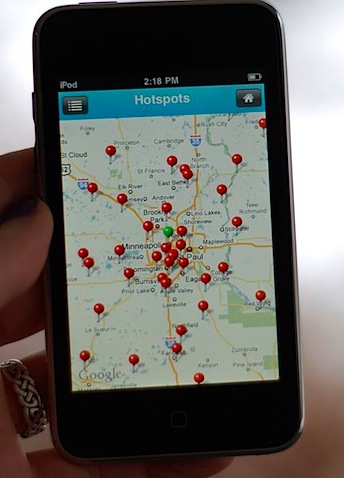
The application requires access to the internet. I have an iTouch and so if I have access to a wifi signal, I can use it. If you have an iPhone, you can use it with your internet plan. The menu gives you the option to either look for nearby birds, look for a specific bird, find out what birding hotspots are near where you are at that moment, check out what birds are being reported at a particular location, and keep a life list of North American Birds. Above, I have entered where I was starting from--that's the green dot and all the red dots are birding hotspots near me--at least, hot spots that have been entered into eBird.
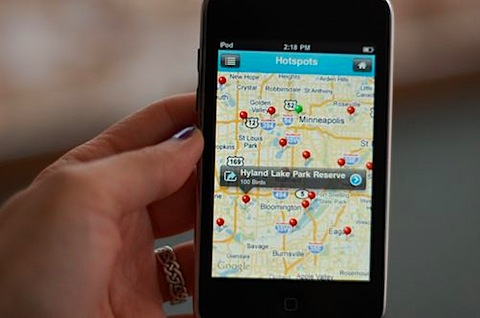
I touched one of the red dots on the map and the name of the location came on. It mentions how many different bird species have been reported at this location (by eBird users). If you touch the blue arrow next to the name, it will bring up a list of birds and a thumbnail photo of the birds.
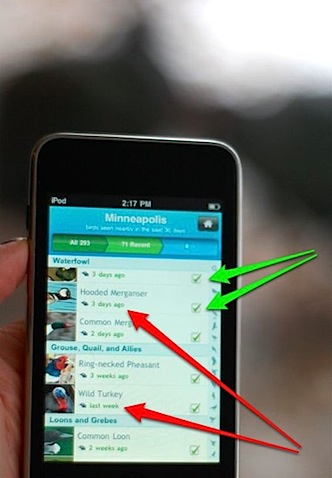
You can see the lower red arrow is pointing to wild turkey (and the two dark blobs behind my iTouch are turkeys that were staring at me at Hyland Lake's visitor center). But note that under the turkey it reads, "last week." That means someone reported it at this location last week. Check out the hooded merganser, it's been reported on eBird within the last three days. The green arrows are pointed to check marks. That means I have checked that bird off on my life list. Thanks to this app, I can look up a bird and see if I've seen it before...and I know how many birds I have on my North American life list.
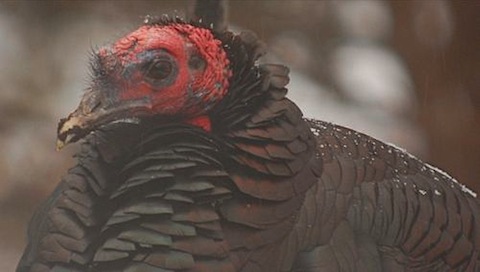
Here's one of the turkeys that's listed as being seen in the last week at Hyland--I saw it. As a matter of fact, when I came home, I logged into eBird and entered in the birds I saw at Hyland...
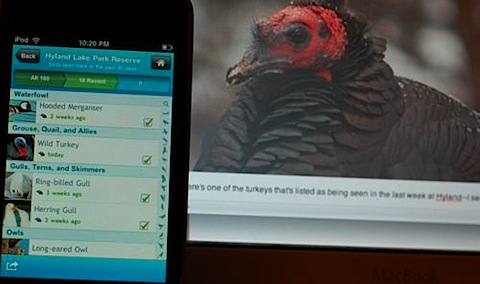
And if I look at the Hyland list now--it reads that the turkey was seen today--that's my update! It updates surprisingly fast. I'm told that the eventual goal will be that you will be able to update your lists to eBird by using the app, but it's not quite ready for that yet. But for a bird finding tool, this is really, really cool.
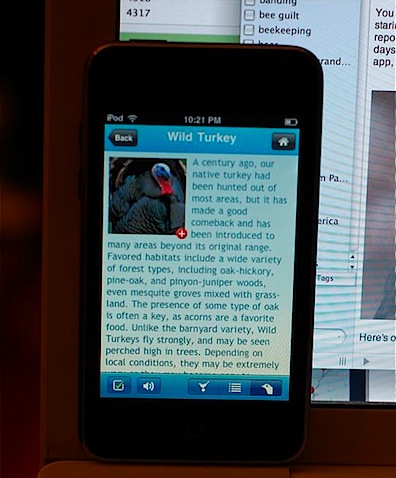
The initial app costs $19.99 and comes with gorgeous photos from VIREO as well as bird calls from the Macaulay Library of Sounds for 470 of the most reported species. The photos and bird calls also include a brief description written by Kenn Kaufman. The descriptions are not to give you clues to tell a first year Thayer's gull from a first year Iceland gull, they are designed to help you find the bird by mentioning behavior and habitat. Also, the photos tend to fall on the pretty side, not on the identifiable side of things.
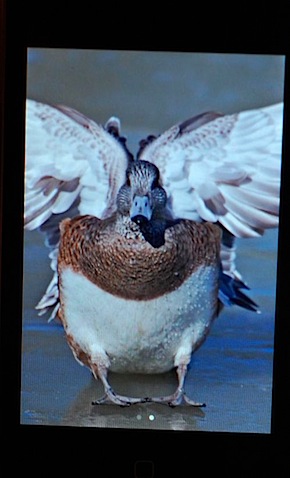
For example, the above is an interesting photo, but I'm not sure it's the most useful for helping a person id an American wigeon. Keep in mind that this is designed to help you find birds around your home and travel in North America, the photos are just a reminder of the species. I will say, the bird call collection is very good. I was disappointed that there were only 470 bird species with the added photos, calls and descriptions. For example, when I was going through it for last week's Sax Zim trip, I was able to find photos and descriptions for northern goshawk, but not northern hawk ow. I can purchase the rest of the birds (another 377), either by group for $2.99 per or all of them for $19.99.
I understand why it is this way--it costs money to get access to the photos, bird calls and Kaufman's time to write the descriptions. This app is worth the price, I'm not sure I'll go for the rest of the photos and calls--I already have that with birdJam. But using this for locating birds birds is awesome.
I love this app because it's solving several issues for me:
1. I've grown tired of the birding listservs. Every state's birding qroup has their quirks and nothing brings out quirkiness like email. I unsubscribed to my state's birding listservs during one of my longer trips and was amazed at how much I didn't miss it. I didn't have to see the emails from birders arguing over how dead a bird has to be before it's no longer countable, or the hardcore birders who get mad about backyard sightings or the casual birders who take hardcore birders to task for for just listing. With this, I can get bird reports without the added quirkiness.
2. I've always thought eBird was a good idea, but never got in the habit. This gives me a good reason to form the habit--especially if the app will eventually let me report birds with it.
3. I now have a reason to use my iTouch. My phone is a Blackberry. I have the iTouch because it came free with Non Birding Bill's last MacBook purchase. I've half-heartedly been using it and seriously considered selling it (I still have an older iPod with all my music on it). But ever since I got this app, I've been using my iTouch on a daily basis...well, that and FourSquare.
I've been behind on getting my gift guide together, but this is the most exciting bird app I've seen come down the pike this year.
An OpenSky Promotion
I just got an email from from OpenSky that from now until Wednesday at midnight you can sign your email up and receive a coupon. Coupons range from $15 - $100 off or 10% - 50% off. If you are interested, you enter your email address here and use the code BIRDCHICK. Everybody who enters and email gets a coupon and the earlier to enter, the better the coupon you get.
Remember that if you shop at my OpenSky store, 20% of the profits goes to fund kid programs for the American Birding Association.
Growing Nyjer Thistle In North America
Last Saturday was the Minnesota Ornithologists' Union Paper Session (a boring term for annual gathering). One of the presentations was from John and Lisa Loegering about attempts to produce Nyjer in North America.
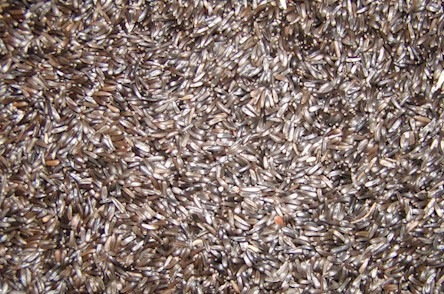
Let's get some basics down about this seed first, on the off chance that someone reading this doesn't know about the tiny seed for finches. Above is a picture of Nyjer also known as Niger and Thistle. Most of what you purchase for goldfinches at your local feed store comes from Singapore, Burma (I remember seeing that location frequently when I got in 50# bags at the bird store I managed), Ethiopia, and Myanmar. This is not a seed grown in North America. It is in no way related to the noxious weed thistle. It was originally called Niger but frequently got mispronounced as a racial slur. So many retailers referred to it as thistle. Since some got confused that it might be seeds of the noxious weed thistle, some cities tried to ban its sale. The Wild Bird Feeding Industry has pushed for the name to be changed to a phonetic spelling: Nyjer.
Confused yet? Basically at bird stores: Nyjer = Niger = Thistle, it is all the same seed. It's that tiny seed you put out for finches, siskins and redpolls and it's not grown in North America--one of the reasons it's one of the more expensive seeds.
According to the Loegerings, attempts have been made to grow a type of Nyjer in North America. A Niger Growers Group was even formed. By 2002, a plant had been developed and seeds were produced...and no bird would touch it. The group contacted the Loegerings and asked them to figure out why birds wouldn't eat the seeds. They set up 15 different feeding stations with the North American Nyjer in one feeder and Ethiopian Nyjer in the second. They measured the amount of seed put in the feeder, the amount the birds ate, the type of birds and the flock composition. The most common birds coming to the feeding stations were goldfinches and redpolls. Sure enough, if the birds had their choice, they ate the Ethiopian Nyjer more than the North American Nyjer.
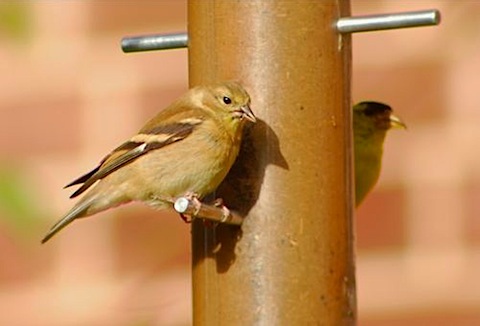
Loegering wondered what was different. One of the first things that came to mind was that Ethiopian Nyjer is supposed to be heat treated to prevent it from germinating in North American soil (we all know how successful that is...not). So he got the directions for the exact process and heat treated the North American Nyjer and restarted the experiment. This time, the finches ate both types of Nyjer at the same rate. Now why would they prefer the heat treated seed? Does the heat remove the moisture to make the shell easier to crack? Does it make for a better tasting seed? Does it look different in the UV color spectrum? We don't know.
Now, this does not mean you will be finding locally grown Nyjer anytime soon. The Nyjer Growers Group has since disbanded. Part of the reason is that there is no farm equipment available to separate the tiny seeds from the chaff. Nyjer is all hand harvested overseas, think about that when you are pouring it into your feeder--that is a hand harvested seed. Kind of makes you wonder about the age of the harvesters and if they are paid a fair wage for harvesting that bird seed. Between that and tariffs, you can understand why it's an expensive feed to put out. The other reason was that when corn prices went crazy on all the ethanol speculation, many farmers gave up trying to grow bird food like Nyjer or sunflower (it's costly since you have to protect from the very creatures it is being grown for) in favor of growing corn. They also gave up some of their CRP land, so birds got a raw deal from ethanol...no bird can live in a corn field.
And now a few words from one of my site's sponsors:
Hey! While we're talking Nyjer and finches, you might need one and some are available at the Birdchick's OpenSky Store. One that is pictured quite a bit in my blog and used by thousands of finches is the Finch Flocker (a 36" feeder). There's also the Droll Yankee Clever Clean Series for finches too.
Remember that 20% of the profits of my store are donated to the ABA's kids programs.
You must follow the link below
Peregrine falcon vs snowy owl. What more do you need to know?
Jays Feeding On Suet
I thought this was a fun contrast of jays feeding at Sax Zim Bog. Here we have the gray jay feeding on the deer rib cage--something that they would feed on naturally in the wild if say a wolf had killed a deer and the cage was exposed to the elements:
And here we have a blue jay feeding on a suet cage with a flavored suet cake--suet that has evolved over the last few decades. It's gone from being just fat from a carcass to a melted down substance with nuts and seeds and who knows what else added to it for flavor.
I love the blue jay bouncing on the thin branch and the cage swings to and fro.
Bird Feeding In Britian Affects Birds
Well, now here is an interesting article from BBC News on how bird feeding id affecting birds over in Europe. The traditional thinking with bird feeding is that birds use feeding stations as a small part of their diet, using various other sources for food. But a study on a European warbler called a blackcap is changing that. Scientists seem to think the bird is in the very early stages of evolving into a new species:
The birds' natural wintering ground is southern Spain, where they feed on the fruits that grow there.
Researchers describe the impact this well-intentioned activity has had on the birds in Current Biology journal.
Dr Martin Schaefer from the University of Freiburg in Germany led the research. He and his team found that blackcaps that migrated to the UK for the winter were in the very earliest stages of forming a new species. He explained that some blackcaps (Sylvia areicapilla) would always have migrated "a little further north" than others and eventually "ended up in Britain in the winter".
"But those birds would have had nothing to eat," he said.
It was when garden bird feeders became more popular in the UK, that an evolutionary division began to emerge.
"As soon as the British provided a lot of bird food, those birds would have had a much higher probability of surviving the winter."
And because the UK is closer to their breeding ground, those birds would also have returned earlier to claim the best territory. The researchers, from Germany and Canada, set out to discover if the birds that spent the winter availing themselves of garden bird-feeders were in fact a distinct group. To do this, they studied the blackcaps at a breeding ground in Germany. The team were able to use a chemical "signature" from the birds' claws to identify where they spent the winter, and what food they ate.
"Then we took blood samples and analysed those to assess whether... we had two distinct populations. And that's exactly what we found," said Dr Schaefer. To a very large extent the birds only mate [with] birds with the same overwintering grounds as them."
This initial "reproductive isolation", Dr Schaefer explained, is the very first step in the evolution of a new species.
"This tells us that by feeding birds in winter we... produce an evolutionary split. And we have produced these initial steps in as little as 50 years."
The team also observed differences in the birds' beaks, wings and plumage. Blackcaps that migrated along the shorter route to the UK had rounder wings, and longer, narrower beaks. The scientists said these differences were evidence that the birds had adapted to their shorter journey, and to eating seeds and fat from bird-feeders, rather than fruit from shrubs and trees. But, Dr Schaefer pointed out that the evolution of a new bird species "could take 100,000 to a million years".
"At this stage this is reversible," he added. "And it's hard to envision a species change, because if there's another economic crisis and people stop feeding the birds, the whole system might just collapse."
In this case, Dr Schaefer thinks the human impact on blackcaps has been a positive thing.
"[The birds have] found a better overwintering area that is closer to the breeding ground, where they can obtain food easily. And I also think its positive news for us, because it means not all the changes we produce are necessarily bad, and that some species have the potential to adapt quickly to the changes."
You can read the full article here.

Which now makes me wonder if more in depth banding and blood samples need to done on North American birds--like goldfinches. Are feeders making a change in some of their winter movements? It's kind of mind blowing if you think of that research on the blackcap. It's one thing to affect a bird species population and seasonal movement, quite another to cause a species split.
This also makes me think of the trumpeter swans in Monticello, MN. As trumpeters were being reintroduced to Minnesota in the mid 1980s, a woman in Monticello, MN was casually feeding ducks and geese from her yard on the Mississippi River every winter. In 1986 a few trumpeter swans joined the group for the winter. The Mississippi water stays open all winter long because of the nearby power plant, giving the swans a safe place to roost at night. Over the years, more and more swans showed up and now it's a tourist attraction to see the 1000 - 2000 trumpeter swans wintering in her neighborhood in Monticello. The woman still feeds the trumpeter swans and puts out over 1400 pounds of corn a day!
That's one woman who has changed a migratory population of birds and added a tourist attraction to her town to boot.
Birding Sax Zim Bog
I really hate car shopping. When we had to go through the process a few weeks ago, I heard through the MN birding grapevine that several northern hawk owls were reported in northern Minnesota, I decided a day up to Sax Zim Bog with my good friend Amber would be my reward. Besides, what better way to get to know our Kia Pet (the named dubbed to our very beige vehicle because it looks like a Chia Pet before the grass grows out) than by taking it on an all day birding trip?
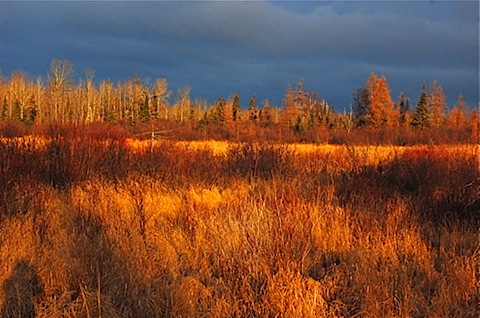
Since daylight is short, Amber and I left the Twin Cities early to arrive at Sax Zim Bog just after sunrise and get some great photography light. Our plan seemed to work. The light was great when we arrived, and dark clouds in the distance only enhanced the bog's colorful landscape.
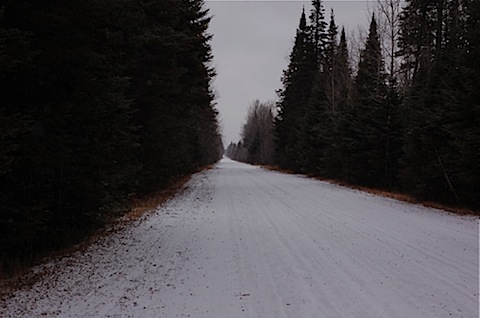
Alas, the sun was a total tease and soon hid behind clouds that brought light snow. On the upside, I got to really test out the Kia Pet's brakes and refamiliarize myself with driving on snow and a few patches of black ice. Whoopee, I stayed out of the ditches. I do laugh, we've had this vehicle for a couple weeks now and I still drive it like our old sensitive Saturn, like pausing before I press the gas to go in reverse. You had to give the Saturn a minute to think about it or she wouldn't reverse or would jerk violently into it. I forget with this car, I reverse without pause. Ah, the joy of driving a reliable car! But back to birding the bog...
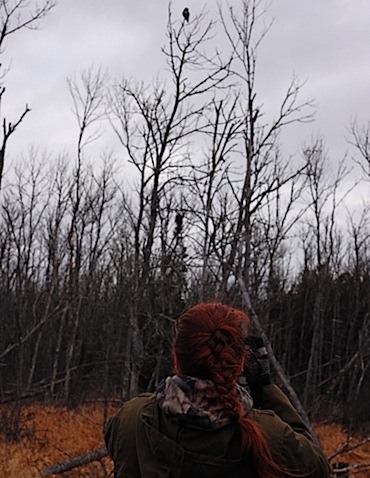
We got a northern hawk owl right away near the corner of 7 & 133 near Meadowlands. If you are interested, there's a google map of where northern hawk owls have been reported which members of the Minnesota Ornithologists' Union add sightings to help those who visit the bog. There appears to be a small irruption of hawk owls this year (perhaps a crash in the vole population on their breeding grounds, pushing quite a few owls south into Minnesota). It's not on the scale of the owl irruption of 2004/2005 but we will never see the likes of that again...or at least not in our lifetime.
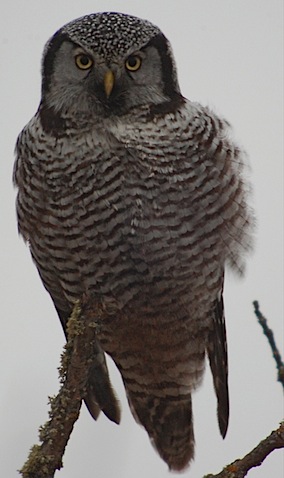
This bird put on quite a show for us, as it was actively hunting. It dove down into the grasses, we could see it scurry though and then fly back up. This spot is right next to some railroad tracks and is a road that's used quite a bit in the bog. I'm always fascinated by an owl's ability to hear any prey in a spot like that. I must say, I'm loving the Nikon D40 for digiscoping. This photo turned out way better than it should have considering how low the light conditions were. In the past I've used point and shoot cameras for digiscoping with my Swarovski scope and I would have gotten blogable photo, but nothing this clear on a cloudy day. We ended up seeing a second northern hawk owl as we meandered around the bog, but it was much further away from the road and flew off to parts unknown. I couldn't believe we got our target bird so early.
But the blog is not just about owls, there are so many great birds to find this time of year!
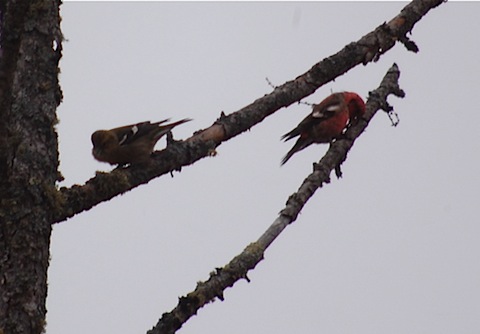
We used the MOU's Sax Zim Bog site maps (particularly the Birding Roads tab) and went looking for birds. Any time we saw a flock of birds land nearby, we pulled over to investigate. We found a small flock of white-winged crossbills working their way through.
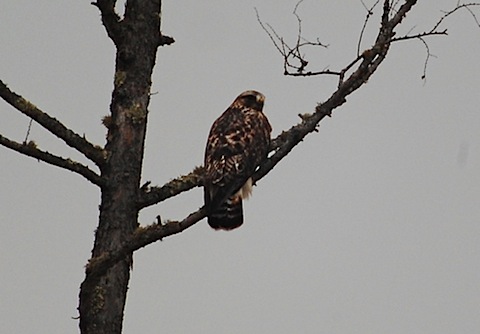
We also saw about a dozen rough-legged hawks--each one different (we even saw a couple of dark morph birds). We saw many bald eagles as well but we did note that we did not see any red-tailed hawks, interesting change of buteos. The rough legs are very cagey and hard to get photos of. No matter how far away you park, as soon as the scope is trained on them, they poop (a sure sign they are about to fly)...

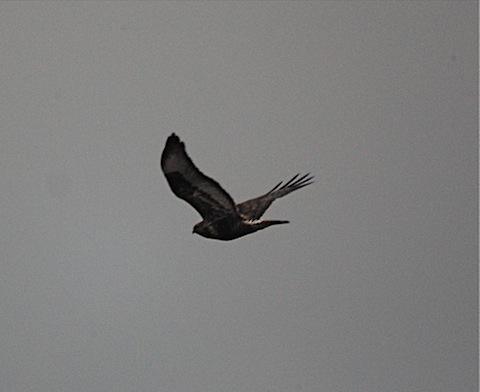
This is a different bird than the one perched above--very dark, almost a dark morph. It's cool to see them in so many different color variations. One of the things I love about living in Minnesota is that a day's drive at the right time of year can give you a completely different set of birds. In the Twin Cities, we're loaded with red-tailed hawks. A two and half hour drive north and we're surrounded by rough-legged hawks. Awesome to have a change of pace.
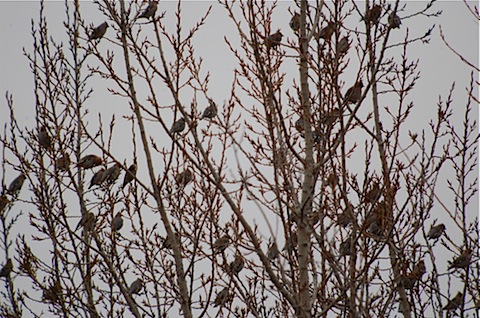
Speaking of a change of pace, Amber and I started following another large flock of birds. When they landed, I rolled down the car windows and was excited to hear the louder and deeper trills of bohemian waxwings.
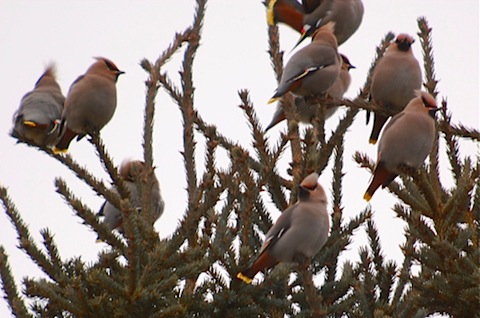
Here's a closer photo of them. Can you spot the differences between these and a cedar waxwing? If you follow this link, you'll see photos of cedars--they have white butts. The above bohemians have rusty butts. Bohemians also have a red and white patch on their wings. So, cool--a different type of waxwing too! I tried to get a video so you could hear the difference in their calls, but the wind blocks it a bit:
At Xeno Canto, you can also here the difference. This is the sound of cedar waxwings and then this is the bohemian waxwings.
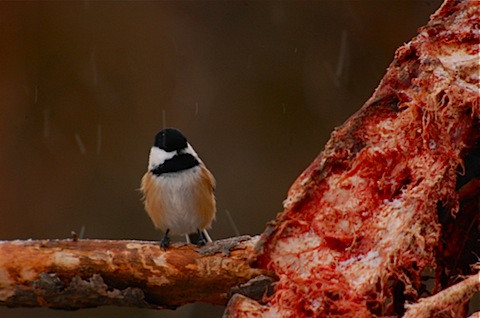
We drove down Admiral Road where a deer carcass is usually hung. In the past this has been a great spot for all sorts of birds. Amber and I found that a deer carcass was already up. Black-capped chickadees and down woodpeckers snuck it for bits of fat and meat.
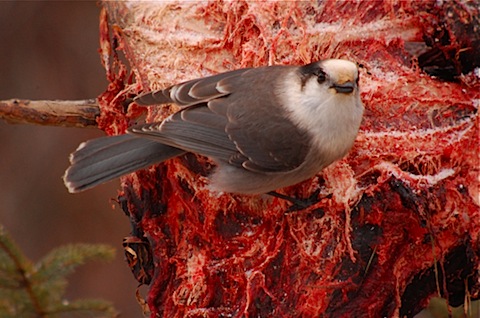
As did about five gray jays (who kind of look like a balding chickadee on steroids). I showed this video to Non Birding Bill and he said it reminded him of Hannibal Lecter which led to this photo caption. There ended up being about five gray jays who came in for the food source. It was interesting to watch the difference in these jays, the crept in quietly like the snow for the food. I'm so used to blue jays--or even green jays or Steller's jays who noisily announce their presence before coming into a feeding station. These birds swooped in secretively, very unjay-like.
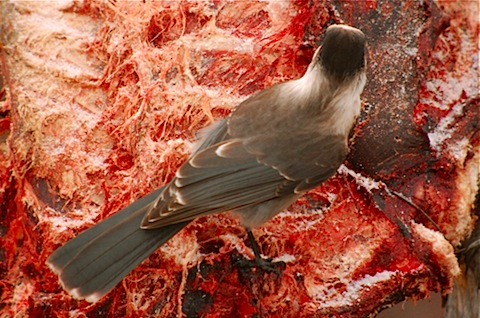
I loved the contrast of the ragged, bloody cage compared to the soft feathery gray of the jay. I took a ton of photos, but the wind picked up at this point and my eyes were watering, I could barely focus my scope.
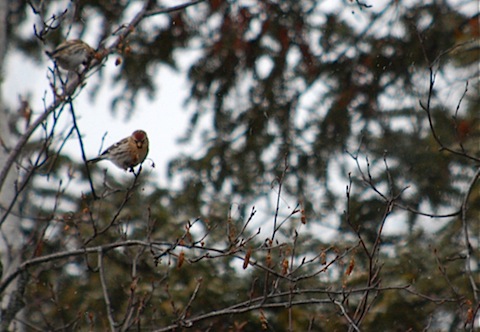
We also came across several flocks of common redpolls feeding on birch seeds. It was great to see them eating on a natural food source and not a feeder (not that I won't take them at a feeder, but I read they eat birch seeds, I enjoy seeing a bird doing what a researcher tells me they do). We've already had pine siskins show up at Mr. Neil's. I wonder if we'll get redpolls too?
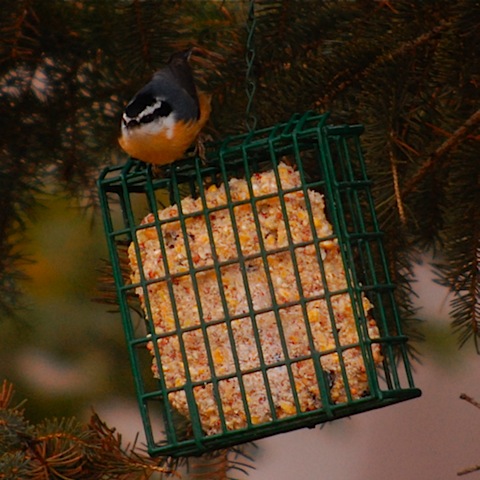 We also stopped at one of the feeding stations open for public viewing at the bog (which was innundated with red-breasted nuthatches). One of the residents has been kind enough to put bird feeders at the end of their driveway and you can park across the street and stand at the end of the driveway and enjoy the birds. In the past, this has been chock full of birds. She came out to greet us and said they had just put the feeders up so the birds were just discovering it. There's normally a little box requesting donations for bird food, she hadn't even had time to put that out yet (so we put a few bucks in her mailbox as a thank you).
All in all it was a GREAT day. We didn't see every bird possible--no boreal chickadee or great gray owl so Amber and I decided that we're going to have to take another day and bird the crap out of the bog.
We also stopped at one of the feeding stations open for public viewing at the bog (which was innundated with red-breasted nuthatches). One of the residents has been kind enough to put bird feeders at the end of their driveway and you can park across the street and stand at the end of the driveway and enjoy the birds. In the past, this has been chock full of birds. She came out to greet us and said they had just put the feeders up so the birds were just discovering it. There's normally a little box requesting donations for bird food, she hadn't even had time to put that out yet (so we put a few bucks in her mailbox as a thank you).
All in all it was a GREAT day. We didn't see every bird possible--no boreal chickadee or great gray owl so Amber and I decided that we're going to have to take another day and bird the crap out of the bog.
Digiscoped Images
Fresh Tweets
Would you like to hire me as a speaker for your event?
Email sharon@birdchick.com