Birdchick Blog
The One That Got Away
A couple of weeks ago, I saw a squirrel loafed out on the top of the telephone pole outside our kitchen window. It seemed to be staring in, willing me to put seed out on the ledge of the kitchen window. It would then be able to walk the wires to gain access. I'm not really supposed to feed birds there. That window is right over the back door of our building. But I figured one little handful wouldn't hurt. It would snow soon, covering any evidence of empty seed shells below.
But the squirrel ignored the seed. A week went by. It snowed. Nobody ate the seeds, nobody noticed the seeds. That is, until today, a curious chickadee found the stash and quietly spirited away the black-oilers one by one (leaving the white millet untouched--no surprise there).
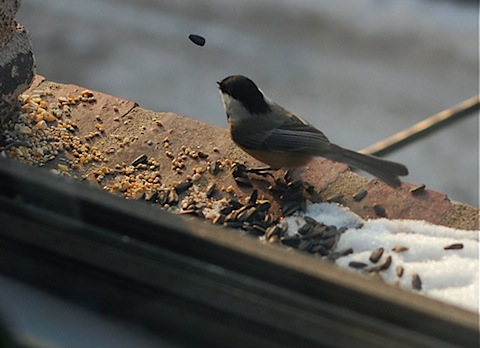
Although, one seed did escape the little bird. You could almost here a Homer Simpson-esque, "Doh!" as it slipped over the side.
Now, let's see how much I toe the line and sneak bird seed on this ledge over the winter. I think as long as the pigeons and house sparrows don't find it, I can manage my bird feeding addiction.
Neck Bands on Swans and Geese
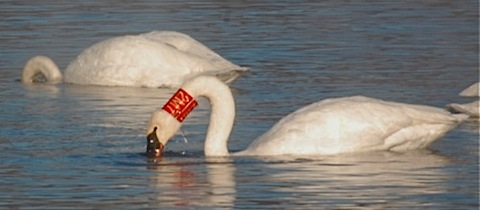
So, when I was out looking at the harlequin duck last week, I found a few banded birds at Point Douglas. It's not the first time, last winter I got video of a banded trumpeter swan. I sent the band info along to the Bird Banding Lab and it turned out the bird was from Iowa. I saw the above swan with a neck band and noticed that it had a different code and sent that along to the lab. I'm still waiting to see where this bird came from. But notice how the band is moving up and down the swan's neck. Above, the bird is just taking its head out of the water and the band has slid towards the head.
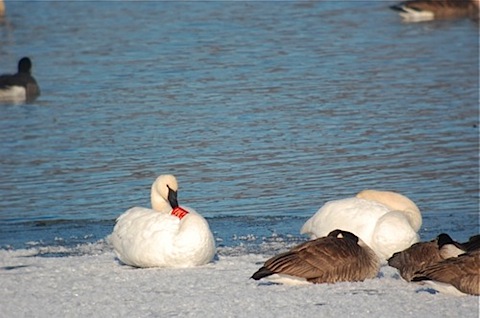
Here that same swan is preening and you can see that the band has moved back down. These types of bands are used on swans and geese to track individuals and where they are going. There's no way you'd be able to do id that particular swan with just a leg band (even if they are out of the water). Those metal bands on the legs are too tiny to read. But the bright plastic neck bands are easy to spot and read with a scope or binoculars. Because of the reintroduction program with trumpeter swans, it's not out of the ordinary to see one here and there.
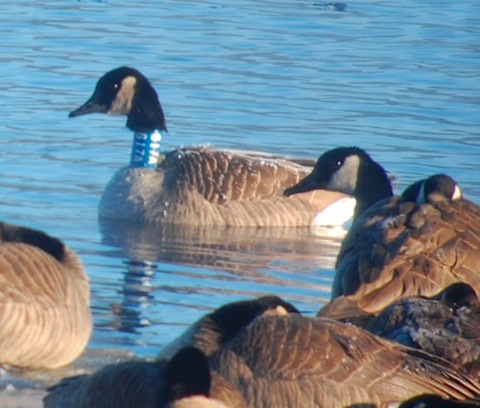
It is, however, unusual to see bands on a Canada goose these days. You used to see it all the time with the Canada goose reintroduction in the 1980s but by now it's an understatement to say that the geese are well established so it's not so common. But what really struck me about this goose was how tight the neck band appeared. I took this photo the same day, during the same time period as I did the trumpeter swan. The goose's band did not move like the swan's neck band did. It did not look comfortable at all. At first, I thought that maybe this was a fluke that maybe I caught this bird at a bad angle, but all my photos look the same, the band looks tight and does not move no matter what position the goose was in.
Then, earlier this week, this story appeared in the Duluth paper about a Canada goose that had Ice build up on its neck band. If you follow the link, you can see photos--the ice is about the size of a dinner plate. It has a happy ending, rescuers were able to get the goose and remove the ice and the collar but it has me questioning neck bands used for Canada geese.
I have to say, I'm a bander, and I see the value of neck bands--I truly do. But I think we need to rethink how neck collars are designed for some species. Even if the Canada goose in my photos is fine and the BBL backs it up with research and studies that say those collars look bad but are comfortable and fine for the geese--it's not a good advertising for banding. If someone knows nothing about banding saw that, they'd have a hard time seeing the value of banding and that it's not harmful for the banded birds.
Mom's Christmas Cookies
I'm trying my best to get through all of my Christmas errands this week. Tonight I divide up honey to give to the family. Bill and I gave each other a Roku box for Christmas (which conveniently arrived early). This magical box allows us to watch Netflix instantly on our tv. Right now, as I type this, I'm watching the Parapluie de Cherbourg. Streaming technology is a strange and wonderful thing.
I'm also enjoying a box of cookies that my mother made and sent up from Indiana. I post this to answer the same questions she asks every year:
Yes, the cookies arrived. Thank you.
No, none of them were broken!
Yes, we actually eat them!
And to prove it and show everyone what massive cookie makin' skillz my mother has:

She made us a Cinnamon the Disapproving Rabbit cookie. Look at the fluffy white tail and the chocolate icing she made to get Cinnamon's coat just right.

She also makes a pretty cool bald eagle--again with home made chocolate icing! Very nice.

Oh no! Cookies running amok! The eagle is trying to steal my disapproving bunny! Run, Cinnamon, run!

Alas, the eagle got the bunny and I had to step in and reestablish my top position on the food chain. Gr.
And that concludes this portion of Cabin Fever Theatre.
See, mom, we do enjoy your cookies.
Harlequin Duck Again At Point Douglas
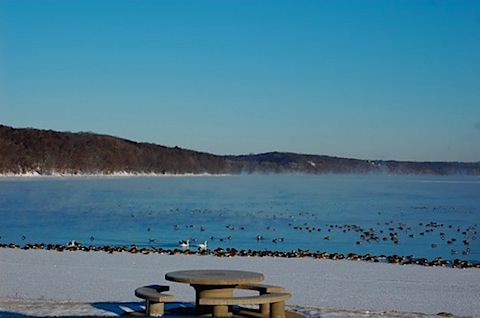
Winter got a tad aggressive last week. It's been weird, we had snow in early October, so I was prepared for six months of cold and snow. Then it got strangely warm for the rest of October and November and thought, "Terrific, maybe winter won't be so bad!"
Then out of nowhere, we went from 40 degree weather to below zero and single digits in one night--no build up, just blammo: booger freezing cold. On the upside, all the area lakes froze up in a hurry making places where water stays open popular with the remaining waterfowl. One particular hot spot this time of year is Douglas Point Park. This is where the Mississippi River meets with the St. Croix River on the Minnesota and Wisconsin border. I love it for a couple of reasons. One--it's in the boundaries of the National Park I work for and two--it's a hop, skip and a jump away from Carpenter Nature Center. The water here stays open and it corrals some of the waterfowl. I headed out there on Friday.
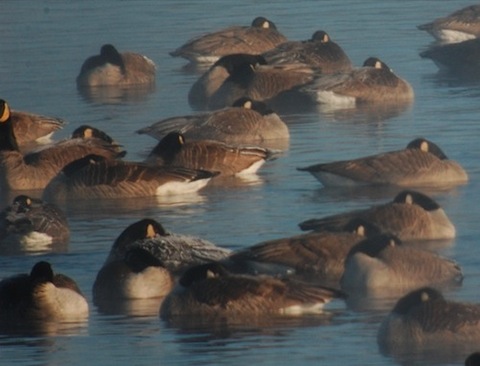
When I arrived, there was still a bit of a mist on the river and some of the Canada geese were covered in frost on the back. See the guy towards the bottom of the photo just covered in frosty white on the back? I always do wonder about ducks and geese in cold water. Yeah, I get that feathers are a terrific insulator and that birds have a different circulatory system and metabolism than humans so they handle cold in a way that I simply cannot understand--but damn, thats incredible to witness.
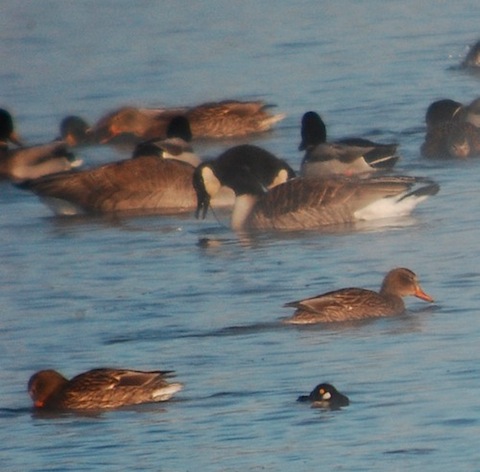
The mix was mostly Canada geese and goldeneye. The goldeneye crack me up, as soon as they realize a scope is on them, they dive or take off. I love this shot above of Canada geese and mallards and one lone lurking male common goldeneye coming up after diving under. Isn't he just a little Mr. Lurky McLurk Lurk!
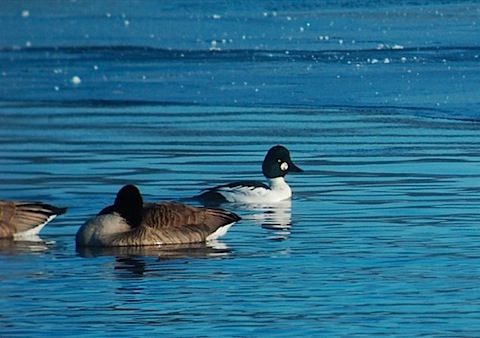
Goldeneyes are just awesome little diving ducks. We'd seen a ton of them on our waterfowl surveys this fall. It was a treat just to hang out and watch a big section of waterfowl and not have to worry about counting them or identifying them in a hurry. But I had plenty of time scan and got a kick out what I found:
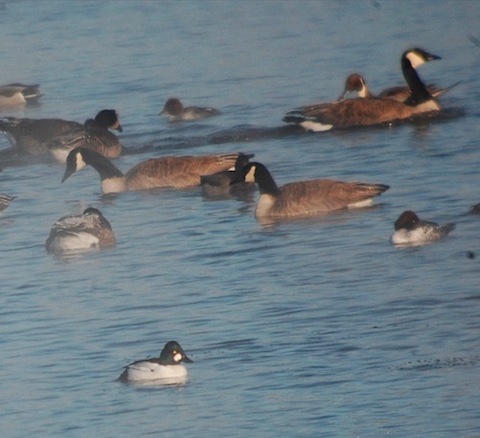
Like the stealthy pintail male behind the Canada goose in the upper right hand corner. It's fun to find a big stretch of waterfowl which on the surface look like a ton of Canada geese only to scan and find a few different guys mixed in.
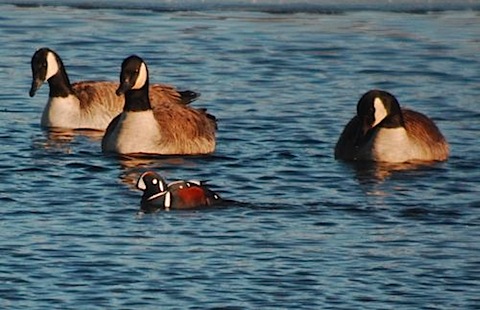
But the big excitement of the day was the above male harlequin duck that was floating around the area--even the Canada geese seem to look like, "What the duck is that??"
This duck is exciting on several levels. Number one: it's a cool looking duck--a male in full on adult plumage. When I tell my non birding friends about this exciting bird, I say, "It's blue and white duck!" They seem to understand. As a matter of fact, I'm typing this blog entry backstage during our Golden Girls Christmas Carol and the other actors agree that he is very, very sweet.
The second thing that makes this a cool bird is that a male harlequin duck, is not even supposed to be here any time of year and one has been spending the last three winters at this spot--this is quite possibly the same bird. If it is, I got a photo of him last winter.
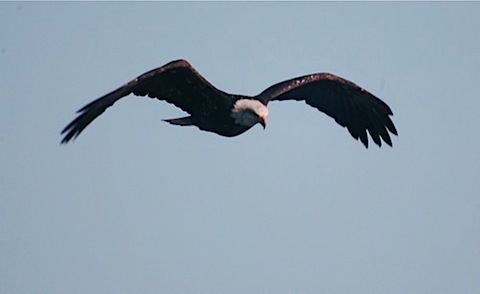
Just because the water stays open doesn't mean this is the safest place there is. Bald eagles patrol this spot regularly and both adults and immature eagles take pot shots at the waterfowl. I digiscoped the above bird actively hunting and it was zeroing in on some goldeneye. I've not seen an eagle take a dive at the harlequin. I wonder if Minnesota and Wisconsin eagles think blue ducks "just aren't right" and avoid diving for it? Nah, I've seen them eat dead chickens mixed in with chicken manure, I don't think their standards are that high. Must be one evasive harlequin duck.
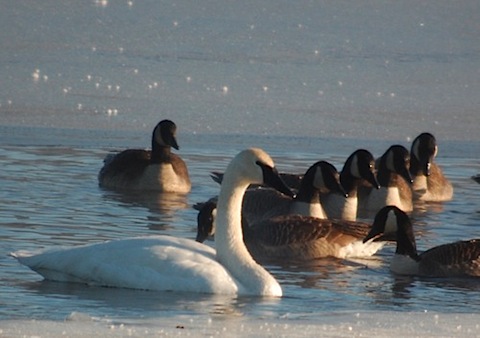
For some reason, this photo reminds me of a Huey Lewis and the News album cover. There were quite a few trumpeters mixed in with all the other waterfowl. It was fun to hear their trumpet calls rise above the over a thousand or so Canada geese. Since this spot was part of the Mississippi National River and Recreation Area, I asked my boss if I could work some of the day today at Point Douglas to help people watch the waterfowl. He bought it or...I should say, he agreed that it would be a great idea. I thought I would interact with mostly with birders from Minnesota and Wisconsin, but a vast majority of the people I spoke to just happened to be driving along the river and stopping for photos of the swans, completely unaware of the harlequin duck or other waterfowl. The harlequin didn't show up to Point Douglas while I was there in the morning, but there are still quite a few open spots around Prescott, WI. As the ice closes in further, people should have a better chance of seeing him this winter.
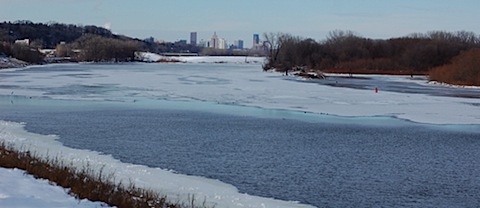
Word spread from some other birders that a long-tailed duck was seen along the Mississippi River in South St Paul on the corners of Grand Avenue and Hardman so on my way back to the visitor center, I stopped by to look for it. There were quite a few common mergansers working the shrinking patches of open water.
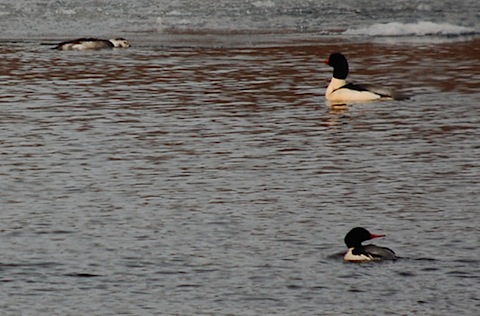
Sure enough, you could see it--she's the bird laying flat on the water. The other two are male common mergansers.
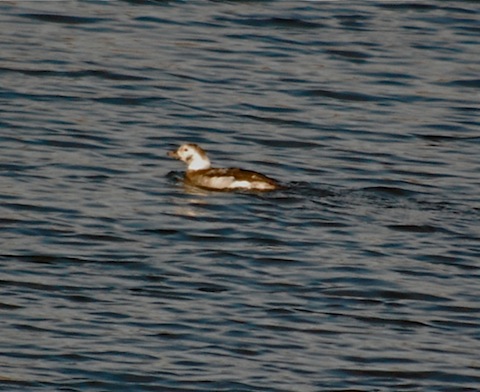
She's the opposite of the male harlequin, this is a female long-tailed duck. Still cool to see a rare bird, but not as striking as the male. This is a bird that I have a tough time convincing my non birding friends is a cool find. Word spread on the birding trail that a white-winged scoter was seen here earlier in the morning. I wanted to walk along the trail and look for it, but I had to get back to the visitor center--all in all, not a bad weekend for waterfowl.
Christmas Bird Count & Birds and Beers
The next Birds and Beers is December 17, 2009 at 6:00 pm at Merlin’s Rest.
Birds and Beers is an informal gathering of birders of all abilities–if you’re interested in birds, you’re invited. You can meet other birders–maybe find a carpool buddy, ask about where to find target birds, share cool research projects you might be working on, ask a bird feeding question, share life lists, share some digiscoping tips, promote your blog–the sky is the limit. It’s low key and it’s fun. I'll have to head out early that night. We added a performance to our A Christmas Carol: The Golden Girls Remix and I'll have a show at 9:30pm that night.
To get updates on when the next Birds and Beers will be, become a fan of Birds and Beers on Facebook and when a new event it planned, you’ll get a notification. Or check back here.

I imagine that we will be talking quite a bit about Christmas Bird Counts. And, hey, if anyone in the Twin Cities would like to try out a Christmas Bird Count, I'm looking for volunteers. We'll count any bird we see like the cardinal above to house sparrows to eagles to ducks to hopefully something really cool like maybe a Thayer's gull.
The Christmas Bird Count started in reaction to the 19th century tradition of people going out to shoot as many birds as they could on Christmas Day. In 1900 a group went out and counted birds rather than shoot at them and the tradition as grown to the big December event now. The data collected is used to document winter bird population trends in North America.
I've always wanted to participate, but for many years I worked retail and getting time off on a weekend in December is next to impossible. This year, I'm helping out with St Paul Audubon and their Christmas Bird Count area, specifically the Lilydale Area on December 19, 2009. I'm looking for people to help with the count!

This is my count area. If you live in this area, have some feeders (or not) and want to track what birds you see and turn those in, that would be great! If you want to bird Lilydale Park, we should have a great time. If you're thinking, I don't want to watch birds outside of the warmth of my vehicle and want to cruise some neighborhoods for birds, I can use you. Let me know in either the comments or drop me an email: sharon at birdchick dot com.
If you don't live near the Twin Cities but want to participate, find out what Christmas Bird Counts are in your area and see if you can help them.
New BirdsEye App
There is a very cool new application out for the iTouch/iPhone called BirdsEye and I love it!
The application was developed by Birds in the Hand, LLC, of Virginia, and brings together content from the Cornell Lab of Ornithology, eBird, the Academy of Natural Sciences, and Kaufman. It's available on the App Store in iTunes.
This is not a field guide, this is a bird finding guide. There are photos and some information, but if you were expecting a Kaufman Guide for your iPhone this is not it. But what it is, is incredibly useful and solves a few problems for me.
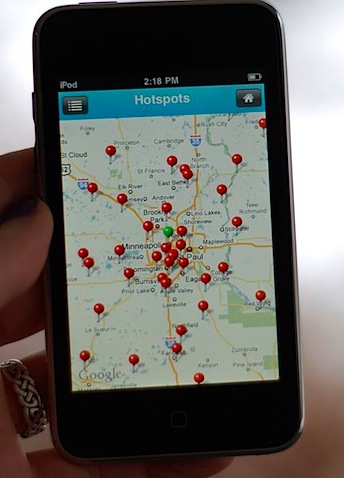
The application requires access to the internet. I have an iTouch and so if I have access to a wifi signal, I can use it. If you have an iPhone, you can use it with your internet plan. The menu gives you the option to either look for nearby birds, look for a specific bird, find out what birding hotspots are near where you are at that moment, check out what birds are being reported at a particular location, and keep a life list of North American Birds. Above, I have entered where I was starting from--that's the green dot and all the red dots are birding hotspots near me--at least, hot spots that have been entered into eBird.
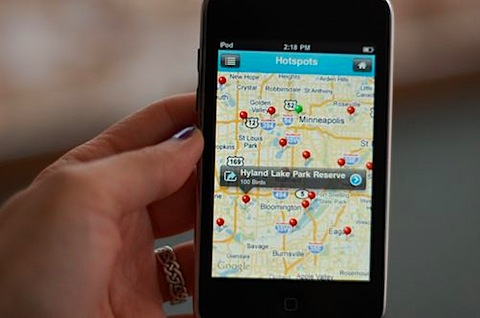
I touched one of the red dots on the map and the name of the location came on. It mentions how many different bird species have been reported at this location (by eBird users). If you touch the blue arrow next to the name, it will bring up a list of birds and a thumbnail photo of the birds.
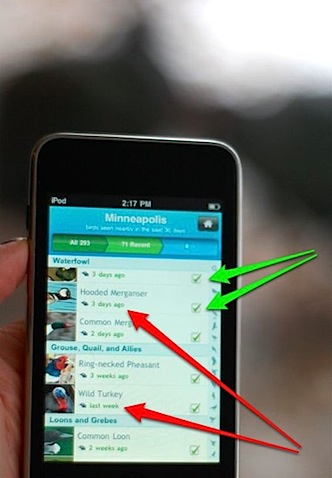
You can see the lower red arrow is pointing to wild turkey (and the two dark blobs behind my iTouch are turkeys that were staring at me at Hyland Lake's visitor center). But note that under the turkey it reads, "last week." That means someone reported it at this location last week. Check out the hooded merganser, it's been reported on eBird within the last three days. The green arrows are pointed to check marks. That means I have checked that bird off on my life list. Thanks to this app, I can look up a bird and see if I've seen it before...and I know how many birds I have on my North American life list.
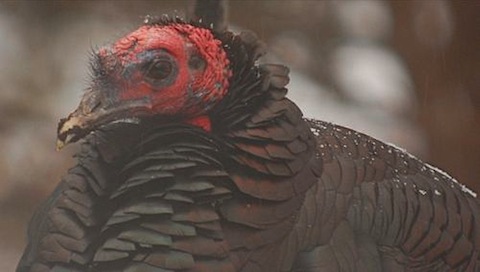
Here's one of the turkeys that's listed as being seen in the last week at Hyland--I saw it. As a matter of fact, when I came home, I logged into eBird and entered in the birds I saw at Hyland...
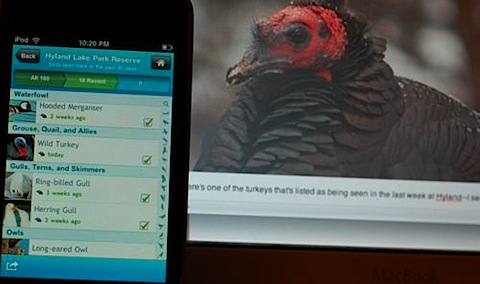
And if I look at the Hyland list now--it reads that the turkey was seen today--that's my update! It updates surprisingly fast. I'm told that the eventual goal will be that you will be able to update your lists to eBird by using the app, but it's not quite ready for that yet. But for a bird finding tool, this is really, really cool.
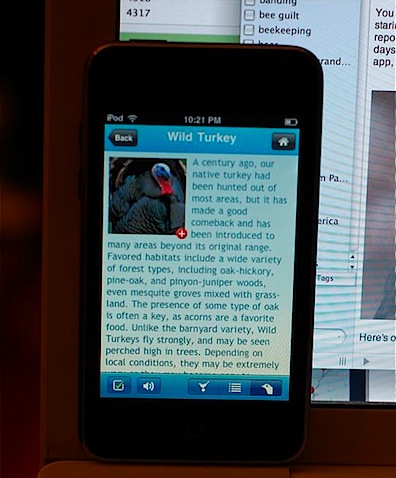
The initial app costs $19.99 and comes with gorgeous photos from VIREO as well as bird calls from the Macaulay Library of Sounds for 470 of the most reported species. The photos and bird calls also include a brief description written by Kenn Kaufman. The descriptions are not to give you clues to tell a first year Thayer's gull from a first year Iceland gull, they are designed to help you find the bird by mentioning behavior and habitat. Also, the photos tend to fall on the pretty side, not on the identifiable side of things.
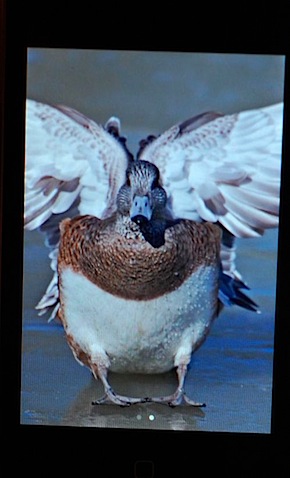
For example, the above is an interesting photo, but I'm not sure it's the most useful for helping a person id an American wigeon. Keep in mind that this is designed to help you find birds around your home and travel in North America, the photos are just a reminder of the species. I will say, the bird call collection is very good. I was disappointed that there were only 470 bird species with the added photos, calls and descriptions. For example, when I was going through it for last week's Sax Zim trip, I was able to find photos and descriptions for northern goshawk, but not northern hawk ow. I can purchase the rest of the birds (another 377), either by group for $2.99 per or all of them for $19.99.
I understand why it is this way--it costs money to get access to the photos, bird calls and Kaufman's time to write the descriptions. This app is worth the price, I'm not sure I'll go for the rest of the photos and calls--I already have that with birdJam. But using this for locating birds birds is awesome.
I love this app because it's solving several issues for me:
1. I've grown tired of the birding listservs. Every state's birding qroup has their quirks and nothing brings out quirkiness like email. I unsubscribed to my state's birding listservs during one of my longer trips and was amazed at how much I didn't miss it. I didn't have to see the emails from birders arguing over how dead a bird has to be before it's no longer countable, or the hardcore birders who get mad about backyard sightings or the casual birders who take hardcore birders to task for for just listing. With this, I can get bird reports without the added quirkiness.
2. I've always thought eBird was a good idea, but never got in the habit. This gives me a good reason to form the habit--especially if the app will eventually let me report birds with it.
3. I now have a reason to use my iTouch. My phone is a Blackberry. I have the iTouch because it came free with Non Birding Bill's last MacBook purchase. I've half-heartedly been using it and seriously considered selling it (I still have an older iPod with all my music on it). But ever since I got this app, I've been using my iTouch on a daily basis...well, that and FourSquare.
I've been behind on getting my gift guide together, but this is the most exciting bird app I've seen come down the pike this year.
An OpenSky Promotion
I just got an email from from OpenSky that from now until Wednesday at midnight you can sign your email up and receive a coupon. Coupons range from $15 - $100 off or 10% - 50% off. If you are interested, you enter your email address here and use the code BIRDCHICK. Everybody who enters and email gets a coupon and the earlier to enter, the better the coupon you get.
Remember that if you shop at my OpenSky store, 20% of the profits goes to fund kid programs for the American Birding Association.
Growing Nyjer Thistle In North America
Last Saturday was the Minnesota Ornithologists' Union Paper Session (a boring term for annual gathering). One of the presentations was from John and Lisa Loegering about attempts to produce Nyjer in North America.
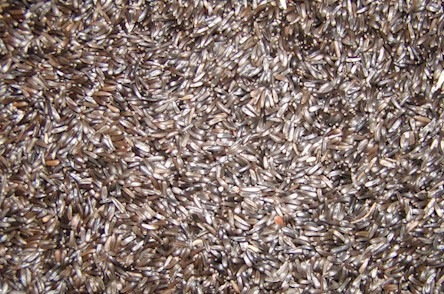
Let's get some basics down about this seed first, on the off chance that someone reading this doesn't know about the tiny seed for finches. Above is a picture of Nyjer also known as Niger and Thistle. Most of what you purchase for goldfinches at your local feed store comes from Singapore, Burma (I remember seeing that location frequently when I got in 50# bags at the bird store I managed), Ethiopia, and Myanmar. This is not a seed grown in North America. It is in no way related to the noxious weed thistle. It was originally called Niger but frequently got mispronounced as a racial slur. So many retailers referred to it as thistle. Since some got confused that it might be seeds of the noxious weed thistle, some cities tried to ban its sale. The Wild Bird Feeding Industry has pushed for the name to be changed to a phonetic spelling: Nyjer.
Confused yet? Basically at bird stores: Nyjer = Niger = Thistle, it is all the same seed. It's that tiny seed you put out for finches, siskins and redpolls and it's not grown in North America--one of the reasons it's one of the more expensive seeds.
According to the Loegerings, attempts have been made to grow a type of Nyjer in North America. A Niger Growers Group was even formed. By 2002, a plant had been developed and seeds were produced...and no bird would touch it. The group contacted the Loegerings and asked them to figure out why birds wouldn't eat the seeds. They set up 15 different feeding stations with the North American Nyjer in one feeder and Ethiopian Nyjer in the second. They measured the amount of seed put in the feeder, the amount the birds ate, the type of birds and the flock composition. The most common birds coming to the feeding stations were goldfinches and redpolls. Sure enough, if the birds had their choice, they ate the Ethiopian Nyjer more than the North American Nyjer.
Loegering wondered what was different. One of the first things that came to mind was that Ethiopian Nyjer is supposed to be heat treated to prevent it from germinating in North American soil (we all know how successful that is...not). So he got the directions for the exact process and heat treated the North American Nyjer and restarted the experiment. This time, the finches ate both types of Nyjer at the same rate. Now why would they prefer the heat treated seed? Does the heat remove the moisture to make the shell easier to crack? Does it make for a better tasting seed? Does it look different in the UV color spectrum? We don't know.
Now, this does not mean you will be finding locally grown Nyjer anytime soon. The Nyjer Growers Group has since disbanded. Part of the reason is that there is no farm equipment available to separate the tiny seeds from the chaff. Nyjer is all hand harvested overseas, think about that when you are pouring it into your feeder--that is a hand harvested seed. Kind of makes you wonder about the age of the harvesters and if they are paid a fair wage for harvesting that bird seed. Between that and tariffs, you can understand why it's an expensive feed to put out. The other reason was that when corn prices went crazy on all the ethanol speculation, many farmers gave up trying to grow bird food like Nyjer or sunflower (it's costly since you have to protect from the very creatures it is being grown for) in favor of growing corn. They also gave up some of their CRP land, so birds got a raw deal from ethanol...no bird can live in a corn field.
And now a few words from one of my site's sponsors:
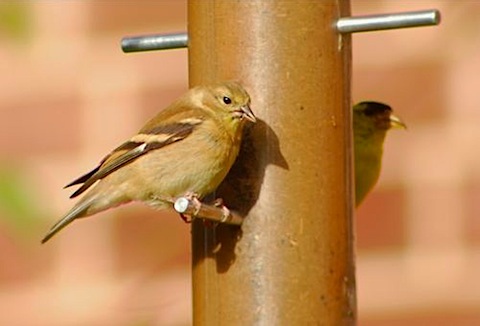
Hey! While we're talking Nyjer and finches, you might need one and some are available at the Birdchick's OpenSky Store. One that is pictured quite a bit in my blog and used by thousands of finches is the Finch Flocker (a 36" feeder). There's also the Droll Yankee Clever Clean Series for finches too.
Remember that 20% of the profits of my store are donated to the ABA's kids programs.
You must follow the link below
Peregrine falcon vs snowy owl. What more do you need to know?
Digiscoped Images
Fresh Tweets
Would you like to hire me as a speaker for your event?
Email sharon@birdchick.com