Birdchick Blog
Caribou Coffee Maybe Going All Shade-grown All The Time?
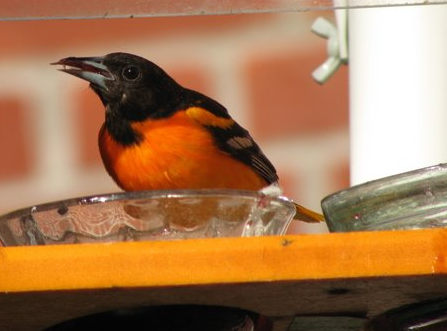 I've mentioned shade-grown coffee in here before. It's beneficial for many birds you see in your backyard in North America in the summer birds by giving them wintering habitat--like the above Baltimore oriole. There are some challenges with shade-grown coffee: some taste nasty, it tends to be higher priced, it's not always easy and convenient to find at your local store or coffee shop and sometimes the bag can read "shade-grown" and the coffee plantation only has one tree.
There are some brands like Birds and Beans which has some very tasty versions of shade-grown coffee--I'm a big fan of the Chestnut-sided Warbler Blend--it's worth every penny. It is also certified shade-grown by Smithsonian Migratory Bird Center and Rainforest Alliance--both very trusted seals to know that the coffee was indeed grown in the shade, in a sustainable way and the workers were treated fairly. Even so, I have to order that by mail and none of my local coffee shops or grocery stores carry that brand. If I'm out, I can't just bike down the street and pick some up.
Well, over the next year, my options are going to improve. In my neck of the woods we have Caribou Coffee shops and yesterday they announced that they want to be the first major U.S. coffeehouse committing to 100% Rainforest Alliance certification for all of its coffees -- a goal the company has set to achieve by the end of 2011!
If you are in one of the 21 states that has a Caribou Coffee, make sure you stop in with your binoculars and let them know that you support their changes and how their changes benefit birds. I've visited shade-grown plantations in Guatemala and I've seen some our breeding species there: painted buntings, Baltimore orioles, Wilson's warblers, and indigo buntings just to name a few.
Coming Workshops
 This Sunday, I’ll appear in a National Park Ranger capacity at Freedom Park in Prescott, WI. This will be a slide show of birds along the upper Mississippi Flyway like the above hooded merganser and along the park’s borders, the Mississippi National River and Recreation Area. I’ll share photos I’ve taken of some of these great birds, tell some stories about finding them and give tips on the best places to visit. Freedom Park has a fantastic view of the river and it’s great for waterfowl and eagle watching–I’ve even watched coyotes hunting along the banks. This is a fun place to spend an early spring afternoon (and don’t forget to allow time for some of the tasty restaurants in downtown Prescott).

I also got booked last minute for the Hawk Migration Association of North America Conference in Duluth, MN on April 16. It will be a digiscoping workshop (using a point and shoot digital camera or digital slr camera with your spotting scope to take photos. I think afterwards we can walk to one of the nearby peregrine falcon nest boxes and practice taking photos.
For anyone attending either workshop--feel free to bring your digiscoping equipment, especially if you have trouble getting photos with your set up. If you are not sure if you can digiscope and you only have the camera or only have the scope, bring them along and we can discuss options for you.

MPR Segement
Hey, mom, here's a link to that heron rookery segment that you can listen to online.
MPR and Herons
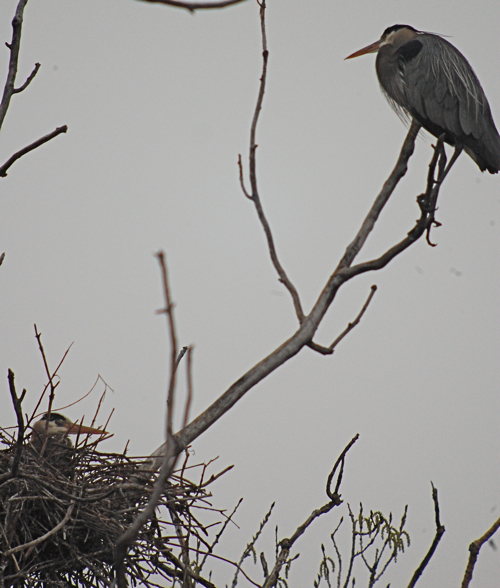 Providing that there is no major news breaking, the segment I recorded with Stephanie Hemphill about the North Mississippi Regional Park should air today between 5am - 9am on Morning Edition. (Mom, they said an online version will be available at some point too).
I'll probably be roving out at that park in full ranger gear between 10am - 12pm today.
Duck Smorgasbord!
 Last week I had to go to a meeting in Lake City, MN about the waterfowl surveys we did last fall, sort of going over the info collected and assessing what we might do different in the future. I headed down with Mark Martell and we took the scenic route to see what migrants might be lurking on the flooded river...we were not disappointed there was an awesome collection of ducks to be seen on the river. How many species can you pick out above?

I love the Ravenna Trail drive towards Treasure Island Casino and just off of Co Rd 68 was a GREAT flock of ducks thanks to the recent flooding. The Vermillion River was over its banks and demonstrating what a floodplain forest is all about. We pulled over and scanned the ducks. Since we had to get to our meeting and couldn't dally for long, I made a mental note to revisit the spot to enj0y the ducks during my vacation--I even dragged Non Birding Bill with me since he does enjoy a bird that is colorful, big, obvious and fairly easy to see.

Just sitting in the car on the side of the road was a great way to watch males competing for the attentions of females and to note comparisons of different species. The two male bufflehead on the left hit the light just right and you could see the green and purple sheen of their head feathers. The female bufflehead is in the center and the other two ducks were a pair of lesser scaup. I sat in my car along the road figuring that the ducks wouldn't mind it. I have a window mount for my Swarvoski scope so it can function as a blind. Most birds don't seem to mind cars...just the things that come out of them.

Other people pulled over to watch the ducks. Some foolishly parked on the far side and walked across the road to get a better view--flushing the ducks in the process. Doh! They guys didn't have any binoculars and soon left. But, I was on vacation with oodles of time and figured that the ducks would eventually drift my way again.

There were other birds to watch for like the above sandhill crane foraging in the flooded farm field. Horned larks and robins were mixed in too. As I was scanning some of the vegetation further out, I was surprised to find snoozing pectoral sandpipers and blue-winged teal--too far for photos, but pleased I was able to figure them out.

After about fifteen minutes, a very obliging bald eagle flew in chasing some of the gulls and ducks (in case you can't tell, that biggest dark bird in the above photo is the eagle). The eagle drove all the ducks back towards my car much in the same way the three mean earlier flushed them away.

It was interesting to note the birds that grouped together like the above American wigeon (the bird with the white patch on his head and aka the bald pate) hanging with the northern shoveler (the bird with the enormous bill in the front). This group clustered nearest the vegetation, dabbling.

There were also quite a few canvasbacks ( the redheaded duck on the right with the whole swoop thing going on) hanging out with some redheads (the redheaded ducks are the ones with the yellow eyes and light colored bills). I love all the red headed ducks--perhaps that's the reason my hair is red right now. I love watching these male ducks mixed in with the spring colors in the surrounding landscape.

There were quite a few lesser scaup mixed in and it was a great opportunity to observe the many different head shapes. I have a tough time when someone tells me that they see a greater scaup mixed in with lesser scaup because they look so similar. The best way to work on a species is to watch the common one long enough and eventually you will notice with the non common one shows up (in my case, greater scaup is less common). Above is one female lesser scaup being followed by three lesser scaup males--note how different the head shape can look between three males of the same species.

Here are the same three males. Ugh. I think I will only count greater scaup when they are in areas when they are the most likely species. For non birders who are not privy to the whole greater/lesser scaup thing here are some photos to show how similar they are. It's crazy to me how one duck species can have so many different shapes.

All in all it was a great spot to watch ducks. There were several ring-necks and gadwall mixed in too (gadwall not pictured). Are you seeing any waterfowl where you are?
At Last A Fox Sparrow!
I had a conversation with my friend Hans about Adam Savage coming in town for W00tStock and if there would be any way to entice him to blow up a stump for us. Hans said, "You know, I bet that since he blows up stuff for work all the time it isn't fun for him any more." I disagreed and said, "That's like me saying that birding isn't fun any more. Some things you just love whether they are part of your job or not.
Non Birding Bill and I noticed that we both had four days in a row off over Easter and he insisted that I take a vacation--no blogging, no scheduling, no media, no nothing for four days. Although, since I enjoy birding as much as I do, it was hard to avoid that altogether--especially with spring raging early and hard in our neck of the woods.

Yesterday along I found this obliging fox sparrow, heard ruffed grouse strumming incessantly and strong, found flocks of phoebes and noticed all sorts of mating shenanigans with wintering birds.

This morning, I came back to work by escorting Stephanie Hemphill from MPR to the North Mississippi Regional Park heron rookery. The birds are still fairly easy to see and if the weather is good on Thursday, I'll probably roam out that way in a ranger capacity with my scope around 10 am (if anyone is playing hookie from work).
I have some fun duck photos coming, hope everyone had an enjoyable weekend.
Peregrine Falcons At The Colonnade
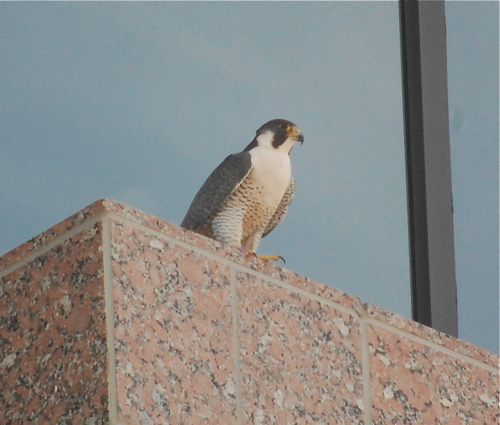 I was out at the Colonnade to check out the peregrine falcons that nest on that building. I had a KARE 11 segment this week and when I drove by the tall building, I could make one of the birds perched on the nest box ledge. When I returned with my digiscoping equipment that male visible. This is a nesting territory that I've blogged about before and some very interesting prey items have been found in their nest box.
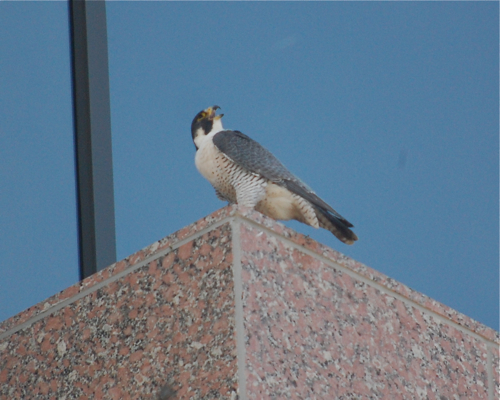
As I watched him for a bit, I wondered if he had a female laying eggs or incubating. Then he kept looking up and soon began to vocalize. When I volunteered at The Raptor Center and we would be outdoors with the education birds, we learned that if they looked up, you should look up, they saw an aerial raptor--sometimes it would be a mere pepper speck to me. I tried to follow the male's gaze skyward but could not see any other raptors flying over.
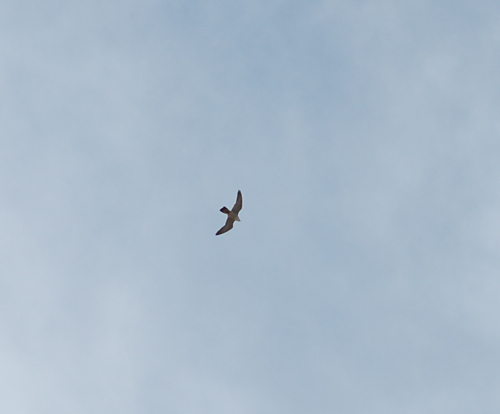
Then I saw her. A big female circling...and then I saw a second one (who was too fast for a photo). An aerial battle between two females was underway. Look at those distinct pointed wing tips that separates a falcon from a red-tailed hawk! In raptors, females are larger than the males (especially with peregrine falcons) and the females will engage in bloody battles to the death for prime territory. There's an infamous story from the Colonnade in the 1990s of 2 females who battle for over 2 and a half hours for the nest box--one losing an eye and eventually her life. Excited at my discovery of an aerial battle, I texted my buddy Mark Martell who has been involved with banding the birds at this building. He immediately replied, "I can just see you out there shouting, 'Chick fight!'"

He wasn't too far off in his guess. The best part of it was as the females circled the building and chased each other, the male remained at his perch screaming...perhaps he too was calling, "Chick fight...over MEEEEEEEEEEE!"
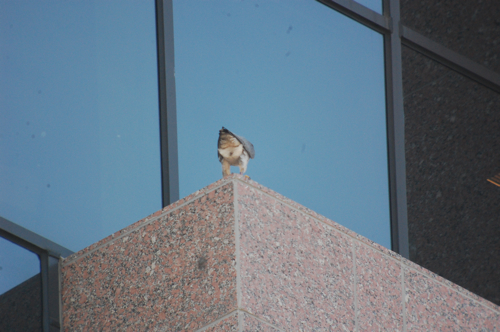
Actually, he did something kind of interesting. As the females duked it out in the air, he hunched over, fluffed his feathers and appeared to flash his cloaca. I wondered if this was some sort of display of encouragement to his mate or he was just flashing the goods to the females, "Yes, ladies, this is what I have to offer the winner of this display!"
The battle was probably more about the territory than the male.
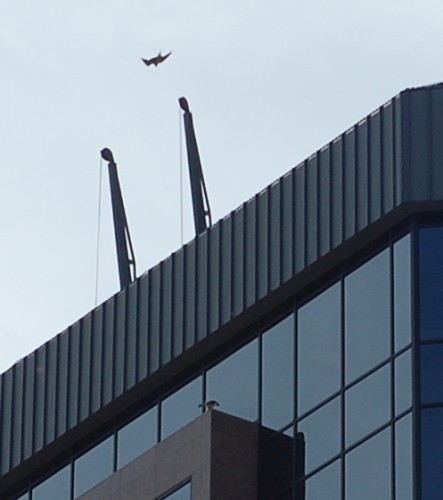
It wasn't a very serious battle and it soon ended. The other female was chased off and the remaining female circled the building and flew to the ledge where the next box it tucked away. Mark said that the people who monitor the falcons from inside the Colonnade report there is one egg in the nest.
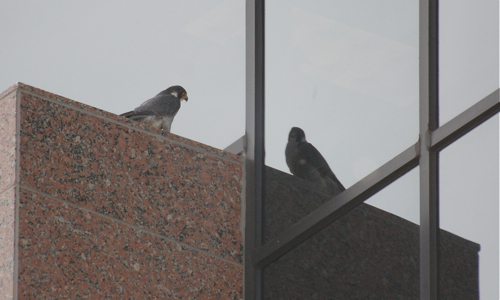
After all settled down, the male continued his watch of their skies from a nearby ledge. Then he walked towards his reflection on the windows. If one were to attribute human emotions to this bird, he could be thinking, "Yeah, boy, you are the total package. They wanted you, my man."
But who knows what drew this bird to the window.
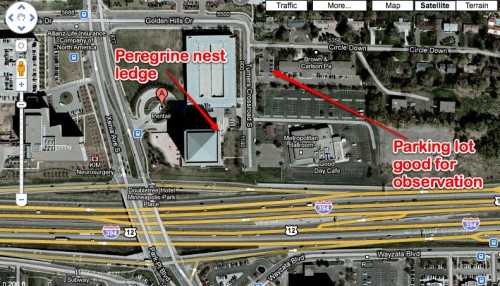
If you want to watch the peregrines at the Colonnade there is a small parking lot to the northeast of the building--just to the east of the parking garage for the Colonnade. You could also try driving to the top of the Colonnade's parking garage and watching from a scope there but I'm not sure how the building's security team feels about that. The Colonnade is on the northeast corner of hwy 394 and the Xenia Ave & Park Place exit on the west side of Minneapolis.
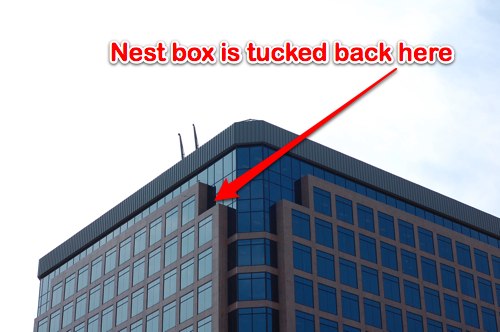
If you know what to look for, you can usually make out one of the adults perched on the ledges of the building. But to see the falcons well, you will need to have a scope or at the very least some binoculars to get a better look.
Cat vs Fox While Eagle Watches
This is from the same YouTube Channel that I posted earlier of the eagle contemplating the tastiness of a cat: [youtube]http://www.youtube.com/watch?v=V63-jJknM9A[/youtube]
I think putting scraps on your deck to attract foxes and bald eagles and allowing that wildlife to mingle with your cat is a risky proposition. One day there will be a larger fox who will not be so started by that cat. Or maybe the local food will not be enough and the usually satiated predators will try for the cat.
Random Song Sparrow
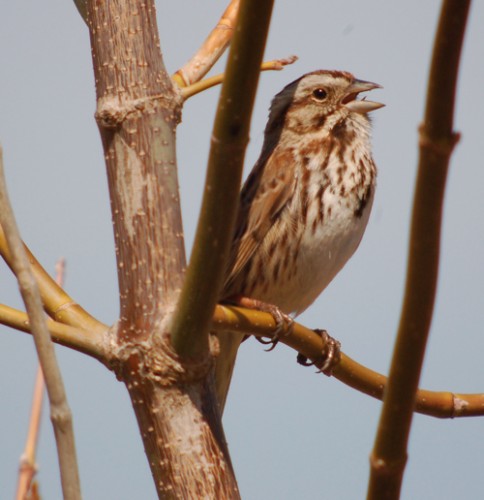 Holy cow I saw a lot of migrants back today! Some like the above song sparrow were singing right on the same spot they were singing the year before. Today was full of first of the year birds for me including pelicans, phoebes and tree swallows. I hope we don't five inches of snow in the next month that puts a hitch in their arrivals.
Digiscoped Images
Fresh Tweets
Would you like to hire me as a speaker for your event?
Email sharon@birdchick.com