
Birdchick Blog
Oil Spill in the Gulf Disaster
When I first heard about the oil drill rig explosion on the Deepwater Horizon in the Gulf of Mexico, the gravity of the situation didn't hit me. I thought it incredible that over 100 workers came out alive and felt bad for the anguish of the families of the 11 missing. Then the story got worse and really hit me hard in the last 24 hours. It didn't occur to me that the well 5000 feet deep in the gulf waters would still be spewing out oil with no one sure how to stop it...and now reports are that it's spilling out 5000 barrels (210,000 gallons) a day. A day. This is likely to exceed the Exxon oil spill in 1989 when 11 million gallons spilled in Alaska.
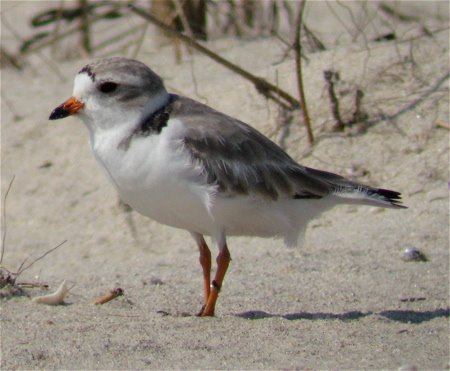
The reports this morning is that it's hitting the Louisiana Coast. I feel totally helpless. Creatures that I love are nesting in sensitive areas and this gloppy mess is creeping their way. I know a lot of news reports are focusing on pelicans but not so much on the uber cute birds that nest on sandy shores like the above piping plovers.
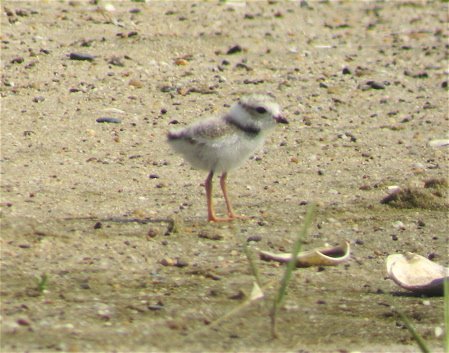
Their chicks look like little cotton balls running around on toothpicks. And it's not just nesting birds that are affected, but sea turtles and otters too, not to mention fish. This is going to have long range and far reaching effects. We already have a dead zone in the gulf, now this. If you are feeling helpless to the situation like I am, I think the group to watch is the International Bird Rescue Research Center which sadly is well experienced in dealing with spills. They have a blog with up to date information on the spill and what they are doing like helping to support and mobilize wildlife rehabbers in that area. Wildlife rehabbers already have it busy this time of year because of baby bird season, who knows how much oil covered wildlife they take in. Already the IBRRC has contact info for those who want to help:
"Anyone wishing to learn how they help must contact the British Petroleum Community Support Team Hotline at 1-866-448-5816.
To report oiled wildlife affected by the Gulf oil spill please call the Wildlife reporting hotline at 1-866-557-1401."
If you are like me and cannot fly down to Louisiana and help pick up oiled critters or do the painstaking task of wiping oil off rocks and cleaning soil, you can help support the organizations doing it. You may not have a ton of money, but something simple you can do is the next time you purchase detergent for your dishes--get DAWN. When you purchase a bottle of DAWN, you can enter the bottle's number online and IBRRC and the MMC will split $1.00 per bottle donation from Proctor & Gamble. The maximum donation from DAWN will be $500,000 to both groups. IBRRC will certainly need the money in the coming weeks.
Wildflowers Around The Beehives
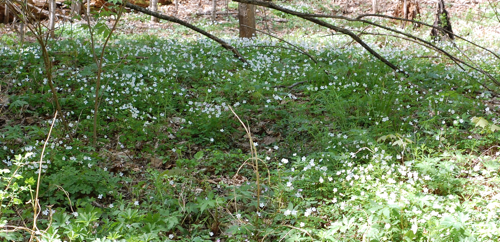 I mentioned earlier that the wildflowers seemed to be going gangbusters this year around our bee yard--perhaps it's a matter of me exploring an area around our bee yard that I usually do not get around to visiting? They are in an area outside of Mr. Neil's property--across the creek as it were. Hans (the groundskeeper) has put up a bridge over the creek making it easier to access. The ravines across the bridge are well used by the locals for horse trails and hunting (at least four deer stands).

I've gone over a few times in winter to look for owls but this is the first spring that I've done some serious exploring. There's been a pair of Cooper's hawks calling back and forth so I've crossed the bridge looking for them but have been distracted by wildflowers like the above wild ginger (there also a few white Dutchman's breeches in the lower left corner). When I noticed the wildflowers on Saturday, I saw a TON of large-flowered trillium about to bloom and made a plan to come back the following Tuesday to see them in full bloom.

When I found the wild ginger on Saturday, I was excited that I was able to id on my own. It's one of those flowers I've seen in the couple of wildflower books and thought, "Wow, that's an interesting flower." It looks kind of like an orchid, it's purplish, and the flower hides beneath the leaves, low to the ground. When I came back, I wanted to bring someone with me to enjoy the show. I was planning to come back on a Tuesday so that ruled out most of my friends--not everyone has the odd schedule I do. I thought about Non Birding Bill (take a personal day from work) but then realized that bringing my man in the woods to look at tiny flowers was probably not the best thing. But I did think that Lorraine has an odd schedule so I invited her along. She hadn't been across the bridge very much either so I was excited to show her what was there (plus with her love of horse back riding, I figured she would be interested in the horse trails).

The trillium show was spectacular--it was as if we were in crazy trillium land. Pretty much every thing that's white in the above photo is trillium (note the little blurry dots of white in the background). It was just underway too, several more trillium buds still had not burst open yet. The more I learn about trillium the more I like it and I marvel that it's managed to survive at all. Picking it can kill the plant, deer love to browse on it so if you have too large a deer population, that can be detrimental to a trillium patch, it can sometimes take up to seven years for a plant to bloom and it needs ants to spread the plant--it's crazy. I'm sure a survival strategy that worked great before European settlement of our continent. It's amazing to find such a huge patch of high maintenance flowers in the woods.

The spring beauties were winding down but a few pink ones could still be found. Below are some others that I'm posting, more so I can have a record of the native wildflowers I have found (it helps me learn):

Another flower I was hoping to find in large droves was the yellow trout lily. Their mottled leaves were carpeting patches of the forest floor. We saw quite a few blooming but the leaves suggest thousands more are still to come.

I love this shot, doesn't it look like the flower is holding its arms out and yelling, "Ta Daaaaaaaaaaa!" I was scanning some of the hills with my binoculars to make sure we weren't missing any flowers when I noticed a trout lily that was white--another species of trout lily--who knew. I kind of hoped it was a dwarf trout lily, but that only grows in one spot in Minnesota and nowhere else so this is a regular white trout lily...still it added to our wildflower list.

Wood anenome was all over in huge bunches, highlighting the forest floor.

This is wild phlox (with a tiny spring beauty in the center and an unopened trillium in the lower right corner).

This is one I had to look up and the noticeable leaves are very cool--it's called a sharp-lobed hepatica.

The bloodroot was almost finished blooming but a few were still going.

The Dutchman's breeches were also about finished blooming but a few patches could be found in the shadier areas. We did note that we didn't see any of our honey bees on these flowers. The one honey bee we saw was on a dandelion (non-native). This is probably because honey bees are non-native and are not attracted to our native flowers. They didn't evolve together and the native flowers grew to attract some of our native pollinators like bumblebees.

And I found one lone Jack in the Pulpit. These were all over the place last year so I can't wait to see how predominate they will be here in the next few weeks. So, after Lorraine and finished the walk on the other side of the bridge, I suggested we check around a different part of Mr. Neil's land and perhaps check out some of the nearby state land. We found a few wildflowers but most of it looked like this:

Good old garlic mustard. We've made attempts to rid this before after a blog reader pointed it out in one of my photos years ago. As we walked we noticed creeping charlie, buckthorn and dandelions--all non-natives. Lorraine wondered, why are there so many cool and different flowers across the creek and all we have over hear is garlic mustard. After seeing the wonderland across the creek, we may have to take some active measures. I've read that trout lily can be a good thing to plant to combat garlic mustard. You can also purchase it from reputable nurseries. Perhaps we will have to redouble our efforts towards the buckthorn and garlic mustard. Anyone have any tips for dealing with garlic mustard (outside of a controlled burn)?
Honeybees or Space Ship?
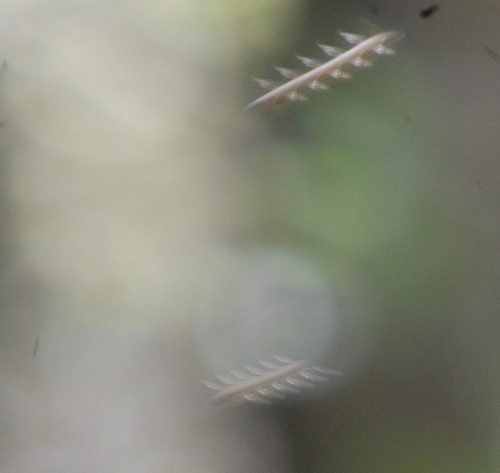 I digiscoped the strangest photo of my bees yesterday. I'm not sure what setting I had the camera on but they look like odd little space ships.
Red-breasted Nuthatch Nest Construction
I headed out yesterday with Lorraine to do some serious wildflower walking (what the heck has happened to me, I'm interested in wildflowers now) near our beeyard. Before Lorraine arrived, I headed down in the woods to see if I could figure out what birds were setting up territory where--I like to get know the neighborhood on the trail to our beehives. There's a pair of Cooper's hawks that have been "kekking" around the hives, but I cannot find the nest at all. There's a creek on the property line, so it's possible that it's across the creek, but from the calling interactions, it sounds like the nest is on Mr. Neil's property. Where ever the nest is, I'm glad they feel welcome (and may they eat lots of deer mice).
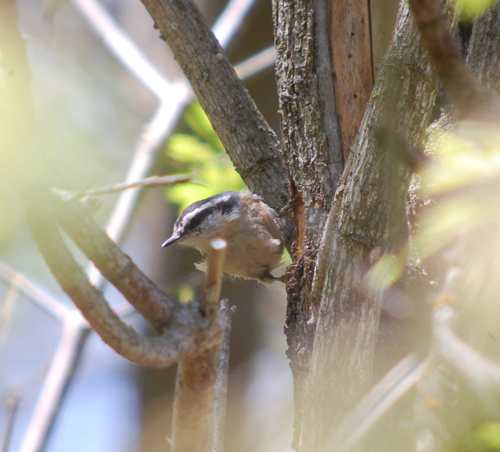
But, while enjoying birds and vainly pursuing Cooper's hawks, I heard some serious pecking going on--it was loud. I wondered if it was a downy woodpecker excavating a cavity and was shocked to discover that it was a female red-breasted nuthatch. That tiny little thing was making some seriously loud pecking sounds! She was actually across the creek and I was still able to hear her. You'll note a little haziness in these images, with the leaves coming out this nest is going to be well hidden very soon. I marked where I stood, but who knows if in a week if it will be visible. I was excited to find my first ever red-breasted nuthatch nest though.
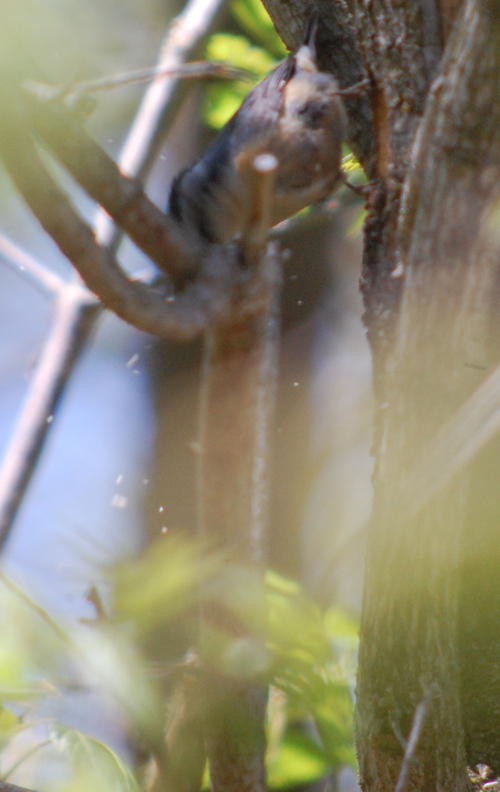
Pitooey! Look at that spray of debris! She was really going to town. It was interesting to note that she was not wearing a band, Mark and Roger have not banded her yet and they have banded a few red-breasteds when they come out to Mr. Neil's. I found it interesting that the female was excavating the cavity, that seems like something a male would do. I checked the handy dandy Birds of North America Online and it reads that female red-breasted nuthatches select the nesting site. It did mention that males who had not paired up early on may excavate four different sites to show a prospective female. The above female worked and then disappeared. I heard some chattering and soon, a male flew in and took over excavation duties:
[youtube]http://www.youtube.com/watch?v=Y-NJGGvH-Ks&feature=channel[/youtube]
He was much more vocal as he excavated where the female had been silent. It reminded me of one of those arguments you can have in a marriage where the male may be doing one thing (like excavating four different holes for you to lay eggs in) and quietly, the female begins work on the place she really wants. The male then comes over to excavate and mutters, "Dammit, I excavated 4 different holes and then she picks one way at the far edge of the territory and now I have to start over on a new one! What does she think my bill is made of? A woodpecker bill? Ratcha Fracka Friker Frack!"
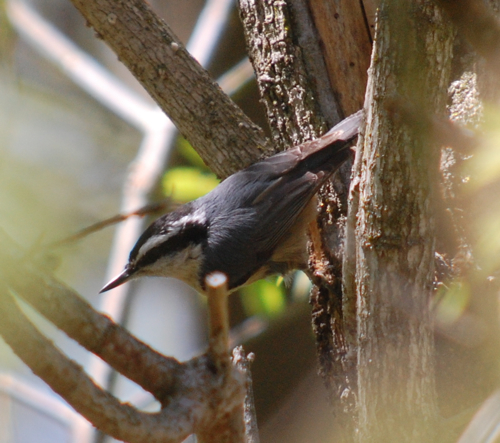
They are excavating near where I hear all of the Cooper's hawk kekking. I hope I'm able to keep watching this nest through the leaves and that the two unlikely neighbors get along.
25% Increase In Bald Eagle Nests In Twin Cities Metro Area
There's an article in the Star Tribune this morning about a recent bald eagle survey conducted in the National Park I work for--the Mississippi National River and Recreation Area. The area surveyed is the same where we do the bald eagle banding in spring.
Cool Things Afoot At eBird
I have to say that I'm totally digging the BirdsEye app from eBird that let's see what birds are being reported during migration. eBird is up to all sorts of cool things, but have you taken a look at what they are doing with all that data they are collecting? Here's a link to an animated map of the eastern phoebe migration reports. Cool.
Random Trout Lily
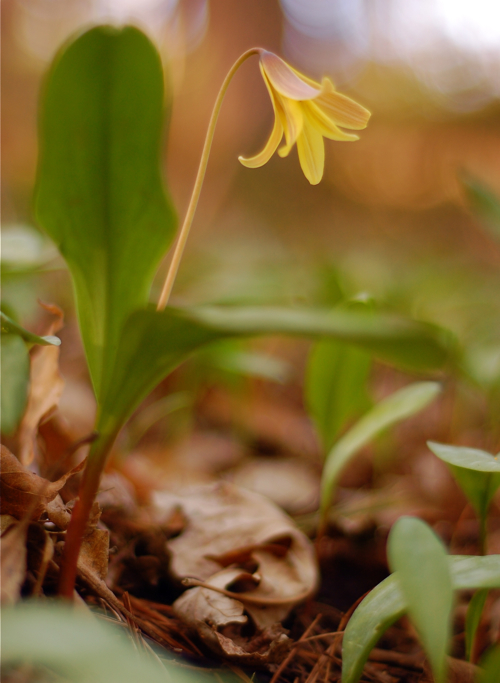 I'm going to have to park myself at my beehives at some point next week. So many native wildflowers are about to erupt. Many are already blooming but there were several sprouting yesterday. If it's sunny the first part of next week...the woods will be dominated by these delicate and brave first flowers of the spring like this trout-lily (so named because the spots on the leaves resemble the coloring of a trout.
Wildflowers To Pass The Time
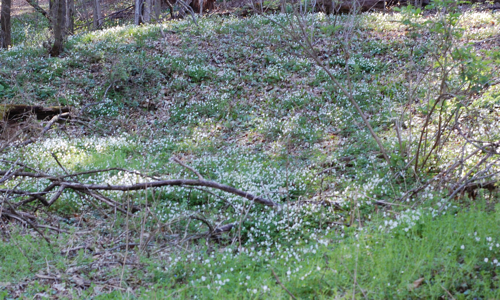 This spring has been spectacular for wildflowers and the woods around the beehives are covered in them. We've planted some natives and a two years ago, I bought some clearance large-flowered trillium to add in. I was inspired to encourage more near Mr. Neil's house because you can find a few small patches of trillium (both nodding and large-flowered) in the surrounding woods and about ten miles away is a HUGE hill that is covered with them in the spring--I've never seen such a large patch in my life. The person who owns the land also has a maple syrup farm so I think that patch is quite safe from development. I was sad last summer that not one of the four clearance trillium I planted grew but yesterday I a nice surprise:
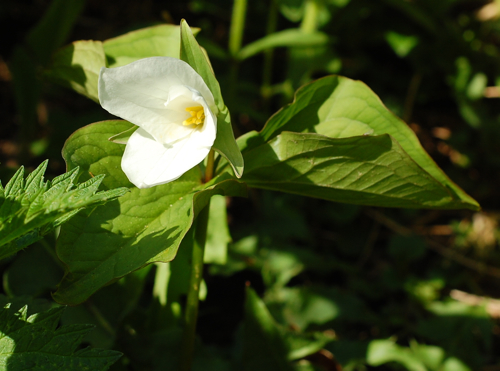
I found one shyly unfolding! A second grew nearby--some of my trillium took after all! Now, I hope that they spread, it's a pretty cool and ingenious process (for a plant).
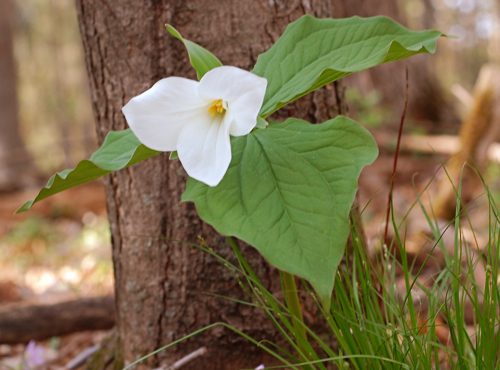
After the trillium matures they get this spongey bit called an elaiosome that holds the seeds. The ants take it back to their nest and eat it, and the seeds are left and germinate. So, if you see a large cluster of trilliums, you know there's a few ant nests there too.
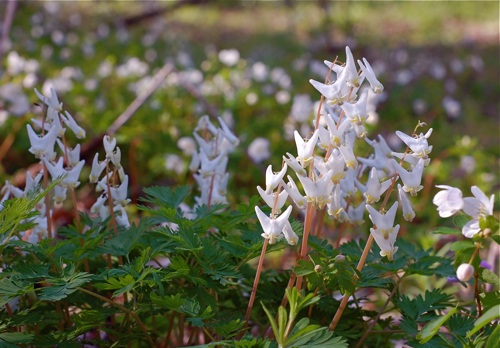
Trillium aren't the only excitement for me in the woods--the Dutchmen's breeches are all over the place--I've never seen so many. Gotta love a plant that looks like there are a bunch of tiny pantaloons hanging off the stem.
North Mississippi Rookery Still Visible
I had to take a local film crew to North Mississippi Regional Park again to see the heron rookerly. Since leaf out is so early (this is the first time since I've lived in Minnesota that I have seen lilacs blooming in April) I was curious how much of the rookery was still visible. Here's what it looked like a couple of weeks ago.
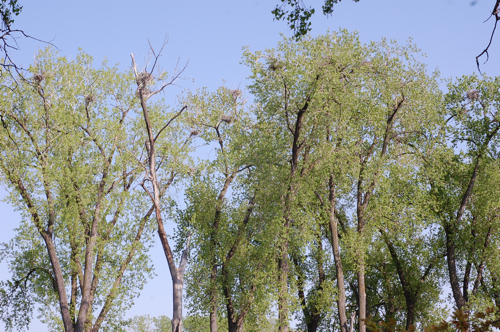
Some of the nests are still visible but most were quite hidden. One of the trees had fallen over in the last week. I'm not sure if it fell because it was dead and weak or if the local beaver had a hand (or should I say tooth) in it? Fortunately it's early enough that there most likely only eggs in the nest and any heron that had a nest in that tree has time to start over. Quite a few males were still flying in with sticks but almost every nest I looked at had serious incubation going on.
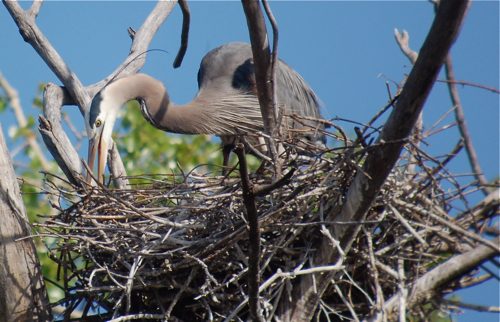
This heron stood up from her incubation and adjusted a few sticks and then she went through the motions of regurgitation. I wondered if she had a recently hatched chick? It's not out of the realm of possibility. What's interesting is that I gave a program last week at the fabulous Coon Rapids Dam and my friend Michelle Cook who works there said that the herons there did not return to the rookery this year. Since North Mississippi Regional Park's rookery is only about 7 river miles south of Coon Rapids Dam, I wondered if the herons were too tired to go further north? Or maybe it's because some other birds have moved into the Coon Rapids Dam rookery in recent years?
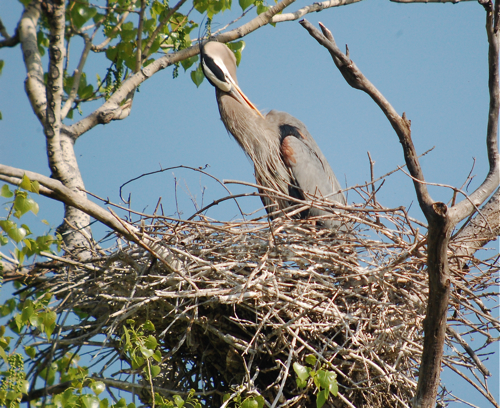
There is some bridge work going on near this rookery and I know people have some concerns. I doubt the bridge work is going to bother the herons. This rookery is in close ear shot of Hwy 94--it's noisy already. The birds seem to have a tolerance for noise. There's also quite a bit of river traffic along the river there anyway. So long as no one is climbing the trees, I think the birds will deal. If not, they will probably end up back at Coon Rapids next year.
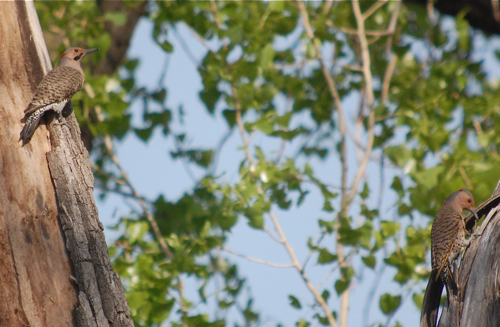
Speaking noise, one of the trees hosting some heron nests appears to be hosting a pair of yellow-shafted flickers too. The male is on the left (with the black mustache) and the female is on the right.
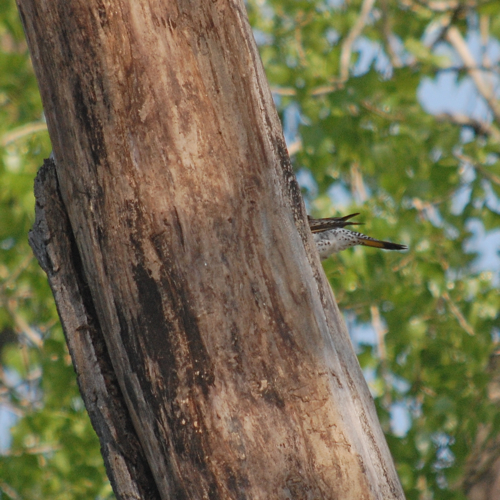
The male flicker worked his way up his trunk and disappeared into a hole. I wondered if he was excavating a nest cavity and soon got my answer:
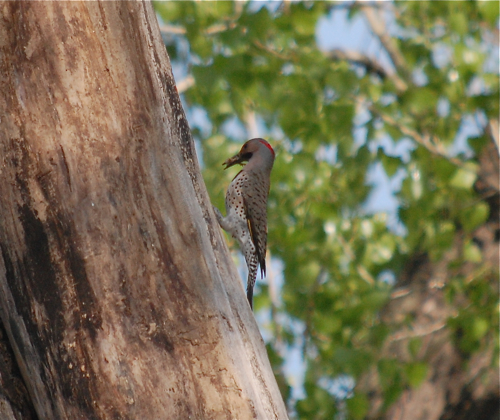
He came out with a beakful of wood chips. Hopefully it will be a successful nest and the pair will not be chased out by starlings. Wow. If the herons in that tree can put up with woodpecker hammering, I think they'll tolerate the Camden Bridge construction.
Purple Martins
 When I was leaving Crex Meadows last Friday, I drove through Grantsburg, WI and a large, dark swallow flying overhead caught my attention--purple martins! There were only a few flying, but I drove to the city park to see if I could get better views.

These are the purple martin houses in the park, mounted perfectly out in the open and next to a lake. They have both a wooden house and hanging gourds on telescoping poles--a professional setup. When I worked at the bird store in the Twin Cities, we used to tell people that you could see purple martins around April 15 (tax time) and I took these photos on April 16 so these martins were right on time.

There were only adult males flying around the house--strong, hardy birds risking an early arrival when food might be scarce to secure the best nest cavities to attract females. I love that people provide housing for martins, but I do wonder that these birds rely too heavily on humans. Before European settlement in North America, these birds nested communally in snags with several woodpecker holes. Now, they nest on human made houses and gourds. And check out that structure: a low oval shaped hole and a little deck--I'm sure this design has come about in the last 15 years as a way to keep out non native species like house sparrows and starlings but still--no tree in the wild is going to have a deck and I've yet to find a woodpecker that would make a cavity in that shape.

I checked out Birds of North America Online to see what information was available on martin populations and found this paragraph:
"Reproductive success can be increased by offering birdhouses with larger cavities (15 x 30 cm or larger), making nests harder for owls or other avian predators to reach (Wilkins 1994), or by using gourds; by installing owl guards on birdhouses (Bowditch 1990) and snake guards on poles; by reducing ectoparasite populations through application of insecticide (pieces of No-Pest Strip or 5% Sevin) to nests or through replacement of existing nesting material with fresh grass; by modifying entrance holes to exclude starlings (Keller 1995); and by installing porch dividers to prevent older nestlings from entering adjacent nests and stealing food from younger broods (Morton 1991)."
I find some of that paragraph disturbing. I love that people are creating nesting sites for martins--that's awesome and great way to give back to what we've taken away from their habitat. However, applying pesticides to nests? Replace existing nesting material with fresh? Installing porch dividers to prevent older nestlings from stealing food from younger nestlings? That is going too far. When people interfere with a martin colony to the point of doing things beyond what the martins would be doing naturally on their own in the wild, then those birds cease to be wild birds, but become pets. Or at the very least, "kept birds" like a set a triplets at the Playboy Mansion. Maybe older nestlings stealing food from younger nestlings ensures the stronger martins survive (happens in the raptor world all the time). Maybe some martins dying from insects will help sort out birds who are strong enough to survive that survive over birds too weak to tolerate blood sucking insects). Maybe birds raised in nests that have the material replaced constantly will have a weaker immune system. BNA pointed out that most people simply put up a house and not go to extreme measures. But still, I'm baffled by people who do these things and think they are helping the population over all.
Although, if I'm going to argue that, should I argue about baffles placed on poles to keep out raccoons, squirrels and snakes? Trees in the wild wouldn't have that? And while I'm complaining about too much human interference, should I take down my bird feeders? And now the can is open and worms are everywhere.

I posted a photo last week of one of these martins and someone said that she couldn't see the difference between purple martins and blackbirds and starlings. So I thought I'd post a couple of photos in case others couldn't tell them apart. Martins are very dark, so I can understand how they could resemble blackbirds to the untrained eye. First, follow this link from Xeno-Canto to hear what purple martins sound like.

Here's a common grackle. Note the yellow eye (martins have dark eyes). Also, if you look at the photos above, you'll see a purple or almost indigo sheen. The grackle has a blue sheen to its head and the body is bronze. The bill and tail is much longer than a martin's bill and tail. Also, if you look up at one of the martin photos above, you'll see a slight fork to the tail--grackles do not have that. Also, grackles are not cavity nesters like martins. They build cup nests in tree branches. Here's what grackles sound like.

Here is a starling. They do nest in cavities and sometimes they will even try to take over a purple martin colony. Starlings during the breeding season have a yellow bill (in winter, it's black). They tend to have a more greenish sheen to their feathers. In winter, they have speckles on their feathers, but they are worn off in the breeding season. Also, starlings can mimic...so they could sound like martin, but here are some common starling songs.

I don't think I need to post a photo of a red-winged blackbird--you don't see any patches of red on the wings of a purple martin. If you've never visited a purple martin colony, do check out the one in Grantsburg...or find out if there are any nesting near your town. They are a pleasant bird to watch and listen too. I do enjoy that loud warble of a large colony.
Digiscoped Images
Fresh Tweets
Would you like to hire me as a speaker for your event?
Email sharon@birdchick.com