
Birdchick Blog
Tawny Owl With Mandarin Ducklings
Check out this story and video from the BBC about a tawny owl (which nests in a box they way our screech owls do here in the US). The box is fitted with a nest cam and watchers were expecting owlets. However, they were surprised to find mandarin ducklings running around and all over the owl in the box (kind of like a screech owl with wood duck ducklings running around all over). The article paints a prettier picture by saying that the ducklings will hop out but who knows if they will without a female duck below to call at them. Since these ducks are precocial like wood ducks--meaning they are fully mobile after hatching and follow their parents while picking up food on their own they do not need to be fed by the adults. Confusion will be had by all if the male returns with a mouse and the female attempts to feed the ducklings who will not beg for it.
A few days before hatching, the ducklings pip from inside the egg, the hen calls back and the imprinting process begins. If these ducklings heard anything, it's the coos of the tawny owl--will they stay in the box if the owl does? If hunger forces the ducklings to hop out, will they be able to hook up with another brood? Will they be able to do it before a fox...or the male tawny owl catches them? Who can say, but it sounds like that pond had some egg dumping going on and more duck and owl boxes need to go up.
This is similar to the osprey with the Canada goose gosling incident we had happen in the western suburbs of the Twin Cities a few years ago.
Kestrel Takes Stage At Target Field
I'm not much of a baseball fan (being from Indiana, I'm pre-programmed to enjoy basketball, specifically Big 10 basketball). However, the new Minnesota Twins stadium has been such a focus of the news, I know far more about it just from osmosis via radio, tv and social media updates. The big news early on was a red-tailed hawk pair that was reportedly nesting behind the new scoreboard at Target Field. I thought it would be interesting to do a story on it and maybe get some photos but Target Field was not really interested in taking calls on the nest. I called the Minnesota DNR to find out if they had any information or photos of the nest and was told that the nest had been removed by workers at Target Field. Since the nest was first reported in March (which is when red-tail lay eggs in Minnesota) and it was removed after that, I wondered if there were eggs in the nest when it was removed, making the removal a violation of the Migratory Bird Treaty. It didn't sound like the issue was going to be pursued and if there was concern over the nest, better to remove it early while the red-tails have a chance to renest (like they would if a wind storm blew it down). Also, it was good that the nest was removed early before there were chicks older, the adults more aggressive in defending their territory and we wouldn't have another mess like last year when a DNR officer shot some nesting broad-winged hawks in the south suburbs.
However, another raptor is filling the void at Target Field--Kirby the Kestrel:

Here is the small male kestrel captured on the jumbotron at Target Field and is entertaining fans with the falcon's awesome ability to grab insects in the air with its toes. This is an American Kestrel and it's been fun to watch news stations like WCCO report on the small falcon but incorrectly use a photo of the Eurasion kestrel. These birds are cavity nesters, usually using old woodpecker holes made by flickers, red-bellied woodpeckers or even pileated woodpeckers to for nesting. They will also use large bird houses like wood duck boxes or you can purchase kestrel boxes from your local bird store. I've seen them nesting in the Uptown area of Minneapolis in old homes with holes leading into an attic or duct work. I'm not sure there are any cavities for the bird to nest in at Target Field, perhaps there are some old trees nearby for the male to lay claim to and he will attract a female...and hopefully the Target Field employees won't remove a kestrel nest and embrace it as part of the fun of an outdoor baseball game.
This particular bird seems to have quite the following. According to this story by the Star Tribune there was a "Name the Kestrel Contest" and he has been dubbed Kirby the Kestrel, in honor of the Kirby Puckett. He's such a hot item that someone started a Twitter Account for Kirby...too bad it's as TargetFieldHawk and not TargetFieldFalcon but I'm happy people are noticing birds even if they are mixing up their species a bit.
Here's a Youtube Video of Kirby in Action:
[youtube]http://www.youtube.com/watch?v=YTvxeZsXa3g&feature=player_embedded#![/youtube]
If you are catching a Twins game at Target Field, watch for Kirby at the right field foul pole.
Cross Section Of Breeding Birds & Migration
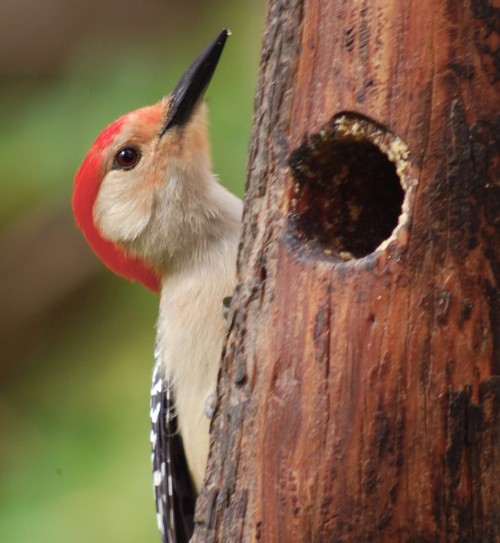 Twice a year I have some bird banding friends come out to Mr. Neil's place to band the birds around the yard--once in spring and once in fall. On Saturday my buddies Roger (aka MNBirdNerd) and Amber (aka AvianImages) set up mists nets to collect data and got a GREAT cross section of spring bird activity from migration to breeding. I hoped we would get a ton of cool information since I've noticed birds like the above red-bellied woodpecker coming and flying away with large beakfuls of suet--do they have young in the nest?
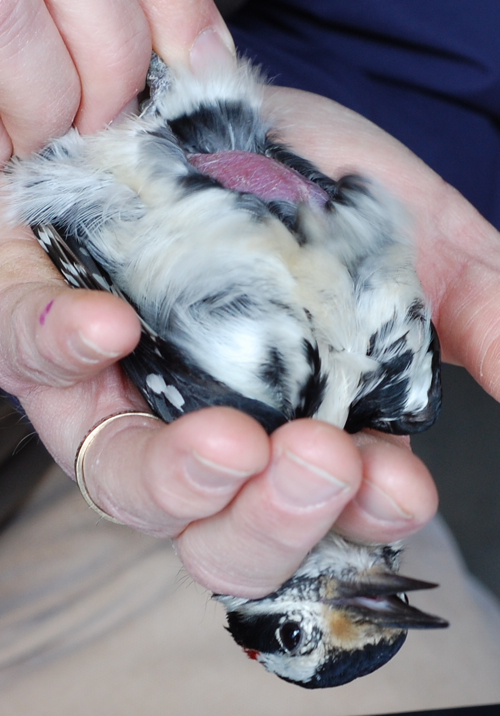
They did get in quite a few woodpeckers. Here's a hairy woodpecker male (note the little bit of red on the head). Roger gave him a blow and revealed a brood patch. Both males and females incubate so both would need a bare patch of skin swollen with blood vessels to keep the eggs nice and warm during incubation. I went to see what Cornell Lab of Ornithology had to say specifically about hairy woodpecker and in the breeding section that mentions, "onset of broodiness" and that "incubation begins in earnest with laying of last egg, but male roosts in nest cavity and de facto incubation may begin with pen-ultimate egg, thus accounting for hatching often occurring over a 2 day period and for some of the size differences noted in nestlings."
I love that someone other than my husband uses the word "pen-ultimate"to say that because the male sleeps in the nest cavity at night, incubation could start when the second to last egg is laid by the female.
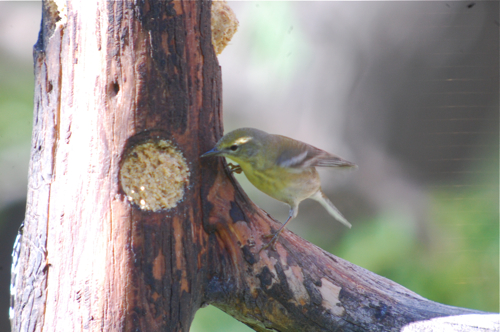
For the past few springs we've had a couple of pine warblers come in to the feeders when the weather is cold and insects are not out in full force. Warblers generally are not feeder birds, this brightly colored group of birds primarily eats insects--except for the pine warbler. During a cold, wet spell like we are having right now in the Twin Cities you can find orioles, catbirds, yellow-rumped warblers, scarlet tanagers coming to suet feeders as an alternate source of protein. Above is a pine warbler eating some no-melt peanut suet. What makes the pine warbler a little different from other warblers is that they are known to eat seeds and sometimes, I see pine warblers eating sunflower seeds out of the shell as well as suet.
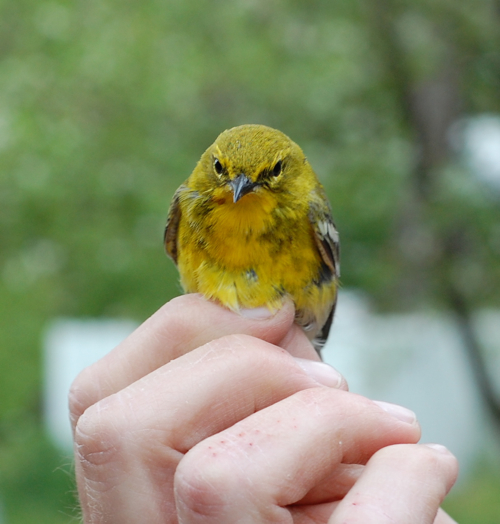
I think the rather disgruntled look on the face of this male pine warbler about says it all. While we banded this bird, a second pine warbler came to the feeder. It looked more like the bird in the photo above this--either a female or second year male. I suspect that pine warblers are nesting nearby since they sing well into June but it's hard to say since they quit coming to feeders so I don't see them feeding young (and I've yet to find the nest).
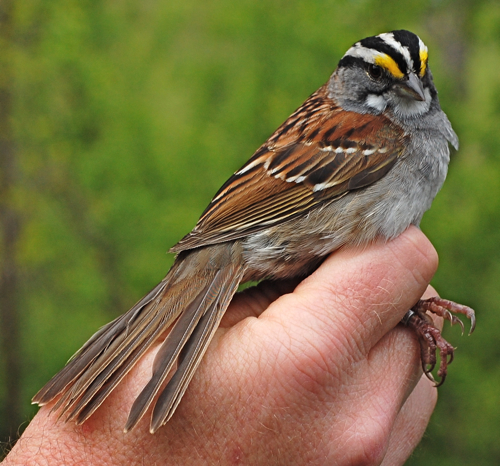
There was a huge brush pile that was chock full of sparrows and they set the nets near that and got a few white-throated sparrows. When Roger blew on their breasts, he was watching for fat rather than brood patches. These sparrows are still heading north and birds that showed yellow globs of fat just under their skin were loading up to travel further north.
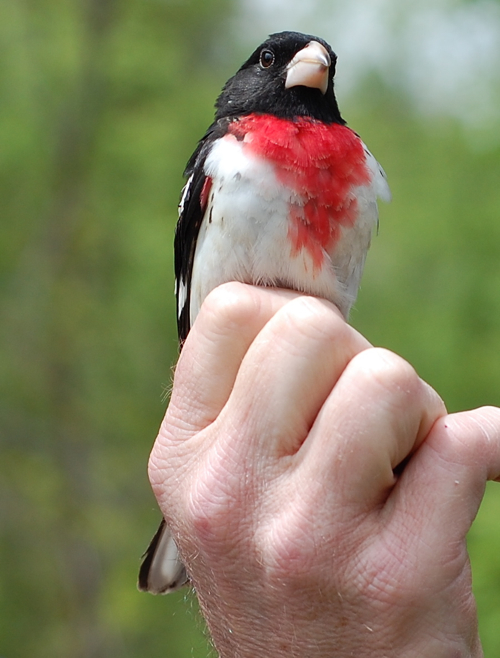
The number of rose-breasted grosbeaks at the feeders have been increasing exponentially this week. About seven days earlier, I heard one, then three days later, three males were at the feeder and by our banding day, I would say that we had five males jockeying for position on the feeder--and then one lone female. Males typically arrive first to set up territory, so it was fun to see that in action. We determined this bird was hatched last year, he had a few brown patches of juvenile plumage that had not molted out yet--not unlike some of the young males I saw in Panama this past February. I wondered if the grosbeaks who arrived early on territory in sleet and cold temps and think, "I left Central America for this?"
Keep your eyes open at the feeders and in the woods. Migration is in full swing, we have quite a few birds just flying and a few more who have yet to arrive. With this wet weather, some birds will look for fast food like bird feeders and you might be surprised by what you find.
Great. Another Invasive Pest To Worry About
[youtube]http://www.youtube.com/watch?v=D0foMKAxCww[/youtube]
A Birding Injury!
Ah, Saturday started out so promising! We had spring bird banding planned at Mr. Neil's, I found out that my nephew has an exhibit at the Louvre (yeah, baby, that Louvre and it's part of an app that's really cool called Augmented Reality Wallpaper), Non Birding Bill was frying up some maple bacon to get the banding started off right--it was all so innocent then. We had the usual Minnesota back hand weather-wise. A snow free March and April meant that the first weekend in May was going to be cold, cloudy and involve snow and sleet. Because of the wet and an mud on the trails, I put on a pair of spare Wellingtons at the house--the boots were a couple sizes too big but I compensated with really thick socks. However, at one point during a net check, my foot went one way, my right knee the other which was followed by my collapse and intense pain. It felt very similar to when I dislocated my knee as a teenager. But I was able to stand up and limp--which I was not able to do when I dislocated my knee.

NBB drove me to Urgent Care where ironically I was banded, weighed and measured (and had a few unpleasant things done to my knee). NBB said, "Ha! Now you know what it's like for the birds when you band them." They made a note of higher blood pressure and assured me that was normal for a painful knee injury. The spike in pressure wasn't about the pain but more like, "Holy Crap, I fly to Utah on Thursday for the Great Salt Lake Bird Festival on top of how much I love gallavanting in the woods for warblers in spring on top of my national park service duties. I can't be injured now!"
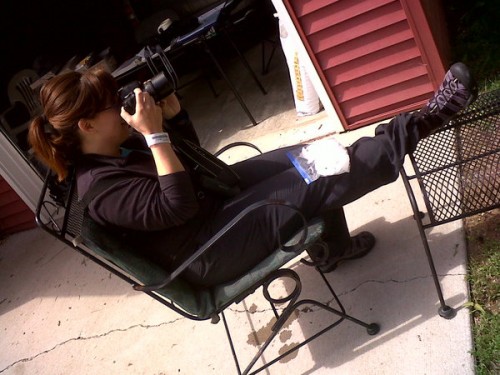
Fortunately, it appears to only be a sprain and not too severe of an injury and I'm supposed to stay off it and ice it for as long as possible. NBB is doing a great job of forcing me to take it easy. I was actually back to the banding in about an hour and didn't miss too much. Lorraine got the above photo of me taking photos of Amber and Roger removing a rose-breasted grosbeak and downy woodpecker from the nets.
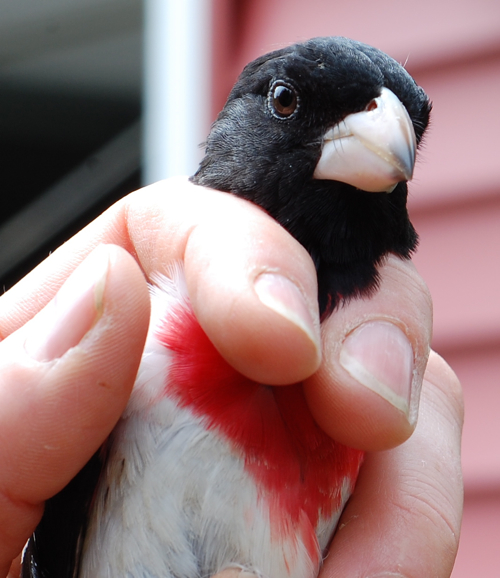
Here is a none too pleased rose-breasted grosbeak.
The great thing about the modern age is that I put in a call to my hotel in Utah securing a ground floor room, made arrangements to get some mobility assistance in the airport and gave the festival a heads up to my limited mobility. But on the upside, I'm doing a digiscoping workshop, Birds and Beers and I'm Friday night's guest speaker--all of those aren't too strenuous.
I'm excited about speaking. The festival keynote had to step down at the last minute for health reasons, so Bill Fennimore who was Friday's speaker is filling in for her on Saturday and I'm filling in for him on Friday night. I'm going to do my Kazakhstan Program: An Adventure in Birds and Bathrooms. Utah is one of my favorite birding states, I'm so grateful that my injury may slow me down but not stop me from enjoying this beautiful area.
In the meantime, this business of being forced to sit in one spot for several hours will be a good opportunity to type up some birding app reviews and a book review. I'm reading an AMAZING feather book--best bird book to come out this year.
Cornell Bird Behavior Course
If I weren't so swamped with birding and work this May, I would totally sign up for this online course on bird courtship and rivalry through Cornell Lab of Ornithology--you'd learn the down and dirty details behind some of those beautiful songs.
Ticks Play Dirty This Spring
 After doing a bit of birding this spring, I was heading home when what looked like a distant sandhill crane caught my attention. I pulled over to the side of the road and grabbed my Swarovskis...only to find a wood tick waiting for me right on the eye cup...ewwww! Ticks, the down side of the outdoors.

As I tried to get my binos in a better position for a photo, the tick obligingly posed. It put its little feelers out as if it were on a blade of grass, waiting for an unsuspecting mammal like myself to brush past so it could latch on and crawl around and find purchase on a tender fleshy area. After I took the above pic, I gave the little tick a flick and away it went. My skin will not be impaled by your hypostome this day, you crazy little arachnid.
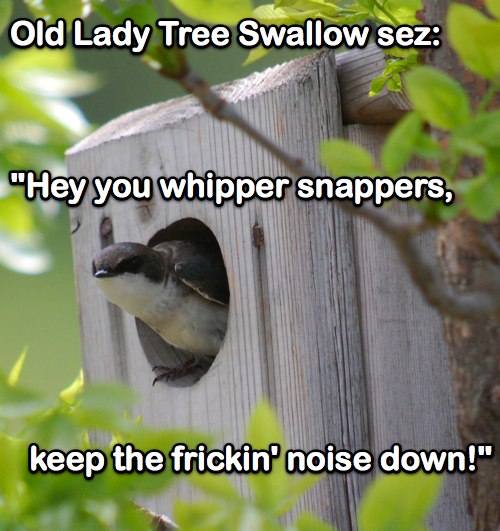
Rose-breasted Grosbeaks Are Back
 We had a small flock of rose-breasted grosbeaks arrive yesterday. They are loading up on food until the insects are out. Just the males are here now, with the cold and the wind, they weren't singing too loud today but I'm sure they will set up terretories soon and if they squabbling at the feeders is to be believed, they'll be duking it out for the best nesting tree too.
Franklin Red-tailed Hawk Cam
I've been checking in on the Franklin Institute live red-tailed hawk cam which is fun now that the babies are about and the adults are doing more than just incubation. I watched some cool behavior that I've read about but not actually observed. I took some screen captures:
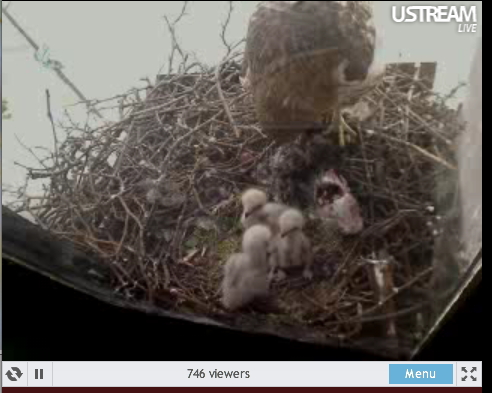
Here an adult is feeding the tiny fierce puffballs.
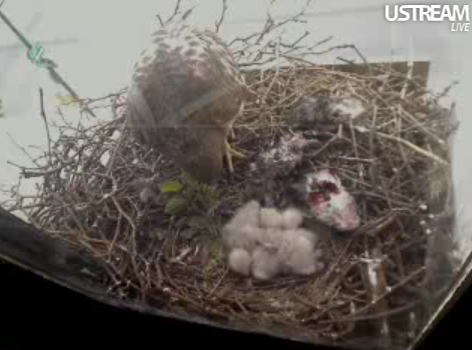
Then the hawk flew off for a moment and returned with a leafy branch. Some speculate that the leaves of certain plants have natural insect repellent properties and help keep nest parasites to a minimum.
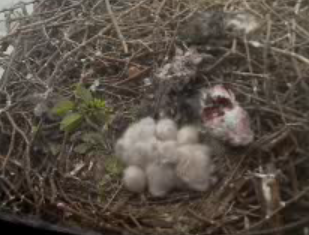
I have no idea what type of plant the red-tailed hawk brought in--looks like it either has some green berries or some green buds on it. Just some of the cool things one can observe in this day and age of online birdwatching.
Digiscoped Images
Fresh Tweets
Would you like to hire me as a speaker for your event?
Email sharon@birdchick.com