
Birdchick Blog
What To Do With Oiled Birds?
There's no way to avoid talking about the horrendous BP Oil Spill. I don't want the blog to become all awful news on the oil spill all the time, but I can't ignore it either. The oil spill has affected many people deeply--areas and birds and wildlife we love so much are in the path of this practically impossible to clean and lethal mess. Not only am I disturbed by the images of injured birds and soiled coastal marshes, I'm also disturbed by my recent mindset--which is clinging to the fragile (if not foolish) hope in the form of Kevin Costner--does he really have a magical contraption to separate the water from the oil? Could this really work? He does have a lot to make up for from Waterworld. As I've been reading some of the reports on rescuing birds, I've seriously questioned if cleaning and treating them for oil ingestion is a good idea. The goal with wildlife rehab is to get the bird back out in the wild. But what kind of environment will we send the birds to? There's more oil every day. It's not like the birds are being cleaned and treated to come back to a somewhat better situation--it's only worse each day.
An article came in to my news feed this morning asking the question: Is it better overall to euthanize oiled birds? Here's a quote from the article"
"Spiegel Online talked with Silvia Gaus, a biologist at the Wattenmeer National Park along the North Sea in the German state of Schleswig-Holstein. "According to serious studies, the middle-term survival rate of oil-soaked birds is under 1 percent," says Gaus.
Gaus' experience comes from the 2002 Prestige oil spill which killed 250,000 birds off the coasts of Spain, Portugal and France. Out of thousands of birds cleaned, only 600 survived long enough to be released back into the wild. The median survival of the released birds was seven days."
Survival rate of less than 1%? Median survival of released birds only seven days? The birds spent all that time in rehab only to die about a week later?
We all want to feel useful in this situation and I think most of us feel a deep need to do something concrete to help. Something beyond sending money or even our hair and pantyhose. Right now the only thing concrete appears to be cleaning and treating oiled birds and wildlife. But in the long run, are we really helping them when they are released to an environment that will only be coated with more oil?
Tent Caterpillars
As I have been traveling all over the state this spring, I've noticed a few tent caterpillars and webs on trees. Two nights ago, I noticed a large mourning cloak caterpillar and thought I might put up a reminder about these different species.

Here's a sample of a bush that I found last week that is covered in webs of the eastern tent caterpillar. These emerge from eggs and the caterpillars form a tent in the crotch on a branch.

The caterpillars leave en masse from the tent to feed and then return to digest. The tent serves as some predator protection and also as a green house to keep the caterpillars warm and aid in digestion. I like to watch these tents during migration, sometimes you can find a yellow-billed cuckoo or black-billed cuckoo tearing in to one and gorging on the ample food source.

When the hundreds leave the tent to feed, you might see them crawling all over on the ground. These two were on one of the walkways at Jeffers Petroglyphs, but I saw quite a few eastern tent caterpillars along the Minneapolis Greenway on Saturday...not faring too well either with the number of riders that were out.

This is a photo from the Vermont Division of Forestry of a cluster of forest tent caterpillars...which do not spin a tent like the eastern tent caterpillars do. They do make a silky sheet to molt under, but according to my Caterpillars of Eastern North America they do not make the tent and use their silk the same way that eastern tent caterpillars do. They do have a tendency to cluster on the side of a tree and could fool people into thinking they are mourning cloak caterpillars.

These are mourning cloak caterpillars that I gathered on the bike trail last summer. The female butterfly lays eggs en masse on the host tree and the caterpillars feed in a large cluster as they grow. When it's time to pupate, large groups will exit the tree--resembling the tent caterpillars. Last year, when I posted my photos, some people commented and emailed me that they had those and were told they were tent caterpillars or gypsy moths and that they should be exterminated. These guys might eat all the leaves off a branch but they will not strip a whole tree. Plus, they turn into gorgeous butterflies (that hibernate over winter--how cool is that). Also, these guys do not make tents, they do not leave a silk trail or make a silk sheet for molting.
People tend not to care for tent caterpillars because of the caterpillars can reduce the growth their host trees. I'm ambivalent about them--they are a great source of food for wild birds. But many understandably call exterminators to deal with tent caterpillars. Make sure you know your caterpillars before you call your exterminator. Not all exterminators seem to know their caterpillars. If you see red spots on the back of the caterpillar and it has a "spikey" look, that could be a mourning cloak.
Homemade Heron Rookery
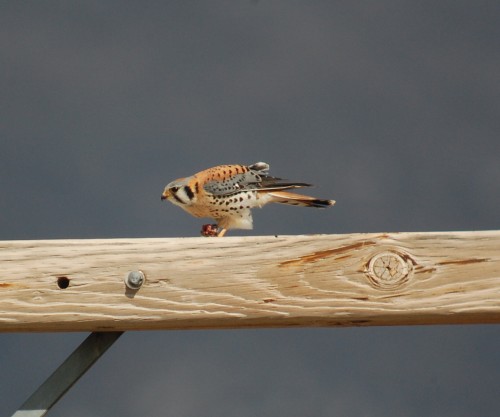
I love this little male kestrel snacking on a small rodent it plucked from a field in Utah. I got its photo at the same place I had my unexpected weasel encounter called Farmington Bay WMA.
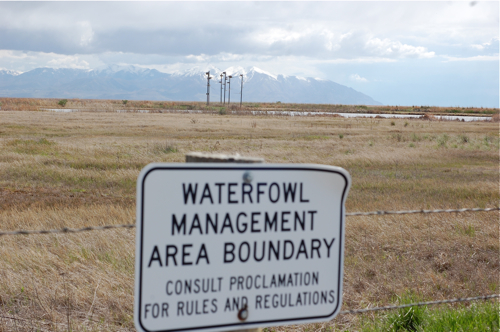
One of the coolest features about this wildlife management area is the homemade great blue heron rookery that is actually being used. I've seen plans for these in books like the fabulous Woodworking For Wildlife and I've seen a few erected, but never have I seen an artificial heron rookery being used by herons.
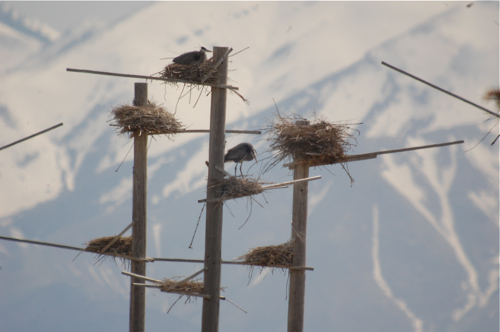 I'm used to seeing great blue heron rookeries on the Mississippi River surrounded by trees, not with a dramatic background full of snow capped mountains--too cool. Apparently, this heron nesting habitat was part of a boy scout project, that is one huge undertaking, but how sweet to see the kids' hard work pay off with actual birds.
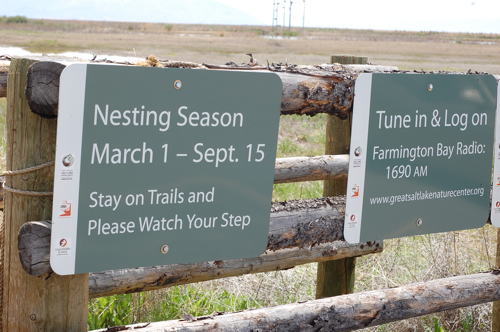 Farmington works hard to keep humans from tramping on ground nesting birds. Trails are blocked from motorized vehicle traffic during nesting season and signs warn you to watch your step.
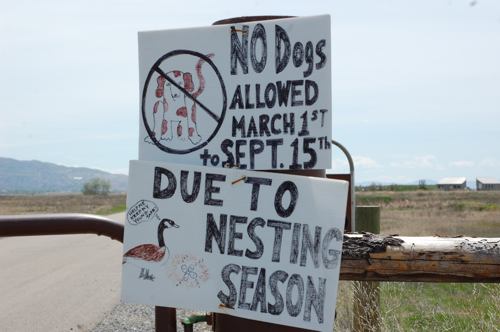
Even dogs are kept away to prevent altercations with waterfowl or to protect wayward chicks from becoming unintentional chew toys.
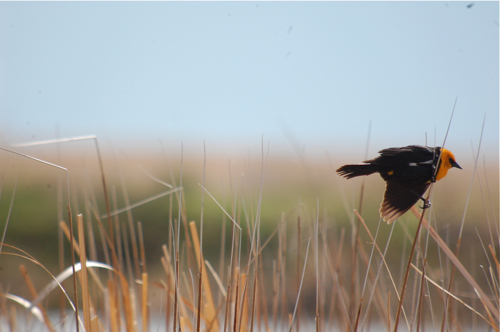
Utah is loaded with yellow-headed blackbirds and they are one of the common nesting birds at this site as are shorebirds. If you have limited time in Utah, this is worth a stop for western US specialties.
NOVA Cowbird Video
Arthur posted a link to a cool video from NOVA about cowbirds and nest parasitism in my comments section--check it out! It's a cool video for several reasons--capturing cowbird "mafia behavior," making nest boxes for prothonotary warblers out of juice cartons and a birder named "Bubba." Also, here's a link to a blog entry with Non Birding Bill's footage of a roadrunner nailing a cowbird.
Should You Remove A Cowbird Egg?
A question came in to my blog in the last few days and someone asked if she should pull a cowbird egg from a nest. This is an interesting question. For people not familiar with brown-headed cowbirds, they are nest parasites. A female cowbird will lay her egg in another bird's nest. Often the adult bird raising the cowbird is half the size of the young cowbird. Sometimes other nestlings will not survive and sometimes they will, depends on the species. The cowbird can contribute to the decline of species on the brink, like Kirtland's warblers by having the adults "waste time" by raising a cowbird and not another Kirtland's warbler.
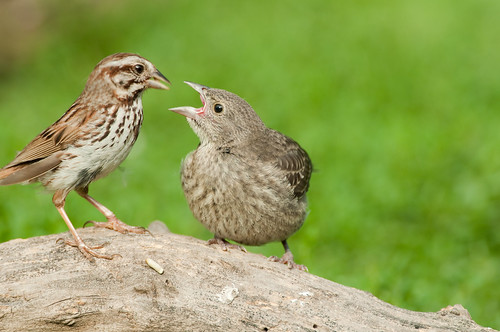
For years it was believed that cowbirds evolved this pattern because they followed herds of bison eating insects. That nomadic lifestyle left little time for raising young. As bison disappeared, cowbirds started following humans...who are rather sedentary and now a female cowbird who would lay 60 eggs in a summer over several miles is now laying those 60 eggs in one neighborhood. Makes sense...that is until Alvaro stepped in.
Alvaro Jaramillo who wrote the book about blackbirds (literally, he wrote the book on blackbirds) has this theory:
“This cannot be true. If you look at the evolution of the cowbirds (the entire genus Molothrus) you will find that they most likely arose in South America where there are no bison. As well, the Shiny Cowbird and Brown-headed Cowbird appear (based on the phylogeny developed by studying variations in mitochondrial DNA sequence) to be the most recently derived species in the cowbird clan. Thus, by the time that the Brown-headed Cowbird arose as a species it was already part of a lineage of brood parasitic birds, it was not the first. Cowbirds were ‘pre-adapted’ to a nomadic lifestyle due to their brood parasitism, but this behavior did not evolve due to a ‘need’ to follow Bison.”
Arrrrrrrg!
Officially, the answer is that it is illegal to remove a brown-headed cowbird egg from a nest. They are a native species and therefore protected under the Migratory Bird Treaty--unless you have a depredation permit from the federal government to remove them as in the case of Kirtland's warblers.
Do one remove it regardless of the legality? Is removing one cowbird egg helping an overall bird population? I've posted the same question on Facebook and people have opinions. How about you?
Birding Jeffers Petroglyphs State Historic Site
Some of my work this spring has taken me to southwestern Minnesota and I was so excited to see that one of the places I have always wanted to visit in this beautiful state was close by.
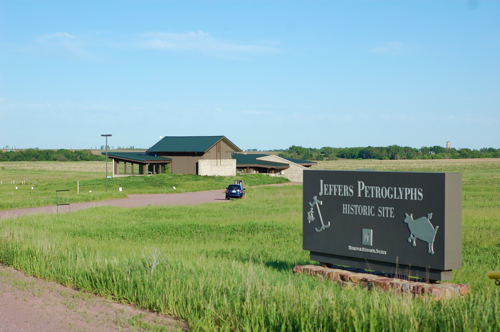
It's called Jeffers Petroglyphs Historic Site and it's in Comfrey, Minnesota. The visitor center itself does not open until after Memorial Day but a person can visit just about any time and walk the well marked trails--and stay on the trails so as not to ruin all the native prairie landscape they have worked so hard to create. I called to confirm they were open before I headed out and the person working the phone recommended evening viewing. Many people come during the middle of the day and it's harder to see the ancient petroglyphs with the sun overhead. She said that the late afternoon sun makes the carvings look almost 3D. That timing worked for me and I knew that would be good photo light. I asked if she was aware of any birds I could find when I visited. Her first suggested bird was:
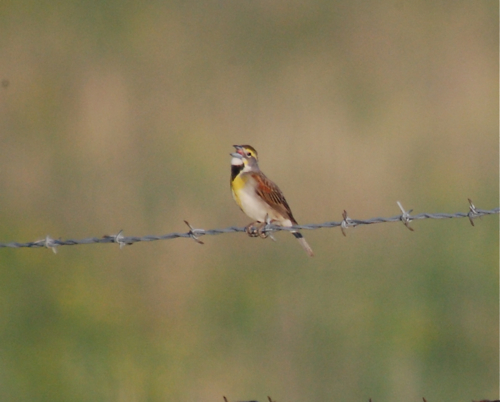
Dickcissel! SWEET--I hadn't seen one of these snazzy looking sparrows for a year or two so I was up for some dickcissel action. When I arrived in the parking lot, both a grasshopper sparrow and the above dickcissel greeted me. I noticed that the visitor center was closed and my vehicle was the only one in the lot. It was a gorgeous late spring night and I thought I couldn't be the only person at the historic site for long, but I ended up spending over three glorious hours alone and some fantastic prairie birds. Many Native Americans consider this spot a holy place and come to pray. I found it peaceful and felt an overwhelming sense of gratitude that some people have worked so hard to preserve it for my generation and future generations to enjoy.

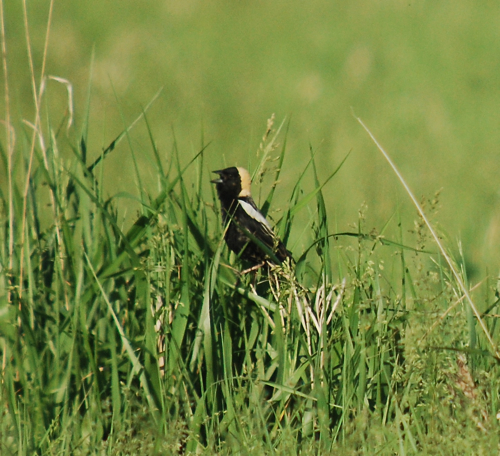
Bobolink (the above male bird) and western meadowlark rounded out the evening chorus. Incidentally, if you are not familiar with the song of the bobolink, listen here. For western meadowlark, listen here. I'm serious, if you have never heard either of those birds, click on those links--can you believe birds like that can be found outdoors? I love the bobolink song so much that it is the default ring tone on my Blackberry (Manilow). The bird song combined with the late spring warm air and sun made for a wonderful place for me to unwind after two (incredibly fun, but) exhausting weeks of travel.
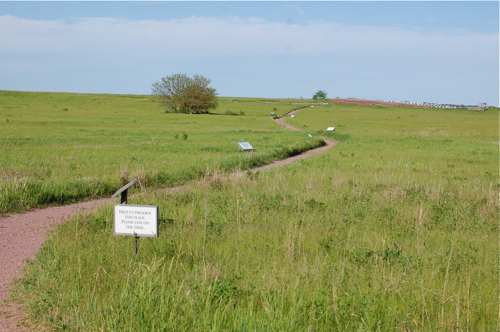
The well marked trails lead out to the petroglyphs. Signs supply some of the information for the long-grass prairie (and to please not pick the flowers) while birds serenade you. I must admit that I wanted to run off the trail the and get better photos of the bobolinks but instead enjoyed the songs from afar.
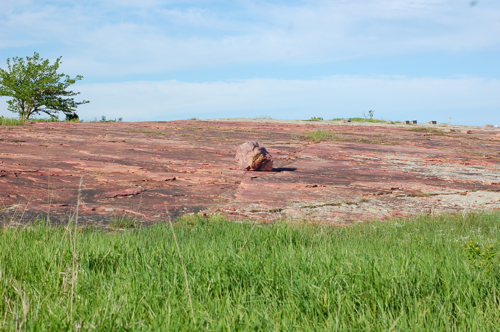
The petroglyphs can be found in the Red Rock Ridge, an outcropping of Sioux quartzite that goes for 23 miles. The petroglyphs were discovered by Europeans in the 1870s and the property was purchased by the Minnesota Historical Society from W. R. Jeffers, Jr. in 1960. The age of the petroglyphs is not known for certain. From what I can find on the internet, they could be anywhere from 3000 - 5000 years old--that's older than the pyramids in Egypt.
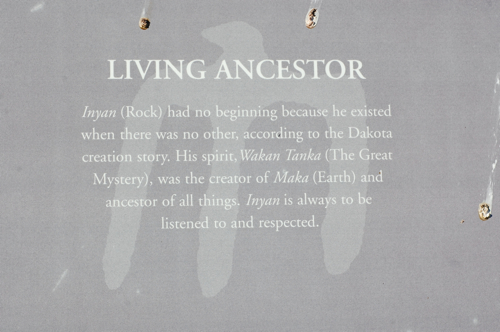
Signs near the outcropping give you a hint of symbols to watch for in the rocks. Above is the sign for Wakan Tanka.
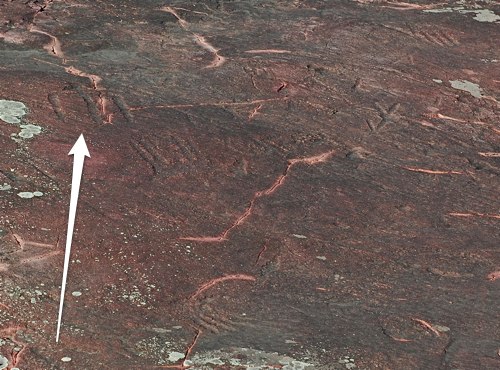
Above is an arrow pointing to the petroglyph of Wankan Tanka. You can see several other ancient carvings in there as well. As I basked in the late afternoon sun and listened to the birds singing (without any man made sounds of cars or airplanes) I fell in love with this historic site: birds and archeology--what a fantastic combo.

The late afternoon sun angle did make the carvings easier to see but I did not find them all, my attention was divided by all the birds. I took in as much as I could and made a mental note to visit again when my travels bring me back this way in the coming weeks.
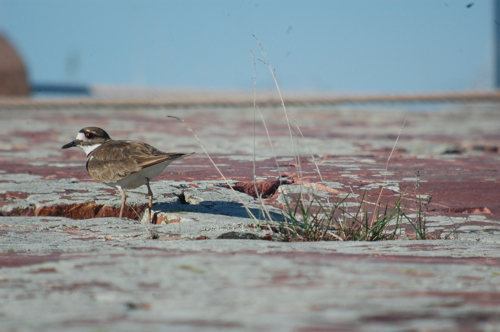
As I continued on along the rock trail, I noticed a killdeer walking slowly and giving a halfhearted attempt to lead me away by pretending to be somewhat injured. The killdeer apparently ignored all the signs to stay off and not touch the petroglyphs and nest on one.
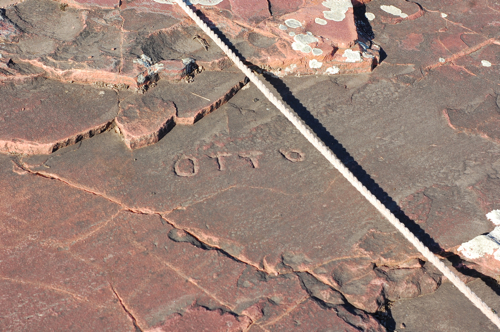
There were some noticeably newer carvings in the rocks. I think it's a safe bet that this is not a 3000 year old artist's signature to the rock carvings. I doubt there were too many Dakota running around with the name Otto.
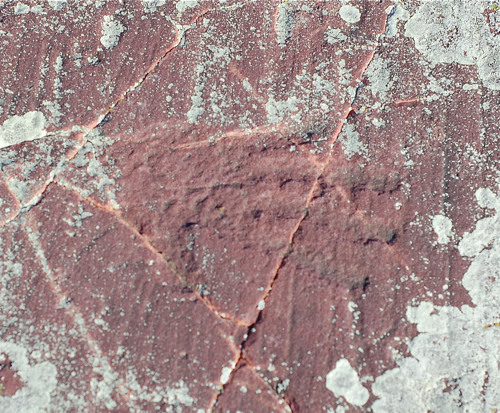
Here's a proper signature. I was struck by how similar in size this carved hand was to mine--such tiny hands!
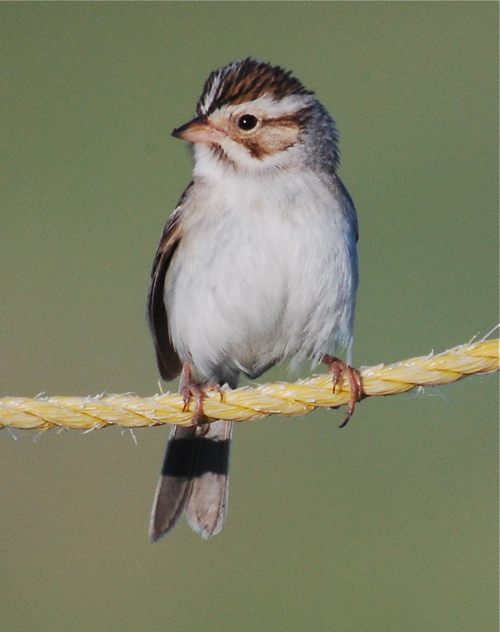
As I walked to my car, I noticed some clay-colored sparrows furiously chipping back and forth. I figured that they must have been setting up territory near the building. Lots of birds were nesting on the closed visitor center: starlings, robins and barn swallows at the very least.
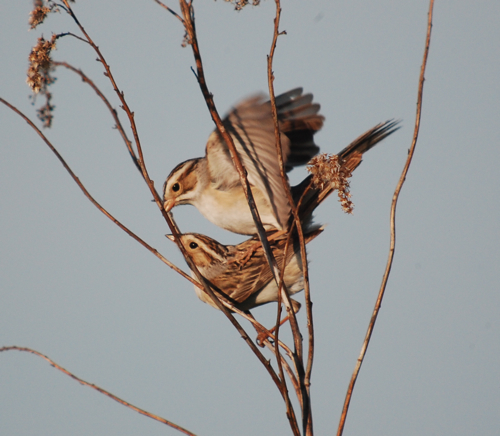
And then to cap off my perfect time at a perfect historic site, I got a shot of the clay-colored sparrows engaged in a cloacal kiss. Ah for one brief moment I could tell male and female apart! I know bird sex is fast, but I'm still amazed that any eggs are produced from balancing on the back of a small brown bird while she is balanced on a branch.
To learn more about Jeffers Petroglyphs State Historic Site visit here and here. They will have some official programming this summer and a guide can give you the inside scoop on the site's history and ancient symbols carved in the stone. If you are a birder and in the mood for some great prairie birds, definitely check this little spot out. The small patch of prairie is surrounded by agriculture so it concentrates some awesome species in one spot.
Seriously, if you have ever had it in the back of your mind to visit this place, make it a must do this summer. I love all the archaeology we have in this state from fossil hunting in St Paul to petroglyphs in Comfrey.
Blue-winged Teal: Beak Check
I love living in the Twin Cities. As I'm typing this, I just heard a radio commercial for the MN DNR about taking kids to enjoy the outdoors in our lovely state and one of the lines was: "Today, my daughter learned that the call of the warbler is more powerful than the call of her BFF!" Ha!
I may have over done it this spring.
Every spring I have the best intention to keep it simple--leave some time to actually enjoy birds and not work birds the whole time. And every spring cool bird opportunities come up and before I know it, I have three solid weeks of work. I have a great time but I turn around and wonder, "Whahappa?" Especially for warblers.

Not that I haven't had a great time. I've had the opportunity to enjoy some time up close and personal with sparrows like the above vesper sparrow (love that little rufous patch on the shoulder) but I look at this week and think, "Wait, wasn't it just tax day last week and how is it already the week of my wedding anniversary?" Incidentally, Non Birding Bill and I have been married for 12 years now--our marriage has now lasted longer than the M*A*S*H tv show!

But despite feeling like I've been birding at the speed of light, I've seen some beautiful birds in beautiful light. Here's a pair of blue-winged teal at a WPA in southern Minnesota (one of my jobs is forcing me down near the Iowa border this year and even though I may not be getting the warbler action I'd hoped for, I'm getting the opportunity to bird some habitat that I generally avoid). The male is on the left and the female is on the right. Both are helpfully showing their sky blue patches on their wings.

And I chuckled as I watched the male go to town in his preening and focusing on his belly.

And he kept focusing on the same area.

...and focusing...That must be one itchy spot! I think I have about 250 shots of him working his belly...I almost wondered if he was really just trying to work his way down to his cloaca...
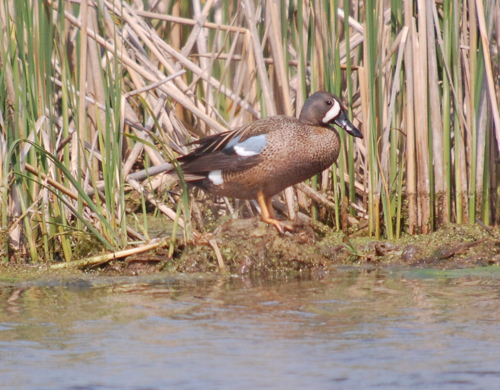
When he finished, he had that look of, "Hey, lady, don't judge."

And then he gave a big stretch revealing how large that blue patch on the wing really is. Such a brown bird, with a lovely shade of blue tucked in the wings.
When NBB Attacks!
Hello all, NBB here. Shaz is back from two weeks of travel, her brain so full of birding that I've had to pull her off the ledge at least twice, her mouth stuffed with string, twigs, and animal fur. A typical Saturday night 'round here, then.
Sharon's asked me to blog for her—worried that you lot are feeling neglected. But since I've already written every single thing I know about birds during our last mutual incarceration, I'll write on a subject that I know a few things about: bad movies.
Ah, terrible, terrible films. I love 'em. The goofier the better, but there's also something to be said for a film that is certain it is making a grand statement about humanity, only to find that it is really, incredibly, embarassingly wrong.
NBB's List of Some Bad Movies That May Feature Birds
1. Ladyhawke. This one's kind of a fudge, as there's a decent film buried somewhere in there, underneath Matthew Broderick's spotty accent and uninventive cinematography. But the film is absolutely murdered by its horrible synthesized soundtrack.
"Dude! You know that movie you're making with the staggeringly beautiful Michelle Pfeiffer, and the raw manliness of Rutger Hauer? The tale of forbidden love and dark sorcery? That you've convinced a studio to spend millions of dollars on? How's about we save a few bucks by replacing an orchestra and an epic score and instead just hit the 'demo' button on my Casio? What could go wrong?"
The hawk, however, does a pretty good job, although I understand she regularly fought with the director over her motivation.
2. Barbarella. There are those who will tell you that Barbarella is a misunderstood film, a delightfully campy romp that's waiting to be rediscovered by each generation.
These people are alien invaders. Wait for your chance to strike and don't turn your back on them.
A sex farce with no sex and precious little farce, Barbarella is the film to watch if you've ever wondered what would happen if you took Sudafed and NyQuil at the same time. The... oh, I hesitate to call it a "plot," but I suppose that'll have to do—the "plot" reaches its most ridiculous when Barbarella is sentenced to be killed by a flock of killer budgies. No really, this happens. The poor birds flap around while Jane Fonda tries to act afraid. In fairness, it is pretty terrifying if you accept that a woman could be killed by a parakeet sitting on her and preening.
3. Night of the Lepus. Giant. Killer. Rabbits. Let that sink in for a moment. Another film where poor actors (including DeForest "Bones" Kelley!) have to stare out windows and act afraid of, yes, Giant Killer Rabbits, who run rampant in slo-mo over model train towns, with red dye occasionally sprayed on their lips to show how truly vicious they are.
The best (and by "best" I, of course, mean "worst") part is that after the first victims are found, a scientist is asked to figure out, based on the injuries, what attacked them. His first guess, he says, would be sabre-toothed tiger, but since that's impossible, he thinks it's Giant Killer Rabbits.
Okay, that's all you get for now. I'd like to say that it's because I'm going to pop in my Criterion Collection Blu-Ray of Citizen Kane, but I think we both know that I'm going to root around in my closet for a VHS of Giant. Killer. Rabbits.
Cooper's Hawk and Crow
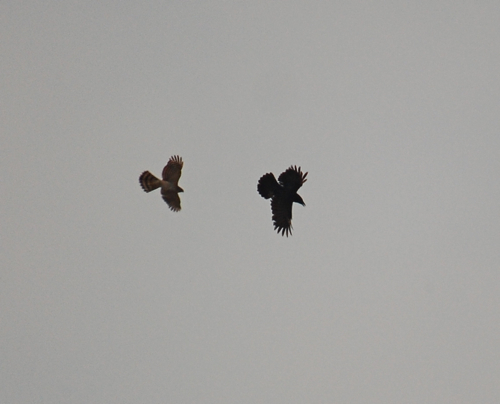 I caught this interesting interaction between a Cooper's hawk and crow. I had noticed the crow going back and forth throughout the day and figured it had a nest nearby and was bringing back food. Later, I heard red-winged blackbirds giving their aerial predator call and looked up. The crow was chasing a Cooper's hawk. The hawk circled as though to glide into a thermal but then turned the tables and chased the crow.
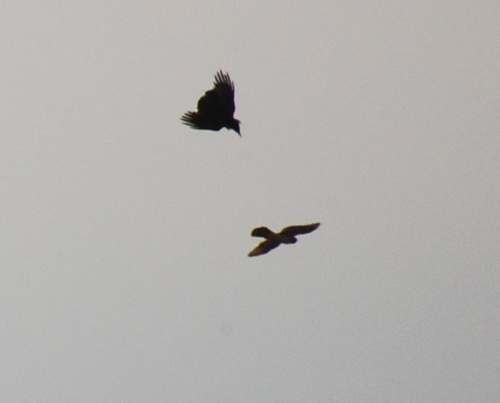
The crow managed to dodge the hawk, flap upward and then get in a position to dive at the hawk. The shape of the crow reminds me a bit of a stealth bomber. It was interesting to watch one crow chase a raptor instead of a full on murder of crows mobbing the crap out of a red-tailed hawk or great horned owl. I think the crow had a nest and territory to protect, but realized it was not part of a flock and Cooper's hawks are crazy enough mothers and not to push the envelope too much.
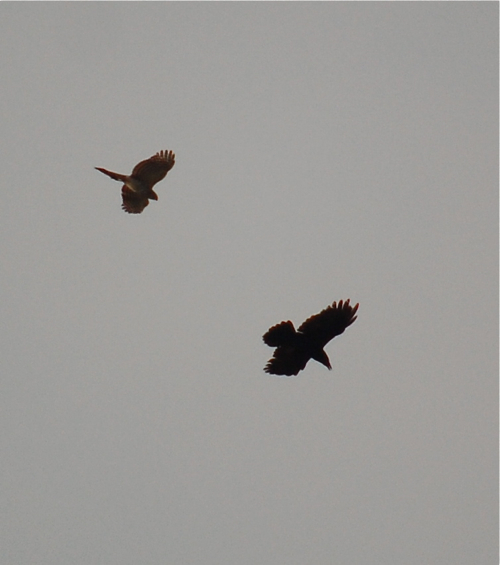
But a fast accipiter like a Cooper's hawk is a master of maneuvers and soon was above the crow again. The hawk didn't appear to be seriously diving for the crow, just giving it a warning to back off.
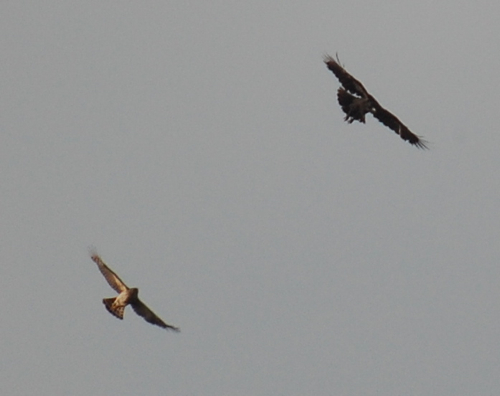
The crow continued its pursuit and was once again above the hawk--it even dropped its landing gear down towards the hawk.
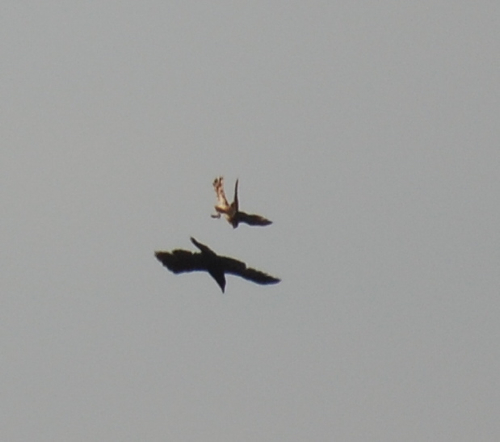
But once again the Cooper's hawk got above the crow and showed it some real landing gear. The birds took turns diving after until they were well out of sight. I'm sure the crow eventually gave up its pursuit and that the smaller Cooper's wouldn't have been quite sure what to do with the crow if it actually nailed it in midair. The interaction seemed to be the equivalent of two birds trying to get the last word in.
2 Cool Birding Opportunities
Looking for some cool birding opportunities for a vacation? How about volunteering for two weeks in Maui (that's right, go to Hawaii) for 2 weeks and help researchers with endangered birds: MAUI RARE BIRD SEARCH VOLUNTEERS (4) wanted for two weeks, 13-24 Sep 2010, to conduct transect searches for Maui Parrotbill, and other endangered forest honeycreepers, in Waikamoi Preserve on Haleakala, Maui, Hawaii. Parrotbill are critically endangered, estimated at around 500 remaining individuals.
Primary field duties include aiding staff from the Maui Forest Bird Recovery Project with finding and GPSing locations of Maui Parrotbill and `Akohekohe and recording Maui Creeper encounters along transects. Field duties are physically challenging, working at 5,000-7,000 ft elevation, in muddy and steep rainforest conditions.
Desirable Qualifications:
1. Excellent physical health (no chronic problems with knees, ankles, or back)
2. Excellent birding skills and capacity to detect birds by their vocalizations
3. Experience and comfort with wilderness hiking (4) Experience and comfort with group living.
Provided Benefits: (1) Learn about Hawaiian forest bird conservation and bird ID with biologists from the Maui Forest Bird Recovery Project; (2) Search and probably see one of the most endangered birds in the United States in an amazing rainforest setting; (3) Housing at our intern and volunteer cottage and in the conservation research cabin on Haleakala (4) Transport to and from the airport and into town for shopping (5) Field gear required for searches.
Work schedule will include 2 full days of training and 7-8 days of searches in The Nature Conservancy’s Waikamoi Preserve with a weekend break in between for your own free time to explore Maui. Volunteers will provide their own food during their stay as well as their transport to and from Kahului, Maui. The Maui Forest Bird Recovery Project is asking for a $600 donation to help off-set costs of volunteer accommodation rental, transport, and field supplies. The donation is tax deductible. To apply please send a cover letter outlining your current physical fitness for rugged field work, your field biology experience, especially bird surveys or rare bird searches, your wilderness or back-country experience, and a recent resume to DR. DUSTI BECKER (EM: dusti AT mauiforestbirds.org).
It's tax deductible, you get to help birds and researchers, it's in Hawaii and it's a cool way to spend a vacation! Now, Hawaii is all well and good, but the following opportunity is more my style and if I weren't happily married and I would be applying for one of the following positions to study boobies in Galapagos...yep, 2 magical words for birders: Galapagos and boobies!
GALAPAGOS ISLANDS--NAZCA BOOBIES. Two field assistants needed for each of two trips (mid-Oct. 2010 to mid-Jan 2011 and mid-Mar to mid-Jul 2011) for work on breeding biology of Nazca boobies on Espanola Island, Galapagos, Ecuador. The assistants will join a group totaling five continuing a 26-year study of this species.
Majority of the work will be identifying banded parents at nests and marking nests, 7-9 hrs per day of physically taxing and fascinating work in an incredible place. The group will live in tents and a primitive field camp on this uninhabited island, a day's boat ride from the nearest civilization.
Requirements: physical fitness, tolerance of heat and sun, cheerful can-do attitude. Previous field experience required, Spanish desirable. All expenses paid, including travel from your home base. No salary. These positions will be filled as soon as possible. Presently we are recruiting for the first trip, but if you are interested in both trips, please indicate this in your cover letter. Please email a one-page cover letter and contact information for three references, with c.v. attached, to DR. DAVE ANDERSON at Wake Forest University (EM: da AT wfu.edu).
All expenses paid and you get to spend a 2 months in a tent on Galapagos--for free! And it's not just sightseeing, you are on a project to help boobies. Can you imagine the great stories you'd have to tell at cocktail parties? Or how that would look on a resume? That's one heck of an adventure! Ah, I wish I could do this trip, sounds amazing!
Digiscoped Images
Fresh Tweets
Would you like to hire me as a speaker for your event?
Email sharon@birdchick.com