
Birdchick Blog
BirdLife International Needs Some Help
I love the organization BirdLife International and they are in need of some help if anyone can spare it. A massive forest fire on the island of Madeira has killed several breeding adults and 65% of this year’s chicks of Zino’s Petrel (Endangered). BirdLife International and SPEA (BirdLife in Portugal) have launched an urgent appeal for funds to carry out emergency conservation work needed before the winter sets in.
Zino’s Petrel Pterodroma madeira is Europe’s rarest seabird and one of the rarest birds in the world, nesting only on a few mountain ledges in the rugged central massif of Madeira island. Once on the edge of extinction with numbers down to a few tens of pairs, intense conservation action over the past 20 years, led by the Natural Park of Madeira (Parque Natural da Madeira - PNM) with support from SPEA, the Freira Conservation Project and Funchal Municipal Museum, has seen its population grow to almost 80 pairs.
In recent weeks, forest fires have ravaged parts of Madeira, and on 13 August they hit the heart of the central massif. This area (which is protected as part of the EU’s Natura 2000 network) comprises a very important habitat and supports several endemic plants and animals, including the Zino’s Petrel breeding colony, where many nestlings were still in their burrows.
On 15 August, as soon as the ground and soil had cooled down sufficiently, PNM staff visited the breeding cliffs to assess the damage. The results were shocking: 25 young and 3 adults were found dead, and only 13 young fledglings were found alive in their underground chambers.

“The loss of 65% of this year’s potential young is a huge blow to Zino’s Petrel. Our immediate conservation efforts are focusing on helping the remaining 13 fledglings to survive and minimising the risk of further soil erosion on the breeding ledges,” said Ana Isabel Fagundes, SPEA’s Madeira Coordinator.
“All nests with surviving chicks have been reinforced, all corpses removed, and bait stations for rats around the now barren nesting areas established. Burnt bushes and trees have also been removed to avoid the risk of adult birds colliding with them on their nocturnal visits to feed the chicks,” reported Paulo Oliveira, PNM Director.
Encouragingly, the immediate conservation action taken by PNM at the breeding colony appears to be working: “Since our first visit to the breeding ledges, we have monitored the 13 surviving fledgings closely and can confirm that they are still being fed by their parents and appear to be healthy,” reported Paulo Oliveira following his latest visit on 24 August.
The PNM and SPEA have now developed an action plan for the breeding colony. Immediate measures needed include covering areas with anti-erosion materials and constructing artificial nesting burrows, both of which have proven successful on other seabird breeding colonies on neighbouring Bugio island. Other planned work includes taking steps to help the natural vegetation recover through seed dispersal.
The PNM and SPEA are now seeking financial help to cover the costs of the materials and manpower needed to implement these essential emergency measures. BirdLife International has set up a secure online donation web page to help collect the urgent funds to help Zino’s Petrel.
Click here to find out more and to donate. Even if you can only spare $5 it can help. All of us can do a little and it will add up to a lot. Sometimes, when you see news all over the place about what is wrong, it's encouraging to see a way to help an endangered species.
Shorebird Migration
Migration is in full swing!
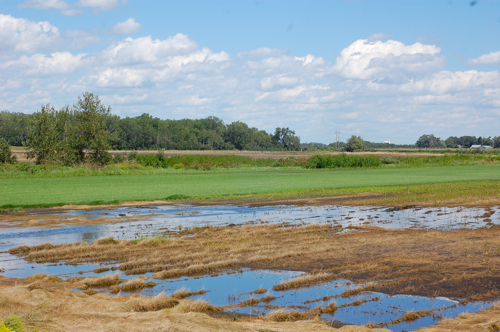
Ah, it's the special time of year when I drive around looking for flooded farm fields and get the opportunity to misidentify shorebirds. We've had several flooded fields thanks to some heavy rain storms in Minnesota this summer. My neighborhood flooded again two weeks ago. In general, I like shorebirds--they are cute, have crazy shaped beaks and run around comically as they probe mud or sand for food. But they do have a tendency to defy the field guides or at least my understanding of them. If your travels over the next few weeks take you to some shallow waters in a flood farm field or around some sod farms, take a closer look. Even if the field looks deserted of birds with the naked eye, give it a quick scan with binoculars, you might be surprised at what you find.
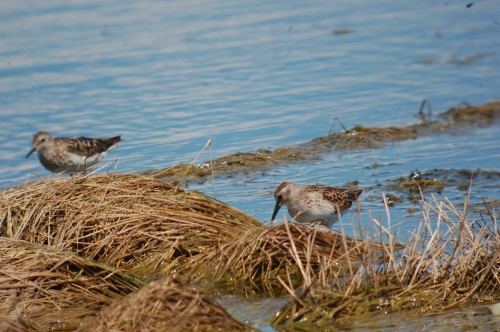
Some of these birds, like least sandpipers are the size of sparrows and easy to miss. But the sure are adorable to watch as they probe for food.
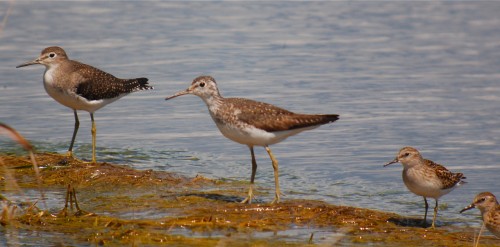
Here's an example of my misidentification misadventures: I tried to make the four birds above from left to right a solitary sandpiper, a lesser yellowlegs, least sandpiper and least sandpiper. Turns out that both the 2 larger birds are solitary sandpipers and different plumages. There go birds again--not living up to the field guide name. Shorebird id is so much like a logic problem.
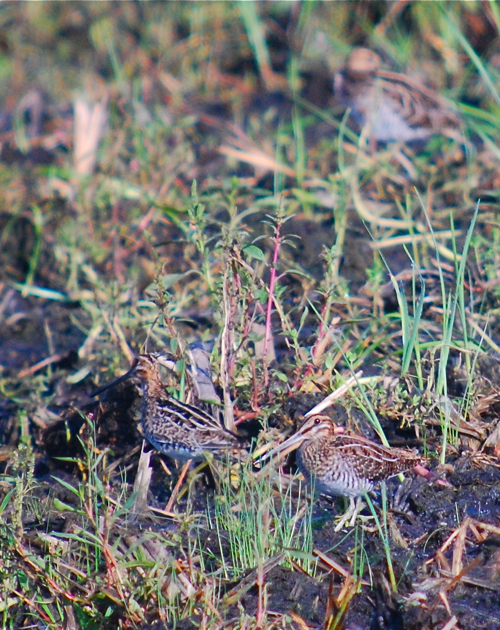
I get excited when I do find easily recognizable shorebirds like the above Wilson's snipe. I saw several working a farm field southwest of the Twin Cities. Not only do I enjoy these birds for their identify-ability, but they look so strange, with the super long bill. What kind of squishy bugs and crustaceans can a bill like that detect. According to All About Birds, snipe have sensory pits at the tip of the bill which allows them to feel its prey deep in the mud. I often wonder what it's like to experience the world as a bird when it can see in the ultraviolet spectrum, but how about detecting things with your mouth--crazy!
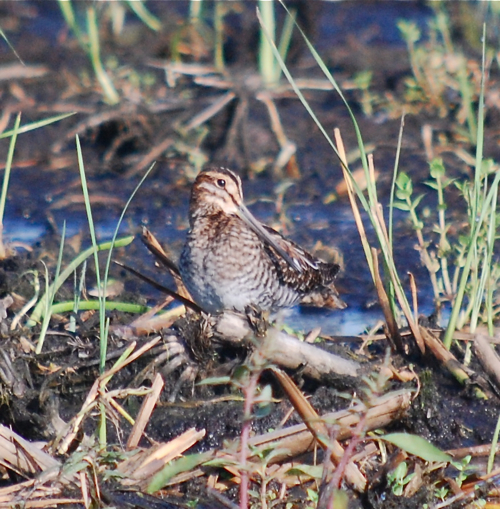
The field had several shorebirds, mostly pectoral sandpipers, but as I scanned, I found several snipe lurking in the vegetation. They look similar to woodcocks but an easy way to tell them apart is the striping over the head. The above poor guy kept trying to take a snooze but was constantly interrupted by foraging shorebirds or more snipe calling as they landed in the same field.
I do have mixed feelings about the shorebird migration this year and feel an especially hard pull to go out and really watch birds and enjoy them. I love seeing them and I wonder if their numbers will plummet. I wonder how many are off to the Gulf and how many we will lose on the way down and on the way back up. Has their fuel supply been altered in some way we can't detect yet? Will they find food, but will it be contaminated and force many birds to die in the Gulf waters rather than flying over the whole body of water? Migration is tricky business and I always wonder who will be strong enough to survive and return next year, but the oil contamination in the surrounding Gulf marshes could kill more birds.
There's a really, really good article at One Earth that even has some quotes by bird people who know far more than I do like Laura Erickson and Scott Weidendsaul. It's a good read and highlights many points anyone involved with birds has about the Gulf Spill not being over. I know BP and surprisingly some government officials want us to believe that it's over, but it is not. Just because the oil is below the surface and "out of sight" does not mean it is gone.
Some Great Conservation News In The Amazon
Well, now here is some positive news for birds! American Bird Conservancy in cooperation with the Amazon Conservation Association, has helped finance the purchase 7,427 acres of world-class bird and wildlife habitat in southern Peru that may contain the highest bird diversity for a single site in the world! The area is within the spectacular 4.7 million-acre Manu Biosphere Reserve, which is one of the most pristine areas of remaining rainforest in the Amazon.
This large property, called Villa Carmen, is situated at the confluence of three rivers, with frontage on two: the Pini Pini and the Tono. The property also has numerous streams and waterfalls, an all-weather road, and a small airstrip. The land ranges from about 1,500 to 3,500 feet in elevation, and contains roughly 90 percent old-growth rainforest, with about five percent diversified agriculture and five percent secondary forest.
The property is adjacent to Amazonia Lodge, a popular birding destination along the Manu road with a bird list of over 600 species including several globally threatened species, such as the Black Tinamou, Military Macaw, Blue-headed Macaw, Wattled Guan and Solitary Eagle. The area also supports wintering habitat for a number of neotropical migrant songbirds. Wintering U.S. WatchList species of conservation concern include the Olive-sided Flycatcher, Cerulean Warbler, and Canada Warbler.
The area joins a growing list of protected areas within the ABC Latin American Bird Reserve Network that currently numbers 36 reserves spanning 700,000 acres in 12 countries. Plans for the new reserve include cooperative efforts with local communities in the area to help preserve the greater Manu ecosystem, stimulating a local conservation economy with demonstration projects in sustainable agroforestry and aquaculture, and hosting environmental education programs, while providing lodging for visiting birders.
Cool Adult Camps
I was just talking to a friend the other day about how there needs to e adult camps and low and behold, I get an email for two really cool camps coming up in Minnesota at the Wildlife Science Center specifically for adults. A camp for those bird inclined is Adult Raptor Camp where you can learn about the natural history of Minnesota birds of prey, identification, falconry and care and management. The best part is that each participant gets to handle 2 different birds of prey. If you've ever seen some of my photos of bird handling and you think it looks like a good time, this would be the camp for you.
They are also offering an overnight camp about wolves. Both sound fun and you can learn more at the Wildlife Science Center site.
Drawing For Free Field Guides @PrincetonUPress
This week Princeton University Press has a bird book give-away: Birds of Western North America:A Photographic Guide and Birds of Eastern North America:A Photographic Guide. If you follow Princeton University Press on Facebook or Twitter you are automatically entered. If not, follow them for a chance to win one of these new photographic field guides. The drawing for the books is on Friday.
Homosexual Pairings in Birds
According to a study coming out, a researcher is suggesting that in some cases homosexual pairings in birds can be beneficial. Live Science reports: After all, in evolutionary terms same-sex mating seems to reduce the birds' chances of reproductive success. But that's not necessarily so, according to a new study. In a given species, the sex with lighter parental duties tends to mate more, period — whether with the same or the opposite sex.
In 2007, a team led by Geoff MacFarlane, a biologist at the University of Newcastle in Australia, reported that male homosexual behavior was more common in polygynous bird species, where males mate with numerous females, and that female homosexual behavior was more common in monogamous species.
Intrigued, MacFarlane looked for help explaining the pattern in a theory predicting that whichever gender spends less time caring for young tends to have sex with more partners.
To find out whether the theory might extend to homosexual behavior, MacFarlane and his team exhaustively combed the literature for accounts of same-sex courtship, mounting, or pair bonding. They focused on the 93 bird species whose homosexual interactions scientists had seen in the wild. For each species, the team calculated the frequency of homosexual behavior as well as both sexes' contributions to parenting.
Overall, homosexual behavior amounted to less than 5 percent of all sexual activity in the 93 species, though in some cases it was much higher. And sure enough, there was a strong correlation between a species' mating system and its homosexual behavior. Whichever sex did less parenting also typically did more same-sex canoodling – basically because they could. This tended to be true for the promiscuous males in polygynous species. The balance shifted to females in socially monogamous species, where the sexes split the work more equitably.
You can read the full article here.
Awesome Bird Nests
Is this the best osprey nest ever? This is from Cornell's Celebrate Urban Birds, you can see more here.

Unexpected Chukars
I had a meeting with my friend Mark Martell at Minnesota Audubon yesterday. When I pulled into the parking lot I saw a bunch of small, round birds running in the parking lot. At first, I thought, "young pheasants?"

When I parked my car, I could see they were chukars...and rather friendly ones at that. I've seen chukars in Utah but this was the largest flock I have ever seen in Minnesota. Theses are most certainly released birds--they are native to Eurasia. Either there is a game farm nearby and they are escaping or someone is raising and releasing them.

I'm not really a fan of raising and releasing chukars--they are non native and therefore competing for food with native wildlife, they don't do well in Minnesota winters and really, all these chukars ever become are coyote and fox food...and maybe food for Cooper's hawks too.
Anyone else have chukars showing up to their feeders?
Autumn Bobolinks
I woke up in the dark on Sunday morning and was irritated. I realized that I was awake and since it was still dark out, I assumed it must have been in the middle of the night. Was it the humidity? Was it the moon? Was it that early evening cup of coffee? All three could be causes of insomnia for me. Since sleep wasn't coming, I decided to get up and do some writing (Non Birding Bill calls this my acorn gathering time, I generally say yes to a TON of freelance projects in the late summer to tide over the leaner months in winter). I walked into the living room and was surprised to see the clock read 5:30 am. Waking up at that time would make sense since I went to bed early the night before...CRAP, it's dark at 5:30am--that means the days are getting seriously shorter. I said, "Screw writing." Then grabbed my digiscoping equipment and hit the road. Gotta enjoy the warm weather and birds while it lasts.
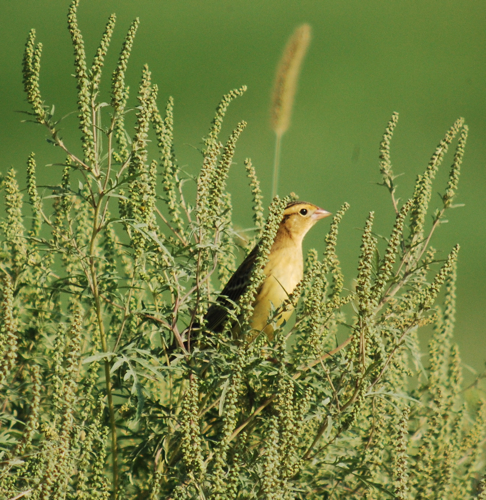
I took in a ton of fall migrants, but my favorite birds were the flocks of bobolinks nibbling on grasses along some gravel roads. I pulled over and was serenaded by late summer katydids while took photos of the yellow birds as they popped out and then down in the tall grasses. I'm not sure if this is a male or female, this is the bobolink's non breeding plumage and they both look the same. If you click on this link you can see what a male bobolink looks like during the breeding season--quite a dramatic change!
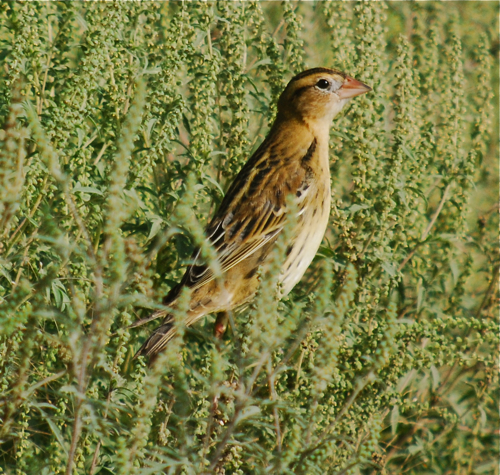
I sometimes have trouble remembering that bobolinks are thought to be in the blackbird family--especially in the fall. They look like large yellowish sparrows.
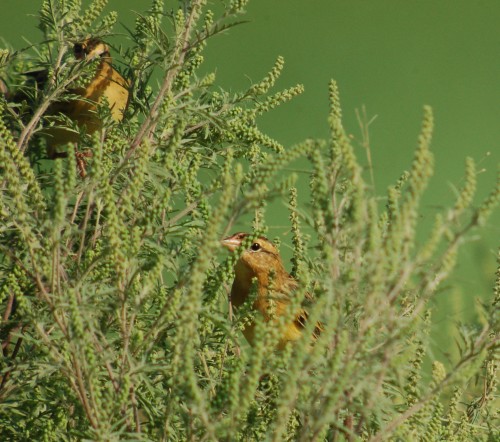
This is my favorite photo--the bobolinks lurking and hiding while feeding. The plumage makes sense while migrating. These birds will also have to contend with the millions of raptors moving south this fall too. They yellow and brown stripes will help them hide while they feed.
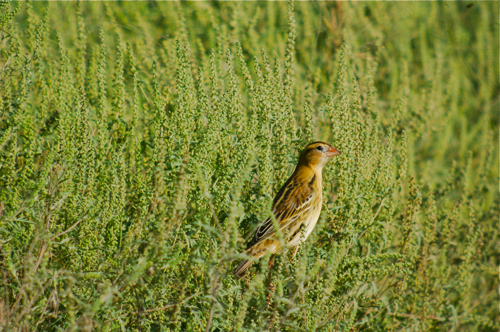
These bobolinks were near some flooded farm fields with lots of shorebirds, I actually went shorebird watching a couple of times last week, but shorebird id stresses me out and I haven't put the photos up yet. I'll have to bite the bullet and get them up. Their migration is full on.
If you haven't been out to enjoy some birds, get out there now. Migration is on!
Wanna Help Finance Alex & Me Movie?
I got the following request in my inbox: We are reaching out to you for your help on our special project. It is our great pleasure to announce the launch of our brand new website aimed at including you and your fellow bloggers in the making of a real Hollywood motion picture!
Earthrise Pictures and FaR Out Productions have acquired the theatrical rights to Dr. Irene Pepperberg’s book “Alex & Me.” This New York Times best-seller is the heartwarming true story of the incredible bond between two special creatures--woman and bird--who over the course of 30 years opened an unprecedented window into the hidden world of avian intelligence.
In order to maintain a day-to-day commitment, we need the loving support and generosity from bird lovers everywhere. Writing a screenplay takes a tremendous amount of time and research to craft a story that is both accurate and entertaining.
Every donation made on the website will help us expand our lab space, offer video blogs & fun interactive games, and post updates with the latest news from Hollywood. It’s all through PayPal so the contribution is safe and secure.
Also, for a minimum donation of at least $20, the contributor will have their name in the credits of the film and full access to everything inside the Movie Lab.
This is a rare opportunity for the birding community. Alex and Irene’s story is one of a kind, and we owe it to them for all their hard work and amazing accomplishments. This is indeed a story for the big screen.
Digiscoped Images
Fresh Tweets
Would you like to hire me as a speaker for your event?
Email sharon@birdchick.com