Birdchick Blog
Jeff Gordon announced as new ABA president
Just a quick note while Sharon is doing her aerial surveys. The ABA has announced that Jeff Gordon has been selected as their new President. Kenn Kaufman, who was on the search committee, has a blog post up about the process and Jeff's credentials. Sharon wishes to personally extend her congratulations to Jeff, she just can't do it from the plane.
Birder's Exchange
If you are not familiar with Birder's Exchange, you should be. It's the American Birding Association's world-renowned conservation initiative, to help Neotropical migratory birds by promoting good science and public awareness in Neotropical regions. In these areas, many researchers, educators, and conservationists work without the most basic equipment. The ABA addresses this need for equipment and educational tools and contributes to bird conservation through its Birders' Exchange program. Birders' Exchange takes new and used birding equipment and educational materials and matches it with local scientists, conservationists, and educators, in Latin America and the Caribbean. Find out more about this exciting program and how you can get involved by exploring the Birders' Exchange website now! There are several ways that you can help--have an old pair of binoculars that still work well? You can donate them. Have some spare cash, even $5? The Birder's Exchange will take that purchase equipment for researchers in the Neotropics. Do you have an upcoming trip to a country in Latin America or the Caribbean? Would you be willing to take down donated equipment in your luggage on behalf of Birders' Exchange? There are several ways to help.
Here's a video that does a great job explaining the program and includes some great bird footage:
[youtube]http://www.youtube.com/watch?v=wBQTC3wez2c[/youtube]
Drunk bees!
Hello all, NBB here. Yesterday was a pretty shining example of why, three (?) years into this process, I'm still the junior beekeeping assistant, the Barney Fife of the apiary world.
To get everyone up to speed: the bees needed to be fed, Sharon has to work, Neil is out of town, Hans is out of town, and Lorraine is sick as a dog. Which left me. Now, the last time I was sent off alone to check on the bees it was a comedy of errors, if by "comedy" you mean "it's funny because it happened to someone else."
This mission, however, was a simple one: feed the bees. I didn't have to switch boxes, combine any hives, or search for the queen. Just feed the bees by mixing sugar and water in a pail, then add the pail to the hive. A job so simple, an idiot could do it.
Which is why they sent me.
It was a cold day, about 44°, which meant the hives would be less active, they tend to stay inside and cluster for warmth. I got there in plenty of time, figuring to take about an hour to make the sugar water solution. Small problem:

The sugar, having been left in the garage all summer, was not so much as “easy pour” as more of a “solid brick.” After chipping away at the bags, I was able to produce several manageable chunks and also a large mess. So after about an hour I had five pails full of sugar water.
Too bad we have six beehives. Sigh... what can I say? Math is hard! Back to the house to make another pail, then back down to the hives.
Amazing, the bees were still alive by the time I got to them.
[youtube]http://www.youtube.com/watch?v=TsJIUgrF0ws[/youtube]
We didn’t get as much honey as we were expecting this year. I wonder if the wetness of the season had something to do with this, or the fact that we had eight hives competing for pollen rather than two.
Regardless, the remaining hives seemed full. And thirsty...

[youtube]http://www.youtube.com/watch?v=cAv3TBxv7-Y[/youtube]
For reasons that escape me now, I had to reopen one of the hives after I put the pail on. I noticed one of the bees had gotten splashed with the sugar water, making her the most popular girl at the dance.

Her wings were sparkling.
We’re heading towards the end of bee season. Soon we’ll be taking the hives down to two or three brood boxes (filled with honey, which the bees will eat over the winter). We’ll wrap the hives in insulation, put the entrance reducers on (to keep out mice and other pests that would make a honey-filled box a winter home), and that’ll be that. We’ll sneak down in the winter and press our ears to the side to make sure they’re alive, dreaming whatever winter dreams bees have.
Bee Deals & Roosting Vultures #birding

October is going to be insane schedule wise. There's bee stuff to tend to, migration to watch, park service shifts, waterfowl surveys, deadlines, speaking engagements, family visits--aarg! I was coming to this realization yesterday and last night over dinner, made a deal with Non Birding Bill: I'll do laundry on Friday if he will go out Saturday while I'm working at the park service and harvest the rest of the honey and feed the bees. Deal accepted. Sometimes after a conversation like that, we stop and ask, "Is this what you imagined married life to be like?"
Some of our hives are a little behind on their honey production for winter survival and we need to help them have enough for winter. It's not unusual for beekeepers to add a nectar pail this time of year to give them a little extra. It's weird, hives that filled a honey super have a few empty frames in their brood boxes. Ah well, I no longer question what the bees do, I offer help and if they want it, they can take it. If they don't want it, I do not take it personally...anymore.
I harvested some honey on Wednesday and set up a few other hives for harvest before I left. Mr. Neil bought this really cool trap door system for the hives. You put it on the bottom of a box you want the bees to vacate--they can crawl out but cannot crawl back in--it's slick and is the best for harvesting honey.
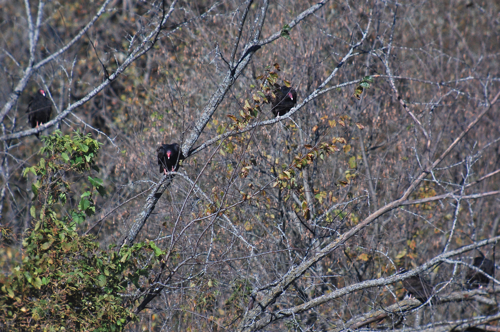
I headed out to the hives around 10am and found some vultures roosting in a nearby tree. I'm sure they roosted there the night before--a rest in the middle of their migration south. Birds that rely on thermals (warm currents of air that spiral upwards) for migration don't need to fly early in the morning. It takes a few hours for the sun to warm up the ground to create the thermals the vultures will want to glide on. These birds were loafing until the thermals were just right.
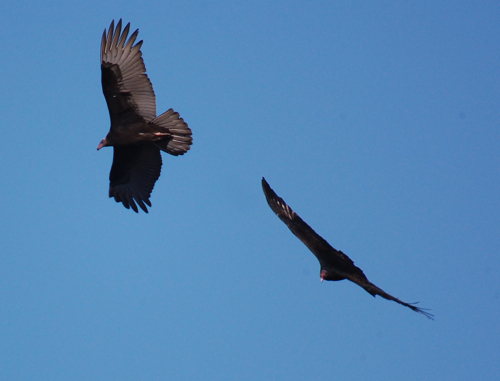
Some turkey vultures were already testing out the sky, trying to find a thermal to glide on. If you look closely at these two birds, you can see a hatch year and an adult. The vulture on the left has a dark beak and the one on the right has a white beak. The bird with the darker beak is the younger bird.
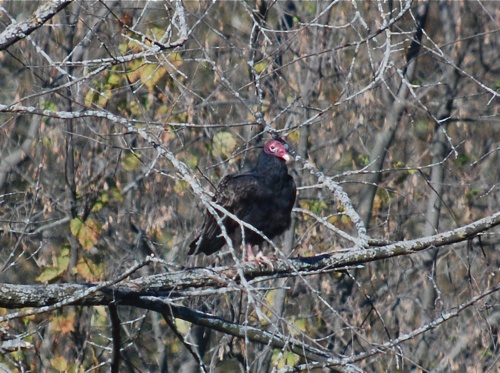
When the vultures noticed me in my beesuit, I got their attention--the white suit kind of sticks out. The spotting scope makes me very suspicious to vultures. Turkey vultures around here to do not trust a spotting scope and even though I was a good distance away, the scope did not set well with them and the rest of the flock decided to join the others already in the air.
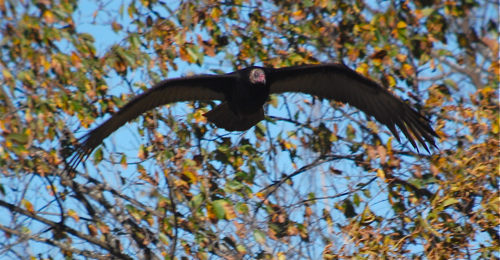
But it gave me a chance to test out digicoping birds in flight. Above is another young turkey vulture with a dark bill, even the head is still a little dark and not completely red.
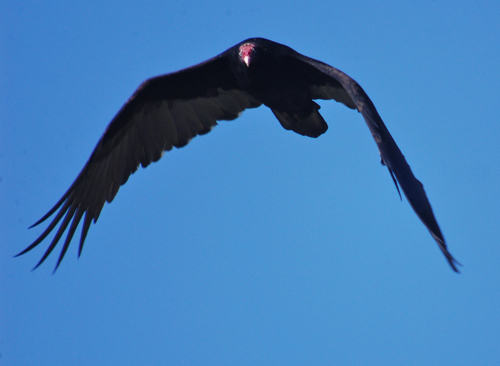
Here is an adult turkey vulture. I wondered how far south these birds would go? Florida? Would they go to Panama and visit my friends at Canopy Tower?
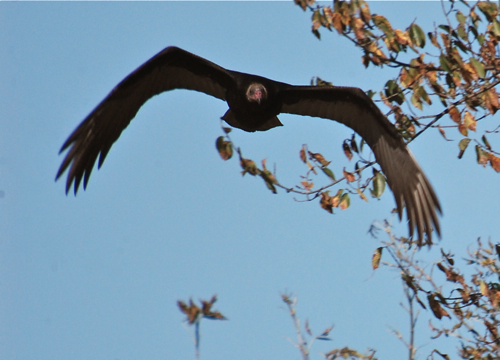
Incoming vulture! Speaking of Canopy Tower, my buddy Carlos posted a video of raptor migration seen from the tower that includes quite a few vultures, hawks and kites. Check it out. I need to get there for fall migration next year...and not overbook myself for fall.

Jupiter Again
Last night I tried to take pictures of Jupiter through my spotting scope again. A few days ago, I had pretty good luck getting the moons around Jupiter, but I wanted to try and get the cloud bands on the planet itself. I didn't have the best of luck. I was out at Mr. Neil's with Lorraine, Non Birding Bill stayed home. I spent the night because I needed to grab some beehive frames and take them to a Twin Cities nature center today so they can be used for programs. The center does a honey extraction program this time of year and they didn't have enough frames for demonstration, so I was glad we could loan a few to help them out. Not only are we helping a friend, but someone else will extract our honey for us--that's a win-win if you ask me.

So, I set up my scope on Jupiter and enjoyed the fall night--the heavy smell of pine, the quiet peeps of small birds migrating in the night...and the few random wood frogs giving it one last go before the cold forces them underground. The above photo made the planet look more like cell division rather than Jupiter. That was from hand holding the camera, so I tried using the timer on the camera while it was attached to the scope to reduce shake.

Hm...that setting didn't work. You can make out Jupiter and it's moons...but it looks rather...phallic.

Oh my...the moons took on a rather different shape...uh...wow...

Well, wow. That just...all I can say is that clearly, my mind was not on astronomy...and possibly that I was missing NBB.

I did get one very grainy photo of jupiter and you can kind of make out the cloud bands. I think I'll stick to digiscoping birds.
Waterfowl Surveys & Flooding
 Monday was our first flight out for our annual fall waterfowl surveys on the upper Mississippi. This is our initial flight to get back into the swing of things, make sure our maps are correct and to get a refresher course on identifying and counting waterfowl while flying over them. Last year my route went from around Hastings to Lake City. This year, there were some staffing changes and now my part of the surveys go all the way down to Brownsville, MN.

We had some heavy rains last week and parts of the Mississippi River and the Minnesota River are flooding. In downtown St. Paul, the Mississippi is expected to crest at 18.5 feet by Friday. That will be in the top ten highest crests of recorded history.

We saw several areas affected by the flooding Mississippi south of St. Paul. The above photos are cows working to stay high and dry.

American white pelicans and double-crested cormorants were some of the most common species that we observed. They are mercifully some of the easiest birds to identify--especially those pelicans.

There were also quite a few great egrets staging for migration. Unlike other types of waterfowl, they tend to gather in loose flocks. They do not bunch together like pelicans, each egret appears to need its own fishing space. But these loose flocks are a sign that they will be gone soon. We saw far more egrets than great blue herons.

We did see some ducks. Can you make out any different species? The big white ones are easier--those are pelicans. The rest are mostly American wigeon with a few gadwall mixed in with a few coots too. It's all about wing pattern. The wigeon are the bird with the white wing patches with a dark patch below the white. The gadwall just have a white patch.

We even found a few small groups of ruddy ducks too. They don't have the bright blue bills right now but they have those big white cheek patches which makes them obvious when we fly over--which I love.

And so we're off with our counting. I'll be curious to see how the flooding affects our surveys in the first few weeks. I'll admit, I'm a bit nervous about the sheer number of birds we'll be counting, but I'm learning some techniques that seem small but help a great deal. One technique is when you see a huge flock of 3000 ducks and it's mixed--say 3000 and give percentages of species. We fly to fast to do it any other way.
Now, as long as my stomach stays settled and I don't get motion sickness, I'll be good to go.
Digiscoping Jupiter
If you follow astronomy, Jupiter is very bright in the evening sky. I thought I would see what I could do with my Swarovski spotting scope. I aimed it and at 20 power magnification, I could easily make out the planet Jupiter and four of its moons. I was even able to digiscope it with my Nikon D40:

I managed to capture it--a bit shaky but still, you can make out the large planet and two moons on either side. My eyepiece zooms up to 60 power and when I did that, you could actually make out the cloud rings on Jupiter. Alas, I was not able to digiscope that but it's cool to know that the spotting can be used for more than just birds.
Ducks Wear Dog Masks #birding
 I was watching some mallards at Wood Lake Nature Center this week. As I took note of how far they were in their eclipse plumages (male mallards resemble females in their late summer molt, they lose their flight feathers and need to blend in rather than fly away from predators). Some are almost complete, while others still have a bit to go. Both birds in the above photos are male mallards but at different stages in their molt.

You can really see the shiny green feathers of the male's head just creeping out--a bright contrast to the duller brown feathers. But as I was watching the mallards, I thought back to a link several people have sent me in recent days.
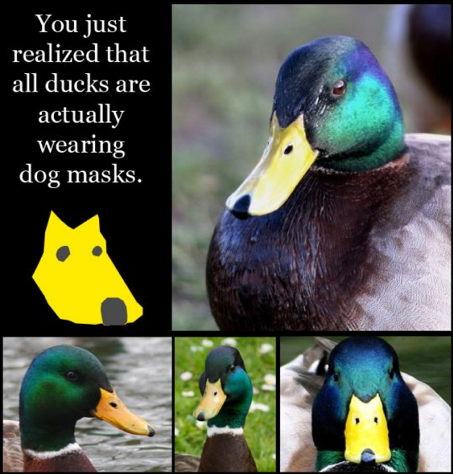
And once you have seen that, you can't think of mallards in any other way. Observe:

Now I see dog masks on every male mallard beak.
Digiscoped Images
Fresh Tweets
Would you like to hire me as a speaker for your event?
Email sharon@birdchick.com