 Is it me or does this hen mallard look like she's about to engage in some tomfoolery and goose that trumpeter swan?
I Bird. I Vote.
Very interesting blog post from the new American Birding Association president Jeff Gordon (birder, not racer) who attended the Rally for Sanity and/or Fear over the weekend toting signs that read "I Bird, I Vote." How many times have we seen bumper stickers that read "I Fish, I Vote" or "I Hunt, I Vote" so why not one for birders? It's supposed to be the second fastest growing hobby in the nation. And from the many voters I meet, it crosses all political lines and parties. I personally don't vote based on a particular party. I tend to put my vote to the person I think will do the most for birds and wildlife and I think we need to waive our bird flags a bit harder in the future. We are the voice for birds and wildlife...or at the least the translators and interpreters.
Interesting Trend In Birding Blogs
There's an interesting trend going on in the bird blogging world--bird bloggers are banding together to form multi author blogs. Recently, the guys over at 10,000 Birds announced their new "Beat Writers." Besides the usual updates from Corey, Mike and Charlie you get other great writers like Patrick from Hawk Owl's Nest, Nate from Drinking Bird and Julie Zickefoose. Some of my favorite bird bloggers all coming together to what already is a great site. I like how it's becoming a news oriented site. Mike, Corey and Charlie have been kind enough to include me in the list and starting Wednesday, I'll have a post there every other week.
There was also the recent announcement of BirdingBlogs which is billing itself as "the birding bloggers in one site." The site's founder writes:
"I noticed it was hard to get a lot readers to my own blog unless I posted something every day. Also it would be difficult to provide top notch content every time one writes. The day simply has not enough hours for all I wanted to do. I looked at the amazing numbers of unique visitors ranging to several thousands per day on sites such as 10000birds and grrlscientist. It was clear that post frequency and good content together was the key to more visitors."
Some of the bloggers this site will use to increase traffic include Kenn Kaufman, Jeff Gordon and Dale Forbes.
The American Birding Association also has also launched a multi author blog as well--different birders from around the organization sharing their passion for birds. I'll also post here too along with several other members like Nate from Drinking bird and Laura Kammermeier.
I'm excited about the changes the organization is making, curious about the new leadership with Jeff Gordon and hopeful that the organization can turn itself around and one day be a loud voice for birding and birds they way Ducks Unlimited is for hunting and conservation.
With so many birding blogs bringing together so many voices at the same time, this appears to be a big trend. I'm interested see where all this multi-author blogging goes. I like that we are developing Salon or DailyCos type of birding sites.
UPDATE!
There's also another multi author bird blog that I just learned about called North American Birding. This site boasts:
"You’ll find a hugely talented – and growing – group of contributing bloggers, from seasoned experts to young beginners. Scientists and photographers, professional guides and graduate students. Oh, and a professional writer or two. Our goal is to assemble voices and opinions as diverse as the birds themselves."
I'm excited to see Chris West as part of their roster--he's an awesome up and coming birder!
Can't Stop Watching Ducks
I'm a sick, sick girl. Once a week, for work, I am assigned to go in a plane and focus an insane amount of energy watching and counting ducks from a plane. Then after an intense day of not stop ducking, I have to listen to the audio recording of my notes, tally the numbers and enter them in to a database. If I have time, I try to enter the numbers in to eBird or write up little articles of our progress for the park service or other organizations.
So. What do I do on my mornings off?

I watch freakin' ducks! There was a report on the listservs of a long-tailed duck on Vadnais Lake in St. Paul. But of more interest to me were the numerous other species of ducks reported on the lake. It was mostly ring-necked ducks (there's a few mallards in the above photo too). So, I headed out. I didn't care if I got the long-tailed, I've seen them before, but some non work related duck watching sounded good.

In fairness, we didn't fly last week because of that massive wind storm/"landcane"/record low pressure system. The 45 mph winds made flying 100 feet above the river a wee bit too dangerous. Perhaps, I was feeling a bit of duck withdrawal--I was torqued and ready to go and then got the rug pulled out from under me. I do appreciate ducks in the fall. Most birds are brown and somber in coloration. Male ducks--still quite colorful--above with the ring-necked ducks are a lone bufflehead and a redhead.

Here was the view of Lake Vadnais. This view was from a pull0ut lot of the road. Some trumpeter swans were near the shore along with a few mallards. The large raft of ring-necked and other ducks were just beyond. I situated myself against a tree and the swans paid little attention to me. As they swam closer, the larger raft of ring-necks didn't seem to to be disturbed by me.

As other birders continued further down the road, the raft of ring-necks drifted towards the swans...and me! I really enjoyed the pressure of enjoying duck colors and numbers without the pressure of counting and documenting.

The lighting was so perfect, I could actually make out the ring on the neck of the ring-necked ducks (bird in dire need of a name change).

Here's a pair of goldeneye that were mixed in with the ring-necks.
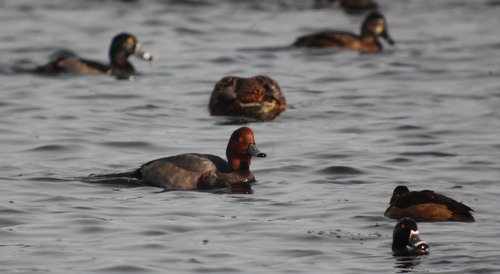
The raft of ducks were in a feeding frenzy, bobbing and dipping--the yellow eyes on most of them gave the whole party a maniacal look. Here's a closer look at the redhead duck (love the ring-neck with just its head visible in the lower right corner).

If you find a raft of ducks in your area, take a few moments to soak up those colors before they fly off when the water freezes.
Winter Robins Arrive In The Twin Cities
 We're down to the bitter end in migration. The fall robins are all over the place in Minnesota. On the bike trails around town, the robins are so numerous, I can hear them over the sound of my headphones as I bike past. These tend to be more aggressive birds and I'll admit that it's fun to see someone who can bully starlings.

I was a little surprised to see a Swainson's thrush mixed in with the robins. We usually see other thrushes mixed in with flocks of robins, but this late it tends to be hermit thrushes. The bird was not a welcome part of the flock. The blurry robin in the above photo was on its way to making a sneak attach and chased the thrush off before I could get a better photo.
Robins totally dig all the fruit trees people plant in their yards, although many of the robins I find are raiding the buckthorn branches. I'm torn, I'm happy to see robins adapting to a source of food, but I also realize that they are laying the groundwork to plant more buckthorn that has been removed.
Take That, Wax Moths!
Earlier in the summer I reported that an empty hive feel victim to a wax moth infestation. The frames were nasty and full of webbing and tons of squishy larvae. This gross combo did lead to me finding a way to combine my love of beekeeping and birds:
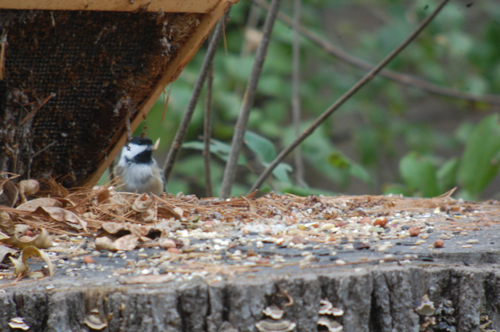
It took some convincing, but the birds got comfortable enough to approach the frames and totally dug the fat little protein packed larvae (note the black-capped chickadee above with a worm)! I placed the frames on a stump that I use as a tray/feeder photography studio. At first, I had to scatter some favorite seeds to get the birds' attention and when they landed, they instantly saw the squirming wax worms and chowed down. I did have to flip the frames over from time to time, the larvae would crawl to the other side to hide but I think the titmice, chickadees and nuthatches took care of them. I'm not sure what to do with the webs that remains on the frames. Some beekeepers say to put them in the hive and the bees will clean it off. At night, something has been coming up to the stump and eating all the wax off of the frame (perhaps mice). Maybe if I leave the frames out, the mice will take all the webbing too and I'll have a totally bare frame?
Unadulterated Dog Joy In Leaves
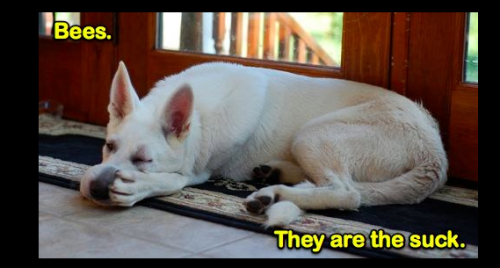 You may recall that earlier this summer, Mr. Neil's newest dog Lola learned that if you violate bee ettiquette, you get stung. I must say, this incident of swollen dog face was not enough to convince her to avoid mischief around the hives. Non Birding Bill and I took her to the hives after this incident and she went straight for one and started sniffing the entrance. She got bonked and a sting and then went back to the entrance for more. We had to guide her away and fortunately, she did not swell to the epic proportions as she had before.
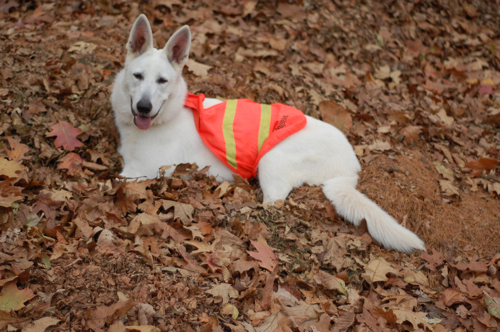
When we went out last weekend to the hives, I learned that Lola is in love with piles of leaves--like any eight year old (even the one buried inside every adult).
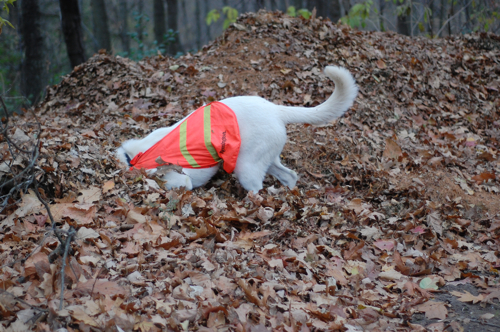
Which is a much safer area for her to play in rather than right in front of the hives.
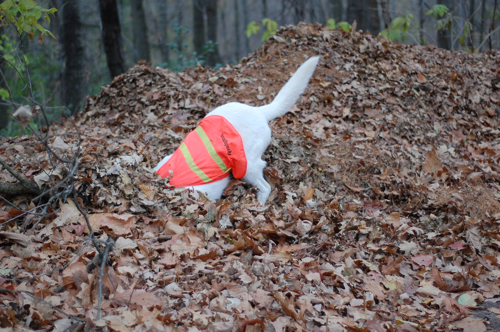
If you are wondering about her cape, it's hunting season. Currently it's bow hunting season on deer and grouse shooting season. In a couple of weeks it will be deer shooting season. The dogs run so quickly it's best that they wear orange when they are barreling after small mammals in the woods. You may think that a white dog couldn't be mistaken for a deer, but there are some hunters who shoot first and ask id later (as in this infamous 2002 MN incident) and we do have quite the population of albino deer up here. I saw them on my first trip to Father Hennepin State Park...I should go back and try to digiscope them sometime. Here's a video of an infamous albino buck that used to live along the Minnesota/Wisconsin border.
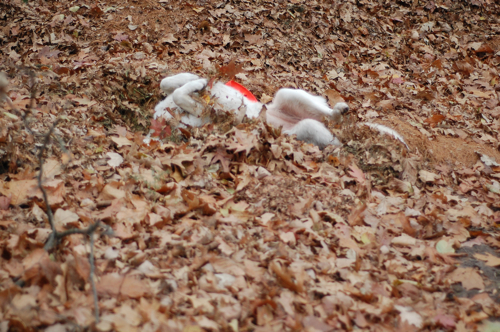
But check out the unadulerated joy that is Lola in a pile of leaves!
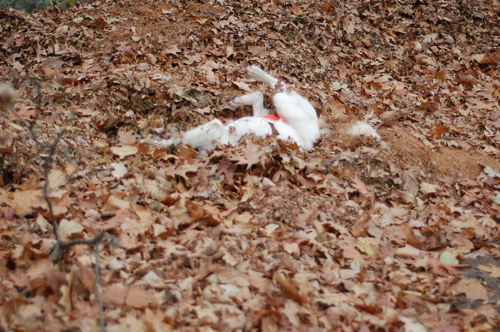
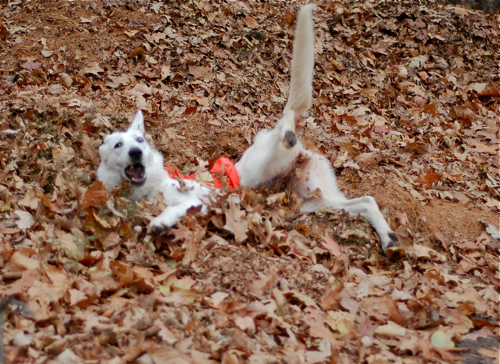
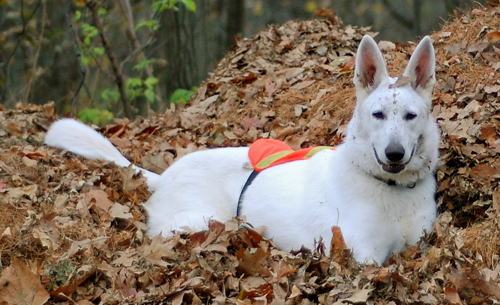
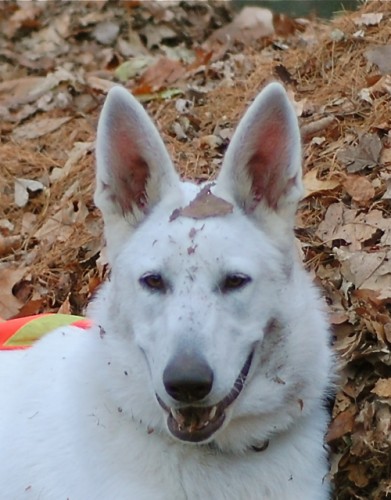
Dog smile! A much better time for Lola at the hives than earlier this summer.
Hey? Any Food In There?
 I found this nuthatch meticulously searching beneath each shingle for insects to eat. Woodpeckers aren't the only birds looking for insects off the sides of houses.
Useful Beekeeping Tools
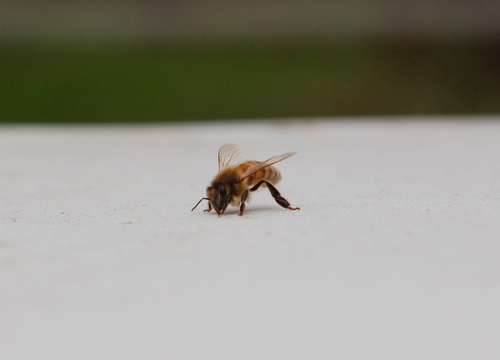 The lone bee!
It's late fall and we are getting our bees ready for the winter. As we were winding our bee season to a close, I thought I would bring up 2 different pieces of bee equipment that have been incredibly useful to use this year. There's a lot of bee equipment equipment that is mediocre (or does not come with instructions so is about as useful as a Slap Chop).
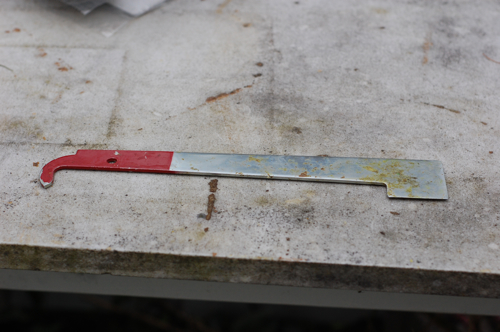
This was a hive tool Mr Neil found...I think when he went to Australia. Hive tools are needed to pry boxes and frames apart--especially after bees have propolised them together. Our newest one is called an Australian hive tool. What separates this from your garden variety beekeeping hive tools (besides higher cost) is the little hook on the end--you can use it to pull out the frames from the brood boxes. If you are only going to have one hive tool...I'd go with with this one.
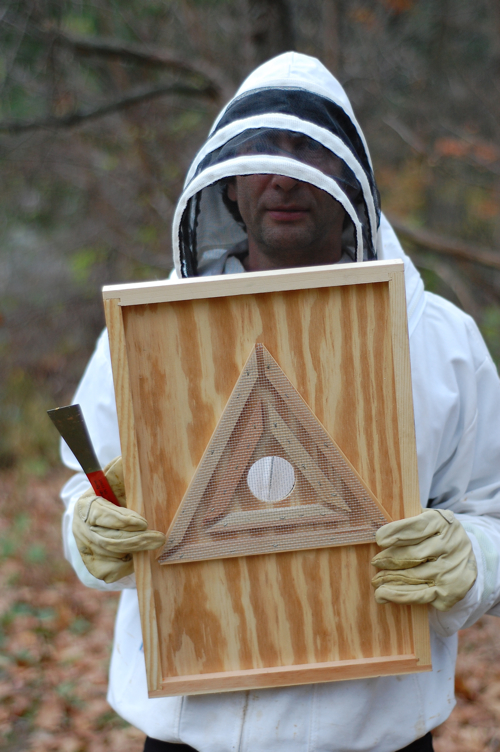
The other really cool piece of equipment that Mr. Neil ordered for us is the escape board. Every year when we extract honey, we have the not so fun task of convincing all the worker bees to leave those honey supers and join all the other bees in the brood boxes. We don't always see eye to eye on this sort of thing. We've tried other things to get the bees to leave like Bee Quick which is an essential oil that you spray that causes most of the bees to leave the super and go deeper into the hive. You have to order a new bottle every year because it appears to be less effective after the first summer. There's also Neil's shake the hell out of the box to flick the bees out method.
But I gotta say that this escape board works WAY better!
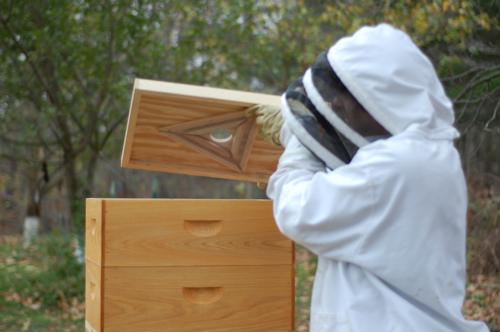 You place the escape on top of the supers or boxes that you do not want to remove and place it so the triangle side is on the inside of the hive. The top has a hole, the bees crawl down that and out the triangle to join the rest of the hive at night. The next day, when they try to return to the other honey supers, they can't figure out the triangle maze and don't go back.
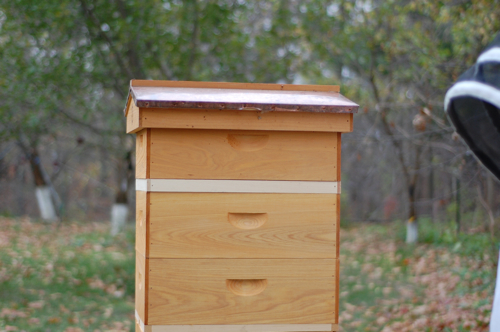
You then place the box full of honey that you want the bees to vacate on top of the escape board and in a day or two you have a bee-free honey super--it's awesome. More effective than the Bee Quick and the flick method.
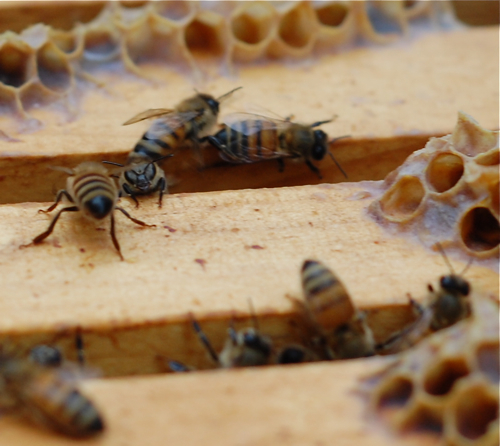
You end up with happy bees and not angry bees lost and irritated in the honey super you are trying to harvest. Bonus!
Random Autumn Photo
