
Birdchick Blog
Crossley ID Guide
I get books sent to me all the time and the words, "innovative" and "revolutionary" and "amazing" get tossed around. The books are good, but rarely live up to the hype. Richard Crossley's new Crossley ID Guide to Eastern Birds is a guide lives up to those words. This book is going to be talked about A LOT. Some people are going to dislike this book (there are rumors of "well respected birders" refusing to review it). Some are going to love it. The bottom line is that Mr. Crossley took a huge chance and this is a book that has to be seen to be believed.
I've heard of this book coming down the pike for months. When I saw the first few pages, I thought, "Ahhhhhhhh, A.D.D. birding! Stop the insanity!" Here's why:

This book assaults you visually. The above is the page for the osprey--birds are everywhere, coming from every direction, looking in every direction--everywhere you look: osprey! Ahhhhhhhhhh! I think we are used the very orderly and tidy designs of Sibley and the National Geographic Guide that the Crossley Guide seems almost too intense. But I do like what he is trying to communicate here. He has a photo of the typical habitat that one might find an osprey in and then tries to show you every possible angle at which you could id the birds. It's almost as if this book is the "missing link" between illustrated guides and what I see the future being of video bird guides on smart phones.

It's as if the author went out of his way to make his guide as different as possible. He uses photos of birds in the beginning to show you the different parts of the bird, but rather than using "pretty shots" he goes for more realistic, like using a house finch with conjunctivitis (ew).Despite one really gross (yet realistic and accurate) photo, the photos of birds are very useful tools for showing anatomy.

Here are the pages for common yellowthroat and hooded warbler. On the one hand, I really like how he gives you suggestions for the type of habitat that you mind the birds. However, I could see young birders getting confused. For example, the habitat shown for yellowthroat is the type of habitat I would expect to find them if I were along the coast in Cape May, NJ but not the type of plants I find them lurking in if I were birding in Minnesota. Also, since each bird is in sort of a flock photo, will a new birder think that this is how you find the birds in the wild, are they always in flocks?

I do really like this book, it's interactive, it challenges you to think of birds in their habitat and it gives you so many ways to prep for how you might observe the birds in the wild. Many of the pages can serve as a quiz to help you age and sex each species. For newer birders, I would say to remember that the habitats are just suggestions...you're not always going to see a northern goshawk just when there's a rainbow.
I think this book is best used for study before going out in the field--and that's another thing, this book will most likely not travel with you out in the field. According to my kitchen scale, it's three and a half pounds--three quarters of a pound heavier than Sibley and this guide is only for the eastern region of the US--not a complete North American guide. Unless you are trying to burn some serious calories out in the field, leave it at home.
One thing that might drive a new birder crazy is the use of 4 letter banding codes to describe the birds. Each photo takes up so much space on the page, the text is minimal. Those familiar with bird banding would easily understand that in describing the finer points of ID for the alder flycatcher: "In many respects, intermediate between LEFL and WIFL. Larger than LEFL with longer and broader tail."
If you know the banding codes, that sentence makes sense. If you don't, figuring that info out might be tedious (but in the long run worth it).
This book is definitely worth having your bookshelf.
Word is that Crossley will be working on a western version and a British version too. Oh and speaking of which, I did see on the bird jobs listerv that he's looking for an assistant, so if you'd like to work for this author and help:
CROSSLEY BOOKS has a unique employment opportunity, in Cape May, NJ for a highly motivated individual in a very fast-paced environment. We are presently working on a series of innovative bird books with the first, The Crossley ID Guide being released in Feb 2011. We are looking for a hard working and creative individual. The most important aspect of the position will be to help the author create and edit texts for these books and other publications. This will involve working closely with the author but also requires self-motivation and independent duties. Excellent writing skills are essential along with creativity. Other tasks will be varied and wide-ranging. Duties may include dictation, answering e-mails, Facebook, Twitter, media contacts and all other office support. This is a full-time position, starting immediately. Good knowledge of birds is a big advantage. All resumes and inquiries can be forwarded directly to our email address: (EM: thebrit1 AT verizon.net)
My Great Backyard Bird Count 2011
The Great Backyard Bird Count was over the weekend and normally for bird county things I like to do it at Mr. Neil's because he gets better birds at his home than I do. But I never cease to be amazed at what I can attract with some sensible bird feeding choices out of my very urban apartment.

My first day on the count wasn't all that. Oh sure, I had these lovely house finches, but I didn't see any of the hoped for winter birds for my hood like robins, Cooper's hawks or chickadees--not that I don't appreciate that pretty pink of male house finches (I love you boys, really I do).

I was starting to think that all I was going to get on my Wingscapes Camera and on the count were non native species like the above starlings until that blue jay photobombed them. Even the house finches are somewhat non native (western species introduced to New York in the 1940s and they gradually worked their way east). But then, Saturday morning I noticed that my news alerts were saying my town was under a Winter Storm Warning.

And snow hit like crazy on Sunday. I had to laugh when I was filling out the form on the Great Backyard Bird Count site. You had to fill in out much snow you had. I was trying to calculate what we had because we had 61 inches on the ground, but last week we hit 45 degrees and some melted. Fortunately, the highest total was 24 inches or above. Even with the melt, we had at least 30 inches. Then 12 more fell on Sunday.

This is from one of the beaches off of Lake Calhoun...where's the horizon??? The frozen lake and the sky were the same color! It was a bleak horizon on Sunday. Fortunately, that changed the game for how many birds that came to my apartment window.

The chickadees and downy woodpeckers came back in spades. They had to fight their way through some pigeons and starlings, but these hard urban residents were able to hold their own.

Everybody was digging the peanut suet. I have some in a suet log that's outside of the view of the camera, but I slathered some on the wall and sprinkled a few chunks on my window ledge. In the above photo, the female cardinal has a huge chunk of suet in her beak and the white-breasted nuthatch was working on the patch of suet I stuck to the wall.

I had to chuckle at some of the photos the Wingscapes camera picked up. This house finch was trying to beat the starlings to the last remnants of the suet on the wall. I didn't even know they would go for suet.
All in all, we had 14 species show up which isn't bad for how urban an area our apartment is located in.

And now that the count is over, I have to figure out how to deal with another 15 inches of snow dealt to us (no doubt by some vengeance seeking groundhog). I keep reminding myself that this time next month, I may find myself sitting in a cool field of freshly melted snow listening for the "peent" of displaying woodcocks.
Field Guide To Angry Birds
 Around the holidays, I finally downloaded Angry Birds. Many of my non birding friends had been telling me that I needed the game for my iTouch but I resisted. Quite frankly, I really don't need another sedentary hobby and I know how I am with "simple games." Where Non Birding Bill will get caught up in more complex games like Civilization, I get easily hooked into solitaire, cryptograms and what would life be without Fruit Ninja?

But Angry Birds was sweeping that nation and as a die hard birder how could I not test it out? I waited until I didn't have hard deadlines and started playing it. The premise is that green pigs have stolen the birds' eggs and the birds launch an all out attack to annihilate the pigs. In turn, the pigs build elaborate forts and put on armor to guard against the furious birds hell bent on destruction. Kind of based in reality...wild boars would eat bird eggs if they found them...but I don't see any wild birds with the ability to explode and take down a fort of glass, rock and wood. You use a slingshot to launch the birds at the pigs and different birds have different abilities. Physics actually plays a part in the game as to how you launch the birds.
If you are wondering why I'm explaining the game, I asked how many people played Angry Birds at a Birds and Beers and was greeted with blank stares from the entire crowd. Not many birders play or are aware of it.
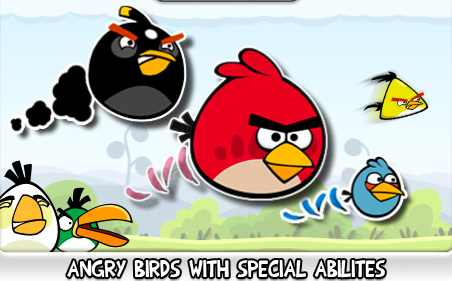
As I played the game, I tried to identify the birds. I wondered...what real birds are the Angry Birds based on? Here' my opinion, how does it compare with your thoughts on the id of the Angry Birds? Some are easy:

The Red Angry Bird is a Northern Cardinal--that's a total no brainer and makes sense. Having had more than one cardinal in my hand, that hard beak is no lie. They are truly angry birds and capable of nasty bites.

The Yellow Angry Bird is an American Goldfinch. In the game, it's special ability is to have sudden short bursts of speed. This would be something more suited to a Cooper's Hawk or Sharp-shinned Hawk but that's not as funny as tiny cute bird being angry and taking out big green pigs.

The Blue Angry Bird (that morphs into a flock of three birds when tapped) has been vexing me. It's tiny and all blue, so that makes me think Indigo Bunting...but that's the wrong shade of blue. Could it be a Mountain Bluebird? Or do we need to look at birds outside of North America and could it be an African Blue Flycatcher? It does have a slight crest and that is about the same color of blue. This bird's special ability is to break out into three birds when you tap the screen after launching it.
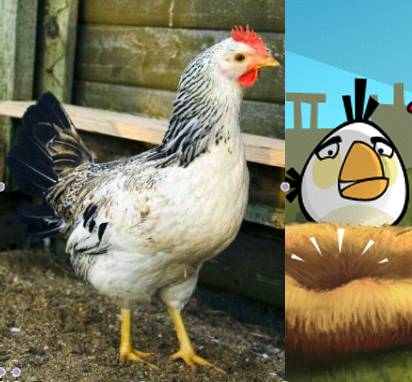
This is the Egg Dropping bird. I think it's an artistic version of your average chicken, right down to the little orange patches on the cheek. Note on the above real life chicken that the skin around the eye is yellow. I will say that its face does remind me of a goose, but I think its body is more egg shaped because it drops egg. I feel comfortable calling this chicken.

I think the Black Angry bird that explodes is based on a myna bird, most specifically, the Crested Myna. Look at the color scheme between the two. The Angry Birds version is more stylized but you can see the the little crest and the red and yellow. I think there might be some elements of the Common Hill Myna in there too. And that's a family of birds that always kind of looks angry anyway. Good thing the real life ones do not explode, it would make keeping them as pets incredibly dangerous.

The Green Angry Bird which acts like a boomerang in the game has got to be Emerald Toucanet, a bird that I've seen in Panama and Guatemala. Although, I didn't see actually do anything remotely boomerang like. But compared to the other birds in the game, it's smaller--like the toucanet and has a giant schnoz...or beak.

And then there is the Mighty Eagle, which you never fully see but enough hints are dropped that has to be a Bald Eagle. Number one, you can see that the head is white. But the real key is that you never fling this bird--you fling a tin of sardines and the eagle casts a shadow and bounces in for the tin annihilating every pig in sight in the process. Bald Eagles are capable of hunting but are just as content to eat carrion and dead fish--this so has to be a Bald Eagle. It is hands down my favorite Angry Birds character...even if you do have to pay extra to get it.
So those are my thoughts of the Angry Birds...how about you? Do you agree with the id? Incidentally, I linked to a trailer earlier for the movie Rio. Word from the producers is that an Angry Birds version of the birds in the movie will be coming so you can fling Spix Macaws, Red-crested Cardinals, Canaries and perhaps a Keel-billed Toucan. What really cool is that the game touches on the issue of illegal trapping for the pet bird trade. More awareness of that cannot be a bad thing.
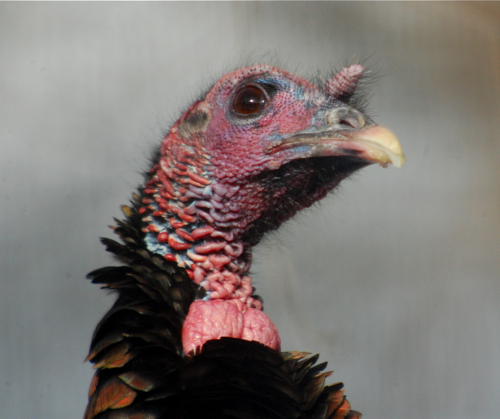
Great Backyard Bird Count #gbbc #birding
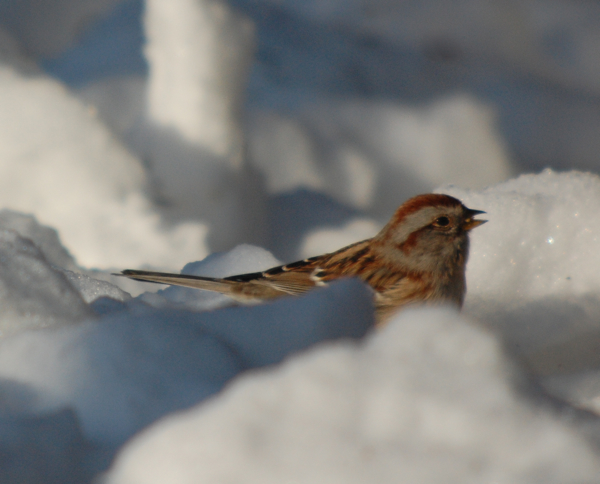 Here is a friendly neighborhood tree sparrow reminding you that today is the start of the Great Backyard Bird Count. This is YOUR chance to take 15 minutes day over the next four days to note what birds and how many of each you see. This is a joint project with Audubon and Cornell Lab. Please consider taking a moment to help get a cross section of winter birds in your yard.
Even if you do not have a bird feed, this is something you can do. Maybe you have robins foraging in mud in your yard--that counts. Maybe you notice a flock of 6 crows fly over your yard--that counts. Maybe you have pigeons roosting on a neighbor's roof--that counts.
Even the most common birds count. It helps in the long run to get an idea of prey base for raptors or population trends for common birds. We especially need a good base on the off chance bird populations may drop in the future. Fifteen minutes day. That's drinking a cup of coffee to note what's in your yard. Give it go, won't you?
If you want to follow it on Twitter, I believe the hashtag is #GBBC.
Pentagon Spends $4 Million To Build Robotic Spy Hummingbird
I'm not making that up.
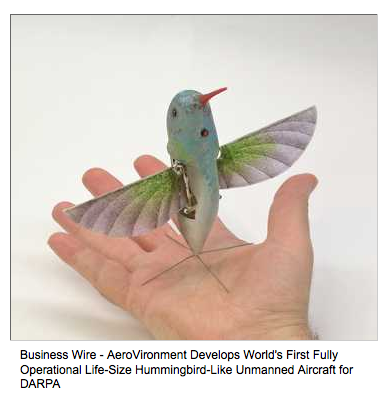
And before anyone starts up with, "How could they waste taxpayer dollars like that," consider this: at least they didn't kill thousands of hummingbirds beforehand in an effort to figure out how to attach a camera and control them. You can read the full story here and below is video of RoboHummer in action...hm..I wonder if "RoboHummer" is already a patented item in the adult industry?
[youtube]http://www.youtube.com/watch?v=a8ZbtZqH6Io[/youtube]
Rio The Movie
So, are movie studios finally listening to birders? There's a movie coming called Rio about a Spix macaw that touches on captive breeding programs, bird smuggling and the survival of pet birds in the wild. Not only that...there are identifiable species...keel-billed toucan...red-crested cardinal...hmmm. I heard from the movie studio that the director Carlos Saldanha is a birder...between this and The Big Year movie, I don't know what to do with myself.
[youtube]http://www.youtube.com/watch?v=P1GRO31ve5Q[/youtube]
Birding & Wheaton's Law
I usually avoid "stake out" birds (rare birds reported in someone's yard or park and you show up and BOOM it's there). I don't think they bring out the best behavior in anyone--myself included. This is especially true when it comes to owls. Everyone has such a STRONG opinion as to whether or not you should report owls. It leads to a lot of debate on listservs and forums. Some say to never report a roosting owl ever. Others say that you shouldn't keep bird reports to yourself. Some won't report them publicly, but collect them and then will privately communicate them when asked, but this leads to accusations that the person collecting the sightings won't give out the right directions if they don't like the person who asked. There's also the poor new birder who gets lambasted for reporting an owl and had no idea so many people think it's "poor form" to report them. And then you have owls that break convention and roost in heavily trafficked parks. But when I saw that a northern saw-whet owl was reported in a yard in the Twin Cities with the homeowner saying, "Come on over," I couldn't resist the siren song of a 40 degree, sunny day and a quick and easy owl fix.

Even Non Birding Bill couldn't resist coming along. Above is a photo he took of the owl with his iPhone through my Swarovski Spotting Scope. I cocked an eyebrow when he took it as an Instagram (Really, with my fancy scope and its incredible light gathering ability, you make it look like and old and faded photo?Sigh.).

When I arrived, there were six people with large camera lenses on the bird. There were stationed in a quarter circle around the owl. It was easy to spot--follow all the lenses. As I set up my digiscoping equipment, I realized I forgot to put an SD card in my SLR. Fortunately, we had NBB's iPhone and I brought along an HD video camera and took video (that's a still from the video camera above). It was a quiet and hushed affair. All of us positioned at the best sun angle we could find and a comfortable distance from the owl...but that changed and I was reminded of Wheaton's Law and one of the reason's I don't like stake out birds.
[youtube]http://www.youtube.com/watch?v=GFzAsnyj8eE[/youtube]
If you can't see the video, one of the photographers walked in front of us, didn't bother to ask, "hey can I come past," (or walk behind). It was obvious that my camera was not a still motion camera so it wasn't like he assumed I wasn't taking a photo since my camera wasn't clicking. Bu I instantly thought of Wheaton's Law (originally meant for gaming, but can be applied elsewhere) it's, "Don't be a Dick!"
The dickish behavior didn't stop there. The photographer then went down the hill we were on and got within 10 feet of the tree it was roosting in...with his big ass camera lens.

The saw-whet owl is in the red circle. You do not need to be that close to a saw-whet owl with that size of a camera lens. If the bird flies towards you, then go for it. But this sort of action could make the bird leave this roosting and hunting area which is stressful for the bird and ruins the opportunity for other birders to see it.

The owl tried to watch the photographer with closed eyes. This what they do for camouflage. Keep the eyes as closed as possible to help blend in with the bark. I think the bird is used to human activity--this is a busy urban yard on a busy street, it's used to people being around and making noise. What it probably is not used to is suddenly having 6 - 12 people staring at it all day long and lurking closer and closer. In the wild, if you are stared at, you're about to be challenged or pursued as prey, generally, wild animals don't like it.
There's a time and a place for confronting this behavior--and I decided that given the silence of everyone else and how close this person was to the owl, starting argument was not going to help the bird. So, we left. I thought I would come by later that day and bring my neighbor Zoe who is not a birder but loves owls.
When I returned with Zoe, I walked through the gate as I had before, only to find no birders. Some movement caught my attention in my peripheral vision and found that all the birders had moved to the home owner's balcony, as the saw-whet had moved towards the house--if we kept walking, we could have flushed the owl(accidental dickish behavior on my part). Zoe and I hightailed it out of there and luckily did not flush the bird.

The saw-whet owl had flown over a woodpile up against the house--I bet there's some good mousing there! I wondered if the bird flew there of it's own accord or if it flushed to there because of the photographer from earlier? Zoe and I jockeyed for position on the tiny balcony, I tried to maneuver my scope between deck rails and birder legs to digiscope a shot of the owl:

As Zoe and I were giddily chatting about Minnesota's smallest and arguably cutest owl, one of the birders kept shushing us. At one point he angrily hissed at me, "You're making it turn its head, be quiet!"
I started to mumble, "Dude, this is an urban yard and this bird has hearing beyond our comprehension, I think it's knows we're here."
And then I realized--I was violating Wheaton's Law. I was being the total dick for this birder and I needed to cut it out. See, stake about birds don't bring out the best in anyone (apart from the poor saint who is willing to allow hundreds of strangers into his home with muddy shoes to look at the bird).

Eventually, the man who wanted silence left and more birders arrived and chatting resumed. I tried to atone for my dickish behavior by sharing my scope with those who didn't have one. As more birders arrived, Zoe and I abandoned our perch on the small balcony and headed home.

Ah, look at that tiny talon. It's always hard to remember that saw-whets, though wee are in actuality, Nature's Perfect Killing Machine.
Valentine's Inspiration 14 #birding
Today's final bird was a tough choice. Do I go with the Moonwalking Bird? But that's been linked to to death. Then there's the Lyrebird but again, that's a bird that's made the rounds on websites. I wanted something special. And then I found it from both Cornell Lab of Ornithology and National Geographic. This bird is a club-winged manakin (related to the Moonwalking bird, the red-capped manakin) and can make his body literally sing to attract a mate:
[youtube]http://www.youtube.com/watch?v=7FHSQQMnOko[/youtube]
What better way to keep that pair bond strong than by putting your whole body into it?
Happy Valentine's Day!
Valentine's Inspiration 13
And now, something special for those foot fetish people out there: the blue-footed booby. With these birds, it's all about the size and impressiveness of their...feet. [youtube]http://www.youtube.com/watch?v=oYmzdvMoUUA&feature=related[/youtube]
Digiscoped Images
Fresh Tweets
Would you like to hire me as a speaker for your event?
Email sharon@birdchick.com