
Birdchick Blog
Uptown Great Horneds Still Around
The Crossley Birds and Beers was a blast. He was a fun interview and a blast after his talk--I think we closed the bar. If you would like to find out if Richard Crossley is coming to your town, check his site.
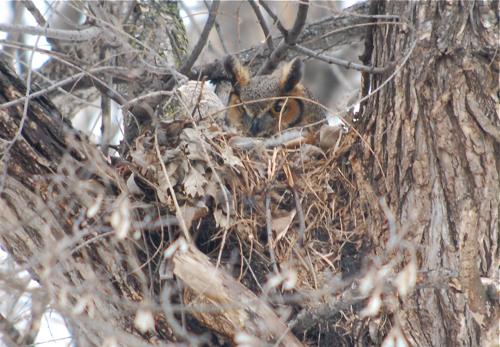
The great horneds near my home continue to incubate. It had been awhile since I took my scope and camera to the owls so I took them out yesterday. Even for a week day, several people passed beneath. The keep an eye on the passers by but otherwise stay still.
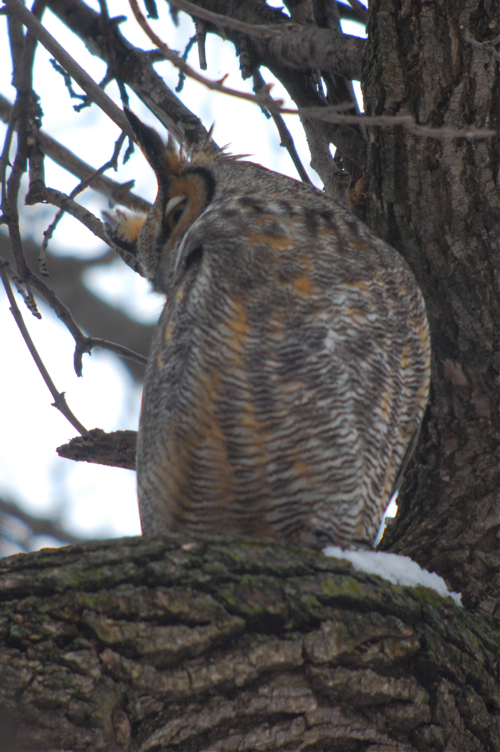
Once again, the male was right over the main walkway. In this photo he's looking down on a dad and his toddler son who had no idea they were walking right under a very large owl. This also leads me to wonder yet again--how many owls do I walk past on a regular basis. I'm willing to bet that the number is very high.
Laysan Albatross Is The Oldest Living Wild Bird #birding #birds
And she's still raising chicks!
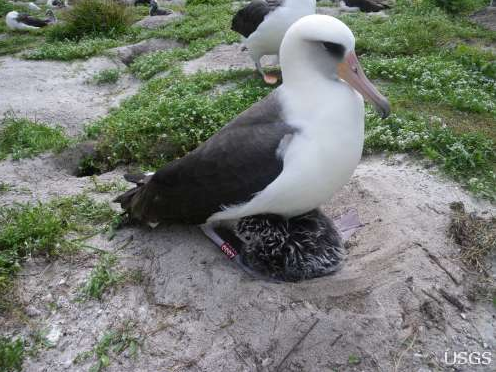
That's right. According to bird banding records, a Laysan albatross on the Midway Atoll is now officially the oldest living (and breeding birds) in the wild! She's at least 60, but most likely older than that, since she was already breeding when she was initially banded. According to the press release from USGS:
"A Laysan albatross named Wisdom, is at least 60 years old and was spotted in February 2011 raising a chick at the Midway Atoll National Wildlife Refuge in the Pacific Islands. The bird has sported and worn out 5 bird bands since she was first banded by U.S. Geological Survey scientist Chandler Robbins in 1956 as she incubated an egg. Robbins estimated Wisdom to be at least 5 years old then since this is the earliest age at which these birds breed, though they more typically breed at 8 or 9 after an involved courtship lasting several years. This means, of course, that Wisdom is more likely to be in her early sixties."
When you think about all the hazards that face albatross from ingesting plastic and lead to the sheer amount of energy and distance they travel when not breeding, this is amazing. Here's the current list of the top ten longevity records according to bird banding studies. Interesting to note the the oldest birds tend to be fish eaters.
Crazy Amounts of Snow Geese
Check out this US Fish and Wildlife video about water management for spring migration. Crazy amounts of snow geese in this! [youtube]http://www.youtube.com/watch?v=gT9mieYWymg[/youtube]
Apparently this link was broken yesterday, it's fixed now. If you can, go directly to YouTube and watch it in HD.
Eagles Fighting Over Carp
 I spent the weekend at The National Eagle Center in Wabasha, MN as a Swarovski Field Tek for a new company called Big River Optics who sells binoculars and spotting scopes through the Center. I'll be there next Saturday and the following weekend (when we have a Birds and Beers) answering questions about digiscoping, binoculars and scopes. Also, if you have Swarovski binoculars or a scope and would like a pro cleaning (similar to what they would do at the Swarovski headquarters) or if you need a minor eye cup adjustment, I'll be there to do that too. Stop in and say, "Hi!" It's not a bad way to spend the weekend--along the Upper Mississippi River watching bald eagles (like the above immature) float by.

We did get to watch some eagles squabble over a carp, right across the river from the Eagle Center. An immature bald eagle got a huge carp and an adult came in to take over. Other immatures came in to see if they could snatch a few morsels or the fish.

The adult was very intimidating to the younger birds. As it would chase off one immature eagle, another would try to sneak in to claim the fish.

The immature eagle on the right almost had the fish when the adult charged it.

I love the eagle on the gound on the left. It's as if the bird is say, "Oh crap, this just got real, I'm gettin' out of the way!"

The adult appears to have won the stand off with that particular immature.

Alas, the adult's charge was full on and it tried too late to put on the brakes. It slid right off the ice and into the water. Above, it's just about to go in.

It managed to turn around and get out quickly. I missed that shot and this picture of it getting out is blurry. Still, not a bad behavior capture for something on the other side of a river from where I was standing.

The adult was the overall winner of the carp. A few of the immature were able to sneak in and get a few tidbits, but the adult ate the most. It didn't have an easy time of it. Below is a video and in the first part, an immature slams it from above. You'll know when it's about to happen because the birds on the right look up and see it coming. And watch how the eagles run around on the ice...it's hard to take them as majestic when they run like that.
[youtube]http://www.youtube.com/watch?v=g1FTyksKEJE[/youtube]
What's An Uptown Owl Eating?
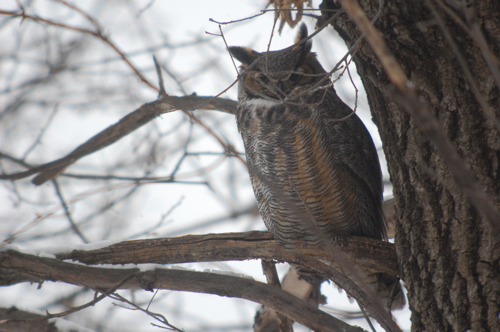 I mentioned earlier that there's a great horned owl pair nesting near my apartment in the Uptown area of Minneapolis. I love that we have such a large bird that is able to hide really well in such an urban area. Also, the distance that this owl is from my home, makes for a nice walk and a good incentive to get out and keep exercising in freezing weather so my biking muscles don't completely atrophy. I digiscoped this photo from the first day I saw the pair nesting, I don't always take my scope and camera. One, walking through urban neighborhoods with that equipment makes home owners uneasy and can lead to police calls. Two, I don't want to aim my scope every day at the owls and the nest to draw further attention and make them uneasy.

As I neared the area for the nest, I scanned the trees for the male. Some crows found him, they were cawing like crazy, but I didn't see him. When the crows saw me, the they took off. I got to point where I found an area in the snow covered in owl poop and pellets (I took the above photo with my phone since I didn't have my camera). Owls (like many predatory birds) cannot digest everything they eat and will regurgitate a pellet of fur and bones of what they couldn't digest from their prey. Owl pellets are fun to dissect because the bones give clues to what they've been eating. You generally do not find bones in hawk pellets because they tend to rip meat off of bones rather than swallow it whole and they have stronger digestive acids and the bones can break down.
Like Indiana Jones at an artifact, I carefully dislodged the large pellets from the snow. It suddenly occurred to me that where you see owl pellets and poop, the owl is generally overhead--at least, that's what I often tell people and have only found that to be true a couple of times. I looked up and was so mad I didn't have my camera. There was the male, directly over my head, about 20 feet up. He stared down at me and was totally giving me the hairy eyeball...or would that be the feathery eyeball in a bird's case? I quickly gathered the pellets and went on my way. The owl never moved and is clearly accustomed to human activity.

Here are the pellets that I picked up. I set a lime beside them to give an idea of size. Two pellets were very dark and one was light gray. I suspected right away that the pellet with the light gray fur was from a gray squirrel, since most of the mammal tracks in the snow around the nest are squirrel...and the female owl appears to be using an old squirrel nest for her nest.

The bones in these pellets are considerably larger than what you find from a pellet that you purchase. Those are usually from zoos and wildlife rehab centers where the birds pretty much eat mice all day. This particular prey item was so large that the great horned owl couldn't swallow it hole and broke apart bones. I think that's a rib bone up there and compared to the lime, that's a good size animal.

There were several pieces of vertebrae in the darker pellets. I circled it in the above photo. I puzzled over how to tell a rabbit spine from a squirrel spine. I tried to crowd source that information on Twitter and got the following gems from the following Twitter users:
@ADruglis suggested: "Use a mass spectrometer to measure the ratio of calcium to disapproval in the bone."
Nice Disapproving Rabbits ref!
@ODN_Editor offered: "Any Easter egg shells mixed in? That's a dead giveaway."
Thanks.
@UppieSand said: "easy. Squirrels actually have them. Jk ;)"
Since Twitter was proving humorous rather than helpful, I went back to study the pellets. I determined already that the lighter gray pellet was gray squirrel, I took to examining the fur of the dark pellet.

The fur was multicolored, dark, then brownish, then dark. That was familiar...where have I seen that fur before? Then it hit me: eastern cottontail. I puzzled for a moment that it might be gray squirrel, the tail can have that color, but a raptor isn't really interested in eating squirrel tail. It's mostly fur and bone--very little meat, why bother?
What was most interesting to me about all three pellets was that there were no small mammal remains in there, no mice, no voles, it was all big stuff. I'll be curious to see if we can find other prey items in future pellets. In the meantime, Uptown rabbits and squirrels, beware.
Great Horned Owl Nest In My Hood
I debated about whether or not to blog this, it's an owl nest and some people can get their undies in a bunch when someone talks about them publicly. Some birds seem to attain a cult status and people get particularly prickly about them. Owls are definitely a cult status bird, even garnering their own set of fan boys and fan girls (and owls are cool, I can see why).
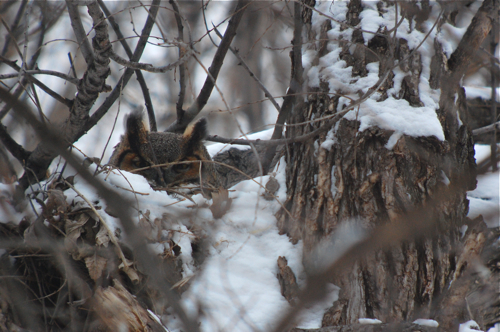
I have a great horned owl nesting within walking distance from my home. I have mixed feelings about blogging it. On the one hand, I get the wisdom of keeping nests on the down lo. On the other hand, I live in a very urban area and these birds have chosen to nest in a particularly high traffic spot. I think they knew what they were getting into. There are all sorts of people well aware of the nest and happy to walk up to any stranger and say, "Hey, there's owl right there!"
I'm not going to reveal the exact location, but that still won't stop some complainers. Last winter, a birding organization received an email asking that something be done about me because I had revealed a northern hawk owl perching location in my blog, it wasn't even nesting. I thought it was funny that an organization that I'm not associated with got such an email (what are they gonna do, fire me). It's no secret you can find northern hawk owls at Sax Zim Bog and I had gotten the location from a website promoting where to find the owls. Ah well, haters gotta hate, as the young kids say these days.
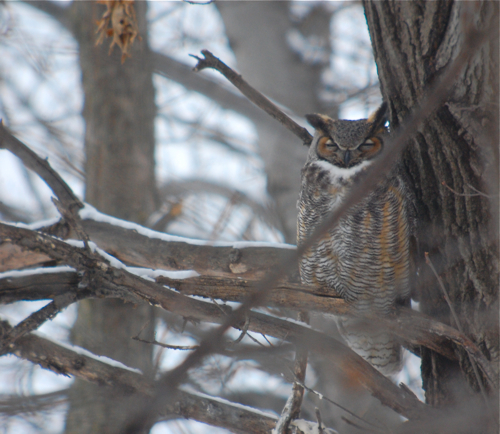
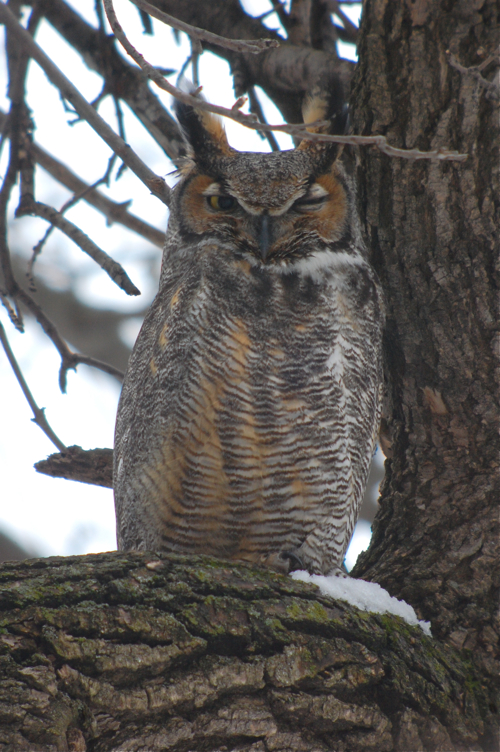
Here's the male keeping watch near the nest, even though it looks like his eyes are closed, those little slits are open and he's keeping an eye on me with my scope.
So, what should you do if you find an owl nest? I think keeping the exact location hidden from the local birding listservs, Twitter, Facebook and FourSquare is a good idea. But when you find something so cool, there can be a huge temptation to share it. Be cautious with how many people you tell. Locations should be shared to some groups--say for instance a place like The Raptor Center. If orphaned great horned owl chicks end up in their clinic, they try to find surrogate nests for the chicks. You could also submit it to Nestwatch a website trying to document bird nesting throughout the US. If someone is keeping track of breeding birds for an overall study or atlas, that would be a good idea too. These could be safe ways of documenting the nesting process, a fun project for you, but won't bring hoards of people to the nest site.
I'm sure I'll be walking by and checking these birds out throughout the spring. I have an idea of when incubation started so hopefully some owl chick photos will come along. I'll be curious to note the number of people, especially those walking their dogs who will walk past it without realizing it's there.
I'll also be curious to see how the nest holds up. Great horned owls do not build a nest, but take over old hawk, crow or squirrel nests. I'm pretty sure that meatball of leaves the female owl is hunkered on is an old squirrel nest. She had lots of squirrel nests to choose from, some more secluded than others. It's interesting she chose one in a well traveled. Here's hoping that this turns out to be a big win for urban great horned owl nesting this spring.
Birds and Beers
I just added some new dates for Birds and Beers and one is next week to happen after the Richard Crossley appearance with Minneapolis Audubon. You can check out his field guide and we can all go for a beer and discuss it afterwards. Perhaps Mr. Crossley will join us? There's also a Birds and Beers in Nelson, WI (right across the river from Wabasha) later this month. Drive along the river and watch for eagles and then have some beer and cheese (noms!). I went ahead and set the date for an April Birds and Beers too, for our annual Woodcock Tailgate Party. Check the Birds and Beers tab for all the dates and locations.
To get the most up to date announcement for Birds and Beers events, "Like" it on Facebook.


Geek A Week, CNN & Honey For Auction @ThinkGeek
 There are times, like when I'm sitting in Mr. Neil's sauna trying to thaw out a frozen bucket of honey from our hives on a Friday afternoon, I think, "My life is different from other people's lives and such weird things come out of this."
One of them is the whole Geek A Week trading card. If you spoke to me when I was 12 or even 21 about what I thought I might accomplish, being a trading card in a deck that includes Weird Al Yankovic, Wil Wheaton and peeps from Mystery Science Theater 3000 was certainly not one of them, it's just been one of those nice surprises that life throws your way.
Len Peralta, the artist behind the project has had some great momentum build up on it in the last week--it's even on CNN today: the cards are going to be on sale through ThinkGeek (my one stop shop for gifts for Non Birding Bill for birthdays and holidays).

What's really cool is that Len, ThinkGeek and some of us who are cards have teamed up for a fundraiser. Many of us donated items to be auctioned by ThinkGeek for the charities, EFF and Child's Play (I really like this one, they give kids in hospitals games to play). Neil and I donated some comb honey that both of us autographed and Adam Savage donated some autographed pieces from the Mythbusters set. You can see the full list here.
So, bid on some items or buy a set of cards. Please buy the set, I love the idea of supporting a great artist like Len and he has lots of kids to feed. You can even hire him to draw you your own personal monster!
Crossley ID Guide
I get books sent to me all the time and the words, "innovative" and "revolutionary" and "amazing" get tossed around. The books are good, but rarely live up to the hype. Richard Crossley's new Crossley ID Guide to Eastern Birds is a guide lives up to those words. This book is going to be talked about A LOT. Some people are going to dislike this book (there are rumors of "well respected birders" refusing to review it). Some are going to love it. The bottom line is that Mr. Crossley took a huge chance and this is a book that has to be seen to be believed.
I've heard of this book coming down the pike for months. When I saw the first few pages, I thought, "Ahhhhhhhh, A.D.D. birding! Stop the insanity!" Here's why:

This book assaults you visually. The above is the page for the osprey--birds are everywhere, coming from every direction, looking in every direction--everywhere you look: osprey! Ahhhhhhhhhh! I think we are used the very orderly and tidy designs of Sibley and the National Geographic Guide that the Crossley Guide seems almost too intense. But I do like what he is trying to communicate here. He has a photo of the typical habitat that one might find an osprey in and then tries to show you every possible angle at which you could id the birds. It's almost as if this book is the "missing link" between illustrated guides and what I see the future being of video bird guides on smart phones.

It's as if the author went out of his way to make his guide as different as possible. He uses photos of birds in the beginning to show you the different parts of the bird, but rather than using "pretty shots" he goes for more realistic, like using a house finch with conjunctivitis (ew).Despite one really gross (yet realistic and accurate) photo, the photos of birds are very useful tools for showing anatomy.

Here are the pages for common yellowthroat and hooded warbler. On the one hand, I really like how he gives you suggestions for the type of habitat that you mind the birds. However, I could see young birders getting confused. For example, the habitat shown for yellowthroat is the type of habitat I would expect to find them if I were along the coast in Cape May, NJ but not the type of plants I find them lurking in if I were birding in Minnesota. Also, since each bird is in sort of a flock photo, will a new birder think that this is how you find the birds in the wild, are they always in flocks?

I do really like this book, it's interactive, it challenges you to think of birds in their habitat and it gives you so many ways to prep for how you might observe the birds in the wild. Many of the pages can serve as a quiz to help you age and sex each species. For newer birders, I would say to remember that the habitats are just suggestions...you're not always going to see a northern goshawk just when there's a rainbow.
I think this book is best used for study before going out in the field--and that's another thing, this book will most likely not travel with you out in the field. According to my kitchen scale, it's three and a half pounds--three quarters of a pound heavier than Sibley and this guide is only for the eastern region of the US--not a complete North American guide. Unless you are trying to burn some serious calories out in the field, leave it at home.
One thing that might drive a new birder crazy is the use of 4 letter banding codes to describe the birds. Each photo takes up so much space on the page, the text is minimal. Those familiar with bird banding would easily understand that in describing the finer points of ID for the alder flycatcher: "In many respects, intermediate between LEFL and WIFL. Larger than LEFL with longer and broader tail."
If you know the banding codes, that sentence makes sense. If you don't, figuring that info out might be tedious (but in the long run worth it).
This book is definitely worth having your bookshelf.
Word is that Crossley will be working on a western version and a British version too. Oh and speaking of which, I did see on the bird jobs listerv that he's looking for an assistant, so if you'd like to work for this author and help:
CROSSLEY BOOKS has a unique employment opportunity, in Cape May, NJ for a highly motivated individual in a very fast-paced environment. We are presently working on a series of innovative bird books with the first, The Crossley ID Guide being released in Feb 2011. We are looking for a hard working and creative individual. The most important aspect of the position will be to help the author create and edit texts for these books and other publications. This will involve working closely with the author but also requires self-motivation and independent duties. Excellent writing skills are essential along with creativity. Other tasks will be varied and wide-ranging. Duties may include dictation, answering e-mails, Facebook, Twitter, media contacts and all other office support. This is a full-time position, starting immediately. Good knowledge of birds is a big advantage. All resumes and inquiries can be forwarded directly to our email address: (EM: thebrit1 AT verizon.net)
Digiscoped Images
Fresh Tweets
Would you like to hire me as a speaker for your event?
Email sharon@birdchick.com