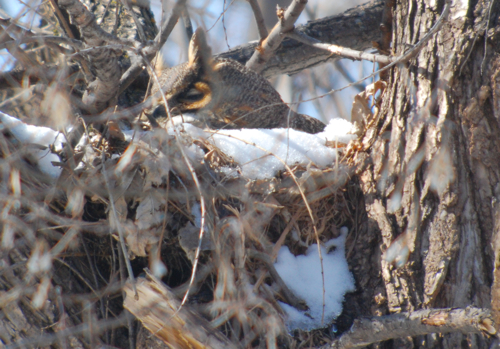
 The great horned near my apartment is still incubating--I got this photo on Friday. I think the chicks should have hatched this weekend, hope to see them soon.
image
Birdchick Podcast #17 Duck Stamps, Shade-grown Coffee, Birder Driving
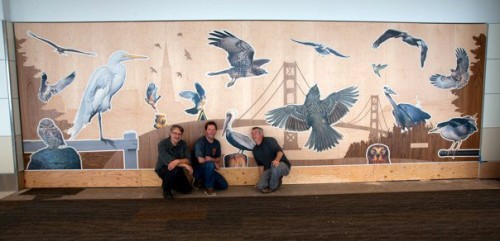
Very cool birding mural at The San Francisco Airport by Walter Kitundu.
The "SmartBird" aka A Bionic Gull.
Birdwatchers are a driving hazard in Nebraska.
Rio Grande Valley Bird Festival Plans.
Outdoor Talk Podcast--I'm on with a teenage urban chicken keeper (it's a 2 hour podcast)
Buy a Duck Stamp!
Birds and Beans coffee (shade-grown coffee that actually tastes good, I like the Chestnut-sided Warbler blend).
Red-tailed hawk nesting
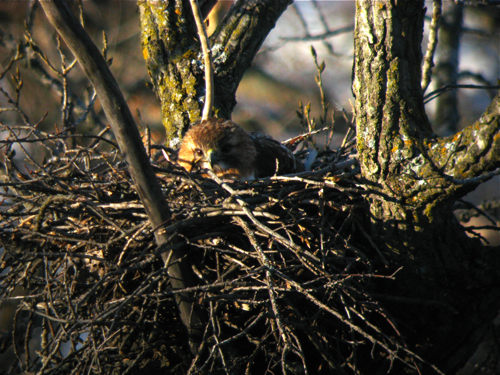 The sexual tensions between pairs of red-tailed hawks was palpable today. They were either paired up on light posts or females were on the nest while a male was perched nearby keeping watching. I passed this particular nest in a ravine just off of a county road in Hastings, MN. I got out to get a photo of the bird facing the road in the morning light, only to discover my battery dead in my Nikon D40--DOH! I ended up hand holding my point and shoot Canon Camera and got a reasonably good photo. I will definitely need to come back and get another photo before the leaves come out.

After my time on the Outdoor Talk show, I was driving home and chuckled when I stopped at the end of the exit for Hwy 7 off of southbound Highway 100. Just to the upper right of the traffic signal is a red-tailed hawk nest. It's a long light, so I took a crappy photo with my cell phone. I had time to scan with binos and could see a red-tailed hawk head sticking out of the nest. I imagine this is going to be a distracting place when the young learn to fly.

Screen shot 2011-03-24 at 11.08.50 PM
Birdchick Podcast #16 "Real" Birders, Leucistic Pileated, Jr Wildlife Program
Sociable Lapwings in Kazakhstan, part of a breeding area sponsored by Swarovski Optik
Links for this week's podcast:
Are Wildlife Gardeners Real Birders?
Leucistic Pileated Woodpecker (hey, it has an ivory bill). Hey, have you seen Bill Stewart's Bird A Thon?
Cool Lyrebird documentary Trailer (the bird that mimics cameras and chainsaws in Attenborough's Life of Birds).
Swarovski Optik Continues to support BirdLife International's Sociable Lapwing efforts. My birding trip to Kazahkstan with Swarovski and the sociable lapwing.
Track spring bird migration with Badbirdz.
International Bird Rescue Research Center's Junior Wildlife Program with Dawn Dish Soap.
Illinois Sate of the Birds--house sparrow decline?
Snow Storms During Migration & Goose Collars
True to form, our great state of Minnesota received a dumping of snow yesterday. The nice thing about March snow storms is that they melt relatively quickly. Even the city gets slack about it, "Eight inches? No Snow Emergency or parking restrictions, it will melt, deal with it." But many people wonder about those early spring migrants and how it will affect them? Over the weekend, my buddy Clay Taylor and I were at the National Eagle Center and we tallied all sorts of early spring migrants--even tree swallows. What do insect eating birds do when they get back early and have to contend with several inches of snow? Yesterday, Michael Bates sent me a photo of a woodcock he found in his yard during our Minnesota snow storm.
So, what do early insect eating migrants do when they come back early? They adapt. Woodcocks eat mainly earthworms, but according to Birds of North America Online the will eat some vegetation. Same with tree swallows, they will eat berries if there are no flying insects to feed on. That's all part of the gamble of coming back early to get the prime territory, if you can find something to keep you going for a few days, you'll get the best territory. Not all bird make this, it's part of what makes migration so fascinating.

Here are some Canada geese who found a puddle of open water amid the snow at Lilydale Park in St. Paul, Mn. These were part of a flock that included about five neck banded geese. All of the numbers were sequential, so I wonder if this is a family group banded last summer that's migrating together. I turned in the band numbers to the Bird Banding Lab and I'm curious to find out where these birds were banded.

Remember this goose? This is a banded Canada goose that I saw at the confluence of the St. Croix River and the Mississippi River in December of 2009. I submitted the record with a note expressing concern about the tightness of the collar on the goose. It's been over a year and I haven't heard a thing. I found a page about goose color bands with some interesting info just based on the color of the neck bands and the characters on it:
"Orange and Blue collars are widely used in the Mississippi Flyway. These collars were part of an extensive effort to track the populations and movements of Canada Geese. Orange collars were used in the Canadian portion of the Mississippi Flyway, and Blue collars were used in the US portion of the Mississippi Flyway."
So, sounds as if this goose is also a Mississippi Flyway bird. Then, I got an interesting email last week from Erik Collins:
"I was birding at Pt. Douglas Park today and saw a Canada Goose with a blue neck collar that had "617A" on it. I got home and searched online for information about blue collars on geese. This link from your site came up.
The goose you photographed with the super-tight collar in December of 2009 was the same one I saw today! Thankfully, it looked a lot more comfortable.
Thought you would find this interesting."
I found it very interesting that someone else saw the goose over a year later alive and well and the collar looking comfortable. Must have been extremely cold that day and the goose's neck feathers were super fluffed.
I resubmitted the sighting a second time with a note saying that as someone who has volunteered with bird banding projects, I understand that it can take awhile to turn in banding entries, but over a year is a bit much. When I received my acknowledgment of the color band submissions from the BBL, I noticed this in the email:
"We cannot predict or control the nature of the response you will get from the bander, although we do make them aware that color marking authorizations carry with them an obligation to respond to the public. Many color marking projects are designed to study only local movements, and the bander may not be interested in reports from afar."
That's such BS. If you put a collar on a bird (so bright that even non birders notice) you should have a system in place so if the goose goes where you don't expect you can at least send out some basic info in an email. I'm not expecting a long response, but I would like to know what state this bird was banded in and what year. It would be nice to know that bare bones info of how old this bird is and where it has been.
By not responding to neck band reports, a researcher could discourage people from ever turning in any band that they find--what's the point if no one responds? That certainly is not helpful to fellow bird banders. Also, a lot of people who don't understand banding do not like it and think it's cruel. Not responding to banding reports only reinforces that idea.
I don't see what's so hard about turning in the date and place of where you banded a bird so the BBL can at least let the person submitting the band number know the basic info. Heck, just create a document with your study's theory and copy and paste when you get a neck report.
At any rate, I'm glad the blue neck band hasn't interfered with the bird's survival and we at least know it's still a year older.

Screen shot 2011-03-22 at 10.10.39 PM
Birdchick Podcast #15 Oiled Penguins, Apps, Vultures vs Ravens
Race to save oiled rockhopper penguins is on. If you need another excuse to reevaluate our dependence on oil, here it is. I wish there was some relief effort we could point you to, at the moment, I would keep your eye on RSBP or BirdLife International.
Other topics:
Vultures using tools to break open eggs and the ravens who use vultures.
William Shatner's Has Been
Bill's mic developed static about half way through this podcast. Rather than annoy you all, we removed his mic from that section and repositioned Sharon's mic for the last part.
Eagle Channeling Huckleberry Finn?
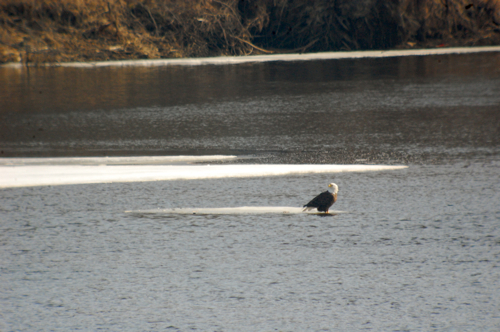 An adult bald eagle rides an ice flow down the melting Mississippi River.
Random Bald Eagle Nest
 Bald eagle nest off of Great River Road in Stockholm, WI.
Why Podcasting?
If you haven't noticed...we started a podcast. The response has been surprisingly positive as Non Birding Bill and I navigate our way through this, but we've had some questions and I want to address those: 1. Why all the podcasting, is that all this blog is gonna be?
No, that is not all this blog is going to be. The Internet is constantly changing. Blogging is not the same thing it was when I started in September of 2004. When I started, there were a handful of birding blogs and now there are a TON. The way people interact with blogs has changed and I've tried to alter my content to work with that, especially as Facebook and Twitter came into prominence. My goal has always been to get people interested in birds and I will experiment with any medium I can to do that.
2. I'm not in to podcasting, will I miss something?
Maybe. The podcast will focus mostly on news links and interesting blog entries. Occasionally, we'll interview people. It's designed for people who don't read blogs and is also supplement to mine. If you follow me on Twitter or Facebook, chances are good you'll have an idea of what's going on in the podcast.
3. Ugh, who has time to listen to this 3 times a week?
I based this podcast on how I use them. I tend to listen to podcasts when I'm tidying my home, cooking or driving. These are designed to be stand alone, you can listen to one here and there or if you subscribe you can listen to all of them each week. You can get a look at the title and get an idea if it's one you're interested in.
4. I wish you would do "blank" differently in the podcast.
Please tell me! I don't listen to them after we record them, so if you have suggestions/recommendations email sharon at birdchick dot com.
5. Wow, I could do a birding podcast so much better!
Please do! I started this because I couldn't find a birding/nature podcast that came out on a regular basis that I liked, I want one to listen to so I hope others start soon. Wouldn't it be great to have so many nature casters out there that it could warrant having it's own channel?
Spring Migration, It's On!
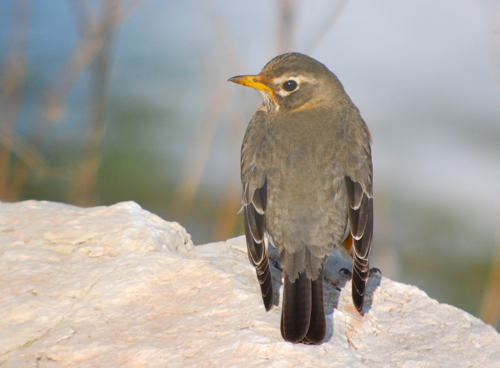 We have turned a corner winter wise up in Minnesota--I was up and at 'em early in the morning this weekend and I heard a robin singing on territory in my neighborhood! I took the above photo of an American robin outside of the National Eagle Center in Wabasha on Sunday (that's roughly 80 miles south of me). I was stationed at a binocular booth all day and it was a great vantage point for watching the birds use the Mississippi River as a major highway. Saturday was bright and sunny and my biggest surprise was seeing a meadowlark zoom right overhead.
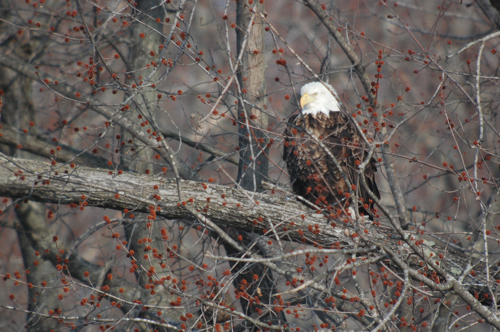
I love this photo of a bald eagle tucked behind some branches bursting with red buds about to pop. That's spring! It was crazy how migration really turned a corner this weekend. The previous weekend I struggled to see a red-winged blackbird and I passed clouds and clouds of them on my way down.
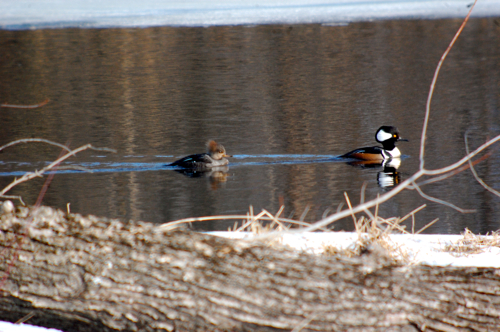
Both days, on my drive down I saw several groups of hooded mergansers involved in courtship display in the backwaters of the Mississippi. Speaking of hooded mergansers, have you seen the shots Picus Blog just posted--amazing!
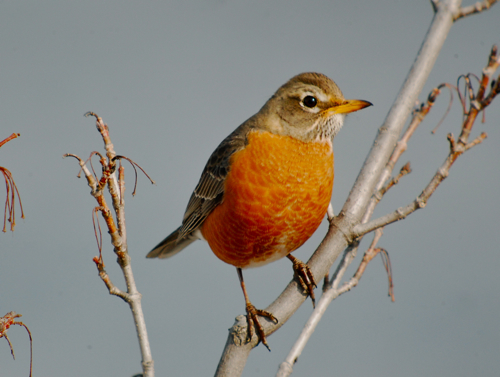
While Saturday was beautiful and offered great views of spring birds (like the above robin), Sunday was cooler and drizzly which eventually turned to fog and was utter crap for getting photos. You could still see migration working through the skies until the fog got so thick that we couldn't see across the river. We would scan the skies with the scopes and watch strings and strings of tundra swans heading north as well as a whole host of other ducks like ring-necks, scaup and common mergansers. I even got my first of year pelicans.
I'll be at the National Eagle Center one more time this month. Next Sunday, I'll do a digiscoping workshop on how to take photos and video of birds and wildlife using a binoculars or spotting scope with a digital camera. I think it starts at 11am. I'll also have my pro cleaning kit if you would like me to tidy up your optics for you too.