Russian Bee Installation

I'm so bummed, I took video of Mr. Neil's first ever bee installation yesterday and I left the video card in my bee suit out at his house.  Gr.  I'll have to get it on Sunday.

We started our first great bee experiment this year.  We're going to have a total of 7 hives:  3 packages of Russian bees (why we're trying Russians) arrived yesterday.  This weekend we'll four more packages of bees: 2 Carniolans and 2 MN Hygienic bees.  For some reason, all of the bee talk got incredibly naughty yesterday--decidedly not safe for work.  I think it had to do with Mr. Neil.  In all the years we've been keeping bees, he's never been home when we do an installation, always off doing writer/movie guy stuff/Doctor Who stuff.

I started by calling him a Bee Virgin and comparing him to girls who claim virginity because they've don't everything but vaginal intercourse (what's up with that anyway). It soon went to telling him not to be nervous about inserting his Russian package (that's big like bull) into the hive for the first time.  Everybody is nervous the first time.  Non Birding Bill frequently asks if I'm 13 years old and I think I am.

Neil did well, he did all three packages--it's only fair since we've done the rest.  I will say that he broke new ground.  No one has ever been stung when we hiving packages, Mr. Neil got stung twice!  He was a brave little toaster though and continued on with no squealing or flailing of limbs.

Here's how you hive a package:

Remove 4 frames from an empty hive and block the entrance with loose leaves and grass (that encourages the bees to spend the night).  We used some of our frames from old hives, some that still had drawn comb, honey and pollen in there to help give them a head start.  We give all of our bees a food pail but that just sugar water.  Some wax foundation and food stores helps them have a head start.  And considering it's April 20 and I woke up to the sound of a snow blower removing last night's snow, I think the bees will appreciate it.

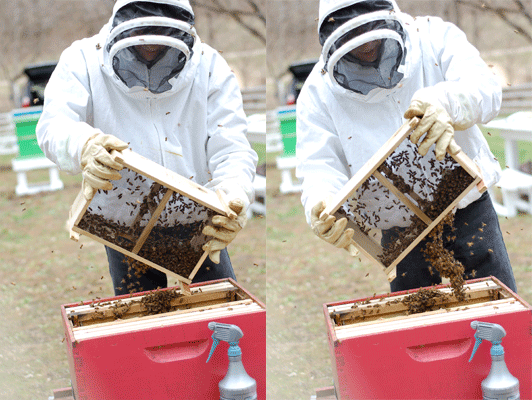
Spray the bees inside the shipping container liberally with sugar water.

Bonk the box so that all the bees hanging on the food tin and queen cage fall to the bottom in a sugar water coated clump.  Use the hive tool to pry open the top of the box.

Remove the queen cage, flick off the outer attendants and put the cage in your pocket (or give it to your personal assistant, Lorraine).

Remove the feeder tin from the bee package and then spray the bees inside again with sugar water.

Shake the bees into the empty hive.  I know I posted this last night, but it makes me larf.

Spread the bees gently like pizza sauce--which they will also do as they explore the hive.

Then take out the queen cage in your pocket and gently pry open the staple holding the screen and release the queen.  Above, the screen is already gone but you can see our queen with her attendants.  She was marked with white spot to make it easier to find her in the hive later this summer.

These Russian queens were a bit different.  Normally, queens are moving fast and sometimes even attempt to fly away when we install bees.  The first queen we put in wouldn't leave the cage, then crawled on Mr. Neil's glove and wouldn't get off, soon causing workers to crawl on to his glove.  It took some gentle nudging to get her onto one of the frames in the hive.  I'm pretty sure it was the cold that caused her to be so slow and sluggish.  The second queen was fast and running around all over--must be a bit more cold weather hardy.  The third queen...well...she looked dead.  Mr. Neil even tried blowing warm air on her to get to her to move in the cold--a little mouth to bee resuscitation.  She still looked dead.  The place we ordered the Russians from is sending us a new queen.  We'll have to do the slow release method with her but I'm hopeful that all will still go well with that hive.

After we installed the queen, we gently replaced the frames we took out at the start, put in the feeder pail and a pollen patty and closed up the hive.  Hopefully, they will get to work drawing out comb and the hive will grow.

The bees are raring to go.  One of the boxes already at the start of a small piece of comb going--I think these Russian bees are going to do great things for us this year.

Something different this time was that our bees came with a few drones--we usually only get workers and a queen.  Drones don't contribute to the hive, they don't build and they really aren't around in the winter.  I think these came from Tennessee so maybe it's been warm enough there to produce drones.

Because of the cold weather, the bees didn't fly around too much.  If they started to fly, they soon landed.  All of us had a good portion of sluggish bees on our suits when we were finished.

So, part one is complete.  Part two comes this weekend.
No Birds and Beers April 29

Due to the pending storm tonight's Birds and Beers is CANCELED.  We'll go with the rain out date of next Tuesday April 26 same time, same location.  Even if it's light snow, the woodcocks won't sing.  We'll meet up next Tuesday.  


Attaching A Spotting Scope To A Bike

I've had a couple of question sent in via email and Facebook asking how I attach my spotting scope to my bike.  I had Non Birding Bill take a few photos to show what I do.  This is for my Swarovski ATM80 mm scope, Nikon D40 and Swarovski 8x32 ELs.  The set up that I'm going to show is primarily for traveling to a location and then walking around to observe and digiscope.

I have a Swarovski backpack (that is at least 5 years old) but any good outdoor backpack should work.  This one has fasteners that hold my scope firmly in place and is fairly weather resistant.  I've had it since 2006 and use it on a daily basis.  It has become my mobile office.  Anyway, if you have a good weather-proof backpack, that should work.  I also store my Niko D40 in here.

I have a basket that's attached to the back of my bike. I put the backpack in the basket and I slide one of the tripod legs through the straps on the pack.  I secure the tripod for the spotting scope to the back of my bike with bungee chords.  My reason to sliding the tripod legs through the backpack straps is to make it difficult for someone to just grab my backpack from my basket if I were stopped at a traffic signal.

When I get to my birding destination, I simply lock up my bike, undo the bungee chords, take my scope out of the pack and attach it to my tripod and go birding.

I wear my binocular harness while ridingon my bike.  It allows for me to comfortably wear my binos while I ride my bike.  I keep my spotting scope stored on the back of my bike.  I'm sure this isn't the only way to do it, but for those curious, it is possible to tote a scope, tripod and camera with you on your bike.  I'm not worried about damage, Swarovskis are good, sturdy scopes and meant to take on wear and tear in the outdoors.  It helps that they are waterproof and come with a lifetime warranty (though if the the glass on the eyepiece is scratched, I'll have to pay a minimal fee to get that repaired).  Otherwise, I feel safe with it on my bike.

This is just my method that I have come up with via trail and error.  If you have tips for toting scopes and cameras on a bike, feel free to share in the comments.

Incidentally, this is the set up I have used when biking to the owl nest in my hood and to observe the waterfowl on the area lakes near my apartment.


Red-bellied Woodpecker Excavating Nest Hole

Just a head's up that I'm keeping an eye on the weather for Tuesday's Birds and Beers (the Woodcock Tailgate Party).  Right now, all Twin Cities tv stations are predicting various amounts of snow and or rain.  Weather Underground is reporting an 80% chance of rain for our woodcock party.  I think we may have to cancel.  If there is any form or precipitation, consider Birds and Beers canceled and we'll go with our make up date of April 26.  I'll wait until tomorrow to call an official cancellation...regardless of weather, Mr. Neil and I will be hiving 3 packages of bees.

Speaking of Mr. Neil, now that the snow has finally melted and created swampy pools of muck in his woods, I went down in there and to some exploring.  They had a nasty ice storm over the winter and several trees are down blocking trails.  While I was inspecting some downed trees, I kept hearing a red-bellied woodpecker.  The bird sounded like he was right over my head, but I just couldn't see him.  Then I backed up and scanned the holes in the trees and bingo--I got the above photo.  Sneaky, sneaky the male red-bellied woodpecker was hidden inside.

I looked down and saw the ground was covered in wood chips from the woodpecker's excavations.  I found red-bellies nesting last summer right in Mr. Neil's backyard, this is down the hill a bit.  This tree is very old and dead compared to the tree that was used last year.  Hopefully it will last the summer.  This blog post is partially for Mr. Neil's groundskeeper, just so he's aware of the tree and won't take it down.

I went on my way through the woods and when I walked back, I saw the male red-bellied still excavating a cavity. He froze when he saw me.  I was hoping to get a shot of him spraying out wood chips, but when it became clear that he was going to stay frozen as long as my scope was on him, I went on my way.  A mouth full of wood chips can't be comfortable.  And someone staring at you while you excavate your super secret nest spot might make you feel uneasy about your nest choice and look for another.

So, Hans, this is the tree.  It's near the lemonade stand--wink wink, nudge nudge.


Birdchick Podcast #23 Gulf Oil Spill, Osprey Nest Removal & Ash Canyon B & B

Here are links to some of the topics we covered in today's podcast: News:

It's the one year anniversary of the Gulf Oil Spill. HBO Documentary Films presents the story of the effort to save the 895th surviving oiled pelican in Louisiana, showing how conservationists, government agencies and wildlife activists joined forces to preserve this one life.  An inspiring bird’s-eye view of the rigorous process of rescuing thousands of oiled birds, SAVING PELICAN 895 debuts Wednesday, April 20 (9:00-9:45 p.m. ET/PT) on HBO.

Also, Cornell Lab of Ornithology has a series of videos documenting the spill and the Mississippi River Delta--fantastic HD bird footage.

Marine contractor Jani Salonen and a member of the Audubon Society gathered three eggs from an osprey nest built atop his crane, and relocated the unhatched birds to a rescue center--without permission of US Fish and Wildlife.  Fine is being negotiated.

More on American Birding Associations Young Birder of the Year, Rachel Butek.

Birds under attack in Malta.  Would you be willing to go on one of the Spring Watches held by BirdLife International to document illegal hunting?  Or should Malta be boycotted?

Blogs:

Life, Birds and Everything on the Ash Canyon Bed and Breakfast--will birders lose this awesome hummingbird spot?

We Love Birds photo contest.

Events:

Junior Duck Stamp live today at 10 am eastern time!

Watch for live tweets at Birdchick this weekend from the Swarvoski team during the Great Texas Birding Classsic.


Birds and Beers Woodcock Tailgate Party

Just a reminder that next Tuesday night is the Birds and Beers Woodcock Tailgate Party! We head out to Lebanon Hills Regional Park, have some laughs and then 15 minutes after sunset try to watch the woodcock display. The woodcocks start their display about 15 – 20 minutes after sunset, which means they will start around 8:30pm. Since the display area is next to the visitor center at the park, we’ll meet there starting about 6:30pm and have an old fashioned tailgate party–you can come early to mingle or come closer to magic hour.  Bring your own food and beverages and we’ll laugh until it’s Woodcock Time.  The park closes at 10pm, so this gives us plenty of time to get some great birding done.  Last year we had a great horned owl show up and still got great looks at the timberdoodles (aka woodcocks).

Recommended to bring: lawn chair and boots, might be a little muddy.  Dress in layers, it could be warm when the sun is out and gets cool quickly when it's dark.  Binoculars and a flashlight are a good idea too.

If it rains on Tuesday, April 19, our make up date will be the following Tuesday, April 26, 2011–same bat time, same bat channel.