
Birdchick Blog
No Podcast Today
Between the strange breaking news and my head cold, there's no podcast Monday morning. Take in the world news today and then take in some migration.
Cooper's Hawk Attacks Owl Nest
Well, Friday morning turned out to be far more exciting than I anticipated! I had to work at the park service in the afternoon and evening and I was meeting a friend for a late breakfast. I thought that since it was warm, I'd peek at the great horned owl nest in my neighborhood and see if the owlets were more visible...

One owlet was easily visible with the naked eye on approach. Great horned owls do not build their own nests, they take over old squirrel, hawk or heron nests. They don't even make any renovations before they use it, they just squat. As the chicks grow, the nests soon shrink. Between the dwindling nest and the larger chicks, the female no longer fits very well and perches near the chicks.

It appears that the nest contains two owlets! When I arrived to the general nesting area, I could hear the crows heartily mobbing. I saw the male fly over with a flock of about 20 crows in tow. The chicks showed a bit of interest in the commotion but mostly laid low.

The female was very interested in the crow activity as she watched the crows surround the other owl. What was interesting was that I thought the crows were chasing one owl, I later ran into a fellow birder who was close the crows and he said the crows were after two great horned owls and a third flew in. I wonder now that as I was watching her keen interest in the crow activity, if she was responding to an intruding great horned owl into her territory rather than the corvids gathering around her mate?

She soon left the nest to try to get a better look at the mobbing crows but still would turn around to keep an eye on her chicks. It was so strange to me to see a secretive owl perched out in the open in the middle of the morning. Not long after I took this photo, she bolted off into the middle of the flock of crows. The owls all went in separate directions and the crows split their murder into 2 smaller groups, diving and cawing at the owls.

With the female away, the young owlets closed their eyes and assumed an upright position. I wondered if this was all part of a camoflauge instinct? With the adults going after the crows, it stirred up the surrounding birds. Robins began giving their alarm calls and then an adult Cooper's hawk flew in. The hawk missed its intended prey...then suddenly noticed one of the owls and started diving at it and screaming its call. If you're not familiar with a Cooper's hawk mobbing an owl, let me remind you of the video of the Cooper's hawk mobbing a plastic owl (they never work to scare birds away).

The Cooper's hawk then made a wider pass and went straight for the owl nest, hell bent on mobbing the chicks. First it bounced off the nest and then started to make a second dive, by that time, the female great horned owl was back on the nest and ready to kick some serious accipiter ass if it tried it again. I have never seen a great horned move so fast in my entire life. I've always referred to them as the Sunday drivers of the raptor world...I got schooled--they can move very fast when they need to. The above photo is on the Cooper's hawk's second attempt at a dive on the nest. The blur above the nest is the female owl defending her chicks.

The angry Cooper's hawk perched nearby and shrieked out angry, "kek kek kek kek kek keks" at the great horned owl. I suspect this bird has a nest nearby.

The great horned owl stood at her nest above her chicks and hooted back her retorts after every kek the Cooper's hawk gave her. The owl even barked a few times in warning at the hawk. It was the weirdest argument I'd ever heard. As the two continued, a few crows gathered nearby to continue their remarks on the two predators they detested. Then, out of nowhere, a broad-winged hawk screamed nearby. Three raptors all at once! An owl, a buteo and an accipiter.

The chicks nestled against the female as if to say, "Yeah, my mom is awesome."
I wondered, how long was this battle going to last? The suspense was killing me...then I got my answer. I heard a helicopter coming fast and approaching low.

This was not digiscoped, this helicopter was THAT low. It was Metropolitan Mosquito Control dropping their corn pellets full of Bti and Methoprene to kill of mosquito larvae. The helicopter skirted the tops of the trees, the owl, crows and hawk scattered. The adult female owl apparently thought, "Cooper's hawk, yeah, I can kill that," but when the helicopter appeared her attitude shifted to, "yikes, too big for me kids, you're on your own, see ya!"

After the raptors scattered, pellets rained down and bounced off my body. I could hear nearby woodpeckers give low warning noises to each other. Robins were on high alert.

A couple of nearby mallards seemed to dig the pellets and tried to eat them as soon as they hit the water--they were the only birds who seemed to be unaffected by the strange aerial machine. The city assures me that the pellets are harmless both to me and the wildlife that might consume it. I was tempted to start running around like Cary Grant in a Hitchcock movie, but it's not so much fun with a spotting scope in tow.

The helicopter made a few more passes and a few moments later, one of the owls flew back with a few pesky crows hot on its tail.

She perched right above my head and the crows still followed. She looked over to see her chicks were still in the nest and I think scan for the Cooper's hawk. Most of the crows lost interest, but a few hung around to caw out their angst. I couldn't stay, I had to get to my breakfast meeting, but things seemed to be settling down and I'm sure she went back to the tree. After a Cooper's hawk and a helicopter, crows were merely an annoyance.

One of the chicks was scratching itself, but it almost looks like it's trying to give a high five. Note the large gray feathers in the nest. Looks like the owls have been eating some pigeon. And based on an owl pellet that Non Birding Bill near the nest, some other surprising species...but that's for future blog entry...

Cooper's Hawk Nest
Ah, bird festival season is almost upon me. Next week is the Horicon Marsh Bird Festival...although, every time I mention it to Non Birding Bill, he thinks I'm either going to a horror convention or meeting up with some odd transformers. But I am so looking forward to birding this part of Wisconsin--it's been too long. I see friends reporting awesome warblers and sparrows just south of us so I'm eager to see these same species next week. Meanwhile, I'm taking what I can get spring-wise here. Last week, someone on twitter pointed out a hawk nest, possibly a Cooper's hawk not to far from my neck of the woods. I thought I'd head over and check it out.
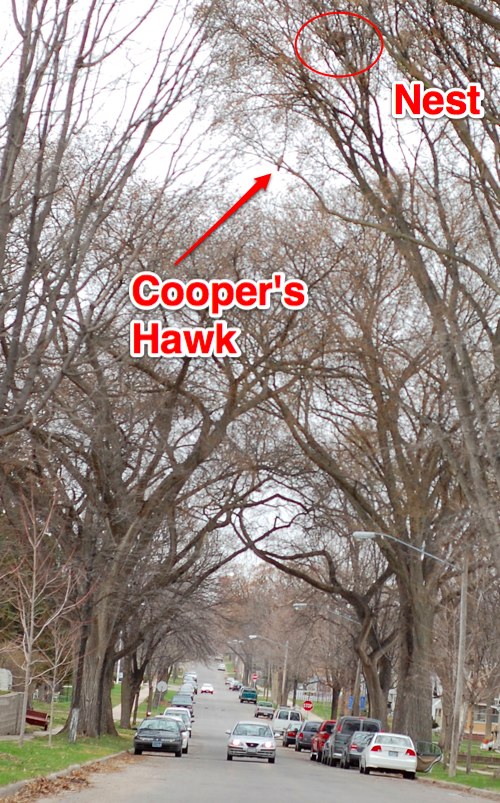
This is a very relaxed urban hawk. This Cooper's hawk has chosen to nest right over a south Minneapolis street. I always think of these hawks as fairly high strung and desiring quiet, hidden areas. Not only was this nest placed right over the road, but the hawk itself was perched in an open area.
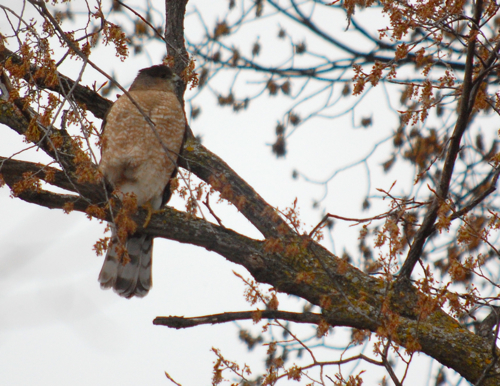
The male didn't seem to mind my scope on him for a few moments as a digiscoped a few photos. Usually, Cooper's hawks don't like that.
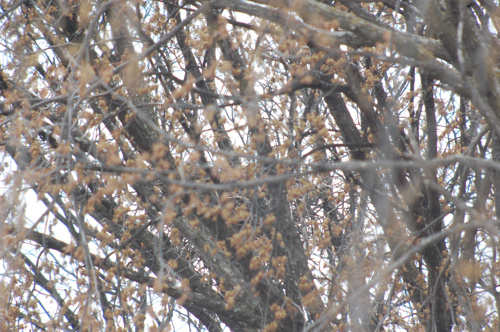
Even though the nest has been built over the street, once the buds show that once the leaves are out the nest will be well hidden. Cooper's hawks do seem to have a knack for selecting a nest spot that will be covered by leaves.
I noted all the surrounding birds singing on territory in the neighborhood, despite the male perched in the open. Robins, house finches and cardinals all sang their song. A downy woodpecker drummed his territory announcement on a nearby branch. I've often heard people express concern that Cooper's hawks nesting nearby scare away other birds. Certainly wasn't the case here.
When I worked at the bird store years ago, we had a Cooper's hawk nest nearby and even though the hawks periodically plucked off birds at the feeder (and a day old Canada goose) we had good activity all summer. I think sometimes people see what they think they should see.
I hope I have time to check this nest through the summer and I hope it does well.
Birds and Beers Rain Plan--Merlins Rest
Well, the weather certainly isn't cooperating for woodcocks this year! I'm not willing to cancel Birds and Beers outright, so let's go ahead and meet at Merlin Rest tonight at 6:30pm instead of a very soggy and muddy Lebanon Hills.
Sorry if this puts a damper on anyone getting a lifer woodcock.
Are You Seeing Tiny Birds with Yellow Spots?
Today, I had a co-worker ask me, "Is it possible that I saw a bird called a dick-shizzle?" I don't think they were using Snoop Dog speak to talk birds, I think he mean dickcissel. It is possible to see them, but it's a bit early, but in migration anything can happen. He said that it had yellow on either side of its chest and yellow on top. I knew exactly what he saw:
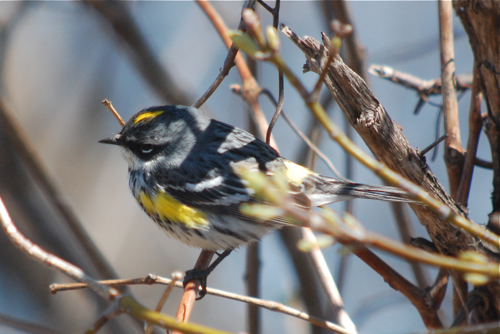
A yellow-rumped warlber. These early arriving warblers have already passed through the southern US but they're hitting Minnesota hard as they work they way north to their breeding grounds. This is the time of year that I would expect them, but because we've had a cold snap with rain and snow, they are having a challenging time finding food, part of the risk of an early return. They eat insects, but they are scarce, they'll go for seeds, buds and fruit. You might even see them flitting around the bird feeder going for suet or sunflower seeds.
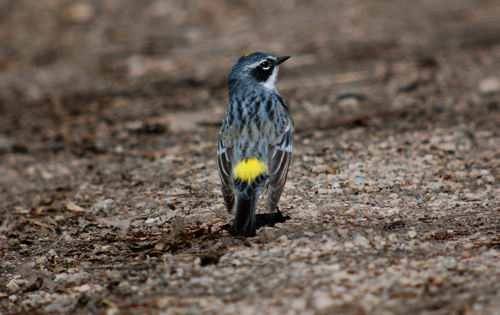
This bird has a couple of different names, one is "Butter Butt" because it looks like there's a pat of butter on their rumps, the other is "Myrtle Warbler" because there are two different types of yellow rumps, an eastern version (the Myrtle) and a western version (the Auduobn's).
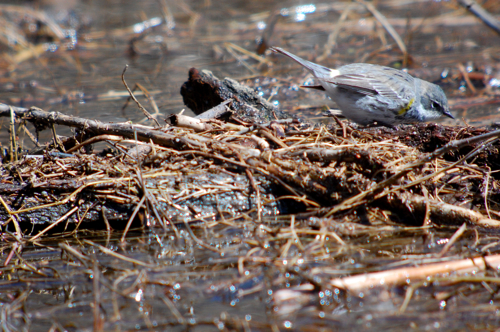
They're very noticeable as they dart around tree branches and flit around on the ground flashing periodic patches of yellow. Their call note in flocks almost sounds like a kiss, you may have noticed it while walking around your neighborhood.
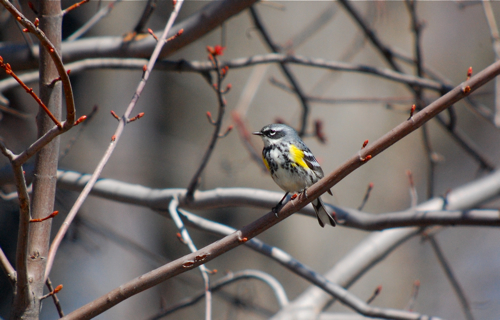
Yellow-rumps are the last warblers to leave in the fall and the first to arrive in spring. These tiny, hardy birds are the warning that all those crazy colored warblers that birders go ga ga for are about to arrive. Enjoy them while they last.
No Birds and Beers April 29
Due to the pending storm tonight's Birds and Beers is CANCELED. We'll go with the rain out date of next Tuesday April 26 same time, same location. Even if it's light snow, the woodcocks won't sing. We'll meet up next Tuesday.
Attaching A Spotting Scope To A Bike
I've had a couple of question sent in via email and Facebook asking how I attach my spotting scope to my bike. I had Non Birding Bill take a few photos to show what I do. This is for my Swarovski ATM80 mm scope, Nikon D40 and Swarovski 8x32 ELs. The set up that I'm going to show is primarily for traveling to a location and then walking around to observe and digiscope.

I have a Swarovski backpack (that is at least 5 years old) but any good outdoor backpack should work. This one has fasteners that hold my scope firmly in place and is fairly weather resistant. I've had it since 2006 and use it on a daily basis. It has become my mobile office. Anyway, if you have a good weather-proof backpack, that should work. I also store my Niko D40 in here.

I have a basket that's attached to the back of my bike. I put the backpack in the basket and I slide one of the tripod legs through the straps on the pack. I secure the tripod for the spotting scope to the back of my bike with bungee chords. My reason to sliding the tripod legs through the backpack straps is to make it difficult for someone to just grab my backpack from my basket if I were stopped at a traffic signal.
When I get to my birding destination, I simply lock up my bike, undo the bungee chords, take my scope out of the pack and attach it to my tripod and go birding.

I wear my binocular harness while ridingon my bike. It allows for me to comfortably wear my binos while I ride my bike. I keep my spotting scope stored on the back of my bike. I'm sure this isn't the only way to do it, but for those curious, it is possible to tote a scope, tripod and camera with you on your bike. I'm not worried about damage, Swarovskis are good, sturdy scopes and meant to take on wear and tear in the outdoors. It helps that they are waterproof and come with a lifetime warranty (though if the the glass on the eyepiece is scratched, I'll have to pay a minimal fee to get that repaired). Otherwise, I feel safe with it on my bike.
This is just my method that I have come up with via trail and error. If you have tips for toting scopes and cameras on a bike, feel free to share in the comments.
Incidentally, this is the set up I have used when biking to the owl nest in my hood and to observe the waterfowl on the area lakes near my apartment.
Red-bellied Woodpecker Excavating Nest Hole
Just a head's up that I'm keeping an eye on the weather for Tuesday's Birds and Beers (the Woodcock Tailgate Party). Right now, all Twin Cities tv stations are predicting various amounts of snow and or rain. Weather Underground is reporting an 80% chance of rain for our woodcock party. I think we may have to cancel. If there is any form or precipitation, consider Birds and Beers canceled and we'll go with our make up date of April 26. I'll wait until tomorrow to call an official cancellation...regardless of weather, Mr. Neil and I will be hiving 3 packages of bees.

Speaking of Mr. Neil, now that the snow has finally melted and created swampy pools of muck in his woods, I went down in there and to some exploring. They had a nasty ice storm over the winter and several trees are down blocking trails. While I was inspecting some downed trees, I kept hearing a red-bellied woodpecker. The bird sounded like he was right over my head, but I just couldn't see him. Then I backed up and scanned the holes in the trees and bingo--I got the above photo. Sneaky, sneaky the male red-bellied woodpecker was hidden inside.

I looked down and saw the ground was covered in wood chips from the woodpecker's excavations. I found red-bellies nesting last summer right in Mr. Neil's backyard, this is down the hill a bit. This tree is very old and dead compared to the tree that was used last year. Hopefully it will last the summer. This blog post is partially for Mr. Neil's groundskeeper, just so he's aware of the tree and won't take it down.

I went on my way through the woods and when I walked back, I saw the male red-bellied still excavating a cavity. He froze when he saw me. I was hoping to get a shot of him spraying out wood chips, but when it became clear that he was going to stay frozen as long as my scope was on him, I went on my way. A mouth full of wood chips can't be comfortable. And someone staring at you while you excavate your super secret nest spot might make you feel uneasy about your nest choice and look for another.

So, Hans, this is the tree. It's near the lemonade stand--wink wink, nudge nudge.
 Dude, how red do you need to be?
2011 Junior Duck Stamp Contest Winner
 Just saw on Facebook that congratulations are in order to 2011 Junior Duck Stamp Contest Winner Abraham Hunter, of Vienna, Illinois! Awesome ring-necked ducks!
Digiscoped Images
Fresh Tweets
Would you like to hire me as a speaker for your event?
Email sharon@birdchick.com