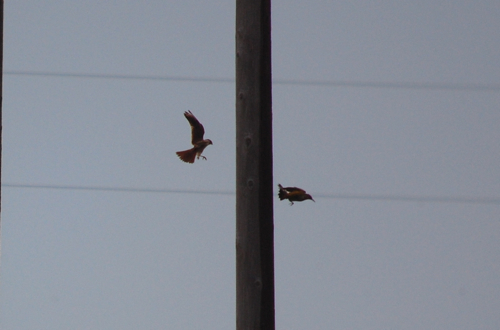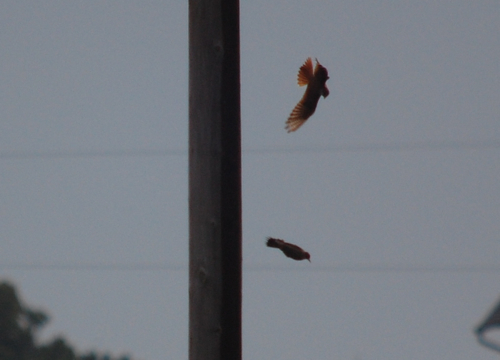
Merlin vs Red-bellied Woodpecker

Non Birding Bill and I were over at Mr. Neil's to do some fall beehive prep (for those who follow, the bees seemed to take my Ned Stark speech well and all but one of the hives actually bumped up production).  After we finished checking the hives we were back in the house surfing the net, dealing with emails when I heard a heard a sound. "Distressed woodpecker sound," my brain noted as I read an email. Then my brain kicked me, "DISTRESSED WOODPECKER SOUND! RAPTOR! ALL HANDS ON DECK!"

Then it sunk in--"Holy cow, look out the window, stupid!"  I turned to look out the window and saw a small raptor gliding away with a red-bellied woodpecker.  I figured the raptor was most likely a male Cooper's hawk or a female sharp-shinned hawk--both a fairly regular bird in Mr. Neil's yard, especially during migration.  I dashed to the front room and was shocked to see...

...a small dark falcon killing a large woodpecker.  "Holy crap! It's a merlin," I shouted...well, I'm sure there was more profanity than that but you get the idea.  Falcons have a notch in their bill that they use to sever the spine from the head and kill prey fairly quickly.  The merlin went in for a bite, but she had to go in for a second to really put the woodpecker out.  While she did that, I scrambled off for my digiscoping equipment.

Look at that face!  She's so adorable--Nature's Perfect Killing Machine! You can even make out those little malar stripes under each eye that all falcons have! I digiscoped this photo of her after she killed the woodpecker. It's not as in focus as I would like, but I was shooting through an old farmhouse window and my scope picks up imperfections in window glass.  I didn't want to open the window because this small falcon had worked hard for her kill and I didn't want to risk flushing her off her food.  This is the first time I've seen a merlin in Mr. Neil's yard.  This bird is possible for the area, but mostly as a migrant.  If she was on a long journey to migrate south, she needed a good hearty meal and my need to get a perfectly in focus shot was not as important as her need to get nourishment.

She was fairly close to the driveway with her kill and I noticed a car coming down.  She mantled a bit over her kill but didn't fly away from it.  I heard voices and noted that Non Birding Bill, Mr. Neil and the newly arrived Steve Manfred hadn't followed me into the front room to watch the merlin.  I shouted, "Hey, you guys really need to come see this, this is a really cool bird!"  Again, the "really" in the previous sentence was most likely profanity.  They soon followed and had to concede a merlin with a red-belly was pretty badass.  Cameras started clicking and both Neil and I got photos.  I immediately called this bird a "she" and Neil asked why.  First, in raptors females are larger than males. Based on this bird taking out a red-bellied woodpecker I knew she was female.  Now, merlins are one of the few raptor species where you can tell male from female apart based on plumage.  Females are brown on back and males are blue:

These are a couple of males that we trapped up at Frank Taylor's banding station in Duluth.  See the blue on the wing feathers?  That's male.  This gets tricky in young birds.  Merlins hatched this year will be brown on back--both male and female.  That's where size comes in handy.

Here's a shot that Mr. Neil took of the merlin.  Note how all the feathers on the back are uniform?  They all look like they grew in at the same time--that's something you would only see in a bird hatched this year.  Adults would still have some molting going on and you'd see worn, older feathers mixed in that would be a slightly different color.  The tail has some light colored bands through it.  The look tawny or buff.  If this were a male, those bands would look gray.  Again, females are larger than males and this small falcon took out a red-bellied woodpecker--it's large, she's female.

This is another shot Mr. Neil got with his camera. I had to chuckle because the woodpecker looks almost "cartoon dead."  See the tongue hanging out of the beak?  The only thing missing is the little "X" over the eye.  Note the size of the red-bellied woodpecker next to the merlin--I've had both in hand and always thought of them to be similar in size.  I decided to do a little digging on the Internet on merlin size vs red-bellied woodpecker size.

According to Cornell Lab of Ornithology's All About Birds red-bellied woodpeckers are about 9.4 inches long, have a wingspan of 13 - 16.5 inches and weigh about 3 oz.

Merlins are 9.4 - 11.8 inches in length, have a wingspan of 20.9–26.8 inches and weigh 5.6 - 8.5 oz.  Figure that the smaller numbers are males and the larger numbers are females.
So according to Cornell, a male merlin could be about as long as a red-bellied woodpecker.  This is another photo taken by Mr. Neil from the second level of his house.  Here you can see that the merlin is larger than the woodpecker, again identifying her as female.  What was interesting was that most of the birds left her alone.  There was some mobbing noise from a hairy woodpecker and goldfinches, but no blue jays came in to scold. A few crows did and the merlin did not like that at all.
She stopped eating and watched them.  The crows didn't caw like crazy at her like they would an owl or larger hawk. They cawed but not as frantic, as if not wanting to provoke her but let each other know, hey Nature's Perfect Killing Machine Down here.  I've seen merlins chase the heck out crows and even heard of accounts of merlins killing crows to take over a nest site.  They will go for something larger than they are and if any small raptor is capable of getting the job done, it's a merlin.  She watched them for several minutes and then to my surprise, took off with the woodpecker in her talons and dove at the crows.  I watched her bank to some trees and tried to go out to follow where she landed to eat but lost her completely. 
I had hoped if I found her that I could see the woodpecker carcass she finished eating to see if the woodpecker was banded.  Sometimes friends of mine come out to band birds here and have ringed a few red-bellies.  It would have been to fun to have that as a banding record.  If the woodpecker was banded we would had an idea of her age and a notation of the really interesting way to die.  I mean, getting killed by a merlin is one of the coolest ways to go.  As I was editing photos for this blog entry, something caught my eye:
In one very crappy photo that I took, I noticed that the merlin was banded.  Noooooooooooo!  Why didn't I get more photos of her foot to id the band number? BLARG!  Based on where Mr. Neil lives this is most likely a bird banded at Hawk Ridge this fall.  She was hatched this year so there are only so many raptor banding stations north of here.  There is a chance that my buddy Frank Taylor banded her, but I'm not sure if he's had a merlin in the nets yet this year.  Most likely a first year female banded on her migration south.  Without the number we will never know for sure but I'm curious of my buddy Frank Taylor or Hawk Ridge has banded any hatch year merlins because chances are good, she is one of their birds.
Man I love unexpected merlins but to have one make such an interesting kill and be banded just really made my Thursday.
Birdchick Podcast: #65 Eagles and Window Strikes

Interesting...do satellite transmitters harm birds? Bald eagle rehabbed by The Raptor Center was banded and the band was recovered, giving a clue as to how birds fare post wildlife rehab.

Bald eagle that was injured and is now used for public programs flies into a window at a football stadium causing public outcry from animal rights groups and highlights how dangerous windows are.

[youtube]http://www.youtube.com/watch?v=YgF6UJ5UgUs[/youtube]

Meanwhile San Fransisco approves guidelines for new construction to include bird friendly.

Terre Haute, Indiana has a Crow Committee.

Ducks Unlimited is asking hunters to purchase 2 Duck Stamps this year.  Will birders purchase 1?

Flicker Shenanigans With A Kestrel

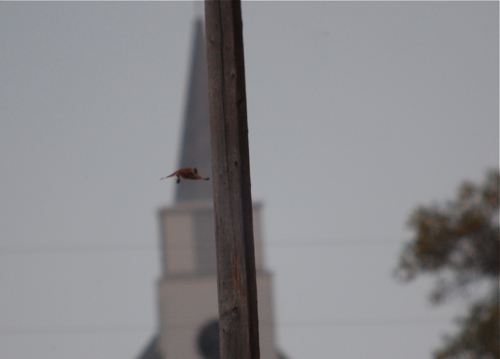
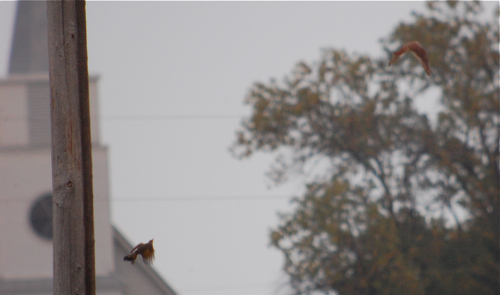
I was out and about doing bird surveys yesterday and I got to watch an interesting interaction between a small falcon and a large woodpecker.

Here's an American kestrel, minding her own business, hovering and looking for mice with leaky bladders or whatever to eat.

There were lots of northern flickers moving through during my survey. Most tried to avoid predators.  Multiple visits to Hawk Ridge during the hawk migration has taught me that at the end of the day, flickers have a body built for food that many hawks like to eat.  I guess this flicker was feeling his Wheaties and went in to hassle the hovering kestrel, vengeance for fallen and eaten brethren?

After getting properly buzzed, the kestrel did an about face and went for the flicker.  Both are about the same size and I think if the kestrel had been a Cooper's hawk that the flicker wouldn't have engaged in any mobbing shenanigans.

Again, these aren't the best shots in the world, I digiscoped them at 400 meters.  But had fun watching the behavior.  The birds chased each other for at least five minutes (could have been longer, but I had to move on to my next survey point), sometimes the flicker was chasing the kestrel and at other times, she was chasing the woodpecker.  Periodically, both would perch on the same wire--sizing the other up?

Fixing the RSS Hack

NBB here. We're fighting off a hack in the RSS feed. Our apologies. The site may be down for a few hours while I try to fix this. UPDATE: I believe I have corrected the problem. The our site had been hacked and altered in such a way that the spam was only showing up when accessed by search engines, such as Google and Yahoo. This made it hard for me to trace the problem until I had found the file. The problem should be corrected now, but may take a day to clear out of Google. If you continue to experience these problems, please let us know in the comments or by emailing Sharon. Please be sure to include what service/URL you were using when you found the spam.

Again, our apologies.

NBB

Birdchick Podcast #64: Pelicans, Forensic Ornithologist

I've been in Berkeley Springs, West Virginia which puts on an awesome little bird festival. I stayed at the Manor Inn and if you are ever there, I highly recommend it. Feathers in amber.

Minnesota man named Craig Staloch accused of destroying 75% of pelicans nests that were on land he was leasing for farming.

Bird watcher dies trying to photograph a peregrine...let this a lesson to all of us.

24 Nihoa Millerbirds have been moved to a different island to prevent extinction.

Birdchick Podcast #63: Whimbrels, Migration & Talking Birds

Kind of a bummer for migration.  Whimbrels--are really awesome type of shorebird have been fitted with satellite transmitters.  One even went through Hurricane Irene.  Alas, 2 of them have been legally shot, story here and here.  It's legal on this island to shoot shorebirds, they are not part of the Migratory Bird Treaty. News that record numbers of birds of prey poisoned in Scotland.

Birds that were pets and released in their native Australia are teaching their wild counterparts human words.

Download the podcast theme song, "The Cinnamon Funk."

Birdchick Podcast #62 Migration News, Bird Art & Bird Sunbathing

The "Happy Feet" penguin that swam up onto the New Zealand shore starving, underwent some wildlife rehab and was released with a satellite transmitter has disappeared. Go check out the Sunbathing Birds gallery at Bird Watching Magazine--the titmouse looks disturbing!

In really nice news, fewer migrating birds were trapped in the 911 Tribute of Lights.  Unlike last year when at least 10,000 migrating birds became trapped in the lights.

Wind tunnels reveals how birds stay hydrated during migration.  I'm so relieved I don't have to migrate.

Several common loons breeding in the Upper Midwest are sporting satellite transmitters in order for researchers to study the migration through the Great Lakes toward their southern winter homes. By using satellite tracking devices implanted in the loons from Minnesota, Wisconsin, and the Michigan Upper Peninsula, USGS scientists expect to learn information about avian botulism essential for managers to develop loon conservation strategies.

I had a guest post over on the Skepchick blog--I'm so honored!


Barred Owl On The Bike Trail

On Saturday Non Birding Bill and I were taking advantage of the beautiful weather and the Twin Cities bike trail system.  We passed into a neighborhood and hear blue jays, cardinals and nuthatches going bonkers.  I took a quick glance but figured since NBB was with me, I might as well ignore whatever was being mobbed by birds.  Then I heard NBB say, "Got it! Owl!" I stopped, pulled over and saw NBB behind me pointing to a tree.  "Great horned?"

"No," he said, "I think it's  barred owl."

It sure was.  We finished our circuit and on the way back found the owl in the same spot but it was no longer being mobbed.  When we heard the blue jays earlier, they some sounded young and I wondered if the adults were using the owl as a chance to teach mobbing behavior.  Did the young ones lose interest when the owl didn't do anything?

When we got home, I debated about biking back to get a scope.  I have a system for packing up my Swarovski scope and camera, but the owl was in a residential neighborhood and I don't like to take my scope in those areas if I don't have to.  Plus, my thighs were putting up a bit of a protest.  I decided to go for it and figured the worse case scenario would be that the owl was gone and I'd get a little more exercise on a gorgeous summer day.

As I suspected, the owl was still there.  This is a well used neighborhood for bike riders, joggers and walkers.  This owl was used to roosting over people and not a lot was going to make it flush.

I aimed my scope, taking special care to never aim it at any windows or house and getting shots of the owl.  What a cutie--I even got to hear it call a few times.

The head feathers of the owl looked like it hadn't quite filled out with the rest of the body and there seemed to be hints of down.  Is this a young barred owl?  I took a quick look under the tree and found a pellet.  Just as a grabbed it, the person who lived in the home came out.  I hoped that I wouldn't have too much explaining to do and she smiled and asked, "Is the owl here?"

Whew--I wasn't assumed a bicycle perv but assumed to be a birder--yay!  She was really nice and told me that they had seen the owls all summer and that the babies even hung out on the porch rails when learning to fly.  Her young daughter came out and said, "The sat on the porch on my birthday!"

What an awesome birthday treat!

We talked bird a little bit and then I headed home suddenly aware that I was in my bike clothes, sweaty and stinky.  I can only imagine what my mother would say about doing sweaty stinky bird chat with strangers.

Relaxed owl toes! What a bonus for biking--a random barred owl.  I love the variety of nesting predators we have in my general neighborhood.  Birding truly can be done anywhere, even in an urban area.

Birdchick Podcast #61: Amazing Burrowing Owl, Lesser Prairie-Chickens & Big Year

This is where I'll be next week. From the American Birding Association Blog: Crazy female burrowing owl does 2 broods--1100 miles apart!

Oklahoma should really look at the lesser prairie-chicken as an economic opportunity, not an economic bust.  There's a lesser prairie-chicken festival--Leks, Treks and More!

It's hawk migration time--find a Hawk Count near you!

Big Year news--lots of discussion about below:

Screen shot 2011-09-07 at 4.06.02 PM

A Swainson's hawk in the snow?

Screen shot 2011-09-07 at 4.05.16 PM

 WildBird magazine makes an appearance in the movie!

Screen shot 2011-09-07 at 4.09.18 PM

Jim Parsons is supposed to play a bird blogger.  Who is he?  Have you ever seen a bird blogger in a beret?

Also Greg Miller (played by Jack Black in the film) has his own blog...and his own line of shirts:

Screen shot 2011-09-08 at 8.53.44 PM