Is It Safe To Go Birding In Israel?

I think the number one question I've had about my recent trip to Israel for birding has been, "Is it safe?" If you look at its location in the Middle East, it can seem a bit intimidating.
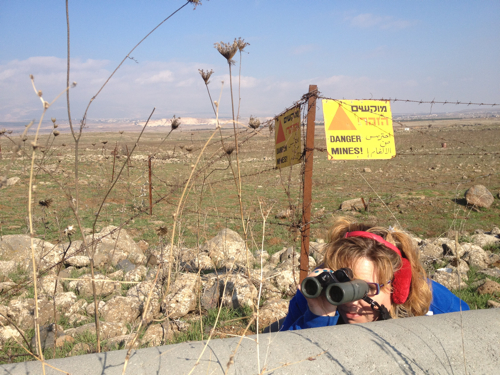
But I can honestly tell you, I felt incredibly safe--even when looking for Finsch's wheatear at the Valley of Tears outside a minefield on the Syrian border (that's what is going on in the above photo).  Actually, I think that could be part of the appeal of visiting Israel for some people--how many times in your life will you be able to get horned larks on both your Israel and Syria bird list and how badass will it make you sound at parties?
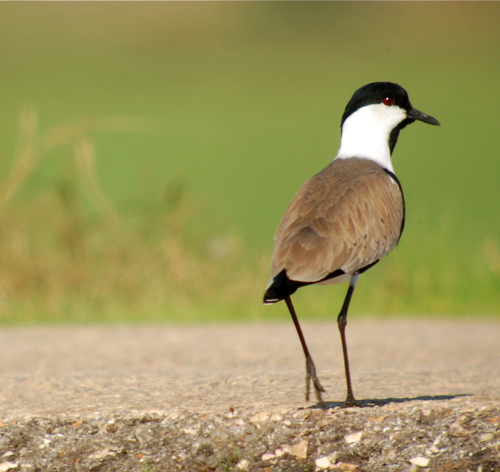
You get a lot of bang for your birding buck in Israel because it is a HUGE migratory hotspot.  You can get flashy Mediterrainian species like the above spur-winged lapwing.
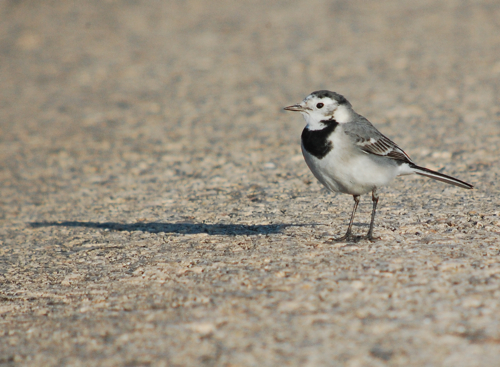
You can also get some of the European and Asian species like white wagtail.  For a North American birder, you are going to get a lot of different species jam packed into this tiny country.

Some areas are easy to check out on your own.  If you flew into Tel Aviv and grabbed a rental car you could drive to the Agamon Hula and walk/bike/golf cart the trails and get some great species and be perfectly safe.  Every place our guide Jonathan Meyrev took us can be accessed by the public, even those visiting from other countries.
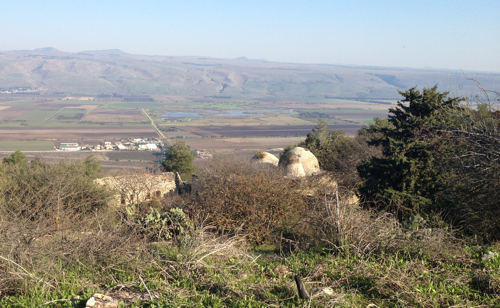
Although, I think hiring a guide is the best way to go for most of these areas.  Not for safety issues, but Israel is so full of history--even if you don't count the last 50 years, you still have all the Biblical history.  It also helps to have a guide say, "That over there, is the Gaza Strip." In the above photo is the Hula Valley itself where did a majority of our birding.  Jonathan had some extra time with us and took us here for quick stop for the view.  I noticed the decaying building in front of us and asked Jonathan what that was a tomb about 300 years old.  History and archaeology is everywhere and you don't want to miss out on that as well as the great birds.

Most speak English very well so even if you don't know any Hebrew beyond "shalom" you would be fine to visit and travel around the country.

More will be coming.  I'm in the process of sorting my photos and story ideas for the blog and for publication (some publications get understandably irritated if you pitch them an article but then scoop them by blogging it).
 

Palestine Sunbird, Best Hotel Bird Ever?

Between jet lag and jumping right back in to my eagle surveys, my blogging this week has been slower than I expected.  I will say, the upside to my freaky sleep schedule makes getting up 2 hours before dawn easy cheesy.  However, staying up past dinner impossible.  I'm kind curious how tonight will play out, I'm scheduled to be a guest at Camilla Parker Bowls at the Bryant Lake Bowl.  Will I be awake?  Will I make sense?  Will it lead to me sleep table dancing in the middle of the show? I have a post up over at 10,000 Birds about using my iPhone 4s for digiscoping.  I had lots of opportunity to use it and do side by side comparisons while in Israel.  I actually ended up taking more photos with my iPhone than I anticipated and was pleased with the results, especially since I was hand holding it.

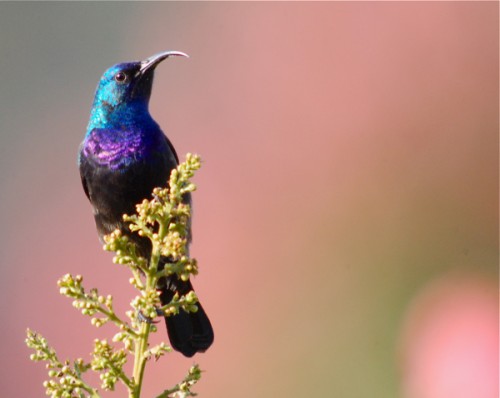
This is a Palestine sunbird--we got them within minutes of checking in to our hotel in northern Israel, the Pastoral Kfar Blum.  Periodically one would even perch on the bush just off my hotel balcony.  It's the Middle Eastern version of a hummingbird (although a bit larger, being about the size of a small warbler).  But that long curved beak holds a tongue with bristles at the tip used to get nectar from flowers.  Dynamite birds to tick off from your hotel, plus it's fun to have a bird with such an exotic name on your list.  The above photo was taken with my Nikon D40 through my Swarovski spotting scope.  Since the birds were fairly cooperative, I thought I would see what I could get with my phone:

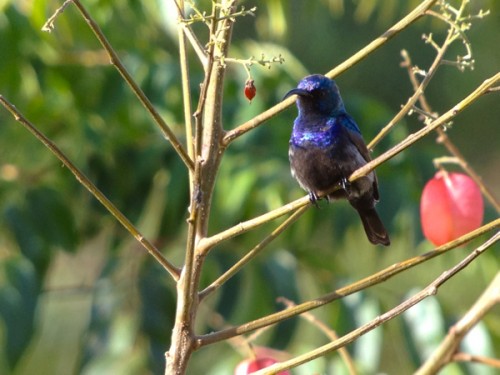
The bird is in a different position and the light is not the best, but still, not bad at all for me just quickly hand holding the phone up to the scope.  It won't be on the cover of WildBird Magazine, but it's perfect for sending a photo to Twitter, Facebook or email.

My article at 10,000 Birds links to a new adapter developed by Meopta that should make securing my phone to my scope a breeze.  I'm practically salivating to test it out, but if it works well, I may never take my SLR in the field again.  Looks like it won't be available until early next year so in the mean time, I'll keep practicing with my hand held technique.

I Think I Saw A Few Cranes In The Hula Valley

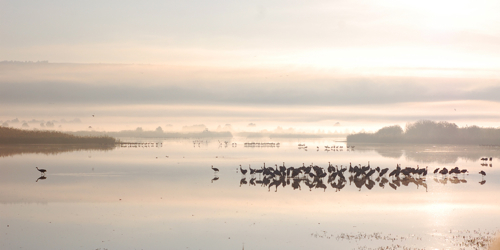
On my way back from the Hula Valley to Tel Aviv, I'm taking advantage of the wifi on our base. I've seen a lot of crane migration in my life and I've loved them all, but Israel is creeping up to the top spot in my heart.  The Hula Valley is an incredible story of conservation, partnership and sheer biomass beauty.
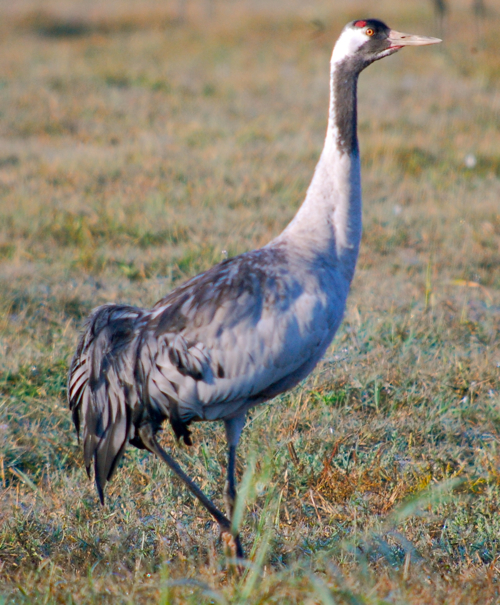
Here's an up close shot of one of the 30,000 cranes.  It is a common crane (Grus grus) and they sound an awful lot like sandhill cranes but look a bit different.


Black-shouldered Kite

Here is a video from Liron Ziv of a black-shouldered kite family in the Hula Valley. There is a nest this year and the local birders are quite proud of this new nest species in this area. http://www.youtube.com/watch?v=4FXOyFfkutA

They look very similar to the white-shouldered kites I've seen in the US. They are beautiful little birds. Still has been a treat to watch them.

Random Laughing Dove

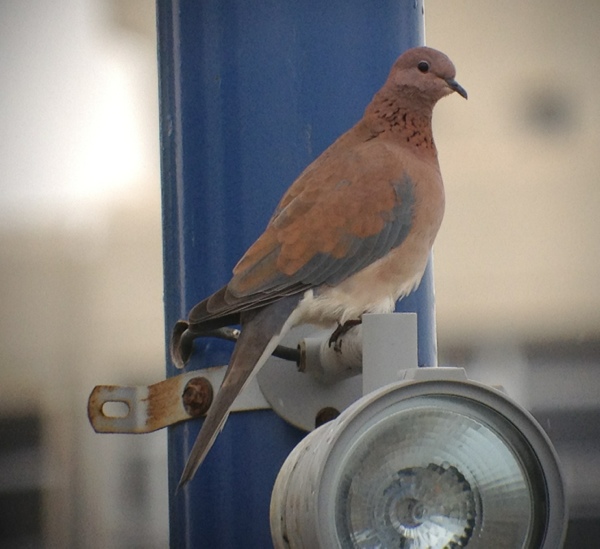
20111120-120924.jpg A laughing dove taken with my iPhone and spotting scope. These were one of the common birds outside my hotel room in Tel Aviv.

Shalom from Israel!

Greetings, in case you haven't heard I'm currently in Israel while poor Non Birding Bill has to live the bachelor life back in Minneapolis.  I'll be posting photos when I can on my Twitter feed and on my Facebook page (you should see what I've been eating).  I'll of course update here, but from what I've heard, it sounds like this trip is the sort where they get you up and dawn and bird the crap out of you until 10pm, so we'll see what happens here.

This weekend was spent mostly in Tel Aviv and we birded around the Negev for some desert species.  Above is a long-legged buzzard that I shot with my iPhone.  I'll note when I can which photos are from my SLR and which were taken with my phone.  This is mostly for me as I'm on a quest to see if I can eventually go out in the field with just my iPhone instead of my camera to document birds.  The long-legged buzzard is in the same genus as red-tailed hawk.  Those are a couple of hooded crows on the fence.

Some of the Negev is cultivated and some is desert.  The brown landscape is full of brown birds (I'm so happy!).  I love travel, it's always been one of my goals with the blog, but I still can't help but look around and think, "How the heck did I end up in the Middle East to go bird watching?"

Here are some of the elegant brown bird running around in the above photo.  These are called cream-colored coursers and they scurry around eating insects, they are so delicate and perfect in their shape, size and movement, they look as if they were designed by the artist Erte.

It's been hard for me to figure out what bird has really knocked my socks off--they are all amazing and I tend to find my favorite bird is whatever bird is right in front of me.  But these Namaqua doves above (taken while balancing a Swarovski spotting scope on the car window with my SLR are made up of pure awesomesauce.  You are looking at thinking, "Yeah, Shaz, I see a bluish gray dove with a black mask and beard, that's a cool looking dove."

But what you can't see is that these guys are about the same size as a house sparrow!  BT3 is commented that they are like a Harris' sparrow of doves.  It's like someone took a little budgie, a little Harris' sparrow and a mourning dove and conjured up this.  Awesome little guys.

Quite a few of the bird species that are in Israel are some of the same that I saw in Kazakhstan a few years ago like the above juvenile red-footed falcon.  It's great to see birds that I was not sure I would ever see again.

This is a photo from my hotel balcony in Tel Aviv this morning.

What I'm most looking forward to in this trip is learn more about the conservation efforts of Israel.  We're on our way to spot with tons and tons of cranes and I hear we are in mobile blinds...as in the blinds move as we are in them.

This was one of the photos they sent along with the information about the Hula Valley Bird Festival.  I noticed the cranes were flushed and that a tractor was pulling the blind bird watchers are using to view cranes.  This is not something that is done at other crane festivals, but the local ornithologists tell me that there is specific method in this madness and we will see why they do it first hand (it's to help the cranes out).

So excited to learn some new bird stuff!


Birdchick Podcast #79: Birder Packing, Protesting: Birding Style!

I have no idea what's going to happen with the podcast over the next week and a half.  I'll be in Israel and though I'm assured that there will be Internet access-I have no idea about what kind of free time I'll have and so we may have a podcast before December 1 or we may not.  Speaking of traveling, I have a post on 10,000 Birds about essentials all birders should back when traveling. In the meantime, check out Twin Cities Naturalist--he has a contest!

Right now if you order a pair of binoculars from Eagle Optics, you can get an ABA membership for $15 instead of $45.  Listen to the podcast for a discount code to Eagle Optics.

Dead found in a salad bag.  What species could it be?

Non Birding Bill's Kickstarter Project!

Birders who are protesting the Sandhill Crane Hunt in Kentucky are buying a license and a lottery ticket.  Only 400 will be given out and it's only $13 to enter if you are a non resident.  This same strategy was used by Paul Johnsgard in the 1990s to protest a prairie chicken hunt and was successful.

Some western marsh harrier males have permanent female plumage. Whaaaaaaaaaaaaa?

Fascinating article about veery migration--where they go, how long they stay.  Wow, if we found this out about veeries, what else don't we know.  This is what a veery sounds like.  If you have never heard one in the wild, it is a moral imperative that you rectify this:

[youtube]http://www.youtube.com/watch?v=cK1gaTqBRRk[/youtube]


Golden Eagle and Bald Eagle Field Trips

Can you tell the difference between these 2 birds?  If not, you should consider coming to the National Eagle Center's Golden Eagle Field Trips.

Identifying bald and golden eagles in the wild can be a challenge. We are fortunate to be able to see both bald and golden eagles in the Upper Mississippi River region in the winter months.  During the NEC Golden Eagle seminars and field trips, you will learn what to look for to distinguish bald and golden eagles, including juveniles. You’ll also gain valuable raptor field identification skills from experienced birdwatcher and NEC Education Director, Scott Mehus.  Each field trip begins at the National Eagle Center at 1:00pm. After a brief classroom session learning tips for identifying golden eagles, participants will caravan out to a field site to observe golden eagles in the wild.  Call (651) 565-4989 or email nationaleaglecenter@gmail.comfor details.

I've already had a couple of golden eagles show this fall during my travels so they are definitely back along the Minnesota/Wisconsin border.  That's a photo of a juvy golden that I got a couple of weeks ago.  Not that eagle watching ever gets tiring but it is fun to pick the golden eagle needle out of the hundreds of bald eagles in the haystack.