
Birdchick Blog
Birding Around The Golan Heights
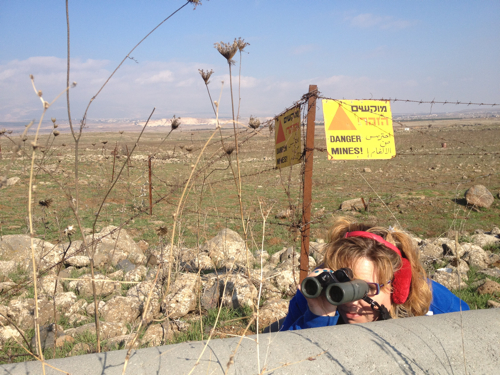 Whenever I see an article or hear a person dismiss birding as boring, I think, "Oh, bite me." I mean, how often does a person have an opportunity and good reason to be near a mine field? If anything will take you to those sorts of places, it's birding. One of the areas we visited while in Israel was the Golan Heights an area just under 700 square miles that is right along the Israel/Syria border and includes Mount Herman. The above photo was taken in the Valley of Tears an area marked in Israel's recent history by being the site of a huge battle during the Yom Kippur War. Our purpose for visiting the area was to find a snazzy looking bird Finsch's wheatear and Calandra larks which we did get but I was unable to get close enough for a digiscopable shots (so follow the links to see what awesome birds those are).


Another bird we got was a Syrian woodpecker which can be found throughout Israel but this one was especially exciting being so close to the Syrian border. How close were we to that border at the Valley of Tears?

Literally down the road. The buildings you can barely make out ahead...that's Syria!

Here's a digiscoped image of the city across the Syrian border. We had to really work for the birds in the Valley of Tears but I think part of the challenge is that you are surrounded by so much history and strange terrain and you can't help but stop and think, "Holy crap, we're on the border with Syria and not only does this seem a little dangerous, the surrounding area is incredibly beautiful!"

We saw several interesting mammals too. Above is a rock hyrax which I thought was another fancy term for groundhog or marmot but turns out the closest relative of the hyrax is the elephant. For realz! We also foxes running around the Valley of Tears too.

Another spectacular part of the Golan Heights is Mount Hermon. The highest peak is over 9000 feet and we got to about 7300 feet where you can view various observation posts that watch the mountains, since this borders Lebanon, Israel and Syria.

You can visit this area on your own, even if you are not an Israeli citizen and you have a rental car. Because it is a military outpost, you have to get permission from the guards to let you in. But if all is safe and clear they will let up no problem.

And you just can't help but take time for wacky photos (like the above of Tim Appleton snapping a photo of Bill Oddie). This was actually on top of Mount Hermon. This was one of the most beautiful spots we visited. Have I mentioned how grateful I was that Bill Oddie was on this trip? If you've never met me face to face, you may not realize that I'm only five feet tall. I'm generally the shortest person in the group and not being used to high elevation, I have a tendency to fall behind as taller, more eager to list birders race ahead. Mr. Oddie is very similar in height to me so it was nice to have some company in the back of the group.

While birding around this military base we saw lots of familiar birds: horned larks--the birds who were a constant companion to me during my eagle surveys this summer and fall! But we also did quite a bit of birding at a nearby ski area.

One of the target birds here was a rock nuthatch (I dare you not to sing that like the B-52s song Rock Lobster). Like our nuthatches here in the states only a bit bigger and they forage around rocks rather than trees. They also sound a bit like canyon wrens.

We actually got to see a rock nuthatch nest. And unlike our nuthatches in the States, they build these crazy burrows onto the sides of rocky cliffs. They construct them out of mud and dung (lovely). In the above nest you can even make out some beetle casings, our guide told us that they rubbed those on the outside, perhaps as an insect repellent.

While we were watching the nuthatch, some of our group go very excited when they found a wolf. I got the above photo holding my iPhone to my scope. When I saw it I said, "That looks like a coyote." Our Israeli guide has spent some time doing bird work in the US and said that the wolves in Israel are much smaller than the timber wolf that I'm accustomed to in Minnesota. It was still a really cool mammal to add to our trip list. There were actually two wolves but I was only able to get a shot of one.

Another bird people were really excited to see and we worked really hard to get was a sombre tit (insert 13 year old giggle here). Which I had a tough time seeing and when I finally did it was because Pete Dunne said, "Chickadee." And sure enough, the somber tit looks an awful lot like our black-capped chickadee here in the states. The head and bill shape is a bit different but this bird did look somber compared to all the great tits working the same area it was (insert another 13 year old giggle here).


This is Nimrod Fortress which you pass on your way up to the Golan Heights, it was built in the 1220a. Most of my photos from this portion are of scenery than birds, but you can get some great ones. We also got imperial eagle, golden eagle, mistle thrush, black redstart and rock bunting.

Again, don't let the proximity to the borders make you nervous. This is a very safe and welcoming area...and unlike fam tours that I've had in a few other countries, we didn't have a police escort the whole time.

And don't worry about asking the border guards at the border--they are really friendly...and did I mention that I'm only five feet tall?
A couple of notes about clothing for Mount Hermon--our guide warned us to pile on the clothes because the mountain weather is unpredictable, no matter what the forecast says. I didn't have long underwear on, but had it been a smidge colder I would have wanted it. Take layers, take a scarf, ear muffs, gloves and wool socks.
Best Place To Watch Cranes On Earth
A large part of my trip to Israel was spent at the Agamon Hula in northern part of the country. The story of the cranes in the valley is quite amazing and quite recent. I've seen crane migration several times in the US, it's one of my favorite things to watch and encourage others to do (I've got a sandhill crane tattoo designed by Paul Johnsgard in the small of back, I love it so much).

But the Agamon takes to you see cranes in the way you've always wanted to view them. Close.

And I mean REALLY close. This is the closest that I've ever been to large flocks of cranes and it's really incredible how the whole situation works.

The story of the cranes at the Agamon started in the 1940s. There was a huge shallow Hula Lake was drained so the land could be farmed. All was well and good for about 10 or 15 years and then the peat dried out. Whole planted fields failed as dried peat combusted--some farmers lost tractors that sank in the combusting dried peat. In the late 1980s to early 1990s they began to rehabilitate the peat and the lake gradually returned, though not quite as large as it originally had been. As the Hula Lake reformed and several birds started using it on their migration south. Some had shown up in the lake's previous glory but nothing like this.

The first year, about 15,000 common cranes used it as a staging area. Many people came to view the cranes and the area began to grow as an eco-tourism site and at this point, roughly 30,000 cranes use the area. It's an incredible site. But what makes this special is that the cranes have developed a fondness for the surrounding farm fields which presents both an incredible wildlife opportunity and a challenge.

On the one hand it's incredibly amazing that the cranes are all wedged into this area and they have grown accostomed to farm equipment. Someone caught on to this and noted that people wanted to view the cranes and thought, "What if we attached a big box that holds 50 - 60 people to a tractor and drove it through big flocks of cranes in the Hula Valley? And it works! The cranes are very used to the equipment and as the tractors tote around groups of crane watchers, the birds casually walk out of the way but stay relatively close. In the above photo you can see the view from our blind and beyond the cranes is a tractor pulling another blind. As you can see, the cranes are relatively nonplussed by all the humans watching them.

It's not 100% an ideal situation. The cranes should be using the area for staging (gathering and feeding like crazy to continue their migration south). However, the cranes have found ample forage and several thousand are spending the winter in the Hula Valley roosting on the lake and foraging nonstop in the surrounding field. This is a problem, both for cranes and for farmers, as cool as the birds are, the farmers don't want to lose their income and really, the cranes should be migrating.

So, Israel has come up with a unique idea. There are fields where supplement food is set out for the cranes and a squad who patrols the area and flushes cranes from farm fields where they shouldn't be feeding by using loud noises like fireworks and gun shots--the cranes are not harmed, but flushed from areas where they shouldn't be, keeping the farmers happy and the cranes safe.

It's quite amazing how acclimatized to humans the cranes are despite being flushed from certain fields. In Nebraska, you can't get as close to the birds and if you went out into the fields where they forage during the day, the sandhill cranes take off. In the Hula Valley in Israel, you can get quite close and the refuge is happy to help you get there. It's great for getting photos, for sketching or for just sitting there and enjoying the spectacle of thousands of cranes.

Even in the hides built around the refuge to visit birds throughout the year are visited by cranes. You don't even have to keep quiet. While I was in the above blind several people were inside chatting animatedly in Hebrew. Even when we were in our tractor blinds our guides had microphones and speakers and spoke at a very normal level when close to the cranes and the birds were not perturbed.

Common cranes are only part of the magic of viewing birds in the Hula Valley, but they are a great part. To view them at their peak you need to visit in early November. There are always great birds at the Hula, but for a crane migration spectacle, plane on early to mid-November. After visiting the Hula Valley, I may have to adjust my tattoo.
Oh and to give you an idea of how similar they are to sandhill cranes in North America, check out this video, they sound almost exactly the same:
[youtube]https://www.youtube.com/watch?v=uTw6fp6JB_4[/youtube]
Winter Surveys
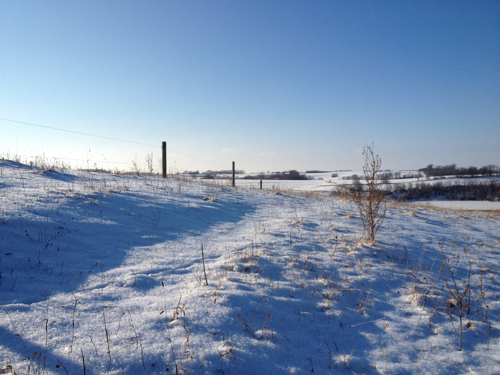 I'm still doing some of my bird surveys. And up until this week I was having a cheery time in the field, but now it's so incredibly silent. I can't believe this is the same spot that was chock full of bobolinks not so long ago. It's so strange to suddenly have a spot that was so vibrant with sound from breeding birds then switch to crickets then to chips of secretive migrating sparrows and then to nothing. It makes those hour long point counts feel like a long time. And though the landscape is beautiful, it's bleak and lonely...and not nearly as much fun to scramble under electric fences as the snow piles up.

We've even been able to squeeze in another aerial waterfowl survey this week. Half the Mississippi River is frozen and reminds me a bit of a lunar landscape.

It snowed lightly while we were flying and the ending result made it seem as though we were flying right through a holiday card. I suggested the pilot attach a bright red nose to his plane and I'm not sure he found that nearly as funny as I did.

Swans fly like shimmering ghosts through the snow. The numbers of swans has dropped on the Mississippi and I'm not entirely sure that a majority of them are tundras. In early and mid November, I watched huge strings of swans fly over while I did my eagle surveys. I could hear their calls well before I saw them and knew they were tundra swans heading to the staging area on the Mississippi. Last week, I had smaller groups of swans using the exact same route, but listening to them, they were distinctly trumpeter swans. It's hard to tell the 2 apart in a plane at 100 miles an hour.

They are easy enough to count and id on the open water...

But much harder on ice and snow. This was as we were doing a high pass to see if there was enough open water to warrant a fly by. At fist, I though there are a few swans but not many...then I noticed how many of the whiter spots were moving on the ice, there were still hundreds of swans to be counted.

Canada geese are in large numbers, the biggest numbers I've seen all season. Considering all the waste corn in farm fields and all the places that have open water along the river, it's no surprise.

Here's part of a flock of bald eagles, there are at least 29 in this photo. I saw some very interesting behavior that I've not seen bald eagles do this week. Common mergansers are in huge numbers on Lake Pepin, but I was able to get a shot of them. Where ever we had huge flocks of mergansers, we had sizable flocks of bald eagles hunting them. It was crazy, we would have 10 bald eagles actively trying to nail a mergansers over open water. One spot was so active and dicey with mergansers and eagles, our pilot skillfully dodged around the flock. Our pilot doesn't like eagles to be directly over head because they can suddenly drop, through in a few thousand panicked ducks and barely freezing water and you have a dangerous situation. It was cool to get a fleeting glimpse of the behavior. Lake Pepin is so huge, it's not something easily viewed from shore. I'd be curious how successful this technique is and if any bald eagles ever end up drowning after catching a merganser on water. I know eagles are capable of swimming some distance to shore by paddling wings, but I don't think an eagle could make it from the center of Pepin.

Not as many ducks, but what a treat to get to view the bluffs in Minnesota and Wisconsin on either side of the Mississippi River. This was our last flight for ducks. I might do one ground survey next week, but that depends on if Pepin stays open. To view our waterfowl numbers check here. If this week's numbers aren't up yet, they will be up by Friday.
Birdchick Podcast #81 Snowy Owls!
Snowy owls are in the news! They are everywhere. Here's a link to my Google News with "snowy owl" typed in! Some of the most interesting stories: over 100 snowies are reported to be in Wisconsin! And of course the obligatory "a snowy owl killed my dog." Wondering how to find a snowy owl near you? Try typing in your state's name and the words "bird listserv" to see if there are reports in your area or check out the handy dandy map that eBird has set up based on user reports.
Check in with us on Wednesday...we're going to have a really cool bird contest courtesy of Larkwire!
Also, have you ever considered signing up for a Christmas Bird Count? If not you should, find one near you!
Dynamite Kingfishers Of The Hula Valley
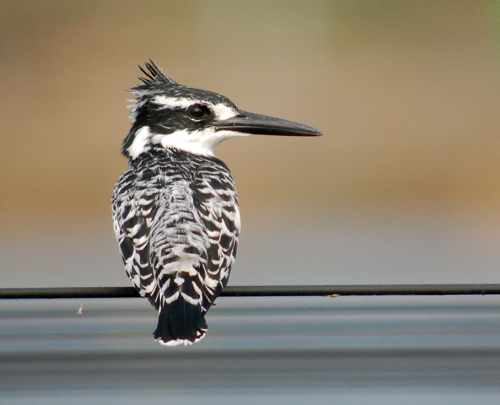 One of the big highlights visiting the Hula Valley in Israel was all the kingfisher action. This is a pied kingfisher, about the size and shape of belted kingfishers but are all crazy black and white. And unlike the kingfishers in my state are incredibly cooperative:
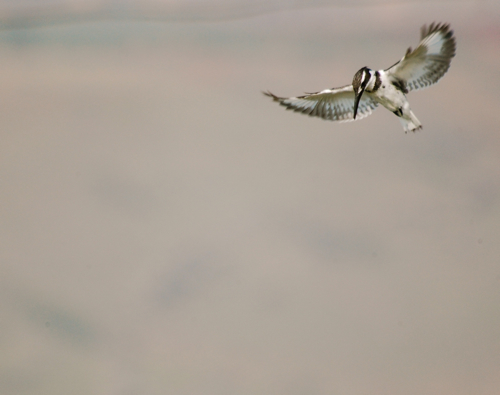
The pieds were especially obliging and would hover quite close allowing for photo opportunities! They were an easy species to watch, we had them along the beach outside of our hotel in Tel Aviv, they perched nearby when we were watching cranes in the valley and they were all over around the fish ponds.
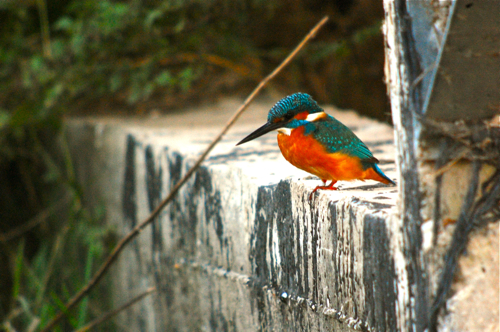
This is the common kingfisher and about six inches long is about the cutest thing on wings. It zips around like a little race car.
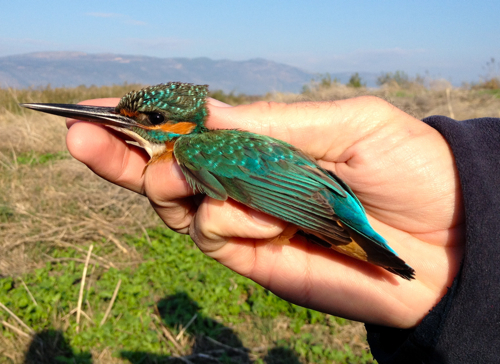
Here's an example of how tiny they are. This bird was part of a banding operation going on at the Agamon Hula.
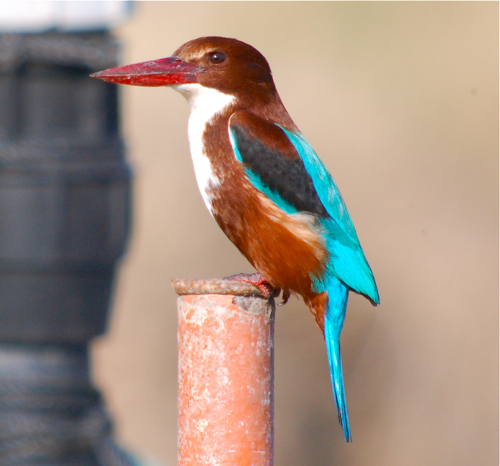
Then there's this bad boy. This is the white-throated kingfisher or Smyrna kingfisher. And the blue on the back looks as though it can't exist in nature, yet it does. Now even though this is called a kingfisher, note its shape. It's shaped more like a kookaburra. And though it will eat fish, these guys will also go for snakes, frogs, lizards and small rodents.

Just a few more examples of the really cool birds you can see in the Hula Valley.
Is It Safe To Go Birding In Israel?
I think the number one question I've had about my recent trip to Israel for birding has been, "Is it safe?" If you look at its location in the Middle East, it can seem a bit intimidating.
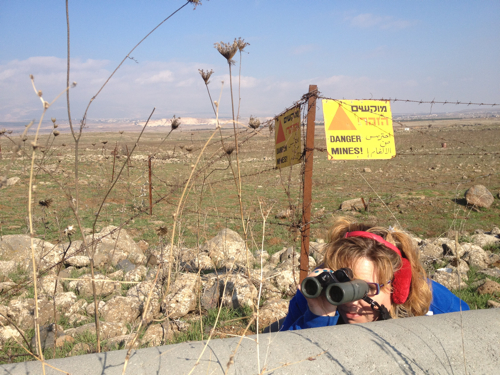
But I can honestly tell you, I felt incredibly safe--even when looking for Finsch's wheatear at the Valley of Tears outside a minefield on the Syrian border (that's what is going on in the above photo). Actually, I think that could be part of the appeal of visiting Israel for some people--how many times in your life will you be able to get horned larks on both your Israel and Syria bird list and how badass will it make you sound at parties?

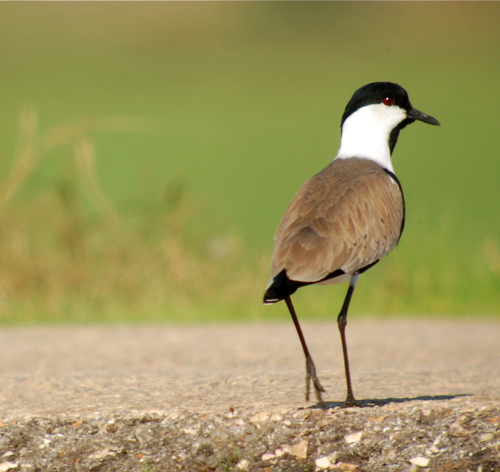
You get a lot of bang for your birding buck in Israel because it is a HUGE migratory hotspot. You can get flashy Mediterrainian species like the above spur-winged lapwing.
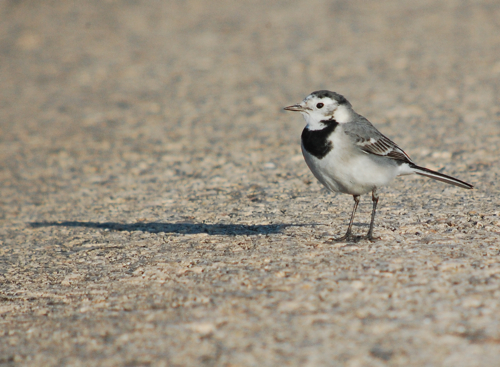
You can also get some of the European and Asian species like white wagtail. For a North American birder, you are going to get a lot of different species jam packed into this tiny country.
Some areas are easy to check out on your own. If you flew into Tel Aviv and grabbed a rental car you could drive to the Agamon Hula and walk/bike/golf cart the trails and get some great species and be perfectly safe. Every place our guide Jonathan Meyrev took us can be accessed by the public, even those visiting from other countries.
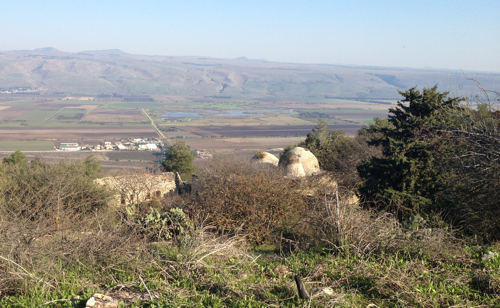
Although, I think hiring a guide is the best way to go for most of these areas. Not for safety issues, but Israel is so full of history--even if you don't count the last 50 years, you still have all the Biblical history. It also helps to have a guide say, "That over there, is the Gaza Strip." In the above photo is the Hula Valley itself where did a majority of our birding. Jonathan had some extra time with us and took us here for quick stop for the view. I noticed the decaying building in front of us and asked Jonathan what that was a tomb about 300 years old. History and archaeology is everywhere and you don't want to miss out on that as well as the great birds.
Most speak English very well so even if you don't know any Hebrew beyond "shalom" you would be fine to visit and travel around the country.
More will be coming. I'm in the process of sorting my photos and story ideas for the blog and for publication (some publications get understandably irritated if you pitch them an article but then scoop them by blogging it).
Palestine Sunbird, Best Hotel Bird Ever?
Between jet lag and jumping right back in to my eagle surveys, my blogging this week has been slower than I expected. I will say, the upside to my freaky sleep schedule makes getting up 2 hours before dawn easy cheesy. However, staying up past dinner impossible. I'm kind curious how tonight will play out, I'm scheduled to be a guest at Camilla Parker Bowls at the Bryant Lake Bowl. Will I be awake? Will I make sense? Will it lead to me sleep table dancing in the middle of the show? I have a post up over at 10,000 Birds about using my iPhone 4s for digiscoping. I had lots of opportunity to use it and do side by side comparisons while in Israel. I actually ended up taking more photos with my iPhone than I anticipated and was pleased with the results, especially since I was hand holding it.
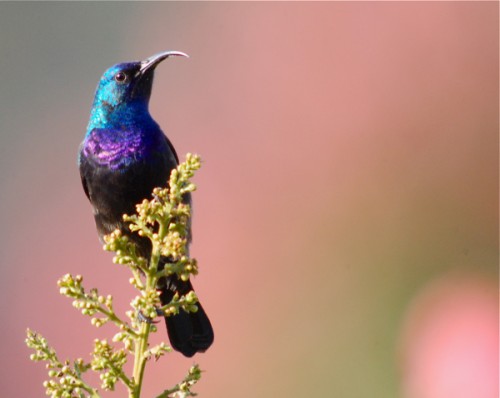
This is a Palestine sunbird--we got them within minutes of checking in to our hotel in northern Israel, the Pastoral Kfar Blum. Periodically one would even perch on the bush just off my hotel balcony. It's the Middle Eastern version of a hummingbird (although a bit larger, being about the size of a small warbler). But that long curved beak holds a tongue with bristles at the tip used to get nectar from flowers. Dynamite birds to tick off from your hotel, plus it's fun to have a bird with such an exotic name on your list. The above photo was taken with my Nikon D40 through my Swarovski spotting scope. Since the birds were fairly cooperative, I thought I would see what I could get with my phone:
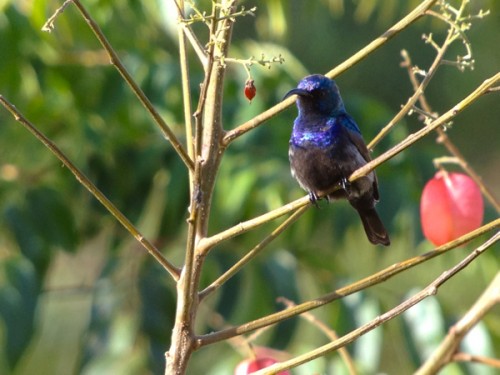
The bird is in a different position and the light is not the best, but still, not bad at all for me just quickly hand holding the phone up to the scope. It won't be on the cover of WildBird Magazine, but it's perfect for sending a photo to Twitter, Facebook or email.
My article at 10,000 Birds links to a new adapter developed by Meopta that should make securing my phone to my scope a breeze. I'm practically salivating to test it out, but if it works well, I may never take my SLR in the field again. Looks like it won't be available until early next year so in the mean time, I'll keep practicing with my hand held technique.
I Think I Saw A Few Cranes In The Hula Valley
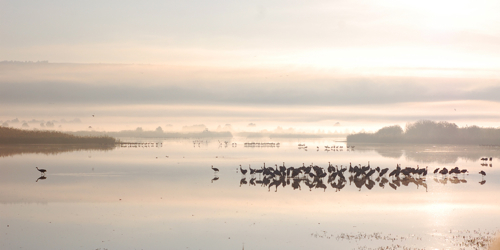 On my way back from the Hula Valley to Tel Aviv, I'm taking advantage of the wifi on our base. I've seen a lot of crane migration in my life and I've loved them all, but Israel is creeping up to the top spot in my heart. The Hula Valley is an incredible story of conservation, partnership and sheer biomass beauty.
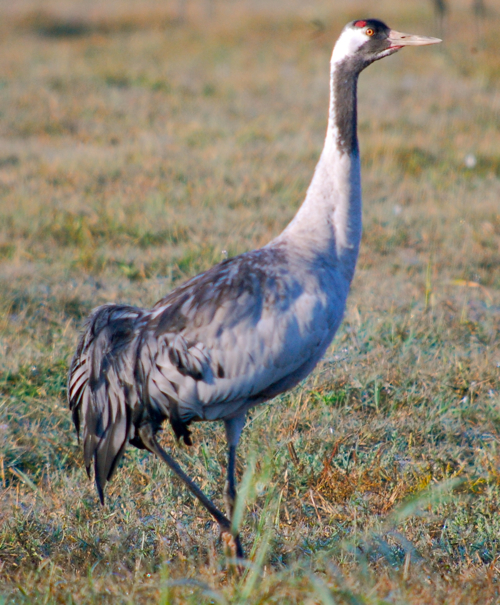
Here's an up close shot of one of the 30,000 cranes. It is a common crane (Grus grus) and they sound an awful lot like sandhill cranes but look a bit different.
Sharon's Geek a Week card now on sale
 Hey all, NBB here. Sharon's still in Israel, but I wanted to let you know that Sharon's Geek A Week card is now available for purchase at Think Geek (she's in Set 3). The cards were illustrated by our buddy Len Peralta with text on the back written by our likewise buddies Paul and Storm!
There are 18 cards in the set and it'll cost ya $16+shipping. Flavorless piece of pink gum not included.
Black-shouldered Kite
Here is a video from Liron Ziv of a black-shouldered kite family in the Hula Valley. There is a nest this year and the local birders are quite proud of this new nest species in this area. http://www.youtube.com/watch?v=4FXOyFfkutA
They look very similar to the white-shouldered kites I've seen in the US. They are beautiful little birds. Still has been a treat to watch them.
Digiscoped Images
Fresh Tweets
Would you like to hire me as a speaker for your event?
Email sharon@birdchick.com