Birdchick Blog
Digiscoping with an iPhone vs SLR
I digiscoped the following photos using both my Nikon D40 and my iPhone 4s with my Swarovski Scope. Can you tell which ones are the iPhone 4s and which ones are the Nikon D40 photos? 1. Green-winged Teal
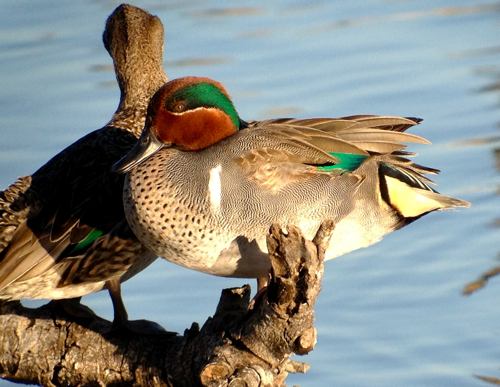
2. Northern Pintail
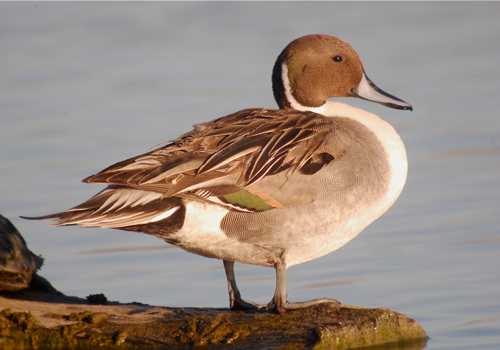
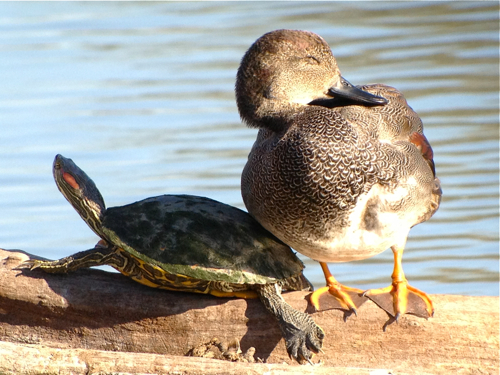
3. Red-eared Slider and Gadwall
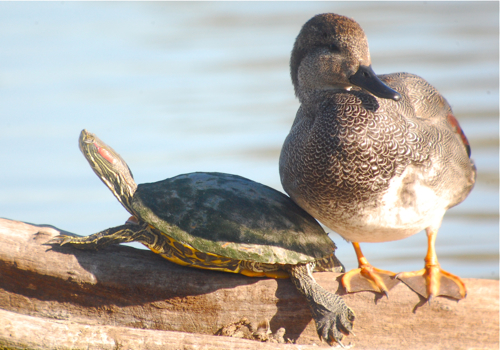
4. Red-eared Slider and Gadwall
Flat Stanley Misadventures
One of my nephews has sent me a Flat Stanley. Having the mind of a 13 year old, I'm tempted mostly to take inappropriate photos of him:

I mean, come on, if you have a friend who has a zombie arm and tombstone in their backyard, of course you are going to put Flat Stanley in it and send a letter home that he was lost in a freak snow zombie attack. But most of my photos have involved Flat Stanley and compromising photos with bottles of Jameson and I can't really send those back to his school so I've tried to take Flat Stanley birding:

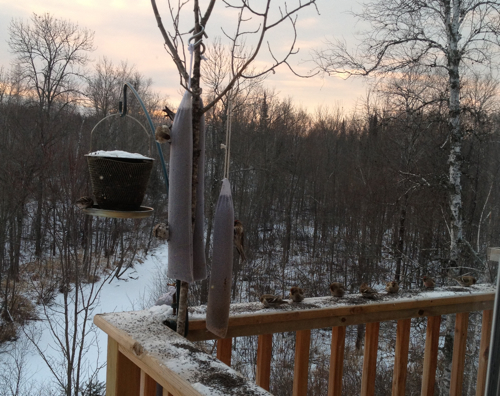
I set him out at a bird feeder with some seed and immediately he had fun with juncos. I think he'll be fine so long as a Cooper's hawk doesn't shows up.
Boreal Birding & Digiscoping with an iPhone
 I think I had the most fun at Sax Zim Bog last weekend since the great owl irruption of 2004/2005. An informal gathering of birders headed up and we started at Hasty Brook. I've known Lynne for some time and I've always wanted to visit. What a treat to start it off with her deck full of common redpolls. I wish we could have spent more time there, she's so lucky to have such a beautiful view to watch birds and animals go by--and incredibly sweet. Our group birded the crap out of the little daylight we have up here in winter and when we went back to her place, her husband was heating up a huge kettle of wild rice soup.

As much as I miss the birds who sing in the summer, I truly do appreciate living in Minnesota where a few hours drive north gives me a different set of habitat and birds. Redpolls are in abundance this winter in northern MN, which was actually predicted in the Winter Finch Forecast.

Huge flocks of redpolls would descend onto the roads to chow down on either spilled grain or salt mixed with snow. When they would take off, you could actually hear their woosh of wings.
We had a bonus in the car with us when we went, a guide for the bog by the name of Erik Bruhnke came along with us--for fun. He's a young kid trying to earn a living in birding--it was fun to go out in the field with someone so young and excited about birds. There are a lot of great guides up at the bog but the area is so popular they book up quickly, so if you're ever looking for one, Erik is an enthusiastic and knowledgeable guide. Some in our group had been to the bog several times before and had an idea of where to go, but having someone along who birds the area on a regular basis really helped get all the bog specialties that are being seen.

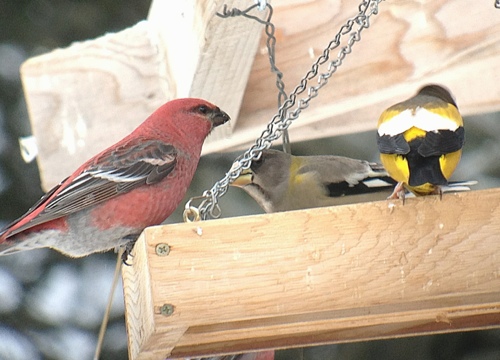
I used the day to compare digiscoping with my iPhone 4s vs my Nikon D40. I don't have an adapter yet for the phone so photos like the one above of evening and pine grosbeaks are taken by hand holding the iPhone up to my scope. Not bad at all! I've been playing with the camera app that comes with the phone but there's the Camera+ app, I like it because it has image stabilization and the ability to go into burst mode and take a crap ton of pictures all at once. It's handy if you are doing this without an adapter.
One thing I did learn about my iPhone is that it's not ideal for cold weather digiscoping. My fingers got so cold that the touch screen function ceased recognizing when something had been touched (it was about 10 degrees Fahrenheit when I took the above photo). I do have a pair of gloves that is supposed to work with the touch screen, but I have a screen protector and it doesn't work with the gloves. Also cold fingers can lead to shivering which also doesn't help image stabilization.

Can I say what a treat it was to get some quality time with evening grosbeaks (the above photo was taken with the D40, not the iPhone). I haven't been around a good sized flock for a few years so it was fun to spend time with these birds who look like like a goldfinch on steroids...though Non Birding Bill thinks they look more like Ed Asner. We're so lucky that the people who live on Blue Spruce Road just north of 133 in Meadowlands place feeders at the end of their driveway so people can enjoy a bunch of boreal feeder birds.

It's a great little spot to practice digiscoping. Lots of great colorful winter birds to get shots of like the pine grosbeak. They seem very used to the traffic.

White-winged crossbills were all over around the bog too. This one was part of a flock that was in the road. As we watched it, we picked up a tail of other cars. It's kind of a strange thing to bird around the bog. You want to get all the specialties and there are plenty of maps to be found of it on the Internet describing where to go, but at the same time if you see someone pulled over, you tend to pull over too to see if they have something you don't.
This is especially true when it's dusk and close to great gray owl time. One road had a recent report of great grays and around dusk there were almost 2 dozen vehicles slowly cruising back and forth, creeping along and watching, waiting for the elusive giant. I watched but I'm so spoiled when it comes to great gray owls. I remember driving and finding 50 in a day.

Fortunately a great gray owl was spotted and the birding paparazzi excitedly moved in to watch it.

It was far, lightly snowing and dusk but thanks to the timer on my Nikon D40 I was able to get an ok shot of it in the low light conditions.

All in all it was a great day of seeing some northern specialties (like the above rough-legged hawk). If you haven't birded the bog and live within driving distance, grab some friends and head on up. It's a doable day trip from the Twin Cities. We left the the northern suburbs at 5:30am and stayed til dusk then stopped for dinner. I got back to NBB by 9:30pm.
If you'd like to learn more, come to Birds and Beers on Monday. Lots of people will be happy to share tips (and maybe you'll find a birding buddy to go up). Also there is a Sax Zim Bog Bird Festival in Feburary which I haven't been to but I know lots of people who have gone and had a great time. Bird festivals a great way to get to know an area you haven't birded before.
Birds & Beers @WildRoastCafe January 23
 The next Birds and Beers is less than a week away and we trying some place new. Regulars have asked for a place without a band and plenty of room for our group, so we're going to try the Wilde Roast Cafe. I've been there to meet with friends and for a play reading last month and thought it might be a good fit. They have a room just for us (I did have to commit that our group would order at least $100 worth of food and beverage which for our group isn't a problem). Wilde Roast has beer, wine, tasty eats and great atmosphere. No scotch or whiskey, but I think that's more my issue than anyone else.
Birds and Beers is an informal gathering of birders of all abilities–if you’re interested in birds, you’re invited. You can meet other birders–maybe find a carpool buddy, ask about where to find target birds, share cool research projects you might be working on, ask a bird feeding question, share life lists, share some digiscoping tips, promote your blog or your bird tour business–the sky is the limit. It’s low key and it’s fun. I'll bring my iPad full of Israel photos and birding apps anyone would like to play with and I know several birders have gone to Sax Zim Bog so if you've never gone and would like to try it, this would be a great place to get the skinny on birding this awesome winter boreal hotspot.
Visit the Facebook Event Page for directions and to get the latest on when I'm hosting one, fan it on Facebook. Rumor has it that we'll have one in Ohio in May...
Sometimes eBird Is A Little Nuts
Over the weekend I took a trip with some friends to Sax Zim Bog, Minnesota. This is a great spot to get boreal species and perk up your winter birding. Thanks to social media, I had a good idea of where specialty birds were being seen but thought I would use the BirdsEye app (the app that tells you what people are reporting to eBird).
Most of the time I find this to be a very useful app, especially when I'm visiting an unfamiliar city or looking for a new place to watch birds. The app has a "Birding Hotspots" tab that lets you see via Google Maps where the best birding spots are. These are highlighted by red dots that you can click on and shows you a name and a list of birds that have been reported there. Generally, it's different parks.
This is what I found when I looked at hot spots for Sax Zim Bog:

What the frickity frack?? Okay, I know that the county roads can have redpolls, crossbills, hawk owls and what not at any point...but...um, really? Do we really need to mark every 25 feet as a birding hotspot?
I have a resolution this year to use eBird and contribute sightings on a regular basis, but that is a bit insane. I will not be adding in sitings from this weekend's trip. It's overwhelming and really, I thought there was the option to say that you went up to five miles on a trail? Unless eBird is going to let me enter in my sightings real time with my phone, I don't see people who are new to eBird being eager to look at this and figure it out.
I know we want birds to be easier to find but they don't always need to be an X marks the spot type of hunt. There is something to be said for the thrill of the chase.
Great Horned Owl Barking
I had a meeting at The Raptor Center yesterday. At the end, we got a brief tour, which despite having given hundreds in the past, I was excited to do because it's been about 3 years since I volunteered there and things change quickly. Many of the birds I worked with are still there...as in the turkey vulture who like me is 37 years old. But because it's owl breeding season, the great horned owls were all very hooty in the courtyard. One of the imprinted owls (a bird raised by people and imprinted on them) gives a strange sound for an adult. It barks. This is a sound usually given by immature birds and is associated with food begging. In the wild they would grow out of that. But imprints do it a lot. I think this is a sound people hear quite a bit in the wild at night and since it is such an un owl like sound, it's hard to id.
Here's a video (with a really dramatic title sequence courtesy of Non Birding Bill):
http://www.youtube.com/watch?v=rSxh1LDFPY8
Bike Birding In Israel At Agamon Hula
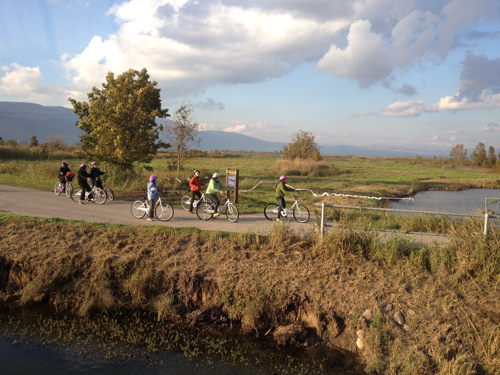 I've blogged already that the Agamon Hula is fabulous for common crane watching but that barely scratches the surface of all the bird life that can be found at this birding hotspot. The refuge has a little over 5 miles of trails that can only be accessed on foot, bike or electric golf cart. I love a place where one can safely and easily ride bikes for birding (biking is awesome, even if you dip on a bird, you still win by getting exercise). The trails are well maintained and it's relatively flat so even if you don't consider yourself a hardcore bike rider, you should be able to do it.

And there are a variety of bikes to use and rent out from the refuge (as well as the electric carts visible above). If you want to take out some scopes or cameras, these are perfect. I especially like the three seater bike above. Your optics can go in the middle seat and with two people you can share the pedaling. There's also space in the back of the above for more people to ride or to store a cooler with beverages and snacks. The birds are accustomed to the bike and cart traffic so don't worry about flushing birds when you pedal up. I did have a big giggle moment while we were at the Hula. As I traveled with our posse (all men and me the only female) some teenage women biked past our group they were all dressed very modestly but did indeed bat their eyes at the male birders--where else will male birders get hardcore flirting from young women?

The trails weave around the wetlands that in November are chock full of waterfowl. You'll also find snipe and even a crake or two if you are really observant.

I never cease to be amazed by seeing birds I would see in the US--like the above coots alongside a spur-winged lapwing (say the name of that bird five times fast). There were also mallards, gadwall and green-winged teal.

Or I see odd variations of common birds at home. Above is a pygmy cormorant. It looks like the cormorants we have here in the US but is about the size of a duck--a surprisingly cute cormorant...though I doubt very cuddly.

This handsome fellow is a male Eurasian wigeon (a cinnamon colored counter part of our American wigeon). Whether you are on foot or on a bike or cart, it's fairly easy to get great views of the birds.

And it's not just waterfowl, there are tons of songbirds like the above white-spectacled bulbul--which I was delighted to learn that bulbul is Hebrew for penis. Brings a whole new meaning to announcing, "There's a bulbul in my bush!" I don't quite see why you would name a bird of that body part, not sure I see the resemblance...

If you are nervous about visiting the refuge and missing information, there are podcasts and cell phone tours. Just watch for the Sassy Looking Cell Phone Gal for your clue to get info--audio tours are offered in Hebrew, Arabic and English.

For people who enjoy bird banding and ringing the Agamon has an active banding program. I had to smile, they were very excited to have this rare bird at the banding station when I arrived. Recognize it? It's a house sparrow. North Americans appear to have an over abundance, but in their native lands house sparrows are on the decline!

Other birds they showed us up close included a pair of penduline tits (I saw these in Kazakhstan a few years ago and even got a picture of a penduline tit nest). It was fun to see birds again that I thought I might never have the opportunity to chase again.

Here's a reed bunting...if you love brown birds this is the place to be!

Birds aren't the only highlight of the Hula Valley, mammals abound too. Above was a friendly neighborhood nutria getting the full paparazzi treatment. Some of you may be saying to yourself, "Hey, wait a minute there, Birdchick. Nutria or coypu as they are also known aren't native to Israel. They're from South America, what gives?"
They were introduced to be a booming fur trade. Alas, after the nutria were released people suddenly realized that Israel doesn't get cold winters and the critters never grow that luscious winter fur and they remain unharvested. Big score for the anti-fur movement, not so much for conservation. Not many of the predators in the area eat the introduced nutria so their numbers swell.

Speaking of predators, we saw quite a few of the above jungle cats. Our guide Jonathan Meyrev assured us that the numbers we were seeing was an unusual phenomena. They kind of look like giant house cats with stubby tails. But they stalk the cranes and other waterfowl in the area. Another mammal that I was really excited to see but couldn't get a photo of was a jackal! You get a little of everything in the Hula.

Agamon is also just lousy with eagles. Above is a great spotted eagle and these birds cruise around watching for cranes that died in the night and chow down on the remains. Black kites and pallid harriers frequently cruise the refuge too but several species of raptor can be found.
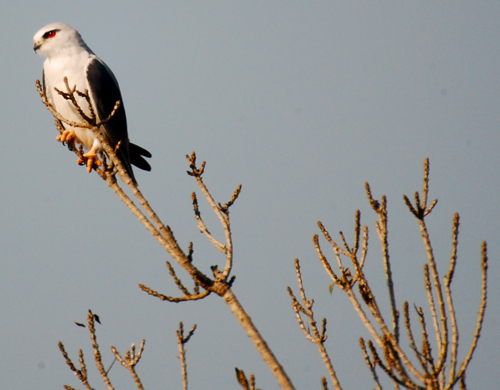
The Agamon Hula was incredibly proud of this black-shouldered kite, a pair nested there for the first time in 2011. The young had recently left the nest when we visited in November but we still got to see the adults (that's one above) hunting with the young.

Depending on when you visit will determine the types of species you will see. For example we saw a few storks but not the huge numbers the refuge has in other months--there's something different every time you visit. This is a great area to get some European species, African species as well as Middle Eastern birds. A perfect confluence that gives you a variety of species and also the spectacle of tens of thousands of birds passing through during spring and fall migration. Whether you visit Agamon Hula in November like I did or any other time of year, you will not be disappointed. I've been to a lot of places and I would put this on my list of must visit areas for any bird watcher around the world.
Happy 2012!
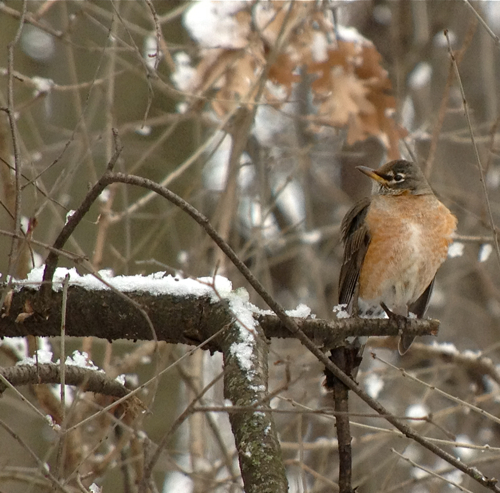 Turns out that my first bird digiscoped in 2012 is an American robin and I got it by holding up my iPhone to my scope. I hope everyone had a safe and happy holiday season. Non Birding Bill and I tried to take some time off but with his show, it was a bit more action packed. When he takes Man Saved By Condiments to New York at the end of February, I'm hoping to come out and visit for a few days, maybe even try a New York Birds and Beers.
I've been trying to figure out what my resolution for 2012 should be. No matter what I come up with it cannot compare to the smashing success that was 2011 (eat more cultured butter). But I thought this year should be more bird related. So I think I'm going to try and be a better contributor to eBird. I started off okay with it in 2011 then ended up doing survey work where I wasn't allowed to submit some of my observations (until the project is finished) and got out of the habit.
But as I looked to my BirdsEye App on my phone to see what birds are being reported in my area, I noticed that there are several birding hot spots that haven't had any reports for over a year or in some cases 2 or 3 years. I think I'm going to do my part to submit observations for those areas to eBird and check out areas that are under reported. There are a ton of places to watch birds and these places wouldn't have been listed on eBird the app as birding hot spots had there not been some activity going on. So I'm hoping that I find some habitat and interesting bird observations for 2012.
Again, hope your year is off to a great start.
Birding Around The Golan Heights
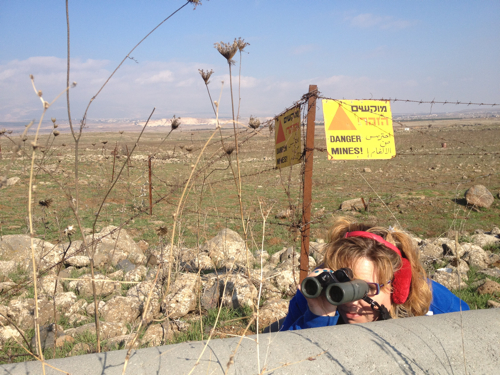 Whenever I see an article or hear a person dismiss birding as boring, I think, "Oh, bite me." I mean, how often does a person have an opportunity and good reason to be near a mine field? If anything will take you to those sorts of places, it's birding. One of the areas we visited while in Israel was the Golan Heights an area just under 700 square miles that is right along the Israel/Syria border and includes Mount Herman. The above photo was taken in the Valley of Tears an area marked in Israel's recent history by being the site of a huge battle during the Yom Kippur War. Our purpose for visiting the area was to find a snazzy looking bird Finsch's wheatear and Calandra larks which we did get but I was unable to get close enough for a digiscopable shots (so follow the links to see what awesome birds those are).


Another bird we got was a Syrian woodpecker which can be found throughout Israel but this one was especially exciting being so close to the Syrian border. How close were we to that border at the Valley of Tears?

Literally down the road. The buildings you can barely make out ahead...that's Syria!

Here's a digiscoped image of the city across the Syrian border. We had to really work for the birds in the Valley of Tears but I think part of the challenge is that you are surrounded by so much history and strange terrain and you can't help but stop and think, "Holy crap, we're on the border with Syria and not only does this seem a little dangerous, the surrounding area is incredibly beautiful!"

We saw several interesting mammals too. Above is a rock hyrax which I thought was another fancy term for groundhog or marmot but turns out the closest relative of the hyrax is the elephant. For realz! We also foxes running around the Valley of Tears too.

Another spectacular part of the Golan Heights is Mount Hermon. The highest peak is over 9000 feet and we got to about 7300 feet where you can view various observation posts that watch the mountains, since this borders Lebanon, Israel and Syria.

You can visit this area on your own, even if you are not an Israeli citizen and you have a rental car. Because it is a military outpost, you have to get permission from the guards to let you in. But if all is safe and clear they will let up no problem.

And you just can't help but take time for wacky photos (like the above of Tim Appleton snapping a photo of Bill Oddie). This was actually on top of Mount Hermon. This was one of the most beautiful spots we visited. Have I mentioned how grateful I was that Bill Oddie was on this trip? If you've never met me face to face, you may not realize that I'm only five feet tall. I'm generally the shortest person in the group and not being used to high elevation, I have a tendency to fall behind as taller, more eager to list birders race ahead. Mr. Oddie is very similar in height to me so it was nice to have some company in the back of the group.

While birding around this military base we saw lots of familiar birds: horned larks--the birds who were a constant companion to me during my eagle surveys this summer and fall! But we also did quite a bit of birding at a nearby ski area.

One of the target birds here was a rock nuthatch (I dare you not to sing that like the B-52s song Rock Lobster). Like our nuthatches here in the states only a bit bigger and they forage around rocks rather than trees. They also sound a bit like canyon wrens.

We actually got to see a rock nuthatch nest. And unlike our nuthatches in the States, they build these crazy burrows onto the sides of rocky cliffs. They construct them out of mud and dung (lovely). In the above nest you can even make out some beetle casings, our guide told us that they rubbed those on the outside, perhaps as an insect repellent.

While we were watching the nuthatch, some of our group go very excited when they found a wolf. I got the above photo holding my iPhone to my scope. When I saw it I said, "That looks like a coyote." Our Israeli guide has spent some time doing bird work in the US and said that the wolves in Israel are much smaller than the timber wolf that I'm accustomed to in Minnesota. It was still a really cool mammal to add to our trip list. There were actually two wolves but I was only able to get a shot of one.

Another bird people were really excited to see and we worked really hard to get was a sombre tit (insert 13 year old giggle here). Which I had a tough time seeing and when I finally did it was because Pete Dunne said, "Chickadee." And sure enough, the somber tit looks an awful lot like our black-capped chickadee here in the states. The head and bill shape is a bit different but this bird did look somber compared to all the great tits working the same area it was (insert another 13 year old giggle here).


This is Nimrod Fortress which you pass on your way up to the Golan Heights, it was built in the 1220a. Most of my photos from this portion are of scenery than birds, but you can get some great ones. We also got imperial eagle, golden eagle, mistle thrush, black redstart and rock bunting.

Again, don't let the proximity to the borders make you nervous. This is a very safe and welcoming area...and unlike fam tours that I've had in a few other countries, we didn't have a police escort the whole time.

And don't worry about asking the border guards at the border--they are really friendly...and did I mention that I'm only five feet tall?
A couple of notes about clothing for Mount Hermon--our guide warned us to pile on the clothes because the mountain weather is unpredictable, no matter what the forecast says. I didn't have long underwear on, but had it been a smidge colder I would have wanted it. Take layers, take a scarf, ear muffs, gloves and wool socks.
Best Place To Watch Cranes On Earth
A large part of my trip to Israel was spent at the Agamon Hula in northern part of the country. The story of the cranes in the valley is quite amazing and quite recent. I've seen crane migration several times in the US, it's one of my favorite things to watch and encourage others to do (I've got a sandhill crane tattoo designed by Paul Johnsgard in the small of back, I love it so much).

But the Agamon takes to you see cranes in the way you've always wanted to view them. Close.

And I mean REALLY close. This is the closest that I've ever been to large flocks of cranes and it's really incredible how the whole situation works.

The story of the cranes at the Agamon started in the 1940s. There was a huge shallow Hula Lake was drained so the land could be farmed. All was well and good for about 10 or 15 years and then the peat dried out. Whole planted fields failed as dried peat combusted--some farmers lost tractors that sank in the combusting dried peat. In the late 1980s to early 1990s they began to rehabilitate the peat and the lake gradually returned, though not quite as large as it originally had been. As the Hula Lake reformed and several birds started using it on their migration south. Some had shown up in the lake's previous glory but nothing like this.

The first year, about 15,000 common cranes used it as a staging area. Many people came to view the cranes and the area began to grow as an eco-tourism site and at this point, roughly 30,000 cranes use the area. It's an incredible site. But what makes this special is that the cranes have developed a fondness for the surrounding farm fields which presents both an incredible wildlife opportunity and a challenge.

On the one hand it's incredibly amazing that the cranes are all wedged into this area and they have grown accostomed to farm equipment. Someone caught on to this and noted that people wanted to view the cranes and thought, "What if we attached a big box that holds 50 - 60 people to a tractor and drove it through big flocks of cranes in the Hula Valley? And it works! The cranes are very used to the equipment and as the tractors tote around groups of crane watchers, the birds casually walk out of the way but stay relatively close. In the above photo you can see the view from our blind and beyond the cranes is a tractor pulling another blind. As you can see, the cranes are relatively nonplussed by all the humans watching them.

It's not 100% an ideal situation. The cranes should be using the area for staging (gathering and feeding like crazy to continue their migration south). However, the cranes have found ample forage and several thousand are spending the winter in the Hula Valley roosting on the lake and foraging nonstop in the surrounding field. This is a problem, both for cranes and for farmers, as cool as the birds are, the farmers don't want to lose their income and really, the cranes should be migrating.

So, Israel has come up with a unique idea. There are fields where supplement food is set out for the cranes and a squad who patrols the area and flushes cranes from farm fields where they shouldn't be feeding by using loud noises like fireworks and gun shots--the cranes are not harmed, but flushed from areas where they shouldn't be, keeping the farmers happy and the cranes safe.

It's quite amazing how acclimatized to humans the cranes are despite being flushed from certain fields. In Nebraska, you can't get as close to the birds and if you went out into the fields where they forage during the day, the sandhill cranes take off. In the Hula Valley in Israel, you can get quite close and the refuge is happy to help you get there. It's great for getting photos, for sketching or for just sitting there and enjoying the spectacle of thousands of cranes.

Even in the hides built around the refuge to visit birds throughout the year are visited by cranes. You don't even have to keep quiet. While I was in the above blind several people were inside chatting animatedly in Hebrew. Even when we were in our tractor blinds our guides had microphones and speakers and spoke at a very normal level when close to the cranes and the birds were not perturbed.

Common cranes are only part of the magic of viewing birds in the Hula Valley, but they are a great part. To view them at their peak you need to visit in early November. There are always great birds at the Hula, but for a crane migration spectacle, plane on early to mid-November. After visiting the Hula Valley, I may have to adjust my tattoo.
Oh and to give you an idea of how similar they are to sandhill cranes in North America, check out this video, they sound almost exactly the same:
[youtube]https://www.youtube.com/watch?v=uTw6fp6JB_4[/youtube]
Digiscoped Images
Fresh Tweets
Would you like to hire me as a speaker for your event?
Email sharon@birdchick.com