
Hello all, NBB here. I spent some time in New York City recently, more specifically Brooklyn. Since the weather was so beautiful (especially for February) I took advantage of it to walk around the Greenwood Heights neighborhood, so named because of the historic Green-Wood Cemetery (founded in 1838). I expected to walk along its hills, looking at historical headstones and mausoleums, enjoying a quiet day to myself. I did not expect to encounter a colony of South American monk parakeets.
"Man," I thought, "Brooklyn has some noisy starlings. Weird-sounding ones, too." I walked through the double archway to the cemetery, and the noise got much, much louder. So I did what any sensible person, or even a birdwatcher, would do, and I looked up. Here's the entryway:
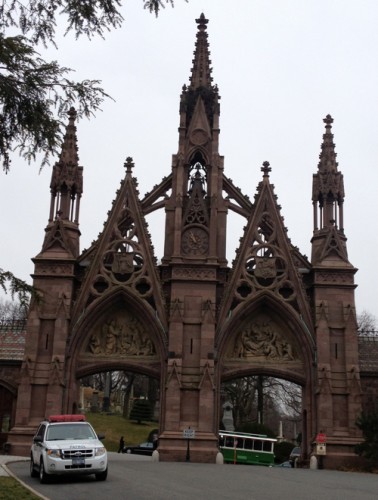
If you look below the peak of the tallest spire, you'll notice a very dark brown patch. That's a large, communal stick nest that wraps all the way around the spire. And flying away from it where some light green birds that were very definitely not starlings. I mean, even I noticed that. When Sharon showed up a few days later, we trekked down to the cemetery and she did some digiscoping:

Monk parakeets. And lots of them. Though the birds seemed to be screeching at each other nonstop (another reason why they may have settled in a cemetery: the neighbors won't complain about the noise), they seemed to be perfectly happy to cohabitate in their giant, self-made cavity nests.
So how did they end up there? There are theories, and this blog dedicated to the birds lists several: the most likely being that they were released from a shipping container by thieves who were looking for more valuable things to steal.
One particularly trouble thing was that the cemetery is located across the street from an electrical power station, and the birds were building stick nests on the power structures inside. That can't possible be safe, I thought repeatedly, and indeed it seems that other states power companies are euthanizing the birds to prevent them from shorting out the power lines they nest on. Fortunately for the Brooklyn Parrots, they have admirers. The cemetery itself organizes regular bird walks, a group at Brooklyn College is studying the birds' behavior, and they even have their own Facebook page. If you're in the area and want an unusual bird that super-easy to spot, check 'em out!


 I know I'm usually the first to say that seeing an American robin is NOT a sure sign of spring since they are in the US all winter if you know where to look, but yesterday while scouting locations for some spring programming for the Mississippi National River and Recreation Area we heard robins singing on territory! On top of that, we heard a red-winged blackbird. Didn't see it, but heard it and in my book, that means spring in Minnesota. Also, look behind the robin's chin in the above photo--that's a full on bud! As much as I've enjoyed a winter without shoveling and snow emergencies, I plan a lot of my work based on the slow birding of March, that usually still winter for us. How can I keep my deadlines if spring is going to happen and Minnesota is having 50 degree days already? Blerg.


