
Birdchick Blog
Notes from the Bird(er) of the Year

Hello all, NBB here. Sharon is in deadline mode, and has asked me to fill in for her. As I have received many thousands of questions about my recent honor, I thought it best to simply post the entirety of my speech here. Thank you.
Ladies and gentlemen, members of the board, Mister President, Your Majesty.
Thank you for attending this gala to celebrate the first time I have been awarded the American Birding Association Bill Stiteler Award for Birder of the Year. This is award is a great honor, not just for me, but for the ABA, and indeed, all of humanity back to and including cavemen, who painted their walls with crude drawings of the birds and possibly dragons they saw soaring high above, creating the first field guides and no doubt the first argument over whether Grog saw a Yellow Chested Uuuugh Uuuugh or a Chestnut-Sided Graaaaah. In those savage days, birding arguments were settled with a sharp rock to the back of the head.
So really, not much has changed. But I digress.
When those Neanderthal-citizen-scientists stared in wonder at the creatures who were not tethered to the earth, they, like us, dreamed of understanding those awe-inspiring creatures, just as they, like us, also dreamed that one day the American Birding Association would give me this award.
It has not been an easy road to this honor that I so richly deserve. Some have said that my relatively recent entry into the birding world, lack of extensive bird knowledge, mocking stance towards birders, and general disinterest in birdwatching itself should have precluded me from winning this award, let alone having it named after me. Well, here I stand before you, wrapped in glory as very definitely the most important birder of this epoch. And where are the naysayers? Lying in a ditch somewhere with a sharp rock in the back of the head.
Birding faces many challenges in the year ahead, not the least of which is the birdwatchers themselves. As we have seen time and time again, fragmentation of the community of birders can only lead to petty squabbles that distract us from the truly important issues of conservation, appreciation, and promotion of the hobby. It is my hope the birdwatchers will set aside the things that divide us and instead choose to focus on the things that unite us.
Namely, me. Because in honoring yours truly, Bill Stiteler, as the recipient of the Bill Stiteler Award for Birder of the Year, the ABA has shown that there are some issues that we can all agree on, like how much I really, really, really, really deserved this. Let us all walk hand in hand into this new Golden Age of Birding, and also make the award bigger when you give it to me again next year.
I thank you.
Birds & Beers and Photo Contest Reminder
Don't forget you still have time to enter my photo contest. Rules here. The winner gets a $250 gift certificate to Eagle Optics! I need photos of birds all over the world, especially birds at feeding stations, bird nests, birds at windows (ie fighting reflections), birds flying. The most important thing for submission is that the photos be IN FOCUS. Contest Details here. And I've set the date for the next Birds and Beers and it's that special time of year when it's time to get our timber doodle on!
Thursday, April 19, 2012 RAIN DATE, Monday, April 23, 2012
This is our annual Woodcock Tailgate Party and we head out to Lebanon Hills Regional Park, have some laughs and then 15 minutes after sunset try to watch the woodcock display. The woodcocks start their display about 15 – 20 minutes after sunset, which means they will start around 8:20pm. Since the display area is next to the visitor center at the park, we’ll meet there starting about 6:30pm and have an old fashioned tailgate party–you can come early to mingle or come closer to magic hour. Bring your own food and beverages and we’ll laugh until it’s Woodcock Time. The park closes at 10pm, so this gives us plenty of time to get some great birding done. Some years we’ve had great horned owls show up and still got great looks at the timberdoodles (aka woodcocks).

Recommended to bring: lawn chair and boots, might be a little muddy, insect spray (ticks could be a possibility). Dress in layers, it could be warm when the sun is out and gets cool quickly when it’s dark. Binoculars and a flashlight are a good idea too.
For up to date info, check the Facebook Invite Page.
What's Up With Hummingbird Migration?
Last night on Twitter, someone sent me a link to Hummingbird.net announcing, "Hummingbirds are here!" And low and behold it looked like ruby-throated hummingbird migration was a month early. I don't expect hummingbirds in Minnesota until the first week in May, MAYBE the last week in April. But then I remembered, I just recorded an interview about migration with Outdoor News and right before it I checked my BirdsEye App to see what eBird reporters had seen hummingbird wise...there's a huge discrepancy. Check this out:

On the left is a screen shot from my BirdsEys app that gives me up to the date info from what people are reporting in to eBird (it's vetted information, if something doesn't gel with their expected birds, you get a request for clarification or documentation). On the right is the Hummingbirds.net map. This is something where anyone can enter a siting and it's not really vetted.
So what's going on here? Are eBird users just not interested in backyard birds and only pursuing hardcore rarities? Are there just too few eBird users and they are missing those early ruby-throated hummingbirds? Do people reporting to hummingbird.net seeing a few early birds? Are they confusing hummingbirds with hummingbird moths or other smaller birds (don't scoff, you'd be amazed what people mistake hummingbirds for, even someone you would consider well educated)?
There are some migrating birds that can arrive early and though it's a gamble, they can navigate a few cold snaps. For example--tree swallows, unlike other swallows will eat berries if insects aren't available. They are one of the first swallows to return. Osprey and loons need open water for fishing. If the ice out is month early on the lakes, it's possible to see them that early. However, bird migration triggers vary from species to species. For some it's hard-wired timing or daylight length and temperature has little to do with it.
I posted the above image this image to my Facebook page to see what others thought. I personally am more inclined to trust the eBird reports since they are vetted and in the past when I've linked to the Hummingbird.net sightings page, it was often a good two weeks before I saw hummingbird activity myself and have been a bit suspect of it. A rule of thumb for Minnesota has been that once you see yellow-bellied sapsuckers, you can see ruby-throated hummingbirds because the wells that sapsuckers drill on trees not only produce sap but trap minute insects, a valuable back up food source for early hummingbirds that can find little nectar from flowers in a cold spring. Corey Finger over at 10,000 Birds said that doesn't work for New York because they have sapsuckers all winter and he directed me to an interesting blog post by Jim McCormack on this same subject--note all his photos of hummingbird moths.

This morning I found an email from Marshall Illiff, the project leader for eBird who tried to answer some of these questions over at the Massachusetts bird list serve (lots of birders are noticing this). You can read his full email here, but I'll highlight a few of Marshall's insights below:
"eBird is now a source of up to 3 million records (from over 200,000 checklists) each month. Although I really wish that more people in more places were reporting their birds to it (contact me if you want to get started!), I believe it now has enough information to provide an incredibly accurate and detailed look at the advancing front of bird movement in the USA.
Check out these maps, for example, of the next species that will hit Massachusetts.
Blue-gray Gnatcatcher: -- already early to our south, they may arrive next week (and will be ridiculously early if they do)
Louisiana Waterthrush:-- Likewise, ridiculously early for Maryland and New Jersey. They should reach us within the next 1-10 days, so check territories near you.
These maps above match the chatter on the listservs about what people are seeing; eBird and the listservs provide quasi-independent verification of what birders are seeing.
Yes, this spring is remarkable, and *population-level* arrival in New England of things like American Woodcock, Killdeer, Eastern Phoebe, Tree Swallow, and Pine Warbler are all far ahead of schedule (averaging 10-14 days or more in most of the cases I have looked at). However remarkable though this is, these are all birds that would be expected in Massachusetts within two weeks of their actual arrival. There is a temptation to say -- hey, it's an early spring, "anything is possible." But that simply is not true. I am willing to stick my neck out and say that, in this decade anyway, a March Eastern Wood-Pewee, Blackpoll Warbler, Yellow-billed Cuckoo, or Alder Flycatcher is simply NOT possible. These are species that do not even arrive on the Gulf Coast until mid to late April, and their arrival in Massachusetts follows 2-3 weeks behind that (only three of the four have occurred in April, ever, and those only barely). There is concern among scientists that these birds may *never* "learn" to arrive earlier, which could have drastic consequences for those species. My point is that anything is NOT possible, and that despite the remarkable weather, bird migration is also governed to some degree by an internal clock and by the simple challenge of geography. All four of these birds I mentioned winter in South America, and it takes a long time and a lot of preparation (i.e., fattening up) for these birds to make the jump.
Granted, Ruby-throated Hummingbirds, which winter in Mexico and Central America, and increasingly in the Southeastern US from North Carolina to Florida and west to central east Texas, are a different case. Their normal arrival dates are earlier (about 25 April-5 May in New England). But regardless that is about one month from now! Could hummingbirds be one month early? Could any bird?
eBird has a rigorous data quality system, with over 370 volunteer reviewers managing several thousand regional checklists that define bird occurrence in each of the twelve months of the year. Any submitted record that falls outside of expectations is flagged for review. I double-checked to make sure there were no Ruby-throateds lost in the eBird review purgatory. There were two, form Indiana and Wisconsin, and one of those lists has many other suspect species on it (Wood Thrush!). In other words, it isn't like the eBird review process is keeping hundreds of hummingbirds hidden. The New England result of that data quality process? eBird has this graph of Ruby-throated Hummingbird migration, averaged across all years for these states: New Hampshire, Massachusetts, Rhode Island, Connecticut, and New York: http://tinyurl.com/75gt2js. The actual numbers? In early April, 1/12355 has reported Ruby-throated; in the second week of April, 0/12826; in the third week, 15/12778; and in the third week, 308/17522 (giving a whopping 1.27% chance of seeing a hummingbird in any of those states in the last week of April…although this chance increases later in April and is probably higher in lowland areas vs. mountainous ones).
Furthermore, the New England-New York arrival takes a full month to occur, with obvious arrivals continuing through the week of 15-22 May and beyond. So we are at least two months from the end of hummingbird migration into New England.
Delving into the literature for this region, here is what I find.
- Cape May, New Jersey (Sibley 1997): extreme early date = 29 March, with bulk arrival not until late April (based on his histogram) - New York (Levine 1998): "extreme early date = 14 April (coastal and inland)" - Massachusetts (Veit and Petersen 1993): extreme dates of 18 Mar 1973 in Sudbury (fide Baird) and 26 Mar 1969 in Chatham (Fuller, fide Baird). [Bird Observer database may have additional info] - New Hampshire (fide Pam Hunt and New Hampshire Bird Records): record early date 8 April, and 14 total April records, with just 5-6 before 26 April
I can't help but wonder if the early dates for Cape May, Massachusetts, and eBird (1st week of April) were carefully vetted. All are far enough outside of the main arrival period as to raise questions. They may be correct. But maybe not. No system is infallible, and all of these raise my eyebrows a bit given how far outside of the norm they are.
Prior to posting this, I checked with bird records managers in Maine, New Hampshire, Massachusetts, Connecticut, New York, New Jersey, Maryland, and North Carolina. Without exception, they responded with skepticism about the posted arrival dates and had never heard of verified (i.e., documented with photo) or even credible reports of hummingbirds as early as mid-March in their regions. Never, and that's including this year. Early spring or not, all were skeptical that the data could be believed."

So should you put out a hummingbird feeder in the northern US? It can't hurt, but I wouldn't trust the Hummingbirds.net map that you will have tons of hummingbirds right away. If you do have hummingbirds...and even a photo, let me know...or better yet, join eBird and submit your sightings.
Birdchick Photo Contest
Hey Gang! I'm working on a book project and it needs some photos! Most of the book photos will be my own but if I need others, that has to come out of my own pocket. I don't have huge amounts of cash but I do have a $250 gift certificate from Eagle Optics. So here is what I propose:
Submit your photos via email to me. If I choose your to be in the book, you get a photo credit, a free copy of the book and your are entered into a drawing to win the $250 gift certificate. If this sounds reasonable to you, please send me photos!
So, what am I looking for? Birds from all over the world--really any species from penguins to hawks to backyard birds. Things I especially need: European species at feeding tables, nesting photos (any species, worldwide), but really any species of birds outdoors and not in zoos. The book is a bird watching book and essentially and Everything You Need To Know About Birding (we're still arguing title). It comes out in 2013.
Photos must be sharp and in focus! I cannot stress the in focus part enough. Photos must be high resolution for print quality, at least 300 dpi or the largest photo size your camera will export. Also, photos must be your own, meaning you have the right to send them to me.
Please email photos to sharon at birdchick dot com and please include your name, how you would like your photo credited and your mailing address.
Contest Deadline: April 2, 2012
Gift Certificate Winner will be announced April 3, 2013 and I will contact your via email and announce it here in the blog.
The important legal bits (please read):
By submitting an image to me via email, you agree to give me, Sharon Stiteler aka BirdChick.com and Perseus Books the right to use that image in my book and anything related to the book. This may include, but is not limited to, reproduction on the World Wide Web, print in the book or magazine form, retransmission via email, and distribution via all electronic means related to the book including but not limited to eBook, audio book or app. You also agree that you have no implicit right to financial compensation from my use of the image. If you don't like this, please do not send me a photo.
ABA's Bird of the Year: Evening Grosbeak
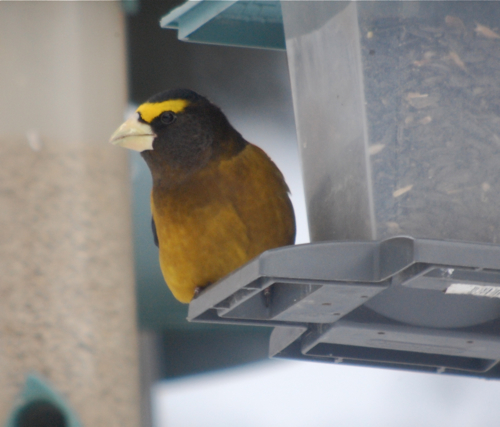 Last year the American Birding Association introduced their Bird of the Year campaign to highlight a species in trouble. We got stickers to place on our binoculars, scopes, computers, phones, etc. Something that could show we are members of the ABA and talk about birds that might need some extra protection and help. This year, the program is expanding, thanks to some help from Robert Mortensen, founder of Birding Is Fun.
Here was last night's official announcement of 2012's Bird of the Year. I love this video so much:
http://youtu.be/YvKoRpDVpMg
Adorbs, Jeff!
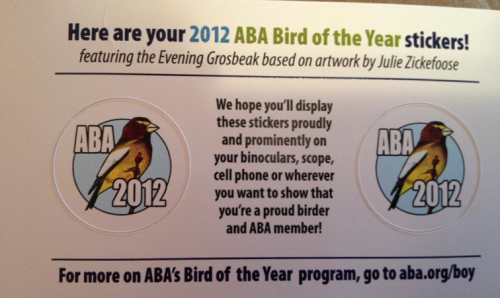
So, if you are a member of the ABA, you will be getting your latest issue of Birding with the stickers included. The stickers are supposed to be made of more durable stuff than last year's sticker and they feature the artwork of the fabulous Julie Zickefoose!
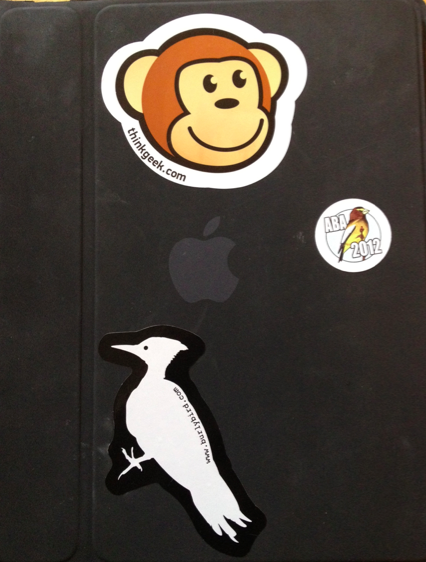
Since I use my iPad for bird programs at the park and I need stickers on mine to separate it from the park iPads that's where I placed one of mine, as well as on my Swarovski scope. The ABA also has suggestions for other things that you can do for evening grosbeaks (whether you are an ABA member or not):
- Report our Evening Grosbeak sightings to eBird, and participate in events such as Project FeederWatch, Great Backyard Bird Count, and the Christmas Bird Count. Our sighting reports are very helpful to bird science and will enhance our understanding of why, when, and where Evening Grosbeaks move.
- Introduce friends and family members to birding. A gift package of a bird feeder, a starter bag of wild bird seed, and a field guide is a great way to do it! Help them learn to identify their feeder birds and keep an eye out for Evening Grosbeaks.
- Get outside. And in the process, check out all the other birds that share the world with us.
- Get involved. Join your local bird club. Volunteer with local conservation organizations.
- Go to www.aba.org/join to learn how to get involved in the American Birding Association.
- What type of conservation projects can you think of that would benefit Evening Grosbeaks? Email us BoY@ABA.org
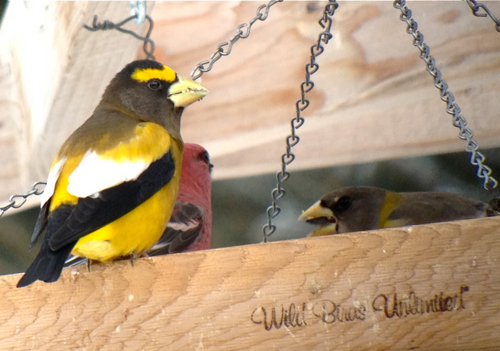
Maybe I'll submit one of my iPhonescoped photos. So, why should we have some concern towards the evening grosbeak? According to recent studies from data collected by Project Feeder Watch, the overall population of evening grosbeaks has decline by 50% between 1988 and 2006...and no one knows why. This used to be a common winter feeder bird. Some years you would see more than others, but even I haven't seen that many the last few years and I live in a place where I should be able to find them easily. I was excited when I got the photos of evening grosbeaks in this post on a January trip to Sax Zim Bog and realized that it had been a few years since I'd seen one of these birds that looks like a goldfinch on steroids. It's a good idea to not take what used to be a common bird for granted, so let's keep an eye on it.
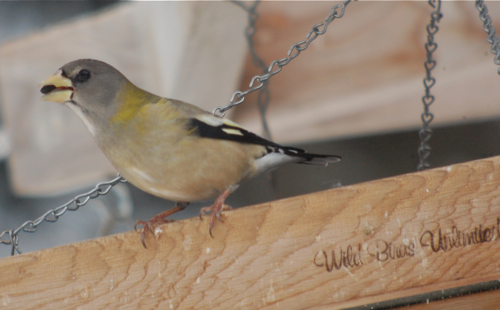
The ABA also has some fun events planned throughout the year that includes a photo contest to show how you used your ABA sticker, a chance for members to show off their evening grosbeak photos, and a media contest--submit artwork, media regarding the evening grosbeak as well as a blog carnival. Check out the Bird of the Year page for more information.
I'm Not The Only One iPhonescoping!
My friend Tammy Holmer texted me a photo she took using her iPhone and her Swarovski spotting scope:

That's a pretty cool shot of an adult peregrine falcon, especially when first testing out the technique! And since I know this question will inevitably come up in the comments, here's a basic tutorial on iphonescoping. Tammy and I aren't the only ones. A quick search of iphonescoping shows BogBumper giving it a go and Monterey Seabirding coming up with an interesting adaptor using a flex tripod.
I'll be in Nebraska this weekend for The Rivers and Wildlife Festival giving a Techno Birding program on Saturday. I've done this program several times and every time I give it, the program is different because technology is constantly changing. I remember early on when I would give it, some would balk and say, "I don't want to take extra stuff in the field."
However, with the smartphones now, I take less in the field. I'm now just going with my iPhone, binos and scope. The phone as bird reference books, a speaker (if I choose to use bird calls for programs or personal use), a camera, maps and of course the ability to actually call someone should I need help.

I've been practicing with my iPhone and scope at bird feeders and I'm hopeful that I'll be able to get some fun shots in Nebraska this weekend and Tweet them or post them on Facebook. Are you iPhonescoping? If so, let me know who it's work for you. You can link to shots in comments or tag me in links on Twitter (@Birdchick) or post them to my Facebook Page.
The Monks of Brooklyn
Hello all, NBB here. I spent some time in New York City recently, more specifically Brooklyn. Since the weather was so beautiful (especially for February) I took advantage of it to walk around the Greenwood Heights neighborhood, so named because of the historic Green-Wood Cemetery (founded in 1838). I expected to walk along its hills, looking at historical headstones and mausoleums, enjoying a quiet day to myself. I did not expect to encounter a colony of South American monk parakeets.
"Man," I thought, "Brooklyn has some noisy starlings. Weird-sounding ones, too." I walked through the double archway to the cemetery, and the noise got much, much louder. So I did what any sensible person, or even a birdwatcher, would do, and I looked up. Here's the entryway:
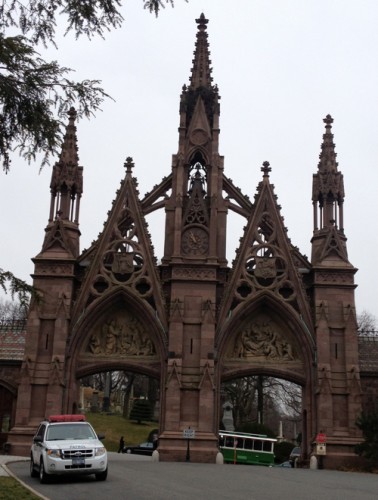
If you look below the peak of the tallest spire, you'll notice a very dark brown patch. That's a large, communal stick nest that wraps all the way around the spire. And flying away from it where some light green birds that were very definitely not starlings. I mean, even I noticed that. When Sharon showed up a few days later, we trekked down to the cemetery and she did some digiscoping:

Monk parakeets. And lots of them. Though the birds seemed to be screeching at each other nonstop (another reason why they may have settled in a cemetery: the neighbors won't complain about the noise), they seemed to be perfectly happy to cohabitate in their giant, self-made cavity nests.
So how did they end up there? There are theories, and this blog dedicated to the birds lists several: the most likely being that they were released from a shipping container by thieves who were looking for more valuable things to steal.
One particularly trouble thing was that the cemetery is located across the street from an electrical power station, and the birds were building stick nests on the power structures inside. That can't possible be safe, I thought repeatedly, and indeed it seems that other states power companies are euthanizing the birds to prevent them from shorting out the power lines they nest on. Fortunately for the Brooklyn Parrots, they have admirers. The cemetery itself organizes regular bird walks, a group at Brooklyn College is studying the birds' behavior, and they even have their own Facebook page. If you're in the area and want an unusual bird that super-easy to spot, check 'em out!

Not Prepared For An Early Spring
 I know I'm usually the first to say that seeing an American robin is NOT a sure sign of spring since they are in the US all winter if you know where to look, but yesterday while scouting locations for some spring programming for the Mississippi National River and Recreation Area we heard robins singing on territory! On top of that, we heard a red-winged blackbird. Didn't see it, but heard it and in my book, that means spring in Minnesota. Also, look behind the robin's chin in the above photo--that's a full on bud! As much as I've enjoyed a winter without shoveling and snow emergencies, I plan a lot of my work based on the slow birding of March, that usually still winter for us. How can I keep my deadlines if spring is going to happen and Minnesota is having 50 degree days already? Blerg.
I usually do not see or hear red-winged blackbirds until late March so yesterday was a surprise. I will get some of my migration fix on. Rivers and Wildlife will be the first birding festival I'll attend in my rather action packed program schedule in the coming months (I'm giving my Techno Birding program that talks about the latest and greatest in technology and birding. Even if you've seen this program before, it's different. Technology for birding changes all the time). I haven't been to Nebraska for a few years and even though this is work, I'm so looking forward to birding this area again. I'll admit that Israel has totally spoiled me for a crane blind experience, but it's always a delight to see the huge amounts of cranes foraging in the fields and hear the constant call of a few hundred thousand sandhill cranes...oh and I'll hear my first western meadowlarks of the season--love that bird call!

And I'm going to go to Kearney SLR free--even if I don't have an adapter, I'm very pleased with the photos I get hand holding the iPhone to my scope (both the robin photos are iPhone scoped). I'm going to use this as a spring board to only digiscope with my iPhone. I did it in New York but we didn't really do that much in the way of birding. My goal is to be able to post photos real time to Twitter and maybe Facebook. If it works as well as I think it will, it's going to be a really fun way to report on warblers in real time when I go to The Biggest Week In North American Birding and Point Pelee in May. Both of these are legendary warbler areas in spring and I'm so excited that I'll get a chance to experience them this year.
Murmuration + Peregrine Falcon + 10th Doctor = AWESOME!
http://www.youtube.com/watch?v=V-mCuFYfJdI This is from a documentary called Earthflight from BBC One and it's narrated by David Tennant (aka the 10th Doctor on Doctor Who). This clip is really cool and explains why raptors don't have an easy time grabbing a starling in a large flock (aka murmuration).
It looks pretty awesome and not nearly as cheesy as that Mississippi River of Death I got from Nat Geo.
Birds and Beers In Minneapolis Tonight @WildRoastCafe
Just a reminder that there is a Birds and Beers tonight at Wilde Roast Cafe starting at 6pm! Birds and Beers is an informal gathering of birders of all abilities–if you’re interested in birds, you’re invited. You can meet other birders–maybe find a carpool buddy, ask about where to find target birds, share cool research projects you might be working on, ask a bird feeding question, share life lists, share some digiscoping tips, promote your blog–the sky is the limit. It’s low key and it’s fun.
Digiscoped Images
Fresh Tweets
Would you like to hire me as a speaker for your event?
Email sharon@birdchick.com