Birdchick Podcast #114: Stowaway Birds & Illegally Raising Wild Baby Birds With Cats #birding

Bird stowaway on a plane goes all the way across the Pacific. Can't wait til US Fish and Wildlife and ABC's Cat's Indoors! Campaign sees this: woman raising baby robin with her cats...I suspect she's not a licensed wildlife rehabber. (This is a terrible idea, if this bird ever gets released, it will not associate cats as predators...not all cats are so relaxed with birds, this story will not end well).

Guy taking pictures of eagles manages to get all the numbers on an eagle band and id where the bird came from--cool follow up story.

As if bird names weren't confusing enough, birders and ornithologists like to argue about whether or not to capitalize bird names.

Oh and for those trying to follow Non Birding Bill's squirrel/bubonic plague story...um...it was actually either a cat or a mouse that infected the man as he was trying to save a mouse from a stray cat...yeah, I know, it's weird.  Read the full story here.

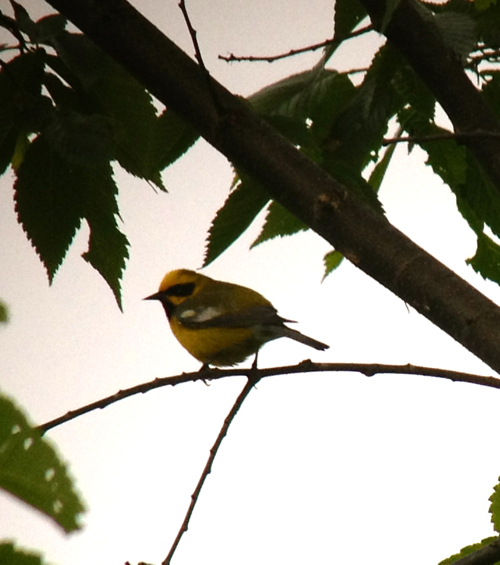
Lawrence's Warbler

I took a quick trip down to Indianapolis to visit my family. On the way, I made a stop at Mr. Neil's and got a big surprise. I went to the spot where blue-winged warblers have nested in the past and sure enough heard the familiar 2 note, buzzy call of a blue-wing. I was excited to see one, but when I got it in my binoculars I was surprised to see something golden-winged warbler-ish...it was a hybrid!

This is a Lawrence's warbler which is some sort of mix of blue-winged warbler and golden-winged warbler. These two species are known to hybridize, the more familiar hybrid is the Brewster's warbler. This bird really threw me for a loop because it sounded so much like a blue-winged warbler. Here's a video so you can hear what it sounded like (there's also a common yellowthroat singing in the background):

http://www.youtube.com/watch?v=4XffAG983LY&feature=youtu.be

I was kicking myself that I didn't wander the trail for bird watching until so late in the evening, I wished I had better light. I took both the photo and video with my iPhone through my scope...incidentally, I used the Meopix iScoping Adaptor to secure my iPhone to my spotting scope...more on that later.

I found an interesting article by by David Bonter and Irby Lovette on these two hybrids. It reads, "The most common hybrid form is known as a "Brewster's" warbler; the rarer form is known as a "Lawrence's" warbler. We currently believe that a "Lawrence's" warbler results when two "Brewster's" warblers mate, or when a "Brewster's" warbler backcrosses with one of its parent species, but research into the genetics of hybridization between these species is underway and many questions remain unanswered."

I haven't paid attention to this spot in the last few years because of my work and travel schedule. Did a golden-winged warbler mix it up with a blue-winged warbler? I can't imagine this bird coming to the exact territory where a blue-winged has nested in the past unless it hatched here. One thing is for sure, I'll be checking it more closely this year.

Here's a an article from the American Birding Association's Birding about the hybrids with lots of great photos.


Birdchick Podcast: #113 Hunting & Birding

A European government agency wants to trap hawks to allow more non native pheasants to breed so people can shoot them (and no, this story isn't from Florida). An interesting discussion about reporting rare ducks and how some hunters use bird listservs, bird blogs and rare bird hotlines to look for rare ducks to shoot.

OMG the most pretentious article/field guide review I've ever read...well, except maybe for that one time a bird book author totally dissed a competitors book and then in the same article touted how awesome his own book was.

The Anniversary Of The Great Blue Heron Rookery Destroyed By A Tornado

This has been an action packed week for me, it's the one year anniversary of the Minneapolis Tornado that ripped through a great blue heron rookery, destroying all the nests (and almost all the offspring) and displacing most of the adults. The herons ended up renesting, some at an older rookery at Coon Rapids Dam and then other establishing a new rookery downriver at the Head of Navigation on the Mississippi River, near Marshall Terrace Park. To our surprise and relief, some of the birds ended up fledging young last year.
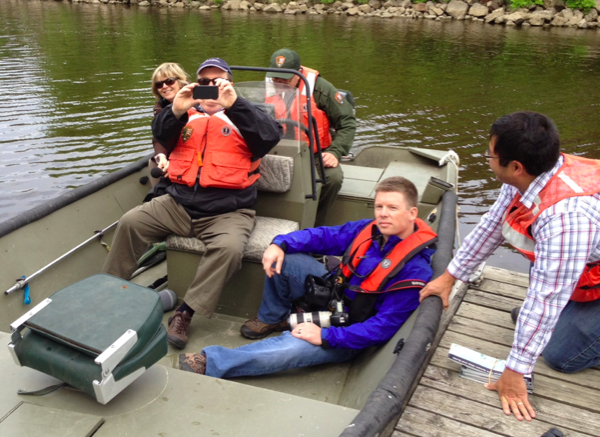
And to my utter delight, they came back this year and nesting is again well under way. Tom Crann from All Things Considered asked if there was a way to go out and visit the rookery. The superintendent of my park (MNRRA) Paul Labovitz offered to drive the boat and try to safely land on the island. So off we went under the threat of rain and lots of wind to visit the new rookery. Above is Jayne Solinger, Tom Crann, Paul Labovitz, Jeffery Thompson and Brian Valentine. Tom was getting a photo of me getting a photo of him.  It was all very meta on Twitter.
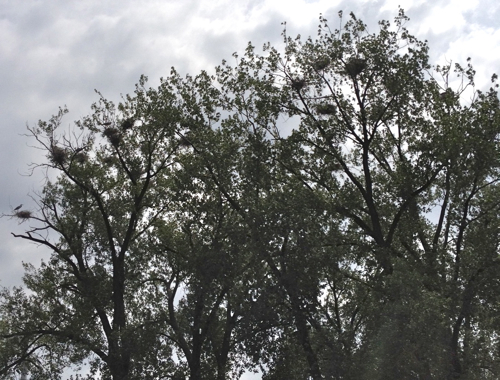
This is a shot beneath the rookery from the boat, look at all those those nests.  Even though it was windy, if you took a moment, you could hear the chicks begging for food. Paul found a safe place to land the boat and we walked around on the island. I was able to count about 40 nests, most of which were active. I wasn't sure if some of the smaller ones were starters or leftover from last year. There's still plenty of room to grow on this island, so I'm sure we'll see more nests in years to come.
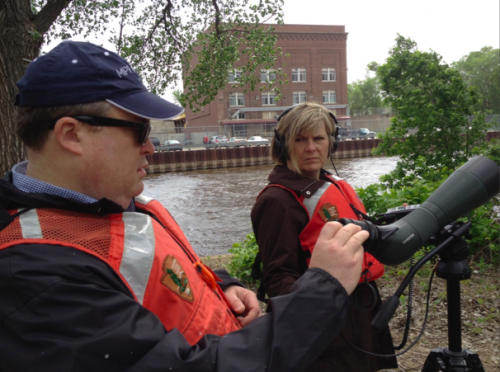
We had fun on the island and I even taught Tom how to digiscope with his iPhone and my Swarovski scope.
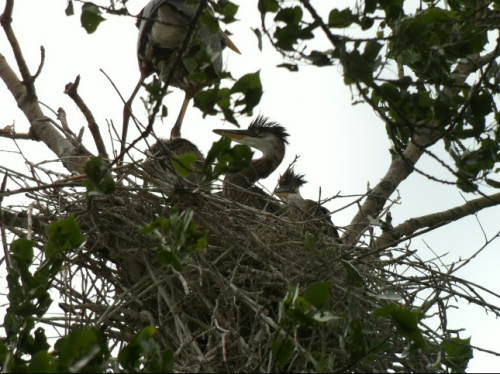
This is one of our iPhone scoped photos, we were sending them to Twitter, but Tom also added them to the story on the MPR site. Awesome. These young herons look like they are about to leave the nest. I think that mild March allowed the great blue herons an early start on nesting.
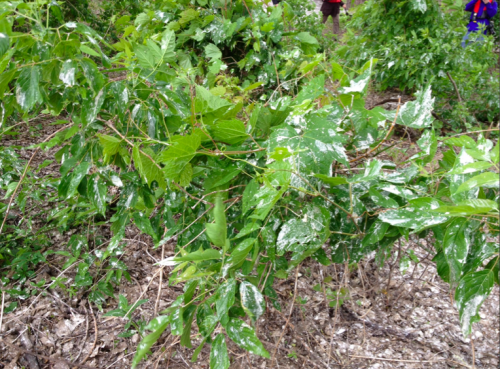
I couldn't help but notice how much poop was on the island. As I understand it, Xcel Energy owns the island and you're not supposed to land on it, but people do.  Last year I found some campers and a local tour operator landing under the rookery. I couldn't help but think this a foolish situation, fish reeking heron poop is no fun to have on your clothing...or to camp under--ew. While we were on the island, we felt some moisture and we thought it had started to rain...
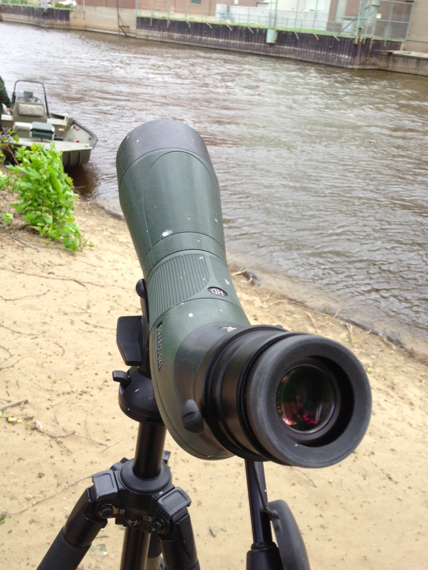
Then I noticed that the speckles were white and realized that I just got the MPR crew covered in heron poo! Way to go, Ranger Sharon! I had to call and ask Swarovski what the best and safest method is for removing heron poop from my spotting scope body. Typically I just run it under the shower but I think this will need a little elbow grease...and quite possibly a toothbrush.

Thanks to the super windy conditions on our way back to shore, everybody got sprayed with Mississippi River water, so that did kind of help clean off the heron poop...though everybody had to go back to the studios a little wetter than expected.
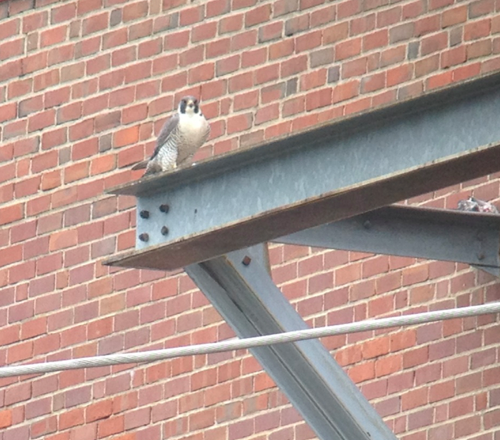
The peregrine falcons who use the nest box flew around us on the island a few times.
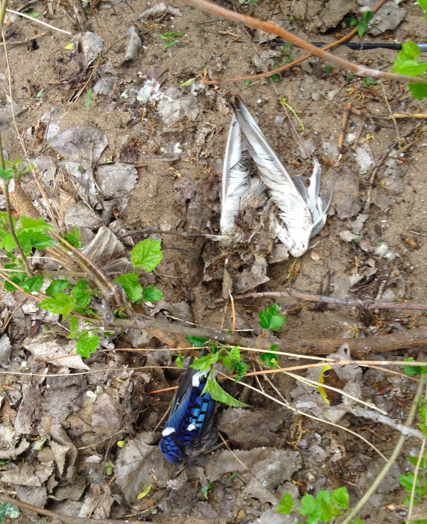
You can see they are still using the island as their plucking perch. We found all sorts of bird parts from several blue jay wings, killdeer wings and catbird parts.
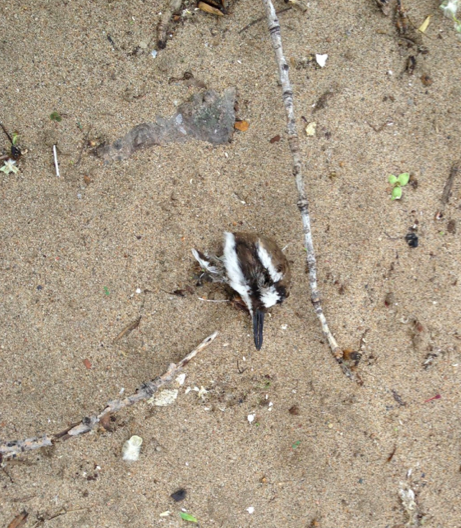
There was even a disembodied killdeer head!
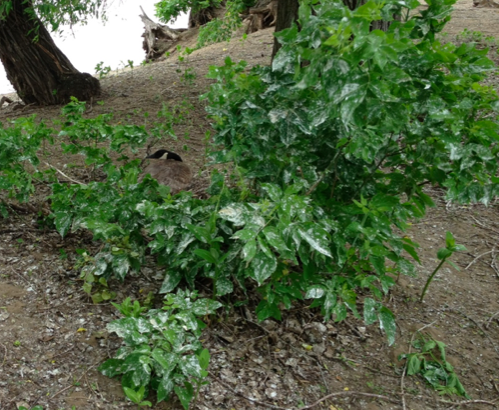
Canada geese nest all over the island, but many of the nests were abandon. I wonder if people landing on the island or the constant barrage of heron poop was the cause.  I wasn't able to get a photo but there are also at least three spotted sandpiper nesting territories. You know, if it weren't for the heron poop factor and parent freak out factor, this island is a naturalist's dream and I would love, love, love to use it as an outdoor classroom.  So much to explore and every bit of it is a teachable moment.

So, here is the story from All Things Considered and Tom also found that Xcel has set up a heron cam, so you can watch from the safety (and less stinky) area of your desk.


Hummingbird Reminder

It's the time of year when I get hummingbird questions so I thought I would do a quick reminder about hummingbird nectar. Here is the recipe:

4 parts water 1 part table sugar (not honey, not corn syrup, not Splenda, not Stevia, no artificial sweetner)

Don't bother with red dye, it's not needed, could be harmful (we don't know for certain but it's best to err on the side of caution). Your feeder should be red enough to get the hummingbirds' attention.

Mix until the sugar is dissolved. One thing that I do is add in a little hot water from our tea kettle to the sugar, just enough to dissolve it. Once it's dissolved I add in cool water so the nectar won't be too hot and can go right in the feeder. You can make a big batch and store the excess in your refrigerator for up to two weeks.

Remember to keep the nectar in the feeder fresh. If you feeder is in direct sun, change the nectar every two days. If it's in the shade, change it every five days. If the nectar looks cloudy or if you see black on the inside of the feeder or around the feeder points--clean the feeder and change the nectar. A clean feeder is essential.

If the idea of keeping a feeder clean is daunting, use flowers to attract hummingbirds instead.

http://youtu.be/JhTSjgwKzUo


Birdchick Podcast #112: Bird Spies, Swan Egg Thefts

It's tough to be a banded bird in the Middle East. A dead bee-eater found in Turkey has been accused of being an Israeli spy.  Apparently this is not the first time. Griffin vultures with satellite packs were detained for similar reasons in Saudi Arabia in the past. Mute swan eggs are being stolen from nests in an Orlando, FL park.  One man was arrested for one particular theft (he ate a couple of the eggs) but the others remain a mystery.  What baffles me is that mute swans are non native so you can't prosecute people for stealing the eggs...unless these are "pet swans" owned by the city.

Here's a short video from Birds and Beans about why you should look for shade-grown coffee.

http://youtu.be/wirnRx-zlNk

And this made me laugh (and you will too if you are familiar with this meme):

FWQG
FWQG

Birdchick Podcast #111: Biggest week in American Birding, Canada

A quick recap of the 2012 Biggest Week In American Birding. Bird festivals make it into Dear Abby or How to nail closed your coffin on the bird festival speaking circuit.

Holy cow, the eagle cam drama over at the Minnesota Bound Bald Eagle Cam. One eaglet fell out of the nest, the other got tangled in nesting material but no worries, after intervention from The Raptor Center, the chick was rescued, rehabbed and back with its parents.