Birdchick Blog
iPhone Digiscoping Adapters
All sorts of adapters for digiscoping using an iPhone and a spotting scope are cropping up. I can barely keep up with testing them. This post covers two different adapters that are very similar and work well with my Swarovski ATM scope.
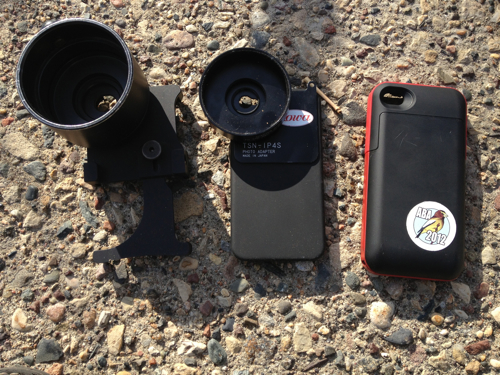
From left to right we have the iTelligent iPhone adapter, Kowa iPhone adapter and my Mophie iPhone charging case. My only complaint with these adapters is that they do not work with the Mophie case. The iPhone 4s has a crap battery life and if you are going to use your phone to take photos and videos, that battery life is going to get eaten up quickly. If someone could find a way to make an adapter that would work with a Mophie case or if someone could create a digiscoping adapter that is also an iPhone battery charging case, I'd be one happy little clam. And I don't want to hear about how that would be cost prohibitive when Mophie cases run $79 - $99 and digiscoping adapters run $65 - $199. I don't think my dream is unreasonable.
But enough of my battery charging rant.

The iTelligent adapter is a case that goes around your iPhone and works with the Swarovski DCA adapter using the M37 ring. I know Swarovski is changing their digiscoping adapters but quite a few of us have DCAs already so this can be a good solution to holding an iPhone steady up against a scope eye piece. I've used the DCA adapter for years to slide a point and shoot or SLR camera over my scope eye piece. It's fast and easy to use. It may seem awkward to have the DCA on an iPhone, but if you are used to having the DCA on a camera in the field, it's easy to adjust to toting it with your phone. The DCA easily screws on and off the case, so you don't have to have it on all them time.
I usually have one of those Women of the Cloud Forest totes with me and this fits easily in there.

The Kowa adapter works without the DCA adapter and is a little skinnier. The Kowa adapter is the one on the right with my finger on it. It wedges on to the scope's eye piece and doesn't have the locking mechanism that the DCA has, but stays firmly in place. I wouldn't leave it unattended, a good bump to the scope could cause it to fall (but that's just common sense with any sort of camera when digiscoping). You do have to do a little futzing to get the full image, but it does the trick and fits in a pants pocket. You can take the ring off of the case too.

I played around with both the Swarovski 20-60 zoom eye piece and 25-50 zoom eye piece. The 25-50 works best with an iPhone 4s. Above is a shot I took with the 20-60 and you can see that there is some serious vignetting which you can get rid of by zooming in the image on the iPhone (not zooming in with the scope eye piece).

But if you start with the 25-50 zoom eye piece you have very little vignetting.
When you use the video feature with your iPhone 4s, you do not have the option of zooming in. If you use the 20-60 eye piece you will have vignetting which you can edit out using a program like iMovie. Or you can use the 25-50 eye piece and have not vignetting in video mode.
I took a couple of short videos with each adapter and the 25-50 eye piece so you can see how they work.
Here is the iTelligent adapter:
http://www.youtube.com/watch?v=I-KIjEAn-oc
Here is the Kowa adapter:
http://www.youtube.com/watch?v=Y6JTKhc5C1U
Both work well and are fun way to digiscope. And with both of these adapters, you can still actually use your iPhone to text and you know...phone calls.
Brown Birds
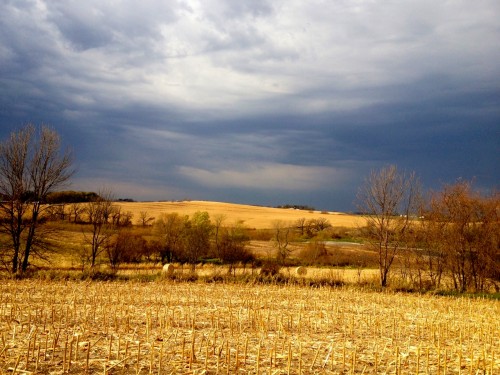 Even though autumn is winding down in my part of the country, the color still tried to pop as in one last hurrah before our white and gray pallet of winter arrives. Bird migration still has a big push going and and though it may not be about warblers any more, it's sparrow city in most of my field work or even around the office. These are a sample from the last week, most of these were taken on the same cloudy day with my spotting scope and either my SLR or my iPhone.
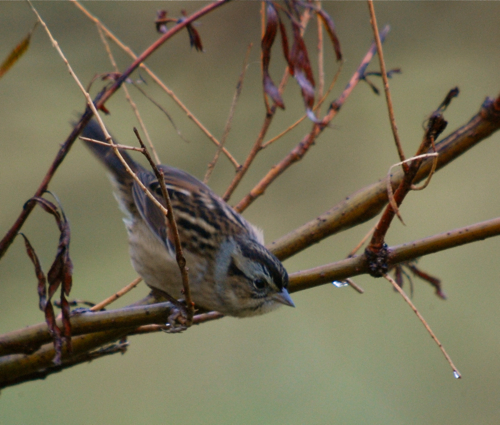
And this last ditch effort at color seems to make all the sparrows even prettier. Now, for all you non-birding/casual birding, the sparrows I'm about to post are all different birds--I swear. Above is swamps sparrow, a native sparrow and not one usually found under bird feeders. I love that pose, the bird had popped up when I pished to see what sparrows were around.
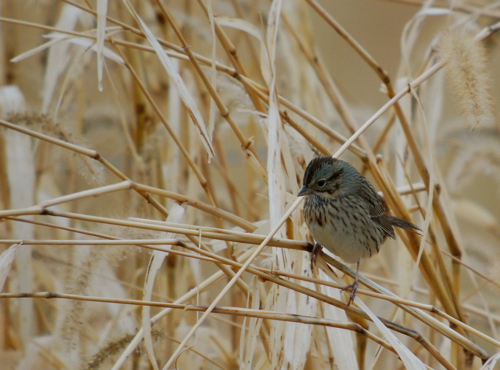
Brace yourself, this is a completely different brown bird that the one above. This is a Lincoln's sparrow that was in the same loose flock with the swamp sparrow. Note how this one is streaky on the sides and the swamp is not? I love the way this bird is highlighted by the yellow grasses.
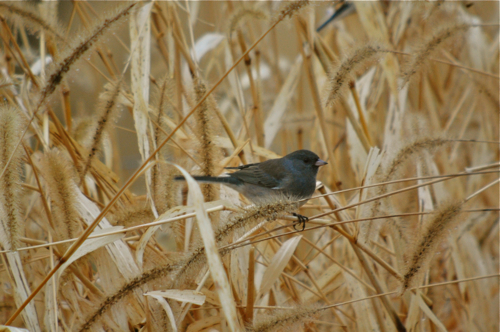
Here's a junco that popped up to remind me that it's still representin' as a sparrow.
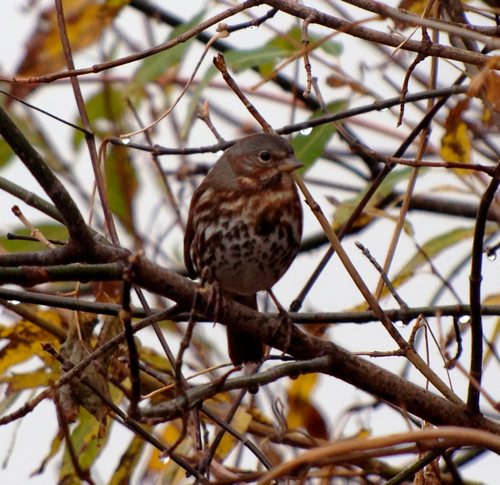
Beefy fox sparrows flush up on wooded arrows when I approach my field survey spot.
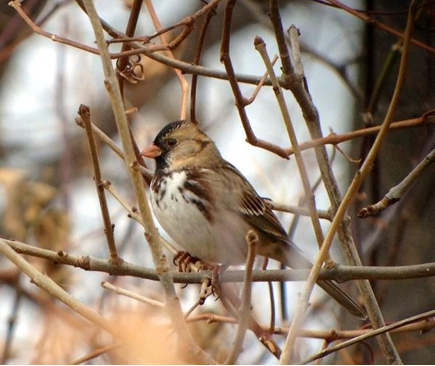
Robust Harris's sparrows are all over the place in the Twin Cities. I even had one show up at the bird feeder outside my office window, but they're all over on my field surveys too...though my non birding coworkers are dubious that this is different from the house sparrows.
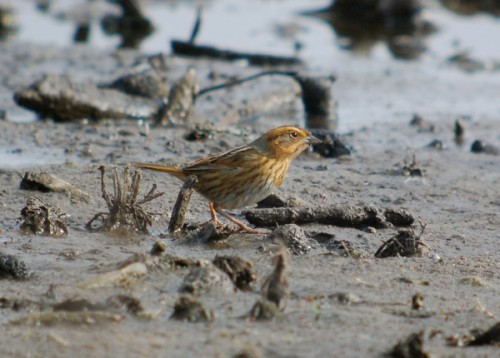
This wasn't seen on my surveys, it's a cool sparrow that with its pumpkin coloring is so appropriate for Halloween. This is a Nelson's sparrow. And as much as I love getting a photo of one, I'd rather have it on its breeding grounds and not foraging on mud during migration. But a sparrow's got eat what a sparrow's got to eat. Wish these guys would learn to love millet. I'd wet myself if a Nelson's ever showed up under my bird feeder.
The Autumn Office
Well, here we are with another report directly from the field as I do a blog post with nothing but my iPhone and my spotting scope.
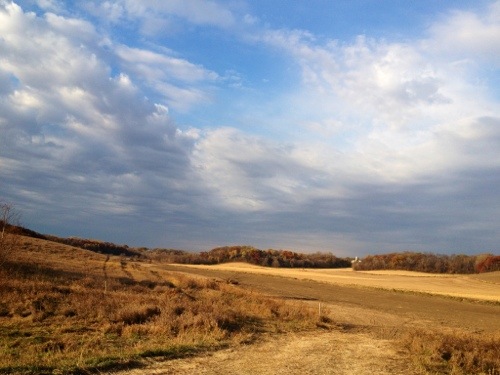
Every autumn when I'm fortunate enough to have fieldwork, I can't believe how lucky I am to have this landscape as an office and that my duty is to do nothing but watch birds or for a specific type of bird. Wearing sensible convertible all weather clothing is far preferable to wearing tights and a skirt in a cube farm.
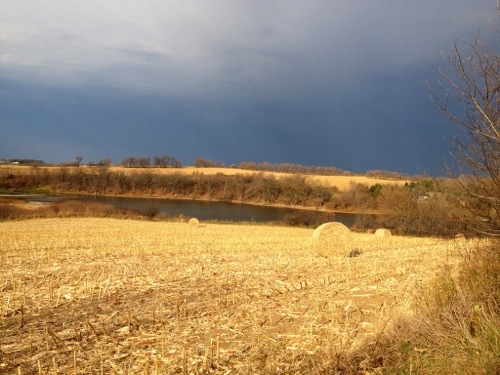
And even when autumn is supposedly Pastor Pete my surrounding office is the most gorgeous thing that I've ever had the privilege to work in. Admittedly, the bathroom situation is getting more dicey as every day farmers continue to mow down the fields of corn and soybeans that were my safe haven to a private bathroom. But you can't have everything.
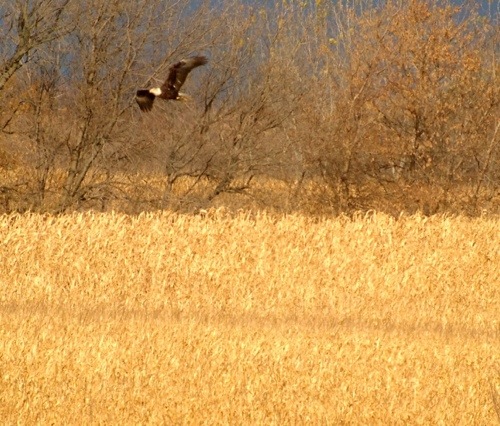
Eagles are certainly out and about this morning here's one and again I got this photo with my iPhone and my spotting scope. It's not the best photo in the world, but keep in mind I was handholding my phone up to my scope and I wasn't using an adapter.

I love watching how bird coloration mingles with the autumn landscape.
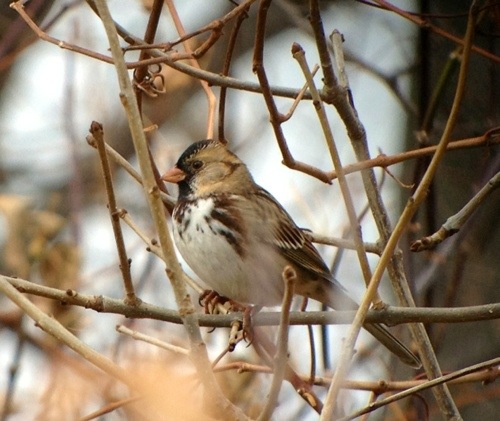
Sparrow migration is still in full swing. And though they are nothing but brown birds, it's fun to look into group of brown and pick out one who is very different from the others. We seem to be having an influx of Harris's sparrows in the Twin Cities right now and how can you not love a sparrow with a beard?
Well back to counting birds. I tried to catch as many typos as I could that AutoCorrect thought I meant, but there may be more. I love that it thought "Harris's sparrow" was "harasses Spero."
Focus on Diversity Conference 2012
My brain is so exhausted from the Focus on Diversity Conference held at Minnesota Valley National Wildlife Refuge this past Saturday. It's no secret that I'm kind of a party girl and like to mix it up, but between an extended Birds and Beers on Friday night, leading a walk for the conference Saturday morning and my brain being jammed packed with ideas and emotions from the conference, I felt like I was jetlagged as if I had just come home from an 18 hour overseas flight on Sunday. Sometimes, I have to force myself and take a moment to realize what I'm doing with my life (usually in a good way). Ferris Beuller was not lying when he said, "Life moves pretty fast. If you don't stop and look around once in awhile, you could miss it."
And I found myself taking stock of what I was doing on Saturday:

Which was moderating a panel with Paul Baicich, Dr. J. Drew Lanham and Kenn Kaufman titled, "Do we REALLY need to focus on diversity in birding?"
I would think the answer to this question would be a no brainer: yes! However, gettting people to come to this event in Minnesota was not as easy as I thought. And it's not because we are an all white city. I know people may think it's all Norwegian up here but we have the largest Hmong and Somali population in the US. I felt certain when I heard this conference was coming to Minnesota that all the local birding organizations would be jumping on board...that was surprisingly not the case. I know part of the reason is that all of us are busy and it's difficult to to find time in budgets and schedules during migration but at the same time, how can we afford not to focus on this issue and figure out what we tend to be a homongenous group.
Other topics covered "Barriers to Birding," "Considerations for Reaching New Audiences" and even breakout sessions to come with ideas for something you yourself could do.

I was struck by the mix in attitudes of the speakers in the conference which echoed that it's not something to be fixed overnight and one single solution is not going to make every person of every race and color comfortable. Above is Kaufman, my good friend Duck Washington (a regular at Twin Cities Birds and Beer), photographer and author Dudley Edmondson, Roy Rodriguez with Texas Parks and Wildlife with Mamie Parker who used to work for US Fish and Wildlife. Duck had a great quote about birding companies marketing to more diverse audiences. I know I've heard before, "We don't need to market to them, they won't be interested or have the money."
Duck pointed out that there's enough of the minority population that does have the money and the interest that ignoring them is a loss of revenue. This rings true with conversations I've had with Rue Mapp at Outdoor Afro, just because someone is part of a minority group does not mean they do not have the money to spend on outdoor equipment.
Dr. Lanham spoke several times and gave a very touching and heartfelt talk about teaching his son how to talk to the police when he's pulled over so he will be safe and not be shot. He also talked about what it was like to look in the mirror and not feel that he may have belonged. All of us who have birded for years may think we are welcoming, but at the end of the day, don't we feel safer mingling with people who "look like us."
And let's face it, not all birders are welcoming. There's a great example of one I intereacted with on Facebook that I wrote about over at 10000 Birds. This person is a birding field trip leader and isn't racist but...you can't trust most Mexicans. I still read that and shake my head with pity.
Dudley Edmondson was decidedly on the opposite side of the spectrum and said he didn't worry if there were nothing but white people in the woods, "I don't care, there's a rare butterfly over there and I need to get past you to see it."
Edmondson also shared a story of when he was working on getting photos for a Wildflowers of Minnesota book, he found a flower he needed in his neighborhood in Duluth, MN. As he was on the ground taking photos, an older white woman came out and demanded that he hand over his camera and film or she would call the police. He explained that he was a nature photographer taking photos of flowers, she said that he was not, he did not look like a nature photographer. The conversation escalated a bit and ended with Edmondson leaving and calling her crazy. Someone in the audience took him to task for not using it as a teachable moment--maybe educating that woman about people of color in nature. Edmundson said that he didn't care, it wasn't always up to him to do that and this woman was crazy.
I sympathized with him--you cannot fight crazy (some of the people I've blocked from this blog have more than proven that rule to be true). And I also thought that is a heavy burden to put on someone--you must educate everyone you ever meet who is distrustful of you. Sometimes, you just want to be outdoors or maybe try to do your job outdoors and because your skin color is different from others who are enjoying nature shouldn't mean that you have to automatically educate everyone about yourself. Duck also pointed out that sometimes leaving before things escalate is the safest thing to do.
This is just a stream of consciousness of some of the things that struck me from the conference, there is so much more. I think some of the conference will be put up online so you can listen later and I encourage you to do so. Also, they announced when the next conference will be--in 2013 it will happen right before the Rio Grande Valley Bird Festival (it always happens the second weekend of November so you can kind of get an idea of when it will be now). Try to put on your calendar--at the very least RGV should be on there, that festival should be on everyone's Bucket List.
Horned Lark
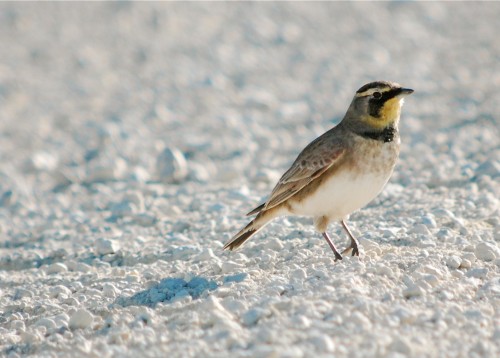 Horned larks a constant in my field work but it seems their numbers have bumped up recently. These birds are fairly common in farm field were I live, I hear them constantly. But I've been on bird trips where people have never seen one and they have been casually birding for a long time. Usually when you see them, they are flying away off the side of a gravel road as you speed past in your car. But since I am stationed on the side of the road for an hour at a time, I have occasion to see them up close.
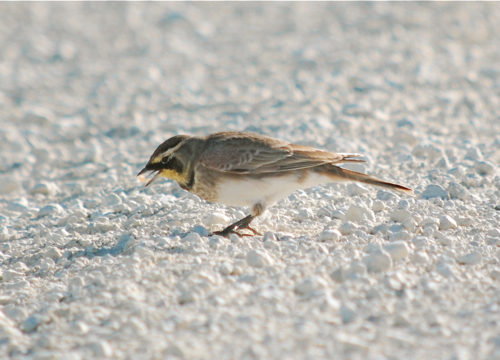
All the farmers are combining right now and migrating sparrows and larks are grabbing the seeds on the side of the road. As I watched this horned lark nibbling a crush corn kernel, I wondered why we don't see these birds scrounging around under bird feeders. Even if you use the argument that the habitat isn't right, what about all the newly developed houses in former farm fields...surely some adaptable horned larks were be scrounging under those at some point?
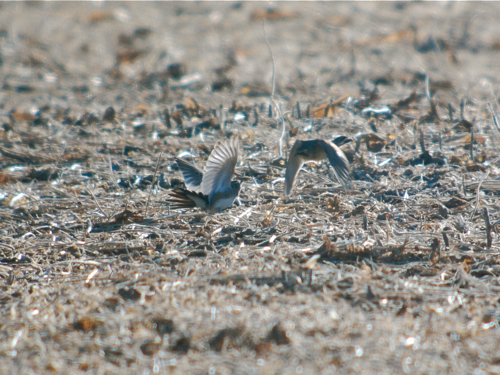
I love the moments my job affords me. Even when things are seeming slow, if I pay attention to what's going on around me, I can find something exciting. This morning, some horned larks were getting into a bit of a fight.
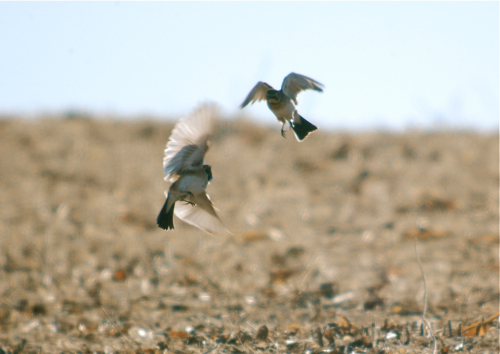
These horned larks kept flighting up against each other. I wondered how well this plays out in migration. Wouldn't it be more energy efficient not to fight and focus on where the birds need to travel to? Although a peck order must be established, I suppose.
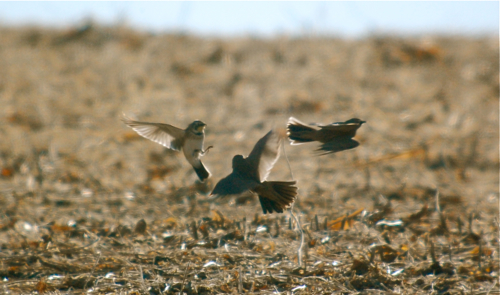
And once 2 are involved, everyone else needs to get a piece of the horned lark fight club action. Who needs to go on an African safari when wildlife fights can happen in a recently combined soybean field?
Camouflage
One of the joys of migration is that you never when something is going to show up. When I'm out doing my surveys, I have my usual suspects of species but every now and then a surprise hits.
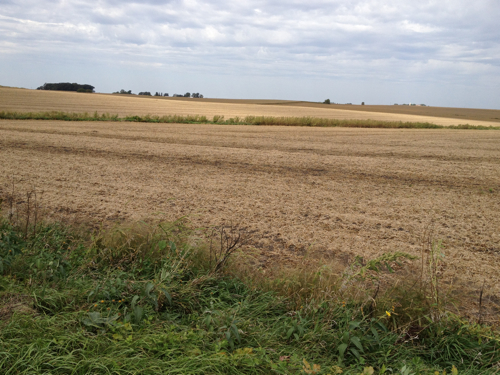
As I was driving between survey points, I passed this field and a small flock fluttered away from the road towards the center. I knew they were shorebirds, but not exactly certain what they were. I pulled over and got my scope out.
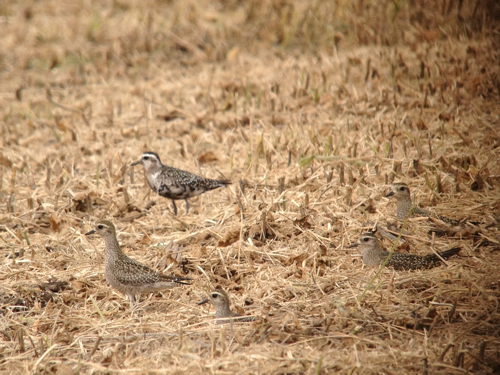
It was a flock of plovers in non-breeding plumage. And when they flew, there was no black in their "wing pits" that you would see on a black-bellied plover in non breeding plumage, so these were American golden-plovers. The birds soon hunkered down into the the soybean stubble and it was amazing how well their plumage mixed in with that. I wondered if they just blew in from their northern migration the night before and were hoping to catch a nap. The above was a shot taken with my iPhone 4s with my spotting scope.

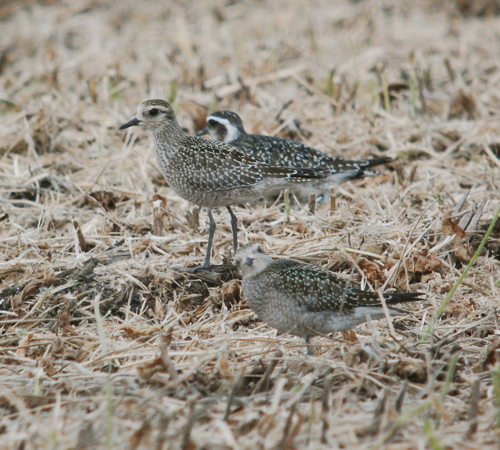
This was taken with my Nikon D40 SLR and spotting scope. Some of the birds were still on high alert. Not the bird in front with a cocked head towards the sky? I looked up and that plover had its eye on a passing Cooper's hawk, high in the clouds.
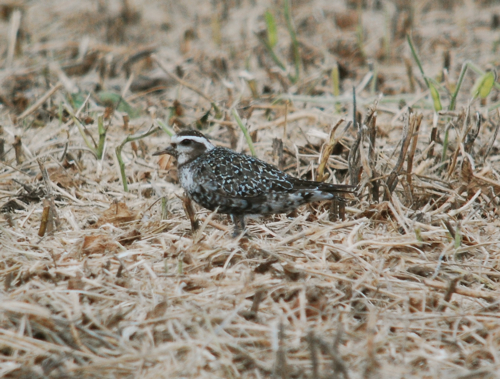
These birds have one of the longest migrations out there. According to Audubon, American golden-plovers fly offshore from the east coast of North America and travel nonstop over the Atlantic Ocean to South America. Individuals may go more than 3,000 miles in one flight. Juveniles and birds blown off track will move through river valleys and I wasn't too far from the Mississippi River when I got these shots. Amazing to think about how far these birds will go.
Focus On Diversity Conference, Be There!
If you are within a day trip of the Twin Cities, you should put this on your calendar. If you remotely work to promote the outdoors with the public, you should attend this event!
The Focus on Diversity Conference is coming to the Twin Cities October 13, 2012 at the Minnesota Valley National Wildlife Refuge in Bloomington, MN (right next to the airport).
The objective of this event is to promote effective outreach to more diverse audiences with birding, outdoor recreation and conservation messages.
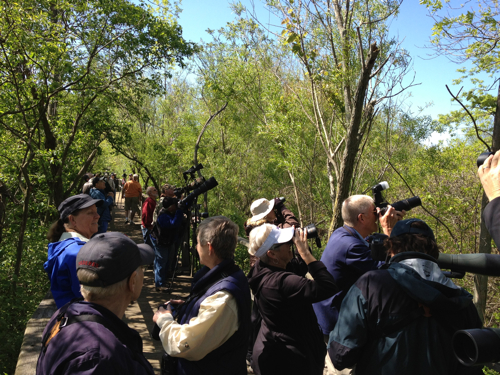
We all know how homogeneous birders can look on the trail, we need to change this and we have some great thinkers coming together to try and tackle this issue. Enjoying the outdoors shouldn't be just a "thing white people do."
The forum and discussion will include Dudley Edmondson, Flisa Stevenson, Dr. Drew Lanham, Kenn Kaufman and even Duck Washington (if you've been to a Birds and Beers, you've met Duck). Put this on your calendar now, be a voice, learn, engage in this discussion.
There will also be a special Birds and Beers Friday night before the conference at The Corner Bar inside the Embassy Suites in Bloomington near the Refuge. Birds and Beers starts at 6:30 pm.
Blogging From The Field
This post is more of a test to see if I can use the voice to text feature with Wordpress and blog while I'm doing a survey in the field.

Above is my current office view. I really love being able to work outside especially during spring and fall migration!

Large flocks of song birds are around me every day right now. The diversity of bird species in the cornstalks around me is amusing. Above is a Nashville warbler. It's so weird to see warblers and corn.
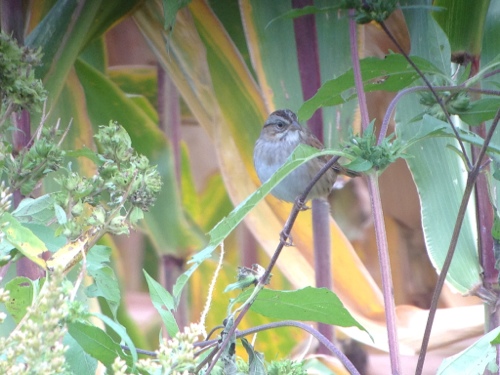
Here is a swamp sparrow that I was able to pish up out of the corn.
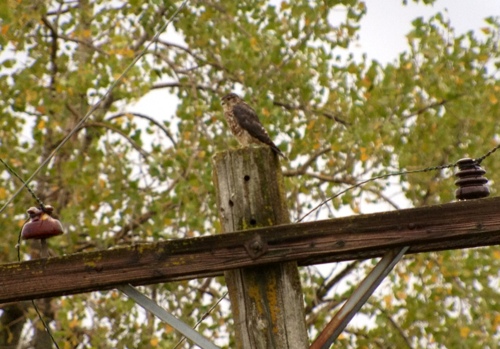
And wherever you have migrating songbirds you're sure to have migrating raptors to follow. This female merlin got my attention when I saw her sitting on top of one the telephone poles in my survey area. She was just finishing up eating a small bird.
Okay I've told my phone everything I wanted to say let's see if this actually posts.
Also all of these photos were taken by using my iPhone and with the bird photos it was my iPhone along with my Swarovski spotting scope.
Honey Bee Nursery
I know I don't do as many bee reports on the blog as I used to but in a lot of respects our bees do the same thing over and over. Not that I don't delight in watching the hive, but how often can I report the same thing? Things that are fun to check are larvae. I especially like frames with black foundation, makes things ten times easier to see and it really pops the color of the bees.
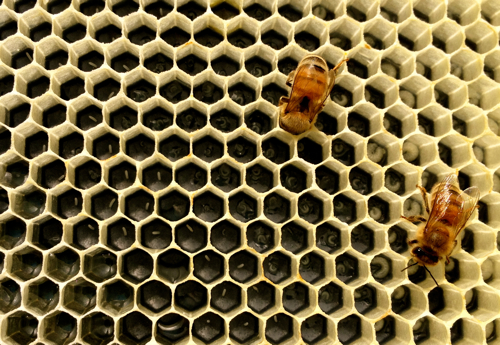
Above are mostly worker bee eggs (the things that look like mini rice) and some larvae off to the right. If you don't find your queen when you're digging around in your hive, you can be relatively confident that a she is alive somewhere in there because eggs stay in that shape for about three days as they are fed royal jelly from the worker bees.
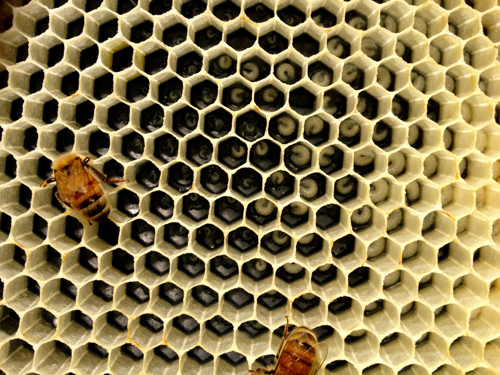
Once the larvae is three days old, it's switched to a mixture of pollen, honey and water (some bee sites call this bee bread). You can see at least one worker up there feeding someboyd as her head is wedged into a cell. The larvae grows and eats for six days.
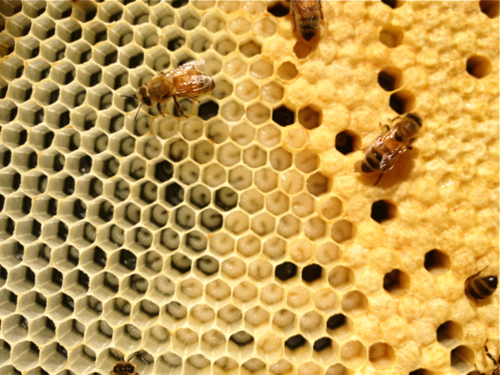
After six days, the workers cap over the brood and they pupate for 12 days as they go from a squishy blob into a segmented, leggy, winged bee complete with stinger.
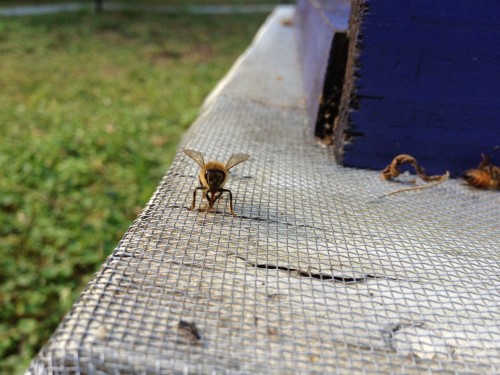
Like this girl! On a side note, while looking up something else entirely I wandered into an article on eating bee larvae. I suppose eating all that honey would make them tasty.
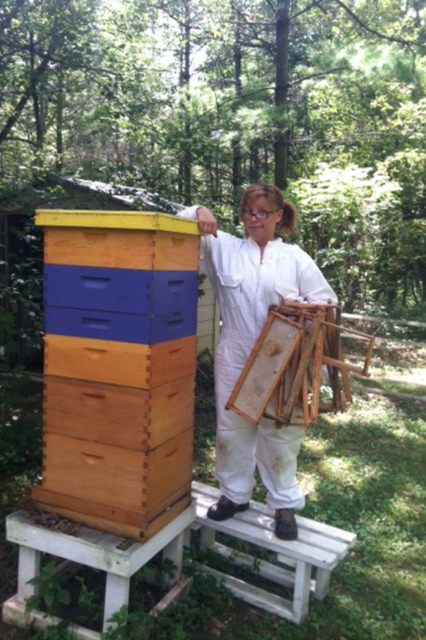
For those curious, I think our hives are doing splendidly this year. Many are as tall or even taller than I am because they are stacked with so many honey supers for us to harvest soon. Though, Lynne was quick to point out that since I'm only 5 feet tall, that's not saying much. Thanks, Lynne. ;)
Digiscoped Images
Fresh Tweets
Would you like to hire me as a speaker for your event?
Email sharon@birdchick.com