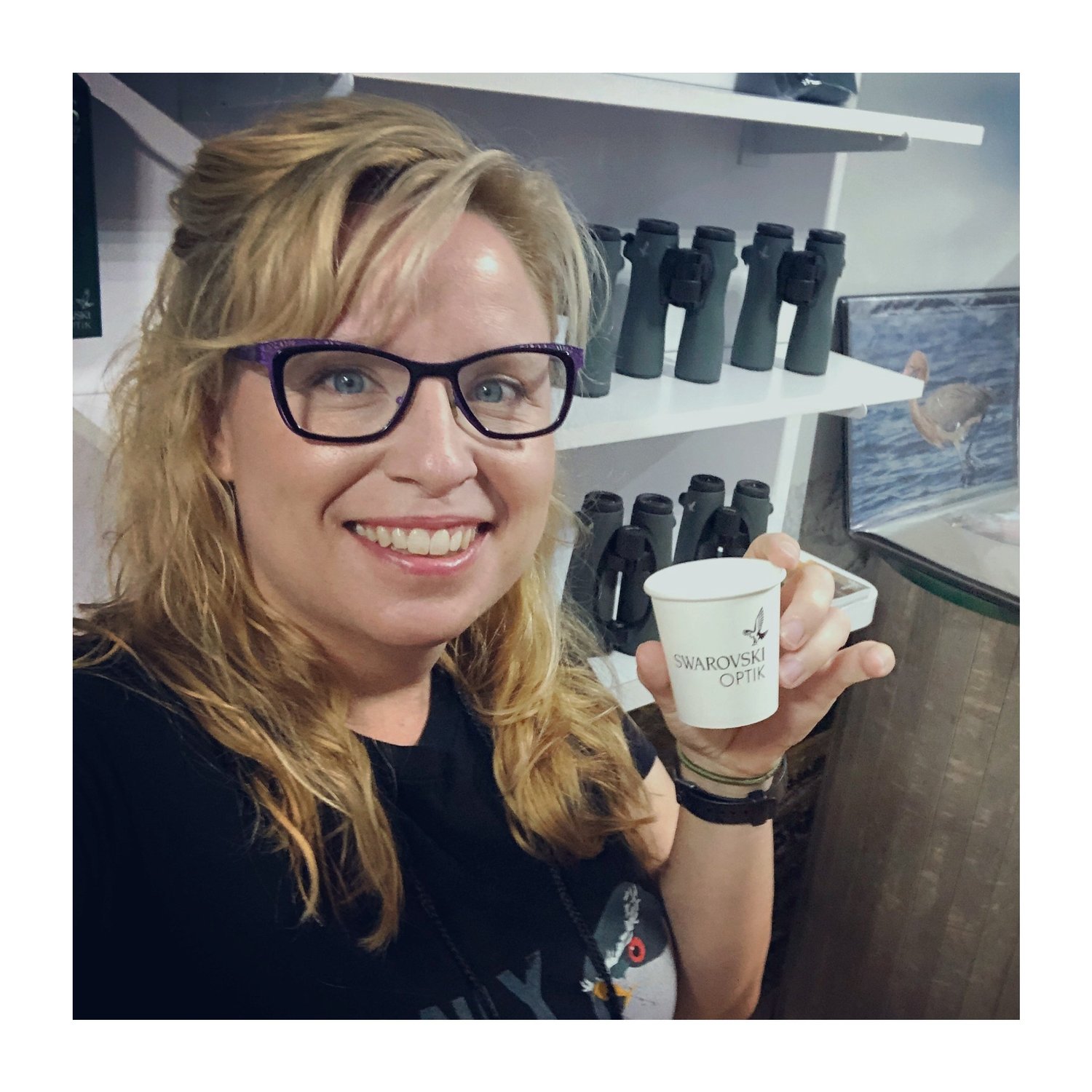
Birdchick Blog
Whimbrels of the Sub Arctic in Denali
What, this blog still works? I know, I blew up my life, moved to Alaska and now all of my writing and creativity goes to a national park.
There are so many birds that I’ve seen and enjoyed over the years, but in many ways I didn’t truly appreciate them. There was a conversation between two men where one said that the outdoors is so much more enjoyable when you what things are. The other man got very defensive and said that he enjoyed the outdoors just as much as anybody and he didn’t need to know the birds, flowers, or trees.
I firmly disagree and the whimbrel is an example of that just being aware of something vs knowing it, is life changing. I know what whimbrels are, I’ve seen them in many places in the Lower 48 of North America. In the grand scheme of shorebirds, they are one of the easier to identify and quite charismatic looking.

This is a whimbrel that I got a photo of while filming a pilot for a birding reality tv show in LA. No, that’s not a joke.
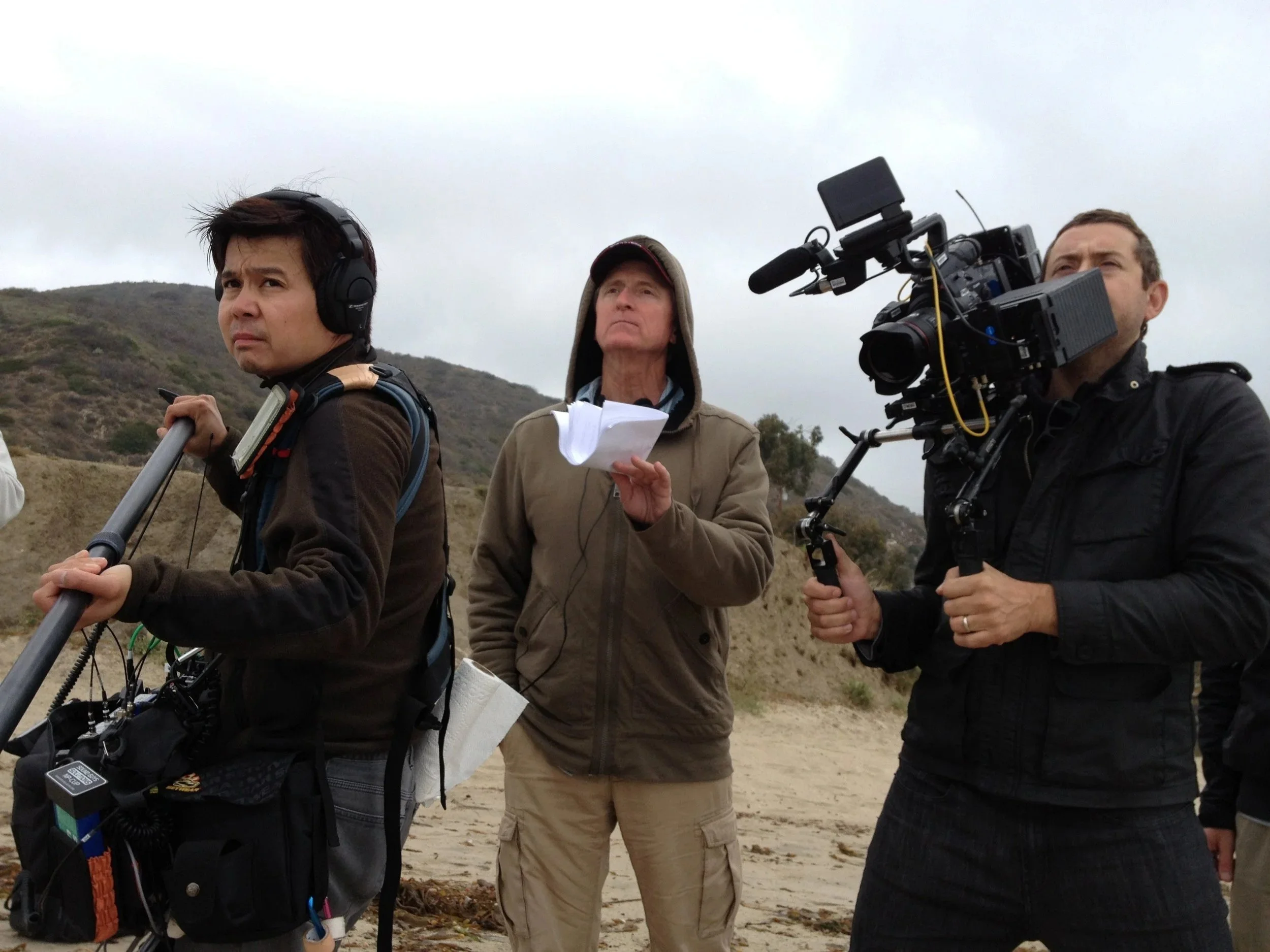
PROOF, took this photo while the whimbrel was about 50 feet away. FYI reality tv shows aren’t scripted, but please note the paper the guy in the middle holding…
I’ve been trying to find photos that I’ve taken of whimbrels and figure out where I was when I took them. I feel like my first whimbrel was exciting but in those heady early days of my birding when I was getting lifers left and right and not quite paying attention to the first sighting because I was getting so many firsts at once. A few photos that I’ve found were from a reality tv show pilot that I filmed, right about the time my book 1001 Secrets Every Birder Should Know came out.
Whimbrels have a crazy beak, not as crazy as a curlew, but still pretty darned distinct. But where whimbrels really got my attention was as we started to study their migration patters and could put transmitters on them to really get an idea of their crazy flights to and from breeding grounds.
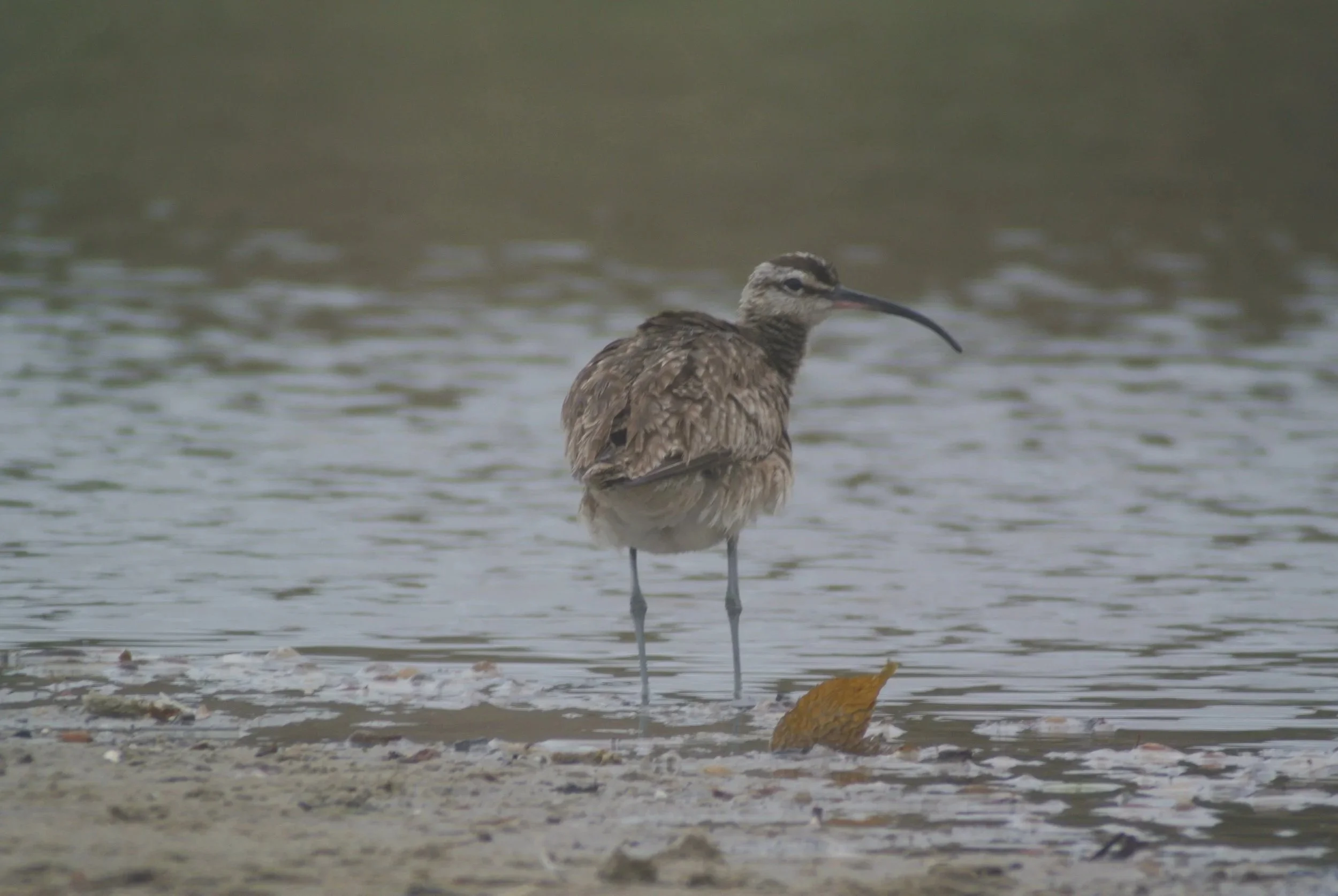
Whimbrels on wintering grounds eat quite a few fiddler crabs and it’s thought that the long decurved beak helps them get into their burrows.
In 2009, four whimbrels were tagged by researchers from the Center for Conservation Biology at the College of William and Mary in Virginia on their southward migration. The following spring, one bird left Virginia and flew to Alaska, traveling 3,200 miles in about 6 days in what looked to be a non-stop flight. Before that, we didn’t know that whimbrels on the east coast of the United States would end up in Alaska. Here’s a pretty amazing migration map based on some of those trackers.
But in 2011 the study showed how these birds managed hurricanes but also the many threats that they face. One bird known as “Chinquapin” successfully flew into Hurricane Irene and survived. A bird known as “Machi” flew through Tropical Storm Maria and another knowns as “Goshen” flew through the east side of Hurricane Irene, both eventually landed on Caribbean island of Guadeloupe and were legally shot as part of a fall shorebird hunt. You can read more on the William and Mary website.
I’m told that whimbrels were seen regularly along the Park Road in Denali. I haven’t seen that, I have had a couple of flyovers on the Denali Highway, but haven’t really seen them around where I live now—especially not nesting. One of the things I love about working here is the rich knowledge of the biology staff. There’s lots of careful research and a push/pull of keeping wilderness wild and allowing visitor access. There’s a known decline of whimbrels nesting on the Park Road, but is that a matter of traffic…or loss in other areas like migratory and wintering habitat? Pressures of unregulated shooting? Storms that are impossible to navigate?
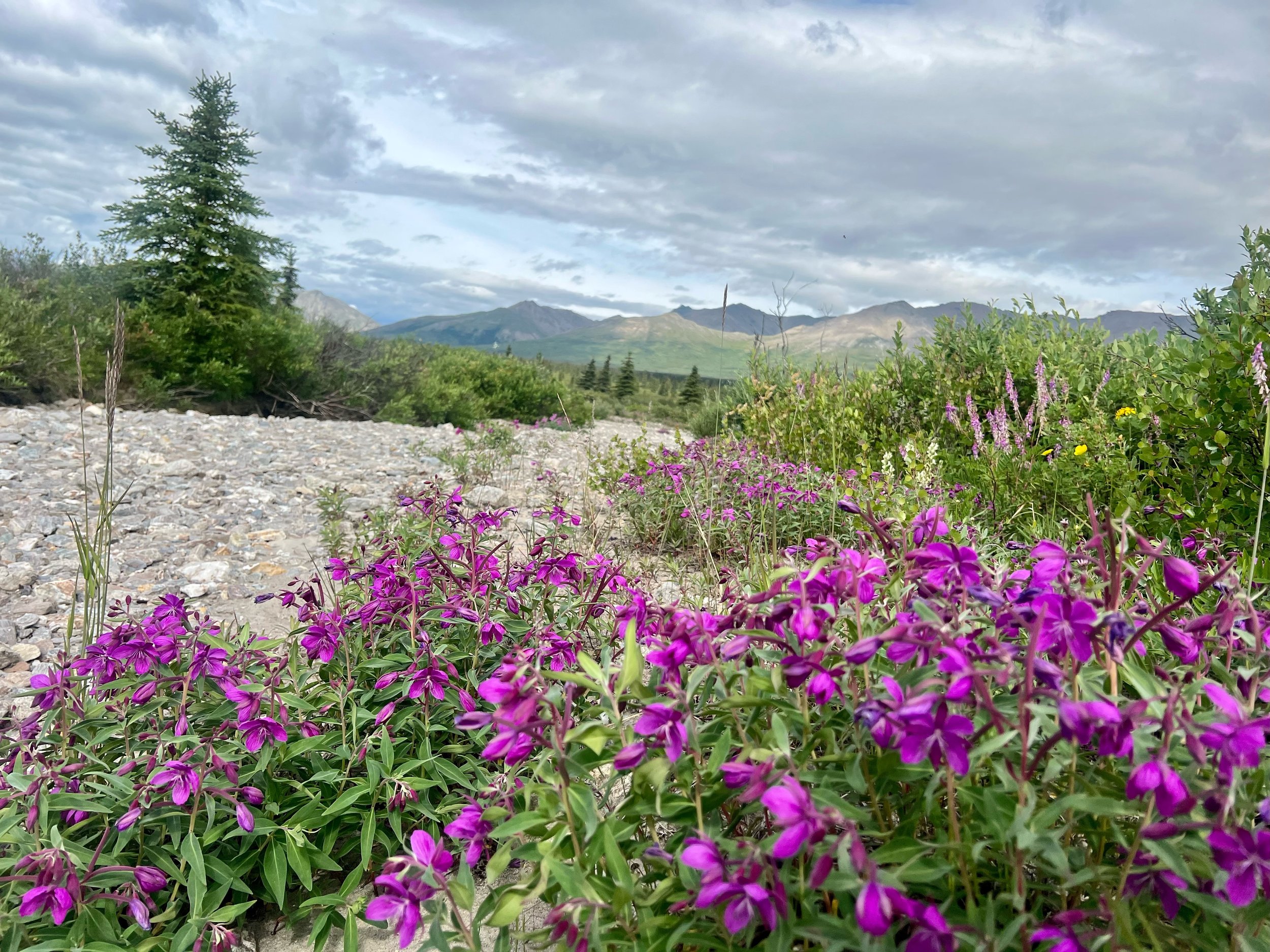
Braided river bed off of the Park Road, the only road that goes into Denali National Park and Preserve.
So when some friends told me they were out hiking in Denali about seven miles from my place and had what they thought was a whimbrel, I went out looking for it. Working and living in a park that is roughly the size of New Hampshire (roughly six million acres), its hard to get bored. There aren’t many trails in the park and you are allowed to hike off trail. Sometimes that’s a challenge for a five foot woman navigating willows about as tall as me where I could surprise a grizzly or moose but I always pack bear spray and talk to myself to prevent surprising anyone.
Denali National Park and Preserve is over six million acres in size, roughly the size of New Hampshire. There is only one road through the park and right now, it’s cut off at the halfway point because that part was built on a rock glacier, the ice melted and the road slid away. I took the dry, rocky bed about a mile and a half to Jenny Creek. It was mostly shallow but with my short legs, I was going to have deep areas of very cold water.
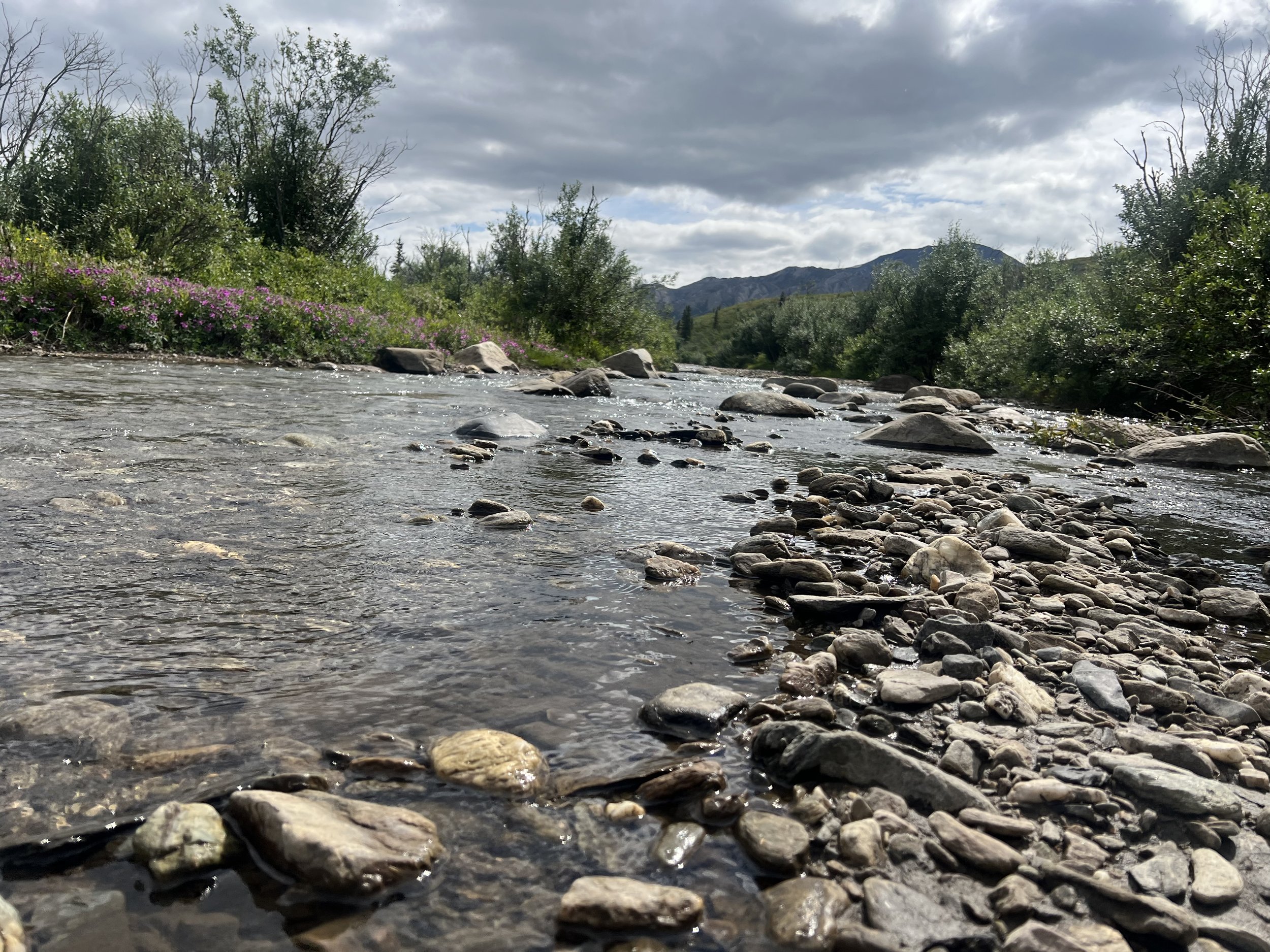
Jenny Creek where I could already hear a whimbrel yelling on the ridge on the other side of the creek.
I always calculate the risk and wonder if it’s worth it. I especially do that living in grizzly bear country. I saw the deeper part of the creek, observed the slow of the water and if I could safely navigate it, and noted the steep side of the ridge vs the gradual. Which had more willows to traverse. It looked like the shallow portion of the creek had fewer willows, but a much steeper climb. The deeper part of the creek had a gradual climb, but more willows. Not going to lie, I entertained just keeping with the easy trail fo the dry river bed and forget the whimbrel…then I heard it calling from the top of the ridge, a bird siren song I can’t resist and opted for the shallow end of the creek with the steep hill.
I opted to bring my hiking poles for this trek and so glad that I did since that made the steep grade of the ridge so much easier to climb. The hilarious part is that I later learned my phone took video from my pants pocket. I can hear myself heavily panting and verbalizing my inner monologue to prevent surprising a bear or moose: “Thank you, past Sharon, for bringing hiking poles, good call. pant pant pant. Yo moose, yo bear. pant pant pant. Just a short lady walking through the willows. pant pant pant. Not interested in hunting today. pant pant pant. No cubs for me today. pant pant pant. Come on, old girl, you got this. pant pant pant. Almost there. pant pant pant. Short lady in the willows. pant pant pant”

Whimbrel flying over breeding territory.
The whimbrel started calling more and I started mimicking its call back to the best of my ability which wasn’t great. But I could make it loud enough that I wasn’t going to startle moose and I was doing it poorly enough that whimbrel clearly knew I wasn’t a rival for territory.
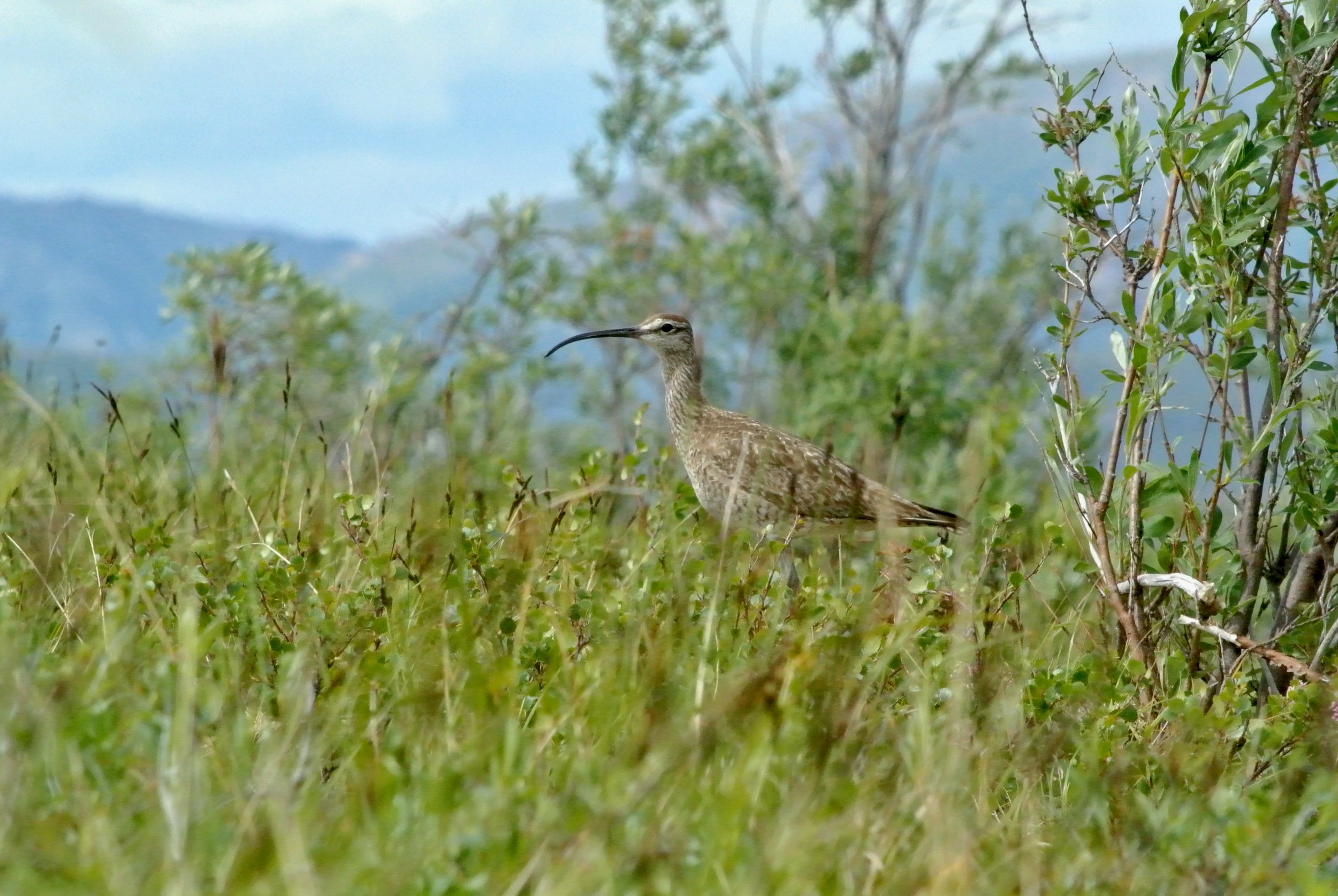
My favorite shot of the whimbrel. It’s not Nat Geo material, but I love it because I get a sense of its breeding habitat.
I eventually made it to top without being mauled by a bear and it was a gorgeous view and a lone whimbrel watched me warily and occasionally called. I sat down and took a breather, ate my lunch, gave the whimbrel time to see that I wasn’t a threat and it went on to foraging. There didn’t appear to be a second bird or even chicks, but the bird clearly acted like it was on territory. They should have chicks at this point.
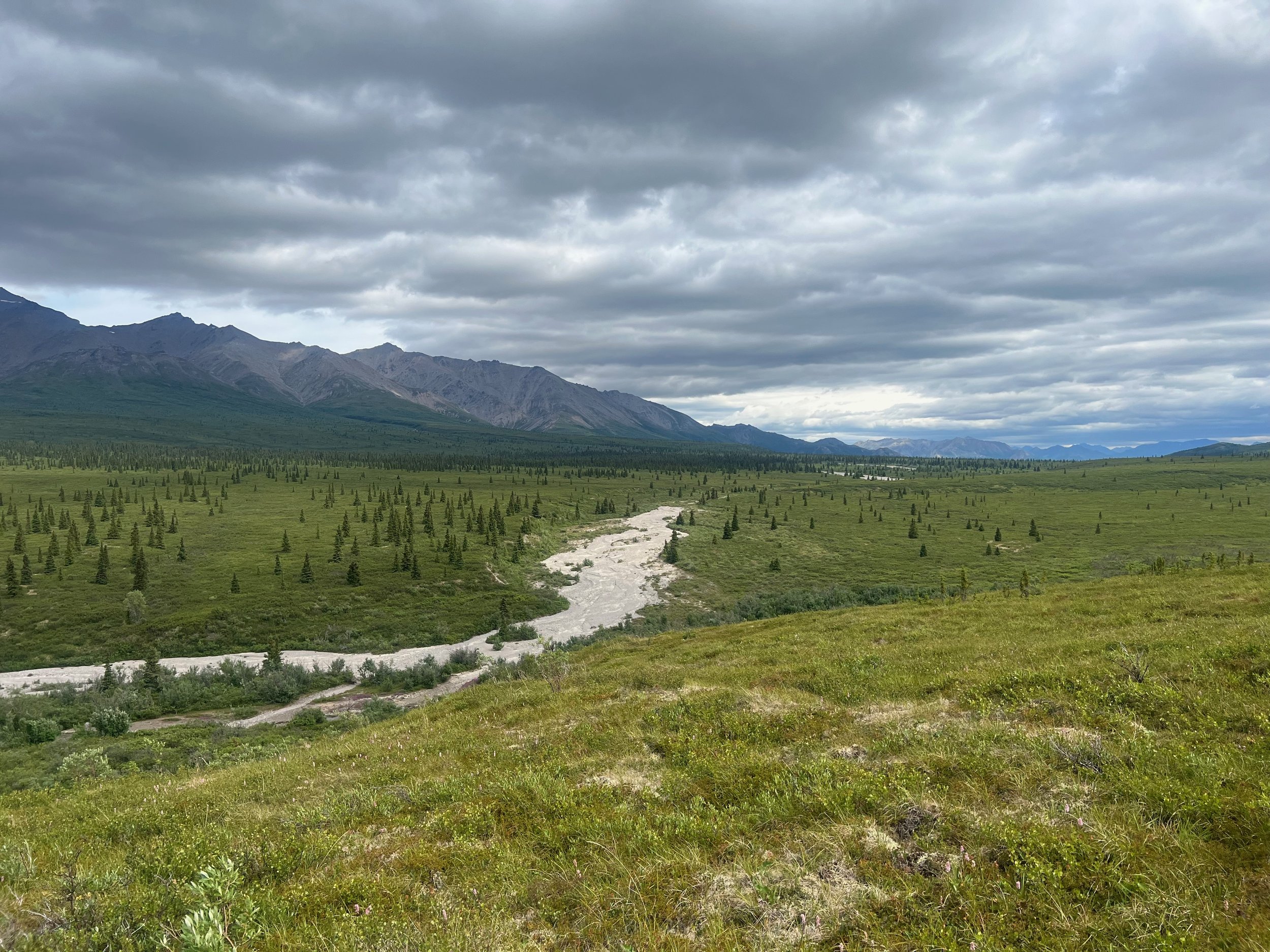
View from the top of the ridge. The dry river bed below is what I used to hike to the area.
I took some time to just soak up the weirdo life I have now. Birding in Interior Alaska is so different. It’s not like living in Minnesota where a short drive will net me 50 species and lots of opportunities for photos and videos. In the winter, it’s downright BLEAK and there are days when I will see or hear only one species of bird a day. If the roads are nice enough, I’ll drive the 16 miles to the Three Bears parking lot to look at ravens out of desperation for anything live bird related.
But even in summer, it’s still not the hoards of birds you think of May and June in the Lower 28. My walk up to the whimbrel spot got me 8 species of birds. Lovely birds like fox sparrow and Wilson’s warbler but it’s not the same as being on a coast. But I’ve learned to savor the time I have with birds in the summer and especially in the case of shorebirds, get to know them in a completely different way—some of them even perch in trees! The whimbrel has its wintering grounds version of itself and its breeding grounds self is different. On the wintering grounds, they eat lots of fiddler crabs, up here…they’ll eat berries. What? A shorebird eating berries? Madness.
And to a certain extent, living up here is doing the same to me. Alaska Sharon is different than Minnesota “Birdchick” Sharon, simply because life up here has so many challenges. In some ways it is exhausting: calculating daylight, chances of hitting moose in the dark, how passable roads are and do I really need a salad that badly in February…couldn’t I just keep eating the canned carrots and frozen broccoli? But in other ways it’s so crazy weird and beautiful like the time your neighbor asks if they can swap you five pounds of roadkill moose in exchange for your bottle of Prosecco (that was an excellent trade).
A snippet of whimbrel breeding habitat.
I opted for the walk back to take the less steep slope of the ridge and the deeper end of Jenny Creek. It was in the upper sixties and mostly sunny which in the land of non stop daylight, makes for warm hiking. The cold creek felt good on my feet and thighs. I made it back with glimpses of caribou but no moose and no bears—which is fine. My preferred encounters with those species is from a vehicle and the moose are so thick in my neighborhood in May and June, I’ve had enough.
If you’d like to read more about whimbrels, do check out All About Birds and if you really want to find out who much we don’t know, check Birds of the World (that requires a subscription but is so worth it.
Snowy Owls on Breeding Territory
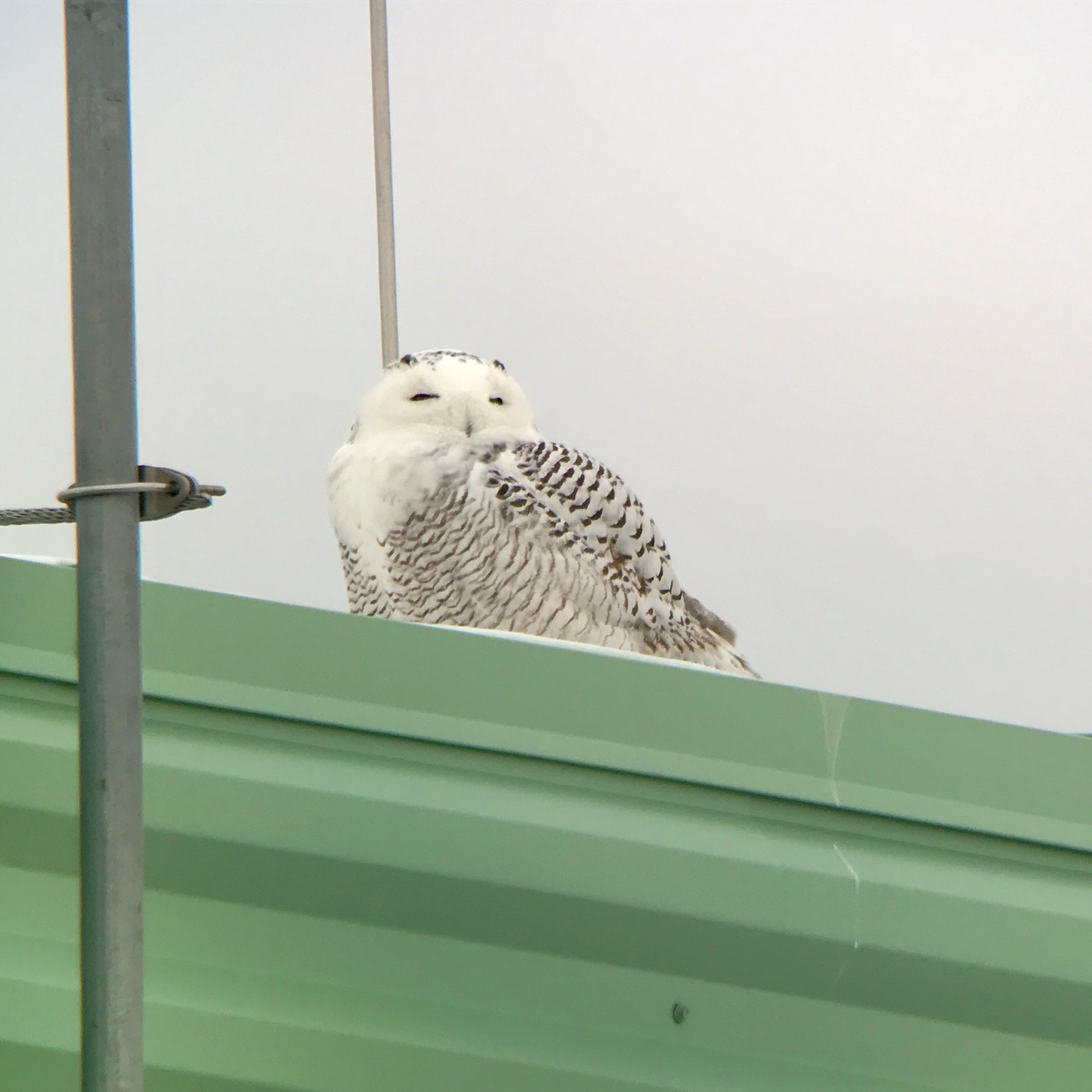
Female snowy owl perched on a building at the MSP Airport. How I normally see them every winter.
Snowy owls are something I regularly see in Minnesota. The Minneapolis/St Paul Airport gets a few overwintering every year. I’ve always wondered what it was like to see them on their breeding territory up in the Arctic, especially as I’ve followed Project SNOWstorm and all they have learned about snowy owl seasonal movement. When I headed up to the Arctic portion of Alaska last summer with Zugunruhe Tours, I got my wish. Fun fact that I learned about the name of the town formerly known as Barrow?
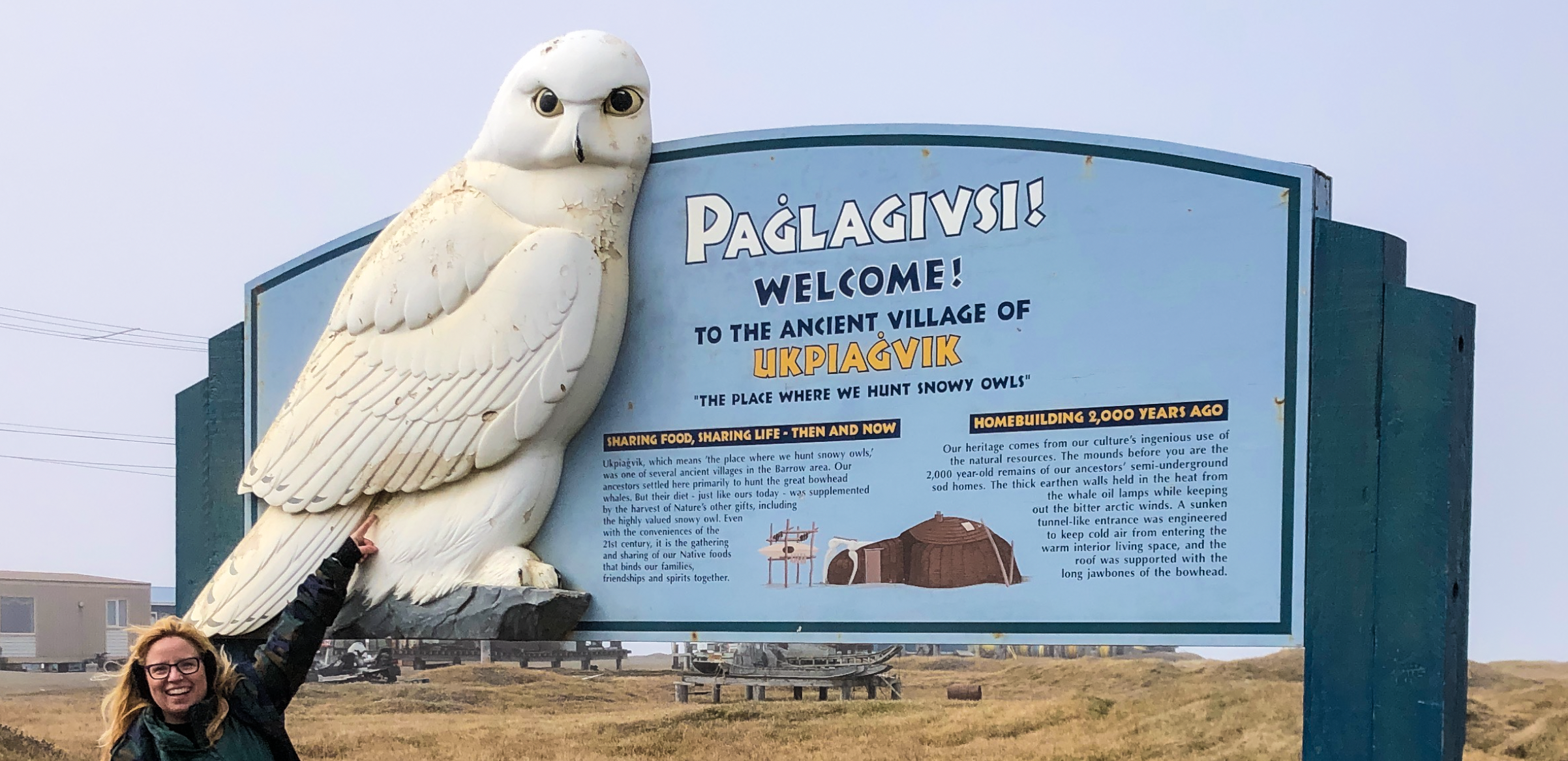
Standing at the town sign! Wait…what does that sign say?

According to the sign, this town’s name means “the place where we hunt snowy owls.”
What some people in the US know as the town of Barrow, AK is now called “Utqiagvik” which is a recent spelling of the town’s ancient name “Ukpiagvik.” According to the town sign the name means, “the place where we hunt snowy owls.” I chuckled when I read that. This sign made me think of how in the winter when snowy owls arrive, the “Owl Police” get riled up about how close people get to snowy owls. What would they think of the traditional town name?
I had a conversation with my friend Mark Martell, a biologist about snowys. “These poor things, they come down south and there are all these trees, that has to be confusing. They must wonder how to find anything.”
“Or,” Mark said, “they think, ‘This is GREAT! We need some of these up in the Arctic! I can hear and so so much futher!”
Fair point, Mark.
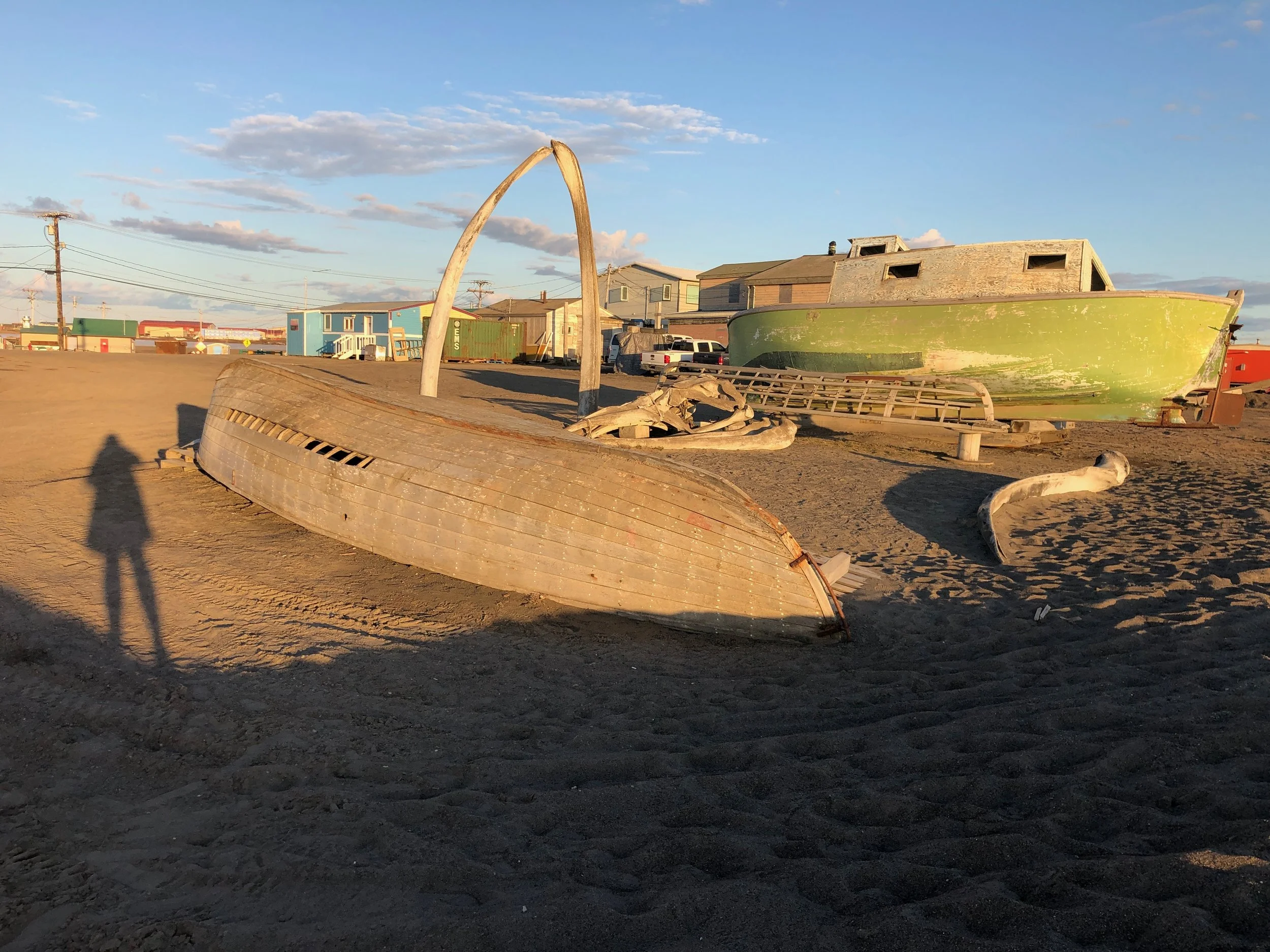
Utqiagvik has short buildings and no trees.
Looking around the town, I could see how it kind of resembled an airport. Some of the building are hangar-like, lots of open space, and trees. It’s right on the Arctic Ocean so lots of opportunities to hunt right on the sea ice.
Even though I was technically in the United States, it still felt like a foreign country because life is so very different there. There is no road to the town. You cannot just drive up with your trailer. You can only get in by boat or plane…and based on weather, that’s not a guarantee you’ll get in or out on the day you planned. Anything people need that is not in the immediate area has to be flown or shipped in. Conversely, anything you don’t need anymore also has to be shipped out. Car has broken down? Do you pay to have it shipped away or let it stay where it is. Along with that, it’s not easy to get food in and out. Really want to those fresh delicate fruits and vegetables…not an easy option. Avocado Toast isn’t a thing. Because of that and the Alaska Native population, there is subsistence hunting that helps people get through and they hunt what they need to in order to survive. Hence the sign about what the name of the town means.
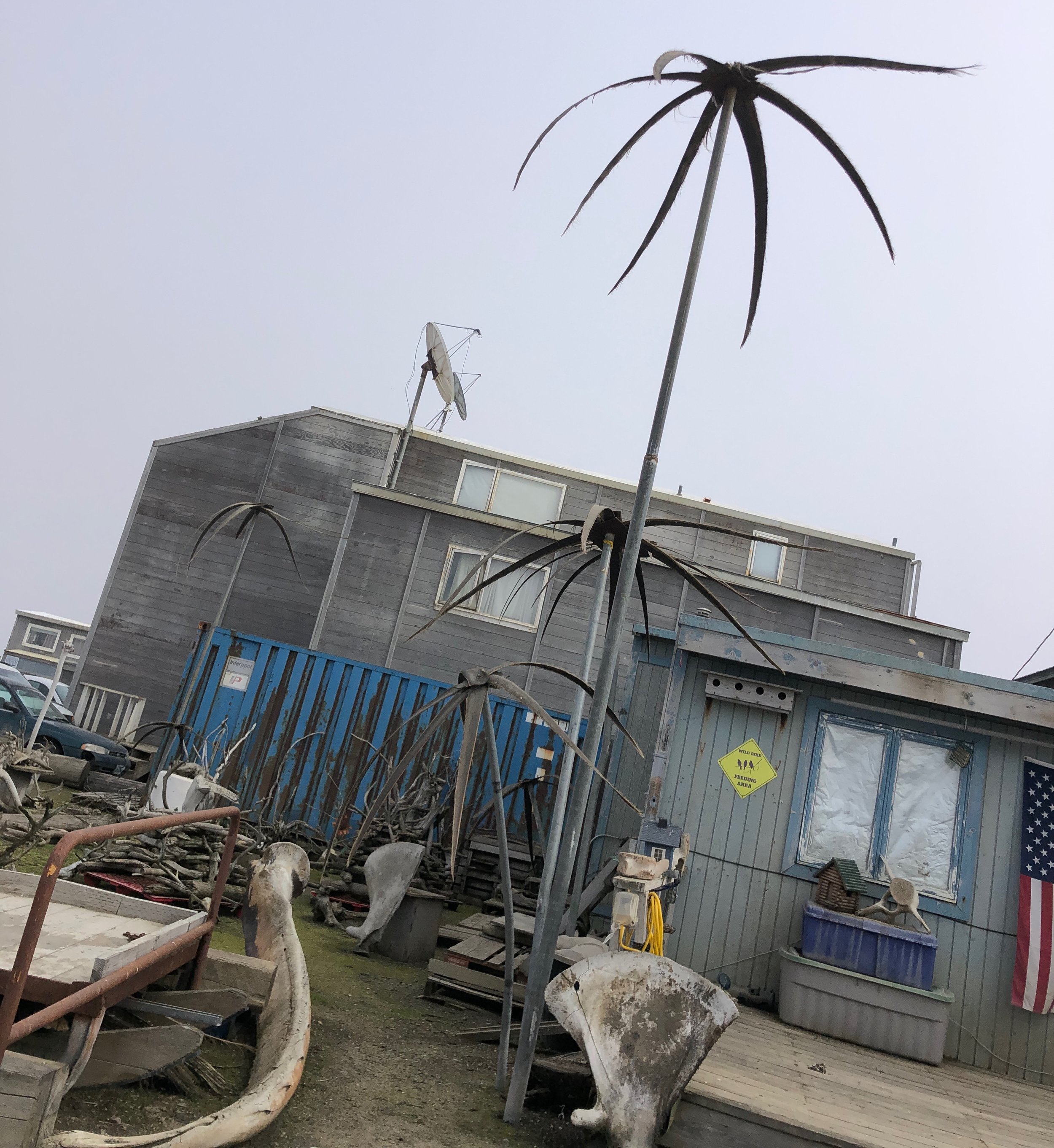
Palm trees made of baleen from whales.
Signs of subsistence are everywhere. Some yards took leftover baleen from whale hunts and turned them into “Arctic palm trees” or other decor. The town was preparing for a Solstice festival while we were there and chunks of whale could be found as people took it out to thaw. It was fascinating to be in that world and learn how survival is very different in this part of the United States.
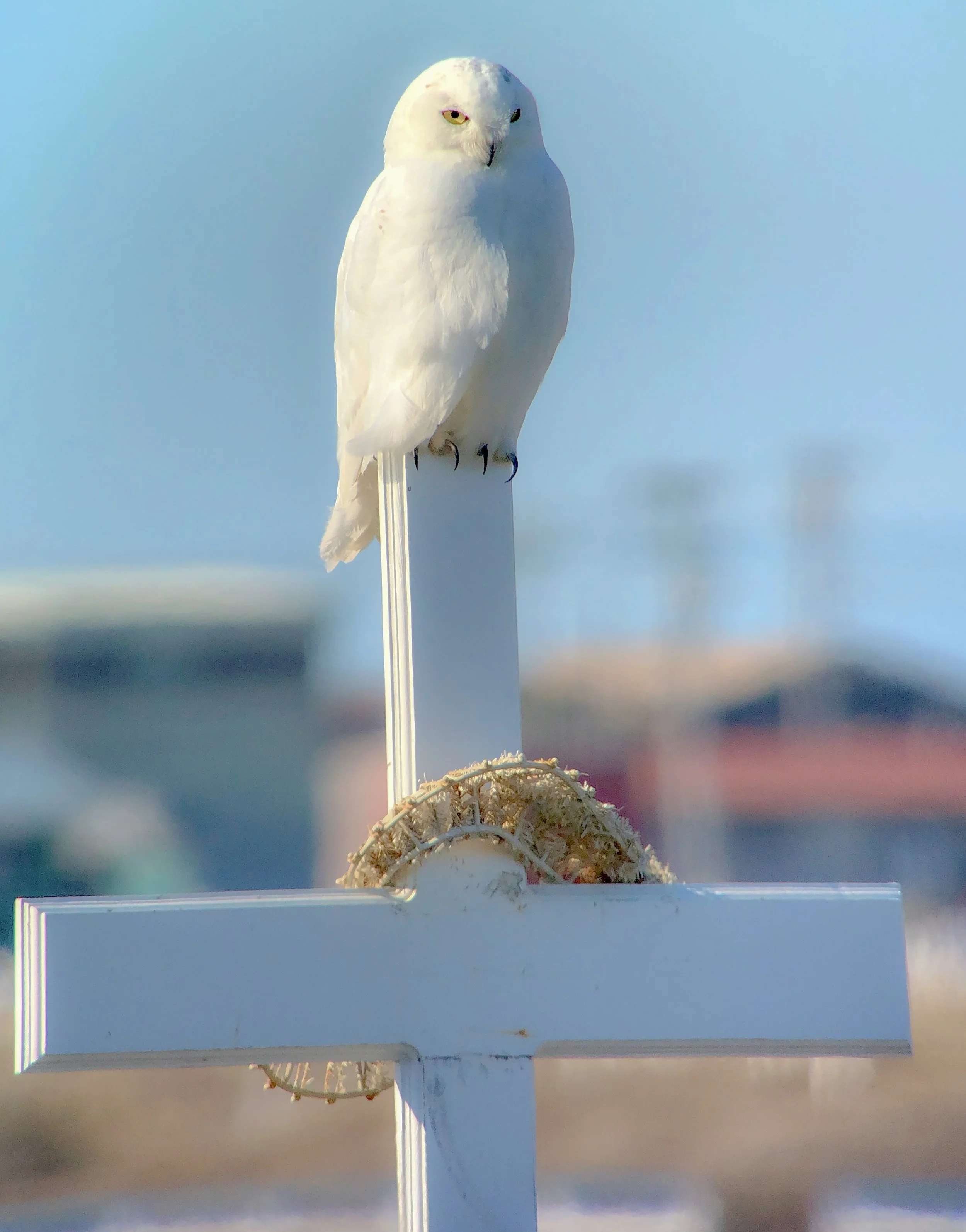
The town sign with a snowy owl did not over-hype and despite its meaning, there were owls around town! As I headed out of our hotel to our truck for the day’s birding, one of the other participants pointed to the cemetery next door and noted the snowy owl perched on one of the grave markers. A man and his dog walked by flushing the owl, but it soon returned. Our guide took us on a road closer to the cemetery so we could get photos. It was a stunning adult male male snowy owl.

Snowy owl perched on a grave marker.
But not only were they in town, we saw them as we hiked the surrounding tundra. We saw many snowy owls, one day we saw about six at the same time. They were far away and spread out, but that is the nature of the tundra—you can see for miles. Even though some were far away, I could see in my scope that they were active and getting mobbed my shorebirds. What a treat!
Our guide was very careful to keep us away from nests while we were out on the tundra so we weren’t trampling young or disturbing birds on eggs. But one day as we were hiking the tundra and enjoying the Arctic sun, our binoculars found a light floofy thing through binoculars. We both said, “Uh oh” at the same time. I looked at the guide, “Is that…what I think it is?”
“I hope not,” he replied. We were worried that we had in fact wandered toward a snowy owl nest. I got my scope on it and was relieved to discover that it was not a snowy owl chick. I walked over to get a better photo of what we saw.
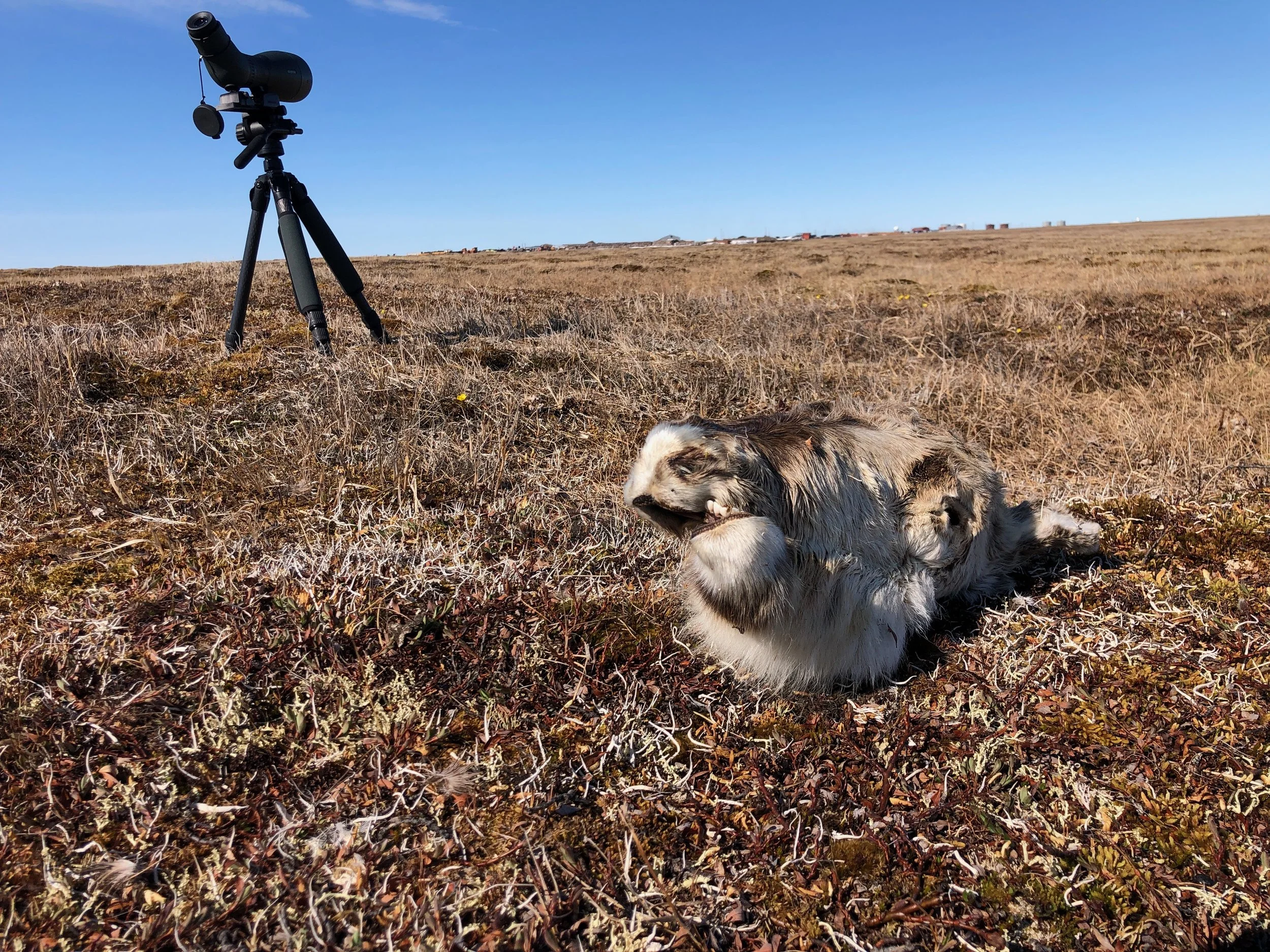
Just a random caribou head. Oddly not the weirdest thing we found on the tundra, that would have been the random hunk of whale meat.
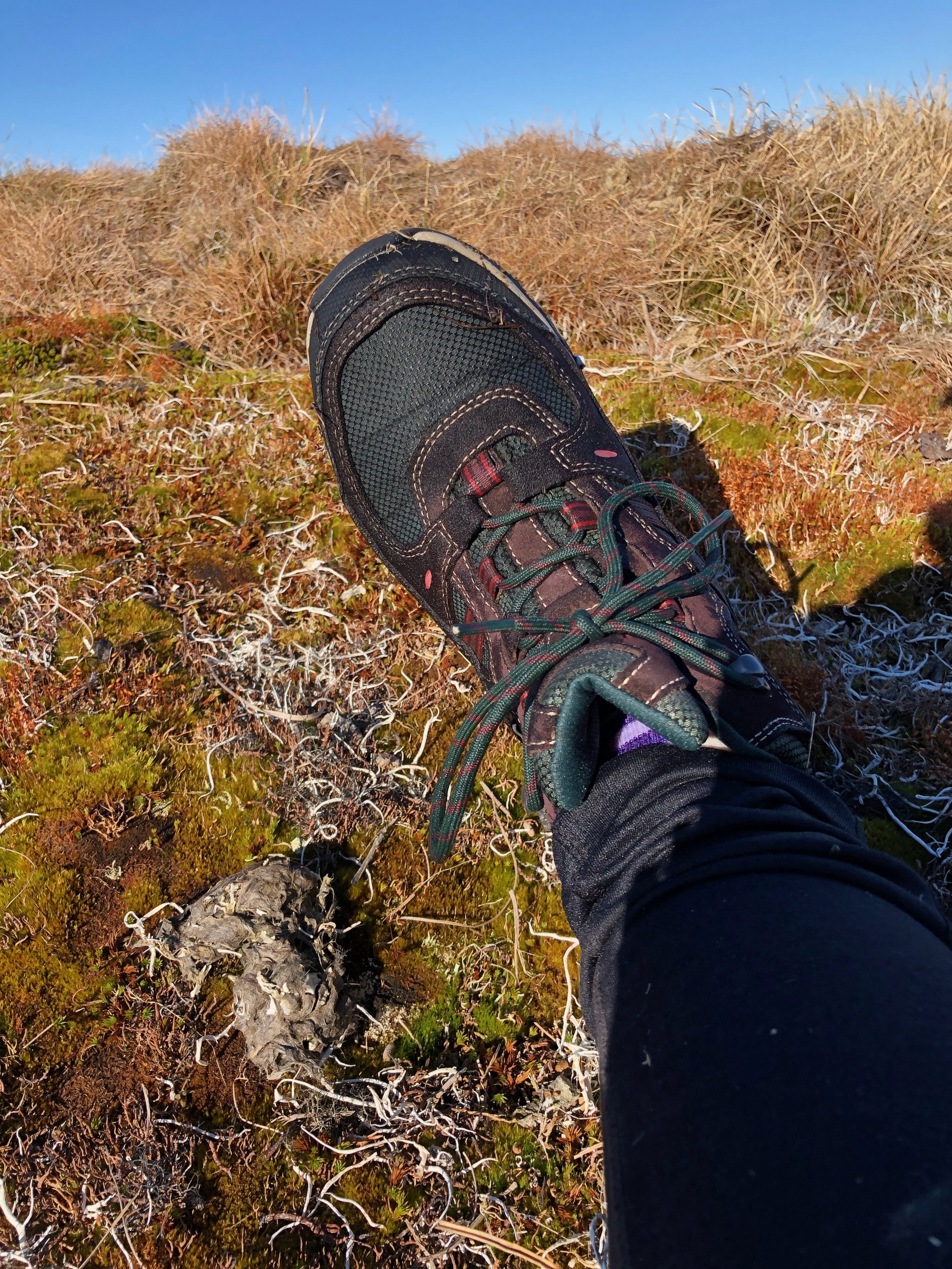
Snowy owl pellets.
Exploring Alaska wilderness is very free form. In many places there really aren’t any trails to follow, you just journey out. The tundra is a spongy wonderland and sometimes you end up in a puddle. As much as this post is about snowy owls, the real fun we were after were all the eider species. As we would work our way towards ponds to get closer to the ducks, we would use small rises to hide our presence. One of my best memories is hunkering behind a rise while a spectacled eider got used to me. The light was tremendously golden at 1:30am in the morning and pectoral sandpipers and snow buntings are singing all around me. I’m high enough on the vegetation that I can sit without my butt getting wet from the spongy ground. I stretched out my feet to enjoy the moment and that’s when I noticed the snowy owl pellet next to my boot. There was also some old white looking streaks of poop. Sometime not too long ago a snowy owl had perched here waiting for prey, digesting its previous meal. I love finding owl pellets and to find them on the tundra similar to how I might find great horned owl pellets in the woods totally delighted me. This pellet was chock full of lemming.

Snowy owl in a Minnesota corn field.
I now have a perspective when I see snowy owls in the lower 48. If you ever have the opportunity or find a bird tour company that will take you up to the Arctic, I highly recommend it. The snowy owls are cool and they are just the tip of the iceberg (ha ha) for all the fun that can be had. But what a treat to see these birds hunting and living in their breeding habitat.
Snow Bunting Nests

Snow buntings flying around a remote road in Aitkin County, Minnesota.
Snow buntings are a fairly regular appearance in Minnesota in winter. It’s one of the birds I will watch for on the way to the bog or birding in the southern part of the state. They are generally in large flocks, skittish, and far away. You’re basically driving down a country road and a bunch of white birds with patches of beige burst off the side of the road as you pass.

Male snow bunting singing on a telephone pole in Utqiaġvik formerly known as Barrow, AK.
In the Arctic Circle, snow buntings are everywhere, practically yard birds and not so skittish. Part of the appeal of working in Alaska for a summer was the chance to explore the state further (I’ve birded Anchorage and Homer), and especially in the Arctic Circle with the hopes of seeing birds like snow buntings, shorebirds, and snowy owls in their breeding range.
When I landed in Utqiaġvik formerly known as Barrow, the northern most point of the United States, the first bird I heard singing loudly was a snow bunting warbling away on top of the airport hangar. They became one of my favorite songs of the trip. Males in breeding plumage are such snazzy looking birds. I immediately fell in love.
Here’s a video I took with my phone, Swarovski scope, and PhoneSkope case so you can hear the song of the snow bunting…and get a sense of the tundra and Midnight Sun:
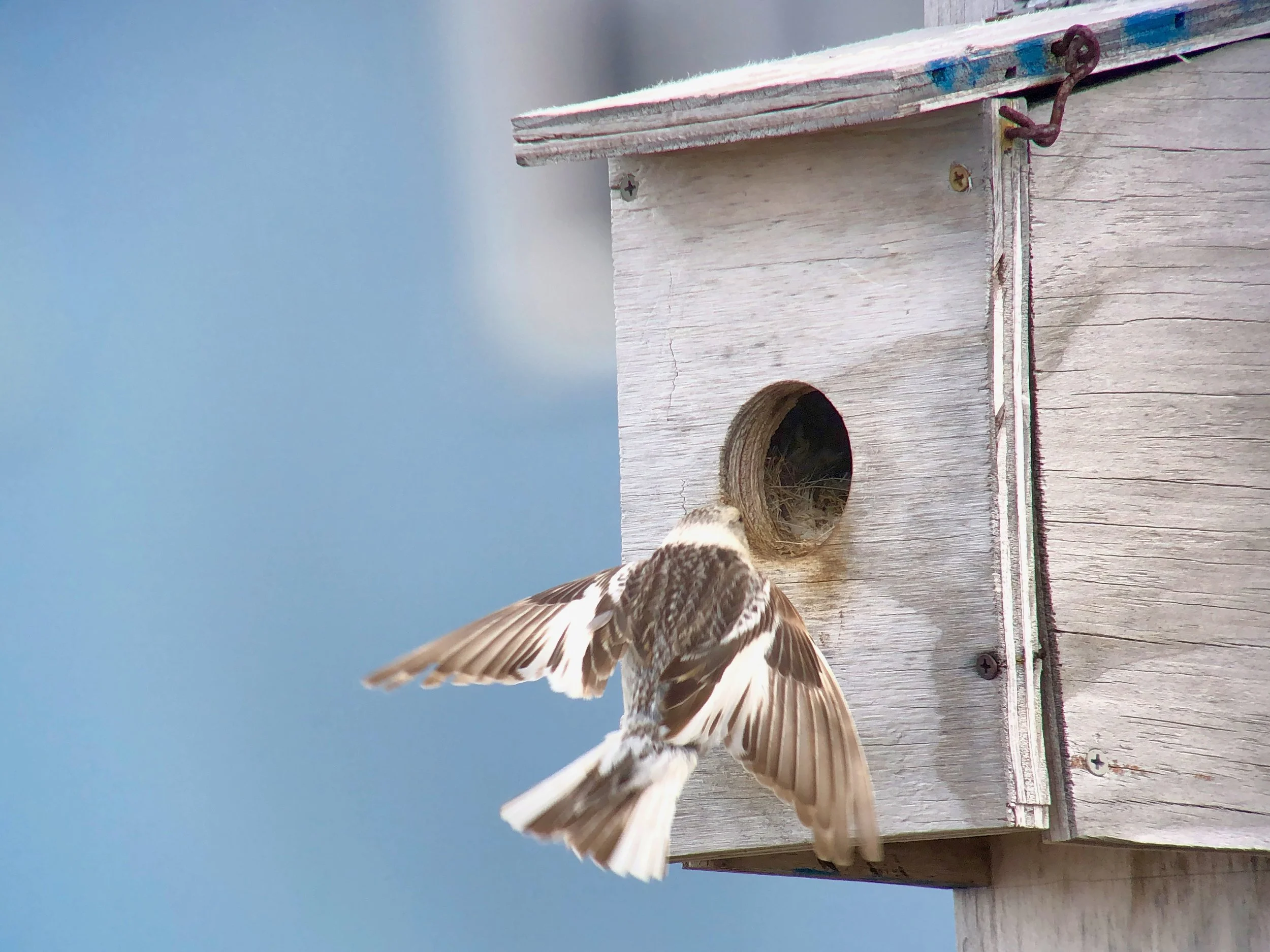
As we drove around the tree-less town, I noticed people had bird boxes in their yards. That was puzzling to me because the tundra is known for not having trees. What possible bird would use a birdhouse or nest box here? Starlings are in the southern part of Alaska but nowhere near up in the Arctic. House sparrows have managed to not get a foothold in the state of Alaska yet. So…in the land of no trees and no woodpeckers, what bird would evolve to nest in a cavity? What cavities would there be? I soon had my answer.
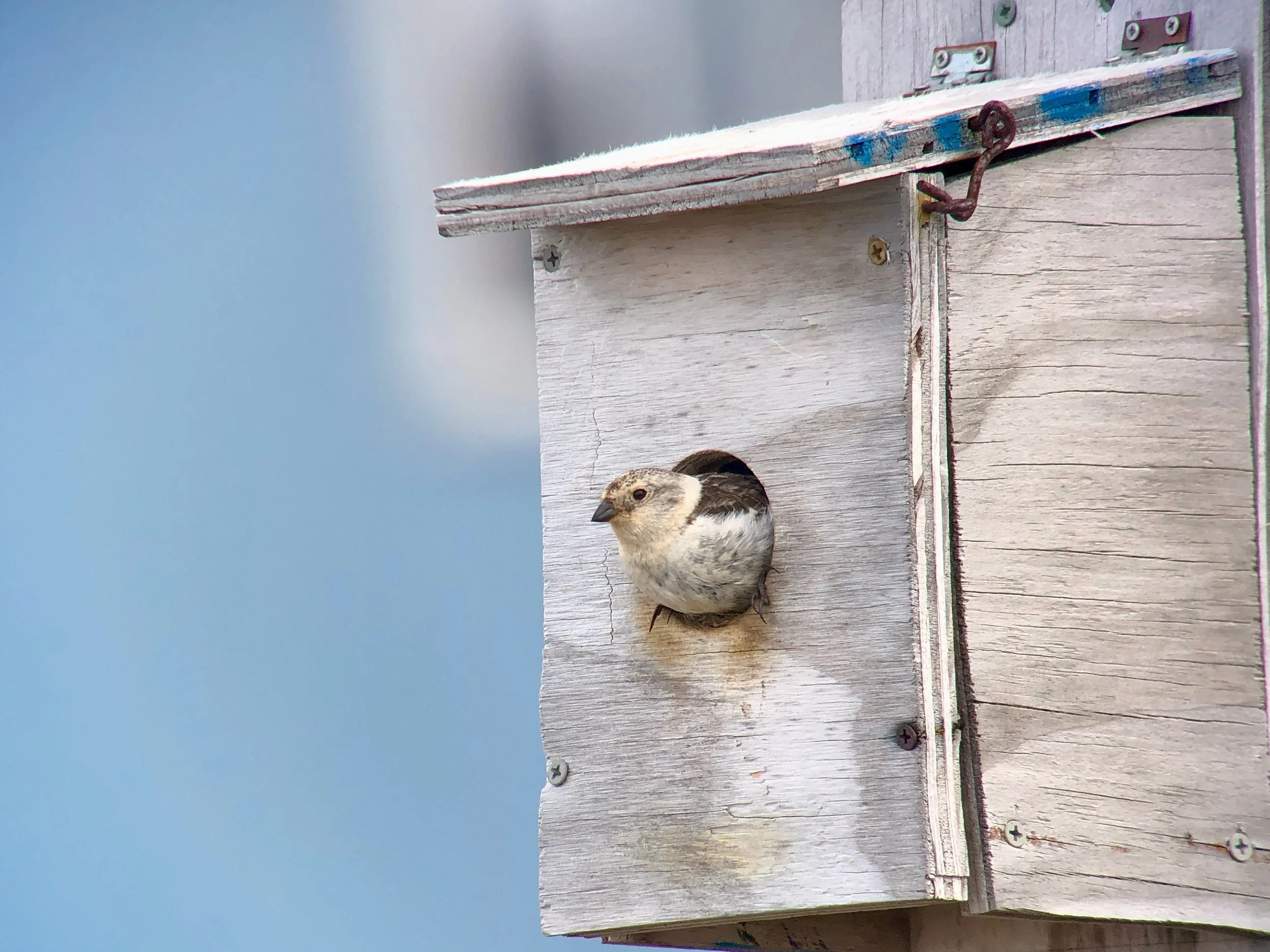
Female snow bunting in a nest box.
Snow buntings used the nest boxes. It never dawned on me that they would use a bird house. But how and why, I wondered. I hadn’t read their nesting section in Birds of the World before I left for the trip. I think I assumed birds in the Arctic were all some form a ground nester.

Lemming tunnels and trails on the edge of of town.
It turns out that there are cavities in the tundra, in the ground made by lemmings. Lemmings are EVERYWHERE and I mean EVERYWHERE. One of our tour participants gave a squeak becase a lemming startled her when it ran over her foot! I did eventually find some snow buntings using an actual lemming tunnel as a nest. I got some slow mo footage with my iPhone attached to my Swarovski spotting scope for some footage. Because it’s slow mo, I cut out all the time she was actually in the nest feeding or this video would be five mintues long.
I did my trip up to Utqiaġvik/Barrow with Zugunruhe Birding Tours which I highly recommend if you like a small group experience.
Getting My Nemesis Bird

My former nemesis.
If you’ve spent time with me in person then you know that spruce grouse is a big nemesis bird for me. Big. Huge. GINORMOUS.
For those new to birding, a “nemesis bird” is a bird that you try to see and never get. You’re always arriving as someone says, “It just flew off, like, five minutes ago…”
Spruce grouse is particularly galling since they breed in Minnesota and yet I still manage to miss them. Now, they are a good four to five hours from where I live so it’s not like I’m missing a bird one to two hours away. I had kind of given up ever searching for them since I wasn’t seeing them and figured like many birds, one would just happen in front of me.
It was such a running gag at Birds and Beers that almost didn’t want to see one since people seemed to enjoy the joke so much. People loved to announcing their grouse find at Birds and Beers and looking pointedly at me. Or tagging me in photos on social media. Heck, even my boss came back from a weekend in northern Minnesota and told me that his brother served him freshly hunted spruce grouse.
I half-heartedly joked that I’d offer sexual favors to the first person to get me a spruce grouse.
And then I started dating a birder, someone with a cabin in northern Minnesota that was about halfway between where I lived in the Twin Cities and where spruce grouse hang out. When the pandemic hit, we kind of made it a pandemic project. Spruce grouse would be a lifer for them. I think we thought that maybe some “pandemic magic” would happen and all the time up north would get us the bird. But there was no pandemic magic. We went to areas where bird guides would say, “I had a group there today” and we’d go the following day and not get spruce grouse. We would see cool things like goshawks or pine martens hanging out, but no grouse.
So when the Alaska gig presented itself, spruce grouse were firmly on the table. As I got to know staff at Denali National Park via Teams meetings before heading to live in Alaska for the summer, word spread of my desire to see one. People would tell when and where they saw them. I’d receive text messages from a staffer of spruce grouse right out their vehicle window on the Park Road. One day, someone tried to arrange their laptop camera to face out their windows so I could watch the spruce grouse in their yard. I have to say that the staff at Denali National Park and Preserver definitely know how to make a girl feel at home. Many staff truly took my nemesis bird more seriously than I did.
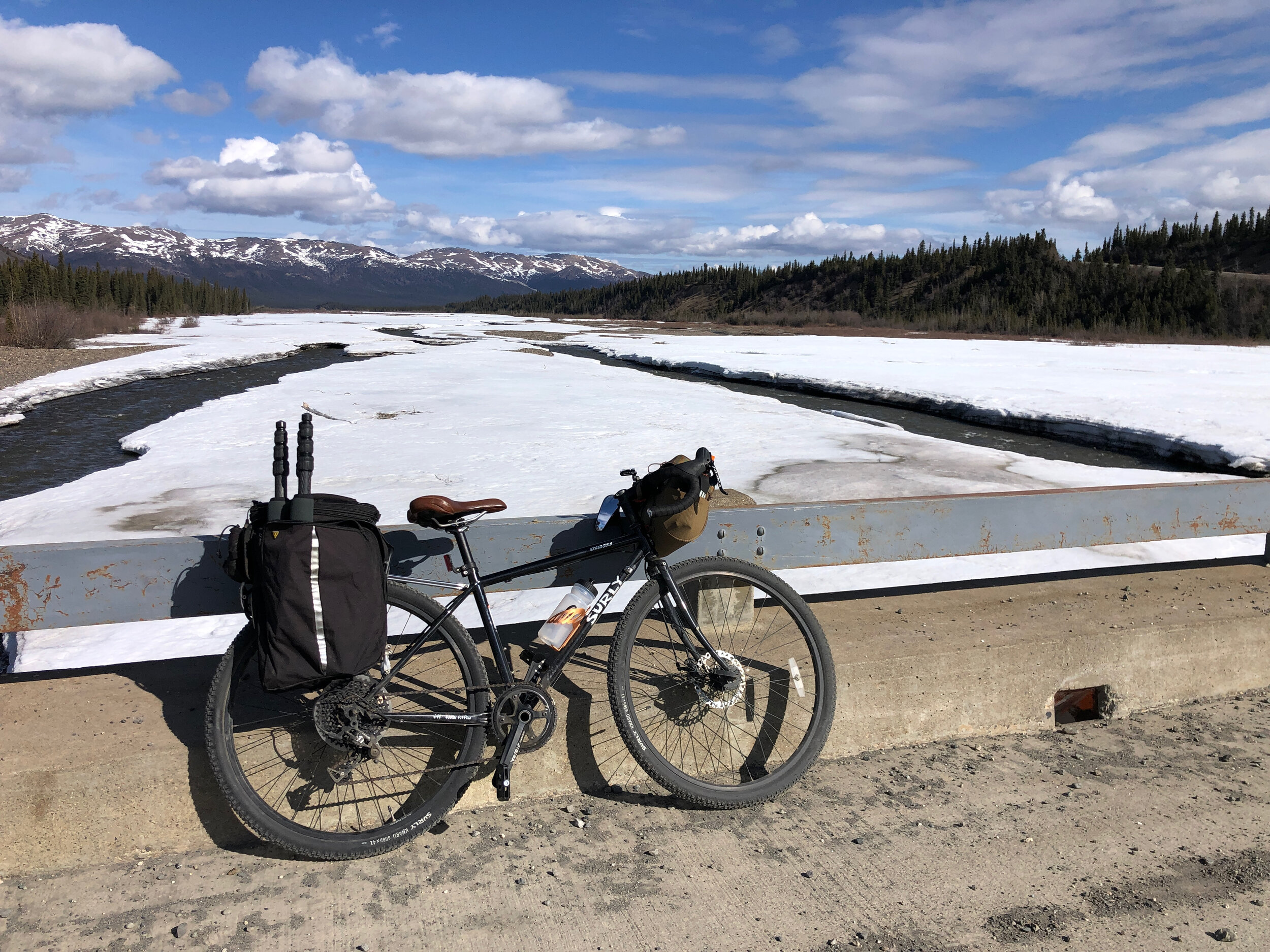
My bike, a Surly Straggler, loaded for birding.
My first morning waking up in Denali National Park, I loaded my bike and my birding equipment in my Prius and hit the Park Road. One of the first birds I got was the willow ptarmigans I already blogged about. But when I was there in early May, the buses hadn’t started running yet and a private vehicle could drive all the way to Teklanika Rest Area and then hike/bike more of the Park Road.
I unloaded my bike from my car at Tek, got my trunk bag on, strapped in my scope and my binoculars and headed out. Yes. I also packed bear spray. I marveling at the beauty of the river and mountains around me, taking in the redpolls and crossbills, thinking how badass it is to be able to say, “Oh yeah, I biked in Alaska.”
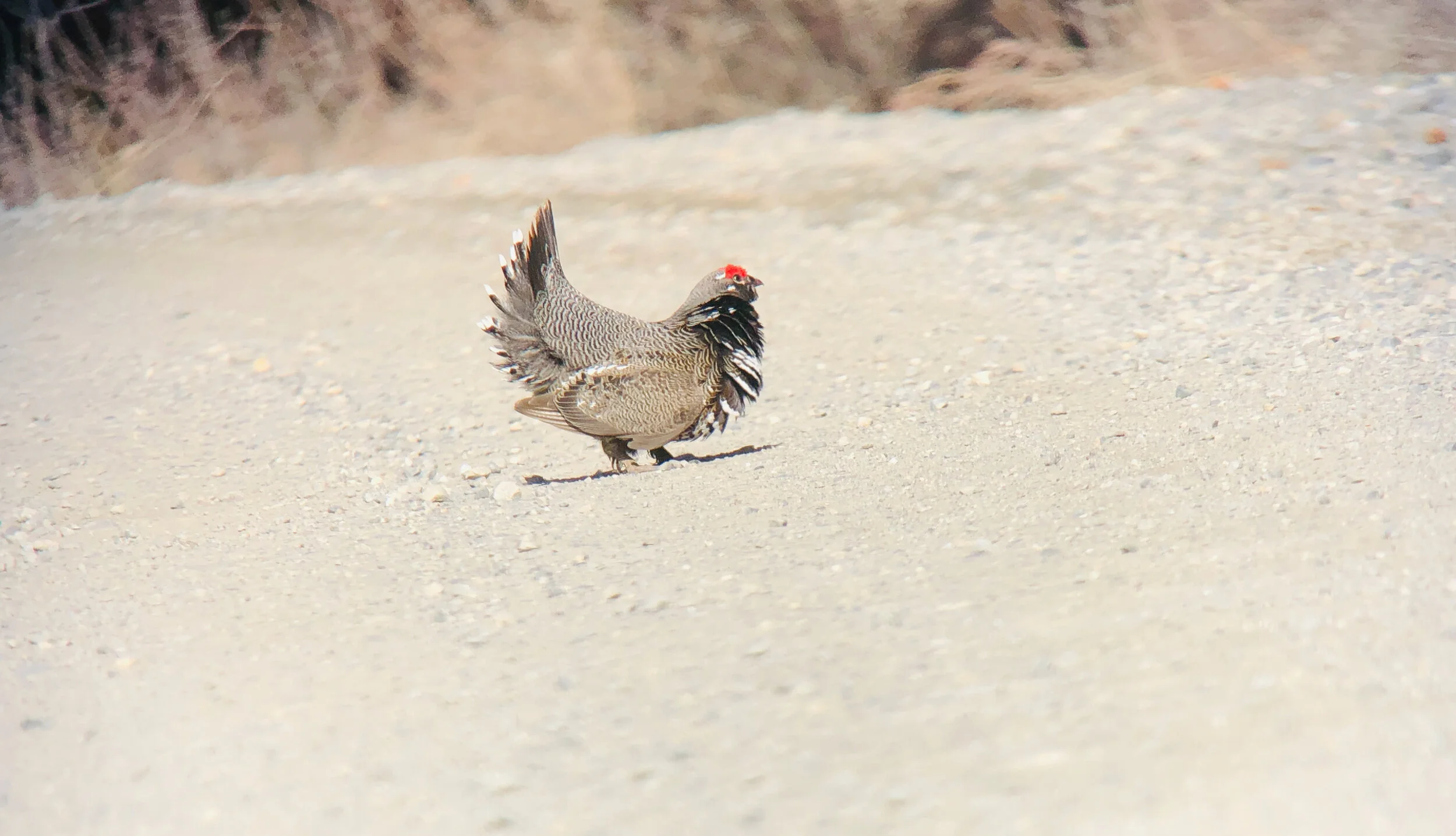
And then the road curved into some spruce and WHAM! I knew the shape as soon as my eyes laid on it. The dark strutting blob was unmistakable. There he was, a displaying male spruce grouse!

That dark lump up the road is my lifer spruce grouse. And yes, please note the bear spray next to my binoculars.
I pedaled as close as I dared and took the displaying male in. I was so grateful for my NL Pures, they truly are a spectacular piece of birding equipment and the clarity of this life bird was overwhelming. I pedaled a little closer, then got off and set up my spotting scope low to the ground to get video of the displaying male. Meanwhile a second male came in…and then a third appeared in the trees just to my right. It took off to chase the displaying male. It was quite a site. I took video and drank in the scene and until all three males chased each other off and headed into the woods.
Warning: swearing. Also, the strut on this bird rivals Prince.

Portrait of a woman who has defeated. a decades long bird curse.
I was riding so high. The willow ptarmigan were one thing, but to just get spruce grouse while doing one of my favorite things (biking) was just too much. I rode the high as I continued to pedal the road. And then I noticed that I was going super slow. I made it all the way to Igloo Campground and was exhausted. My riding was not pretty, slow and quite a few stops. I figured I’d be a little off after driving nonstop for seven days and not being used the elevation, but I wasn’t prepared to be THAT sucky at bike riding. When I turned around to head back, I didn’t pedal for three miles. I’d been on a such a gradual incline and on a spruce grouse high that I didn’t even notice the incline.
The next few days were settling into the job and establishing a routine. About a week into it, I was walking to my office in the Headquarters Building when BLAMMO there was a a female spruce grouse right outside my window. I got a couple of quick and dirty iPhone shots, but I also accepted a universal truth: after you have finally seen and experienced a life long nemesis bird, you will see then everywhere and all the time.
Only I didn’t.
I would’t see another spruce grouse again until almost two months later when the person I’ve been dating came to visit. Spruce grouse was still their nemesis but I wasn’t foolish enough to guarantee finding the bird. But one night we were out walking one of the sled dogs I was assigned to walk (her name is Party and she’s amazing). Party went on point and there was a spruce grouse next to the road! My friend went after it, got a terrible iPhone photo but got great looks. Party was very upset with how the whole situation was handled. She clearly wanted off leash and to follow my friend to get at the spruce grouse, but I think she thought our interest was in eating it, not just looking at it. I could tell from her tugs on the harness that she was thinking, “No, you’re doing it wrong, let me help you, I’ll totally kill it and we’ll all eat it!”
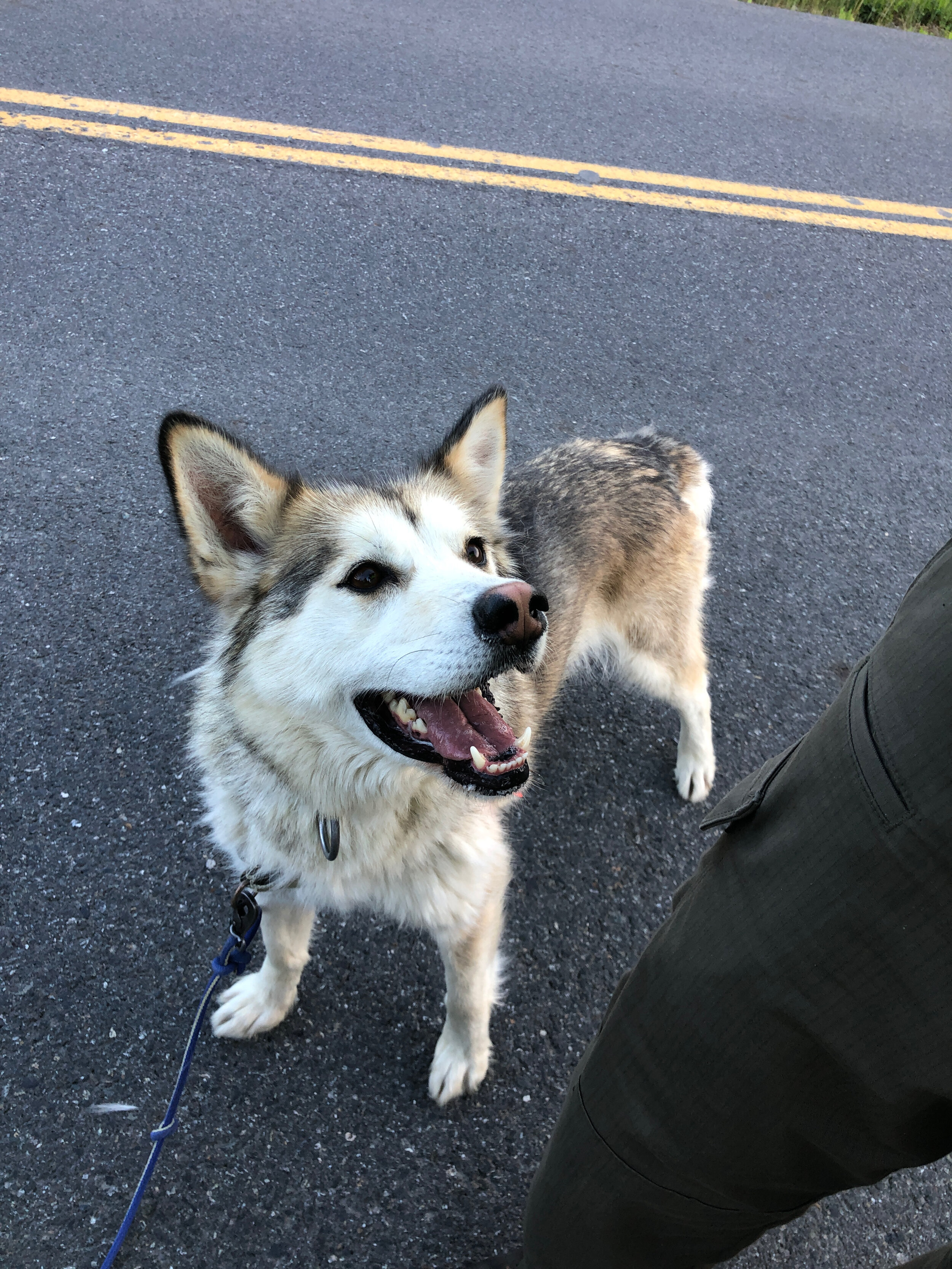
Afterwards as the two of us celebrated a much sought after lifer with whoops and maybe even a slap on the back, I got this photo of Party. She’s so proud that she found the grouse.
And then it was several weeks until I had my fourth and final spruce grouse encounter. I made a reputation for myself among staff that if you needed to leave town and you had indoor plumbing (especially a bath tub) I was happy to watch your place and feed your pets.

One of my regulars had a cabin in the woods with a jacuzzi. One day, I noticed birds about the size of a thrush running in the grassy driveway. I was ready to dismiss them at Swainson’s thrushes, but the run was wrong and the shape…wait…that’s kind of a young pheasant shape…no pheasants in Alaska…wrong habitat for ptarmigan…what else…holy crap…SPRUCE GROUSE BABIES!
And there we were. All of us frozen. The grouse realizing something was moving in the driveway that hadn’t been moving before. Me, frozen hoping not to disturb them. Eventually the attention span of youth won and the chicks continued to forage while mom kept a watchful eye on me. I tried to play it cool and grab my scope from inside the cabin to get pictures and video.
And there we have it, I had a perfect nemesis/life bird experience of the summer:
I found a displaying male bird on my own while doing something I love like bike riding.
I got a female outside my office.
I got to show someone else who needed spruce grouse (with the magic of a sled dog).
I got to see a female with chicks.
Who knows if I’ll ever see one in Minnesota. And goodness knows that I have received plenty of good natured ribbing that I can’t really count spruce grouse until I’ve seen them in Minnesota.
But the big takeaway that I have is that some birds just need to happen. You can chase them all you want, but at the end of the day, the only way to get them is to let go and just let them happen. And when the time is right, they eventually will happen for you.
Sounds of Willow Ptarmigan

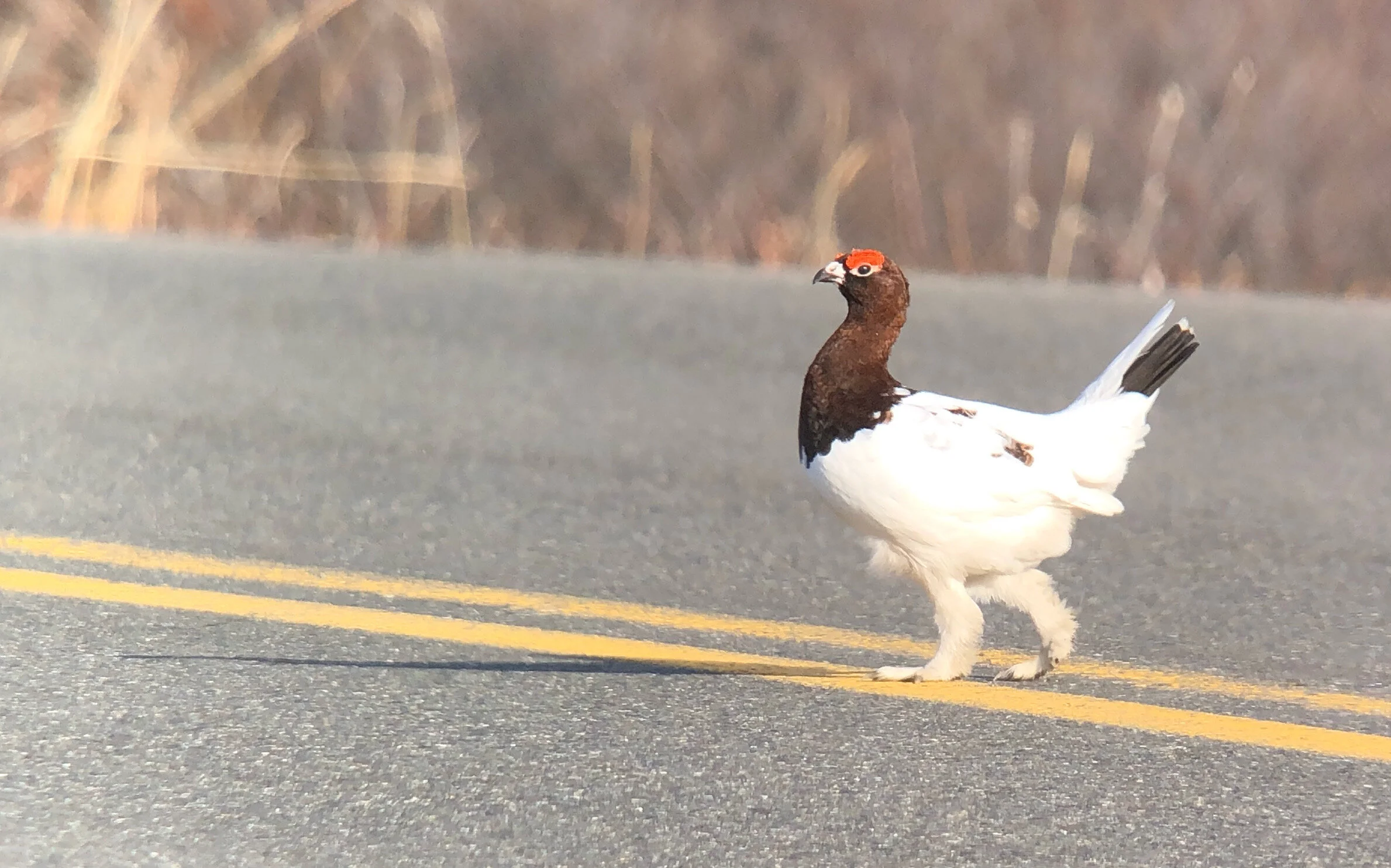
What does a willow ptarmigan sound like? Utterly bonkers!
When you work for the federal government, you occasionally have opportunities to apply for “details.” If you are permanently stationed at a park and another park has a temporary staffing need, you can apply for it and work there for a few months. This is meant to help out a park as it rehires a new position. It also gives the person who gets the temporary job some career development—you can use it as a chance to work for a different type of park or to try out a different type of job.
Given all of the change in my life in the last few years, I saw an opportunity to work in Denali National Park and Preserve for the summer and thought, “YES! I want that please!” Part of it is a desire for change but also two birds I’ve always wanted to see are practically guarantees if you go at the right time of year: willow ptarmigan and my long-time nemesis, the spruce grouse. So I applied and then bada bing, bada boom I found myself in central Alaska in early May, living in a cabin in the park.
The morning after I arrived in Denali, I hit the Park Road in search of ptarmigan and places to ride my bike. I only went a few miles to where I hit subarctic tundra and there in the road was a male in all his ridiculous glory.
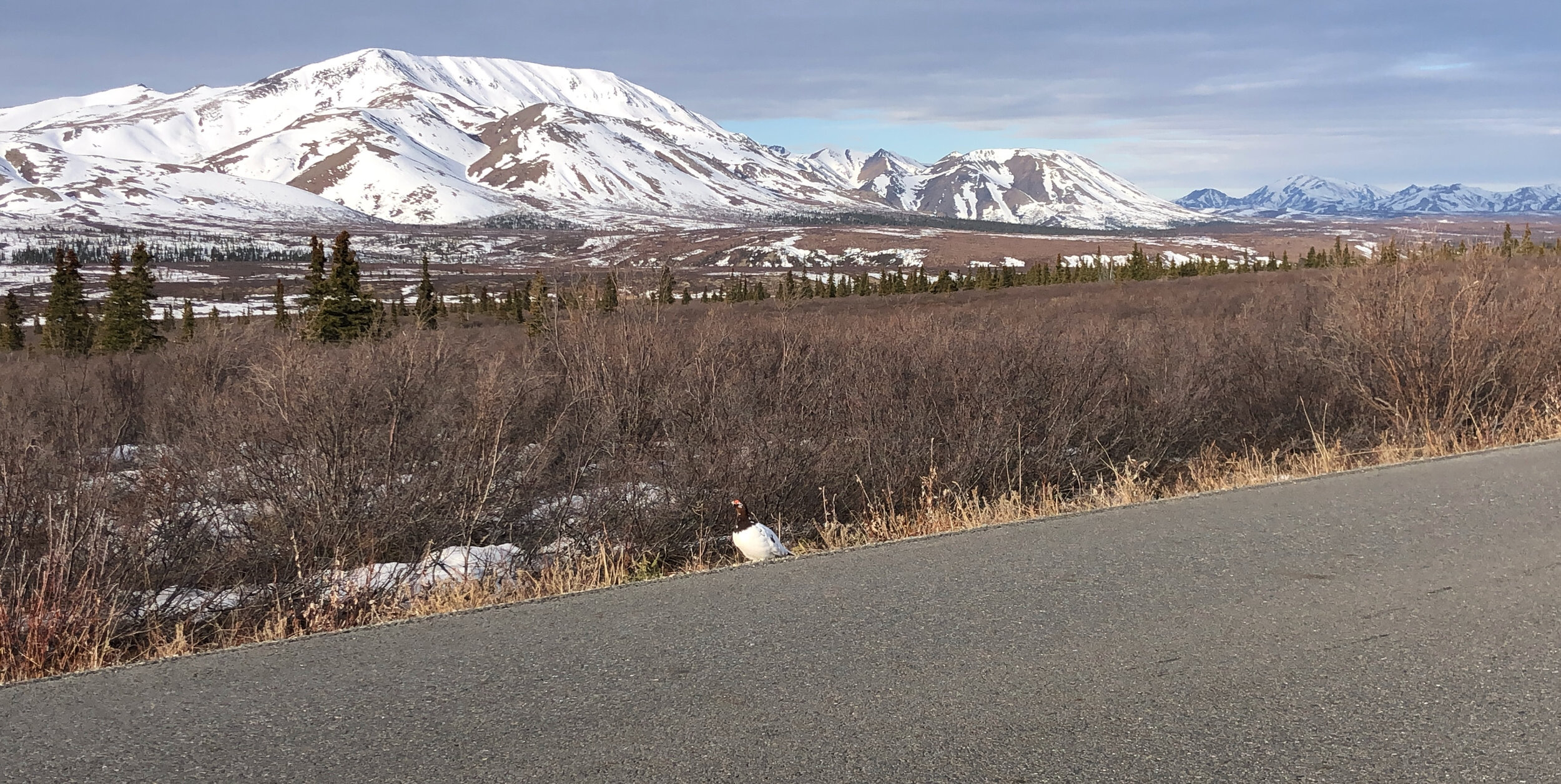
Life bird with a view!!!
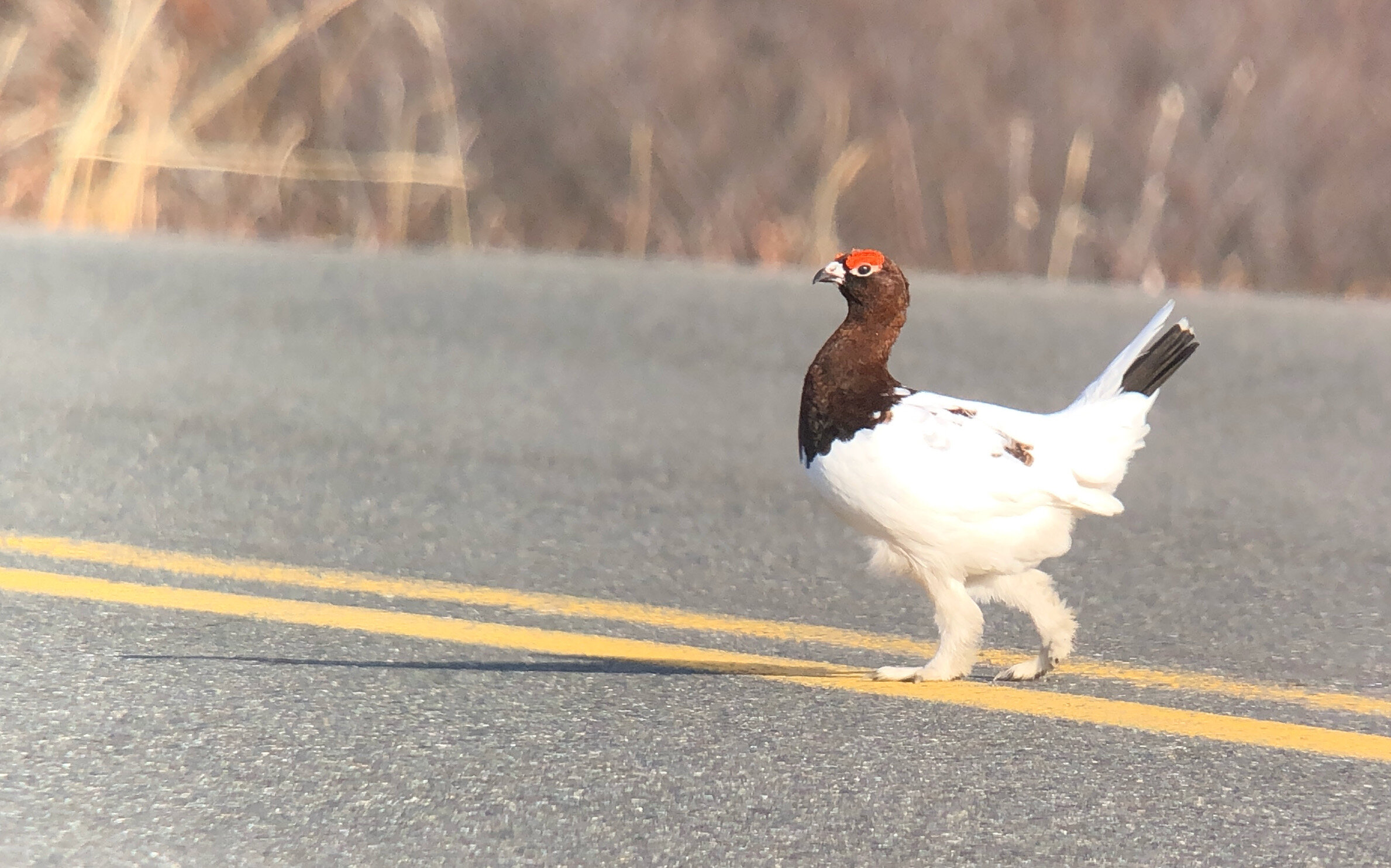
My first ever willow ptarmigan strutting like a boss in front of my Prius. And yes, I drove a Prius to Alaska from Minnesota.
I pulled over and the ptarmigan immediately began singing me the love songs of his people. I was thrilled, elated, swearing with all the lifer joy a birder can feel. There was another male further away perched in a tree—I WAS NOT PREPARED FOR PTARMIGANS IN TREES! I made myself comfortable to listen and bask in this bird’s “song.” I ended up encountering willow ptarmigan on a regular basis in May and June along the Denali Park Road. One day I biked up to Sable Pass and was surrounded by males chasing each other. I wasn’t prepared for their even sillier chase call. I made a compilation video of their sounds. It’s so strange to be in land that is crazy majestic only to be serenaded by the likes of Looney Tunes.
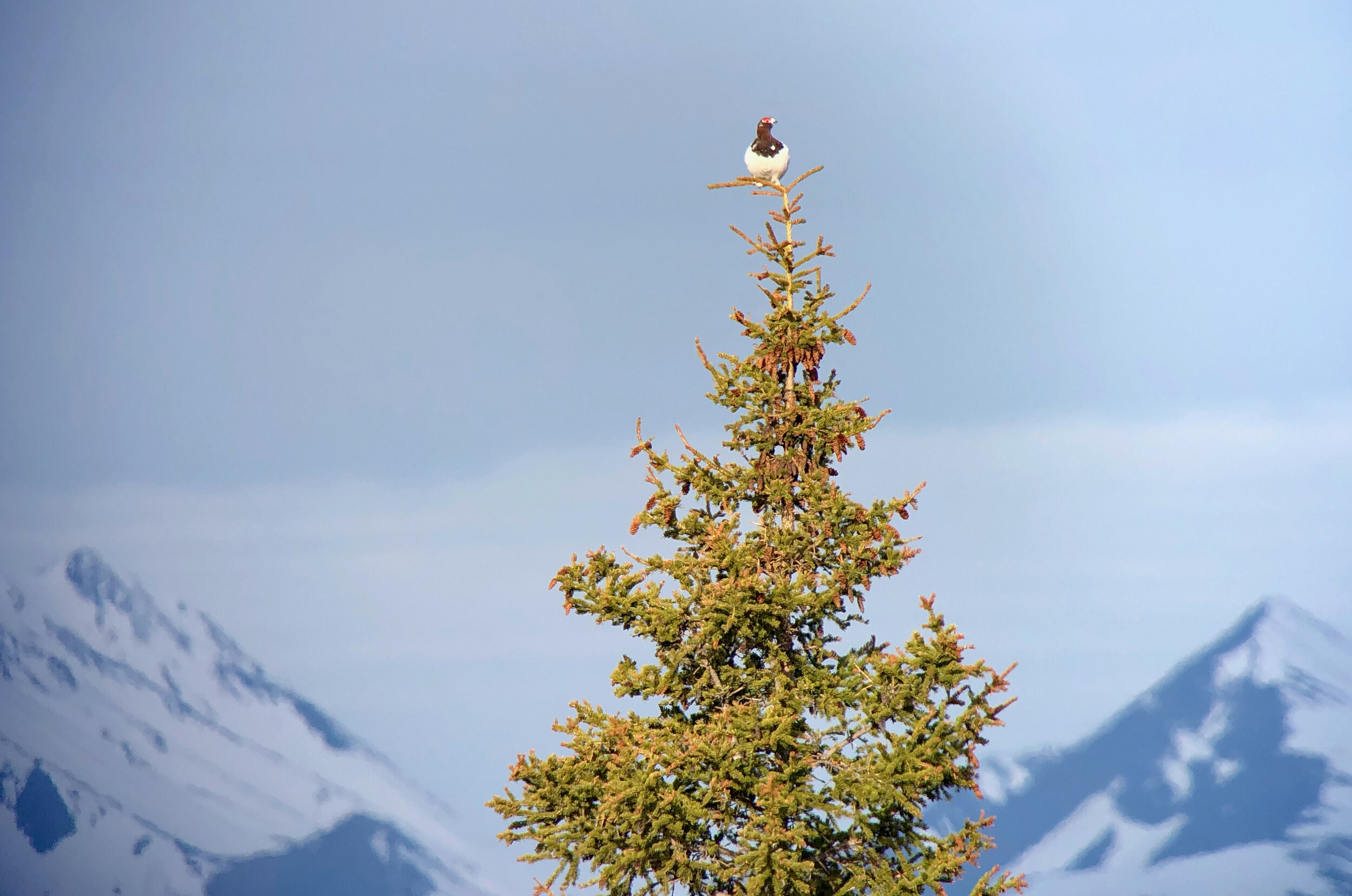
My first day in Denali and my true love gave to me, a ptarmigan in a spruce tree.

This is the face of a woman who has finally heard willow ptarmigan live and in person and it was as glorious as she always imagined it would be.
Betrayed By My Government Pants
It was the best of times, it was the moistest of times...2016 was a difficult year for me for a variety of reasons. Here's one of them. Warning, this post is quite possibly a little bit TMI.

We get a good mix of people at the Big Watch event.
One of the things that I love about my job is the opportunity to host a couple of big birding parties throughout the year. One is called the Big Watch which I do with the help of some birders in Washington County, Minnesota in the spring. We go to Grey Cloud Dunes Scientific and Natural Area and tally all the birds we see and hear from sunrise to sundown. In 2016 it was a chilly but fun filled day. This was my first time hosting an event like this outside of the Twin Cities metro and was happily surprised we ended up with more people showing up than birds on our list--it was a good list that ended with 87 species.

Brown thrasher seen at our Big Watch event.
Even though it was chilly, Grey Cloud can be full of ticks and I'd taken the time to treat my ranger uniform with permethrin. The day after the Big Watch I woke up with an itchy welt on my left butt cheek. I didn't think too much about it. I figured a mosquito must have gotten through my ranger pants. April and May is an insane time where I try to balance ranger work with bird festival travel all while enjoying spring migration. I'm on the road more than I'm at home. The bite continued to itch and swell a bit more and yet I continued to ignore it. I noticed that the swelling was getting a little harder, but still paid it no mind because I had paperwork to file and suitcases to pack.
I woke for my flight to Ohio four days after the Big Watch and noticed that my pajama bottoms were stuck to my butt cheek, specifically to the area of the bite that had been oozing. Just what everyone wants to wake up to, a crusty oozy butt cheek. The welt also felt three times the size it had been on Monday morning. I asked Non Birding Bill to do his spousal duty and take a look, worried that perhaps I'd finally gotten a tick bite with Lyme disease. Pulling down my pants I asked him, "Hey, do you see a bullseye-type welt on my ass?"
"No, but wow. That doesn't look good at all," he said, concern in his voice.
However, I had a flight to catch and no time for a doctor. I covered the area with copious amounts of Neosporin and a large bandage and then headed to the airport towards the Biggest Week in American Birding. I figured I would try to squeeze in a doctor's appointment when I got home, before I flew off to Alaska. In my brief flight from Minneapolis to Detroit, the bandage was soaked through and the oozing went through my tights onto my skirt. It also seemed to have gotten larger during the flight and the skin was hot and hard to the touch. I realized that I was in over my head and this ass situation was no good. I needed a doctor sooner rather than later.

Is this Cape May warbler wondering what's wrong with my butt?
I headed straight to Maumee Bay to check in to my hotel room and frantically scan the Internet to find a doctor in my health plan's network. I could hear delightful spring warblers and vireos in the trees, but I was on a mission. I wondered how I was going to check in quickly and make it to my room and not have anyone notice what was going on with my rear end. I love festivals because I run into so many far flung friends who want to hug and chat. There's nothing like an oozy ass to make you want to not be touched or even be friendly. I decided I would avoid eye contact as much as possible and be a merlin--look like I'm late for an appointment and dash through the vendor area to my room. The plan worked and when I got to my room I googled away. I found a Minute Clinic that was nearby and in network. I snuck out the back way of the Maumee Bay to avoid people and drove over to the clinic.
I knew after she examined me and went straight to typing on her smartphone that I was in trouble. She was using a symptoms app and when she found the answer she was looking for told me, "I'm going to call the local emergency room and urgent care and whichever has the shortest wait is where you're going. You need help now."
I protested and said, "Let's go to the one that's in network, I'm not made of money and want to avoid an out of state hospital bill."
Urgent care it was.
The doctor was very kind and said, "You have a staph infection which has led to cellulitis. Without doing a test I can't tell you for sure that it's MRSA but we're going to hit you hard with antibiotics. Oh, and stop scratching it. You may want to followup with your doctor at home."
My main concern was the nonstop oozing and I asked what she could give me.
"That's going to take a few days for the cellulitis to go away. In the meantime you can get the expensive surgical pads, but I recommend you use Maxi Pads since they're so much cheaper and as a woman you know how absorbent they are."

One of my first birds at Biggest Week, an American woodcock. It's not looking at my butt...is it?
I filled my prescription, loaded up on all the anti-itch cream I could find and...Maxi Pads. After returning to my room to get everything situated, I headed out to Magee Marsh. When I got to the parking lot I sat in my car awhile. I was stupidly worried and self conscious, would people see me walking around with a bulge on my butt cheek and wonder what was going on? Would the infection keep oozing and then go through my pants? Would I be able to enjoy the birds or just keep thinking of all the terrible things that are happening to my butt?
However, seeing my first American woodcock of the day and catching a glimpse of a northern parula took my mind of my behind. Birding has always been magic like that for me. Then I noticed something...

During spring migration, the only butts people watch are warbler butts.
It was spring migration. No one was look at me, let alone my ass. Birders watch the trees for warblers. Thank goodness!
I started to ease up and ran into many friends...including former nurse Patteye who I'm pretty sure I overshared, but boy did she help put my mind at ease. As I continued with my festival duties, my butt situation didn't appear to be getting smaller, but it also didn't appear to be growing size anymore so that was hopeful.

My view in Homer as I foolishly googled worst case scenarios for staph infections.
Monday I flew home, did some park service work and then Wednesday I flew to Alaska. I realized that I was creeping up on the one week mark from my diagnosis and that my backside was as weepy as ever. After I checked in to my cabin in Homer, Alaska I took in the view for a bit then settled down with some Jameson and the Internet to read more about staph infections and cellulitis while hermit thrushes and golden-crowned sparrows sang late into the night, because nothing alleviates medical fears like reading Web MD while jet lagged and drinking. After about thirty minutes I was convinced that I was going to have to have an emergency assectomy in Alaska and wondered how it would affect my ability to work and go bike riding. And were there any hospitals in network in Homer Alaska.

Seriously, I had white-winged scoters (including an albino) and sea otters outside my cabin and all I could do was lament over my backside my first night in Alaska.
However, as luck would have it my friend Lynne came along to this festival and I remembered she worked in a lab at a hospital and maybe she had some insight on staph infections. Mercifully I had enough decorum to not drop my trousers and ask her to look. She told me that whatever was going on back there was going to take several days to clear up, to avoid scratching it and take all my meds even if I thought I was better. She also reminded me that she was there and things would be ok.
It also helped that there were so many amazing birds in Alaska. It never ceases to amaze me how I can take a break from whatever problem I'm having by watching birds.

I enjoyed some quality time as my infection appeared to go away.

Parasitic jaegers bombing out to see are a great way to take your mind off your troubles.

The song of a Pacific wren echoing through the woods is another great balm for the soul.
Twenty-four hours after chatting with Lynne and enjoying some birding field trips, time with friends and teaching outdoor workshops while hermit thrushes fluted in the background I finally noticed that the antibiotics were making headway with my infection. I was going through fewer pads and the affected area was getting smaller.

It's not every day you get to see the orange crown on an orange-crowned warblers. This dude stayed put long enough for my digiscoping workshop that my participants got photos of it.
I enjoyed my time in Alaska, I made it home to Minnesota. I finished taking my meds and the oozing stopped. Things were a little pink back there, but it was definitely on the mend. I went back into my uniform into work.
Twenty-four hours later the oozing began again. I went to the doctor and explained everything that happened over the previous weeks and he assured me not to worry that we would treat it with even stronger antibiotics. I asked how I could be getting it and he said, "Staph can be anywhere. Even on your body. All it takes is an open area on your skin for it to get in. And stop scratching."

Spring migration continued while I wondered if my behind would ever be normal again.
The week long antibiotics did the drink. Everything was fine. Until I did another ranger program and the next morning a small, itchy oozy bump appeared. I hightailed it again to the doctor. He seemed more concerned this time compared to last time and we tried a different antibiotic. "I can't say without a test that this MRSA but if it keeps coming back we may have to look at some alternatives."
With this third visit, I noticed a common denominator. Every time I wore my ranger pants I got the infection back, no matter how many times I washed them. There was a part of me that wondered if I had developed an allergy to my ranger pants and I'd get a special dispensation to never have to wear those polyester wool monstrosities ever again. But before I could say it was an allergy for sure, I knew I had to burn my old pants and order a new pair.
The final round of antibiotics did the trick. After living life in my new ranger pants I haven't had any issues again. All in all I lived with this for three months. I was reminded of what a weird biological experiment our bodies are and if I had this infection 100 years ago would I have even survived?
Anyway, I'm grateful to friends who kept me calm and to all the birds that took my mind off of it.
Birding Around Homer, Alaska
There is never enough Alaska to be had. I loved exploring Homer so much, I'm already eyeing a tour offered by Zugunruhe Birding to Barrow next year.

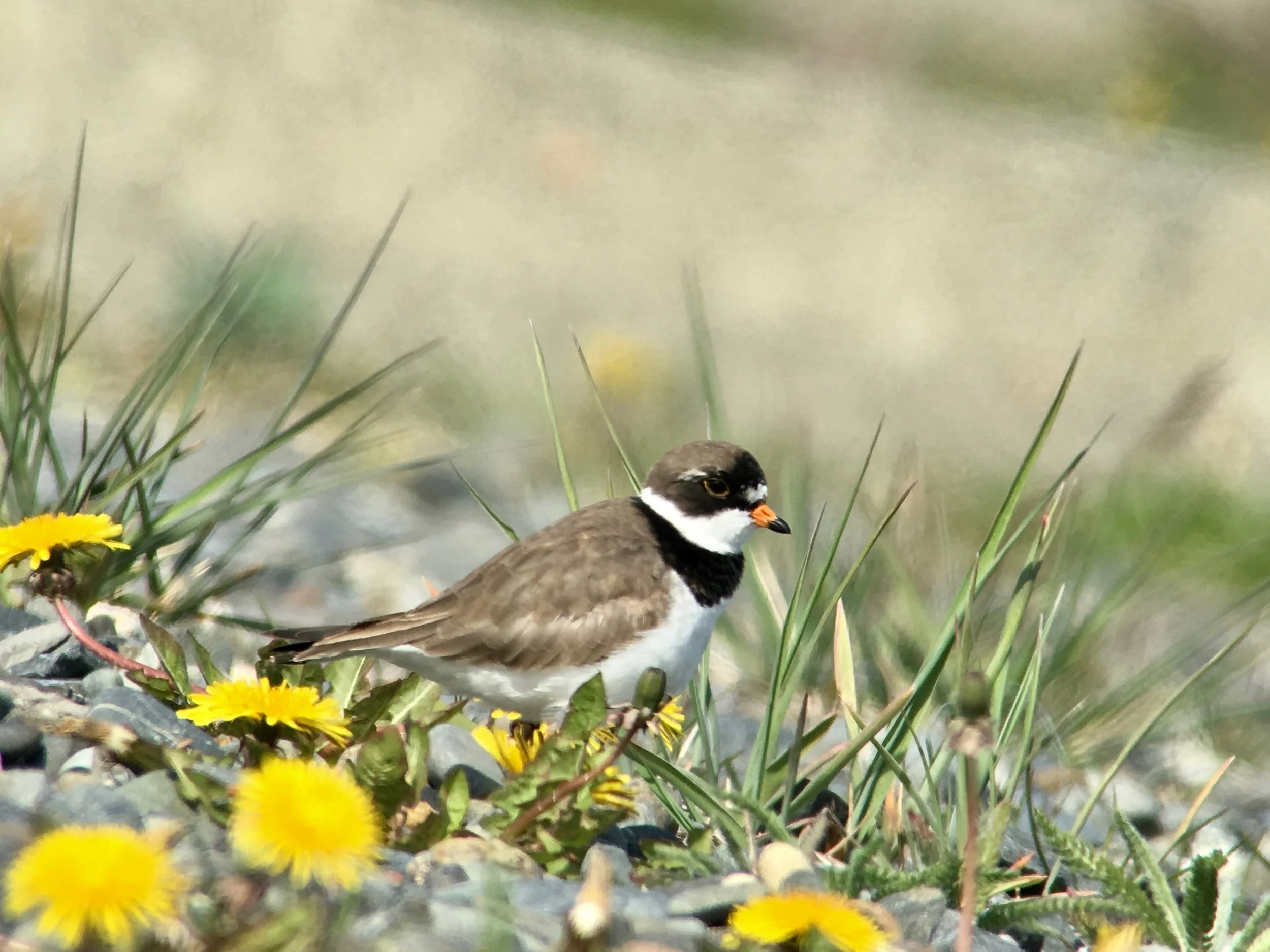
Semi-palmated plover seen along the Homer Spit.
Alaska is one of those states you can't say no to when it comes a callin'. It's so far from the lower 48 states I was the speaker in 2016 for the Kachemak Bay Shorebird Festival and it was a place I immediately felt at home. One thing that struck me about the area was how much it reminded me of northern Minnesota if it had mountains. I met quite a few people who were originally from Minnesota and Wisconsin, came to Homer for work with the intent to stay for three years and yet found themselves in Homer going on 16 or more years. I could see myself doing that...not so sure about my city loving husband, but me? I'd for sure give Alaska a go.
The state of Alaska is so huge, you need more than one visit or the opportunity to live there to really get to know all of the different areas. It's beauty is overwhelming and the day length is unnerving.

Everywhere you look in Alaska you see a Bob Ross painting. This is Chugach National Forest, Moose Pass between Anchorage and Homer.

My foot compared to a moose track.
I wondered how quickly I would see a moose on my drive from the Anchorage airport to Homer. I had to stop at a few scenic vistas on my way because I was not focusing on the road but the overwhelming beauty. Everywhere I stopped were signs of moose from tracks to poop. We have a small and dwindling population of moose up in Minnesota and I went on a moose safari in Sweden a few years ago so they aren't new for me but are always cool to see. I have a fairly distrust of moose on the side of the road ever since I saw the episode of Mythbusters that pretty much said you're boned if your vehicle collides with one.

Moose blocking traffic in Homer.
The closer I got to Homer, the more moose I saw: in the road, along the road, running along side my vehicle...which was quite nerve wracking. And signs like these didn't ease my mind. But I made it to Homer without incident and picked up a few lifers along the way.
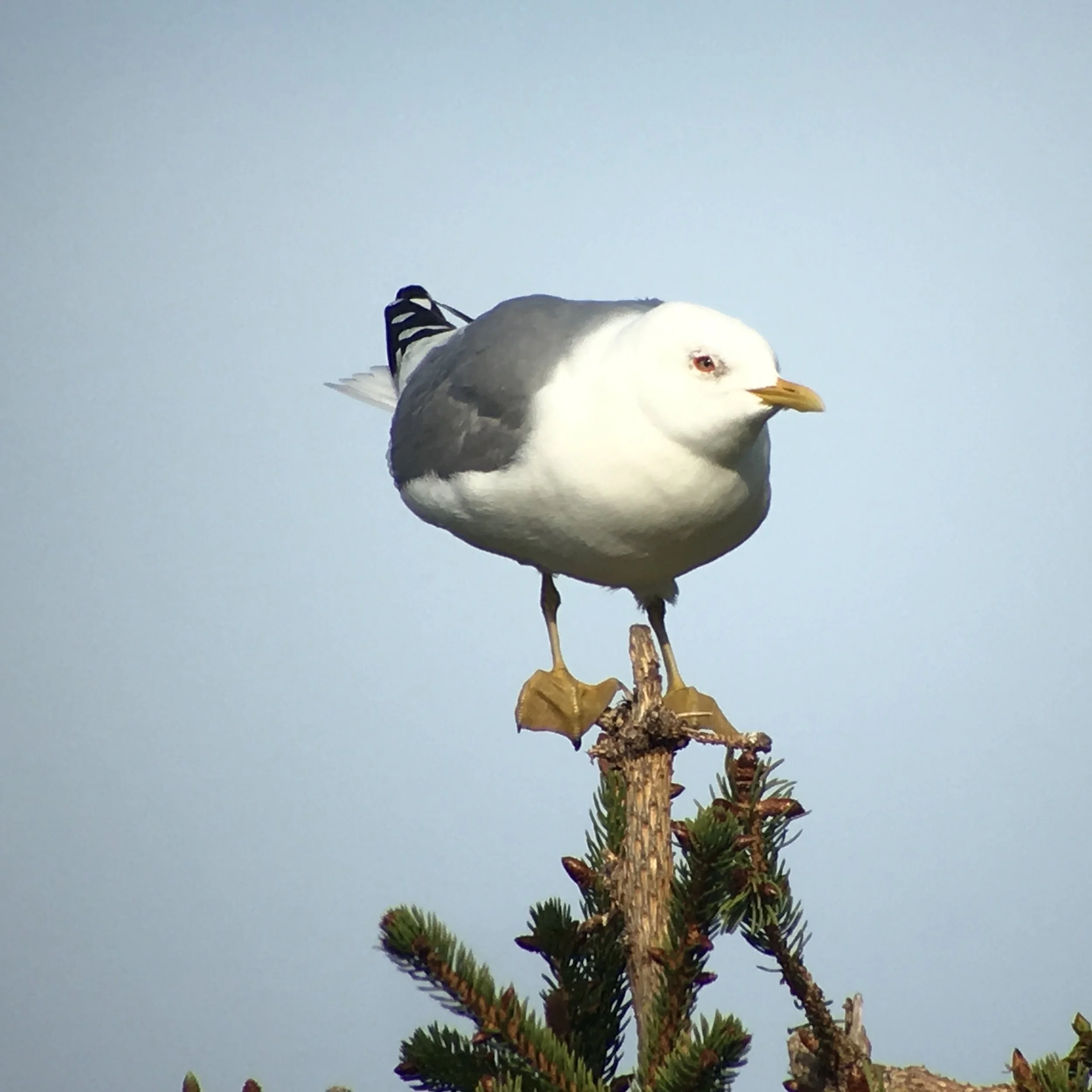
Mew gull...so weird to see a gull perched in a tree and also weird that I was able to id a gull on my own...

Golden-crowned sparrows sang all around my cabin.

The light at 10pm in Homer in May...
I checked into my cabin at Shadow Star Vacation Rental which was right on the bay and gave me views of scoters, sea otters and of course lots of bald eagles. Golden-crowned sparrows, sooty fox sparrows and hermit thrushes serenaded me as long as it was light out. Which was a bit of a problem for me. I tend to wake up with the light and the cabin had excellent light blocking curtains so when it was still dusk like at 11pm I'd have a shot at sleep. However, the hermit thrushes and sparrows kept going and my brain refuses to turn off when bird song is going, especially gorgeous songs from thrushes or birds I haven't heard before. But fortunately, Shadow Star offered the most comfortable bed I've ever slept on in my life and that combined with noise cancelling headphones playing white noise allowed me sleep.

The Sourdough Joe breakfast at the Fresh Sourdough Express. There's fresh reindeer sausage in there so I had to order it.
After a good breakfast, I explored Homer and what it had to offer for birding, specifically along the spit. This area was infamous for years for the Homer Eagle Lady who fed chum to hundreds of bald eagles. Since she's passed away, Homer now has very strict rules about feeding birds along the spit. Apparently, there are some after effects of the feeding like black-legged kittiwakes now nesting under the piers so as to not have their nests predated by eagles.

One of the piers where kittiwakes seek shelter from eagles.

Black-legged Kittiwake up close.

That's not to say a kittiwake colony doesn't attract attention. Here's an immature peregrine falcon and northwester crow near the kittiwakes. Eagles still abound as well.

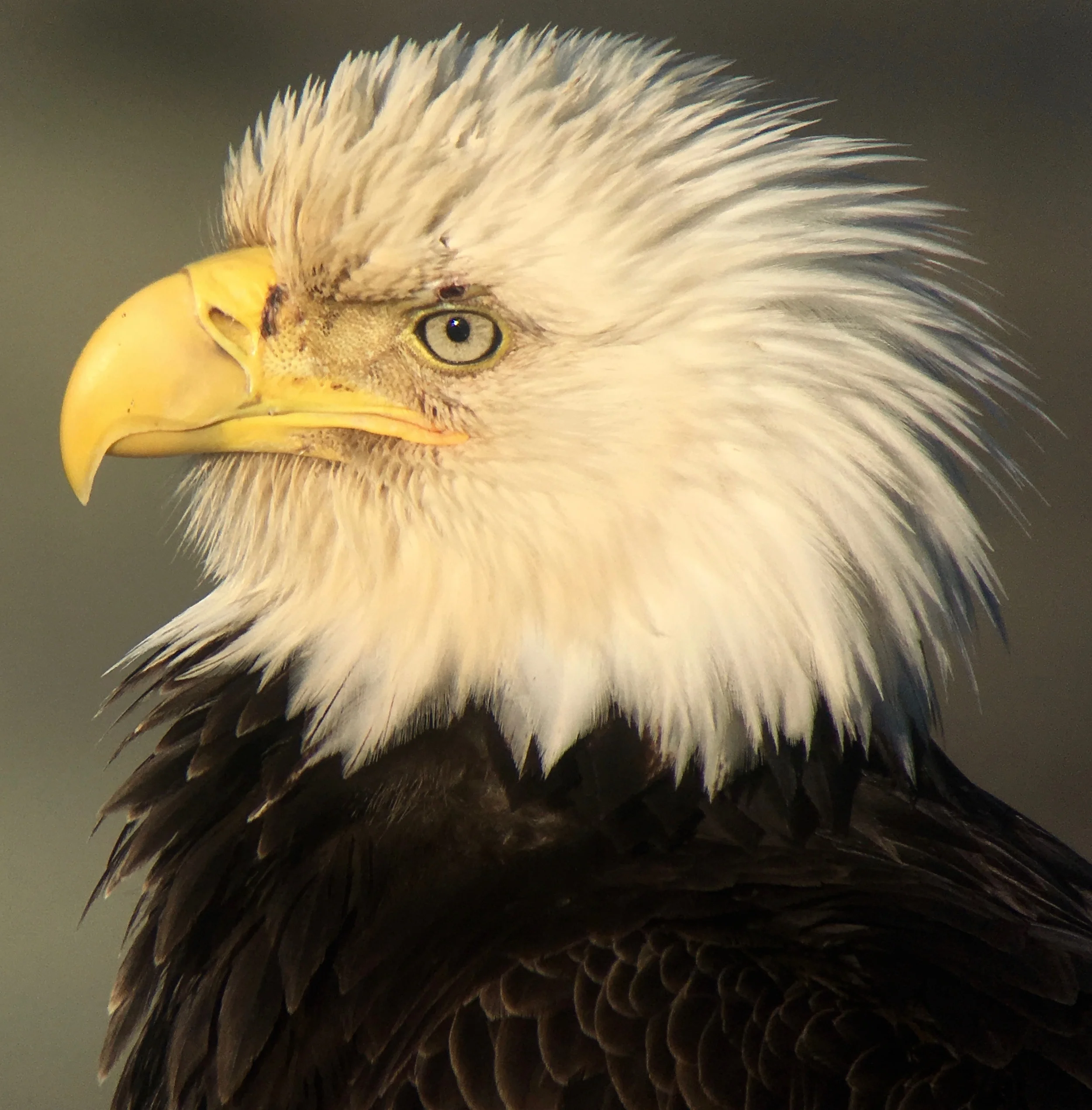
Obligatory bald eagle photo from Homer. They pretty much nest on anything that can find. You might be at risk if you stand in one spot for too long.

Black oystercatcher seen along the Homer Spit.
You may have noticed that I attended a festival with "shorebird" in the title and I've posted very few photos of shorebirds. I went in 2016 and the timing of the festival and shorebird migration didn't quite coincide. Such is the nature of migration and weather. Though I didn't get the big numbers of godwits, sandpipers and plovers, there are plenty of birds to keep you entertained and to fatten up your life list.

Common murres against the sun taken from a boat.
One of the field trips you will want to make sure you get a space on is the seabird trip. It's only three hours but you can head out to a common murre colony and find eiders, common and Kittlitz's murrelts. It's also a gorgeous way to experience the Homer Spit view. If you're not sure how you would ever do on a pelagic, this small trip and a good way to test out your sea legs. You get quite a few opportunities for seabirds and shorebirds.

Common murres and black-legged kittiwakes on Gull Island. Digiscoped from a boat. The iPhone is a very forgiving camera.
I like the above video because it captures the frenetic activity of the birds and the adventurous air on a boat birding trip. Just walking around Homer can feel like an adventure, but the sights, the wind, the roar of the common murres and kittiwakes yelling overhead combined with the aroma assaulting smell of copious amounts of bird guano just adds to it.
But that's just the birding around Homer. There are other places to explore in the next post. Also, be sure to check out the shenanigans my friends Sue and I got up to with our friend Flat Michelle.
Experiments With Eagles
I went to the Kachemak Bay Shorebird Festival in Homer, Alaska--which is a delightful festival, I highly recommend it. I met a ton of people who were originally from Minnesota and for one reason or another had moved to Alaska. I can see why, it's beautiful and great for people who enjoy the outdoors. Homer actually reminded me quite a bit of northern Minnesota--only with glaciers and mountains.

I got a kick out of this sign--it reads "gulls" and not "seagulls."
As I was birding along Homer Spit, I saw the above sign and suddenly remembered this was where you used find Jean Keene the Eagle Lady (another former Minnesotan). She lived along the spit and collected fish from various sources as well as roadkill moose to feed 200 - 300 bald eagles a day in the winter. That's a lot of bald eagles. Many enjoyed it--especially tourists and wildlife photographers (if you Google search "bald eagle flock" the first several photos are from the Eagle Lady feeding spot). Local hotel owners also appreciated a boom in business in winter. But some residents were not so thrilled to have eagles perched on their cars or homes and pooping all day. So the town of Homer has banned the feeding of predatory and scavenging birds, grandfathering her in so she could continue. But when she died, the eagle feeding stopped.
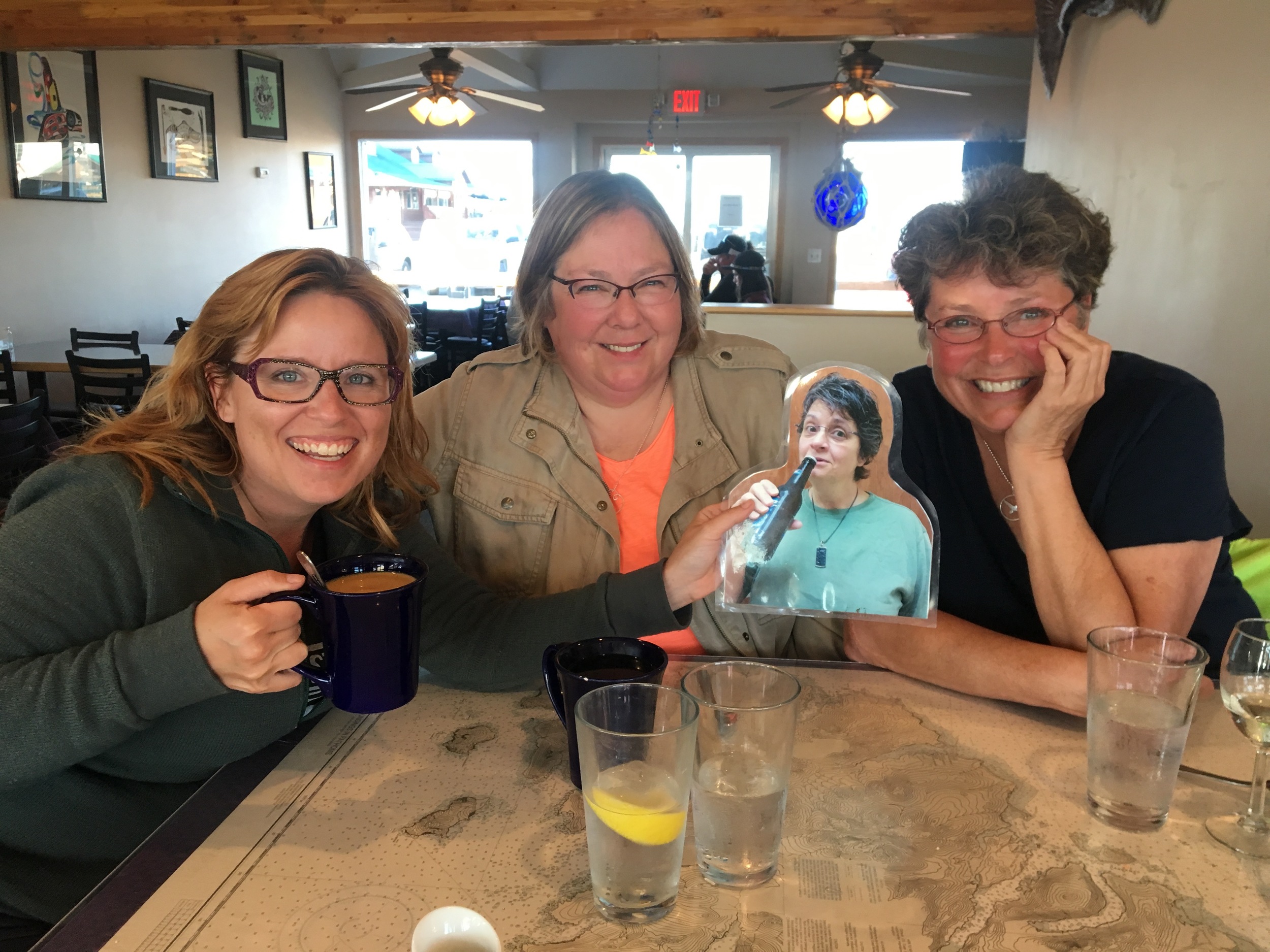
Me with Lynne Schoenborn, Sue Keator and Flat Michelle.
Two friends from Minnesota, Lynne and Sue came up to the fest and we got to spend some time together. Sue brought along a couple of photos of another friend named Michelle. I love Michelle, she takes photobombing to another level, knows lots about native plants and is always a good time at Birds and Beers...but there's one way we differ: she hates travel. She hates it so much she has said that her goal is to never have a passport.
So we brought along her avatar in the form of Flat Michelle and began posting photos of her on Facebook. Michelle says it's her favorite form of travel.

Flat Michelle kicking on back with an obliging sandhill crane in the background.
Here's Flat Michelle with an obligatory Alaska bald eagle photo.
One of the places Lynne, Sue and I birded was Anchor Point--which is great for sea ducks, shorebirds and sparrows. There were a gazillion eagles and unlike Homer, people are allowed leave piles of unwanted fish on the beach. You could get quite close to the them, they really are used to people. I suggested that we put Flat Michelle in one of the fish piles and step away. We could then digiscope her with some bald eagles right next to her face.

Flat Michelle posed with some halibut carcasses.
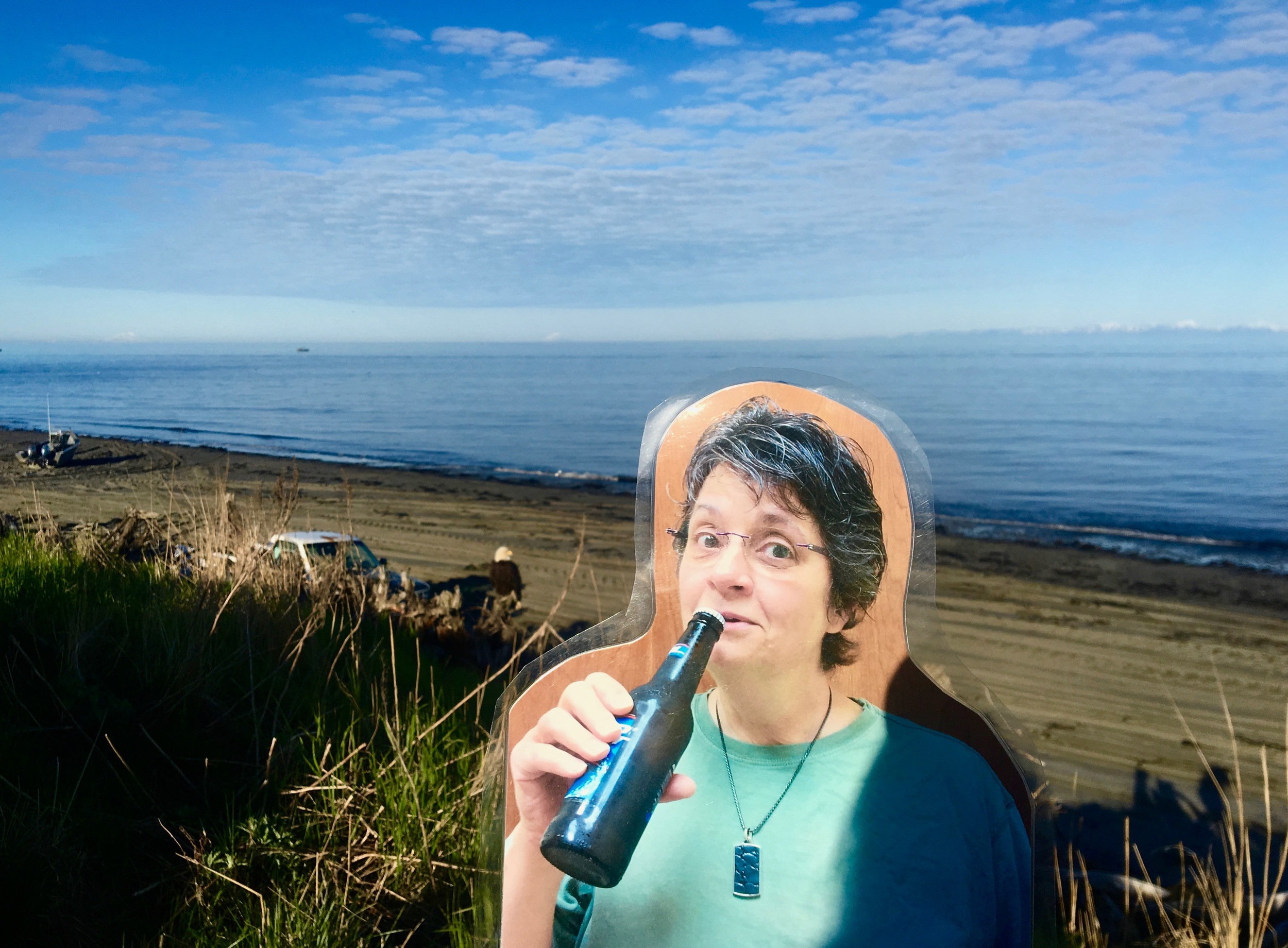
We had two different Flat Michelles. One kicking it with a beer bottle and one looking freaked out. We thought with a close proximity to eagles it would be funnier to start out with freaked out Michelle--you'd look freaked if an eagle was eating a dead fish next to your head, right? We placed it in front of a pile of fish that some eagles had been chowing on. We walked back, I set up my scope and we waited...
And waited...
And waited...
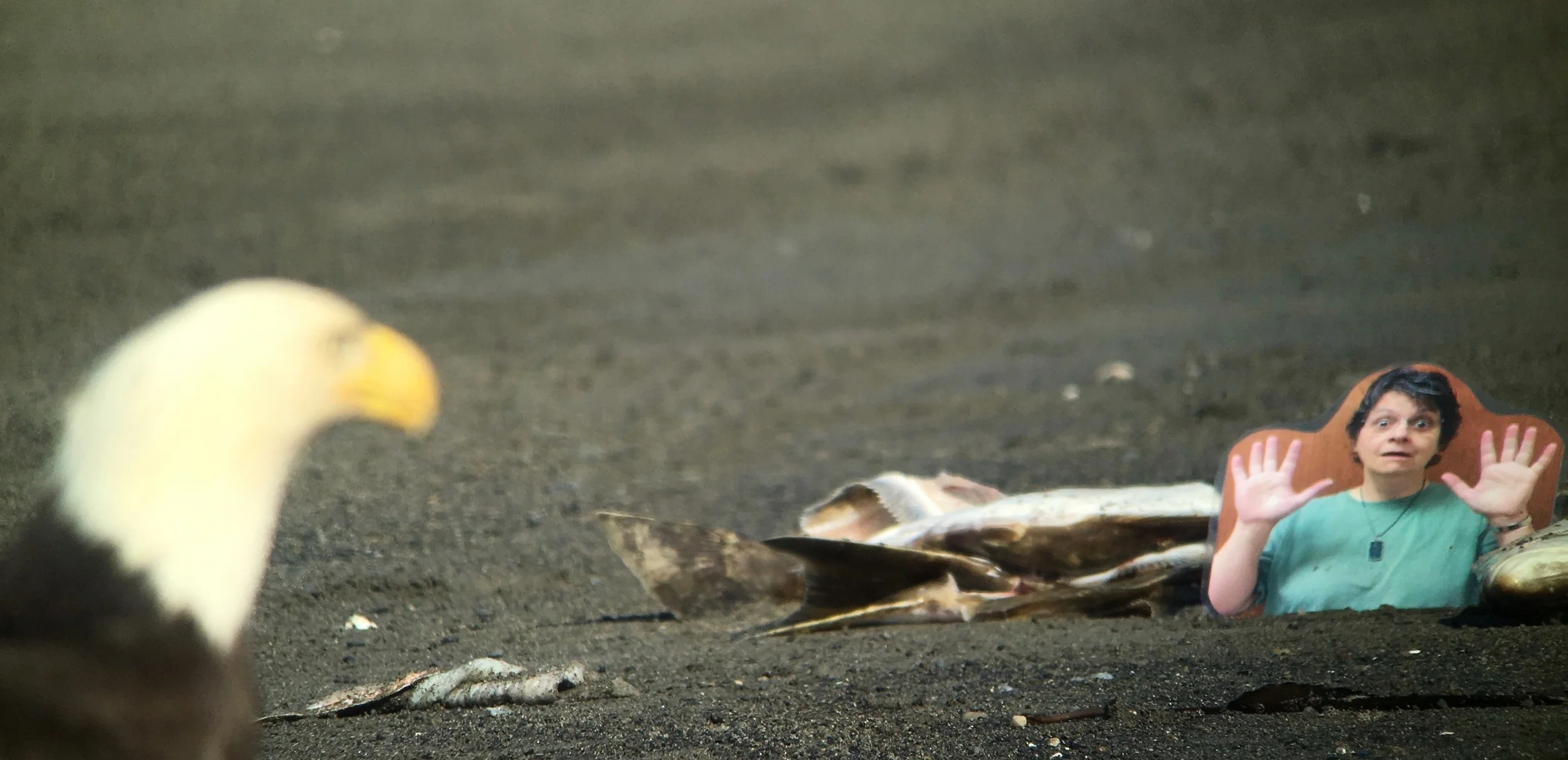
A bald eagle warily eyes Flat Michelle.
Eventually an eagle flew over, but it flared up when it saw Flat Michelle and circled a few more times. It landed nearby and just stared at her. A few more eagles flew in but like the first, just lingered along the periphery, occasionally squeaking in apparenty disapproval. The majestic eagles, all reluctant to land near the picture. Gulls and crows flew in but like the eagles, everyone kept their distance.
The first to let down their guard were the northwestern crows. As soon as one got some food, the others flew in and gobbled up all the fish they could before the eagles and gulls moved in.

A bald eagle walked behind Flat Michelle and the feasting crows.
Several more bald eagles flew over and around the fish pile, but none would get near it with Flat Michelle. I thought once the crows showed that it was safe the eagles would join, but they were having none of it.
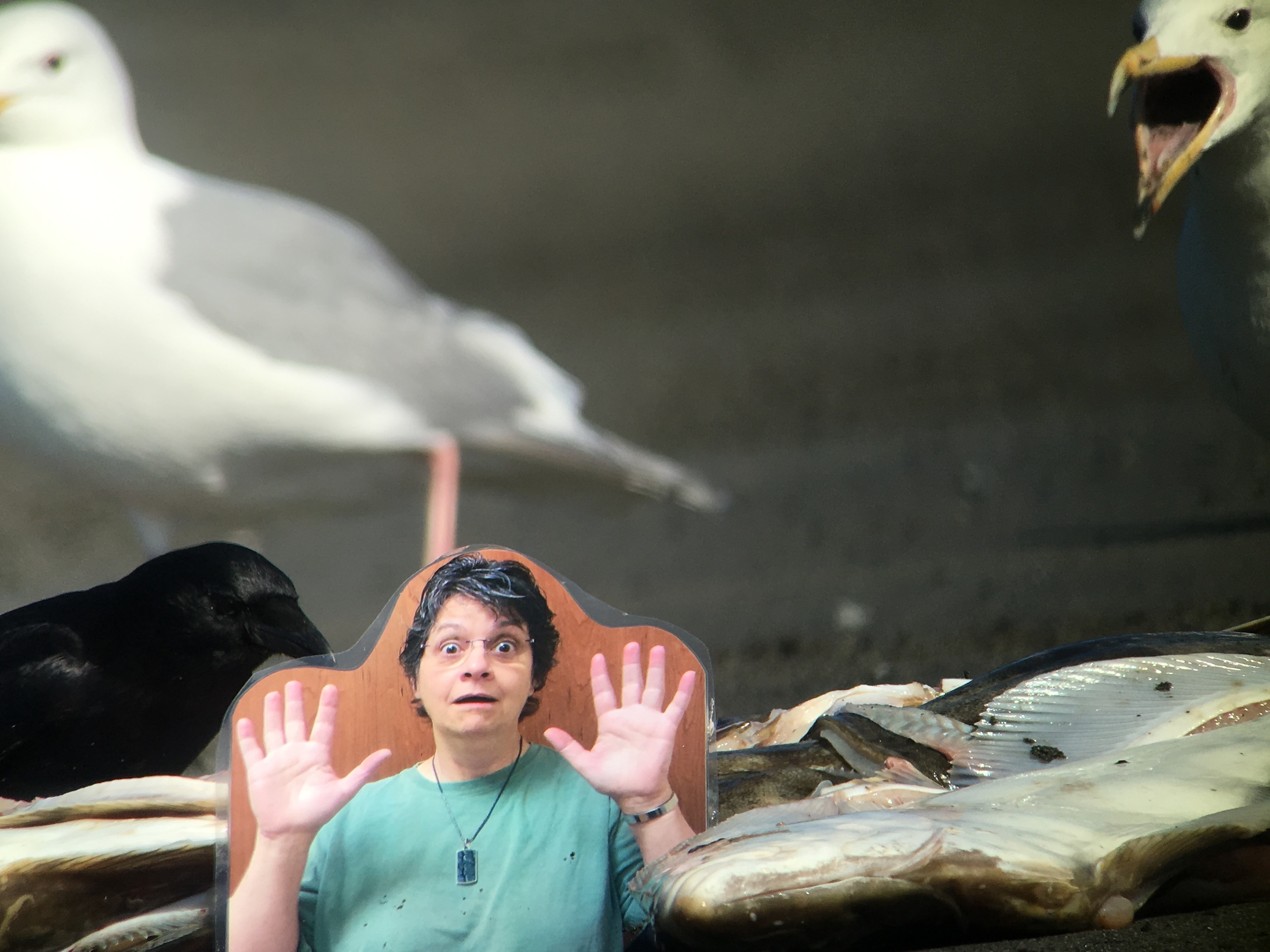
A glaucous-winged gull yells at Flat Michelle while a northwestern crow gets a morsel.
After awhile I thought it would be fun to get a time lapse video of Flat Michelle. Here it is:
Soon, another fisherman dumped a pile of halibut on the beach. And not just fish carcasses that have been filleted already but a few completely intact specimens. The eagles immediately flew over and completely ignored our mostly picked over fish pile. I suggested to Sue that we try that tastier pile and maybe use the beer version of Michelle. I wondered if her wide-eyed expression and both hands up was a threatening site to an eagle? So we placed the relaxed, chill beer drinking picture with the pile and stepped way back.
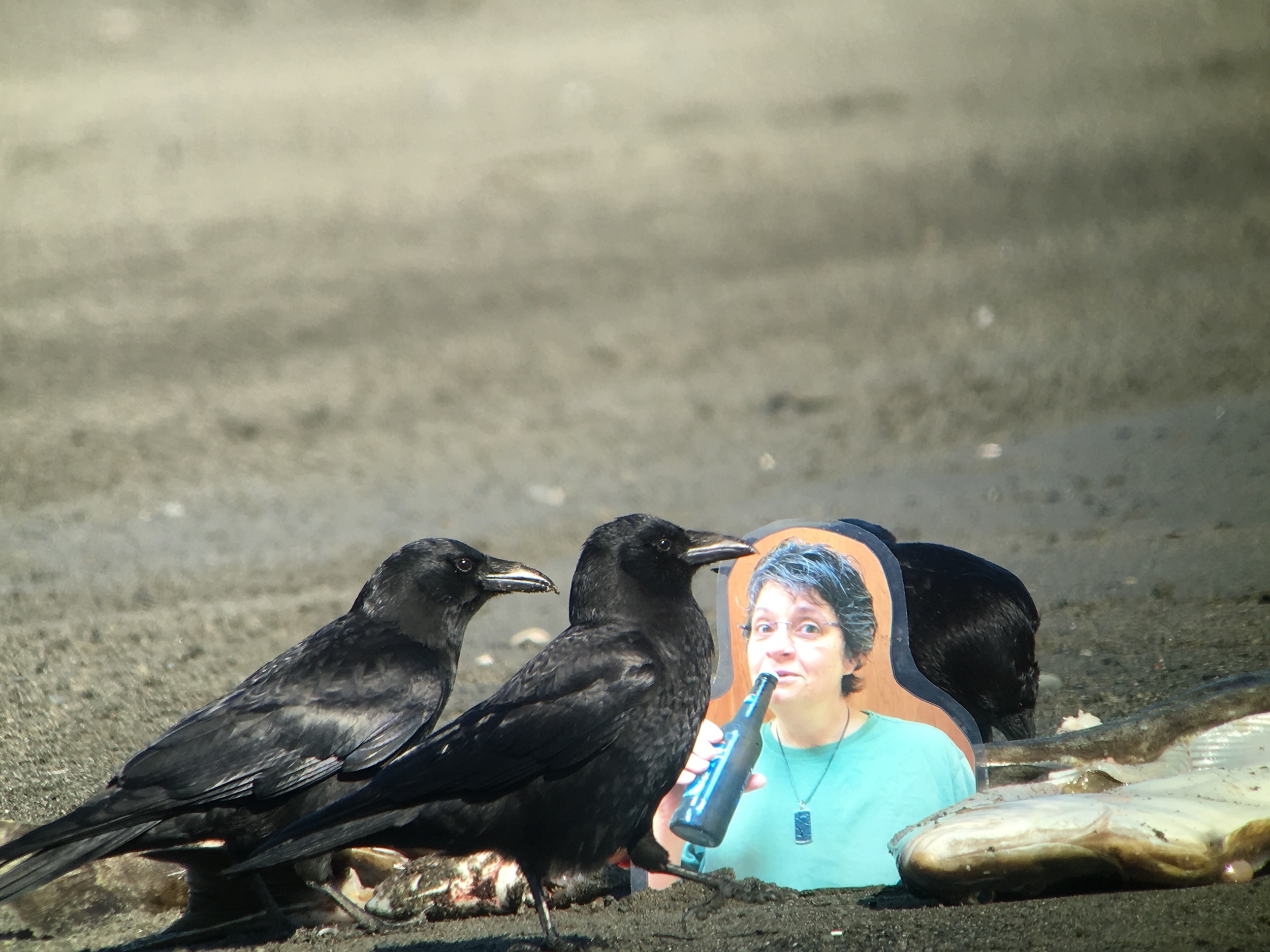
The northwestern crows wasted no time in joining Flat Michelle.
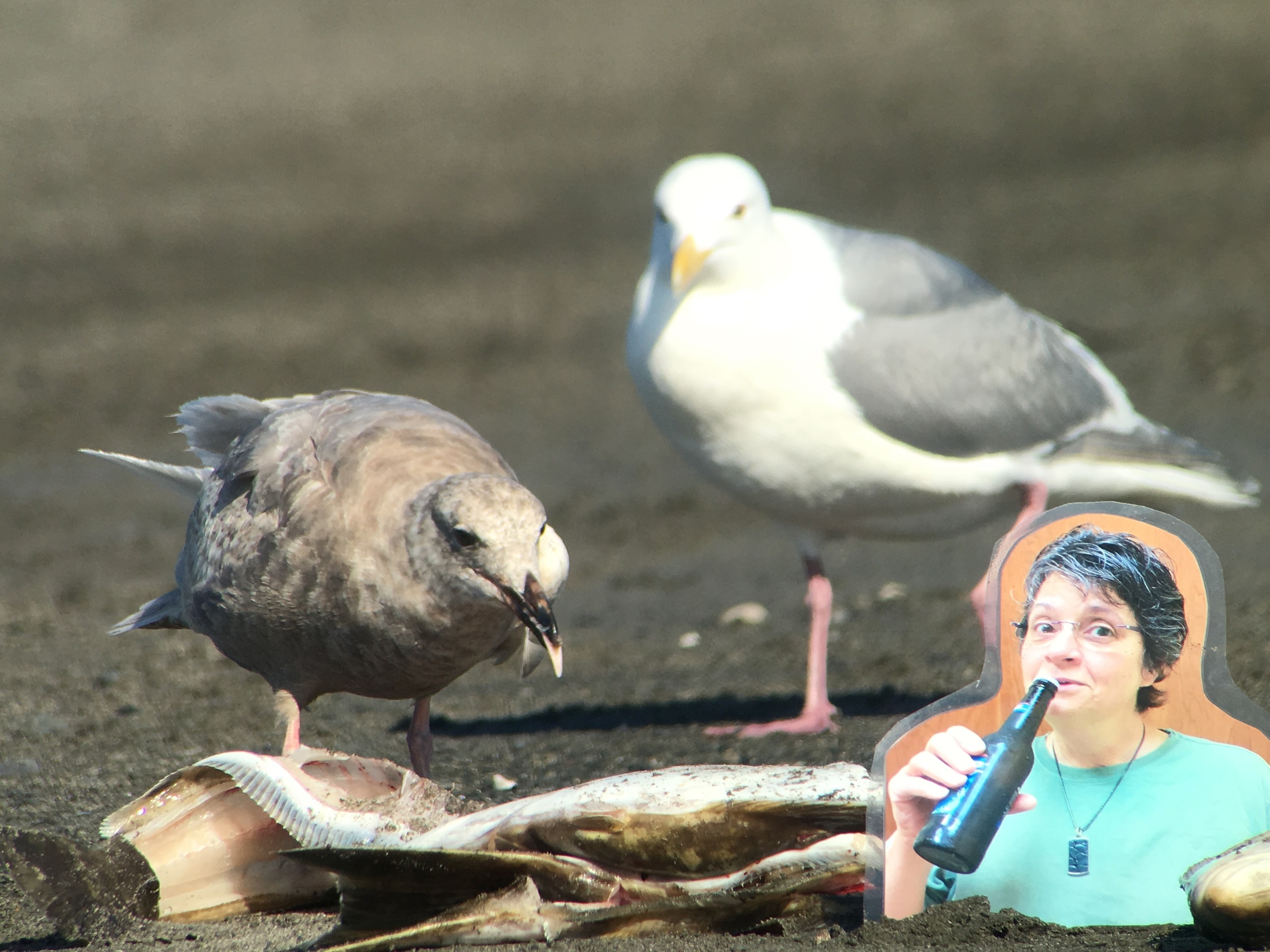
The young glaucous-winged gulls were t he first to come sample the fish. After the adults watched to see that nothing bad happened to the young ones, they moved in.


Meanwhile, that was as close as a bald eagle dared to get to Flat Michelle.
Here's another time laps with the "beer Michelle."
We also made a movie trailer so Michelle could see the fun she had around Homer, Alaska.
Digiscoped Images
Fresh Tweets
Would you like to hire me as a speaker for your event?
Email sharon@birdchick.com