
Birdchick Blog
Las Terrazas Birding
After some fun times and barely birding in Old Havana, we met up with our main guide in Cuba, Hiram Gonzalez (pronounced "ear rahm" not they way we say Hiram in the US). Hiram is quite possibly one of the last people to see an ivory-billed woodpecker alive in Cuba. He's an ornithologist who specializes in endangered species on the island. If Zapata wren is your goal--he's the one you want to know to see one.

He's also one of the most colorful guides I've ever gone with. How often do you go out with a guide who points to your endemic lifer with his half finished cigarette? He speaks very good English with a heavy accent. It took me a minute to figure out that "janky bird" was giant kingbird. At night, he'd join us at the bar and school us in birds and the better rums. But he was always so excited to show us his birds which I'm sure he'd seen more times than I've seen a cardinal. Ever time he would exclaim, while wildly flailing his cigarette, "Look AT dat!!!"

Male Cuban martin.
We headed towards Las Terrazas to a plantation to get some of those Cuban endemics we'd been reading about so much. On the way we stopped for gas and got a lifer: Cuban martin. We had martins zooming over the roof of our hotel. Even though it was April, I wasn't sure if there still might be some male purple martins on the island and it's impossible to tell male purple martins from male Cuban martins. But at the gas station there was no doubt.
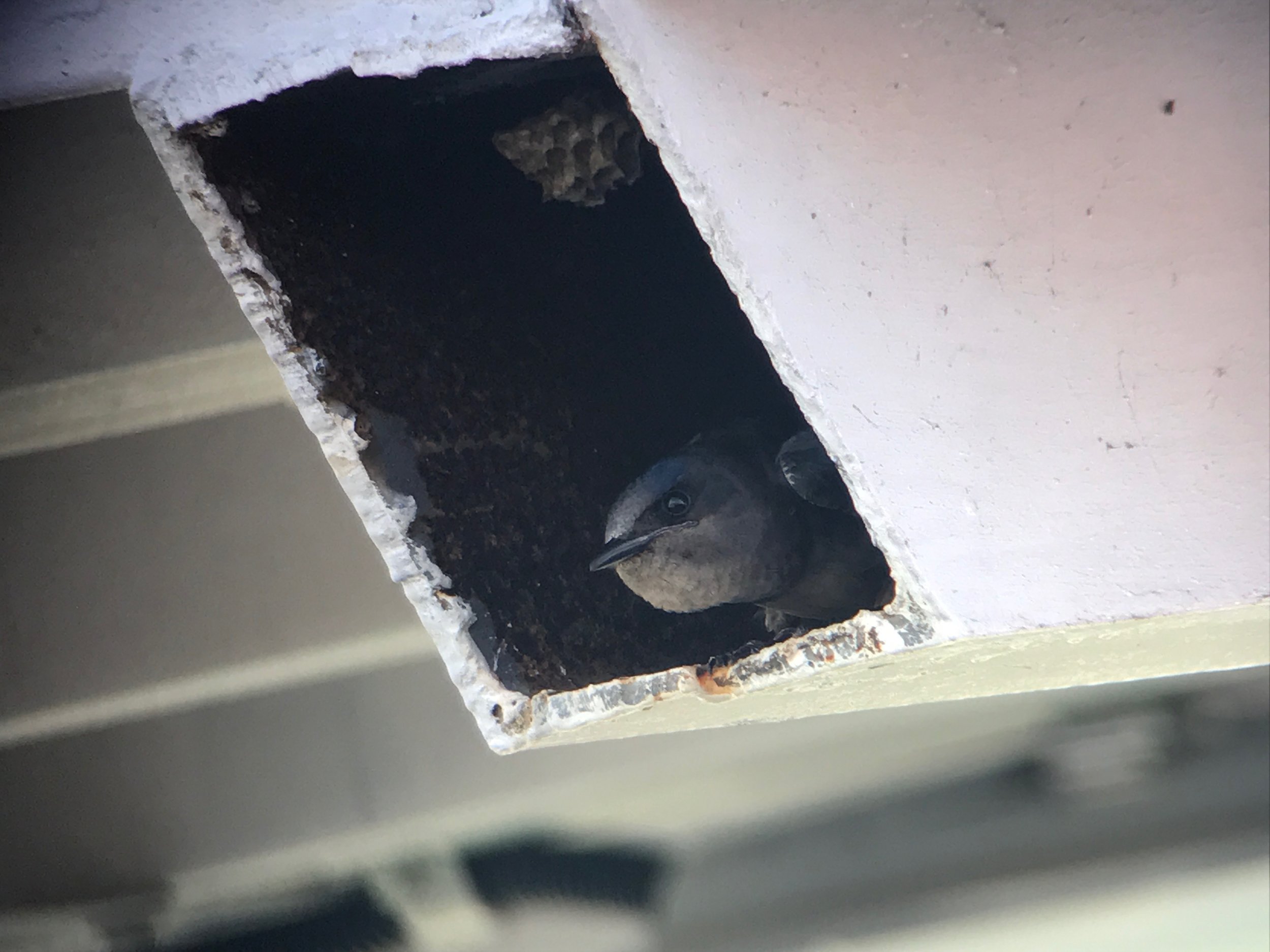
Female Cuban martin in a nest cavity, check out the wasp nest above her head.
Unlike purple martins, Cuban martins nest in holes in buildings--not the houses and colonies people in the United States have trained martins to use. These martins were using any hole or gap in the gas station. Cuba is know for several species that are endemic--spend their entire lives on the island. But martins fly away in winter and only breed here so their considered a breeding endemic. Kind of the way golden-winged warblers would be considered a breeding endemic to the North America.
We continued our journey and at the first stop in Las Terrazas, it was the "holy-shit-new-birds-everywhere" sensory overload time. That lovely point where you are afraid to focus on just one bird because you might not see the other new bird right behind you ever again. Many of the endemics we saw on the first stop ended up being birds we would see almost every day like Cuban trogon, Cuban tody and Cuban green woodpecker...getting actual photographs of them was another story.
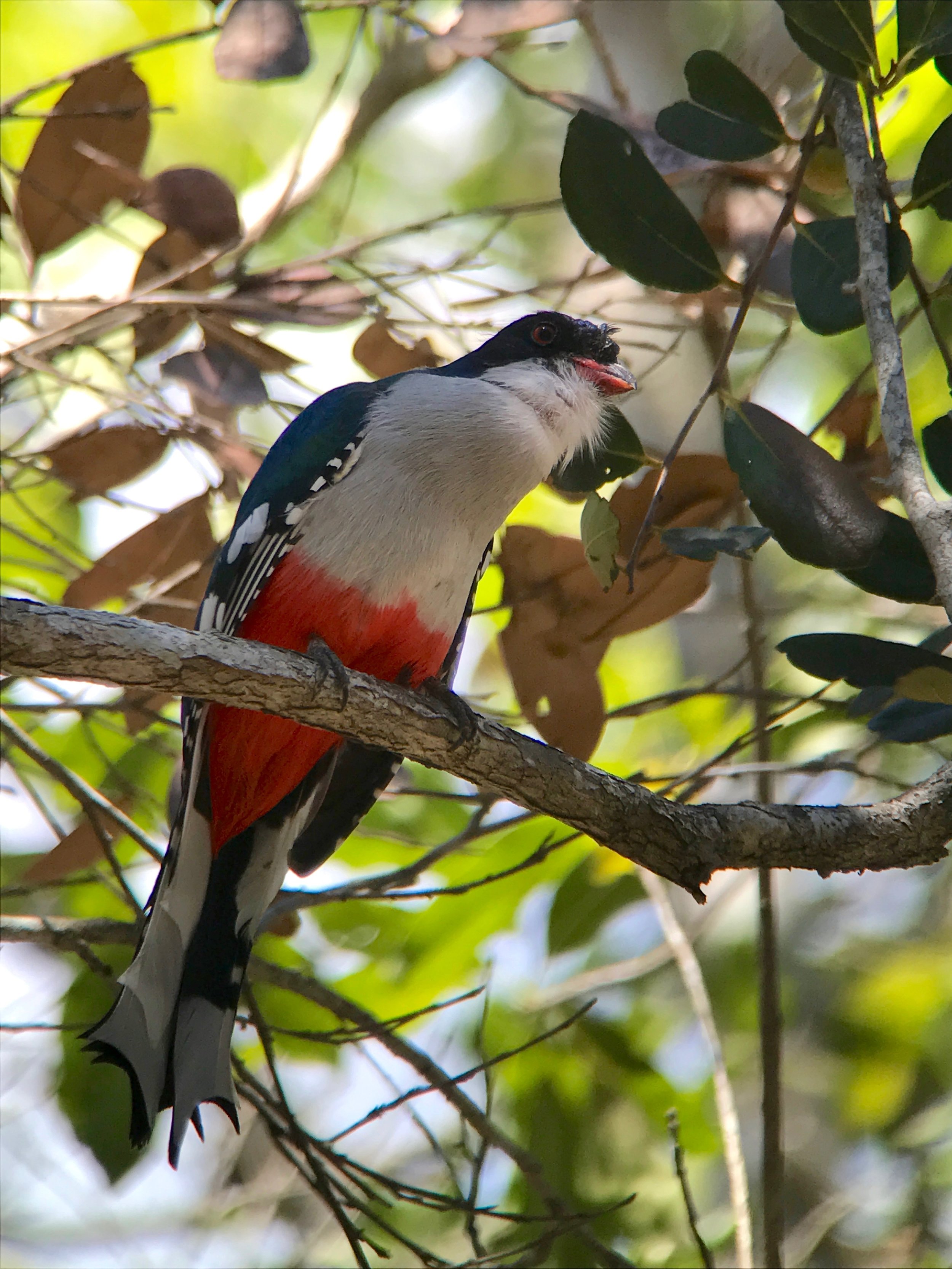
Our very first bird was the Cuban national bird, the Tocororo or Cuban trogon. As we were watching Cuban oriole and Cuban green woodpecker flew over--to a nest.

Cuban green woodpecker.

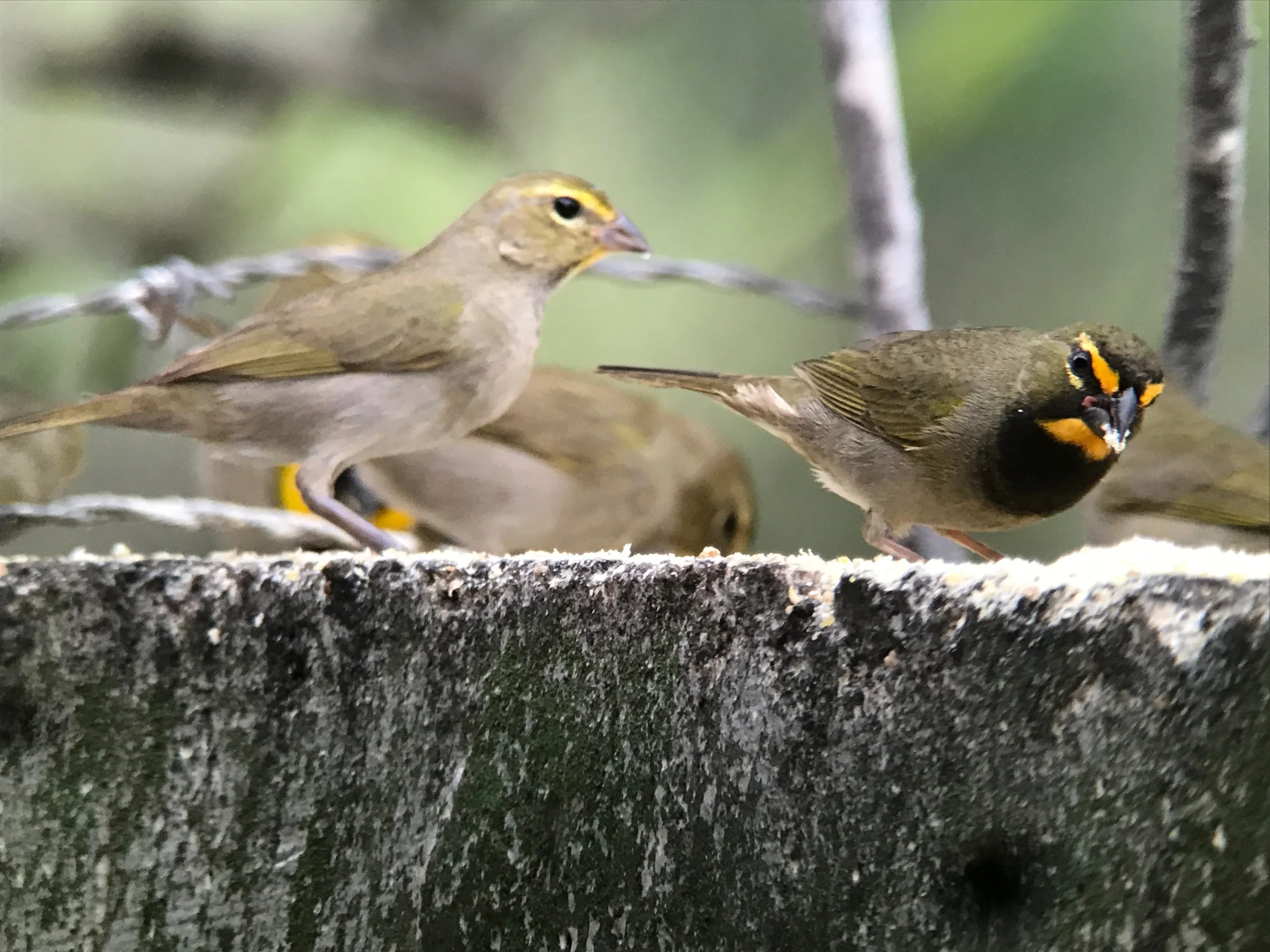
The farm to see grassquits!
Clouds and mist moved in as well giving things a mysterious air. After our initial stop we headed to a nearby plantation where they were setting up to feed their chickens. However, domestic fowl are not the only birds to see. This is the spot to get cracker jack looks at grassquits.

Cuban grassquit.
I could show you images of grassquits but it's far more fun to watch video of them happing around. There were far more yellow-faced grassquits than Cuban grassquits but we got ample looks at both. These are now considered to be part of the tanager family and are related to Darwin finches.

I tried to get a picture of Flat Michelle with the grassquits, but they were having none of it.

So a local farmer was happy to oblige instead.
How To Look Like A Bad Ass Birder
Have you ever been out birding with your digiscoping kit or traditional camera equipment and wondered if there was an easier and more comfortable way to carry your camera and binoculars at the same time? Did you ever hope you'd look like a total bad ass while doing it? Well, I have three words for you: Tactical Birding Harness.
Actually the real name is the CCS Binocular & Camera Harness and as soon as you put it on, you feel ready for what my friend Ben Douglas would call "beast mode birding."
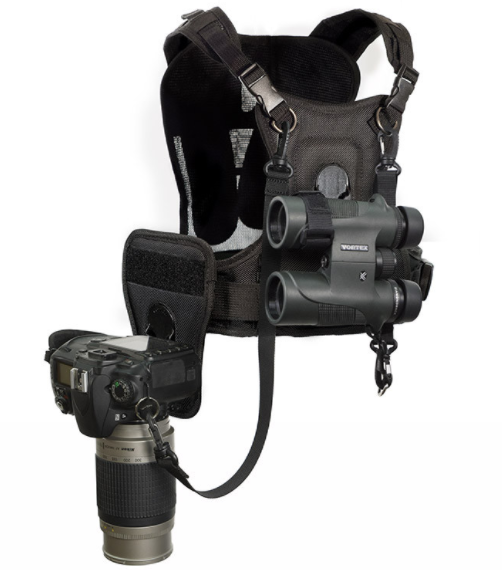
The CCS Binocular and Camera Harness from Cotton Carrier.
Initially, I was skeptical about this harness on two fronts. First, I'm female and I'm a well endowed. Though I enjoy using binoculars harnesses for comfort, it can be a challenge to get those to work around a curvy chest. Many of these products are built for guys and well, the products get weird when applied to a woman's body.

Image of a guy using the Binocular and Camera Harness from the Cotton Carrier website.
The second concern is that I had is that I have a low center of gravity and I wondered if having this stuff hanging on me was really going to be anymore comfortable than my usual set up of a traditional binocular harness with my camera slung over my shoulder while carrying my scope on a tripod.

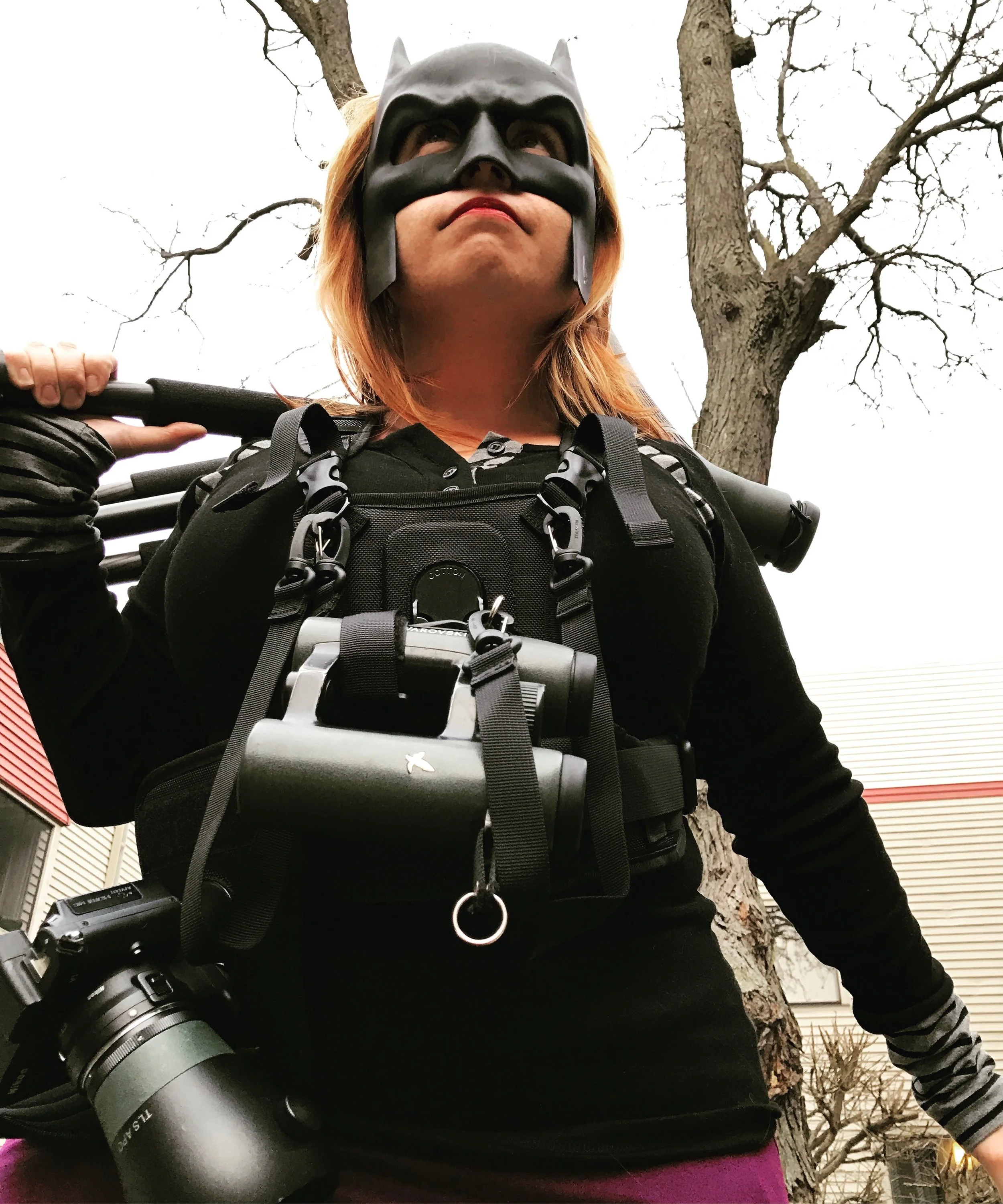
Me wearing the binocular and camera harness.
To my surprise, the tactical harness can be quite comfortable. As soon as I put it on, I felt a bit like Bruce Wayne suiting up for a night with the Joker. Being short, I had to do a lot of cinching of the shoulder straps, but once I got the harness snug against me, it wasn't bad at all. The fitting of this harness is really key (and gents, you may want to skip to the next paragraph as I'm going to get into some serious boob talk here). Ladies, if you leave it slightly loose, the harness shifts a bit as you move and then you're left with that look many of us dread: one of your breasts is randomly hanging out on the side. Don't make it so tight it hurts to breath, but have someone help you tighten it on the shoulders and the waist to keep in in place.
Once fitted well, it doesn't move as much as a traditional binocular harness. Many women tell me that they find the traditional binocular harnesses uncomfortable. I think one reason is that people don't pay attention to where the leather patch is in the back. Sometimes it has a tendency to ride up just below your neck, when really it should be squarely between your shoulder blades and depending on how active you are in the field, you periodically have to pull it down. This harness stays in place for the post part when snug.
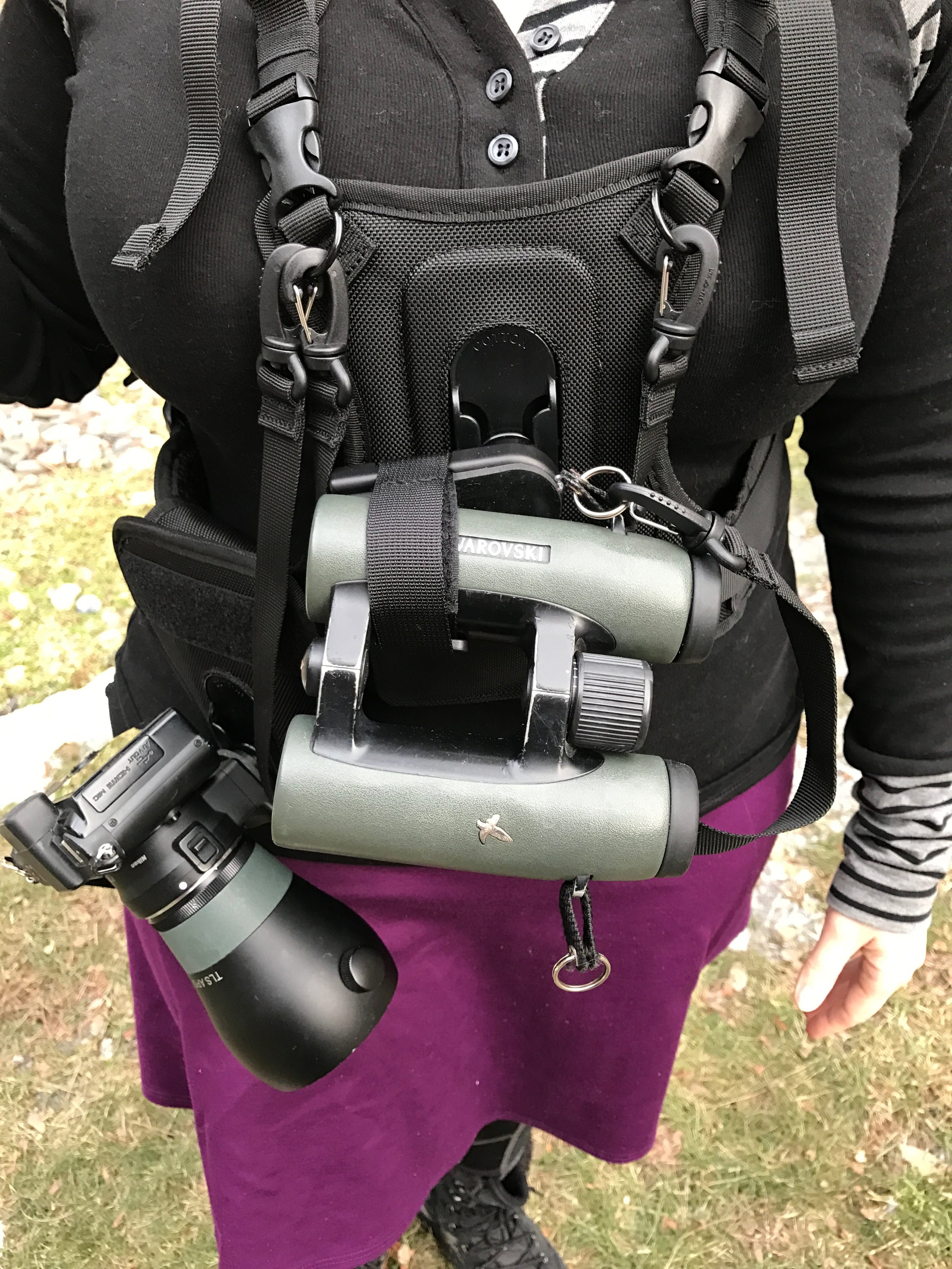
You'll note there are straps with clips to help secure your camera and binoculars to the vest should they become dislodged from the vest, preventing them from dropping to the ground. I like how the binoculars are flat against the chest and don't flop around. I'm using 8x32 ELs which are compact and lightweight, it might be a different story with larger barrel binos.

The harness comes with adapters to attach to the bottom of your camera and around the barrel of your binoculars. The washer has arrows that when aligned correctly will secure your optics to your harness.
The harness has an adapter and velcro strap to attach to the barrel of your binoculars and a tripod adaptor for your camera. These have large washers that will lock your optics in place on the front of the harness, and off to the side (you can adjust whether you have the second piece on your right or left to favor which side you use most). I did notice that after awhile the velcro strap on my Swarovski ELs would come loose and slide a little bit and I'd have to retighten it to keep it aligned with the harness.
I also had to get used to my binoculars and camera in a new area. If you've had your digiscopign set up for awhile, using them has become second nature. This is a bit of a different configuration and it takes some getting used to the different way you have to holster holster and reholster your bins, especially if you're excitedly looking at a bird. Here's a demo of the binoculars being holstered:
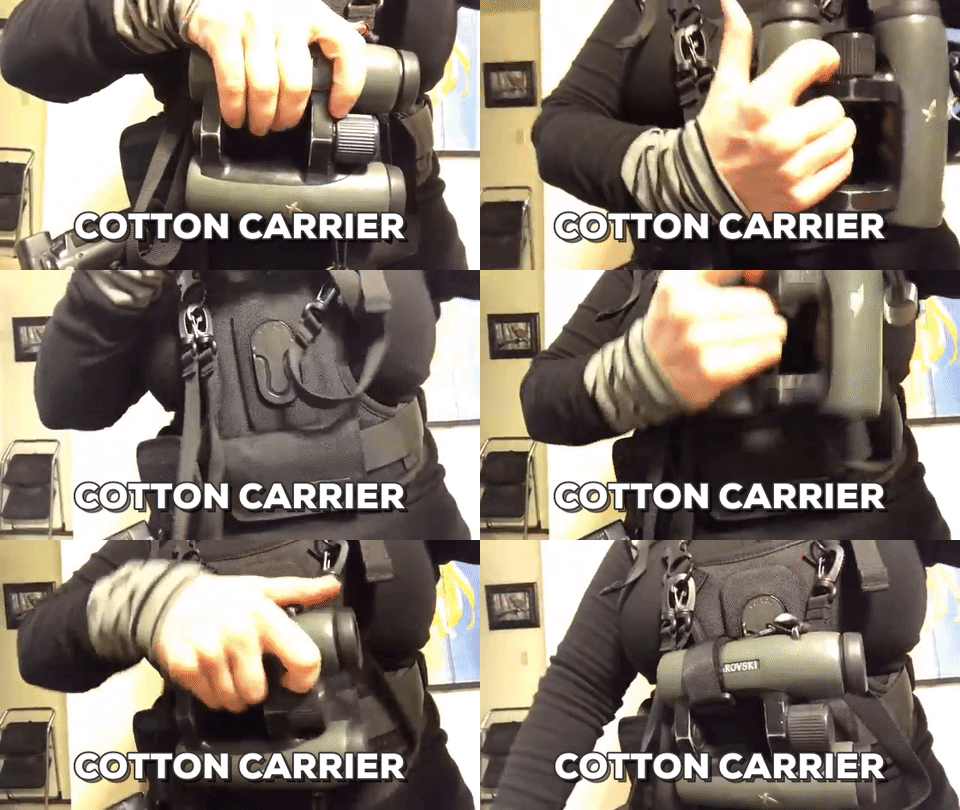
A small pocket in the belt holds a cover to put over camera to keep them dry if it's raining while you're out in the field. There's even a holder just inside the front of the harness in case you have an umbrella with a thin rod that you want to put over yourself to stay dry. Just wearing the whole set up around for an hour was not bad and the best part was that my binoculars and camera felt secure and not like they were bouncing all over the place. This is something I might use while at a birding festival or birding remote areas. I wish I had this back when I was doing bird surveys. I'm not sure if I would wear this set up in an urban park, it might be a bit much and cause neighbors to question you. But if you are going to wear it in an urban park, go big or go home:
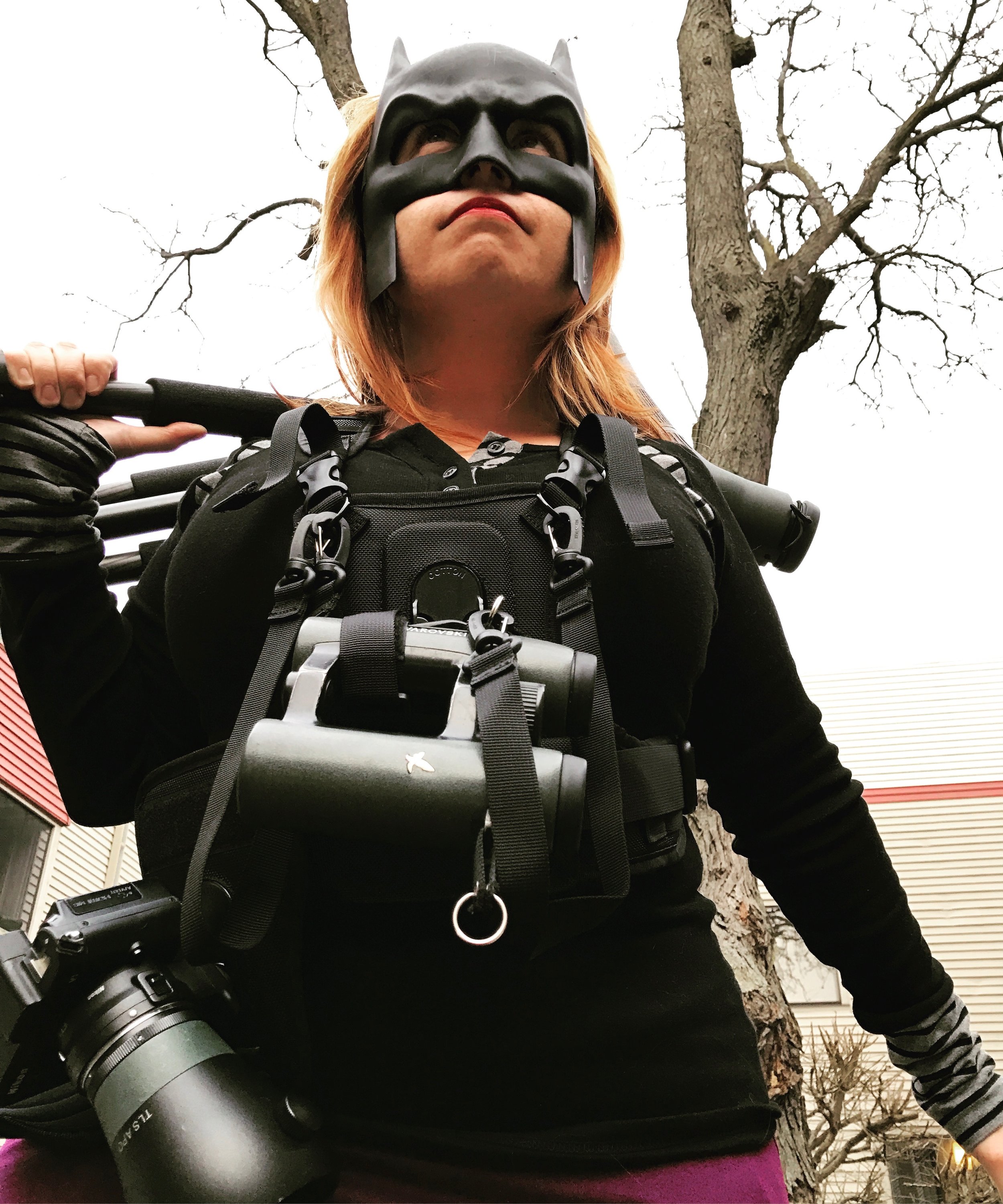
The harness accessorizes well with a Batman Cowl.
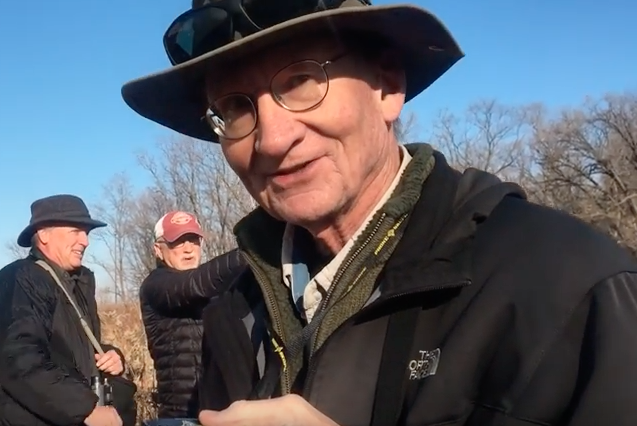
Digibinning with the Renner Technique

I teach quite a few workshops on digiscoping throughout the year. My preferred method is using a smartphone with a spotting scope, but I'll also use an SLR and spotting scope too. My friend Renner Anderson has heralded his love of "digibinning" which is using binoculars and his iPhone to take pictures.

Curt Rawn got a shot at a Birds and Beers of Renner Anderson showing his "rubber band" technique for attaching his iPhone to his binoculars (this was before he had a PhoneSkope adapter).
I've always been been dubious of the digibinning technique and advise against it in my workshops. I think there is no easy way to hold the binoculars steady and get a good shot. Renner feels differently. "I always have my iPhone in the field anyway because I am already using it for eBird Mobile, field guides, Merlin and BirdsEye," Renner said. "I like to hike for adventure and exercise and usually don't bring my telescope so it's nice to be able to use my binoculars for getting documentary photos."
At my last digiscoping workshop that I hosted, Renner arrived and was ready to show off his digibinning techinique using his Swarovski ELs, iPhone and PhoneSkope iPhone case and bluetooth shutter release. I grabbed a quick video so you could see the Renner Technique in action and some of the photos he's gotten of birds in the last year.
Renner also add, "Because I attach the PhoneSkope case to just one eyepiece (the right eyepiece) I can use the other eyepiece to look through with my right eye and this puts me on the bird immediately and very easily, even birds in flight. I focus on the bird using the focus adjustment knob of the binoculars with my right index finger and center the bird in the visual field so I don't have to be looking through the iPhone viewing screen.
"Because both of my hands are holding the binoculars and I'm looking through the other eyepiece of the binoculars I don't have any way to trigger the shutter with my hands. For that reason I have developed the idea of holding the PhoneSkope remote shutter between my lips and activating the shutter by squeezing down on the PhoneSkope remote shutter by tightening my jaw. Not a pretty site but it works really well.
"Only problem here is that if the bird is close I have to adjust for the fact that although the bird may be centered in the field of view of the barrel I am looking through it will be off center for the barrel that the iPhone is looking through. This doesn't matter for birds at distance such as birds in flight.
"With my current technique with the PhoneSkope case attached to a single eyepiece I haven't figured out a way to secure the iPhone to the binoculars with a rubber band so I am always nervous that the iPhone might fall. Currently I just hold the round piece of the PhoneSkope adapter firmly against the binocular eyepiece with my right thumb
"Of course the Blue Tooth can drain the iPhone battery (not to mention the Gaia tracking app that I am using to document my hiking adventure and BirdsEye and eBird Mobile and Merlin and the field guide apps) so I do bring an extra battery along with me in the field."
Remember, you get a discount when you purchase a PhoneSkope product and use the code Birdchick13 when you check out.
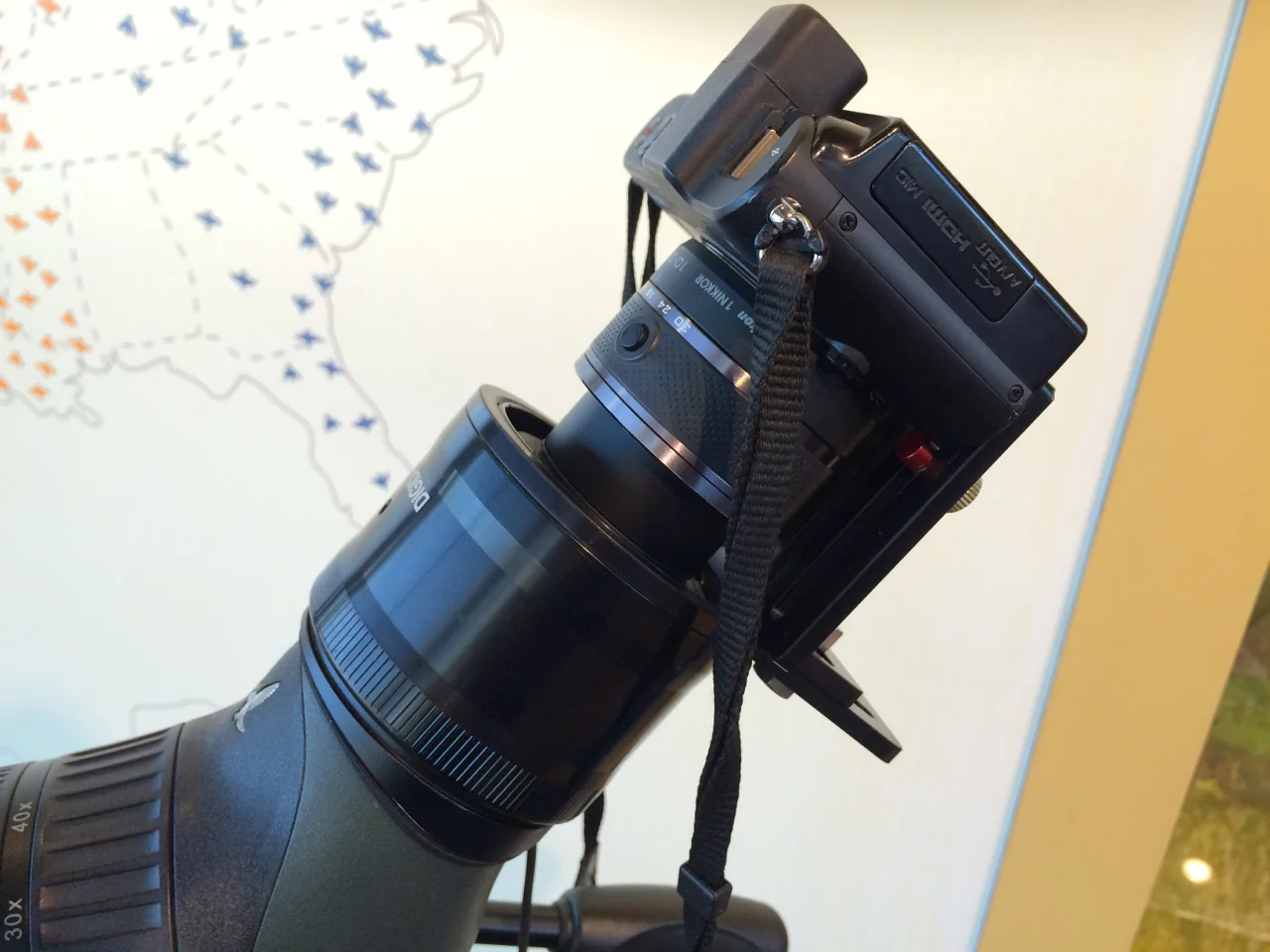
Digidapter For Digiscoping

A new digiscoping adapter I've been playing with since seeing it in Florida called the Digidapter.
I've had the opportunity to play around with some newer digiscoping adapters both for smartphones and for SLRs. When not using my iPhone 5s to take pictures and video, I've been using my Nikon V1, which is a very good camera and generally I use with the Swarovski TLS APO adapter.
The Digidapter is designed so you can set your camera on it and then the hood will fit over the eyepiece. Currently, this adapter will work on Swarovski, Zeiss, Leica, Kowa and Celestron. The owner is able to custom make adapters, but those will probably be a different price than what's on the website.
What I thought was cool about this Digidapter is that it fits a number of cameras--perhaps even a few point and shoots. But the really cool part is that the biggest beef I have with "universal" adpaters is that they tend to be futzy--you have to make constant adjustments. You screw the bottom of your camera to the Digidapter and then make adjustments to how it lines up with your scope eyepiece. The cool part is that the two red nuts on the adapter are adjustable and help you keep track of where to place your camera after you take it off the adapter. Once you know where your camera fits on the adapter, you slide those to the front of the camera and tighten and viola--you always know where the camera needs to go on the adapter.
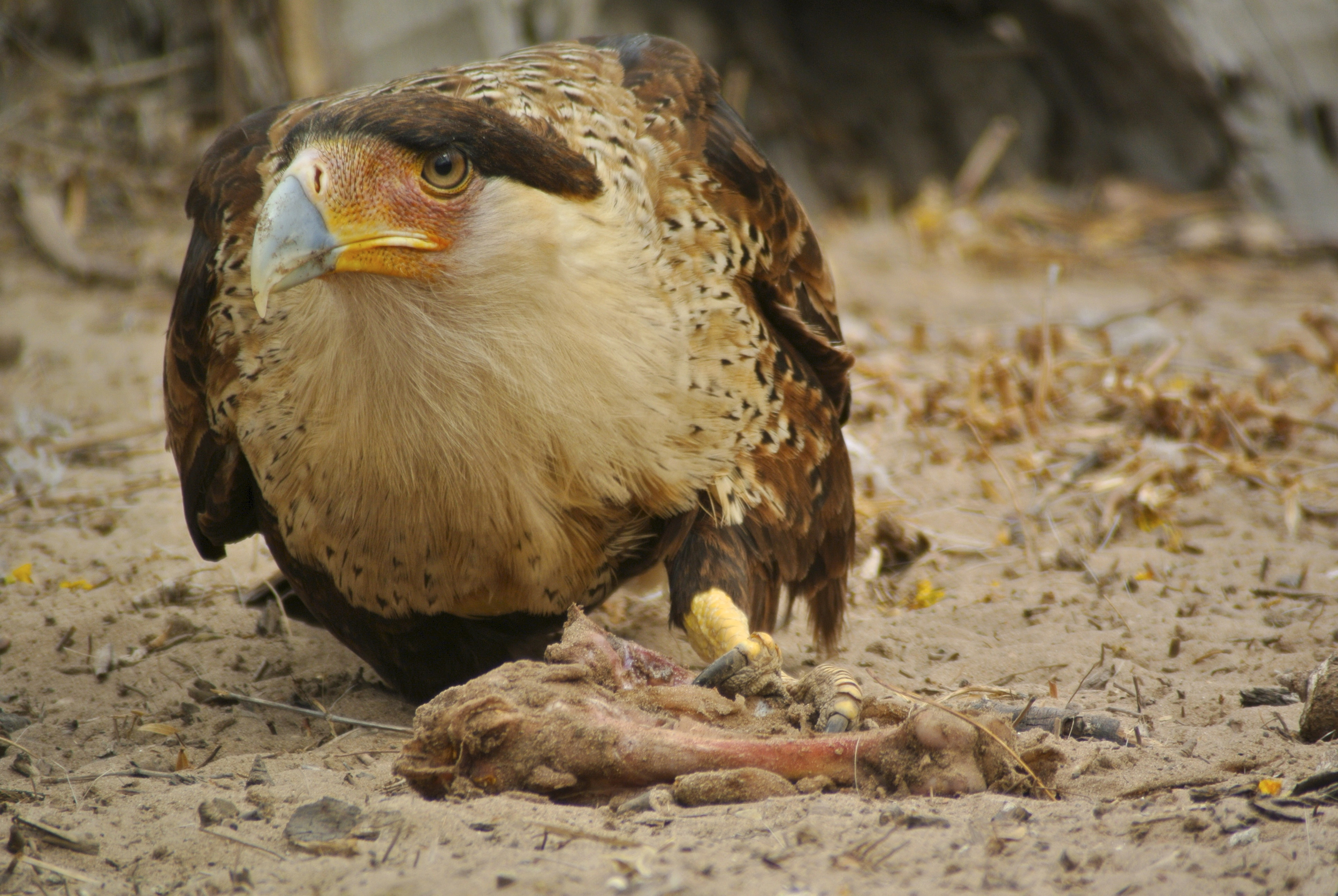
One of my favorite photos I've gotten of a bird--a crested caracara taken with the Nikon V1, TLS APO and Swarovski ATX 85 mm scope.
If there's one downside to the Nikon V1 is that sometimes there's too much zoom with it on the scope. Which if birds are far away is great. But if you want to get birds at a feeder outside the window, you can sometimes be too close to get a full frame body shot. So I thought I would try using the V1 with the Digadapter.
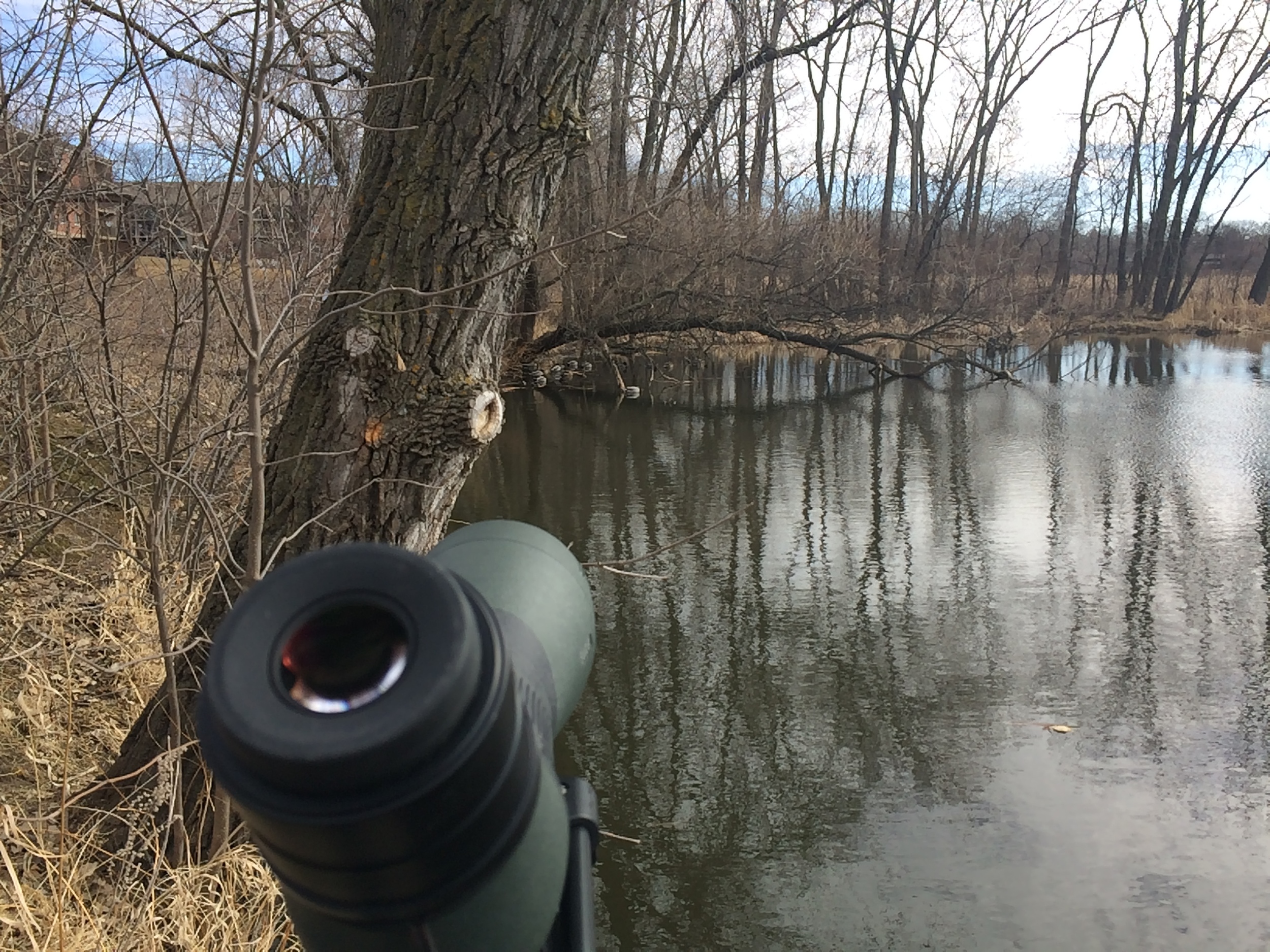
I took some digiscoping adapters to my local patch for some testing (much to the chagrin of the local Duck Lady who was irritated that I declined her offer for duck food and pissed when I said, these ducks have plenty of natural food). All the waterfowl posted in this entry were under the downed snag.
I've been trying to test out these adapters at feeders to give you an idea of field of view in the camera but we keep getting cold snaps and some of my go to nature centers for photos have now covered their windows with stickers to prevent widow strikes which makes bird photography next to impossible. So I found some obliging sleeping ducks in my neighborhood.
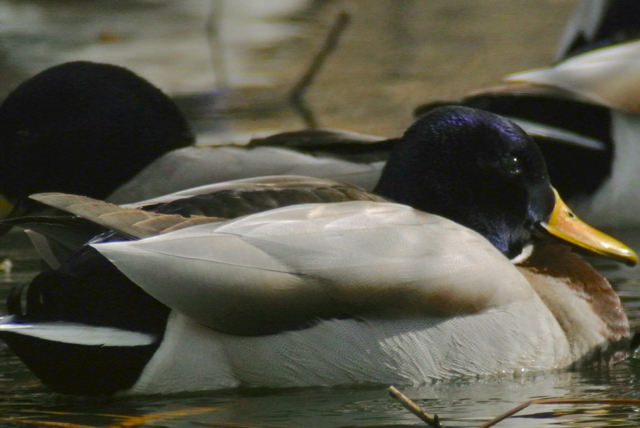
Mallard digiscoped with Swarovski ATX 95mm spotting scope, TLS APO adapter and Nikon V1.
Above is an upcropped image of a mallard taken with Swarovski ATX 95mm spotting scope, TLS APO adapter and Nikon V1. You can see that it's a challenge to get the whole bird in. I normally solve this by keeping my distance with birds and that strategy generally works out. But sometimes, like in the case of being in a blind that's not an option--isn't it always something with photography?

This is my Nikon V1 with the TLS APO adapter. I nice light-weight system.
Above is my current system. I like it because it's relatively easy to carry in the field. To use it, I had to remove the zoom lens that came with the camera body, purchase and an adapter that would allow the body to work--funny thing, if you use a non-Nikon lens on this camera body, it won't shoot. You get an error message that says there's no lens...even though there is one. You have to spend about $120 bucks on a Nikon adapter with electronics that tells the camera body there is indeed a lens attached. You also have purchase a smaller cheater adapter that lets you actually attach another lens to it. Well played, Nikon, well played. If I'm not going to buy lenses from you, you're still gonna get some of my money.
Anyhoo, the TLS APO adapter from Swarovski has a lens inside it that is optimized to work with your scopes eyepiece. I also like that the sleeve of the adapter that fits over the scopes eyepiece also acts as a protector for the lens on the inside. I've generally liked this system and once used to working with it, you can get some really nice detailed shots (like the above caracara).

Mallard digiscoped with Swarvoski ATX 95mm spotting scope, Digadapter and Nikon V1.
Above is an uncropped photo of a different mallard that was slightly to the left of the first mallard (it got chased off by a rival as I was switching lenses. This is with my Nikon's original zoom lens, Digidapter and Swarovski ATX 95mm spotting scope. A wider field of view than with the TLS APO adapter. But I love it's lightweight and how easily it slides on and off of my scope's eyepiece.

This is what the Digidapter looks like attached to my spotting scope.
I think I need a different Nikon lens for this system, it's a little too close to the glass on my eyepiece than I'm completely comfortable with. There is an extender I can purchase too which takes it a little further from the eyepiece. It's a little chunkier than I'm used to, but for an adapter that works with lots of scopes and cameras, it's very good and slides on and off of the scope eyepiece easily. It's solid and made of aluminum so is fairly light weigh.
Episode 3 - Digiscoping Techniques
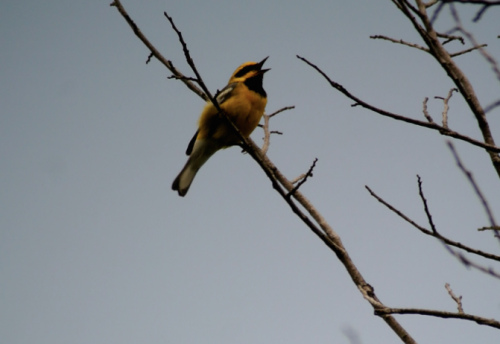
And here is episode three which includes a last minute cameo addition of a Lawrence's Warbler! How many bird shows do you know have one of those in an episode?
https://www.youtube.com/watch?v=LQDKYi3fhKY&feature=youtu.be
Clay and I also talk some photography techniques in this episode and remember, kids, birds shown in the first seven episodes have all been digiscoped by both Clay and me and are a clue to the series theme! If you correctly guess the series theme, you are entered into a drawing for a Swarovski spotting scope.
Be sure to check out the pages of our generous sponsors for this episode, especially if you saw something in the show you liked:
Swarovski Optik (the optics I've been using for years)
Princeton University Press (my favorite nature publisher and sign up for updates on their cook BirdGenie bird call identifier app that's coming)
BirdsEye Birding (the most useful bird finding apps available)
Please read over the contest rules before entering. All entries that deviate from the contest rules will be disqualified. The winner will be announced in the eighth episode airing on June 26, 2014.
To make sure you do not miss an episode, subscribe to the Birdchick YouTube Channel.
Contest Rules (To make sure you do not miss an episode, subscribe to the Birdchick YouTube Channel. )
1. All entries for the Swarovski STS spotting scope need to be emailed to digiscoping@birdchick.com and must include the answer, your first and last name, mailing address and phone number (in case I need to contact you regarding shipping).
2. You can guess the theme more than once, but only ONE correct entry per person will count in the drawing. (You should probably watch a few episodes before you guess).
3. All entries guessing the series theme must be received no later than 11:59pm Central Time on June 23, 2014.
4. The winner of the Swarovski spotting scope will be chosen at random and the decision of the judges is final.
Palestine Sunbird, Best Hotel Bird Ever?
Between jet lag and jumping right back in to my eagle surveys, my blogging this week has been slower than I expected. I will say, the upside to my freaky sleep schedule makes getting up 2 hours before dawn easy cheesy. However, staying up past dinner impossible. I'm kind curious how tonight will play out, I'm scheduled to be a guest at Camilla Parker Bowls at the Bryant Lake Bowl. Will I be awake? Will I make sense? Will it lead to me sleep table dancing in the middle of the show? I have a post up over at 10,000 Birds about using my iPhone 4s for digiscoping. I had lots of opportunity to use it and do side by side comparisons while in Israel. I actually ended up taking more photos with my iPhone than I anticipated and was pleased with the results, especially since I was hand holding it.
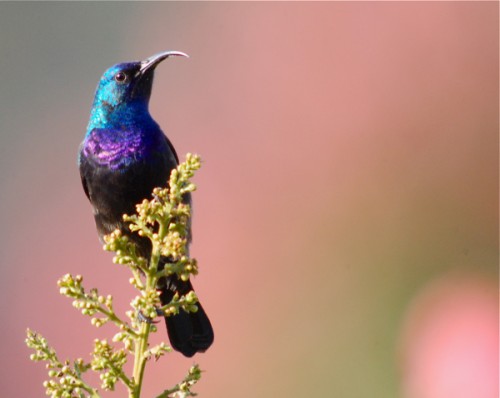
This is a Palestine sunbird--we got them within minutes of checking in to our hotel in northern Israel, the Pastoral Kfar Blum. Periodically one would even perch on the bush just off my hotel balcony. It's the Middle Eastern version of a hummingbird (although a bit larger, being about the size of a small warbler). But that long curved beak holds a tongue with bristles at the tip used to get nectar from flowers. Dynamite birds to tick off from your hotel, plus it's fun to have a bird with such an exotic name on your list. The above photo was taken with my Nikon D40 through my Swarovski spotting scope. Since the birds were fairly cooperative, I thought I would see what I could get with my phone:
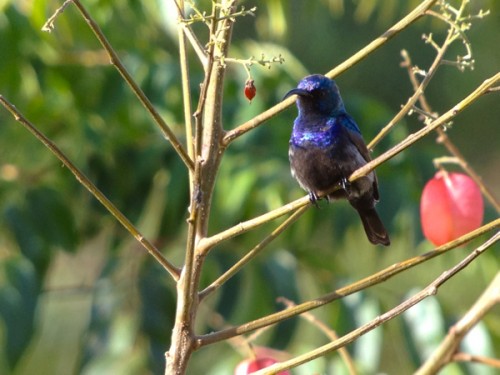
The bird is in a different position and the light is not the best, but still, not bad at all for me just quickly hand holding the phone up to the scope. It won't be on the cover of WildBird Magazine, but it's perfect for sending a photo to Twitter, Facebook or email.
My article at 10,000 Birds links to a new adapter developed by Meopta that should make securing my phone to my scope a breeze. I'm practically salivating to test it out, but if it works well, I may never take my SLR in the field again. Looks like it won't be available until early next year so in the mean time, I'll keep practicing with my hand held technique.
Cooper's Hawk Attacks Owl Nest
Well, Friday morning turned out to be far more exciting than I anticipated! I had to work at the park service in the afternoon and evening and I was meeting a friend for a late breakfast. I thought that since it was warm, I'd peek at the great horned owl nest in my neighborhood and see if the owlets were more visible...

One owlet was easily visible with the naked eye on approach. Great horned owls do not build their own nests, they take over old squirrel, hawk or heron nests. They don't even make any renovations before they use it, they just squat. As the chicks grow, the nests soon shrink. Between the dwindling nest and the larger chicks, the female no longer fits very well and perches near the chicks.

It appears that the nest contains two owlets! When I arrived to the general nesting area, I could hear the crows heartily mobbing. I saw the male fly over with a flock of about 20 crows in tow. The chicks showed a bit of interest in the commotion but mostly laid low.

The female was very interested in the crow activity as she watched the crows surround the other owl. What was interesting was that I thought the crows were chasing one owl, I later ran into a fellow birder who was close the crows and he said the crows were after two great horned owls and a third flew in. I wonder now that as I was watching her keen interest in the crow activity, if she was responding to an intruding great horned owl into her territory rather than the corvids gathering around her mate?

She soon left the nest to try to get a better look at the mobbing crows but still would turn around to keep an eye on her chicks. It was so strange to me to see a secretive owl perched out in the open in the middle of the morning. Not long after I took this photo, she bolted off into the middle of the flock of crows. The owls all went in separate directions and the crows split their murder into 2 smaller groups, diving and cawing at the owls.

With the female away, the young owlets closed their eyes and assumed an upright position. I wondered if this was all part of a camoflauge instinct? With the adults going after the crows, it stirred up the surrounding birds. Robins began giving their alarm calls and then an adult Cooper's hawk flew in. The hawk missed its intended prey...then suddenly noticed one of the owls and started diving at it and screaming its call. If you're not familiar with a Cooper's hawk mobbing an owl, let me remind you of the video of the Cooper's hawk mobbing a plastic owl (they never work to scare birds away).

The Cooper's hawk then made a wider pass and went straight for the owl nest, hell bent on mobbing the chicks. First it bounced off the nest and then started to make a second dive, by that time, the female great horned owl was back on the nest and ready to kick some serious accipiter ass if it tried it again. I have never seen a great horned move so fast in my entire life. I've always referred to them as the Sunday drivers of the raptor world...I got schooled--they can move very fast when they need to. The above photo is on the Cooper's hawk's second attempt at a dive on the nest. The blur above the nest is the female owl defending her chicks.

The angry Cooper's hawk perched nearby and shrieked out angry, "kek kek kek kek kek keks" at the great horned owl. I suspect this bird has a nest nearby.

The great horned owl stood at her nest above her chicks and hooted back her retorts after every kek the Cooper's hawk gave her. The owl even barked a few times in warning at the hawk. It was the weirdest argument I'd ever heard. As the two continued, a few crows gathered nearby to continue their remarks on the two predators they detested. Then, out of nowhere, a broad-winged hawk screamed nearby. Three raptors all at once! An owl, a buteo and an accipiter.

The chicks nestled against the female as if to say, "Yeah, my mom is awesome."
I wondered, how long was this battle going to last? The suspense was killing me...then I got my answer. I heard a helicopter coming fast and approaching low.

This was not digiscoped, this helicopter was THAT low. It was Metropolitan Mosquito Control dropping their corn pellets full of Bti and Methoprene to kill of mosquito larvae. The helicopter skirted the tops of the trees, the owl, crows and hawk scattered. The adult female owl apparently thought, "Cooper's hawk, yeah, I can kill that," but when the helicopter appeared her attitude shifted to, "yikes, too big for me kids, you're on your own, see ya!"

After the raptors scattered, pellets rained down and bounced off my body. I could hear nearby woodpeckers give low warning noises to each other. Robins were on high alert.

A couple of nearby mallards seemed to dig the pellets and tried to eat them as soon as they hit the water--they were the only birds who seemed to be unaffected by the strange aerial machine. The city assures me that the pellets are harmless both to me and the wildlife that might consume it. I was tempted to start running around like Cary Grant in a Hitchcock movie, but it's not so much fun with a spotting scope in tow.

The helicopter made a few more passes and a few moments later, one of the owls flew back with a few pesky crows hot on its tail.

She perched right above my head and the crows still followed. She looked over to see her chicks were still in the nest and I think scan for the Cooper's hawk. Most of the crows lost interest, but a few hung around to caw out their angst. I couldn't stay, I had to get to my breakfast meeting, but things seemed to be settling down and I'm sure she went back to the tree. After a Cooper's hawk and a helicopter, crows were merely an annoyance.

One of the chicks was scratching itself, but it almost looks like it's trying to give a high five. Note the large gray feathers in the nest. Looks like the owls have been eating some pigeon. And based on an owl pellet that Non Birding Bill near the nest, some other surprising species...but that's for future blog entry...

Are You Seeing Tiny Birds with Yellow Spots?
Today, I had a co-worker ask me, "Is it possible that I saw a bird called a dick-shizzle?" I don't think they were using Snoop Dog speak to talk birds, I think he mean dickcissel. It is possible to see them, but it's a bit early, but in migration anything can happen. He said that it had yellow on either side of its chest and yellow on top. I knew exactly what he saw:
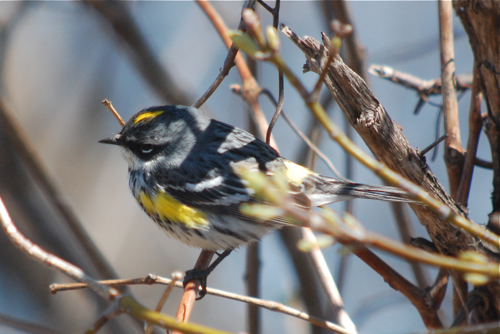
A yellow-rumped warlber. These early arriving warblers have already passed through the southern US but they're hitting Minnesota hard as they work they way north to their breeding grounds. This is the time of year that I would expect them, but because we've had a cold snap with rain and snow, they are having a challenging time finding food, part of the risk of an early return. They eat insects, but they are scarce, they'll go for seeds, buds and fruit. You might even see them flitting around the bird feeder going for suet or sunflower seeds.
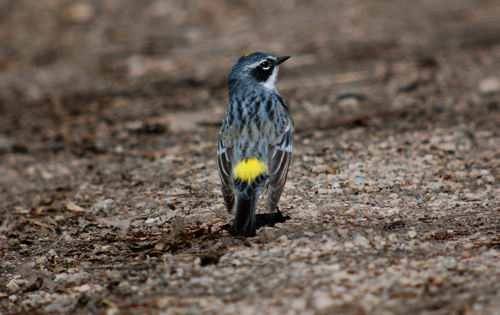
This bird has a couple of different names, one is "Butter Butt" because it looks like there's a pat of butter on their rumps, the other is "Myrtle Warbler" because there are two different types of yellow rumps, an eastern version (the Myrtle) and a western version (the Auduobn's).
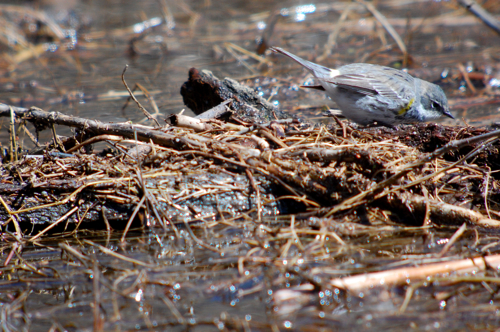
They're very noticeable as they dart around tree branches and flit around on the ground flashing periodic patches of yellow. Their call note in flocks almost sounds like a kiss, you may have noticed it while walking around your neighborhood.
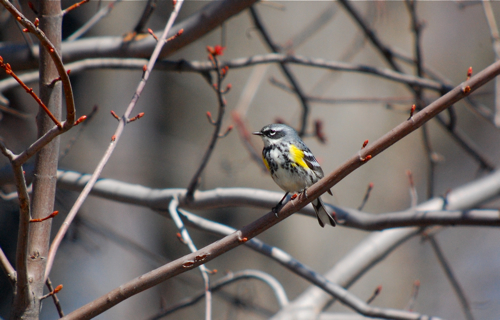
Yellow-rumps are the last warblers to leave in the fall and the first to arrive in spring. These tiny, hardy birds are the warning that all those crazy colored warblers that birders go ga ga for are about to arrive. Enjoy them while they last.
Attaching A Spotting Scope To A Bike
I've had a couple of question sent in via email and Facebook asking how I attach my spotting scope to my bike. I had Non Birding Bill take a few photos to show what I do. This is for my Swarovski ATM80 mm scope, Nikon D40 and Swarovski 8x32 ELs. The set up that I'm going to show is primarily for traveling to a location and then walking around to observe and digiscope.

I have a Swarovski backpack (that is at least 5 years old) but any good outdoor backpack should work. This one has fasteners that hold my scope firmly in place and is fairly weather resistant. I've had it since 2006 and use it on a daily basis. It has become my mobile office. Anyway, if you have a good weather-proof backpack, that should work. I also store my Niko D40 in here.

I have a basket that's attached to the back of my bike. I put the backpack in the basket and I slide one of the tripod legs through the straps on the pack. I secure the tripod for the spotting scope to the back of my bike with bungee chords. My reason to sliding the tripod legs through the backpack straps is to make it difficult for someone to just grab my backpack from my basket if I were stopped at a traffic signal.
When I get to my birding destination, I simply lock up my bike, undo the bungee chords, take my scope out of the pack and attach it to my tripod and go birding.

I wear my binocular harness while ridingon my bike. It allows for me to comfortably wear my binos while I ride my bike. I keep my spotting scope stored on the back of my bike. I'm sure this isn't the only way to do it, but for those curious, it is possible to tote a scope, tripod and camera with you on your bike. I'm not worried about damage, Swarovskis are good, sturdy scopes and meant to take on wear and tear in the outdoors. It helps that they are waterproof and come with a lifetime warranty (though if the the glass on the eyepiece is scratched, I'll have to pay a minimal fee to get that repaired). Otherwise, I feel safe with it on my bike.
This is just my method that I have come up with via trail and error. If you have tips for toting scopes and cameras on a bike, feel free to share in the comments.
Incidentally, this is the set up I have used when biking to the owl nest in my hood and to observe the waterfowl on the area lakes near my apartment.
 Dude, how red do you need to be?
Digiscoped Images
Fresh Tweets
Would you like to hire me as a speaker for your event?
Email sharon@birdchick.com