Birdchick Blog
An Exciting Day
 I'm too wiped out to do a proper entry, but I will leave you with some exciting bits from the day. First up, can you identify the bird in the above photo? Hint: It's not a shorebird. When you're ready to guess, the adult plumaged bird can be seen here. No prize, just glory in the comments section.

Second, I met someone totally cool (in my book) on the trip. Long time readers of this blog may recall that I am a big fan of the crop art at the Minnesota State Fair. One of my all time favorite pieces was a portrait of Jackie Chan in 2005. Turns out that one of the women taking the shorebird workshop not only does crop art, but her husband did the Jackie Chan portrait (I totally geeked out). I told her that her cool points had just sky rocketed in my book. Between that and the fact that there is a Strong Bad sticker on her car, leads me to believe that we could be friends outside of birding--if my overwhelming (but sincere) excitement over crop art didn't frighten her. I'm not sure she wants me to completely out her or her husband as crop artists, but I will say that if you visit Cropart.com they have some work up in the gallery section.
 Take note of the above photo. Notice anything out of the ordinary? Note the bird coming in for a landing. Do you see tags on the legs?
 We found a tagged semi-palmated sandpiper! Normally, I would say that finding a tagged bird is excitement enough--we'll report it, find out where it was banded, how old it is, etc. But I'm even more excited that when it flew in, I was able to tell the trip leader that we had a tagged semi-palmated sandpiper...I identified a semi-palmated sandpiper on my own (sniff, sniff) I've had a total breakthrough!
Friday's Fun At Carpenter
But first, a wee bit of bragging. My sister, Terri N. Graves has a front page article in the current issue of NatureScape News! If you have a copy, it's the one with the blue dragonfly photo. If you don't have one, go out and buy it right now--it's a great paper and my sister is a great writer, a bit different from me--perhaps a tad more conservative...and not as many typos. Here's her profile on their website, but here is what she actually looks like. I think she's going to be a regular contributor to their publication and I'm so excited for her. She'll write on birds, flowers, dragonflies, or whatever tickles her outdoor fancy. NatureScape News covers the whole Midwest and Terri will be their Indiana field contributor, giving her Hoosier perspective. Go, Terri! Whoot.

 Well, it was a mini bogging conference on Friday at Carpenter Nature Center because Hasty Brook and Hell Ziggy showed up to join in the fun. I learned that I am not ready to get black-capped chickadees out of the nets on my own. You would be surprised at how hard they are to retrieve, because they ball up their little toes around the nets, and you have to get their feet out before you get the rest of their little bodies out. Problem is, as soon as you get the toes out, they sneak in and clamp down on more net. My particular chickadee had fluttered quite a bit and was beyond tangled. It had to be cut out, which I didn't enjoy, since banding nets cost about $70--ack. Hell Ziggy did get a photo of me above getting a song sparrow out of the nets--easy cheesy. Alas, I was an over achiever with that bird, for I not only got it out of the nets swiftly, but accidentally let it go before we had a chance to put a band on it. Ah well, easy come, easy go.
 While I was working on a chickadee, I could hear that someone else was trying to get a woodpecker out of the nets. Some can be quite squeaky and vocal when you are getting them out. I wasn't sure of the species, but could tell by tone that is was a woodpecker. I was surprised when they walked in with a young yellow-bellied sapsucker (above)! We really haven't seen them around Carpenter this summer, so I imagine that this is a young bird leaving its nesting territory--kind of like a kid leaving the house at about 18 years old and living on its own. Here's what the adult looks like. It's a pretty woodpecker.

 It was challenging to try and get a photo, it kept flapping and squealing. I was curious to see if any hawks would come in. I've heard that sometimes playing a "wounded woodpecker" call and bring in hawks, foxes, coyotes, and mink.
 We also got in a TON of catbirds. I think they young are finally leaving the nest and we may also be getting a few moving out of territories and pondering migration. I laughed when I was looking over the photos, my shot of one of the catbirds looks rather petulant.
 Hell Ziggy's on the other hand looks down right artistic (and completely in focus). I've been hearing lots of reports of catbirds eating grape jelly (and robins too). Though it is possible that these species will regularly come in for grape jelly, I wonder if the increase in reports to me has to do with the dry conditions in Minnesota or more people taking notice?
 Here's a photo Hell Ziggy got of Hasty Brook releasing a goldfinch. It almost looks like she's doing the flourish at the end of a magic trick. Hasty also got to release a catbird and appeared to have a magical experience.
 Hell Ziggy on the other hand wanted to go for a more hard core, if not masochistic experience of holding a cardinal...
 I got a shot of it, pre-crunch. Now, that's what I call a nail biter! Har har. She took it like a trooper though, and was proud of her blood blister from the cantankerous cardinal bill.
Afterwards, we headed out for lunch and I got some much needed fun conversation. Remember, you too could be having this kind of fun, so stop out at Carpenter sometime.
A Milestone For Me
 And yet another grasshopper sparrow, they are everywhere I go, I can't escape them. I've seen them before, but not like this summer. I don't know if I'm just paying more attention or if we are having a bumper crop of grasshopper sparrows...or if aliens from some distant planet are trying to send me a message about saving the planet via grasshopper sparrow (although, that would seem to me to be an unreliable messenger).
You can tell this press release about Cape May Bird Observatory's new website was sent by a hardcore birder:
"Since you all have blogs and/or have close connections to Cape May I thought you might like to take a look at the site..... and in the event that you might be looking for something to write about given the slow nature of the summer......."
Slow nature of summer? Not in my neck of the woods! There's always some birding happening (and now bees--and some new caterpillar madness had started which I'll be talking about soon). Oh, how my grasshoppery ways have caught up to me this last week--sheesh. Here it is Monday, and I have bloggin' left over from last Friday.
 So, Friday at Carpenter was a first for me--banding a tiny bird. Usually, at Carpenter, I'm happy to lurk and watch the pros but the bands swiftly on the birds. I enjoy trying to get the birds out of the net and bringing them in, but I always felt my place at the table was to just promote all the cool things that they do. I'm used to banding large birds, but not the tiny ones, so I have avoided actually pacing a band on a bird. Friday that changed. There have been offers before, but every time I always answer, "Oh, let's wait for a cowbird, let me practice on a cowbird, not a chickadee or goldfinch."
Friday, Jen Veith, the Development Director and experienced bander would not take no for an answer and had me band my first tiny bird--a house wren--man oh man, talk about a really tiny bird to band! Larry took a photo of this momentous occasion (above photo). It all happened so fast, and I was so freaked about not breaking one of those tiny wings, or legs that I barely remember it.
 Up next was a house finch. Larry helped supervise the banding of that bird. You will note that we are doing these outside. Jen recommended that the first few times I band birds outside, that way, if I accidentally let one go, it won't risk injury by hitting walls and windows indoors. I was much more comfortable putting the band on this one.
 Here I am taking the wing cord--fancy talk for measuring the wing. This house finch was a hatch year bird (hatched this year) and we couldn't tell if it was male or female. I measured the wings, all went well and the bird flew away.
 Since many of the birds I have banded (pelicans, hawks) it's still hard for me to get the songbird bander's grip down: holding the bird in my left hand with it's back to my palm, it's head between my index and middle fingers, also holding it's chest. With my small hands, the finch and wren fit easily in my hand...
 Then came a much larger hairy woodpecker--not so easy to hold in one hand--good grief, how will I ever hold a blue jay in one hand? This bird we could tell was female and were able to determine her age by her eye color (brown to grayish brown indicates that this bird was hatched either last year or this year). She also had a brood patch for incubating eggs and chicks, which she wouldn't have if she hatched this year, so that means she is a second year bird--she was hatched last year.
 In between teaching me how to band, Larry got to band an eastern phoebe. I took a picture with his new Sony digital camera--it's got a pretty good macro feature--look at that feather detail. While we were taking this photo, the phoebe flapped a few times, and each time we heard a rapid clicking noise--phoebe's snap their bill when agitated--just like owls do! I never knew they did that. Of course, I've never had the opportunity to make a phoebe angry.
 After banding, Jen and I explored the prairie area at Carpenter--loaded with grasshopper sparrows (another one above) and sedge wrens. Jen and I came upon a family of grasshopper sparrows, and the young were just learning to fly. It was a hoot to watch their labored flights around us and then the oh so awkward landing on what looked like a sturdy perch but turned out to be a wobbly prairie flower. About as graceful as a girl in her first pair of high heels.

 There was also a pair of eastern meadowlarks scolding us, we must have been too close to their nests. It would be fun sometime to move the banding operation out to the prairie and get some bands on the birds out here.
Banding Young Raptors
A question came up in the previous entry about banding young raptors, do we worry about being bit and do we band the adults (and if so, how do you get the adults)?
 Let's talk about handling raptors: If you have ever noticed from my fall hawk banding photos, we always are holding the hawks and falcons by the feet. It's the same with the young osprey, note Reier in the above photo. It looks like he is cuddling the bird, but he's keeping the feet safely away from his body and since the bird is pressed to his body, that prevents it from flapping around.
 We're not really worried about the the hooked beak. The feet on raptors are the business end of the bird--their powerful toes are what separates them from other predatory birds--they grab and kill with their toes. So, when a raptor (eagle, hawk, owl, falcon, kite) feel threatened, their instinct is to always defend or attach with their toes and sharp talons. The beak is a last resort, it's too close to their eyes, and eyes are so crucial to their hunting ability that they don't want to risk putting them near danger.
 In the last few years, researchers have also been taking blood samples from the birds. This could be useful for future DNA studies--especially if the populations fall low again and a reintroduction is necessary. Again, in the above photo, note how Amber is holding the young osprey's feet, and has her other hand over the bird's chest to hold it in place while mark takes its blood. Osprey are about five weeks old when we band them, they have learned to stand up and walk a little, but their wing muscles are weak. They also haven't figured out quite what their feet are for. As we are holding them, sometimes they will weakly and slowly make grabs with their toes, but they aren't nearly as swift and as strong as the adults.
 Even when its time to put the bands on the legs, one person needs to hold the large chick while another places the band on the legs. Above, Amber holds the bird and feet steady as Mark places the band on the young osprey. Already, osprey banding is a two person job. However, that's just putting the bands on--getting the chicks out of the nest is another matter altogether. You either need...
 ...a cherry picker to donate their time and truck to go up and retrieve the chicks and put them back. Or you will need...
 ...a professional tree climber to donate their time and skills to go up and retrieve the chicks. It's a group effort to band osprey--at least two to three people are needed. Note that the climber in the above photo is also having to climb past a slick metal raccoon baffle to to get to the top.
 As to the adults, they don't band them anymore in Minnesota. They used to do that when they first started the reintroduction program in the Twin Cities, but I've never observed it. To my understanding, it's not easy. It's not like other raptors where you can put out a bait pigeon and some mist nests--osprey only eat fresh (live) fish. From what I understand, they would take one of the education eagles from The Raptor Center and perch it out near the osprey nest. The adult osprey would fly in to chase off the eagle and either get tangled in nets surrounding the eagle, or some other type of trap. I remember a few times that adult osprey were brought in to TRC from banding because after they trapped it, they found fish hooks in their talons and were able to remove them and return the adults to the nest that day.
And for those curious, no education eagles or wild osprey were hurt or got hold of each other during the banding process.
Now, on to get check the the doin's a transpirin' out at the Kitty hive.
Osprey Banding
 I don't know how many of you readers have been following the Zickefoose Blog about blogging styles: as a blogger, are you an ant (writing posts ahead of time and having a store of well thought out, well written, typo free entries) or are you a grasshopper (posting as the muse strikes you, never bothering to have a larder of entries)? If you haven't been able to catch on by my typos, I am very much a grasshopper. I would say that for the most part, that works for me. However this week, the blogging has been a struggle. Nor for lack of inspiration--but lack of time and alertness to do many posts. I have a back log of entries.
Now, on to Thursday's osprey banding:
 My friends, Amber and Reier picked me up Thursday morning for some osprey banding with Mark Martell. We stopped at four different nests and had some interesting discoveries.
 Nest 1: only one chick to band (mark did two nests on Sunday and each had three chicks) and the adult female had a transmitter on her back--she's from Milwaukee. Can you see the chick in the nest in this photo? When the osprey parents call the warning, the chicks go flat like a pancake, this only shows their brown feathers and hides the white feathers. To a passing aerial predator, the nest would look empty.
 Nest 2: three chicks, one died as soon as it was taken out of the nest--very similar to what happened in 2005. The necropsy of the 2005 chick showed that it was severely weakened from a liver problem and that it died from cardiac arrest. The stress of being taken from the nest killed it, but had it been healthy to begin with it, then it would have survived the banding. The problem that the chick had would have killed it either before it left the nest or not soon after. I have a feeling, the necropsy for this bird will show that they same thing happened. Bummer.
 Nest 3: Two healthy chicks. Although, besides just the pair of adults screaming at us as we banded, a third flew over and joined in the screaming and yelling. You should be able to see three birds in the above photo, flying in the sky.
Nest 4: Empty. What was interesting about this nest was that chicks were observed in the nest this past Sunday but a mere four days later they were gone. It was way too soon for them to have left the nest and even still, there should have been some osprey activity and it was dead quiet. A new eagle nest was built withing half mile of the osprey nest and Mark speculated that the eagles at the chicks sometime between Sunday and Thursday (guess the pancake defense didn't work so well that time). Talk about getting two birds with one stone (har har)--they get to juicy birds as well as cut back some of the competition for fish in the lake.
 Sometimes great horned owls will take osprey chicks, but they aren't strong enough to carry the body away and eat it right in the nest. An eagle, is much larger and can easily carry an osprey chick. The lack of feathers and body parts in the nest points the finger to the eagle.
 For me, the best part of the day was at the Lake Josephine nest. There were some kids who came to watch the banding and while this bird waited its turn to be banded, I let them touch it and even better--smell it. Since osprey only eat fish, they have a very distinct aroma. They also became our helpers, holding the bands and other equipment before we put them on the birds. They did a good job. Perhaps future naturalists?
 And, because I feel like everywhere I go, I'm finding grasshopper sparrows, I'll include the above photo. This bird was near one of the osprey nests, perched on top of a sapling covered with a plastic tube (to keep deer from chewing it) and then covered with netting on top (to keep bluebirds from going into the tube looking for nest cavities and getting stuck). It tried not to move, hoping I wouldn't notice it just sitting there with some incredibly incriminating billful of food, on its way to feed a nest of hungry chicks. I was more entranced by the insect that whipped around in the tiny bill. I wonder what it was?
I'm Trying
 I keep trying to do a blog entry about osprey banding today, but I keep finding ticks. I've lost count of how many I have found crawling on me and I'm not sure what's more disturbing: the number of ticks I keep finding or the fact that I've been out of a tick area for over six hours and I'm still finding them. Why are they just crawling on me, why aren't they latched on? Am I not to their taste or is something wrong my blood?
What does it say when you are rejected by ticks?
For Teageeare
Who tells me that I don't put enough Kabuki in the blog: Here is my cranky little cockatiel, eyeing my inbox, hoping I will not notice if he pulls out and chews some paper. He and Cinnamon are about to go an a small adventure. We're going to dog sit for the next few days and we're bringing the pets with us.
 I can't believe blogging escaped from me for a couple of days--it turned much busier here than I had anticipated. Next weekend should be about the same. I took Cinnamon with me to Carpenter Nature Center on Friday. I got an email a few weeks ago from some blog readers who said they might join us for banding. They asked if Cinnamon would be there and originally I had said no, but Thursday night and Friday morning, she was doing all those things that say, "Hey, mom, I need some stimulation." ie - digging in her litter box and sneaking into the kitchen. So, on went her leash and she went with me to Carpenter and found a whole slew of new things to disapprove of.
 Even though we can still get her to put on the leash and harness without too much of a fuss doesn't mean she tries to chew and whip it off when she thinks I'm not looking.
 We're getting in quite a few of the summer residence. Above is a male robin we have had in the nets twice this summer. You can tell he is male by the dark head and the darker rusty breast. Boy, he really looks unhappy in this photo.
 We also got in this hairy woodpecker. Notice anything strange about him? Check out his red patch--it's on the front of his head and not the back--a way you can tell if the bird just hatched this year when it is at your feeder.
 Cinnamon was not as impressed with all the banding going on and was way more interested in exploring all the prairie grasses. Just by hopping in a few feet, she would completely disappear.
 Apart from the leash, the only other way you could tell she was in there was by watching a tall piece of grass waver for a moment and then fall over as she had chewed its stalk. She was almost on sensory overload with the abundance of chewables at her feet.
 To a blade of grass, she's kind of a scary looking monster. Afterwards, she kept me company as i scouted for a field trip that I was leading on Saturday. Which I will blog about later tonight. Right now, I have to go out and check on the bee situation...have I prevented a swarm...will the Olga hive be ready for a queen excluder...what wonderful bee adventures will I encounter this week?
Colonnade Peregrine Banding
 Yesterday they banded the peregrine falcon chicks at the Colonnade Building in Minneapolis. This week has been so insane--I just can't seem to keep up with the schedule. I had a business meeting this week and the poor woman and I were trying to get our schedules to sync up, I finally asked, "Dawn, do you want to meet at a peregrine falcon banding event?" Lucky enough, she did! I wasn't sure, she's one of Non Birding Bill's friends.
 Here is Bud Tordoff, holding up one of the four chicks that got bands yesterday. There's a video of it here, you can see one of the adults flying around the nest ledge above Bud. You can also hear the adults screeching in the background of all the chick screaming noises.
There were two males and two females (researchers can tell them apart by size--even at 21 days old). Dawn and I watched a couple of the chicks being banded and then went inside to go over our actual meeting. As we were wrapping things up, the banding crew were coming back into the building. The person in charge is Jackie Fallon, who I know through The Raptor Center so I begged, "Hey, Jackie, can I come up to get photos of you putting the birds back from the floor the nest box is on?"
She said yes. Dawn gave an understanding look and I dashed into the elevator with the peregrine banding posse.
There were some maintenance people taking advantage of the absent chicks to do some minor repairs around the nest. Even though the chicks were gone, the female adult peregrine falcon was giving him the hairy eyeball:
Note the woman in the window well with the padded stick--to keep the falcon from nailing the repairman. There were some interesting leftover prey items around the nest:
 This is a chord from the repair man, but under it is a rail head. I'm thinking Virginia rail.

 There was also this pellet and I'm so bummed that it didn't turn out so well! There's a hummingbird bill at the top of it! Peregrines--eating hummingbirds? How? I know they are fast, but hummingbirds? Why? Wouldn't it be too much work for so little food? It's gotta be like eating a jolly rancher. I begged the banders to bring it in, but their priority is getting the banded chicks back in the nest swiftly and not getting hit by the adult falcons. It was not in an easy to grab area from the window well, and really, I was lucky just to be there watching the nest platform.
 Which reminds me, I ran into HellZiggy and Hasty Brook at the banding. I got this photo of them while I was upstairs. Hi guys, sorry I didn't have more of a chance to chat.
 While I was getting their photo, the male came up to see what was going on and to look for the chicks. The repairs were finally finished at the nest...
 And the chicks were put back on the nest ledge. As soon as they were put down, they scrambled to the back corner of the nest and screamed together. The female falcon swooped back and forth as she could hear her chicks screeching.
 As soon as the window well went up, the female flew in. Both the chicks and the female are looking up towards the well like, "What the heck was that all about?" Here's a video of the female looking over the chicks:
You can almost see her trying to work out in her tiny little brain what just happened. You can also see that she has an urge to feed the chicks. That begging cry stimulates the adults to hunt and feed the chicks.
 We left the female alone with her chicks to get back to the business of rearing them. Ultimately the birds get a sense of "I won". They kind of are thinking, 'This big scary thing came in, took the chicks away, but all the falcons screaming and swooping frightened the big scary thing so much, the chicks are back."
Okay, now I have to load up the car and hit the road to North Dakota.
Friday Birds
A quiet day of banding at Carpenter Friday morning--I keep hoping for a big warbler wave in the nets but the timing has been off when we are banding. Some birders are mentioning that they aren't seeing warblers like they normally do this spring, but I think they are there. We had one heck of a leaf out in early May and most the warblers have been hidden. Much my warbler enjoyment this spring has been by ear.
 We did get a ruby-throated hummingbird stuck in the nets. We don't have any equipment for banding hummers so when they are in the nets, someone takes them out and we let them go. This girl needed a few minutes for recovery and we got to get a good look at her feathers.
 As Jim was getting her out of the net, we noticed that her throat was tinged a light golden yellow. I wondered if this was a plumage variation--the older the female she gets some coloration on her throat? We looked it up in the Pyle book and on BNA Online but could find not mention of gold throats on males or females. The only explanation we could think of was pollen dusted onto her throat from foraging on flowers. Has anyone else seen anything like this before?
 The peony garden at Carpenter was loaded with pollen. The gardens are gorgeous right now in various reds, whites and pinks. If you are a fan of the Hoosier state flower and live near Carpenter Nature Center, I'd stop by this weekend.
 I did get a chuckle when I found one of Carpenter's honeybees gathering pollen in the peonies. Who knew I'd be paying attention to bees in flowers? Am I losing my birding edge?
 Since the banding was slow, I thought I would take some time to try and digiscope some kingbirds with Larry around the property. While walking, I noticed some monarch eggs. Above is a monarch egg on the bottom side of the milkweed--that's my big ole honkin' thumb next to the egg for size comparison. Ah, it's getting to be monarch ranching time. If you would like to learn more about raising native monarchs indoors for release, I'll be teaching a Monarch Ranchin' workshop at Staring Lake Outdoor Center July 7, 2007. Contact Staring Lake for details.
 We did find some kingbirds on our walk. Not the best photo ever, but you get the idea. It was so cute, while I was away at Detroit Lakes last week, I could tell Non Birding Bill missed me--he was noticing birds. He sent me a text message on my phone that he had seen a kingbird in Loring Park on his way to work--I didn't even know he knew what a kingbird was.
 On my way back to my car, I found myself being spied on by a thirteen-lined ground squirrel. Sometimes they snarf up the spilled seed under the bird feeders.
 Larry had posted on the listservs this week that he'd seen dickcissels in Dakota County already. I usually don't see those guys until June. So I drove over to my favorite spots for dickcissel in Dakota County at the Empire Substation on 210th St. There's a small tree farm, power station and Buddhist temple surrounded by farm fields which is great for sparrows and meadowlarks. I didn't find the dickcissels but I did find chipping sparrows singing on territory (above) and lots of singing clay-colored sparrows.
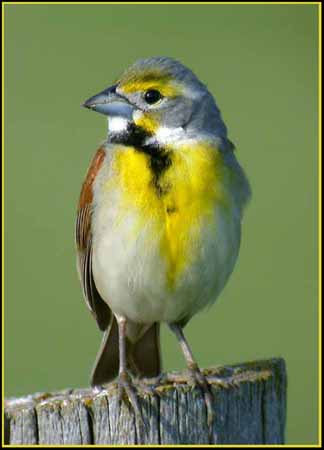
 As I was driving home, a sparrow popped up on a tree on the side of the road--a grasshopper sparrow. I pulled over and set my scope on my window mount tripod--which isn't easy to use for short people, but fortunately for me, the Swarovski eye piece rotates around so I can kind of use it with the window mount--it still takes some contorting on my part.
 The grasshopper sparrow was incredibly accommodating. It stayed perched in the open even though it took me a few minutes to get the scope up and on it. Maybe this sparrow is ignored so much, it was happy that someone wanted to digiscope it?
 Boy, you can tell this has been a good birding month, not many entries on the antics of Cinnamon. She disapproves of her lack of exposure in the blog. Okay, now Non Birding Bill and I are off to celebrate the Holiday Weekend, enjoy the outdoors, irritate a disapproving bunny, grill up some meat, bake some rhubarb pies, and I have to finish up a couple of deadlines. The rain is supposed to ease up tomorrow and I'll try to get out to the beehives and take some photos--our first batch of new workers should be hatched--whoot.
Hope you guys have a good time and enjoy birds where ever you are.
Northern Rough-winged Swallow
 Kudos to everyone who made a guess at the photo id contest--it was pure evil on my part. The northern rough-winged swallow is not a bird I normally talk about, it's brown and nondescript and just not a bird people pay a lot of attention to--even though they are there and easy to see if you look. A big pat on the back to Leanne for the correct answer.
 Here's the original photo of the bird that was zoomed in for the contest. We had two swallows fly into the nets at the same time at Carpenter--near the bird feeders of all places! Since these aren't birds that will come to bird feeders, our best guess is that they were chasing each other over a territory battle and both landed in the nets at the same time.
 At first, there was some talk that it might be a swift, but a check of the tail--and running fingers along the wing confirmed that this was a northern rough-winged swallow. The barbs on in the primary wing feathers on a male rough-wing are distinctly hooked and running your finger over them kind of feels like running your finger over a nail file. Females do not have as distinct barbs. I don't think scientists have figured out the reason for the barbs yet--if anyone knows or has an idea, please let me know in the comments. I would have gotten a photo of the barbs, but the birds were flappy and stressed and we wanted them back out on the wing ASAP.
Again, thanks to everyone who guessed. It's not easy to put your name to an id when you aren't sure.
Digiscoped Images
Fresh Tweets
Would you like to hire me as a speaker for your event?
Email sharon@birdchick.com