
Birdchick Blog
Interesting Info From Banding Birds
I keep trying to write this blog entry, but my rabbit insists on using me as a jungle gym, making typing most difficult.
 Here's a photo of last weekend's banding crew (the only bummer is that Frank Taylor, the guy who runs the blind isn't in it). But from left to right we have Reier Grudem, Joan Schnabel, me, Amber Burnette (holding a red-tailed hawk), Rick Dupont, and Katy Dupont.
 Frank Taylor just included this photo in his weekly banding report. That's me in the pigeon yanking seat holding the pigeon line and a sharp-shinned hawk I lured into the banding station by pulling the pigeon. Whoot!
 Above are two haggard (adult) sharp-shinned hawks. So, I gave you the info for how we have the banding station set up, now let's talk about some of the interesting things observed over last weekend. First off, birds were all over, both songbirds and raptors. Saturday morning, Amber, Reier and I arrived at the field and could see sharp-shinned hawks, harriers, merlins all moving and could hear blue jays all over. You would see flocks of blue jays miles away in your binoculars and there would always be at least one sharp-shinned hawk mixed in with the flock.
 In the above photo is both a haggard (towards the back) and a passage (first year) sharp-shinned hawk. Note the difference in eye color and that the younger bird is brown and white and the older birds is dark blue with and orange breast. The passage sharp-shins were in hunting mode and were bound and determined to take out a blue jay. You would hear a flock of blue jays screaming and then all of a sudden you'd hear one give a strange honking call and that was usually a shin hot on its tail. We also saw flocks of smaller birds in the fields in front of the blind. At one point we had a white-crowned sparrow feeding in the grass in front of us. Just as we identified what type of sparrow it was, a passage sharp-shinned hawk flew down, landed on it, killed it and flew away with it's prize--in less than 40 seconds. It's was a much more effortless affair than the Cooper's hawk incident from yesterday.

 Above is an up close shot of a haggard sharp-shinned. It was one of the busiest weekends I've ever experienced at this little hawk banding station. On Saturday we banded 32 birds (29 sharp-shins and 3 red-tails) and on Sunday we banded 34 birds on Sunday (33 sharp-shins, and 1 Merlin). We did have quite a few heart breaks, including birds bouncing out of the nets before we could get to them and one mouthy little female kestrel. When the kestrels come into the net, you are sure they are going to come in, but they always seem to find the net at the last second and dodge out of the way. This particular female, flew right to us with no intention of going for the pigeon and landed on one of the poles that holds the net. She looked directly to the blind and gave the loud kestrel cry--pretty much the equivalent of giving us the bird. It was as if she were screaming, "Hey, I know you guys are here and any predator withing the sound of my voice should stay away!!" We must have had her in the nets before.

 Here's a haggard red-tailed hawk that came into the nets. This bird was a bit thin and its bill was a tad crusty looking. As Amber was banding it, she noticed that the left eye was clouded over. When you waved a finger in front of it, the hawk could see out of it at all.
 Obviously the hawk had not been surviving well with this disability, but it had been surviving. Who knows exactly how long the birds had been living with sight in only one eye. The bird has been alive at least three years. When red-tailed hawks are young, they have yellow eyes (note the yellow eyes of a passage red-tailed hawk in the next photo). Their eyes get darker as they get older, this bird could very well be 15 years old. Glaucoma doesn't develop overnight, perhaps it has been such a gradual change the hawk has had a chance to adjust it's hunting style. Reier noted how it flew to take to view the bait pigeon and really, had the nets not been there, it would have been able to catch it. There really aren't any treatments for bird glaucoma so taking to the Raptor Center wasn't an option. After banding it, we let it go. Maybe it will survive another few years or maybe it's going to end its last days in a blaze of glory.
 For a comparison, here's a very healthy passage red-tailed hawk, note the yellow eyes? This bird was having some tail issues:
 Check it out, it's missing quite a few feather and has a mixture of both first year red-tail brown feathers and a red tail feather--what the heck is going on? Frank speculated that the tails feathers had been grabbed, maybe by another red-tail in a territorial fight, or by a nest mate, or even some other predator. The feathers are starting to grow back in, and the new feathers are growing in red because the body says "hey, after the second set, these should be red" but at the same time, the feathers are supposed to be brown striped, so you get some striping in there too. And since we have a photo of a red-tailed hawk with the wing extended, note how the wings look very long in relation to the body, and the tail is short in relation to the body--this is a characteristic of this type of hawk, known as a buteo. Compare that to a different hawk:
 Here is a sharp-shinned hawk, they are accipiters and they have a shorter wing in relation to the body, and a very long tail--that's one way you can start to id hawks. When you see one, try to note if the tail is long or short compared to the body and if the wings look long or short. Incidentally, this is one of the birds that I lured into the nets.
 The birds were coming into the nets so quickly, that at times we barely had time to get photos or to release banded birds. We were getting ready to release this merlin (in front) and this sharp-shin when Rick yelled that some birds were coming into the nets. We just ran behind the blind rather than taking the time to go in. Sometimes that's faster and if you're quiet, the birds will still come into the nets. I was going to take a photo of these two when all of a sudden both looked up. They were seeing hawks fly over too.
 When we have a chance, I like to get photos of people releasing hawks. My favorite thing to do is lay on the ground and get a wing shot of the bird. When you release a sharp-shinned hawk, you can pretty much just open your hand and they take off towards the woods right away.
 Reier got a photo of me releasing a red-tailed hawk. They are little heftier and you have to kind of fling them into the air so they don't just thunk on the ground. Unlike the sharp-shinned hawks that head straight for the safety of the woods as soon as they are released, red-tails stay in the open and try to find the nearest thermal to lift high into the sky.
 At one point we had two sharp-shins to release and one merlin. We released them all on once (that's the merlin in the middle). Note the shin on the right aiming right for me? That was courtesy of Katy. I told her that she could just let it drop towards me, boy I think she kind of threw it at me. It's okay, I had it coming, I was making fun of her for texting her friends from the blind. And if you're worried, the bird didn't hit me and made it safely to the woods.
We got to do several multiple releases. Here's a video of a sharp-shinned hawk release. I'm holding a sharp-shin and aiming my camera at my hands. But since two people next to me are releasing birds, it looks like a magic trick: one bird turns into three:
And for those who can't see video, here's a couple of consolation photos:
 Haggard sharp-shinned hawk.
 Passage merlin.
Hawk Banding 101
I'm always amazed at how closely people pay attention to the blog. When I wrote earlier that I was on a tight budget and didn't know if I could go up hawk banding this fall, invitations came from all over for free housing. I am sometimes overwhelmed by friends and their generosity. Another example is what I say I'm going to blog about. While I was having a great time at the banding station, one of the sub banders named Rick said, "Aren't you going to take pictures of the setup?"
"Huh?" I asked.
"You said that you were going to explain how we band the hawks up here." he reminded me. And he was right, I do need to explain the set up so this post will explain that. One BIG point to stress about banding birds:
Because banding birds requires capturing the birds and handling them before the banding takes place, the banding of birds in the United States is controlled under the Migratory Bird Treaty Act and requires a federal banding permit. Some states require a state permit as well. Only official federal bands may be legally placed on birds that are released to the wild within the United States.
You can read more about banding birds at the Bird Banding Lab. I'm fortunate enough to know several researchers who band different types of birds (pelicans, hawks, songbirds, herons) and allow me to tag along and carry equipment and now I'm to the point where I'm actually learning to do different aspects of it. This is just how this particular banding station works and records data, every station is different. This station in Duluth, MN is run by Frank Taylor, who has been banding hawks longer than even Hawk Ridge--38 years--and he doesn't look a day over 39.
 Here are the nets. Can you see them? There are two different ones there, right in front of the trees--can't you see them? Heck, I took the photo and I can't even see them. Let's look at them from a different angle:
 These are the front nets and this photo was taken from the banding blind where we hide while the hawks fly in. The nets form a sort of U-shape, with the open end of the U facing the blind. There are nets surrounding the bait bird (pigeon). Most hawks aim for the pigeon and fly into the front net, but some species are able to see the front net at the last second, dodge above it and as they go up and over, end up in the nets behind the pigeon. Sometimes, they hawks are so fast and maneuver so quick, they elude both front and back nets! It's incredible to watch the mad flight skills of all raptor species. Even a big chunky buteo like a red-tailed hawk has some fast peregrine moves inside it.
 This is the pigeon harness. This is a vest of leather that covers the pigeon around the chest to protect it on the off chance a raptor grabs it when coming into the net. The harness is also attached to a pull chord.
 Rick is putting the harness on one of the pigeons. The wings and feet fit through the holes comfortably and all the pigeons have to be the same size, if they are too small they can get tangled in the harness, so their weight and size is closely watched. You pull the cord, and the pigeon is aloft in the air, it flaps its wings and then flutters to the ground. The pigeon yanker has to pull, get the pigeon to flap the wings and then prevent the bird from thunking onto the ground and breaking some bones, so it does take technique to do it so the pigeon has a natural looking flight and doesn't get injured. We use several pigeons throughout the day. If it's a busy day and lots of hawks are flying over, a pigeon can be yanked a lot and tire easily, especially in warm weather, so you must keep an eye on the pigeon so you don't exhaust it. Rotating the pigeons gives them a chance to relax.
 Rick's primary job at the hawk blind is pulling the pigeon, or as I affectionately call him, The Master Yanker (this is the part that I got to learn this weekend, so I guess that makes me a Novice Yanker). When a hawk is spotted, Rick has the job of controlling the pigeon. You yank the pigeons in different ways for different birds. For accipiters or for larger hawks that are far away, you yank hard and get the pigeon high in the air. For larger hawks that are close, you just kind of wiggle the cord and get the pigeon to flutter slightly, too much flapping can freak out a red-tailed hawk or bald eagle on close approach--seriously, it will. I have to say, this wears out your arms pretty quick. You pull hard and far from the blind, and sometimes you punch people sitting next to you, or knock your knuckles on the boards inside the blind, not to mention how the cord rubs the skin on your hand raw.
 That's Rick in the blind in the above photo. See the hole in the lower left corner? That's where the pigeon chord comes into the blind. Another important job that the Master Yanker has is to pull the pigeon out of harm's way. Some raptors dodge the nets or are so big they can still reach the the pigeon though the nets, so you have to pull the pigeon out of the way at the last second, so it doesn't get killed. Frank has only lost 3 pigeons to raptors in the 38 years he has been doing this. As if all that isn't pressure enough, Rick has to burst through that little door at lightening quick speed when a raptor gets in the nets before it works itself out and flies away. It's a high pressure job, but man is it fun. I only did it for about 45 minutes and about 8 hawks flew in, two bounced out of the nets, but still I got six, man am I sore!
 We watch for hawks coming in. It's so much fun to watch a speck in the distance, identify what it is and then watch that speck come in to the nets. The red-tailed hawks are one of the coolest. You can see them from miles away, circling in a thermal and if you can figure out when its looking in the banding station's direction, you pull the pigeon. When the red-tail sees it, the bird will flap to get out of the thermal and then set on target for the pigeon--it's incredible once it has set, the red-tail won't usually flap, but just hold the wings steady and come in for a dive. There's a red-tail in the above photo. It's hard to see, I'll try and zoom it:
 It's interesting to watch some raptors come in low, using the vegetation behind them to hide their shape as they approach their prey. At the last second before the red-tail hits the nets, it will swing its feet forward, baring the talons--it's like watching an airplane drop its landing gear, and sometimes you can even hear the woosh of their wings--if you're thinking that sounds really awesome, it is.
 My friend Reier took this photo from the blind. When Rick had to take a break, I asked Frank if it would be okay if I took a go at pulling the pigeon. He seemed hesitant but gave the go ahead. It took some practice to get the pigeon yanking down (and I'm still no Rick) but Frank then asked, "Sharon can you book it? You have to be fast when the hawks hit the net and grab them before they get loose." I said I could do it. I took off each time and on the last time, my shoe got caught in the nets and I fell over, but still grabbed the hawk before it flew off. That's me, as if I just slid into home base, holding my hand it the air, "I'm okay!" I shouted. I got the hawk, and provided comic relief--that's what I call a job well done. I have a beauty of a bruise today and have made the extra effort to wear cropped pants to show it off. "Ew, Sharon, how did you get that nasty bruise?" and I will proudly exclaim, "Hawk banding." I love my bruises and scars.
 After the hawks are in the net, you have to untangle them quickly--and I have to say that it's much easier to get raptors out than songbirds (you just have to watch out for the feet). That's Reier above getting a hawk out of the net with Rick. From thew, the hawk is processed, it's measured, banded, aged, and in some cases we try to determine sex. My buddy Amber is learning the measuring and banding end of things (and I just realized that I have tons of bird photos, but none of Amber in action), but I have to say I am a pigeon yanking junky--it's sooooo fun--and GREAT exercise. I'm okay with how my body looks, oh sure I would like to be a but more buff or a few of my parts could be a little smaller (it would make clothes shopping for tv, ten times easier) but it's hard to find exercise that's not redundant and boring. Today, after doing the pigeon yanking yesterday--all the right parts of me are sore--my arms from yanking, my thighs from squatting and lunging to get hawks out of the net, my torso (I'm not sure why) but if a gym could come up with some sort of virtual hawk banding station where every ten minutes I do some sprinting to get hawks out, and pulling to get the pigeon going, I would SO sign up! You could have screens to show hawks flying in, ah, it would be so cool.
 For some birds, we take photos before they are released. Seriously, little male sharp-shinned hawk, you thought trying to catch one of those pigeons who are bigger than you was a good idea?
 "Yeah, and I still say I could take one!"
 And then the hawk is released and we start the process over again.
 I love this photo. It's Frank (in the green fleece) standing in front of the hawk blind with some friends getting photos of the hawks that were just banded. If you look at the blind behind them, Rick is scanning the skies for more incoming hawks. Rick, Master Yanker, ever ready to bring in a hawk.
More hawk banding photos and interesting bird things we learned coming in the next entry.

Great Hawk Banding
Ehn.
I am so tired, worn out, bruised, and have a feeling of overall contentment. It was an awesome hawk banding weekend and some in depth posting will be coming, but for now, I'm going to soak, sleep and read about Jim Stevenson in People Magazine (interesting that it takes shooting a feral a cat about to attack an endangered bird before a birder gets a profile, but that People for ya').
In the meantime, here is a preview of hawk banding:

Autumn Banding At Carpenter
 It was absolutely stunning at Carpenter Nature Center this morning. Really, if you have never been there and live in the Twin Cities area, you should go now. The last of the late summer flowers are blooming, the leaves are changing color, and birds are all over the place!
 It was such a pleasure to walk in this environment to the nets to get the warblers out. I was running a tad late to Carpenter this morning (thanks to a Rocky Horror Picture Show discussion on fm107) and all along the way, I could see raptors lifting off the bluffs along the Mississippi River and the St. Croix River. Thursday night, we had some bad storms with funnel clouds right at sunset. I wonder if the migrants were forced down and I was watching them leave. I saw several sharp-shinned hawks (one ambitious fellow was trying to pop a blue jay) and even a young peregrine as well as LOTS of harriers. The songbird banding was great at Carpenter.
 We had a puzzling Nashville Warbler (above). The bird showed many characteristics of being male, but had NO rufus cap. But was way too yellow on the bottom to be female. So, take heart new birders, even in hand, fall warblers are tough to id. But, do note the warblers toes--Nashville warblers have yellow toes--cute!
 The most exciting birds for me were the two above. It was just about time to take the nets down, and I was doing one last round to check for birds in the nets when I found in one of the nets right outside the nature center, two birds within a foot of each other. Recognized one right away. For some reason, chestnut-sided warblers and bay-breasted warblers get cross wired in my head. I know they are two separate species, but in my mind, there's not much difference in color between bay and chestnut.
 I got this one out of the net and confirmed it was a fall male chestnut-sided warbler.
 Larry got the second one out of the net and it turned out to be a fall bay-breasted warbler--in the nets at the same time, withing a few feet of each other--so sweet.
 It was such an honor to hold these birds for a few moments as they start their trek to South America. Who knows, in a few nights these birds could be lurking in a bush in Illinois and then a week later be in St. Louis. Hm, side by side, these two don't look so hard to tell apart.
 We also got in an eastern phoebe today. We've been getting in so many least flycatchers and alder flycatchers, that this looked like one beefy bird. If fooled me at first because it was so yellow. But after we banded the bird and let it go, you could hear a weak "fee bee" call. It's still learning the notes.
 I was surprised to see a monarch lurking about on the prairie. It's still possible to see these guys.
 I think this is an Atlantis fritillary, although a tad beat up. The last few remnant butterflies before winter sets in.
 And, I leave you with one last photo of the chestnut-sided warbler. I have to get to sleep. It's now 10pm and I have to wake up at 4am to go up north for hawk trapping. I don't know what my Internet access will be like this weekend, but when I come home there should be some hot hawk banding photos.
 Giggity.
Banding Giggity Giggity
Banding rocked so hard today--and it's not done, I'm going hawk trapping this weekend. I try to formulate a post about banding at Carpenter before I leave--I still have to download photos from the other camera, but here is a hint of what we got:
 Both of these birds came into the same net at the same time. Can you guess what they are?
The Browniest Of Birds
A cool front has moved in and it's finally starting to feel like autumn. It was another busy morning banding birds at Carpenter Nature Center--when I arrived, they had taken 15 birds out of one net! Incidentally, CNC is selling apples from the orchard (Zestars) and have some you pick raspberries (as if the birding were reason enough to visit).
 I'm finally to the point where I'm an actual helper, really banding the birds and taking them out of the nets. For a long time, I just documented the events, but I'm finally to the point where I can be of some real use. I felt like joined the big kid table somewhat because I got to band a small empid flycatcher. They can be agony to id in the fall--even in hand six inches from your face. But with some help it was determined that the above bird was a willow flycatcher. This flycatcher was so young, that as we were taking it out of the net, it started making whiny calls and fluttering its wings--food begging behavior (kind of an odd little avian Stockholm syndrome there).
 A surprise for me was a cedar waxwing in the nets. Such a pretty bird, almost like a female cardinal with a lot of make up on...which I think I've probably stated more than once in the blog...an probably will again.
 Someone's bringin' waxy back! Check out the waxy appendages on those secondary flight feathers. For those curious, BNA says that the red bits are colored by astaxanthin, a carotenoid pigment and increase in size and number with the waxwing's age. If they don't have any, they are likely immature waxwings.
 Later in the morning, someone from the Wildlife Rehabilitation Center came by with about 23 young mallards that had been raised in the waterfowl nursery. They are going to be released in a few days so we put bands on them. Interesting to note: if you hold a duck in just the right way, it can act as a very stinky squirt gun when it poops--just so you know.
 The cool sunny day was so gorgeous, that I couldn't leave when we finished banding so I went out to take some photos. The prairie is glowing with late summer flowers. Above is a young song sparrow with its back to the wind. Take a look at the tail--feathers are still growing in.
 A field sparrow popped up on some sumac, not too far from the song sparrow. As I was watching this bird, a second field sparrow flew in:
 This one was carrying food. Curious, it chipped nervously while I walked the path and took photos. Eventually, it ducked down into the grasses and I could hear faint begging calls. Seriously? You guys went for another brood in Minnesota? It's early September, what's going to happen next week when the young fledge? Will you say, "Great, now that you've mastered flying five feet, you need to know that in the next couple of weeks, we're gonna fly a few thousand miles south...at night." I wonder if any studies have been done on migratory birds and multiple broods? Do birds hatched earlier in the summer that have had more time to master flight and catching food fare better than birds hatched late?
 Another interesting thing about the second bird--it's wearing a band, it's been in the CNC nets at some point. Oh, and we had a very interesting retrap today--a female goldfinch who was originally banded SEVEN years ago. Incredible!
That concludes our regularly scheduled update of brown birds.
Hawk Trapping Has Begun
My friend Frank Taylor opened his hawk banding station this weekend. I couldn't go because of the state fair and I'm so bummed that I missed it. I just got his report and found this in the notes--for this bit to make sense, you need to know that there's a bait pigeon on a harness and there is a net in front of the pigeon and a net in back of the pigeon. There's about 10 feet of space between the nets.
Monday was the most exciting of all! We got started at 6:30 am. There was no wind at all. It was supposed to start up and shift around to the southeast by noon with a chance of showers. I figured we would not see much and be out of there by noon. Around 7:20 while we were watching some shins, kestrels and merlins chase each other around the field, a thing that looked like a small airplane came floating in from the farm. It was an immature male bald eagle! It kept coming and coming and we figured it would just pitch up and sit in the tree above us like all the rest have done. This one pitched up but then came right down in the middle of the nets! Rick was in shock but ran out and scared it into the back of the front net. That is only the third eagle we have ever caught up at the blind in 38 years!
 Here's a photo Frank took of Rick holding the eagle after they banded it. Frank's blind isn't aimed at attracting eagles but they are opportunists and will for anything. For those worried, the eagle didn't get the pigeon (I think Frank has only lost two pigeons to hawks in all his years banding--that's pretty good).
I'm not sure how much I can go banding, I need to save money for Cape May. Guess I'll be sleeping in the car when I go up.
Busy Day Of Banding
 This is a photo that Larry Sirvio took of Tennessee warbler at Carpenter Nature Center--one of the 47 some odd birds that we banded this morning. Oy.
It was just nuts at banding today--I barely had any time to get photos. I arrived a little late and noticed some of the parking lot was getting ready to be repaved. I thought to myself, "With all this construction activity, I bet it will be slow." As I walked towards the building, I noticed one of the nets hadn't been put up yet. I thought it strange, but figured with the construction, maybe they weren't putting all the nets up.
Larry passed me and said, "They just radioed, there are eight birds in the orchard nets. There's one over there too." I said I would put my stuff down and start helping. Inside, the other volunteers were furiously looking up small flycatcher identifications, and there were already about six bags with birds hanging waiting their turn to be processed (from a quick glance the bags had warblers, vireos, a red-breasted nuthatch, and some sort of small flycatchers). Yikes!
From there it was just a blur. At one point I was at a net with one of the Carpenter naturalists. There were four birds in the net. While we were trying to get them out, four more flew in, and then another two. We decided that it was so backed up in processing that we would close up the nets until we were caught up. By the time we got to the last net, eight birds had flown in. We were running out of bags, but fortunately, they were all mostly goldfinches and we could put more than one in a bag.
 This is one of the juvenile chipping sparrows we got in--they don't quite look like the adults, about the only thing that really gives them away is the eye stripe and the chipping noise that the make as you untangle them from the nets. We did get in a rather exciting adult--it had a band and turns out that it was banded for the first time on June 17, 2005 and at the time of banding it was already an after hatch year bird, which means that by now it is well over three years old!
 This young catbird looks like it is off to a rough start. First, notice all the pin feathers--it's just growing in its cap. But towards the back of the head, its missing some feather and skin--something poked it, hard. Was it a nest mate? Was it a blue jay trying to attach the young in the nest? Who can say. It reminded me of the red-headed woodpecker we got in last year.
 And it's interesting to note how different birds feel in the hand. Above is a male Wilson's warbler that I got out of the net. He felt so tiny, like I would break him. The easiest way to get birds out is to grab the feet and untangle those. Most of the time, if you can get the feet out, you can get the rest of the bird fairly easily. Most of the time.
 Volunteer Dennis Donath go this photo of a female Wilson's warbler (note the lack of black cap). Today was good practice for untangling birds from the net, I just kept doing the over and over. The goal is to get birds out quickly. Usually, when a bird is REALLY tangled, I defer to the more experienced banders to get the bird out. However, everyone was so busy today, that a coupe of times I found that I was the only option and just had to muddle through. Sometimes, when I'm trying to get out a really tangled bird, I panic. My hands start to shake uncontrollably and are completely useless. When that happens, I just have to let go, take a step back, take a few deep breaths, understand that my panic is not going to help the situation and then go back to the task at hand.
 Above, Jim Fox is handing a Wilson's warbler to a young girl whose family came to visit today. Sometimes, you can place a warbler on its back and it will lay there for a moment before flying away. That gives the kid holding it a chance to marvel at the magic of the the little thing in their hands. I got a five second video. Note the little girl's face.
Tell me that she's not now hooked on birds.
 I'm still kind of learning the ropes at banding. I'm now to the point where I can actually band a few birds. I insisted that the first practice birds be ones like cowbirds--let me mess up on a cowbird, not a warbler. But I'm to the point that today, when I got an ovenbird out of the net, I got to band it myself--WHOOT!
 First, let me say that after handling other warblers from the nets, the ovenbird is much chunkier. That is one beefy warbler--very chunky. You don't really get a chance to notice that when their flitting about in the wild. I'm happy to report that I banded it, aged it (after hatch year--at least a year old) and sexed it (unknown). We got some photos and let it continue on its southward journey.
Today was the first day of sun after six days of non stop clouds and rain. I finally noticed that migration in Minnesota is sincerely underway. If you have a chance, get out and enjoy it while you can.
Lawrence's Warbler?
As if fall warblers weren't already tricky to identify! Here comes a whopper.
All the photos in this blog entry were taken by bird bander Mary Messerli. She and Robert Fashingbauer were banding birds near Willow River State Park in Wisconsin on August 15, 2007 when they banded these two unusual warblers. Take a look at this:
 At first glance this looks like a golden-winged warbler, however it has way too much yellow. If some of you are jumping to a hybrid conclusion, you are right. Sometimes golden-winged warblers will hybridize with blue-winged warblers.

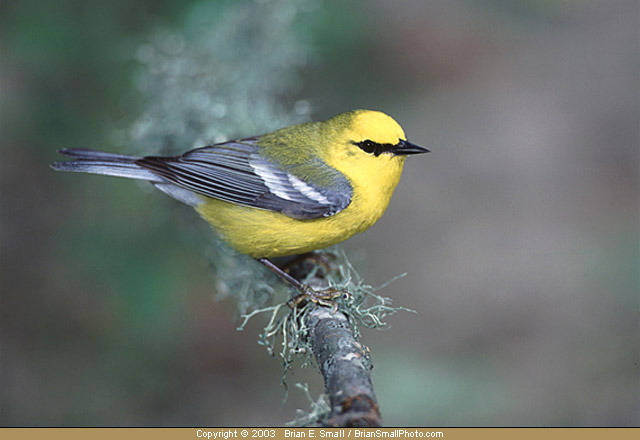
 When a golden-winged warbler mates with a blue-winged warbler, you usually get a hybrid called a Brewster's warbler. This bird doesn't look anything like a Brewster's. It has the masking of a golden-winged, but the yellow wash of the blue-winged warblers. This bird is a backcross--one of it's parents was a Brewster's and the other was either a true golden-winged warbler or true blue-winged warbler. When this happens you get another type of hybrid called a Lawrence's warbler. Confused yet? Were you able to follow that? Well, hold onto your hat, it gets even trickier:

 That same day, those banders caught this bird--another hybrid. Oy! The banders said that this bird had characteristics of being a hatch year bird (it came out of the egg this year) the bird above had characteristics of being an after hatch year bird (at least a year old). But really, it's hard enough to identify hybrids and even harder to age and sex them. I think this is another Lawrence's warbler backcross (a Brewster's hybrid that bred with either a true golden-winged or blue-winged warbler). The banders felt that this bird is of unknown sex, but with the pale mask, I think it is reminiscent of a female golden-winged warbler, so I'd be willing to go out on a limb and call this female.
 I nipped over to BNA Online to see what they had to say about hybrids and found this:
"Molecular analyses of hybridization indicate that Blue-wing mtDNA introgresses asymmetrically and perhaps rapidly into Golden-wing phenotypes without comparable reverse introgression and footprinting of Golden-wing mtDNA into replacement Blue-wing populations."
Holy crap, I though Pyle was hard enough to read. Basically, (I think) this is saying is that all this hybridizing and backcrossing can result in fewer golden-winged warblers and more blue-winged warblers. The hybrids and the backcrosses end up in future generations breeding into blue-winged warblers.
Banded Sandpipers
 Remember the banded semi-palmated sandpiper we found over the weekend along Duck Banding Road on Big Stone NWR? Well, Doug Buri found out where and when it was banded from Nate Thomas, the doctoral candidate working on tracking them:
The first bird was banded about 2 miles south of Salt Lake on the Minnesota/South Dakota border on July 21-23 2004. That means that the bird is at least 3 years old! Since we couldn't read the individual band number, we don't know if it was tagged as an adult or an immature bird but it has been surviving and migrating since 2004! WOW!
 I didn't mention that on our final field trip, we found a second banded semi-palmated sandpiper with different colored tags. I can tell you from my other banding experiences that finding recovered birds is unusual, but finding two banded birds in a weekend--that's unbelievably rare. Again, we couldn't read the individual band number, but based on the color marks on its legs, Nate said the bird was banded in either 2003 or 2005, making the bird either 4 or 2 years old.
These birds breed in the Arctic and migrate down to South America for the winter. Think of the thousands of miles they cover year after year--I'm still trying to wrap my head around that one. What is this saying about migratory route fidelity? So, if you are lucky enough to see any shorebirds in your neck of the woods, even if you can't identify them, think about the migratory journey they could be on.
Digiscoped Images
Fresh Tweets
Would you like to hire me as a speaker for your event?
Email sharon@birdchick.com