Birdchick Blog
Banding In March
 Well, one of the things about March is that it's a transition month and when it comes to banding it's feast or famine. This red squirrel in a Potter's trap. Don't worry, we didn't band it. It was set free.
 We did get in a few birds like this junco, but that's nothing compared to Minnesota BirdNerd (aka my buddy Roger who often shows up at Birds and Beers with has banding partner Mark) who was having a slow bird banding day until a pileated woodpecker flew into the nets. Check out his blog entry here for some photos of the event. Also, check out his face in this photo--he totally looks like he's a breath away from some choice four letter words--I'm sure a pileated pecking your hand is up there with getting footed by broad-winged hawk.
Pouring More Salt
As if missing the northern shrike banding weren't bad enough, my buddy Larry Sirvio has sent more photos of what I missed at Carpenter's banding this morning!
 Hm. I don't think that turkey is going to fit into that Potter Trap...and the next photo I think deserves a caption contest:
 Here is a first year sharp-shinned sitting on top of a Potter Trap with a freshly trapped junco. I bet a junco has never been so happy to be trapped in its life. Got any caption ideas? The one who makes me chuckle out loud wins their choice of a Kaufman Field Guide to Birds of North America or a Lang Elliot's Music of the Birds: A Celebration of Bird Song (with CD)--prizses courtesy of Houghton Mifflin.
Final Rio Grande Valley Bird Festival Post
Really, it is. I swear. At least for this year.
 Banding was slow today at Carpenter Nature Center and I spent the morning talking to the Development Director while she repaired nets. Fortunately, I had a chance to observe some banding while at the Rio Grande Valley Bird Festival. Once again, a Sunday morning trip was scheduled to watch bander Mark Conway (that's Mark in the above photo banding a kiskadee) and his assistants band birds at Los Ebanos Preserve.
 Here's a closer shot of the kiskadee Mark was banding. Something interesting that I learned was that all kiskadees have a yellow gape.
 I took a photo of one earlier in the festival and I had never noticed that before and thought it was a young bird, but all kiskadees of all ages have that yellow outline at the corners of their mouths.
 The first bird of the morning wast a gray phase eastern screech owl. The banders weren't targeting owls, but they had the nets up at not long after dawn and this bird was just flying through and flew into the net.
 Here is a long-billed thrasher which I hear way more than see in when birding in South Texas. That bill is not deformed, that's the way they are.
 The best part of the day was getting to see a green jay up close. Last year they banded quite a few and I figured that green jays were par for the course.
 But Mark said that they don't get green jays in the nets very often as they are members of the corvid family and very intelligent. They had not banded at Los Ebanos recently so the birds were just not used to it.
 Mark said that this set a record for the most green jays that they have ever caught in a day: 9 green jays banded--and I never got tired of them.
 Another exciting bird of the day was an olive sparrow--one of the hardest birds to see, you hear them quite a bit. I was glad to have a chance to get this photo because, frankly, my earlier efforts were just plain sad:
 Behind all those tiny branches lurks an olive sparrow at Llano Grande. This was not bad, just finding an olive sparrow sitting on a branch long enough to aim your scope and camera is feat within itself.
 Here, Mark is holding an orange-crowned warbler. These guys are all over in the trees in south Texas this time of year. They're not an easy warbler to see, so when a guide finds one, I think people hear warbler and hope for an exciting/colorful bird. As they search and search, they'll say, "I see a small brownish bird..." Yep, that's the orange-crowned. It's not even as orange as a blackburnian warbler. You may be wondering to yourself, why this bird is called an orange-crowned warbler...

 Here, Mark demonstrates the name. When you hold and orange-crowned warbler about six inches from your face and blow on its crown, you can see a kind of orangish color on the underside of the crest feathers--see how obvious that is? Another one of those birds that was named when bird watching was done with a gun, not with binoculars.
 Here are one of the many great-tailed grackles in the area. When you get them in the sun, they really are a striking bird. You can hear great-taileds singing all over Harlingen, any time of day--even all night long when they are roosting in the trees--how do those guys get any rest?
 They do sound incredibly mechanical as opposed to musical. I wonder how that adaptation sounded, and what must have early explorers to North America have thought hearing those things chatter all night in the trees above them?
 There was also a very exciting bird into the nets--a common yellowthroat, which to Mark are not common but something to study in depth. He thinks that there is an isolated population of yellowthroats that could be a subspecies that he calls the Brownsville yellowthroat. Will there a split some day separating this species of yellowthroat from the rest of the common yellowthroats seen around the United States? If so, Mark will have been instrumental in that research.
 Okay, this doesn't have too much to do with banding, but there were quite a few anoles running around during the banding program and this guy with the wavy tail caught my eye. I wondered what happened to make it look like that? Did appear to slow it down in its daily travels.
 And so, I leave you wit one final green jay photo, because they are just so darn cool looking. I'm very excited, it looks like we will be able to go out with Mark one day on the South Texas trip next year, which would be awesome for the group and great for me to learn different banding techniques from different people.
Fall Banding At Carpenter Nature Center
 Hey, check it out, it's Stardust Girl, proudly holding a bag full of angry red-bellied woodpecker. She's visiting from the Hoosier State of Indiana to see friends, watch the banding at Carpenter Nature Center and to attend the Disapproving Rabbits book release party. The party and signing exceeded my dreams. I really didn't expect that many people to show up, it was a blast and you can read about it here.
 Another fun Friday banding songbirds at Carpenter Nature Center. It was interesting to note that we got in quite a few ground feeding birds. You have to kind of watch out when you let ground feeding birds go after you band them. Their natural tendency is to fly low for cover.
 Unfortunately, that sometimes lands them right back into the nets! Doh! Yes, after I took the head shot of the cardinal, he was released and went right back into the nets. That's Jim Fox, one of the banders at Carpenter getting him out of the nets...again. Not an easy feat when the cardinal is trying to slice open your skin.
 Cardinals weren't the only birds having blond moment (oops, did I anthropomorphize, sorry about that). The same thing happened with a few juncos--again, ground feeding birds looking for cover, get tangled in the net when they fly away. I got this guy out of the net and let him go on the other side. He chipped angrily to a tree. Dude, I may be responsible for the little bit of silver on the leg, but don't blame me when you fly into a net the second time in a day.
 But let's not focus on that, let's just focus on the junco cuteness when in hand. I just cannot get enough of these guys! There's another species besides juncos who come to our feeders in winter and I saw my first one of the season in the nets at Carpenter on Friday:
 Tree sparrows--these guys with the rusty cap similar to a chipping sparrow should be showing up to feeders about now in the north--all you southerns should have them soon enough. It's hard to see in this photo, but tree sparrows usually have a distinctive spot on their chest. I've had tree sparrows come right up to finch feeders, so don't just watch for them on the ground.
 This bird was a surprise on many levels--we just don't get brown creepers too often. But the biggest surprise came as I was downloading the photos and my darling husband aka Non Birding Bill looked over and said, "Oh! Disapproving brown creeper!" I gave him a slack jawed look which he immediately interpreted and followed up with, "I've been around ya' for like 13 years--you pick stuff up."
I think it had more to do with one just being on Mr. Neil's window ledge in recent weeks. What's next, cats and dogs living together?
 What was interesting was how we appeared to have gotten the creeper in the nets. As I said, it's just not one that we normally get in our set up, but if you notice in the above photo were Jim is trying to get the creeper out of the nets, you'll notice that the nets lean against a tree trunk. Based on where the bird was located, we think it was creeping up the tree and creeped (or do I mean crept, Amy?) right into the nets. Alas, when we let this one go, it too flew right back into the nets, clearly aiming for a tree trunk on the other side. We're excited about retraps at Carpenter, but we like a little more time between 'em.
 Our final bird of the day was the handsomest house finch I have seen all year. When I first saw this bird on the feeders, I did a double take. He was so red, he might have passed as a purple finch to some. But that streaking on his flanks gives him away at ye olde house finche.
 We did have one male house finch in the nets this morning with a slightly swollen eye-possibly the early stages of the eye disease they sometimes get. This bird was robust and healthy but I still made a point to wash my hands thoroughly after handling it.
 Oh! I also have to point out one crazy little chickadee we had on the table. One of the best parts of banding is that we have a donut pool. Every Friday, someone picks up donuts and we all chip in a dollar. Donuts and banding--throw in Daniel Craig reading me Bent books and you have my idea of heaven. Anyhoo, when we take birds out of the nets, we put them in these mesh bags until they are banded. Jim had laid this bag full of chickadee on the table and has he was prepping the band, the chickadee had hopped over to his donut plate and started pecking at it through the mesh! On the one hand I admire the bird's cleverness, on the other the last thing the world needs is a chickadee souped up on sugar. Can you imagine?
Birding The Meadows
I started writing this entry last night, and completely fell asleep while typing it--completely slumped over on the couch. Thank goodness I didn't drool on the keyboard.
 Ack! I birded this place Sunday, how is it now Thursday that I'm finally blogging it? Ah well, at least I'm getting to it now. When we watched the weather over the weekend and learned that Sunday would be the first sunny day of the festival, we all were planning our morning birding strategies. Clay Taylor recommended going to The Meadows for just loads of birds flying over, so that was where I went.
 We found a good sampling of ducks in the above pond. Here we have a mallard, a blue-winged teal, and a gadwall. It's fun to note the size difference of all three of these ducks when side by side.
 I think gadwalls have one of my favorite ducks calls of all time. You can find it on this WhatBird (you may have to scroll down a bit when you get there). They sound like Muppets--mer mer mer. As we were taking these photos, a steady line of small raptors were zipping just over our heads--and I mean mere feet above our heads. The change in weather had pushed songbirds down south on their migration and they were landing in the meadows to feed, sharp-shinned hawks and merlins were taking advantage of the situation. While I was shooting ducks, I would look over my view finder and I'd see sharpie, sharpie, sharpie, sharpie, MERLIN, sharpie, sharpie, etc. It was pretty darned sweet.
 Ducks were well and good, but being in Minnesota, I was more interested in doing some beach digiscoping. Clay decided to try his luck with warblers, so we briefly parted ways. I love photographing on a beach with little to know humans. You hear the crash of the surf, you feel the wind on your face, you smell the salty air and you just can't help but feel like an adventurer. I was also feeling more confident about my shorebird id skills and photography after taking that shorebird workshop this summer.
 Alas, a little tougher than I thought! Well, one of the things that separates sanderlings from other shorebirds that can look similar like the semi-palmated sandpipers is that they constantly run back and forth with the waves. Which makes them hard to photograph--and just plain hard to find in the scope as the waves and birds move.

 Fortunately for me, some much slower shorebirds moved in! Not only that, they have a pretty distinctive bill shape, making them dunlins--whoot! I decided that I would just try to follow shorebirds and take as many photos as possible to have a reference of sanderlings in my photo library.
 When I downloaded the photos later in the day, I discovered that some of them were banded! I didn't notice it while out on the beach, but fortunately I was haphazardly shooting and got the evidence. I thought I was photographing sanderlings and honestly, from this angle we can't see the front for positive id, but it's a pretty good bet.
 And that wasn't the only one! I found a second banded shorebird! This does look like a sanderling, but it's interesting to note that both birds have similar banding patterns to the banded semi-palmated sandpipers we found this summer during the shorebird workshop. I know the green flag on the bird in the above photo means it was banded in the US, but not sure about the other one. I'll turn these photos into the Bird Banding Lab and when I find out more info, I'll post an update in the blog. Well, as I was just enjoying the day and a set of willets just landed, a peregrine flew into view and chased all the shorebirds away. It dawned on me what a beautiful and unusual site this is for me. To see the large dark falcon fly right on the beach--I usually see them around skyscrapers. Since the shorebirds got the heck out of Dodge, I decided to try my hand at the gray hair inducing task of photographing fall warblers.
 I never thought I would say this, but it was like shooting fish in a barrel! It was mostly yellow-rumped warblers, but it was just a matter of picking a perch, keeping your scope aimed there and waiting a few minutes for a warbler to land. This yellow rumped perched here for a full three minutes!
 Heck, I even managed to get a shot of it nabbing insects when it flew. That is what is part of the magic of Cape May during migration. Oh sure, you may be able to see many of the bird species there, but it's the sheer number and magnitude that consistently shows up during migration. On year, over a million robins flew over in an hour. While I was photographing this warbler, several hundred turkey vultures were moving through.
 I even managed to photograph a second species of warbler--this lovely palm warbler popped up. Only in Cape May, folks, can a novice digiscoper manage to get some decent warbler shots.
 The Meadows is run by the Nature Conservancy and you do need to pay a small fee (well worth it) to enter. I will say this, about Cape May--it attracts some old school birders...dare I say crotchety birders. One man was very angry about paying for entering The Meadows, "This place is ruined, I shouldn't have to pay." Which I think is utterly ridiculous. Natural space for birds is at a premium, it takes money to maintain it and people should pay to make sure it stays. Of course, this guy also grunted at the birdJam software, "In my day, we just went outside to learn the bird calls." He would have finished his speech, but he had to run after some teenagers to shout, "Get those darn smoochers offa meh property."
Mental note to old schoolers talking to whipper snappers: Starting a sentence with the phrase, "In my day..." automatically induces eye rolling on the part of the listener.
Speaking of old school, another conversation that I had at Cape May about iPods:
Old School Birder: In my day we did this thing called listening to the radio to get our music.
Birdchick: Yeah, but sometimes the Sinatra or opera isn't on the radio.
Old School Birder: My dear, public radio has opera every Sunday, so there you go.
Birdchick: But what if you're jonesing' for La Traviata on a Thursday night, the iPod's there for ya'.
Old School Birder backs away in apparent confusion that a whipper snapper would know the title of a Verdi opera or the possibility of being able to listen to any kind of music at any time of day...or at the use of the word "jonesing".
I wonder what I'm going to be crotchety about when I grow up? What will be the technology that I think is too much or just think it too complicated to use? I seriously ponder this. "In my day, we held the digital camera to the spotting scope to get photos...we didn't have the camera built into the scope."
And for the record: "old school" and "crotchety" have more to do with a state of mind than with age. I know birders older than I am who act younger than me (I like to think I act like a 15 year old, and there are a couple who qualify as 13 year olds--you know who you are) and some birders younger than me that could qualify for crotchety.
Weekend Of Red-tails
Sometimes, it's fun to live in our neighborhood. Oh sure, there are noisy neighbors, but there are benefits. Twice in the last week I have seen Sir Ian McKellen, once behind me line at the grocery store and tonight on our way to the movie theater (he's in town performing King Lear at the Guthrie). I didn't say anything at the grocery store, but tonight when I pointed him out to Non Birding Bill, he went over, greeted him and told him how much he enjoyed his work as an actor. He was really, really nice and very gracious. Can I say how much I enjoy just picking him out in the streets among all the other people? It's like finding a Ross's goose mixed in with a bunch of snow geese.


On to hawk banding!
 Here's the man who makes my weekends of hawk banding possible--Frank Taylor! One of the coolest guys I know and the man who taught me to handle birds of prey and to give an entertaining yet informative program.
 Well, it was a weekend chock full of red-tiled hawks at the banding station (that's a passage or first year red-tailed hawk in the above photo). On Saturday we got 7 birds (1 northern goshawk and 6 red-tailed hawks) and on Sunday we got 8 birds on (1 sharp-shinned hawk, 1 northern goshawk and 6 red-tailed hawks).
 I think of all the birding things I do throughout the year, hawk banding is my favorite. I love everything about it, the fall foliage, the layers of cold to ward of the chill in the air, the waxy chocolate donuts we eat in the blind, watching the birds fly in, picking our raptors from the specks flying away.
 We got to see some other wildlife besides raptors. We heard the crows going berserk on the other side of the field. Eventually, a coyote came into view. Rick Dupont got the above photo. They coyote kept coming closer and closer. Every time someone's camera beeped, the coyote would look right at us. Even with the wind blew and they coyote turned to sniff, if a camera beeped, it looked towards the blind. The coyote kept on its merry way and disappeared and suddenly as it appeared, followed by some noisy crows.
 We even had a lone raven meander towards the blind. We watched this bird for the better part of Saturday morning, walking along through the grass snatching up lethargic grasshoppers. Periodically, the raven would hunker in the grass and sleep. After awhile, the raven would resume hunting grasshoppers. It worked its way closer and closer to the blind, oblivious to the many red-tails zooming over head, the half dozen people popping out of the blind, and even the noisy goshawk. When I watched it through my scope, it blinked both eyes in quick succession and not always at the same time. I've seen birds with West Nile Virus do this and wondered if that had struck this raven. The bird would let people get within 10 feet of it and then would fly. It had an ample food source and was wise enough to evade humans, so we didn't make too much effort to catch it.
 There were also quite a few horned larks lurking in the grass. It was fun to watch them disappear and then reappear. A couple of northern shrikes hunting in the field would try to separate one of the larks to catch it, but to no avail, the larks were too fast. Another bird that hung out near the blind was a boreal chickadee. A small flock of black-caps flew in and one of them sounded a little nasally--instead of chickadee dee dee it was more of a chickashneeee. It hung out low in the trees and I got one of my best looks at one (alas, I didn't have the digiscoping equipment set up).


 Even though we had almost all red-tailed hawks come in, each one had an interesting story. Like this bird. It was in haggard (adult) plumage, complete with red-tail (although the eyes were kind of half passage, half haggard). Note the blood mustache over the bill--this bird had eaten fairly recently. However, it did one of the most powerful dives into the nets I had ever seen. We actually almost missed this bird coming in. We were kind of chit chatting, someone had asked me a binocular question and looked out the blind window and said, "Well, 8x42's are good GASP..." and most everyone else saw it at the same time straight ahead, wings tucked, the bird going over 60 miles straight for the pigeon.
 The red-tail blasted through the front net so fast and so hard it went all the way into the back net! Frank and Rick had to get the hawk out of two nets! Rick, ever the master yanker, did manage to pull the pigeon out of the way before the hawk nailed it. I did get to thinking though--if the nets hadn't been there, and this hawk was hunting the pigeon, it would have hit the prey so hard it would have blasted right into the woods. It would have rolled and tumbled and maybe slammed into a tree. That bird was intense. It wasn't skinny either, it had been eating well.
 It's always interesting to see the differences in adults and young birds when you have the up close. Even without seeing the tail, you can know this is a young bird by how yellow the eyes are. Red-tailed hawk eyes get darker as they get older. So, above is passage red-tail...
 and here is a haggard bird--look at how dark brown those eyes are! Speaking eyes, one of Frank's sub banders was up the whole week banding hawks and found an interesting one:
 Chuck Schotzko got in this one eyed red-tailed hawk. Look at that, the whole entire eye ball is missing from the socket! Chuck is a medical doctor and guess with how dried out and healed up the injury is that this happened long ago, perhaps even when the bird was young. He speculated that this happened with the bird was young, even in the nest. It would be much easier for a young bird to learn to hunt with only one eye, than for an adult to suddenly lose an eye after hunting for years with two. Regardless, the bird was very chunky, the tissue around the keel was very plump--this bird had been eating well. If it can fly and is a good weight, there's no need to take it some place like The Raptor Center, this bird is doing just fine on its own.
 Here you can see clear back into the empty eye socket. This really makes me wonder about birds in wildlife rehab facilities with only one eye that are turned into education birds or euthanized. This is the second red-tail we've gotten into the nets with vision in only one eye that was fat and sassy. Birds always remind me that they are more resilient than we give them credit for.
 On Saturday night, I slept in Frank's van. He has a cot set up inside, so all I had to do was unroll my sleeping bag. I brought a pillow and stuck some hand warmers in the bottom to keep my toe warm. The stars crowded the skies and I was tucked warmly inside my sleeping bag and watched the sky. I was only disturbed once when someone drove slowly by shining a very bright flash light (I assume looking for deer). I set my iPod and iMainGo speaker to alarm so that I would wake up the next morning to the sound of bobolinks. I met Frank and his wife Trudi in their cozy trailer for hot chocolate and donuts, then it was off to more banding. It is nice to stay in hotels, but I have to say that I'm glad that I still have it in me to sleep in a van and use the woods for a restroom all for a cool birding experience!
 This is one of the many red-tails we got in on Sunday, note the blood stains on the breast? This bird totally punk'd me! We were watching it in the distance and it hovered, it held its wings in a v-shape, the wings looked longish--I called it a rough-legged hawk. Until it flew into the nets and showed itself to be a juvenile red-tail. Later on, I tried to turn a kestrel into a merlin--I was having an off identification day. Maybe sleeping in a van dulls my bird id skills. Ah well, happens to all of us.
 I did find a red squirrel lurking in the trees. It was surprisingly quiet. I suppose it noticed all the hawks flying in and decided that hunkering down and eating would be a sensible tactic instead of chirping and drawing attention to itself.
 After we banded and released one of the many red-tailed hawks that came into the nets, it landed in the top of a spruce. As I set up my digiscoping equipment, it started to take off and I got this photo. But my favorite photos to get are the ones of me laying on the ground while people release the birds:
 Like this...
 Or this...
 And this...
 This was a little boy who got to release a red-tail. Since he was a tad short, I opted to take his photo from the side. The last thing I want is a face full of red-tailed hawk. He did a great job doing the release--that's a lot of bird for young boy.
 I love this photo, that little boy looks like he's about to go into the sky along with the red-tail!
Gratuitous Goshawk
 At first when I was looking at my schedule and budget for the fall, I was worried I just wouldn't be able to get to my friend Frank Taylor's hawk banding station--my favorite bird activity I do all year. I was very down that I would not get to see a northern goshawk (my favorite raptor and next tattoo) fly into the nets But thanks to help from my great friends, I managed two trips. And I got to see a first year northern goshawk fly in! Whoot!
 Frank asked me to hold the young goshawk so he could get photos and I gave my camera to a wonderful woman I've been getting to know at the blind named Joan. We were working as swiftly as possible with the goshawk so we could send it on its way.
 Why would we want this magnificent bird away so quickly? Because the moment it hits the nets to the very second it is released, it give a loud, piercing, melt-your-eardrums shriek over and over and over. All we're doing is holding it, it's not in any pain what so ever. Such a big bird, such a big whiner. Even the smaller cousins of this accipiter, the sharp-shinned hawk and the Cooper's hawk take the banding process with stoicism. Frank wanted to try and get a photo of the goshawk with its mouth closed--not an easy feat.

 I think this photo that Joan got about sums it up. Yes, here I am with my favorite raptor and you can see that I'm clearly thinking, "Are we done yet? Can we move on?" I bet you're now curious, just how awful this sound is, aren't you? Okay, here is about five seconds of ear-splitting goshawk (those you cannot view video should be grateful):
Annoying, huh? As if that weren't bad enough...
 The goshawk started attacking my coat. It was time to set this bird free and continue on its way.
 I tossed the bird in the air and Joan got this great shot which actually looks like the bird is reaching out to attack me. Actually, what's going on is that I tossed the goshawk out to the field, but being the type of hawk that hunts in the woods, the bird is turning around in mid air so it can fly into the safety of the trees behind me. Still, I love how it looks like I'm reaching out it and the goshawk looks like it is going to nail me.
More banding fun to come!
Hawk Banding Preview
 "I'm gonna eat you and your little disapproving rabbit too!"
Just rolled in, ate some dinner, pealed off two layers of clothes, and sifted through 98 emails. Am now going to bathe and autograph some books. More hawk banding fun tomorrow.
Banding Birds At Mr. Neil's
 I know quite a few banders and I've always wanted to try a banding project at Mr. Neil's. Number one - he's got great bird nesting habitat. Number two, a fair number of migrants pass through and use the area for fueling up for migration. So, I asked my friends Mark Newstrom and Roger Everhart who do regular banding programs at Lowry Nature Center in Carver Park if they would be interested in banding at Mr. Neil's. Being banders, the answer is generally "yes".
 They were due to come Saturday morning and I had a somewhat sleepless night between my waning cold, thunder storms all night long, and just general excitement at banding. But the rains finished about 6 am followed by intense humidity.
 Roger and Mark set up nets in three different areas: one near the feeders, one near a stand of pines that's full of birds, and one near a small pond. The banding conditions were not perfect. It was hot and humid (hello, it's October, it's supposed to be in the 50s in my neck of the woods), the winds were high (making it easier for birds to see the nets move), the falling leaves kept getting trapped in the nets. Above is a photo of Mark trying to get about 300 oak leaves out of the nets. They took two nets down and left one up by the feeding station.
 Here is the first bird banded that day: a red-breasted nuthatch! Even though banding conditions weren't the best and with only one net, Mark and Roger managed to get band twenty-five birds (of five different species) before noon--and the feeder activity was unusually slow. Not bad!
 We also got in one very feisty white-breasted nuthatch who did not care for my finger (or maybe just my green nail polish). When biting didn't seem to cause me any agony...
 The nuthatch tried the clever and effective nip maneuver. Point taken, nuthatch, point taken.
 At some point we had about four birds in the feeder nets at once. We would take the birds out of the nets, put them in a bag and then hang the bags on a string to await being processed. Since it was hot and humid, we had to move the bag hanging area to a more shady spot.
 So, we hung them in a tree. Don't let his photo of a smiling Non Birding Bill with bags full of birds fool you. True to his identity in this blog, he showed little to no interest in the banding. He stopped out at one point and then went right back inside saying, "The excitement is too much, I need a nap."
 I think the black-capped chickadees were the most common species banded that day. It seemed as soon as one got in the net and started protesting, three others would join in at the sound. Since there were so many, Mark and Roger let me band one:
 Talk about pressure! I'm still learning how to do these little tiny songbirds, and I have to do it according to Roger and Mark's protocol.
 They take more measurements than at Carpenter Nature Center. They do wing measurements, tail measurements, weight, and they measure individual feathers like primary wing feather 8 as well as trying to age and sex the birds. However, being just two guys, they do it quite quickly. I don't think any bird was in hand for more than five minutes.
 They also blow on the body feathers to see if and where the bird is molting and to check for any fat stores the birds might have. Mark and Roger can predict when a flock of birds is about to leave an area based on their fat stores. Above is a goldfinch being blown on and if you look closely on the right of the exposed pink skin (which you can see through--that kind of grossed Lorraine out), you can see a bit of yellow--that is some fat this finch as stored up.
 They ruffle the feathers on the head to see if there is any molting up there. Nice Eraserhead look. Don't worry about all the feather ruffling. One good rouse after they fly away puts all the feathers back into place.
 We did have one goldfinch come in that appeared to show signs of either illness or not eating well. It was underweight to begin with and all the feathers on the head appeared appeared to have a crusty texture to them.
 The bird's tail appears to be molting in late. It could be underweight with the molt or there could be something more serious going on. We're far from any rehabber and so we thought the best thing to do was let it loose and I will just stay on top of keeping the feeders clean and full of good food.
 We did get one woodpecker in, this female downy woodpecker. There are usually dozens of woodpeckers at the feeders, but they were wary of the whole situation. We could hear the red-bellies calling from all corners of the yard, but none came to the feeding stations until late afternoon.
 Mark and Roger showed me how dark the underside of her tail was--no doubt stained by tannins in tree bark. Woodpeckers use their stiff tails to prop themselves upright and white feathers are bound to get dirty. Based on this bird's molt pattern, Mark and Roger speculated that she was at least hatched in 2005. Pretty cool.
 I was hoping we would get some of the fun birds (What am I saying! they're all fun! Let's say unusual) would come into the nets like tufted-titmice. But much like the red-bellied woodpeckers, these birds decided to avoid the feeding stations until late afternoon.
 Purple finches managed to avoid the nets as well. The young of the family group are starting to show adult coloring--especially the males. More on these later.
 Since it was so hot, Mark and Roger wrapped up the banding by noon--you don't want to risk birds sitting in the nets on a hot day for any extended period of time--bird safety is top priority. Later on Saturday, I was digiscoping and did find one or two of the banded birds. Here is one of the black-capped chickadees we banded. Perhaps this the one I banded? Even this morning, I saw a red-breasted nuthatch and goldfinch sporting the bands. It will be fun to watch which stick around this winter.
I'd like to thank Roger and Mark for taking the time out of their busy schedule to band birds. I hope they can come again. They are excited about the spring migration potential. Hopefully, next time it won't be 80 some degrees with high humidity.
Carpenter Banding
 It was another beautiful day at Carpenter Nature Center--and busy! There were so many birds to band that I didn't have time to get photos of the Lincoln's sparrow, orange-crowned warbler, and the first junco of the season (although, I think I will have ample opportunity of getting junco photos in the near future). It's so weird to see juncos and hummingbirds all in the same day. I did have time to get photos of a palm warlber in the above photo. Here's another:
 Thanks to all the readers who sent kind notes about my incorrect id in the blog when I originally posted this as a yellow-rumped warbler, they are correct, it is a palm warlbers. Although as soon as I got out of my car I could hear yellow-rumps thick in the trees--kissing sounds everywhere. I'm now to the point where I get to band whatever bird someone hands me or that I get out of the net. I thought this was exciting until I had to start aging and sexing the fall warblers. And if it's any consolation--it's not any easier to do them in hand than it is when they are in the trees. I think we ended saying this one was an after hatch year female. I would tell you how...but then I would have to kill you.
 Here was a Tennessee warbler that Larry was banding. I was trying to help him age and sex this bird by reading through Pyle. We were trying to determine between after hatch year male and female. Here are just one of the differences according to Pyle: male--underparts with a moderate yellow wash and female--underparts lightly washed yellow.
Hmmmmm. Can you tell the difference between those two? Ah, Pyle, I kid, because I love. In all seriousness, Pyle is a helpful book to banders, but sometimes you come across weird bits like that and they just make you want to hit your head and against the table and say, "Huh?"
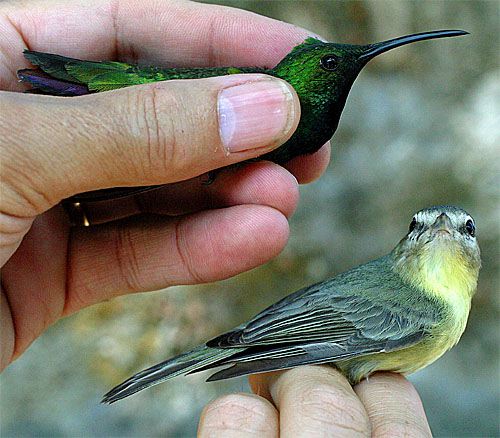
 A fun surprise what a Philadelphia vireo. When it was first tangled in the net, I thought it was a warbler. But when I got it out, I knew it was some kind of vireo. They really are quite small and just to give you an idea, check out this photo at Hilton Pond of a green-breasted mango next to a Philadelphia vireo (that photo was taken in Costa Rica). That's one big hummer next to one small vireo.
 We also banded a ruby-crowned kinglet. This little stinker was flashing its red crown like crazy when it was in the bag waiting to be banded, but once it was in hand, the ruby crown became subdued. You can see a hint of it in the above photo. The kinglet, half bird, half mouse.
 After banding, I went out to get photos of some photos of unfettered birds among the autumn foliage. The song sparrows were quick to perch up to a little pishing. There were quite a few other sparrows lurking about in the brush: white-throated, Lincoln's, clay-colored, and one or two field sparrows.
 I did find this sad looking song sparrow. It looks like it's asking, "Have you seen my tail anywhere?"
Now, off to bed, I have to get up early for a field trip I'm leading to Hawk Ridge in the morning. Also, if you still have not been to Carpenter this fall, it's still absolutely gorgeous. What are you waiting for? Great color and lots of apples on sale. Get thee hence!
Digiscoped Images
Fresh Tweets
Would you like to hire me as a speaker for your event?
Email sharon@birdchick.com