
Birdchick Blog
Great Backyard Bird Count
Want to be part of a cool project and monitor birds this winter? February is approaching and that means it's time for the Great Backyard Bird Count. The event happens from February 12 - 15, 2010 and all you need to do is the birds you see in your yard on one or more of the days during Feb 12 - 15. You count can be as short as fifteen minutes or as long as 24 hours--it's up to you. To make sure you are not counting the same bird again and again, you wouldn't count every cardinal you see. You'd count the most number of cardinals that you see at one time. So, if watched for three hours and you saw 10 cardinals in a flock all at once and then 45 minutes later you saw 4 more, you wouldn't say you saw 14, you'd say that you saw 10.
There's a very helpful video here and written instructions here. It's super simple and gives us some great data on wintering populations of birds--who knows, maybe you have a weird bird in your yard and it needs to be documented? Now, I'm going to be in Panama during the count--I've asked Cornell if I can count it, they are doubtful but they think I should do it anyway just for the bragging rights.

Now, there is also a photo contest for this too. You should enter that as well for some fun prizes. My favorite photo from last year didn't get first place, but you could tell that this woman had some crazy hungry redpolls coming to her feeders.
Follow Up On Banded Trumpeter Swan
First A couple of announcements: I'll be on Showcase Minnesota this morning sometime between 10am - 11am answering your bird questions.
And the next Birds and Beers is scheduled for this Sunday at 4pm at Joe's Garage to try and watch the winter crow roost. Now, the crows have shifted the roost a little bit to the west but we'll still have some crow action.

I got a certificate yesterday from the USGS Patuxent Wildlife Research Center regarding the history of the above trumpeter swan with the neck collar 2M7 at Point Douglas:
This is a male trumpeter swan hatched in 2006 in Ruthven, Iowa by Mr. Guy Zenner.
Still no word on the Canada goose with the tight band, I'll be curious to see if I hear about the origin of that goose.
Ivory-bill Again
And so the Ivory-billed Woodpecker has a new sighting. The Birder's World Twitter feed just broke the news with this press release that a Daniel Rainsong claims to have gotten a photo in the Southern Sabine River Basin in Texas. Many birders are ignoring it until the photos are actually released. The photos "are being sequestered to protect Mr. Rainsong's right of claim in this discovery. After Mr. Rainsong's rights in this discovery have been established and protected, the photographs will then be released to the public."
So it seems suspicious to have a press release before you can release the photo, does it not? It also seems suspicious that if you google the name Daniel Rainsong, you get quite a few gambling references.
Perhaps we have another Fish Crow all over again?
Watching Hummers With Penn Jillette
There are more people interested in casual birding than we realize and you never know who that is. So, last fall I went to Las Vegas with Non Birding Bill, Clay Taylor and WildBird on the Fly to film some digiscoping videos, I think I had my biggest geek out ever--bigger than the time I met Scott Weidensaul. I was a tad inebriated at a bar during an ABA convention and Scott suddenly walked in and all I remember is thinking to myself, "Act sober. Act sober. Act sober."
I must not have been too bad because Scott still welcomes me with a hug when he sees me, rather than darting away in the opposite direction.
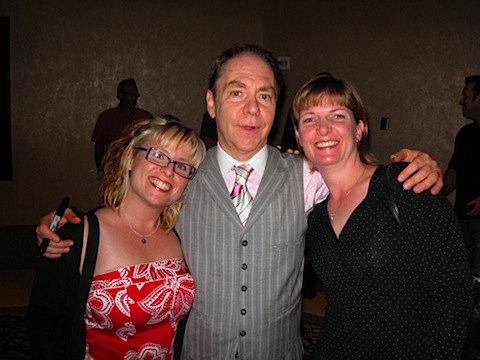
But due to some lucky scheduling and total generosity of Penn Jillette, we got to see the Penn and Teller Las Vegas show , hang out backstage (that's Amy and me with Teller), and watch birds at Penn's house--I got a lifer in his yard, a black-throated sparrow.
It was the most surreal moment of my life back stage. For one thing, it was the first time NBB has met some of my closest birding buddies. For another, how weird was it to be back stage with a bunch of magicians, the editor of WildBird Magazine and Swarvoski Optik--and we ended up talking about bees! Penn and Teller told us about a segment where they made thousands of bees appear on stage, you can watch it here (see if you can tell when they get stung).
I said, "Holy crap! How did you do that," meaning how did they work with bees, but they told me how they did it, how the entomologist they consulted backed out because he got freaked out and how many stings they ended up with and how Penn had a rather unusual injury on a rather sensitive area of his anatomy--I'll let you google that one, it's easy enough to find or better yet, if you meet Penn, he will gladly tell you the story much better than I ever could.
Again, Penn had a lot going on that weekend, he was flown to another state to shoots a scene for a movie, had his own Vegas show and still managed to give us some time to talk hummingbirds (I got to make hummingbird nectar in his kitchen). Since we were dealing with brief time and when working with video things like cicadas and air traffic can get in the way it's not perfect, but it's still someone I think is cool showing an interest in birds.
I've also hesitated posting this because I was geeking hardcore on the inside during this segment and tried very hard to keep my geek in check. I think from now on, I'm going to have to just let my geek flag fly because trying to play it cool makes me look like a dork.
So here it is and thank you to Swarovski for making this possible and to Birdorable for making the perfect shirt to wear in Vegas and especially to Penn Jillette and his people for being so nice, so gracious with their time and allowing us a few moments to chat about birds.
You can do some awesome birding in Las Vegas. We still have one more video to go, but here's a link to some of our adventures. Between this, testing Swarovski awesome new digiscoping adaptor in Kazakhstan, and climbing a volcano in Guatemala to see a giant tree chicken I can safely say that 2009 was hands down the craziest (in a good way) year of my life.
Birds Bathing In Puddles

First, if you are in dire need of spring/cute/amazing, there's a live video cam on an Allen's hummingbird nest. The chicks have both just hatched so should be fun to watch beyond the female incubating.

Part of what made my golden eagle survey last Saturday so much fun was that it was that we were getting a much need thaw after several days of sub zero temps. The bright sun and 30 degree temps were so warm, I had to roll my window down to cool off. Puddles formed on the sides of the roads made impromptu bird baths for birds, as seen in the above photo of cedar waxwings and a robin.

Many of the waxwings flew down not only for a drink, but also for a quick bathe. This was on a lonely country road, so they were not in any danger of being interrupted by cars, but I did wonder about the water quality. The road would have had salt and sand treatment and that would be mixed in with the melted snow and ice. The flock did not spend too much time at the puddle. When I see waxwings going for the roof top puddle in the fall, the flock will hang out and bathe for at least a half an hour. Here, a few birds would fly down, sip a little, splash a little and then fly into the trees. Another group would follow, but they did not stay. I wonder if they could taste the difference in the water or if it had more to do with chillier temperatures?
Rethinking Golden Eagles
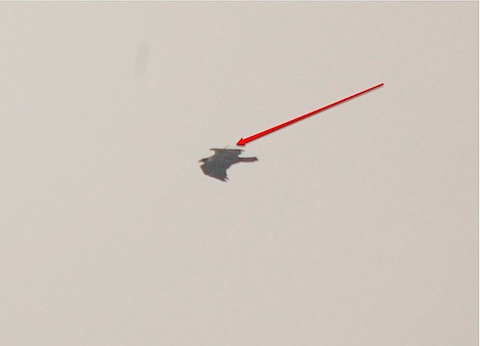
I can't remember if I blogged this already, but I'm fairly certain that the above is a photo of Golden Eagle 42 that I took last fall. Mark Martell posted updates on Audubon Minnesota's website weekly about this birds fall whereabouts, but kept almost daily track of the bird's movements. I told him that when the bird was close to the Twin Cities to send me as many updates as possible because I'd to see if I could get a photo of him--a sort of bird geocaching project. Imagine my surprise when he sent over a map and I recognized the area immediately: Golden Eagle 42 roosted less than a quarter mile from our bee yard! I went out and spent the day looking at every eagle near our bees and found one adult golden soaring in late afternoon. It was cloudy but I managed to get my digiscoping equipment on the it and got this photo. There's a fairly faint line behind the bird which looks suspiciously like the antennae on 42's transmitter. It's a crap photo and regardless if this is Golden Eagle 42 or not--it's exciting. Either it's our boy (which is totally cool to find a specific bird) or this is a separate golden eagle meaning a few might be spending the winter nearby!
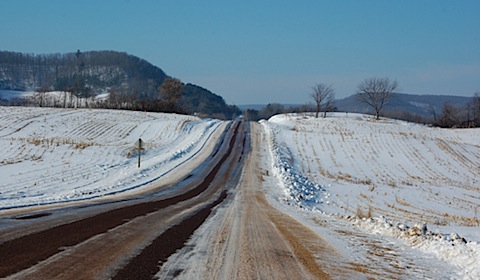
The National Eagle Center has created a survey several winters ago to document the wintering population of golden eagles along the upper Mississippi River. I thought that since Golden Eagle 42 was hanging around the bee yard that I might make that area my survey route. We have bluffs not unlike where I saw golden eagles last winter near the Eagle Center. When I started in the morning, I did not see many eagles--saw tons of red-tailed hawks, but not eagle (not even very many bald eagles, but much of the water in this area is frozen so that is to be expected. I followed the bluffs north of my chosen area, figuring that most of the survey was south.
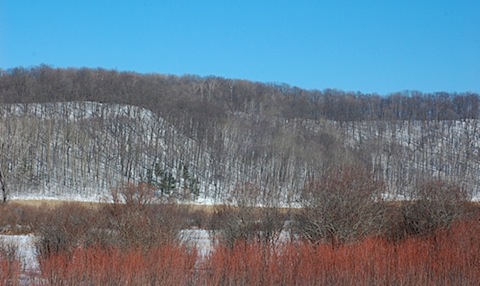
I got to this bluff and was enjoying the winter colors when I saw an adult bald eagle circling over my car. I scanned the skies and saw an immature bald eagle flying towards the bald. I made it a point to get every immature bald eagle in my binoculars or scope to ensure that I was seeing an immature bald eagle and not a golden.
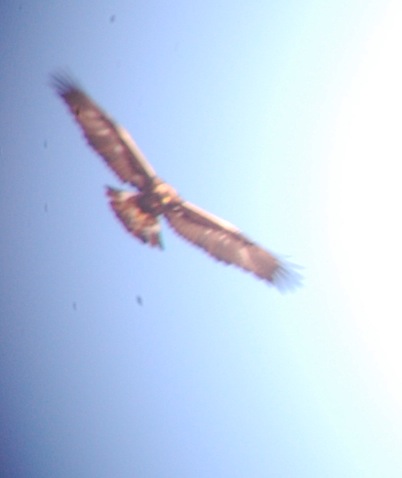
It was a golden, my jaw dropped. I hustled to get my digiscoping equipment on the bird and this was the most identifiable photo I could get. I really wasn't expecting to get a golden eagle on the survey, I figured Golden Eagle 42 just happened to pass over our bee yard on migration but wow, here was one. I was a good 20 miles from the bee yard at this point but I was still excited to see this bird. Energized, I drove along to scan more of the bluffs.
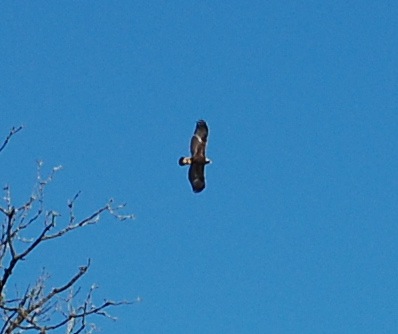
Son of a gun, a little further north, I found a second one! I was stunned. As I watched this bird, I heard the cray of a red-tail and within seconds one was pumping its wings hard trying to catch up to the golden.
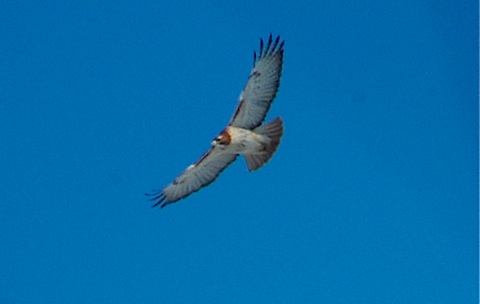
The red-tail flew above the golden and dove down on it several times, screaming. This hawk did not want this eagle in its territory. I've never seen a red-tail dive down like that at a bald eagle, but this bird was seriously driving the golden out of its portion of the sky.
I had a third sighting of a golden eagle, but looking at my craptacular photos, I'm sure it was the same bird i saw the first time, and I was in roughly the same area of the first observation.
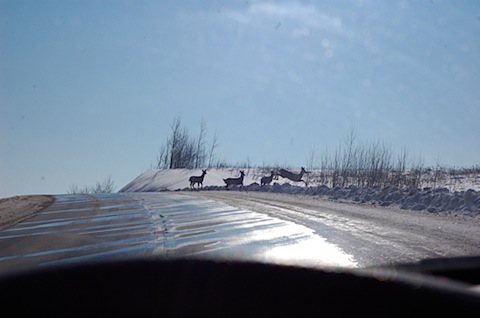
I spent the rest of the survey navigating somewhat icy back country roads and avoiding deer. I realized as I went along that I have to change my thinking on all eagles I see in the air and not just dismiss them as bald eagles. How exciting that we have this wintering flock, that we don't know exactly how large that wintering population is or how wide the wintering territory is. Scott Mehus of the National Eagle Center sent out pointers on what to watch for. One thing he suggested was watching for panicked flocks of turkeys running from fields into the safety and cover of the woods. Goldens have been observed preying on turkeys--I wonder if the exploding turkey population has anything to do with this population of goldens? Here's a link to some pointers on watching for golden eagles. I think I'll be watching the bluffs and coulees around the Twin Cities a little harder for the remaining winter months.
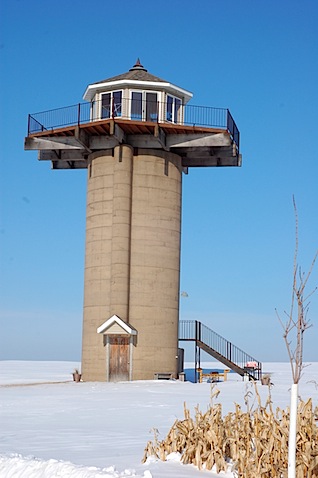
I had to throw this in. While I was out searching for golden eagles, I came across what I think might be my dream house: an old silo with a gazebo on top. I wonder if I can talk Non Birding Bill into it?
Blue Jay Eating Sumac

Yesterday while out and about on a Golden Eagle Survey for The National Eagle Center, I came across a blue jay hanging out on some sumac bushes. I wondered if the bird was perching or if it was actually going to eat the berries.

Sure enough, the blue jay started eating the berries. Sumac is supposed to be one of those native shrubs (at least to us here in Minnesota) that we can plant and it will be food for birds--and it looks pretty. It gets those fabulous burgundy leaves in the fall and those furry red berries that stick around through winter. Seeing those berries all winter has made me wonder on more than one occasion if birds will in fact eat those berries. I once observed a cardinal feeding on them in late winter, but that's about it.

If you google "birds eating sumac" several photos come up--so they do eat it. My buddy Carrol Henderson says that some berries are left alone by birds at the beginning of the winter so they can lose some of their moisture content and be a bit more edible later in winter--when they really need it as all the tastier foods have already been eaten. Has anyone else seen blue jays on sumac?

I found it interesting that this blue jay was foraging on the sumac alone, most of the blue jays are in small flocks--especially when they visit the feeder. I wonder if this bird is trying to keep this stash of food on the down lo?
Build Your Own Digiscoping Adaptor
I saw this video on the Digiscoping Facebook Page on how to make your own digiscoping adaptor with items you might find at home:
Fishing American Robin aka Holy Crap!
One of my favorite parts about this blog is that people email me questions about birds or photos to try and identify something. Every now and then, someone sends in some insanely interesting bird behavior and it knocks my socks off.
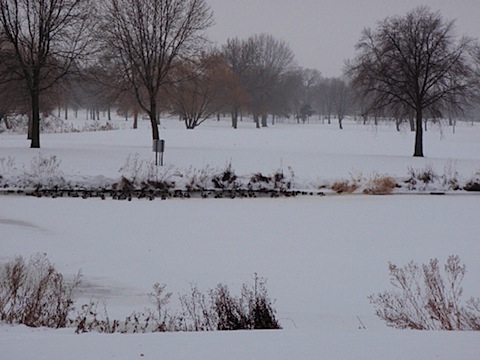
I got an email from JJ Golden who was out taking photos of ducks not too far from where I live. There are still a few patches of open water and JJ was at a Twit Cities Golf course when something strange happened. Golden reports, "As I walked around the pond I saw this Robin so I stopped and watched it for a moment. It flew down to the pond, I assumed to get a drink by a small open/slushy spot. At this point I tripped over my own snowshoes, dropped down to my knees and dropped my point and shoot camera (with lens uncovered) into the snow. I was only a few feet from the Robin who paid no attention to my blundering self."
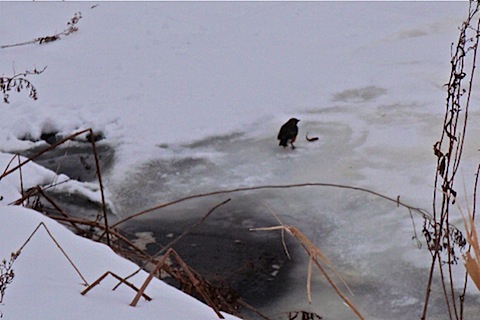
Golden goes on to report, "As I got up I could see the Robin had pulled a small fish out of the water and dropped it on the ice. It flip flopped around for a minute or so as the Robin seemed to be studying how to get it down. It then ate the fish in what looked like one gulp. The open area was very slushy so I'm amazed that the Robin could see a tiny fish from as far away as it was. The fish had a slightly pinkish tinge which made me wonder if it looked like a worm to the Robin."
I know robins will go for some not traditional foods in winter--some will eat seeds out of the shell like sunflower hearts or even go for suet. When I worked at the wild bird store in Wayzata, MN we had a bait shop in our strip mall. They would always toss out dead bait behind the store and we would see flocks of winter robins flying down for tiny dead fish but this is the first time that I have seen someone document an American Robin (Turdus migratorious) actively fishing for food!
So, now I wonder if this is a robin that has grabbed bait fish and somehow put two and two together and figured out how to get slow moving fish from slushy water? Did the robin figure it out by seeing a resemblance between the fish and a worm that it would normally go for?
Has anyone else ever seen a robin active fish for food?
Why Not Use RADAR To Prevent Bird Strikes
As more editorials come out about the concern over bird strikes in airplanes, I had kind of a duh moment yesterday on Twitter. BirdDiva posted a link to the Merlin RADAR system as a means to track birds around airports.
Well, duh!
She brought up a good point--we can track bird and even insect migration with RADAR, so why not translate that technology to airports? It seems to be a better solution that just shooting any bird willy nilly whether it's an endangered species or not?
Is it possible that the solution could be this simple?
Digiscoped Images
Fresh Tweets
Would you like to hire me as a speaker for your event?
Email sharon@birdchick.com