Birdchick Blog
For My Mom
Hey, mom, Mr. Neil and I got a mention in the City Pages about our bees winning the blue ribbon win at the county fair for the third year in a row. Though we get the mention, I'm not fooling myself. It's our bees and dear, sweet wonderful Fabulous Lorraine who harvests it who should really get the credit.
Nightjars of the World
Best bird book of the year! I get sent a lot of books in hopes that I'll write them up in the blog or in one of the publications that accepts my articles. I've slowed down on some of it. I'm interested in certain bird books--definitely not all. For example, I do not want to ready My Aviary of Hope about some woman who goes out to find herself but finds her wings instead (really, publishers, when I say "no thank you" sending me a galley copy, a pre sale copy and a final copy will not get me to read it). That's not my kind of book--not that there's anything wrong with that, that's just not what I want to read.
I usually want the books that publishers don't know how to market. As a matter of fact, the publicist sent the list that included this book with a note that read, "Yeah, these are weird titles but on the off chance any of you want them, here they are." One of the titles practically made me salivate. And last week, Non Birding Bill found it in our PO Box and sent me the photo:
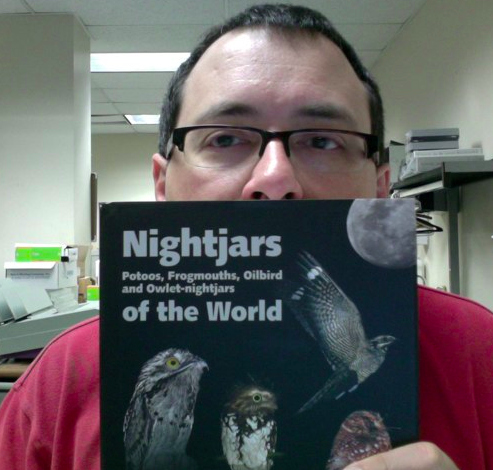
Princeton University Press has made the best bird book I've seen all year with Nightjars, Potoos, Frogmouths, Oilbird and Owlet-nightjars of the World...or more succinctly: Nightjars of the World by Nigel Cleere. It is an AWESOME book. Now, before some of you glance at that cover and say, "Ah, Shaz is geeking out over a brown bird book, time to go to the next blog," let me hit you with some of the pages of this cool tome.
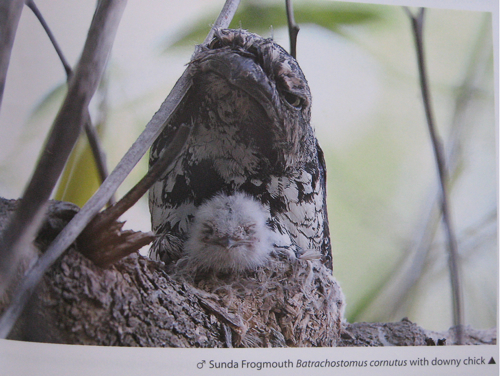
Though brown, many of these birds look like Muppets. Look at the above Sunda frogmouth (and it's little fluffy chick) from the book. Don't you half expect it to break into Manah Manah at any moment? For those who may not be familiar with this group of birds, it includes common nighthawks, whip-poor-wills or the great potoo that I saw in Panama this past February. Birds that for the most part have highly cryptic plumage and look like broken branches in trees or blend seamlessly into leaf litter on the floor.
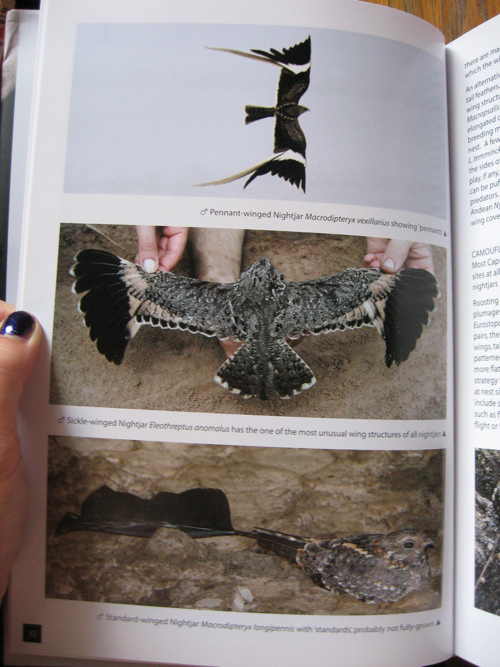
This book is a comprehensive photographic guide (check out the crazy variations these birds come in), but also gives information about this poorly understood group of birds in an easy to read fashion. You find yourself with questions that you didn't know you had like, "Why would a species that is nocturnal need to have bizarro wing and feather patterns to display for mating? How the heck do the females see any of that at night?"
But you're also left with some interesting factoids like:
The common poorwill is the only bird to hibernate in parts of its range.
Oilbirds got their name because people used to boil down the chicks and use the oil for cooking or for lamps.
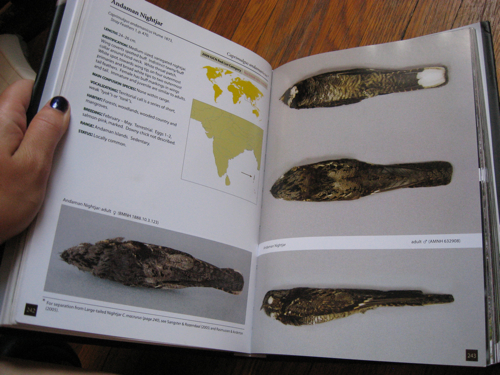
The book also strikes a chord as you realize that for some species--there are no photos of the bird in the wild, only study skins in museums. You'll also be struck by how much we don't know about the birds and how often you'll see the word "presumably" describing nesting or mating behavior.
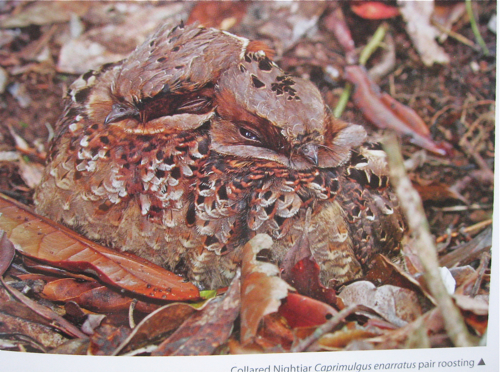
I love everything about this book and this is a trend in books that I first saw with The Shorebird Guide a few years ago and I'm happy to see it continue. We have so many photographers out there as a huge resource so you get to see the birds in different angles and the author is wise enough to write the book in an approachable way, not like a boring lecturer at a stuffy university. This book will appeal to hardcore and intermediate birders alike because this is a fascinating family of birds to study and the photos are incredible--note the snuggling collared nightjars above. Many of us will not get a chance to see most of these birds in the wild and if we do, most likely the bird will be flying away as we just flushed it. For others, this book will be an inspiration to create studies and graduate projects when you realize how much is undocumented for certain species. It's a sort of undiscovered country bird-wise. And yet for many of us, it will inspire us to save money for trips to have a chance to travel to foreign places to have a chance to see this secretive group of birds.
I would even consider giving this book to kids about 9 and up who have a strong interest in birds. There are plenty of photos and again, it's in a fairly easy to read format and the text isn't presented in an overwhelming pile of pages between photos. I would have LOVED this book when I was into birds as a kid.
Thank you, Nigel, for coming out with a great bird book.

Hazards Of Nesting In A Metal Box
As reported last week, there was trouble in the bird feeder that the house wrens had chosen to use as a nest cavity. Today, I got the conclusion of the store:
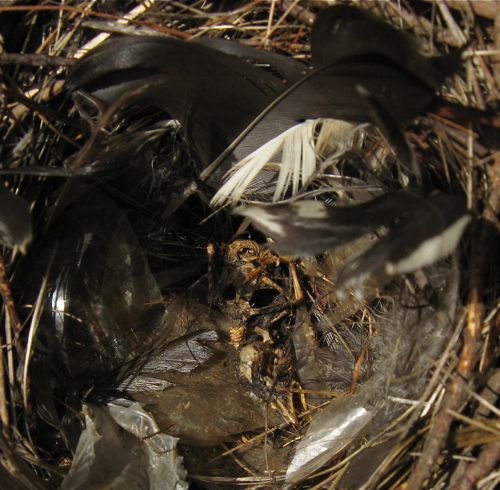
The one remaining nestling was dead. Most likely it died not long after I took it's photo the previous week. It does not look like it was the victim of a predator and chicks that young can die quickly from exposure or lack of food.
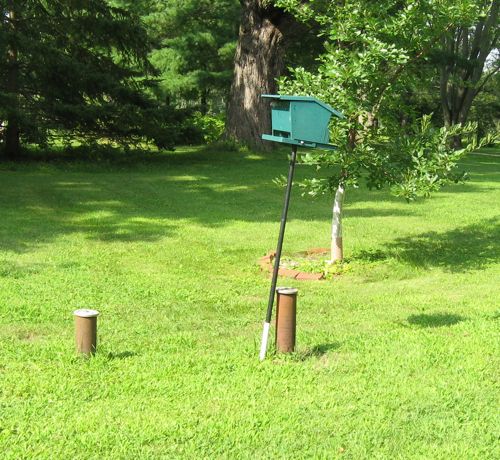
In today's ninety degree temperatures, I suspect heat had a great deal to do with the failure of this nest. This feeder gets direct sun in the afternoon and it's made of metal--not the best nursery in late July and August, even in the northern US.
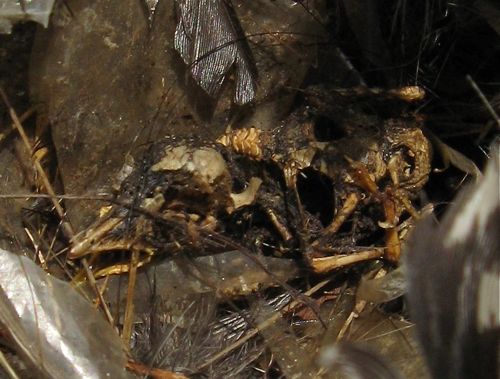
I was amazed at how quickly the chick had decomposed and marveled at the delicate beauty of the minute skeleton. I also noticed that the nest was lined with clear plastic as well as feathers. I knew house sparrows did that, but this is the first time I have seen it in a house wren nest.
It's a sad end to the bird feeder nest, but that's the way it goes sometimes for birds. They try something new and if it works, they continue to adapt to an environment continually changed by humans. If it doesn't, well they can always try twice again next year. And it's a lesson for us to make sure that this feeder stays closed all the time to prevent some other wren family from engaging in this lethal experimental nest.
Unexpected Afternoon Owls
I am terrible with people names--bird names are generally not a problem. However, if I've met someone at a bird festival in Texas and see in them in winter in Minnesota, I have a tough time remembering them. Same with meeting one of Non Birding Bill's friends at the grocery store--totally clueless. Sometimes that happens with birds too.

Saturday, NBB and I met up with some friends who live along the St. Croix River and were gracious enough to take us out on their boat. It was the perfect low key way to spend the summer day. What was especially fun for me was cruising through this area for fun, not work. I've been on this stretch when we've banded bald eagles and as we coasted along, I recognized nests.

The area was chock full of herons, egrets and osprey--we even had fly by of a family group of sandhill cranes. Above is a great blue heron perched on top of a snag. We marveled at how peaceful an area so close to the Twin Cities can be. The back waters were still with lush patches of arrowhead and cottonwoods. Green frogs sounding like a bunch of musicians trying in vain to tune up for a 21 banjo salute called from the vegetation. Taking in all the sounds of summer, I heard a familiar screech. I knew instantly that the screech sound was a raptor...but what kind...the little hamster wheel in my head churned...I'd heard it before...but where...it was a begging call...it was daytime...but I knew it wasn't a hawk...owl...it was an owl...daytime...late afternoon and time of year could be barred owl...but barred owl doesn't sound like that...it sounded...like...a great horned owl.

Our friends eased their boat into a small channel and one owl flushed but then we found another perched on the side of the tree--it was a total great horned owl (all the way). Since we were in a pontoon boat, I thought I would give digiscoping the owl a try.

Getting the great horned owl in the scope was a challenge because any slight movement on the boat moved the scope view and then the darned bird was looking way. As I lined up my camera, I whispered to Non Birding Bill to sound like an injured mouse. He helpfully said in a less than enthused manner, "Ow."

But that did the trick and the owl turned to look at us. There are plenty of times when I suspect an owl is nearby or I can hear a sound and know what bird is there, but I don't always get the opportunity to show friends that what I saw is actually there in the trees.

There were at least three different owls in the area based on the screeching calls and the directions the vocalizations came from. Great horned owls make several sounds besides the expected hooting. They screech, they twitter, they bark, heck, they even snap and hiss. I realized that the screech I heard was the same sound I have heard imprinted great horned owls give at The Raptor Center when they beg for food--I generally don't hear it in the wild, especially in the afternoon. I thought it odd that great horneds would have begging chicks right now, that seems late for Minnesota. But if there first nest failed, the adults could have tried a second clutch.
I thought this was interesting too because we were near one of the bald eagle nests that in 2009 was used by great horned owls. I wondered if the parents of this group of owls had been the ones to use the eagle nest last year?
Always appreciate an unexpected owl.
Spoon-billed Sandpiper Video
Okay, here is someone using YouTube for the powers of good. They digivideoed a Dr. Seuss looking bird called a spoon-billed sandpiper doing its mating display. Incidentally, this was done via digiscoping, the bird was filmed using a Swarovski AT80 HD scope and a Canon EOS 500D--and it was handheld. Awesome video of an awesome bird: [youtube]http://www.youtube.com/watch?v=QmEaCj60mF8&feature=youtube_gdata[/youtube]
Illegal Bird Killing On YouTube
The Internet is a weird and wonderful place. You Tube especially. You Tube appears to be the place to find the extremes of the human condition. You can find the best in people and laugh along with Double Rainbow Guy, Trololo Man, Baby Porcupine Eating Banana with Hiccups and where would be without Maru the box stalking cat? But YouTube has a dark side and sometimes the darker side of humanity can be found there too. Many of us have stumbled upon it accidentally. For me, it's innocently looking up rabbit videos and then the next thing you see in the suggested videos are people feeding live rabbits to their pet snake (who laugh about it). But it even gets darker.
Several months back, Mike McDowell brought to my attention that there were several videos of people shooting birds--not duck hunting, but people (kids and adults alike) shooting swallows, woodpeckers, herons, brown thrashers, cardinals--you name it. Then putting the videos on YouTube. Mike expressed his frustration that YouTube would not take the videos down, even though they were in blatant violation of federal law.
The idea of blogging this was kicked around and I suggested that we wait. Perhaps US Fish and Wildlife was doing an investigation and if we blogged it, the people might take down their videos and interfere with the legal process. Mike had even tried asking YouTube to remove the videos since they showed blatant illegal activity, but YouTube ignored his flagging.
I sent some emails to US Fish and Wildlife along with links (follow the links at your own risk) to videos including a video of a kid shooting what appears to be cliff swallows (documented by his dad), a video of a someone shooting a mockingbird, a video of someone shooting a yellow-rumped warbler. This is just the tip of the iceberg. If you have the stomach for it, you can easily find more. Including birds that have been shot and the person asking what they are because they don't know that they've shot white-throated sparrows (and given the wrong id information about the birds in the comment section).
Here was the answer I received from US Fish and Wildlife:
"Two of the three, and possibly all three of these videos show only evidence of children shooting birds. The Federal government does not prosecute juveniles, except for the most heinous of crimes. Lot's of these types videos floating around the web and not enough agents. Took us several months and hundreds of investigative hours (including numerous interrogations and lab work) to catch the whooping crane shooter, only to discover DOJ would not prosecute the juvenile shooter (he was 17). Some of our agents do pursue these types of investigations when time allows. Thanks for passing along."
Wow, who knew they found the whooping crane shooter? All I ever saw was the reward going up and up, never heard anyone was apprehended. Guess because it was a juvenile, they wanted to keep it on the down low. But shouldn't a juvenile get some some sort of consequences?
The response read to me that the enforcement employee was just as frustrated as I am. They know there is a problem, there's not enough man power to deal with the Internet and even if they could, kids would be ignored.
So, what can we do? I don't think leaving comments on the videos telling them they are illegal jerks (or whatever profanity you choose) for posting this will do anything but reinforce the behavior.
I do think if YouTube got more flagging and complaints about these videos, they might be more willing to remove them quickly.
I do not think blaming US Fish and Wildlife agents is the answer either. They have a tremendous job as it is. They would like to do more, but by the above response, their hands are tied, regardless of what the federal law states.
But I think a deeper problem exists here. We hear lots of complaints about the kids not spending enough time in the outdoors and here we have several kids outdoors but not seeing the value wildlife other than being moving, noisy targets.
I think if anything, this is one of those opportunities where hunters and birders need to work together. I know many birders don't want anything to do with hunting, but true hunters do not condone wanton shooting of any living creature. These kids need a good and responsible hunting role model and someone who won't judge them for hunting yet can show them the value of going out in the woods and enjoying birds in a different way.
What else can we do to stop this problem and help US Fish and Wildlife?
Outdoor Talk
I'll be on air with Rob Drieslein at Outdoor Talk on KTLK on Sunday at 5pm Central Time answering your bird questions. I have a feeling that the new Minnesota Sandhill Crane Hunt will be a hot topic. Studio line is 651-989-5855.
Uncertain Chickadee
 This young chickadee was not sure what to make of the grape jelly feeder. Ah, I love young birds as they try to figure out what is and is not food at the feeding station. The black-capped chickadee perched and stared for about 30 seconds, then flew to the sunflower feeder.
Careful What You Sign In The Name Of The Gulf
There's legislation being considered in both the House and Senate to address the BP Gulf Oil disaster that could fully fund the Land and Water Conservation Fund every year at $900 million annually for land conservation – including funding for national wildlife refuges. On Facebook and Twitter, petitions and letters to support this funding on behalf of taxpayers has been begging for our support. I'll admit up front, that I tend to fall on the side of wanting more money for habitat. I'd much rather my tax dollars go to managing our public refuge system than say a baseball stadium. I'm not opposed to more money for the Land and Water Conservation Fund. But, do you know who else is really excited about this legislation? BP!
Corey Finger had mentioned a few weeks ago that there was a suspicious looking environmental group called America's Wetland Foundation which has great ambiguous phrases on their website "Climate Energy and the Coast for a Sustainable Future." It also has some interesting sponsors which includes Shell, Chevron and BP. One of its partner organizations called Women of the Gulf has jumped on board to help support this legislation and created a petition and a YouTube video including such trustworthy celebrities as Sandra Bullock, Harry Shearer, Dave Matthews, Lenny Kravitz just to name of few to get you to sign.
Last night, Huffington Post released this story about America's Wetland Foundation and Women of the Gulf. Here's an excerpt:
"The America's WETLAND Foundation (AWF) was launched in 2002. It's run by the PR shop Marmillion+Company, whose founder previously served as a PR manager at ARCO and staffer to various GOPers.
According to the Washington Post: "Shell Oil, worried about its offshore drilling platforms, put up several million dollars for a PR campaign to rebrand Louisiana's marshes as 'America's Wetland.'"
Now Women of the Gulf was founded in January 2006 in response to the devastation wrought by Hurricane Katrina, Women of the Storm. Here's what HP found out:
"Anne Milling, founder of Women of the Storm, said in a phone interview that the organization has never received a penny directly from BP or any other major oil company, although she did acknowledge Women of the Storm received advisory assistance from some of these entities when originally launching the project after Hurricane Katrina.
Mrs. Milling was unapologetic when asked about the prominent placement of the America's Wetland Foundation banner on the group's website and its various partnerships with the oil-backed group. She sees nothing wrong with AWF's cozy relationship with the same oil and gas giants that are partly responsible for the coastal wetlands degradation that is the focus of her group's concern.
Why? Perhaps because she is married to R. King Milling, the chairman of America's Wetland Foundation, Mrs. Milling sees nothing wrong with the oil connections."
In the wake of this news, I see that Sandra Bullock has asked to have her part of the video pulled as she tries to sort out who she's actually helping here: wetlands get future funding or BP trying to get out of paying some money to help Gulf clean up of the spill they created.
For myself, I'm torn. I'm generally good with sending money to save public lands that I enjoy birding, digiscoping, hiking, canoeing and now fishing in. However, I'm not a fan of helping BP avoid some of the massive payouts they must do.
Also, I don't blame Ms. Bullock for her involvement. No woman makes good decisions after a bad breakup.
Let this be a reminder to all of us that we need to be careful about what we sign and who we send money to in the name of "saving the Gulf."
Digiscoped Images
Fresh Tweets
Would you like to hire me as a speaker for your event?
Email sharon@birdchick.com