
Birdchick Blog
Coolest Bird Job Ever?
I am a happily married woman. I LOVE Non Birding Bill with all my heart and treasure the adventures we have together. Yet, every now and then, I see bird job opportunities come along and I think, "If I were single...I would totally apply for that job!" Usually it's a position of monitoring birds in the Carribbean for a few months or spending a few weeks in some remote lodge in Ecuador. But today, I found the mac daddy of all cool-ass-adventure-birding-jobs. This job is so cool, that it sounds like it was made up by an 11 year old: Parahawking Team in Nepal is looking for a new assistant. Based on a photo from their website, here's what that might look like:

Are you kidding me?? It's a company that trains birds of prey and vultures to fly along with you while paragliding over Nepal! Remote gorgeous country, vultures and flying--my head just imploded a little at the awesomeness of it.
Based on what the job description reads for Parahawking, the job opening is not for a falconer or a paraglider, but someone to do the grunt work (who cares, the grunt work is in freaking Nepal):
"As the 5th member of the team, your role will be varied but your priorities are to take care of the birds, feeding, weighing, cleaning, general husbandry, preparing for daily flights etc. Parahawking tandem flights are the mainstay of our business, we are busy all of the time. The operation must run like clockwork and each team member has their role to play. You will also be responsible for giving presentations to small groups of American tourists several times a week. These presentations form part of our contribution to the the vital conservation work we do. They normally last for no longer than 1 hour, they are informal and fun and a good opportunity to raise awareness and funds for Himalayan Raptor Rescue and vulture conservation."
So you'd get to do programs and take care of birds of prey (in Nepal). So, since I can't apply for this, someone out there needs to for all of us who fantasize about working cool remote areas with cool birds.
And now I need to find a way to get to Nepal and take one of these trips. I think my aerial waterfowl surveys have mellowed my fear of heights. And if I had a cool old world vulture to focus on, I'd not care about heights.
*I'd like to say that I find what this company is doing fine for the birds involved. It looks like the birds are trained to fly along the gliders and land. The birds are doing it of their own accord with positive reinforcement (if they weren't trained well, they would never fly to the gliders). The birds are in great feather condition and look well cared for. I find this a safe and okay environment.
Completely the opposite of what I think of the dude who flies around with the injured eagle in the hang glider so it can experience flight again. Honestly, I think that is schmaltzy and stressful to the eagle. That bird is completely bound up and has no control of the situation (unlike the birds at the above job that can choose to fly to the glider or ignore it. I think it's dangerous to fly with the bird wrapped up like that where if something goes wrong, the pilot can do little to help it. Quite frankly, I'm surprised US Fish and Wildlife allows it. But that's another blog entry.

Staging Birds

I've been out at the state fair this week doing different things and mostly answering bird questions. Although, there was a minor foray into bird rescue. A young cowbird was lurking around the DNR stage and during a rather long and arduous pan pipe concert, it was weaving in and out of the bleachers. People kept asking us to rescue it but every time I checked on it, the bird was taking advantage of the ample supply of fair food droppings under the bleachers and would fly away irritated when humans would try to grab it.

Many people had questions about pelicans. Quite a few are staging or gathering in larger flocks for fall migration around the Twin Cities--you might see some birds staging for migration where you live. This can include all sorts of species like swallows, blackbirds or waterfowl. The above photo is a flock of American white pelicans that were circling over the Mississippi River last week. I've seen quite a few gathering along the river on our park's canoe trips. I got a slight pang of excitement when we canoed a section that was loaded with birds during our aerial waterfowl surveys...which start at the end of this month.

Here are some pelicans and double-crested cormorants staging on Lake Vadnais--based on the pelicans and cormorants in this photo alone, I would say this might be an ideal spot for fishing...although, I don't think fishing is allowed on this side. The part of staging is that gives you a chance to see large concentrations of birds or...

...odd groupings of birds. Above is a great blue heron, some mallards, a couple of cormorants and a ring-billed gull. Since they aren't breeding, there aren't too many territory squabbles. It's interesting to see that when one bird starts preening (putting feathers in place and conditioning with oil from a gland on their back with their beaks) the rest soon follow suit.

Even great egrets are staging (every white thing in the above photo is an egret). But they do not appear to allow the closeness that pelicans and cormorants allow with each other. Even if a bird flew too close, you could hear their belchy cloaks in protest.

It's interesting to watch these groups when they are not feeding or preening. They all seem to be waiting for something, for some cue. Perhaps it's combination of signs: feeling a certain heft to their bodies from all the fat put on for a marathon flight along with the length of daylight and winds out of the north to help them push south.
Mississippi Birds to Beers Event @MerlinsRest
I am so excited about this event!

I have organized an event for my park called the Mississippi National River and Recration Area at Merlin's Rest on September 11, 2010 from 2pm - 4pm. You can come for the whole thing or just part of it. It's going to be a great way to get to know others interested in enjoying the outdoors in the Twin Cities as well as learn the History of Beer along the Mississippi River (my boss, Ranger Dan is doing this and he is HILARIOUS--really a good program giver and knows his beer). Rangers will also be on hand to answer questions about boating, fishing, birding, biking or whatever you'd like in the park and you can enjoy the fun atmosphere at Merlin's Rest.
I'm very excited that we will have a special Mississippi River themed pub quiz to round out the event! Perhaps I'll bring some of our award winning honey along as a prize for the winners?
Here is the tentative schedule--which may change slightly as we may have a few surprises.
2:00 pm Arrive for fun, get a beer
2:15 pm Opening Remarks from MNRRA Superintendent Paul Labovitz
2:25 pm Movie: Mississippi National River & Recreation Area
2:45 pm Ranger Dan's History of Beer on the Mississippi River
Break for mingling
4pm Mississippi River Pub Quiz!
Here is the Facebook Page for the event which will also have the most recent updates on the events. Tell your friends and join the event.
Owen Wilson Toting Zeiss Binoculars in Big Year
 I must admit, I secretly hoped we'd be sharing the same binoculars, but alas, Owen Wilson is sporting Zeiss binoculars in The Big Year movie. Still, I do like the wardrobe shots I've seen so far...and the fact that he's not in a Tilley Hat.

I can at least content myself that Steve Martin and I are wearing Swarovski binocualrs...now what brand will Jack Black be sporting?
Rough Song Sparrow
 Migration is upon us. Not everyone enjoys birding in the fall, some species can look different in the fall since they aren't in breeding plumage. Young birds haven't grown into their adult plumage yet. Birds usually don't sing their territory song on the way south, but rather chip notes that can sound the same among several species--it can be more of a challenge.
I found one bedraggled looking sparrow the other day. Song sparrows usually have a very long tail which makes them easy to pick out, even if you only see the profile. When I saw this bird hopping in some bushes, I was interested. I made the pishing sound and it popped right up just like a song sparrow should and it appeared to be lacking a tail. Who knows what happened--an overzealous molt? An failed grab from a sharp-shinned hawk? But it's all part of the fun of weird birds on the fall migration.

Coming Attractions
(Not really!) While playing around with MoType, a titles plugin, I whipped this up to amuse Sharon: [youtube]http://www.youtube.com/watch?v=J9cS1_0D83g[/youtube]
The music is from World of Goo, a fantastically fun game which you should totally buy, I think.
BirdLife International Needs Some Help
I love the organization BirdLife International and they are in need of some help if anyone can spare it. A massive forest fire on the island of Madeira has killed several breeding adults and 65% of this year’s chicks of Zino’s Petrel (Endangered). BirdLife International and SPEA (BirdLife in Portugal) have launched an urgent appeal for funds to carry out emergency conservation work needed before the winter sets in.
Zino’s Petrel Pterodroma madeira is Europe’s rarest seabird and one of the rarest birds in the world, nesting only on a few mountain ledges in the rugged central massif of Madeira island. Once on the edge of extinction with numbers down to a few tens of pairs, intense conservation action over the past 20 years, led by the Natural Park of Madeira (Parque Natural da Madeira - PNM) with support from SPEA, the Freira Conservation Project and Funchal Municipal Museum, has seen its population grow to almost 80 pairs.
In recent weeks, forest fires have ravaged parts of Madeira, and on 13 August they hit the heart of the central massif. This area (which is protected as part of the EU’s Natura 2000 network) comprises a very important habitat and supports several endemic plants and animals, including the Zino’s Petrel breeding colony, where many nestlings were still in their burrows.
On 15 August, as soon as the ground and soil had cooled down sufficiently, PNM staff visited the breeding cliffs to assess the damage. The results were shocking: 25 young and 3 adults were found dead, and only 13 young fledglings were found alive in their underground chambers.

“The loss of 65% of this year’s potential young is a huge blow to Zino’s Petrel. Our immediate conservation efforts are focusing on helping the remaining 13 fledglings to survive and minimising the risk of further soil erosion on the breeding ledges,” said Ana Isabel Fagundes, SPEA’s Madeira Coordinator.
“All nests with surviving chicks have been reinforced, all corpses removed, and bait stations for rats around the now barren nesting areas established. Burnt bushes and trees have also been removed to avoid the risk of adult birds colliding with them on their nocturnal visits to feed the chicks,” reported Paulo Oliveira, PNM Director.
Encouragingly, the immediate conservation action taken by PNM at the breeding colony appears to be working: “Since our first visit to the breeding ledges, we have monitored the 13 surviving fledgings closely and can confirm that they are still being fed by their parents and appear to be healthy,” reported Paulo Oliveira following his latest visit on 24 August.
The PNM and SPEA have now developed an action plan for the breeding colony. Immediate measures needed include covering areas with anti-erosion materials and constructing artificial nesting burrows, both of which have proven successful on other seabird breeding colonies on neighbouring Bugio island. Other planned work includes taking steps to help the natural vegetation recover through seed dispersal.
The PNM and SPEA are now seeking financial help to cover the costs of the materials and manpower needed to implement these essential emergency measures. BirdLife International has set up a secure online donation web page to help collect the urgent funds to help Zino’s Petrel.
Click here to find out more and to donate. Even if you can only spare $5 it can help. All of us can do a little and it will add up to a lot. Sometimes, when you see news all over the place about what is wrong, it's encouraging to see a way to help an endangered species.
Shorebird Migration
Migration is in full swing!
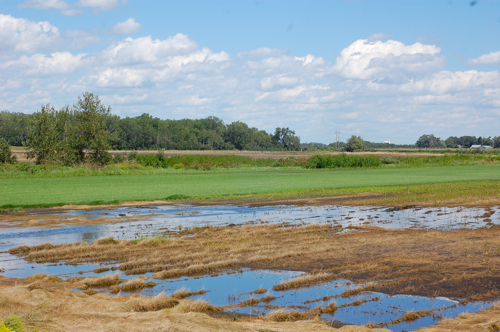
Ah, it's the special time of year when I drive around looking for flooded farm fields and get the opportunity to misidentify shorebirds. We've had several flooded fields thanks to some heavy rain storms in Minnesota this summer. My neighborhood flooded again two weeks ago. In general, I like shorebirds--they are cute, have crazy shaped beaks and run around comically as they probe mud or sand for food. But they do have a tendency to defy the field guides or at least my understanding of them. If your travels over the next few weeks take you to some shallow waters in a flood farm field or around some sod farms, take a closer look. Even if the field looks deserted of birds with the naked eye, give it a quick scan with binoculars, you might be surprised at what you find.
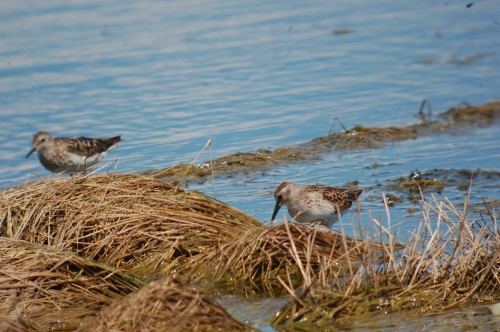
Some of these birds, like least sandpipers are the size of sparrows and easy to miss. But the sure are adorable to watch as they probe for food.
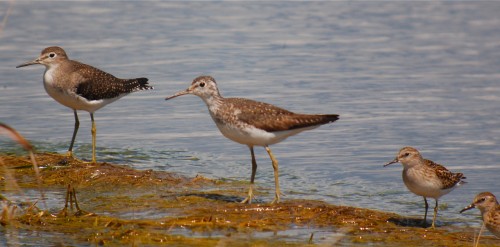
Here's an example of my misidentification misadventures: I tried to make the four birds above from left to right a solitary sandpiper, a lesser yellowlegs, least sandpiper and least sandpiper. Turns out that both the 2 larger birds are solitary sandpipers and different plumages. There go birds again--not living up to the field guide name. Shorebird id is so much like a logic problem.
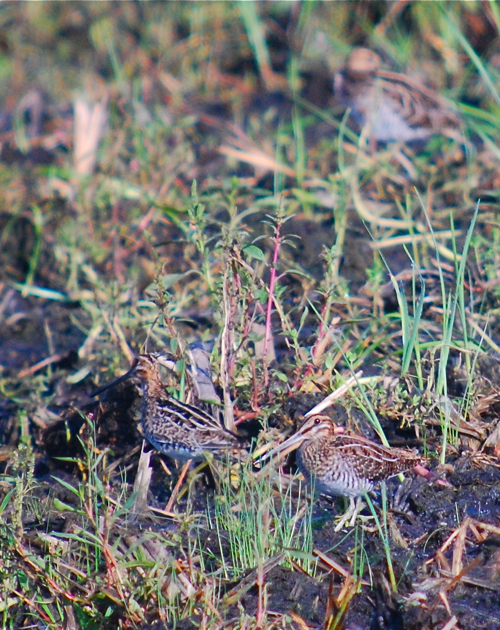
I get excited when I do find easily recognizable shorebirds like the above Wilson's snipe. I saw several working a farm field southwest of the Twin Cities. Not only do I enjoy these birds for their identify-ability, but they look so strange, with the super long bill. What kind of squishy bugs and crustaceans can a bill like that detect. According to All About Birds, snipe have sensory pits at the tip of the bill which allows them to feel its prey deep in the mud. I often wonder what it's like to experience the world as a bird when it can see in the ultraviolet spectrum, but how about detecting things with your mouth--crazy!
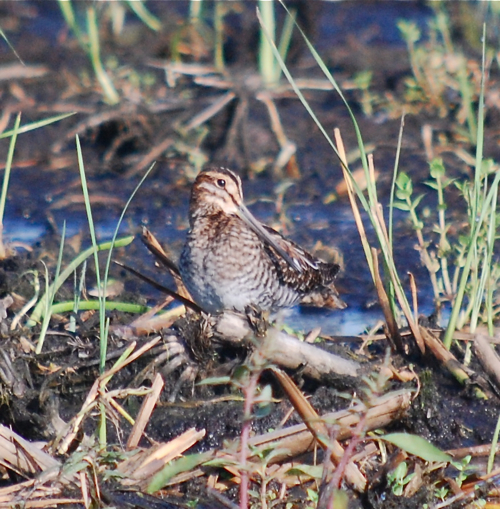
The field had several shorebirds, mostly pectoral sandpipers, but as I scanned, I found several snipe lurking in the vegetation. They look similar to woodcocks but an easy way to tell them apart is the striping over the head. The above poor guy kept trying to take a snooze but was constantly interrupted by foraging shorebirds or more snipe calling as they landed in the same field.
I do have mixed feelings about the shorebird migration this year and feel an especially hard pull to go out and really watch birds and enjoy them. I love seeing them and I wonder if their numbers will plummet. I wonder how many are off to the Gulf and how many we will lose on the way down and on the way back up. Has their fuel supply been altered in some way we can't detect yet? Will they find food, but will it be contaminated and force many birds to die in the Gulf waters rather than flying over the whole body of water? Migration is tricky business and I always wonder who will be strong enough to survive and return next year, but the oil contamination in the surrounding Gulf marshes could kill more birds.
There's a really, really good article at One Earth that even has some quotes by bird people who know far more than I do like Laura Erickson and Scott Weidendsaul. It's a good read and highlights many points anyone involved with birds has about the Gulf Spill not being over. I know BP and surprisingly some government officials want us to believe that it's over, but it is not. Just because the oil is below the surface and "out of sight" does not mean it is gone.
Some Great Conservation News In The Amazon
Well, now here is some positive news for birds! American Bird Conservancy in cooperation with the Amazon Conservation Association, has helped finance the purchase 7,427 acres of world-class bird and wildlife habitat in southern Peru that may contain the highest bird diversity for a single site in the world! The area is within the spectacular 4.7 million-acre Manu Biosphere Reserve, which is one of the most pristine areas of remaining rainforest in the Amazon.
This large property, called Villa Carmen, is situated at the confluence of three rivers, with frontage on two: the Pini Pini and the Tono. The property also has numerous streams and waterfalls, an all-weather road, and a small airstrip. The land ranges from about 1,500 to 3,500 feet in elevation, and contains roughly 90 percent old-growth rainforest, with about five percent diversified agriculture and five percent secondary forest.
The property is adjacent to Amazonia Lodge, a popular birding destination along the Manu road with a bird list of over 600 species including several globally threatened species, such as the Black Tinamou, Military Macaw, Blue-headed Macaw, Wattled Guan and Solitary Eagle. The area also supports wintering habitat for a number of neotropical migrant songbirds. Wintering U.S. WatchList species of conservation concern include the Olive-sided Flycatcher, Cerulean Warbler, and Canada Warbler.
The area joins a growing list of protected areas within the ABC Latin American Bird Reserve Network that currently numbers 36 reserves spanning 700,000 acres in 12 countries. Plans for the new reserve include cooperative efforts with local communities in the area to help preserve the greater Manu ecosystem, stimulating a local conservation economy with demonstration projects in sustainable agroforestry and aquaculture, and hosting environmental education programs, while providing lodging for visiting birders.
Digiscoped Images
Fresh Tweets
Would you like to hire me as a speaker for your event?
Email sharon@birdchick.com