
Birdchick Blog
Rainbow Mealworms Is In Dire Need Of A Bird Consultant
Oh, Rainbow Mealworms, why couldn't you have had a birder to take a quick look at this ad before you submitted it for print? I feel for you, I bet you'll get a few phone calls over this one.
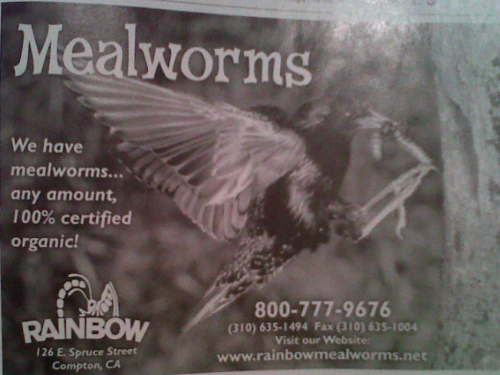
I was thumbing through one of the many bird magazines that find their way into my mailbox when this half page ad caught my attention. Rainbow Mealworms used a starling as the target bird to attract with their product for a US bird publication. This is a bit of an advertising blunder when you consider the type of birders who purchases mealworms: bluebird and purple martin enthusiasts.
Mealworms gained a place on wild bird specialty store shelves because bluebirds do not eat seeds and bluebird trail monitors wanted a way to offer them food. Starlings are one of the birds bluebird and purple martin enthusiasts work to great lengths to avoid since this introduced species will displace so many birds from nesting cavities like bluebirds, purple martins and flickers. Using a starling in the advertising is somewhat of a smack in the face akin to giving the peace sign backwards in the United Kingdom. Mealworms are a great addition to any feeding station, regulars like cardinals, chickadees and nuthatches eat them but so do catbirds, orioles and robins. I've yet to see any US bird feeding enthusiast anxious to attract starlings.
I don't blame the magazine's editorial staff for this one. Editors have remarkably little control over the ads, especially in this media era when few advertisers are investing in print. Often, the advertisers are submitting their pre designed ads last minute and the ads are put in with very little thought. A company should do a bit of research before they do their marketing. I'm sure both the magazine and the company will get some emails over this. Perhaps some enterprising bluebird or purple martin enthusiast will offer use of their photos of birds eating mealworms in exchange for a few bags of a 1000 Mealworms?

Rainbow Mealworms has had a tough few years. They are the biggest supplier of mealworms to North America and were one of the reasons for the mealworm shortage in 2008.
Better luck next time, Rainbow Mealworms.
Valentine’s Inspiration 4
[youtube]http://www.youtube.com/watch?v=ut-bQn88xEc&feature=related[/youtube] Some people are quirky and like to get funky with their partners. So for them, let's get Valentine's Day inspiration from the greater prairie chicken mating dance. Bunch of guys, hooting and stamping, chest pumping all for the attention of their special mate.
And because size isn't everything, even the lesser prairie chickens know how to get down and funky for their partners:
[youtube]http://www.youtube.com/watch?v=CvyjRmHoqfg&feature=related[/youtube]
Hawk On A Deer Carcass
One of the things that I'm bummed about my current schedule is that I do not have the time to get to Carpenter Nature Center like I used to. But, Jen Vieth who is the Development Director, keeps me on the email list to let me know what's going on and yesterday, she sent a very cool email. Al Maloney, the Interpretive Naturalist for Carpenter set up a deer carcass with a game camera (kind of like the Wingscapes Cam). The general goal with the deer carcass in the winter is to get some cool animal prints in the snow to show kids for their Tracks and Trails class. Jen said that so far mostly fox tracks and oooodles of crow photos at the carcass. But the game cam caught this cool visitor:

It's a rough-legged hawk!

It's funny, I've never seen many hawks on deer carcasses. Loads of eagles, crows, ravens, jays, chickadees and downy woodpeckers, but not many hawks. The only other time I have ever found a hawk on a deer carcass was years ago (before the blog even) up at Sax Zim Bog--and it was a rough-legged hawk.
Valentine’s Day Inspiration 3
Today, we have a video from the esteemed David Attenborough and Clark's Grebes. Some couples enjoy a turn on the dance floor...or in the case of the grebes, the dance water. And as I watch this video, I realize I have not actually seen this behavior in the wild but only on videos. I think I need to make that a goal this spring. Western grebes aren't too far from me and they dance too. [youtube]http://www.youtube.com/watch?v=OC5USIwf6yQ&feature=related[/youtube]
So, perhaps your partner would enjoy some connection where they feel bonded and synchronized with your. Consider taking them for a fish dinner and then go for some dancing.
Valentine’s Day Inspiration 2
[youtube]http://www.youtube.com/watch?v=AeG5KKa539A[/youtube] Here's a tip from hooded mergansers to give you an idea on how to attract your mate's attention on Valentine's Day. Even if you're an old married couple and deeply trenched in your routine, even something as simple as a cleaning ritual can be a time for love.
Although, I don't recommend that you react to your partner's amorous ways the way the female hooded merganser responded to this male:

This video was taken at Wood Lake Nature Center a few springs ago.
Random Rough-legged Hawk
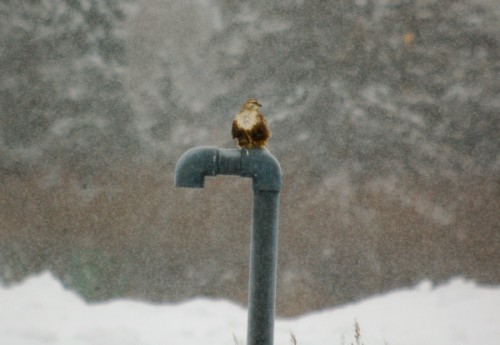 Rough-legged hawk in the snow. This is a bird being seen in the New Brighton area of the Twin Cities. I found it hunting an open area along with 2 red-tailed hawks--buteos getting along. Apparently it's been around awhile. I see it's sunny today, I may go back out and get some sunny photos.
Valentine’s Day Inspiration 1
Okay, for the next 14 days, I'll be posting videos of bird mating displays to give you some inspiration for Valentine's Day. Here's our first contender--get some romantic inspiration from the red-winged blackbird: [youtube]http://www.youtube.com/watch?v=c0Lw23yQFwQ&feature=youtu.be[/youtube]
Another nice reminder of spring from the Cornell Lab of Ornithology. It's a terrific video that explains the mating display of the red-winged blackbird. Gorgeous video that's only 3 minutes long and gives you a taste of what we can expect in the months ahead.
Rockstar Storytellers
[vimeo]http://vimeo.com/19361448[/vimeo] These are a couple of snippets from the Rockstar Storyteller show I did in January 2011. That's my neighbor Zoe reading along with me. This is a piece about a woman who used to call the bird store I worked for who claimed she could psychically communicate with birds.
Thunder Toads
Lang Elliot is one of the coolest guys out there. You may not have heard the name before, but chances are good that if you have listed to any North American bird, mammal, insect or amphibian id CD or tape, you've heard his work (and very likely his voice narrating the tracks). He's got a website called Music of Nature and he's regularly updating some of the nature sounds he's captured. Last night, I stumbled upon his Thunder Toad sounds. He narrates for about 30 seconds to set up the scene and then you get almost five full minutes of American toads trilling, spring peepers peeping and distant thunder from an approaching storm. I lovely reminder of summer for a girl who is watching another four to six inches of snow fall upon the existing 22 inches on the ground.
Unusual Bird Watching Training
For the second time in my life, I have questioned how much I love birds and wondered if I need an intervention. The first time with the Horned Guan Death March , especially in Part 2 of that epic hike up a volcano to see one of the rarest birds in the Americas. But the second time came last week when I did some mandatory training for our fall waterfowl surveys on the upper Mississippi River.

When we do our aerial waterfowl surveys, we fly low. It seems to me that we are right above the trees, but it's about 150 feet off the ground. It's low. Our biggest danger is power lines that run across the river. Most of them are well marked and we have GPS map system on the plane that alerts us to when we are approaching a set. But accidents happen. If I'm going to keep doing these surveys, then the federal government said that I need to have training on plane safety and how to survive a crash, specifically in water. How did we do that?

Why in a pool at a YMCA! That's one of my teammates and me in a makeshift small plane, belted into our seats and about to be dumped face down in the pool to see if we could calmly unbuckle and leave the plane should it submerge in the water. In order to complete the course, we had to do this four times...twice upside down.
I'm not going to lie...it was nerve racking. I survived three out of four times. The fourth time, I got trapped inside the box and had to be pulled out (I was never in any danger, note all the people in the pool). Two people are watching you under water and they knew right away if you were stuck and they pulled you out. I think because on my third attempt, I got a big shot of chlorinated water up my nose and just general fatigue are the reasons I missed on the fourth attempt. And really, the chances of me crashing into water four times in a row in an afternoon are incredibly slim. I have high hopes I'll survive a water crash and even higher hopes that I won't even need to use this training in my lifetime.

Here we are on one of our simulated crashes when they turned us upside down--you can see our toes. I think it was this dunking when I asked myself...how much do I love birds? If this is what I need to do in order to complete my job to watch and count them from a plane, then maybe there is something psychologically wrong with me. But still, even when we did the classroom portion, I asked myself, "Is counting ducks important enough for me to risk not coming home to Non Birding Bill at the end of the day?"
I think what we learn about native duck usage of the upper Mississippi River is important for the long run and it is worthwhile. Honestly, flying in the plane has been fun and seems like an adventure. However, when you're preparing for a worst case scenario (that will most likely never happen) you do play those scenarios in your head and you wonder if you will be ready if that moment comes.
The first day was general classroom work on plane safety and guidelines. We were given examples of plane crashes and outlined all the little things that could have prevented them and the reasons why some people survived and some people didn't. When I first started doing these surveys, I took an online course on crash survival. I chuckled as the training showed little cartoon planes fall to a fiery explosion and then learned that the number one thing that is going to save me in a crash is a positive mental attitude (surprisingly, not a parachute).
Our classroom training reinforced that and we learned the Seven Steps of Survival in a Plane Crash on Water. Any guesses as to what the first step is when the pilot shouts, "May Day, we're going down!" (or some form of profanity) Any idea?
Step one, say, "I'm a survivor!"
Side note: Do not sing it like a Gloria Gaynor song...that's frowned upon. But first things first, you want to mentally psyche yourself up that you will stay calm and get through this. You will survive and end up at home with your family at the end of the day.
You might be surprised to learn that of the Seven Steps, unbuckling your seat belt is Step Six. Before that, you need to (shout, "I'm a survivor!") unplug your helmet, open the plane door (if you're sitting next to it) brace for impact, when you hit the water you want to count to four to give yourself time to for the plane to stop moving and then sit up, find a reference point to the open door (make sure the doorway is still clear) and then you can unbuckle your belt and exit. The last thing you want to do it swim towards the top with a hand up first to check for debris and/or flames on the water (yikes).

The helmets remind me of the movie Spaceballs. The training was fun in a Mythbusters sort of way and a bit morbid, but I'm so grateful that I had it. I'm fortunate in that we have a professional and attentive pilot but I feel more prepared than ever should we have to go down into the river.
All part of the fun and exciting life of being a park ranger.
Digiscoped Images
Fresh Tweets
Would you like to hire me as a speaker for your event?
Email sharon@birdchick.com