Birdchick Blog
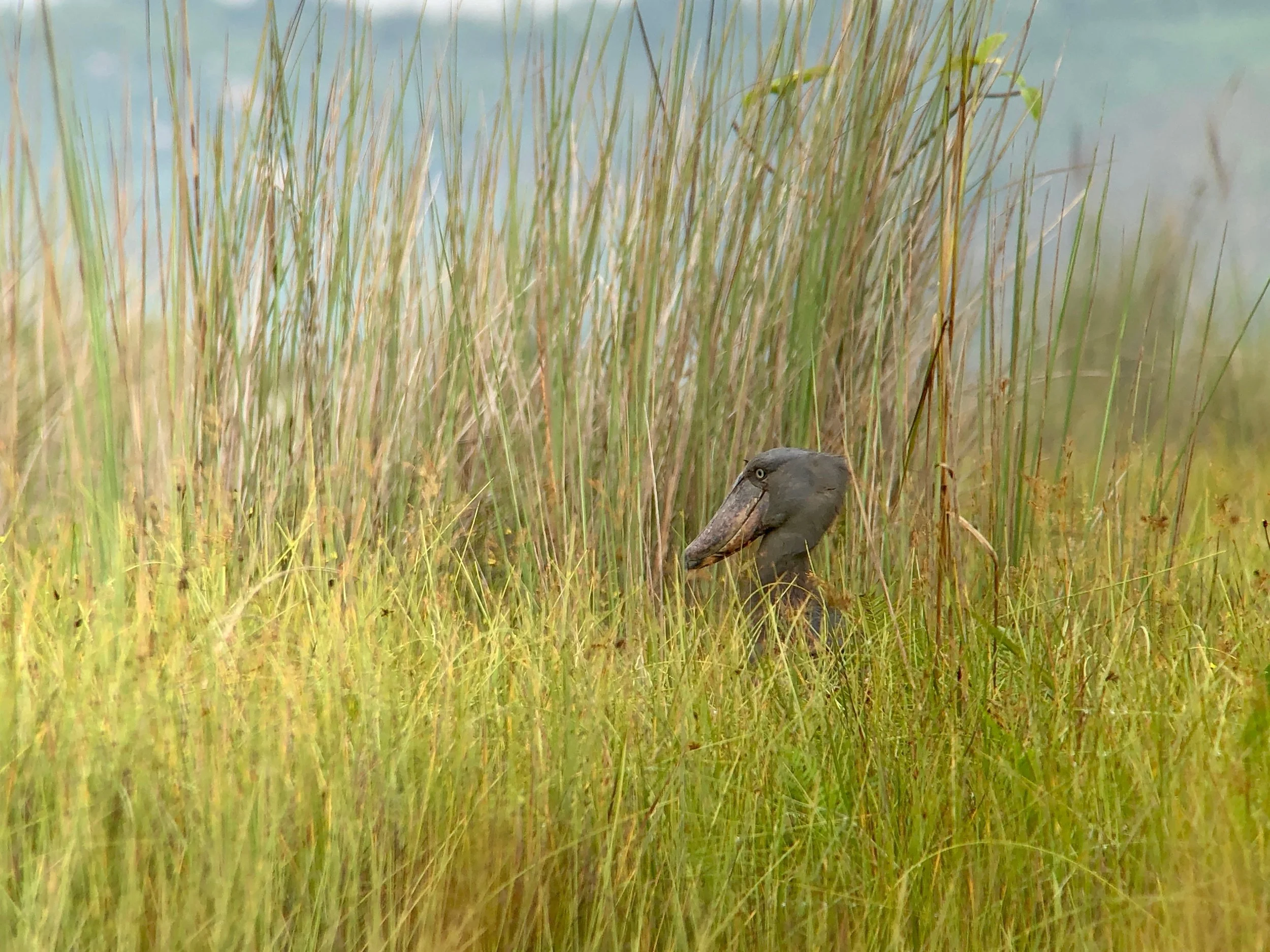
How To See A Shoebill
The answer: head to you Uganda.
I’m a big fan of bullet journaling—I’m by no means anything like what you see on Pinterest, I’m a bit more basic and I find that this form of tracking creates some sort of order to the chaos of my brain when it comes to writing. Since I am no Catherine Hamilton, I don’t do much of the artistic side of it but I will decorate mine with stickers…especially bird stickers. I generally try to keep it to birds I’ve seen and place in weeks when I’m most like to see them. However this time last December a friend alerted me to shoebill stork stickers on Mochi Things.
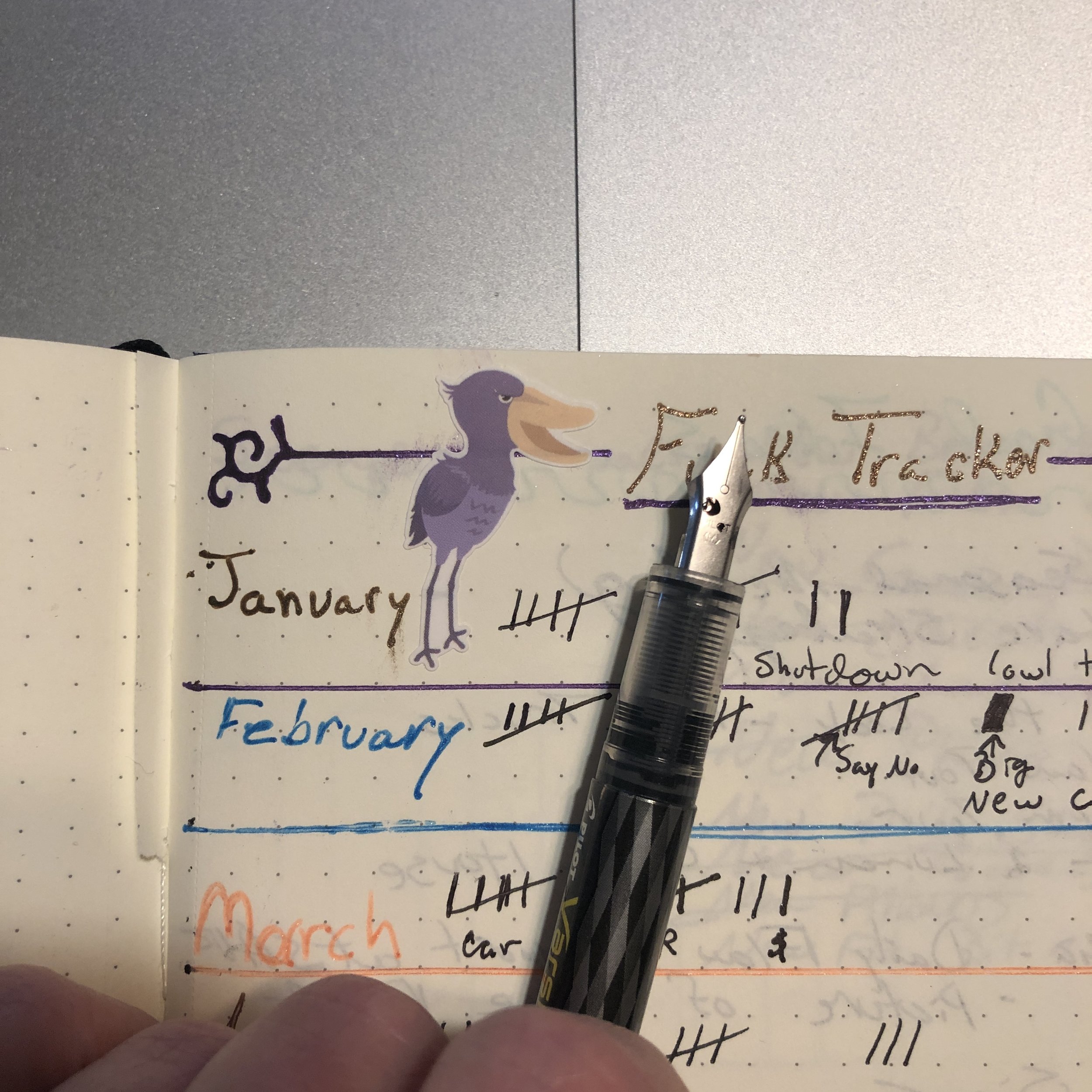
One of my shoebill stickers in my bullet journal. And yes, I am tracking exactly what you think because I noticed I was giving far too many of them away to things that didn’t need them.
I’d never seen a shoebill and had no plans in the foreseeable future for that to happen. But hey, how often do you see shoebill stickers? Thanks to their popularity on the Internet, they warrant their own stickers. Even my non birding friends were excited about them. So I ordered them and populated my bullet journal with them.
Then in May I got in touch with Herbert Byaruhanga from Bird Uganda Safaris and the opportunity to visit Uganda came. Giraffes, hippos, leopards, chimps and gorillas were possible…but so is the shoebill, which can be found in freshwater swamps in central Africa. I could barely think about this trip for months, even delaying vaccinations because I couldn’t believe it was real, something had to go wrong to make this not happen.
The very first full day of the trip was our chance at the shoebill. I worried that something would go wrong with my flights from Minneapolis to Chicago to Brussels to Kigali to Entebbe would go wrong and I’d be delayed and miss it. And then there was the general anxiety of will we get the bird or miss it…because there are over 450 birds to seen in Uganda, I’m not going to see them all. I’ll will have to dip on some.
But my flights were uneventful and after 24 hours of travel I found myself in Uganda crashing on a bed in a hotel room at 1am. The next morning I woke and met my travel companions for the next two weeks in the parking lot a motley crew of birders from the United States, the UK, Panama, Australia and Taiwan. Every movement was exciting and mostly likely a new bird. Herbert took us to breakfast and then we’d be off to the shoebill. Our poor servers couldn’t keep us in our seats to eat or drink because were glued to the window for things like vervet monkeys and shikras.
After breakfast we hit the roads to Mabamba Wetlands where would take large canoes with motorboats out into the wetlands to look for shoebills, malachite kingfishers, yellow-billed ducks, black crakes, African jacanas and anything else, it was all good.

This area is used by tourists to search for birds and by the locals to cross the water and visit other communities. One day we passed a wedding party with a canoe loaded with gifts for the bride. The poor boatman had is motor fall off the canoe. We hope he made it over.
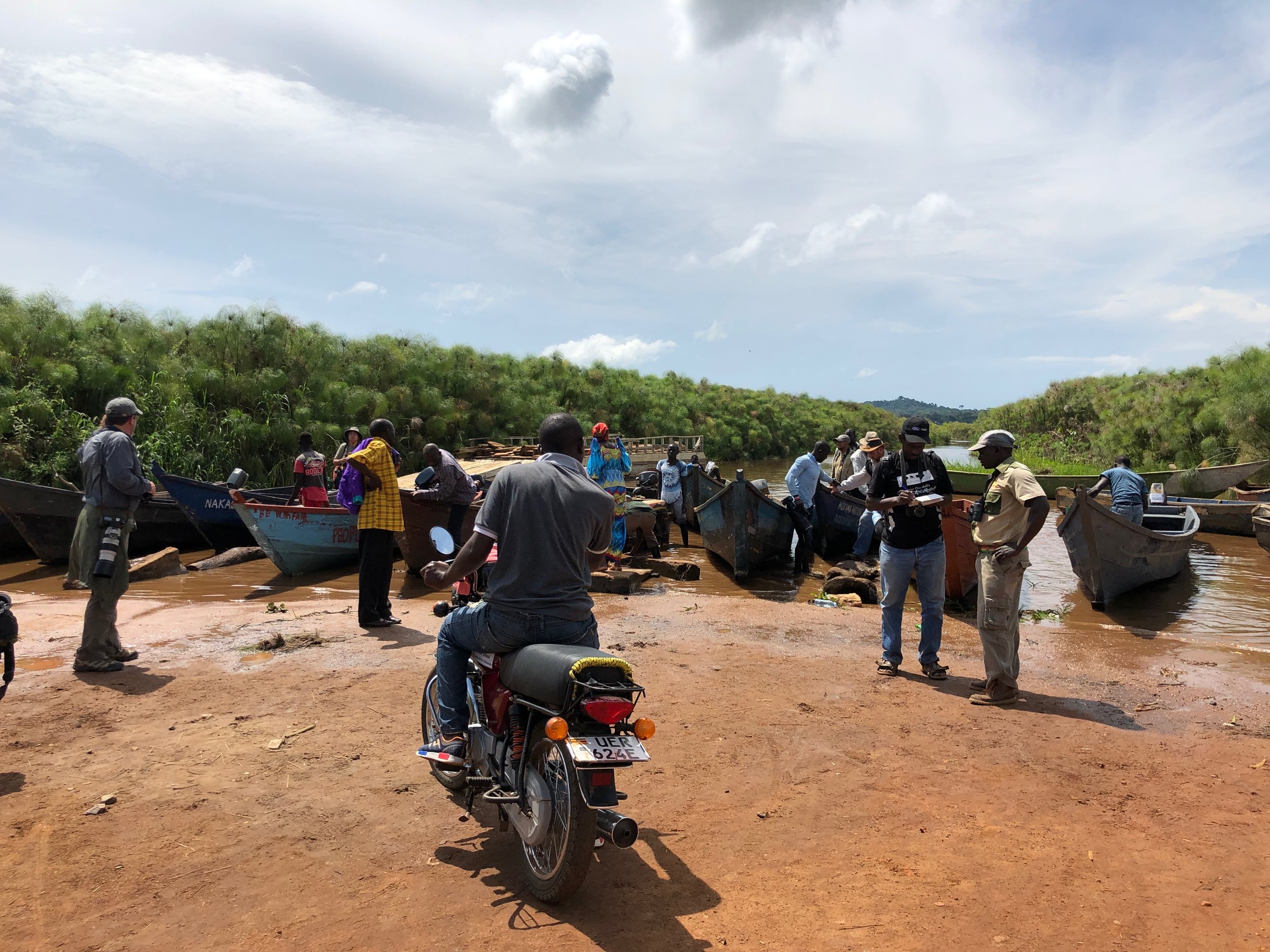
The boats take people and bikes across the water.
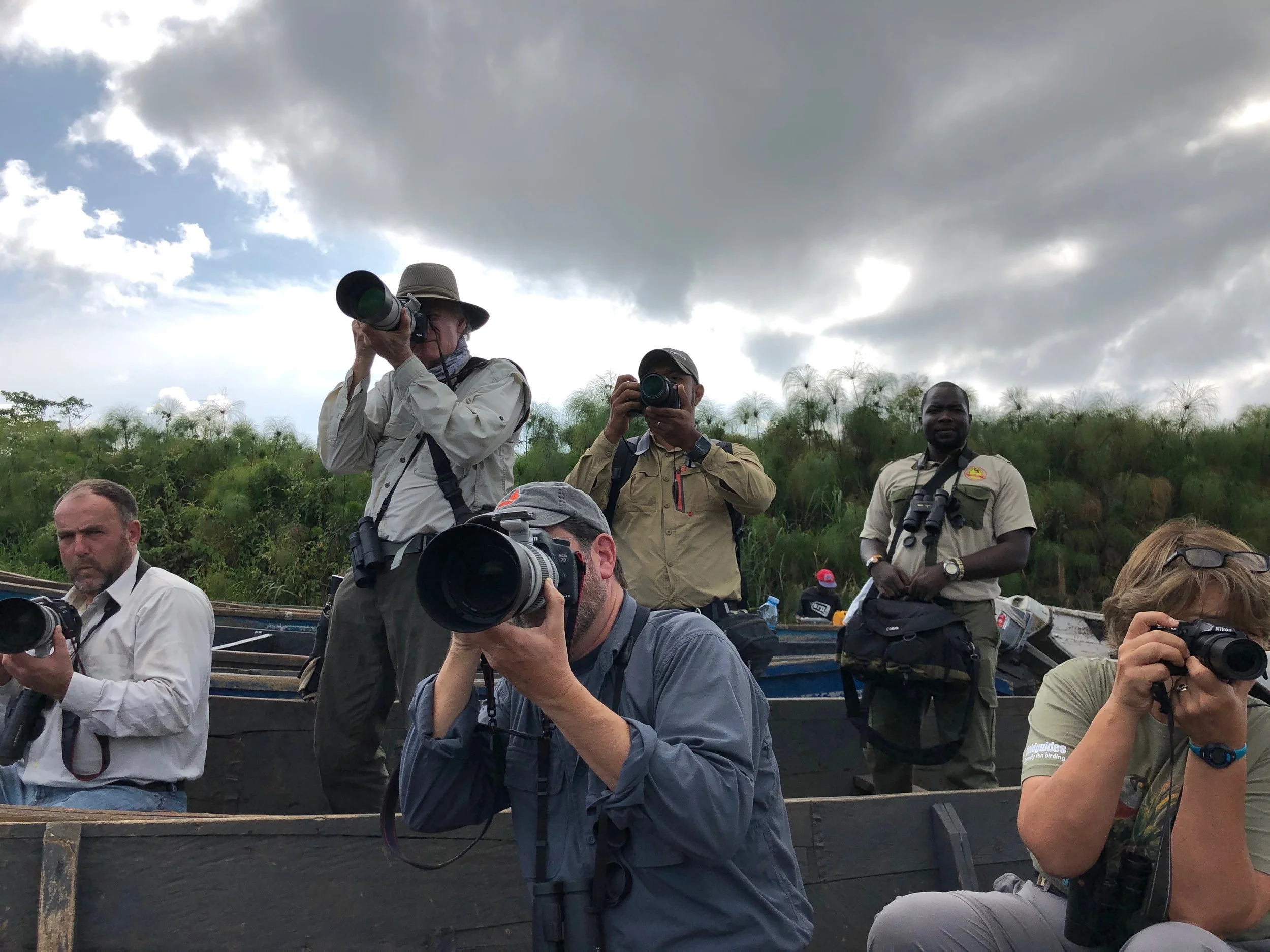
I turned around and discovered that everyone else in my group was excited by a close up hammerkop!
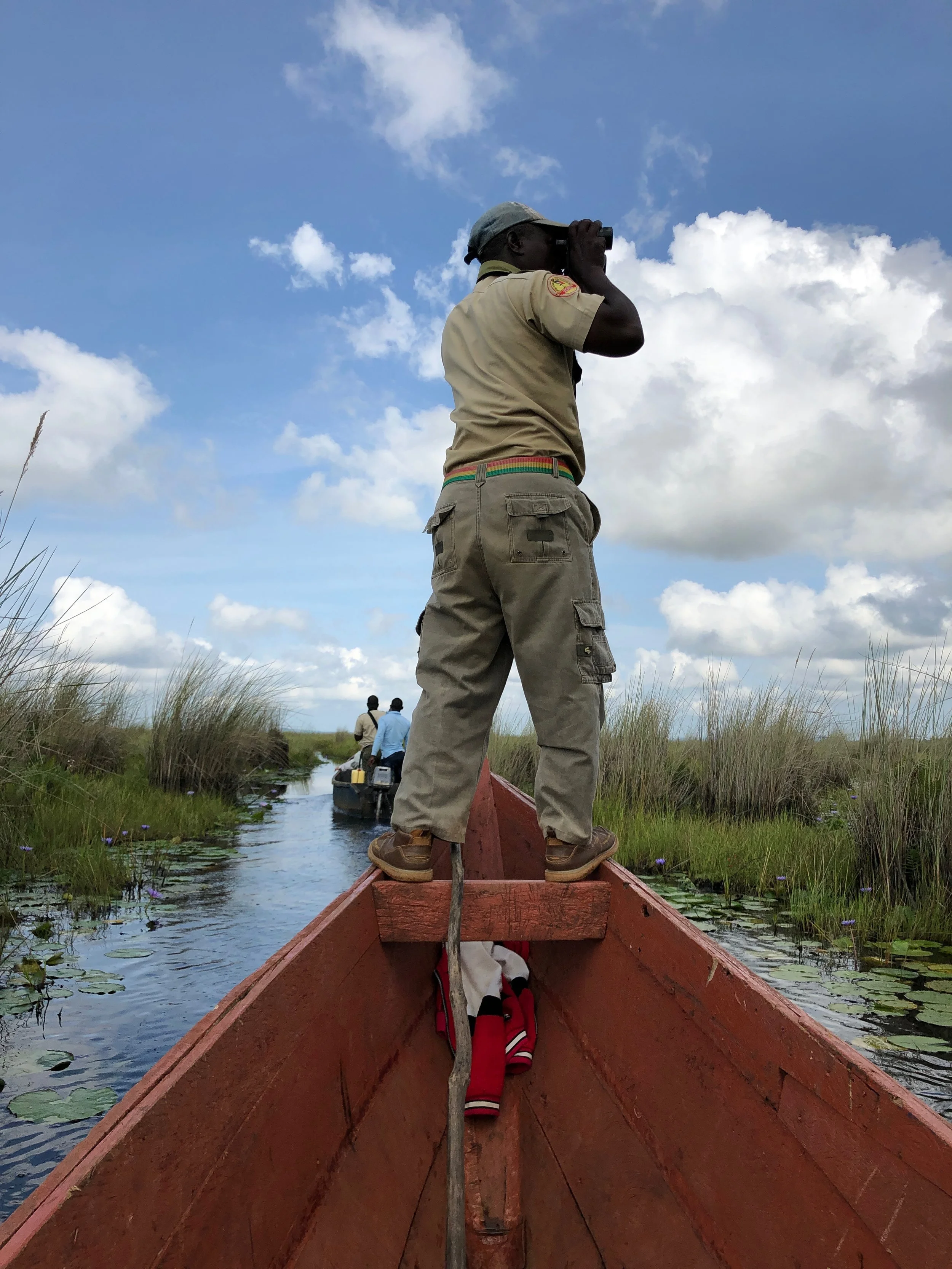
Boat safety is different in Uganda. But our guide was watching for the shoebills. There were also scouts in the swamp looking for them ahead of us.
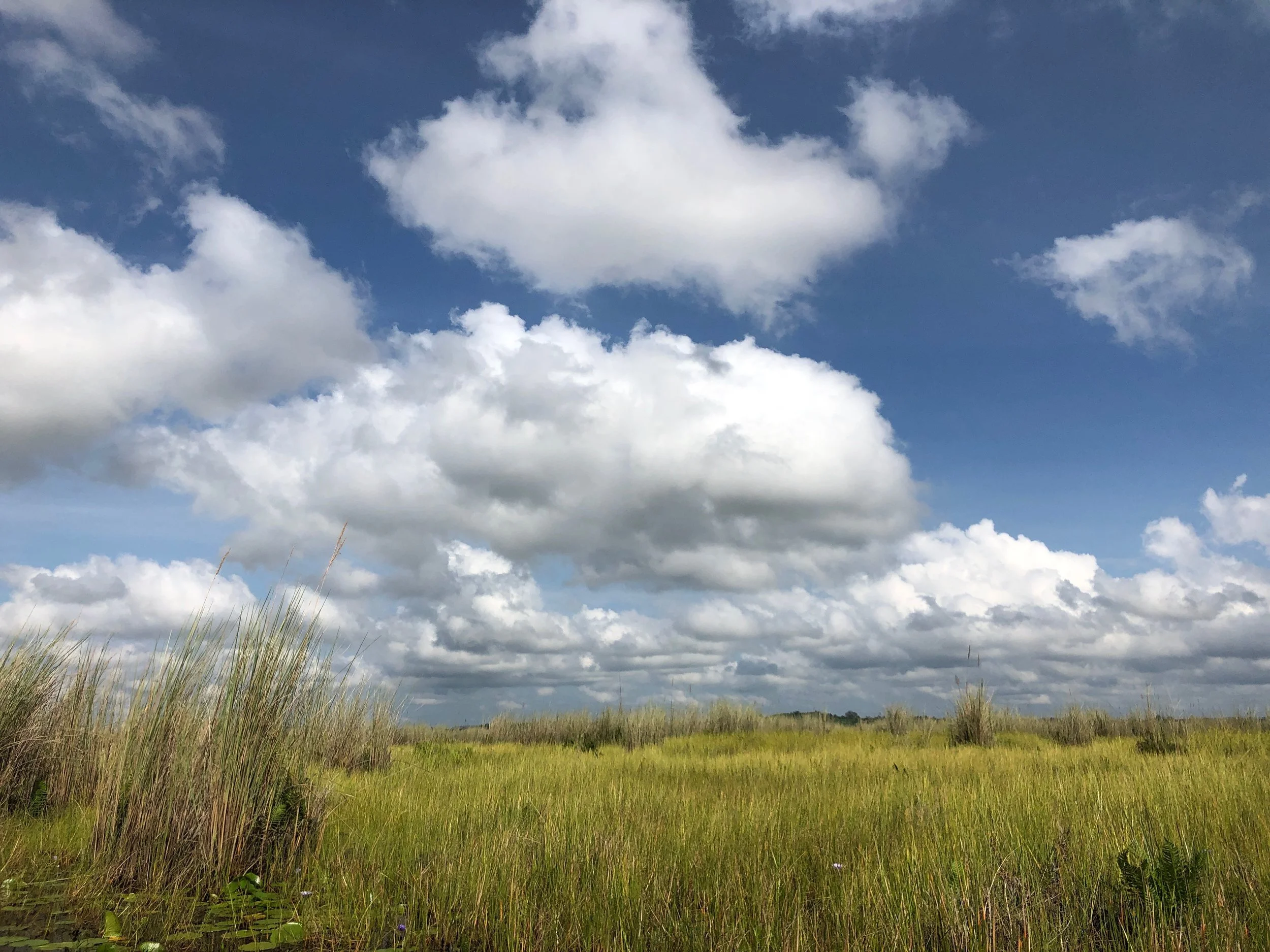
The weather was perfect and the wetlands were beautiful and chock full of birds, just not shoebills.
We spend two hours in the wetland…and completely dipped on the shoebill. It was a disappointment and all part of the game but Herbert assured us that we would have other shoebill opportunities. He wouldn’t let us leave town without seeing one. And we did see the malachite kingfishers, jacanas and crakes, it was a lovely time. You can see the birds and some more photos at our eBird checklist.
Herbert took us out for some more excellent birding through the day and toward the end we stopped by Nabajjuzi Swamp because he had a lead on a shoebill. We scanned the swamp and did see it and we loaded into our vehicles to get to our next lodge. As we were on the busy roadway, Herbert gasped. He saw a shoebill. It was one of those sightings where only someone who sees this bird constantly and knows them so well that only they could spot them because this bird was far and hidden and we were going about 50mph. But we pulled over and everyone tried to get their glimpse of a lifer shoebill. I had a tough time because the vegetation is high and I am oh so short.
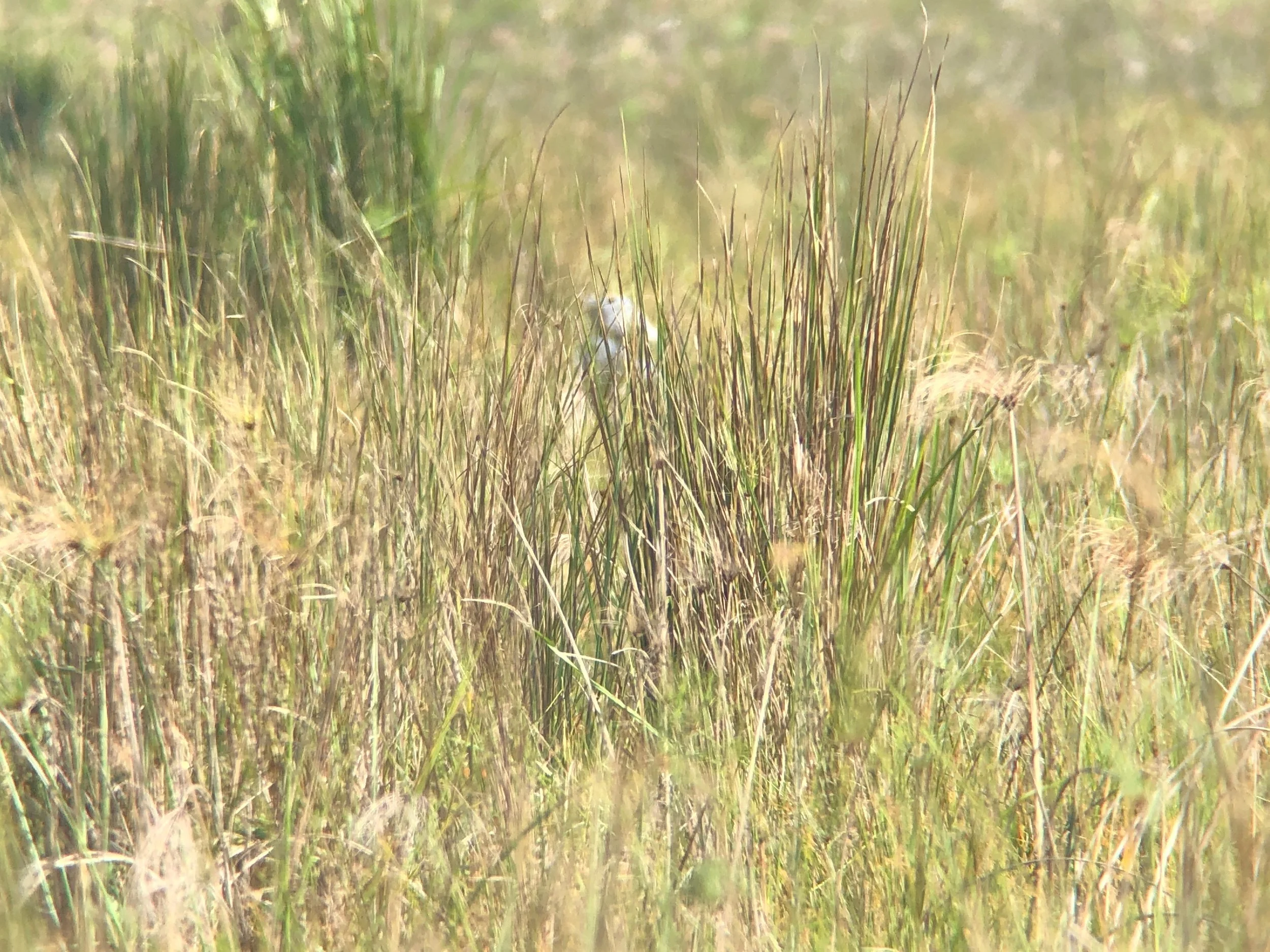
See that light wash of gray? That’s my lifer shoebill view. Weeeeee!
I looked around, I needed to be higher, but how. Then I looked at our super sturdy safari vehicles.
“Hey, Herbert, can I get on top of the truck to see the shoebill?”
”Of course!!”

Top ten life moment here. Standing on a safari truck to get a picture of shoebill. Thank you Carlos Bethancourt for the picture! Warning on the video below, I use “a swear” at the end. I couldn’t help it.
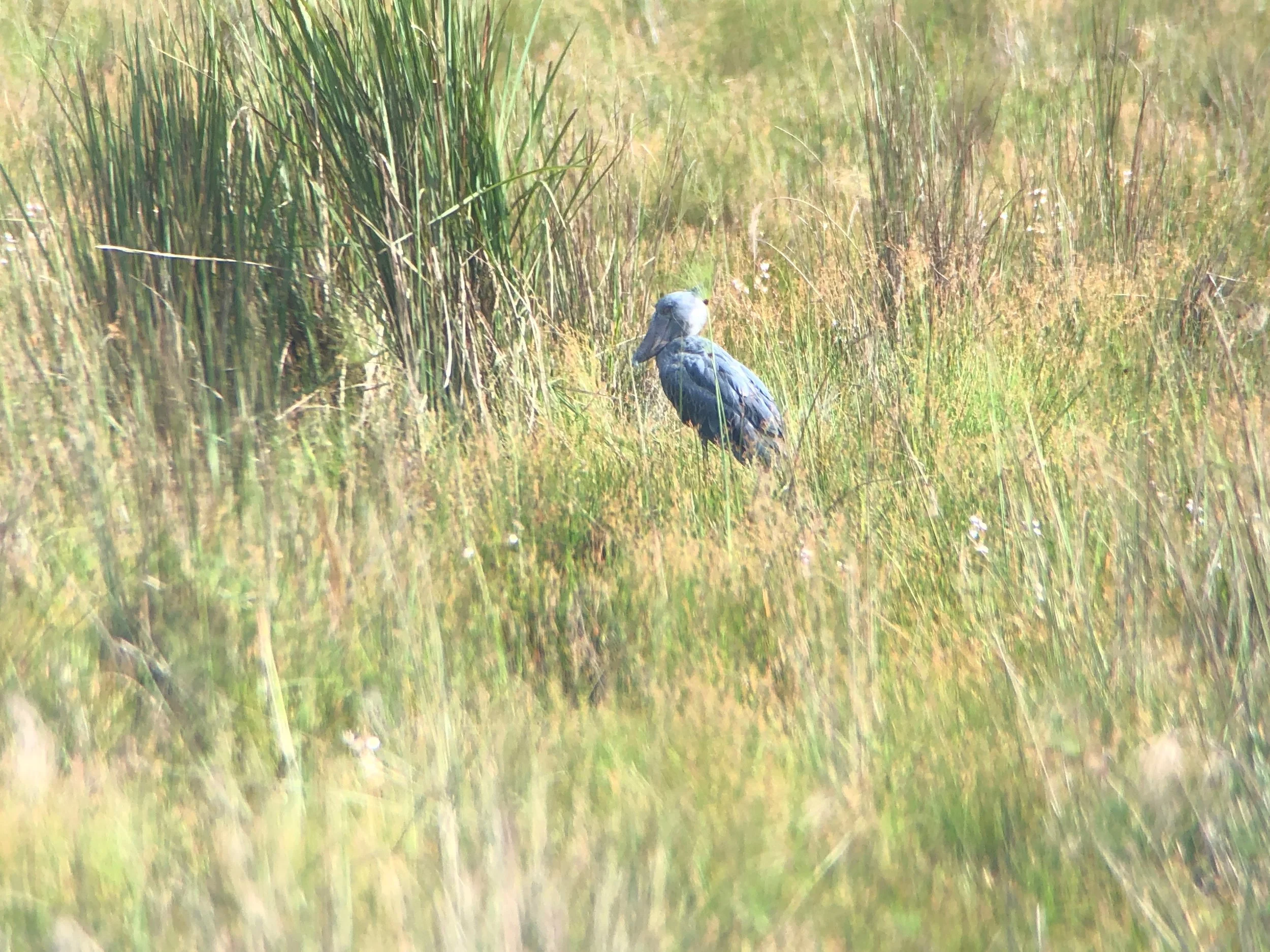
Much better view from on top of the vehicle. It was too far away for a great shot, but good enough for my memories.
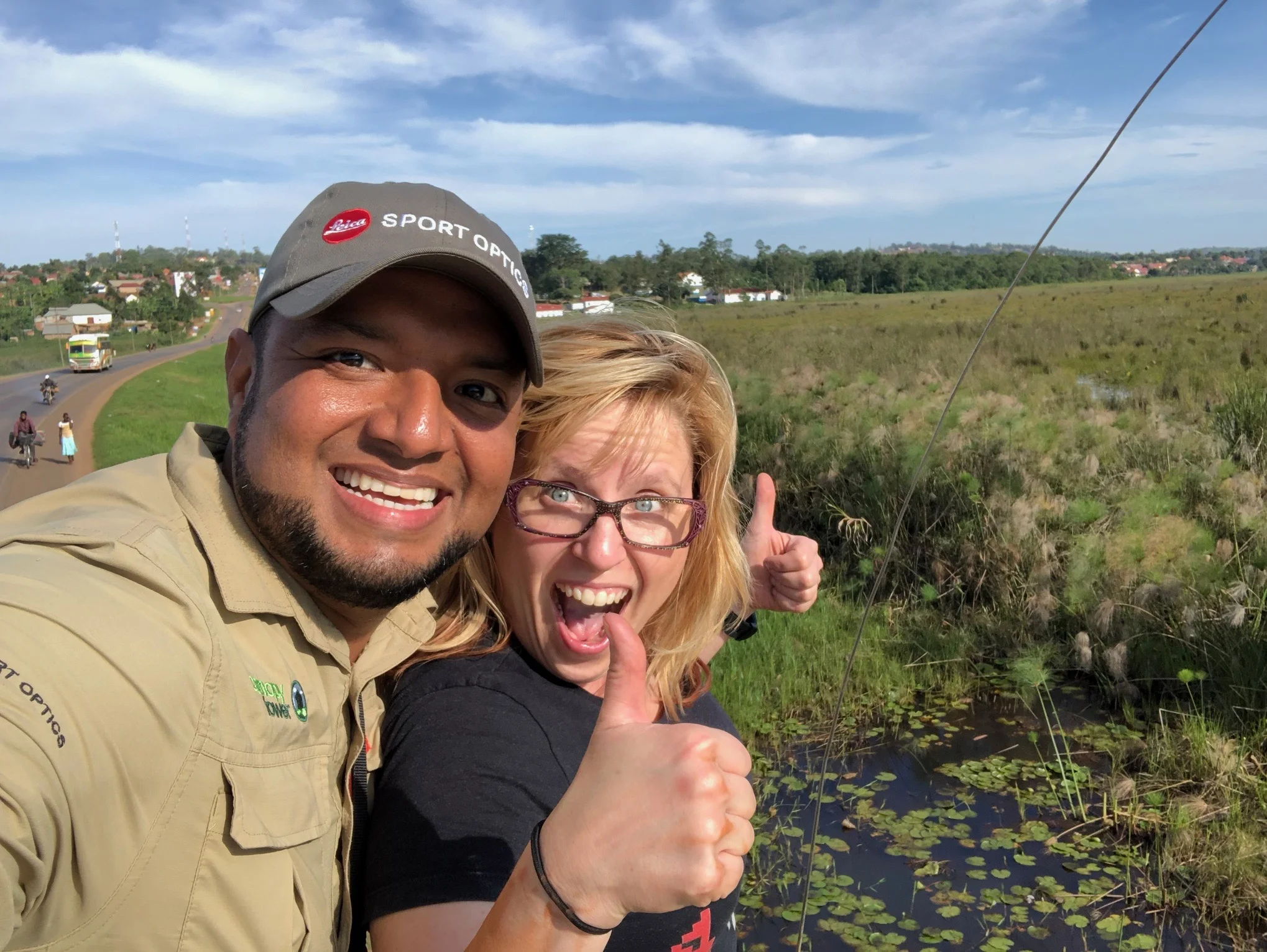
Carlos joined me on top of the vehicle. This is the first time I’ve truly been captured right at lifer bliss. This was an amazing bird and top notch spotting on Herbert’s part.
A crowd gathered to watch the crazy foreigners losing their minds watching this bird.
I felt so relieved. We got the shoebill. It wasn’t exactly the view I had dreamed about, but we saw the bird in its habitat, you could clearly tell what it was and I could see the gorgeous gray eyes. I felt my shoulders relax and I was ready to enjoy everything else—it was all gravy at this point.
And the rest of the trip was amazing and I’ll write more. But Herbert had one more shoebill trick up his sleeve. On our final day of birding. He took our vehicles across Lake Victoria back to Mabamba Wetlands with one of his female guides to get a better view. He said that our group was the first time in 30 trips that he had not seen a shoebill there. He wanted to do it again. We were in, we were all in.

It was much rainier this time!
We were warned about rain and we had our rain gear. The boatmen also had umbrellas for us as well. We had to go into some of the thicker parts of the vegetation to get to the birds and we had to do some waiting while our female scout searched. But we got our shoebill!
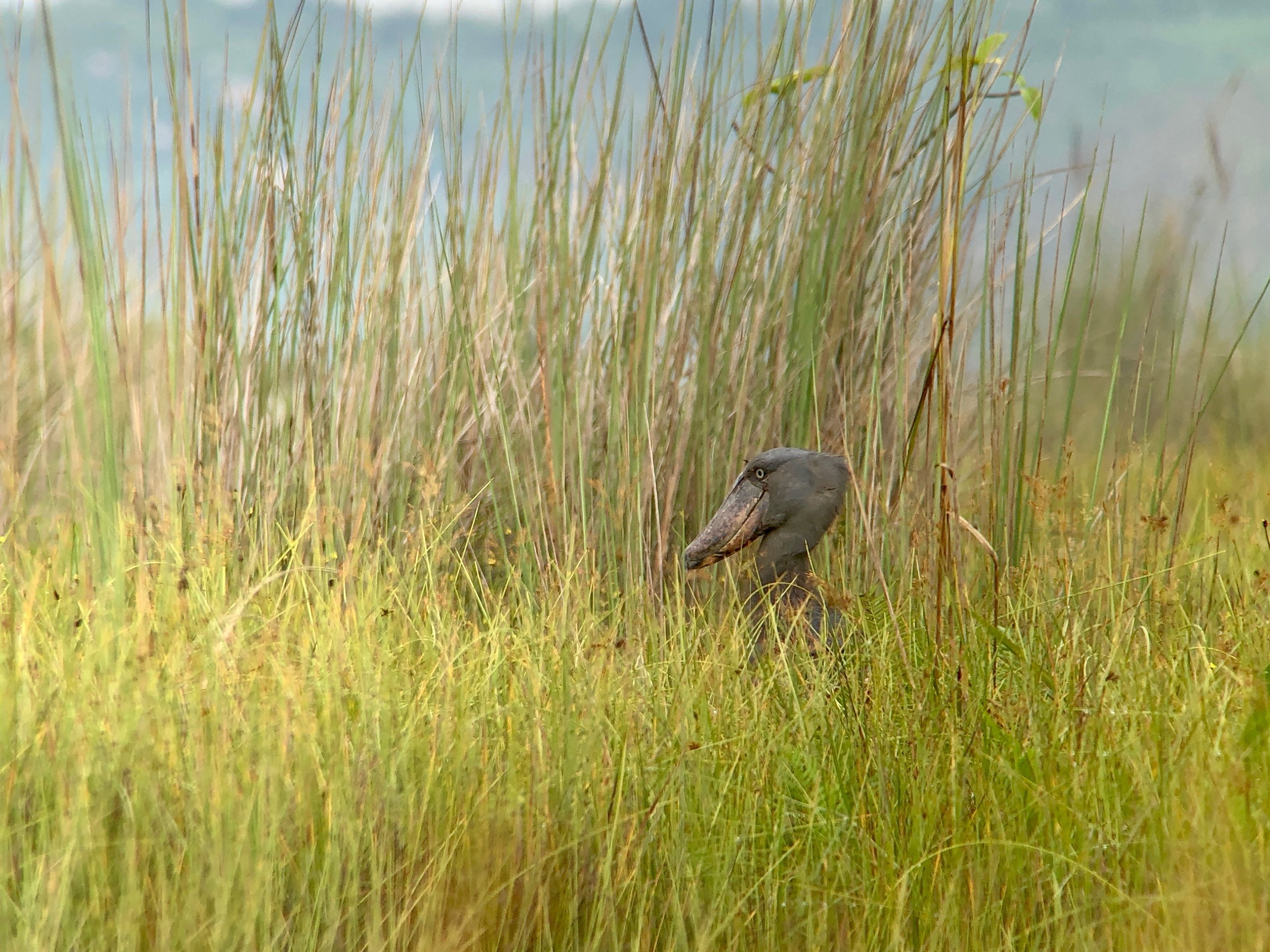
We could see it with the naked eye and that was a satisfying view, but in the scope the bird was outstanding. With this view I got a much better sense of how huge this beast is.
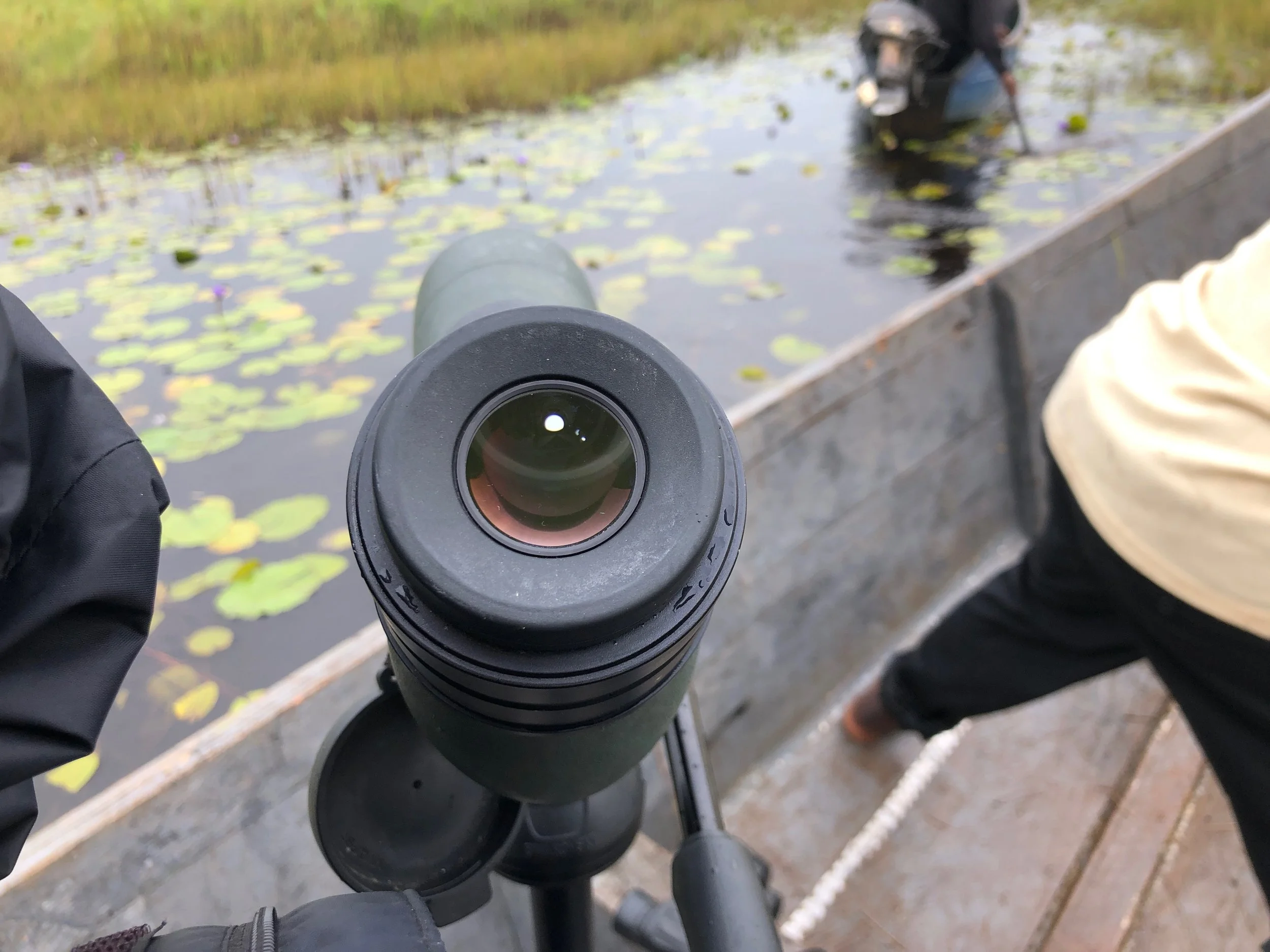
People tell me I’m crazy for taking my scope on a boat but it was so worth it. Thanks to my phone I can get some great shots.
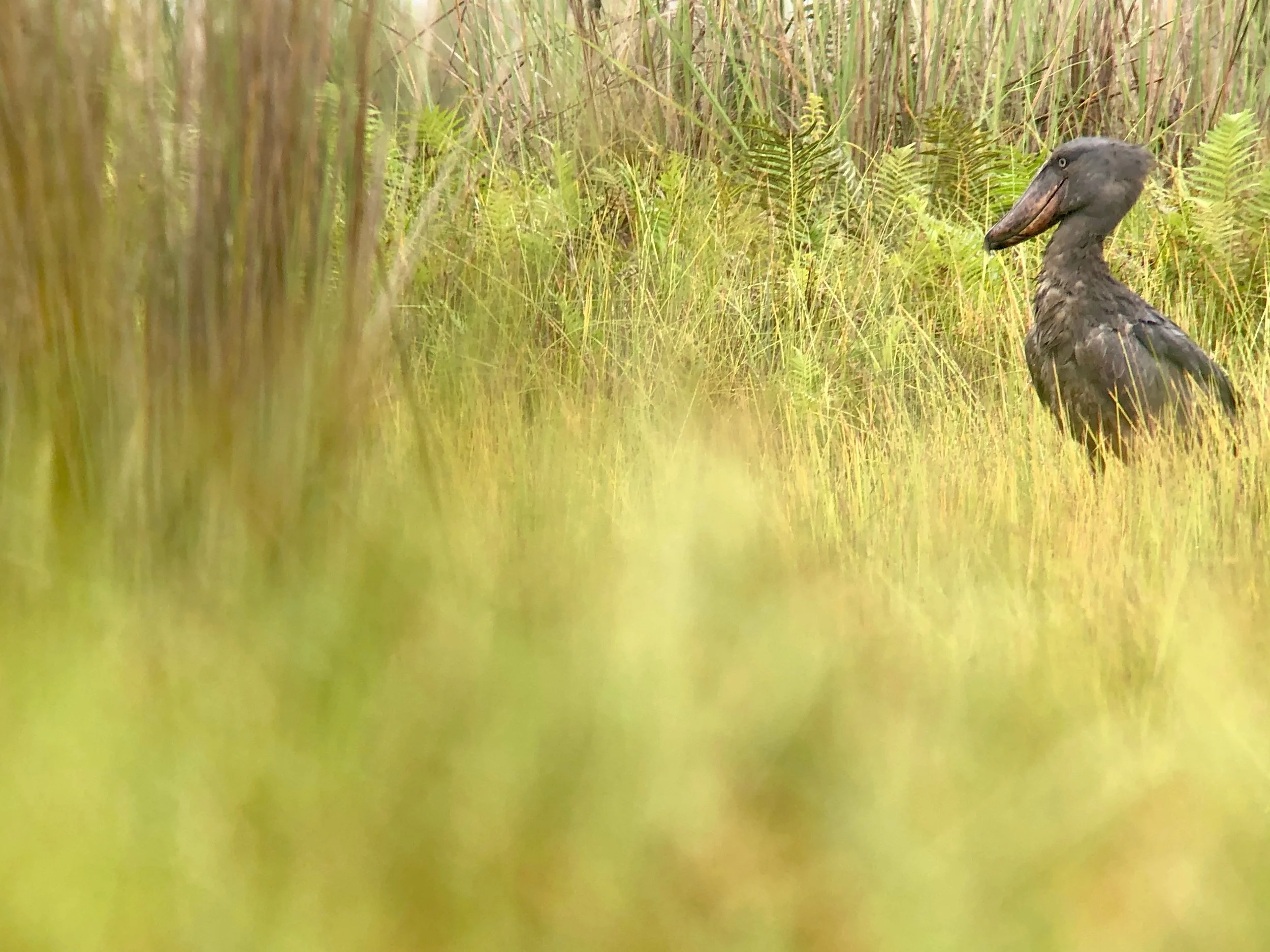
Thanks to my PhoneSkope case and iPhoneX I got this great shot for my memories.
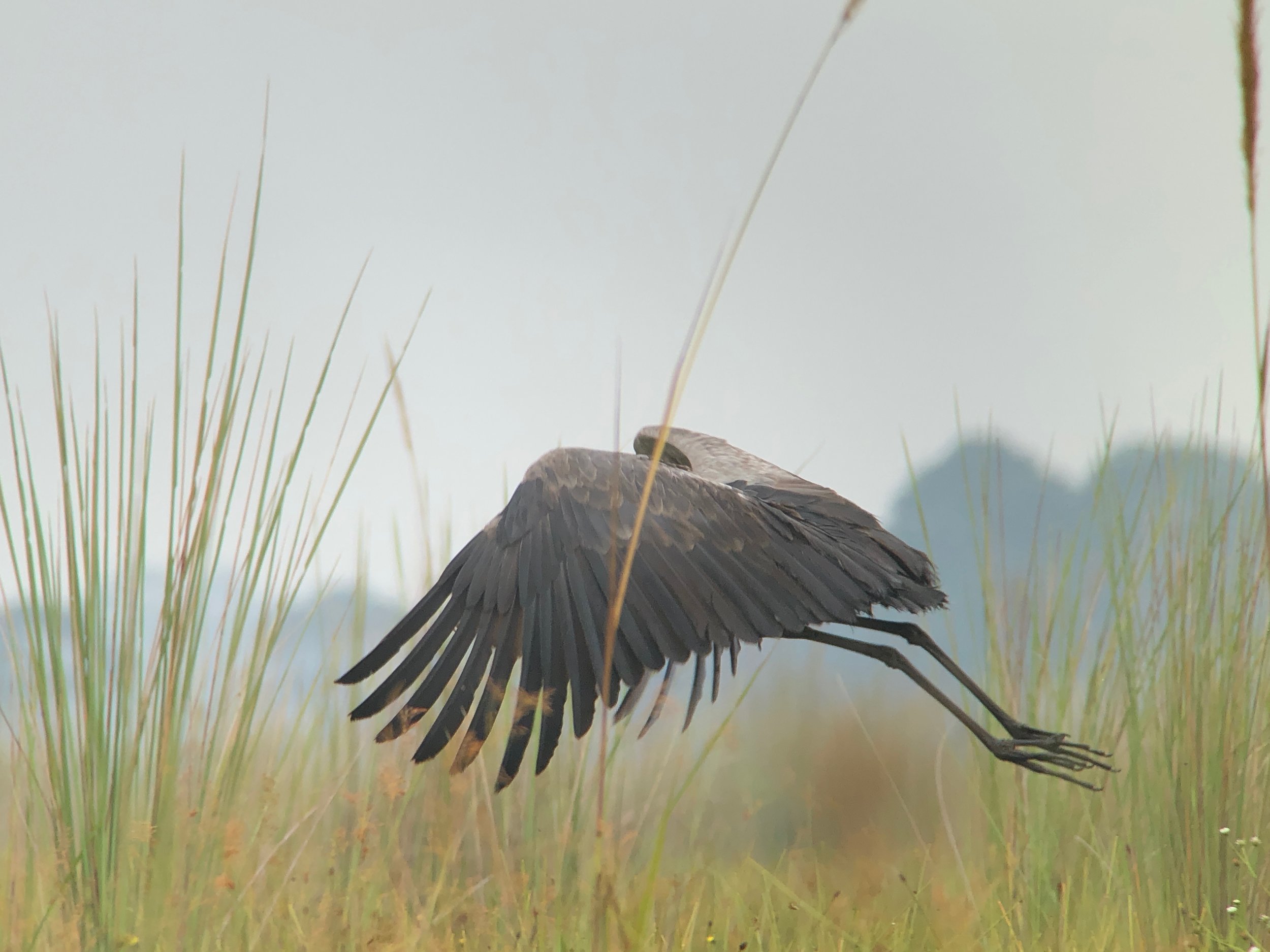
Good grief, they can fly!
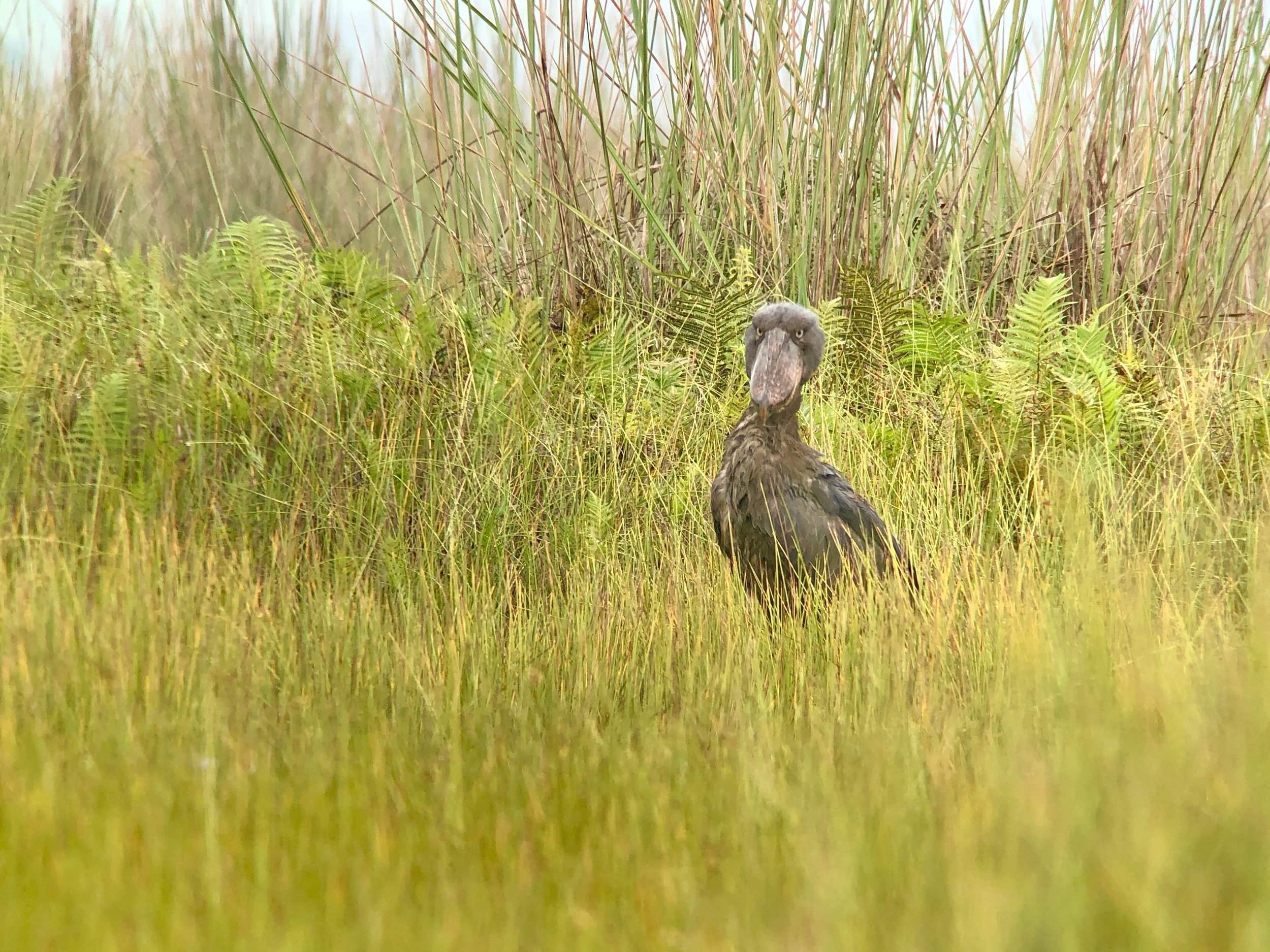
The murder stork’s ambivalent eyes demand respect.
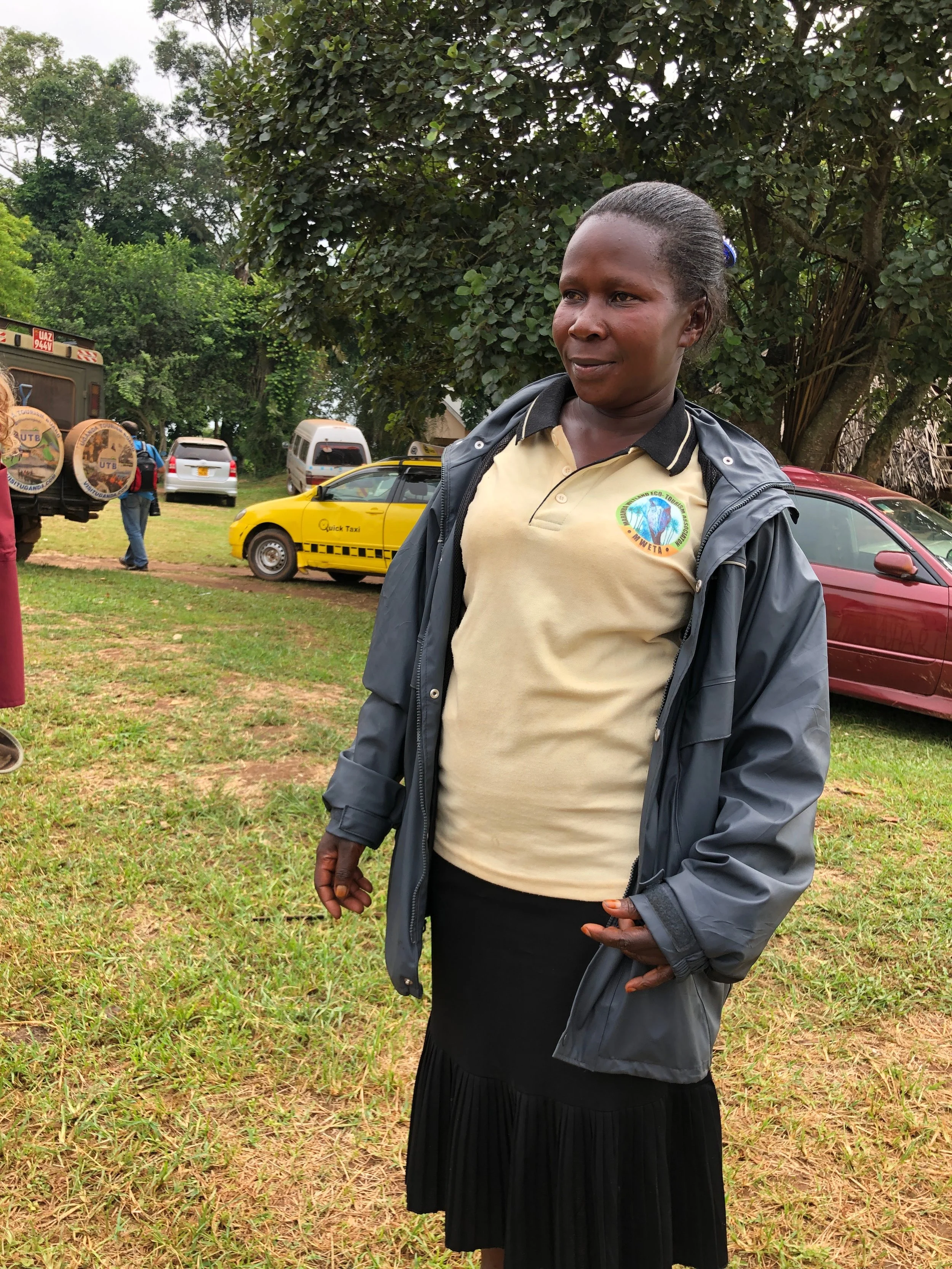
Our wonderful scout who gave me the gift of a wonderful shoebill view. The boatmen and guides worked hard as well, but she’s the one who got us all there.
I made a video of our shoebill search and you get better idea of what it’s like getting around the Mabamba Wetlands.
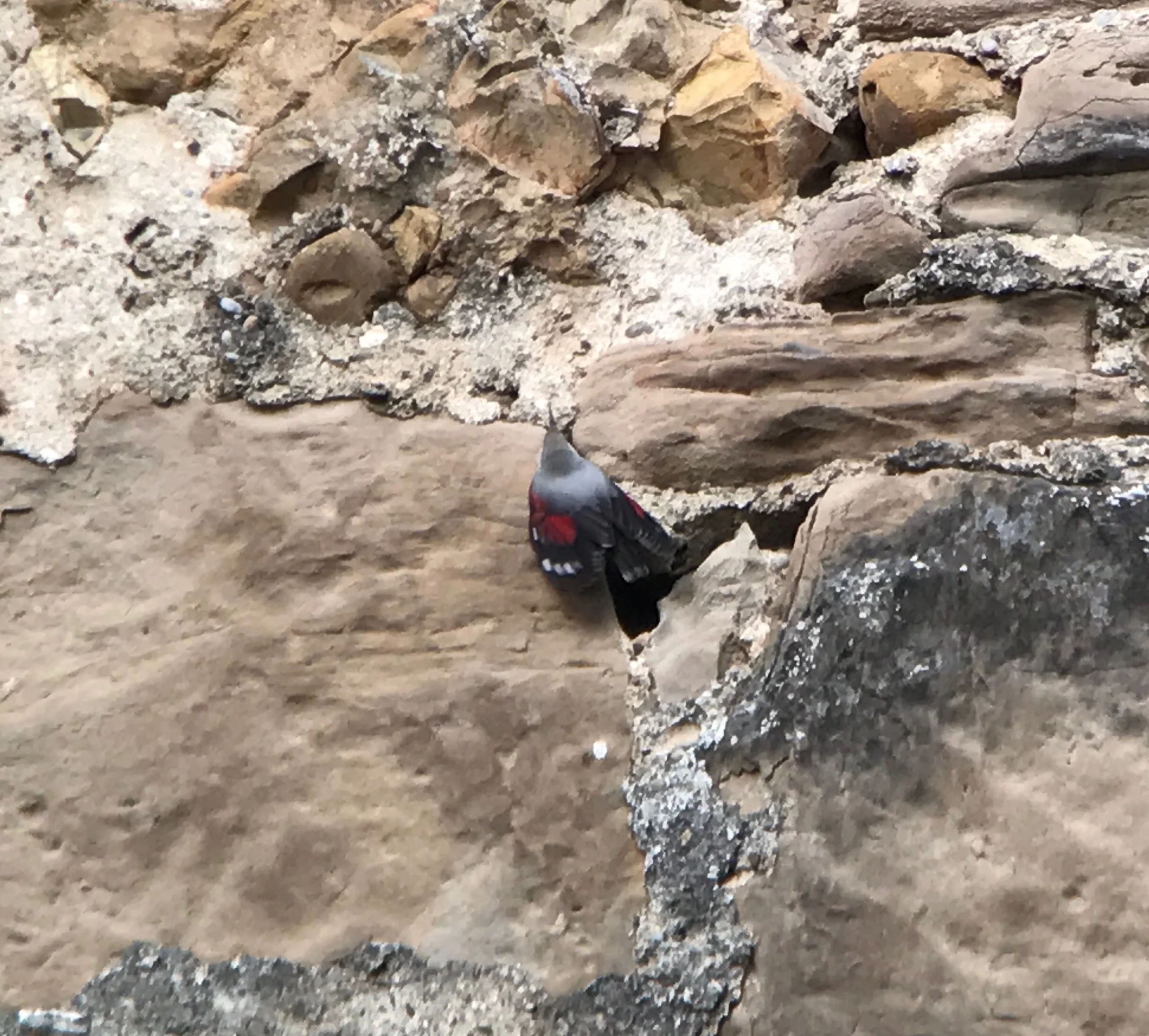
Wallcreeper on a Castle
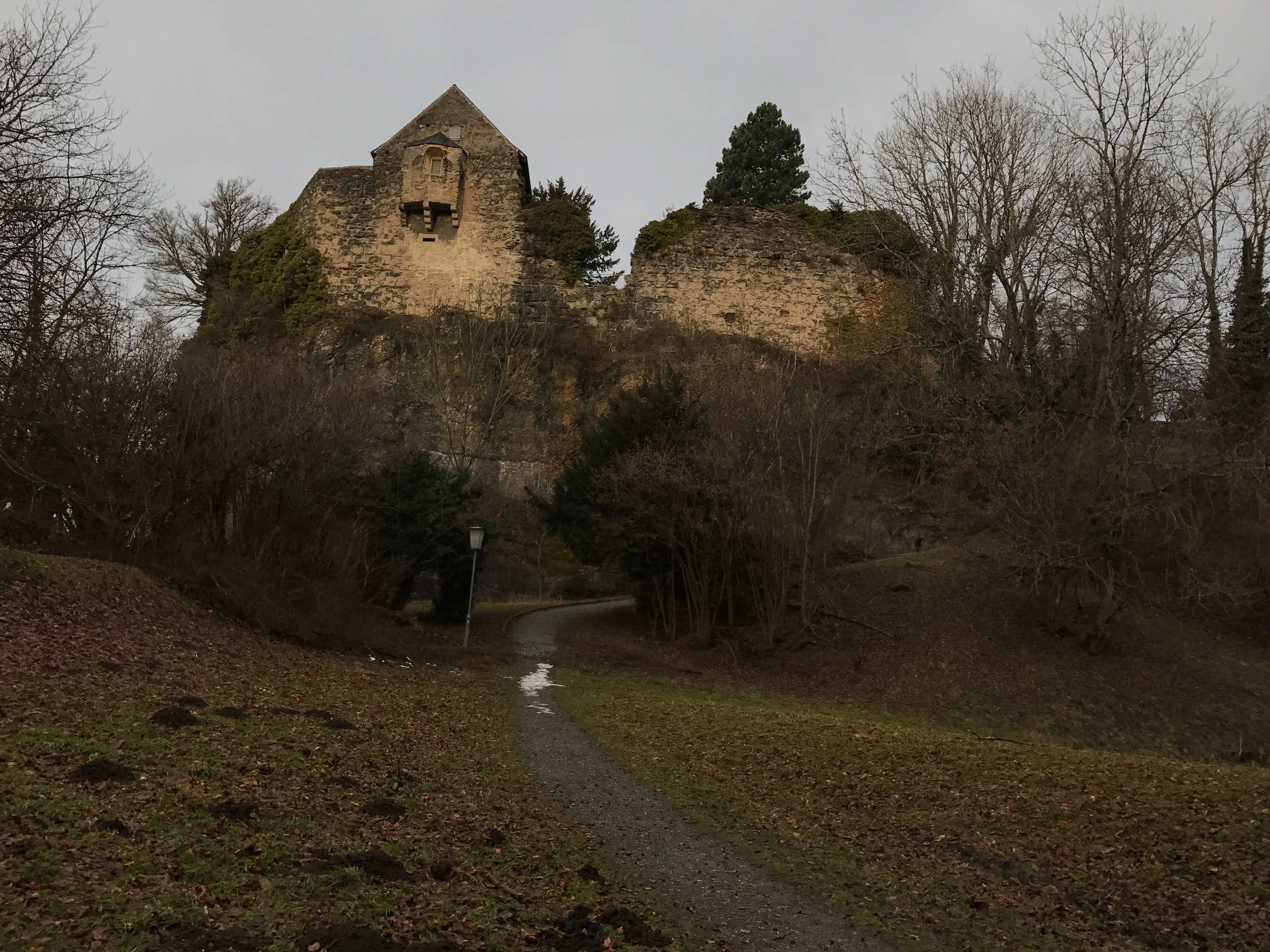
You can’t trip without finding a castle in Europe.
One of the best mornings I ever spent was because of a cheaper flight. Sometimes when flying home from Europe, at least $1000 can be saved by extended the trip an extra day (usually to fly on a Monday rather than a Sunday).
Since we had an extra day we did some birding and for most of us the goal was wallcreeper. This is a mytical European bird that I’ve been interested since the first time I cracked a field guide for this area. Think of an elegant silvery nuthatch with bright pink wings that creeps rocky walls gleaning insects. I’ve dipped on them in Austria and Israel but my friend Dale had a lead on a one overwintering on a castle in Bregenz near Lake Constance. What’s not to love about that sentence? So away we went to locate the bird with our thermoses full of coffee.
Our group had the nervous anticipation of flinching at any leaf movement as we combed the castle wall for the small bird. Eventually the bird was seen high up and worked its way down. We had lots of time with the bird and we were even able to send it to Facebook Live to grip our friends who were at work or on a flight home.
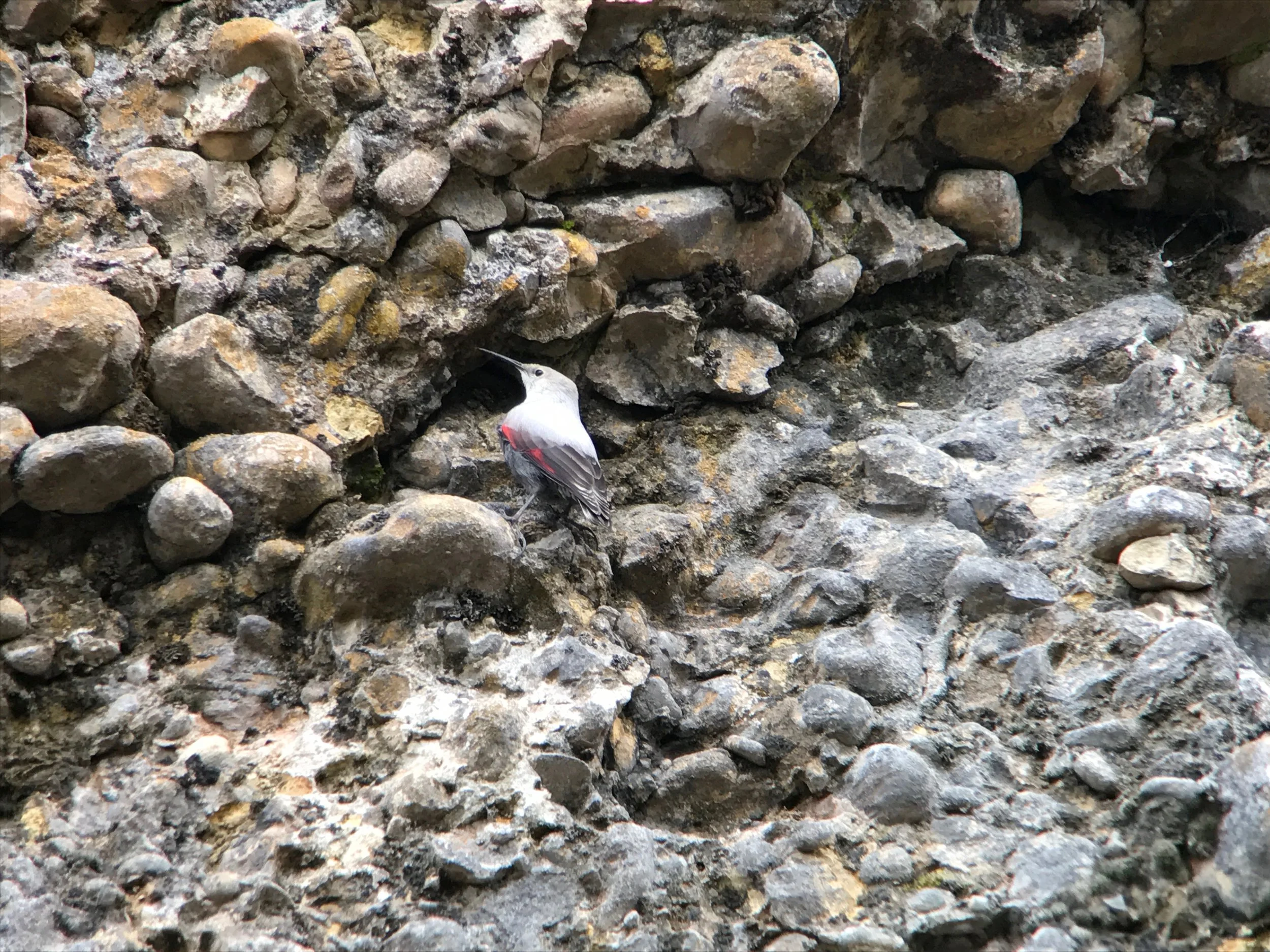
Wallcreeper!
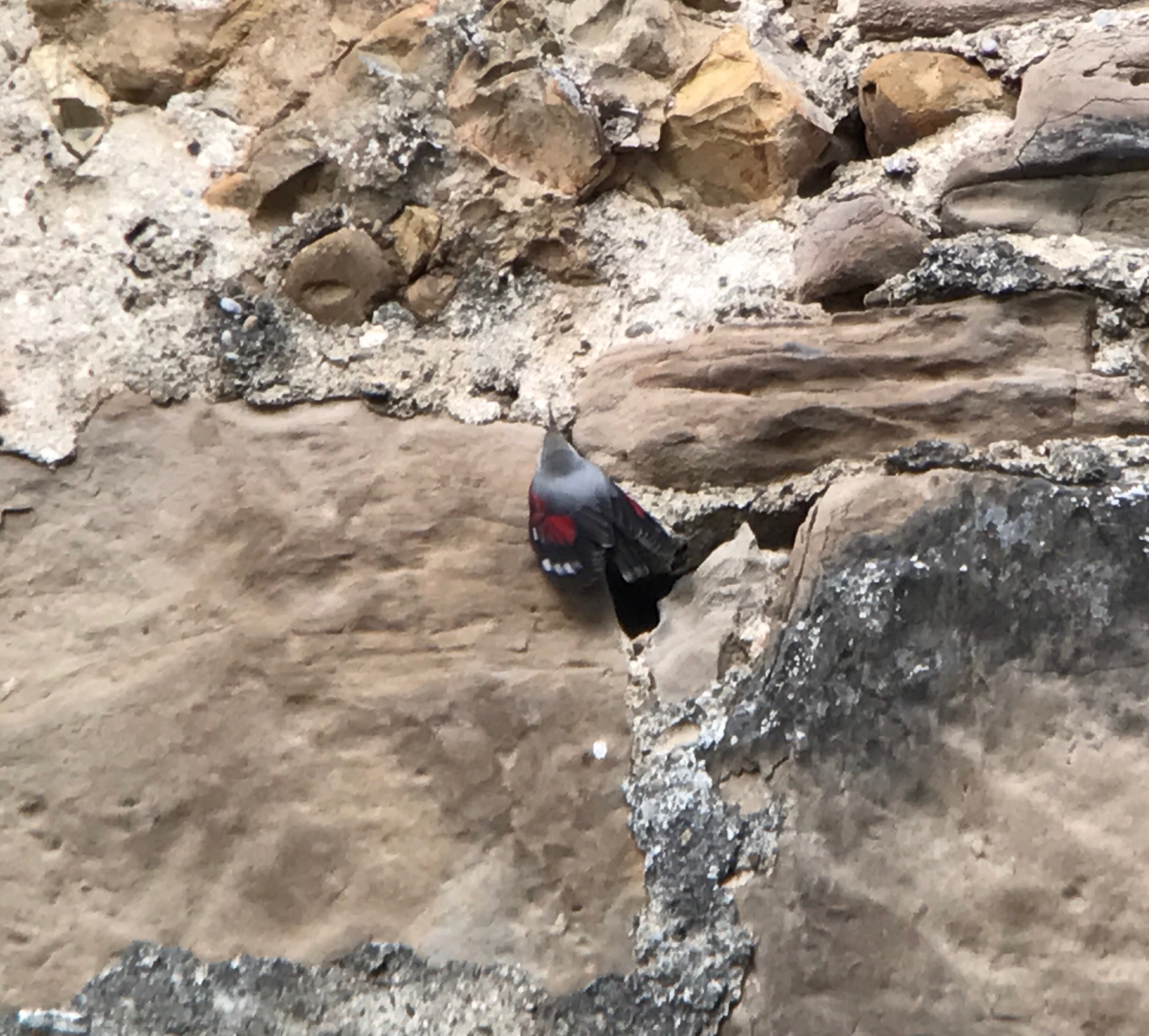
Check out those pink wings!
It’s a strange thing getting such a unique bird on a castle, especially one I’d missed several times. It’s all part of the magic of birding in Europe. The best part was that this was just the start of our birding adventure as Chris Wood from eBird came up with a mad plan to be the top eBirders in Lichtenstein.
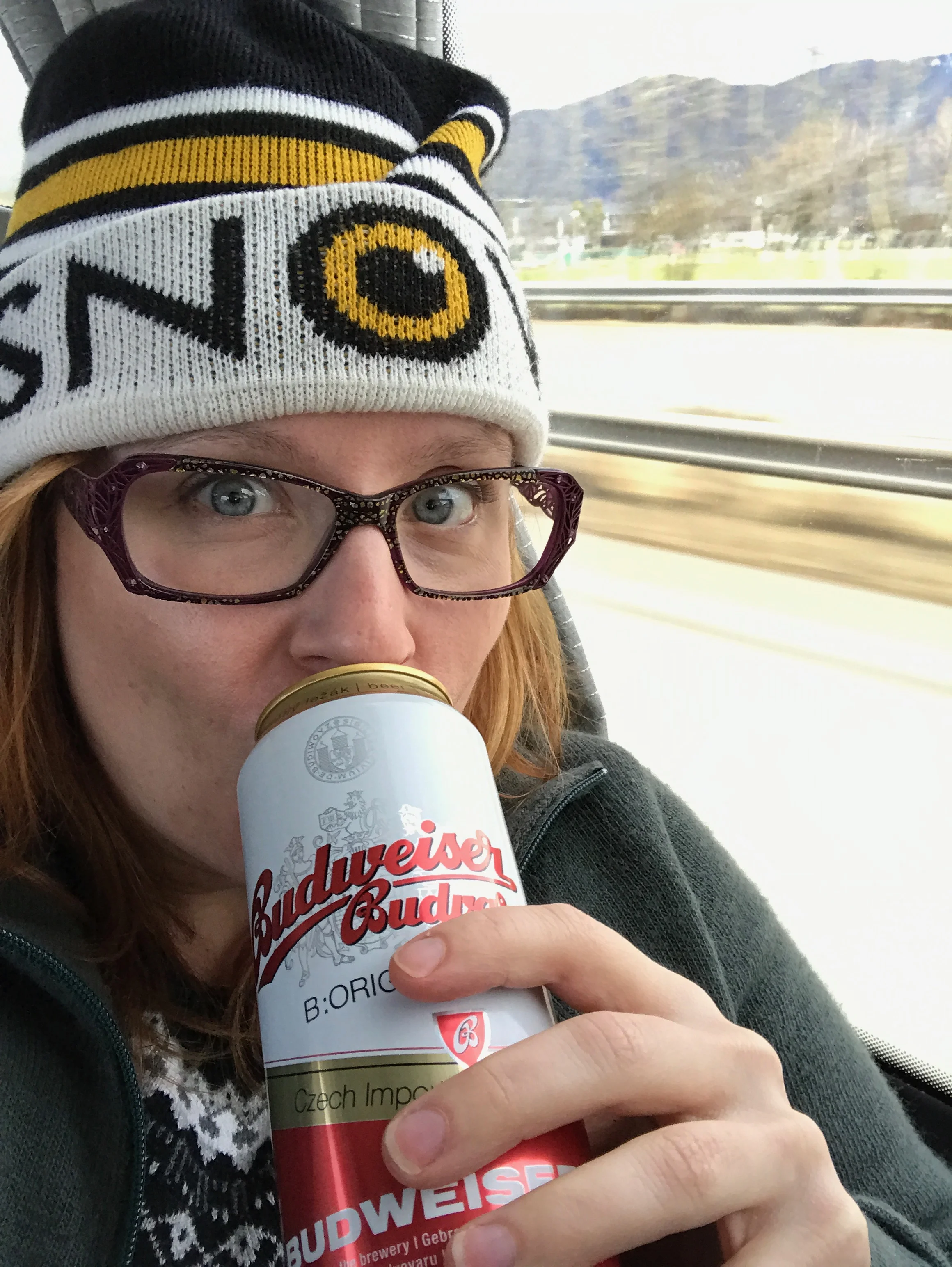
Some celebrate with lifer pie, I celebrated with lifer beer—specifically Budvar in honor of my Czech roots. Unlike Budweiser in the US, this one actually has flavor.
Birding Ethics When Abroad
There is quite a bit to debate when it comes to "ethical birding." You can practically make a drinking game out of arguments of taped calls and bird disturbances on your state's birding group every winter.
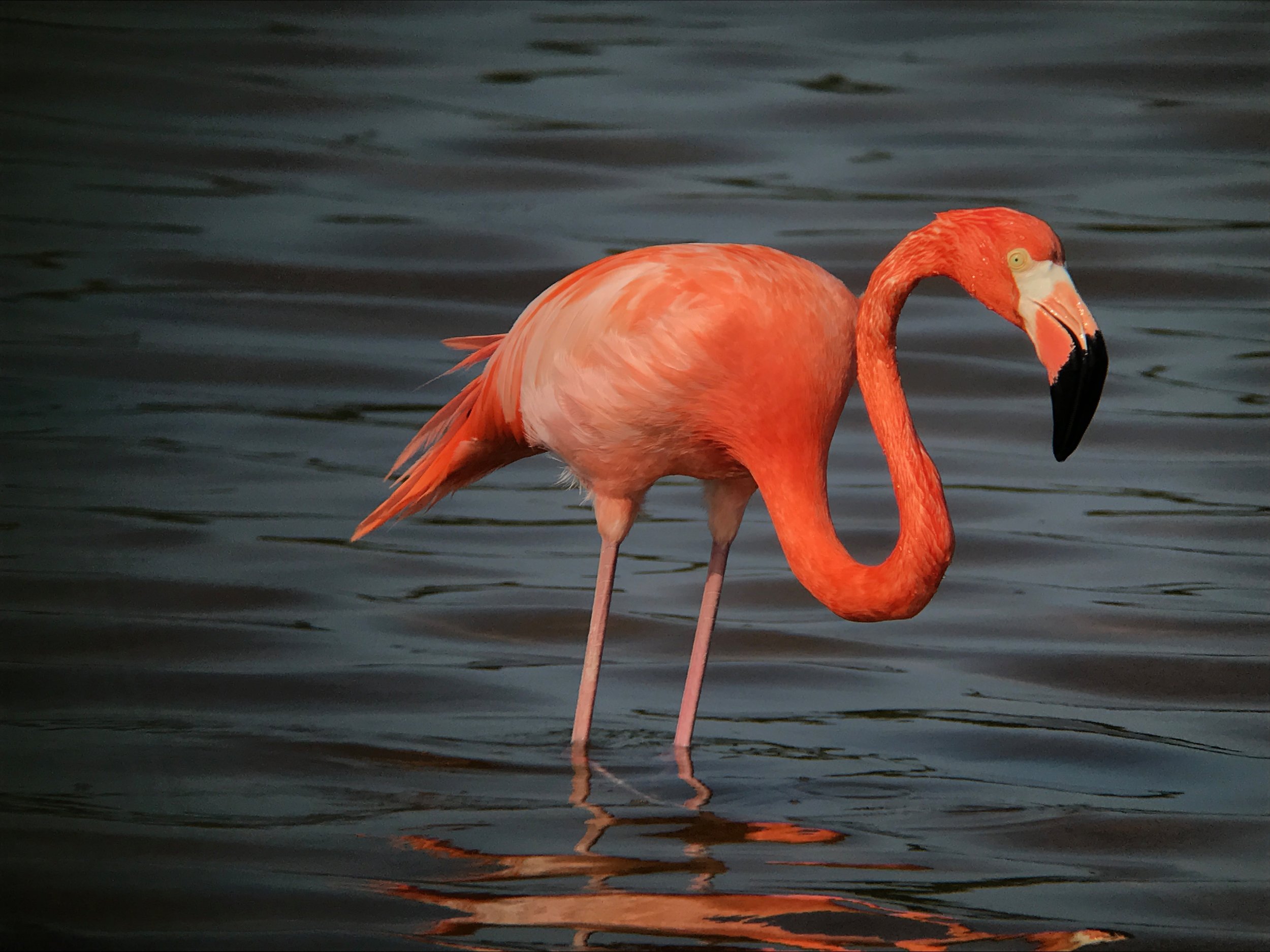
While taking pictures of feeding American Flamingos in Cayo Coco in Cuba, our guides told us they would be happy to make noise so the birds would fly off and we could get flight shots of the birds. We declined.
I've thought of this numerous times when in Central America and a guide used a taped call on a bird that they presumably take people to on a daily basis--or multiple guides visit on a daily basis.
I think there are times and places where taped calls can be effectively used. I would rather play a taped call for ten people who have never seen a yellow rail to get it to come out, rather than have ten people trample through rail habitat to see if one flushes.
There's definitely technique to using recorded bird calls. I wouldn't necessarily play a territory song for a species during fall migration. What works with one species may not work with another. A study in the late 70s/early 80s on how taped calls didn't interfere with nesting trogons can't be applied to Kirtland's warblers.
David Sibley was a wonderful and nuanced post on how to properly used taped calls for birds. Basically, go in with a plan and don't over use it.
When we were in Cuba, we had one overall guide and in every National Park we visited, we were required by the government to also use one of the park guides to take us in the park. They are paid, but they rely heavily on tips. And they have been taught that if people get the bird or the exact photo they want, they get better tips.
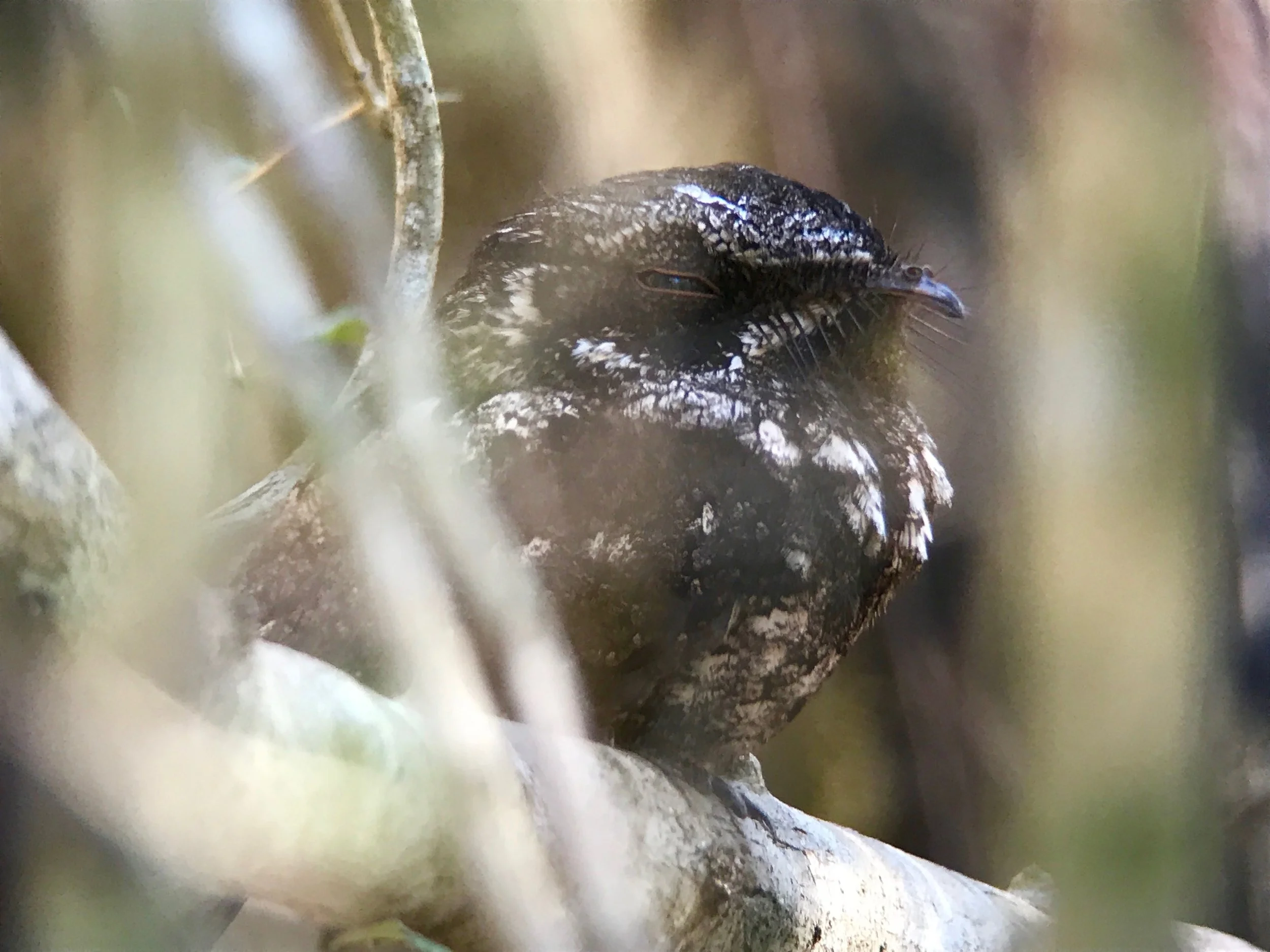
A Cuban Nightjar hidden in its roost in the woods around Soplillar. This and bare-legged owl were two big targets here.
The birding we did around the Bay of Pigs was spectacular and we explored the woods and savannas around Soplillar. One of our targets was the Cuban nightjar and our guides had one staked out, tucked away in thick vegetation. I realized when I got back to the states that I had heard one at night...they just sound more like a frog than a nightjar. We were a respectful distance away, no effort was made to clear vegetation out of the way for photos. Sure my pictures isn't going to end up in National Geographic, but I like how the branches obscure the bird, it takes me back to the moment when I saw it.
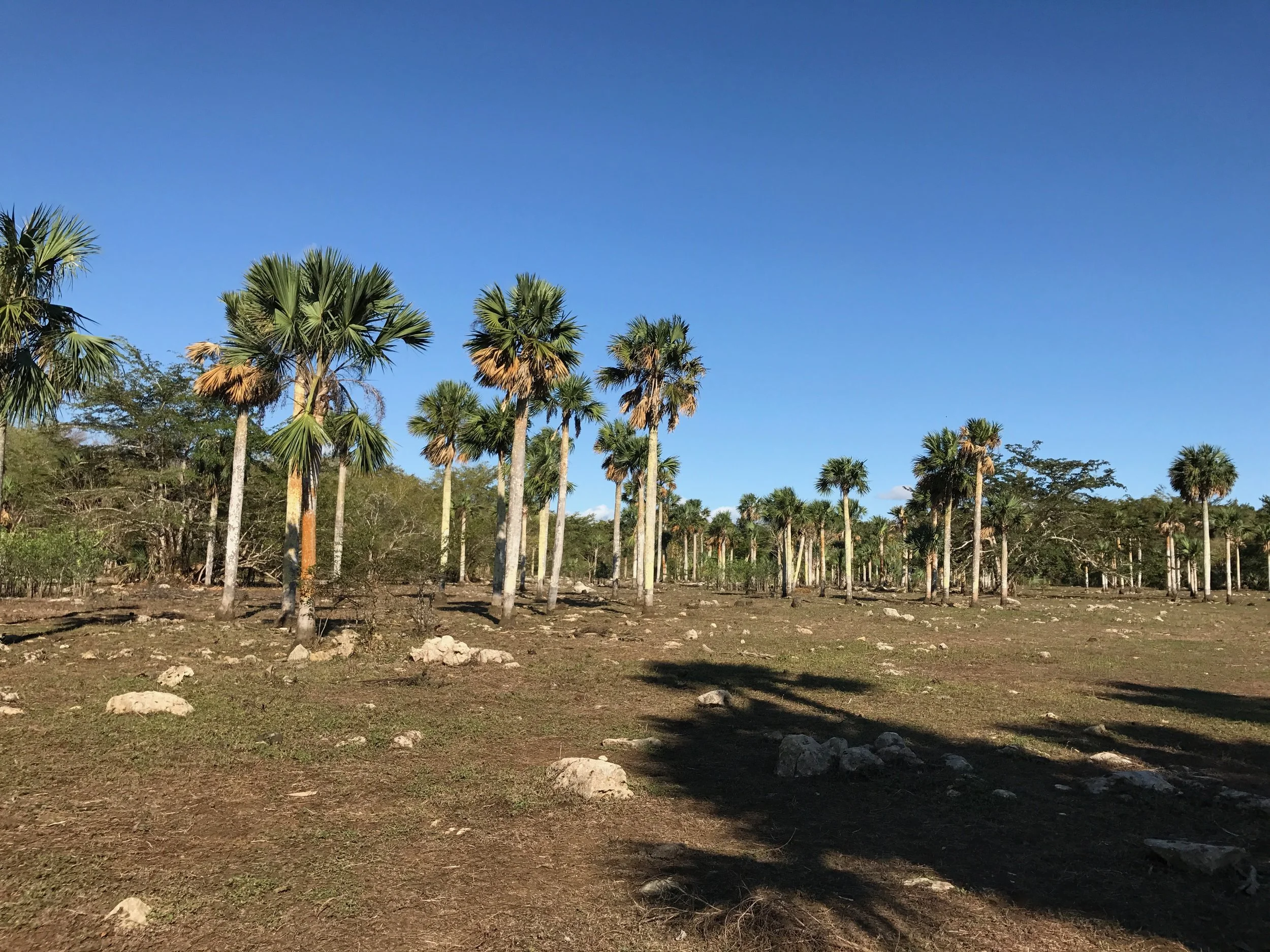
Just beyond those palms was a bare-legged owl.
The other target was a bare-legged owl. The guides knew where one was in a nesting/roosting cavity. They set us up around the deal palm tree pockmarked with woodpecker holes. They told use to aim our binoculars and cameras at a certain hole and then they would get it out. I'm familiar with a survey technique at roost/nesting cavities where you lightly tap on the trunk of a tree like a woodpecker and an irritated owl will poke its head out. I assumed that was what would happen here. I was not prepared for what happened and quickly switched to video when I realized what they were doing.
Yep, the local guide just started violently shaking the palm tree. The tree was in such decay that I was worried it would get pushed over. Sure I could have gone on a tirade, but white lady yelling at people in their own country about what they do is a role I never wish to have. I tried to offer some diplomatic advice as one professional guide to another.
"Hey," I said casually, "there's a technique that you can try where you just tap the tree lightly like a woodpecker. That might be a bit easier on the owl than shaking the tree."
The guide agreed and said that that is what he used to do and the bird stopped responding. Then they started to shake the tree a little and after awhile that stopped working. Now they have to shake very hard to get it to appear. Sigh.
I was amazed that the birds hadn't abandoned the cavity all together. Perhaps they had gotten used to some disturbance? Maybe cavities are so rare that they put up with it? The owl shared the tree with a nesting West Indian woodpecker as well. Based on the woodpecker behavior it clearly had a nest in the tree. There would be lots of noise and pecking that comes with a woodpecker nest that perhaps the owl is resigned to a life of daily disturbance?
There were times when other taped calls were used and I had to get the local guide to stop. Later in our trip we were out looking for a Key West quail-dove. When we arrived we heard a mangrove cuckoo--as species you can only get around Everglades or Biscayne National Park in the Unite States. Our guide of the day immediately started playing the call over and over and over.
I calmly suggested that maybe he should turn it off for a minute--give the actual bird a chance to assess the situation. But he continued. And this went on for several minutes. Not only was I irritated that my request was ignored, but I could tell the rest of my group was uncomfortable with the relentless playing or just downright bored when there were other things to be seen. I finally went to our main guide and said, "Tell him to stop, that bird is not going to come out. They don't call over and over like that."
Sometimes when people play a call nonstop or play it too loudly, the target bird will clam up and hide. The bird may be confused or threatened by the sound, "What is with that crazy sound, I don't sound like that, is this dangerous?" Some birds will hear a call once and clam up. Then it's up to you to wait--sometimes as much as 15 minutes and the bird will come out when it sees the coast is clear.
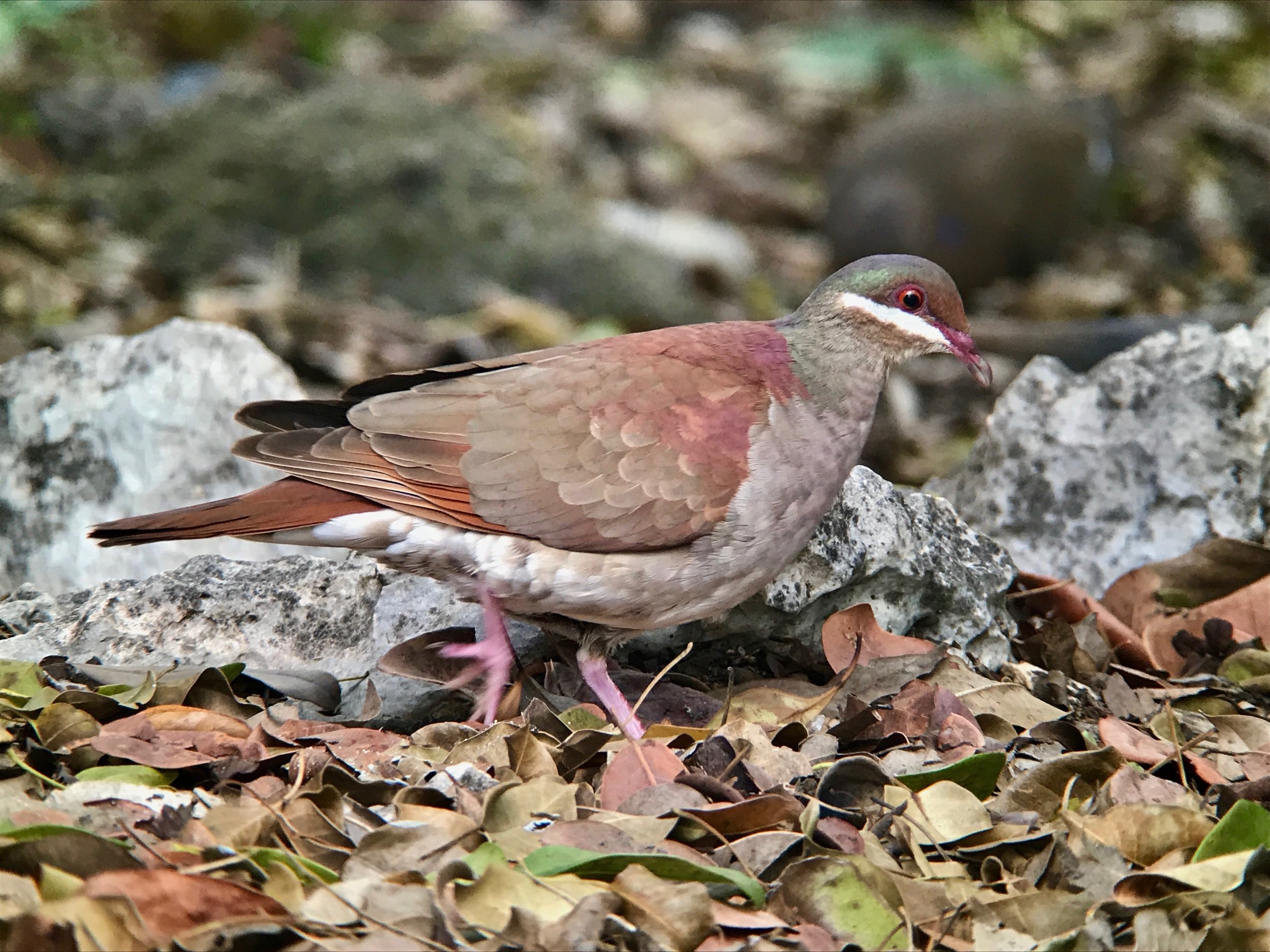
Key West quail-dove.
I suggested that we give up on the mangrove cuckoo, look at some other birds and maybe the cuckoo would come out while we focused on other things. Soon enough we found the original target of the day, the Key West quail-dove. And about ten minutes into enjoying that bird guess who popped out...
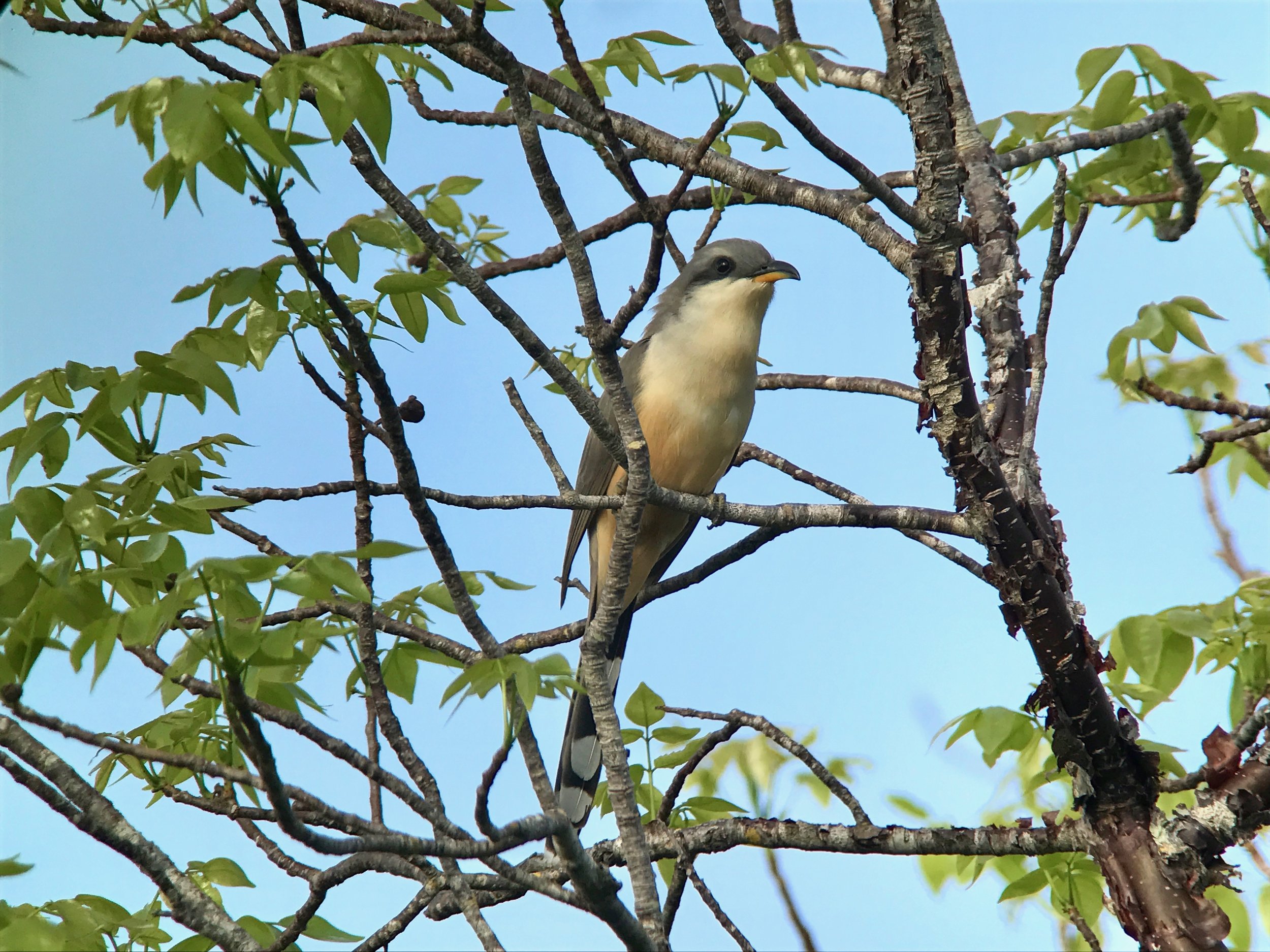
Mangrove cuckoo.
It was one of the best looks at mangrove cuckoo I've ever had. It casually fed in the tree, it preened--something birds only do when they don't feel threatened and are comfortable in their surroundings. Everyone had ample time for photos and video. The bird just needed time to get past all the calls.
I don't blame the guides. Clearly what has happened is that people have come before us and pressured the guides with their tips to get them exactly what they wanted to see or photograph. The guides depend on those tips and will do what they need to do take care of their families.
I referenced earlier that a guide offered to flush some flamingos so we could get flight shots and my group unanimously declined. We were content to watch and photograph them feeding. The birds were fairly close and comfortable with us. And they got so relaxed I got one of my favorite shots.
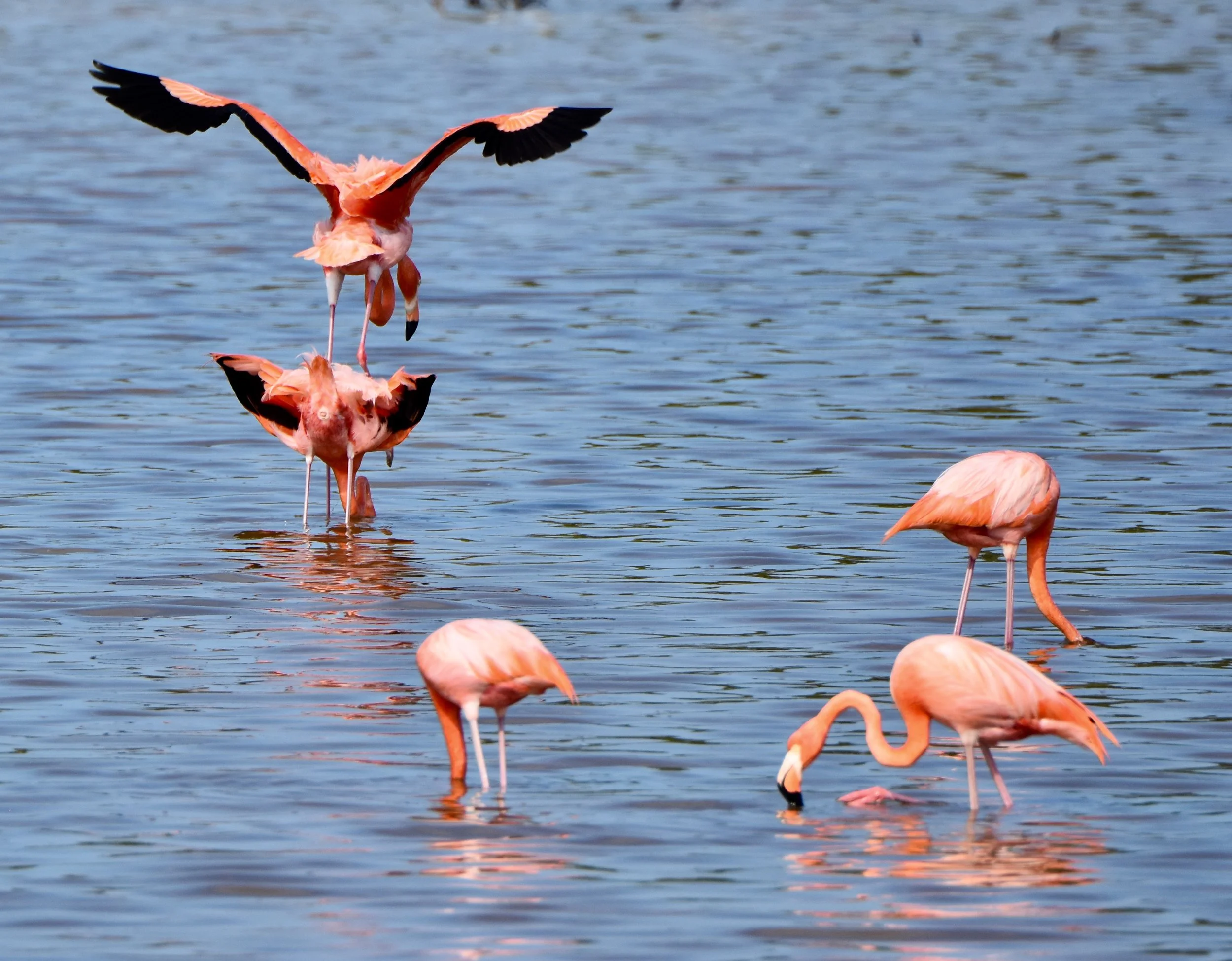
Look at that shiny flamingo cloaca!
I don't mean to pick on Cuba. Birding tourism is relatively new for them. There hasn't been the decades of birding like there has been in the US or the UK. Some of the top guides in Panama, Costa Rica and Honduras have had the chance to come to the US and get to know more about birding ethics. But I do think it's up to us to help point this out politely. If there is something you're uncomfortable with on a tour, have a conversation about it. I don't mean yelling at a guide in the middle of a field trip, no one will listen to that, especially if their being taken to task in front of a group. But when you're sitting down with them at the end of the day and having a drink, engage in a conversation about bird behavior and share how birding happens where you live. If birders/photographers before us are setting a bad precedent, it doesn't hurt to share how birding is different in other areas.
Noticing Birds
"I don't really notice birds."
This was a recent confession from a very good friend who I have known for decades. I was baffled, how can you NOT notice birds...especially after knowing me? Haven't I told them a ton of interesting factoids? OK, I may have traumatized them when they told me they thought ducks were cute and I told them about duck anatomy. But I really thought they could handle that information.
How can someone not notice birds?
When I first started this whole bird writing stuff n 2004 I was used to people saying, "You watch birds? Huh, my grandmother does that." It was always said in way that was almost an apology, "oh that thing you love is boring."
And I've taken it as my mission to say, "Screw that, birds are amazing and we're all over here having an amazing time."
Over the years as all sorts of passions have come about, it feels like we share our passions. Though I may not get why my adult friends are obsessed with going Disney World every chance they get, I appreciate that they like it. When I'm watching that friend's third trip to Disney in a year on Facebook I realize, "Oh, I bet they watch my multiple trips to go birding in Texas with the same bewilderment." How many times do I need to see a green jay? Apparently as many times as my friends need their picture taken with Donald Duck.
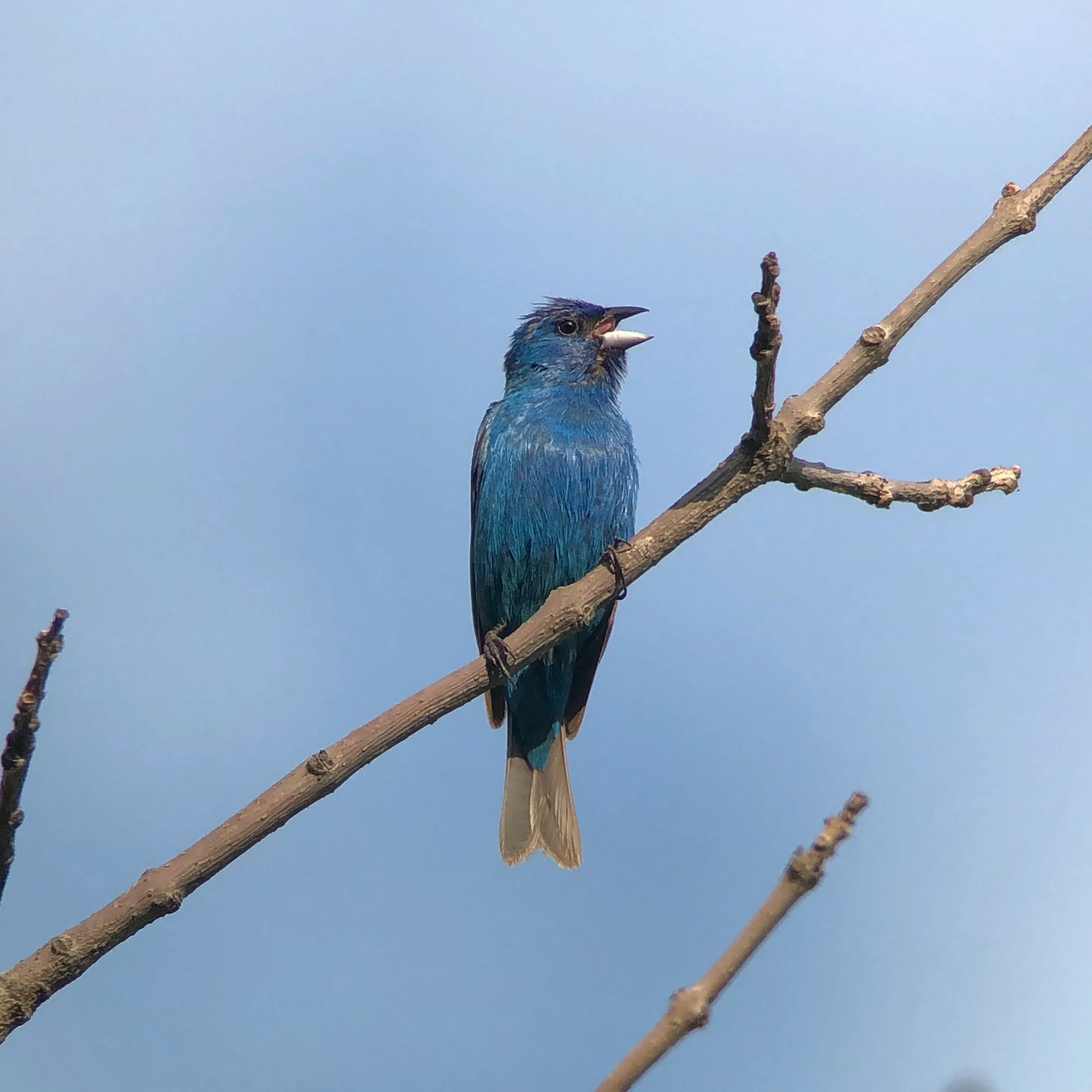
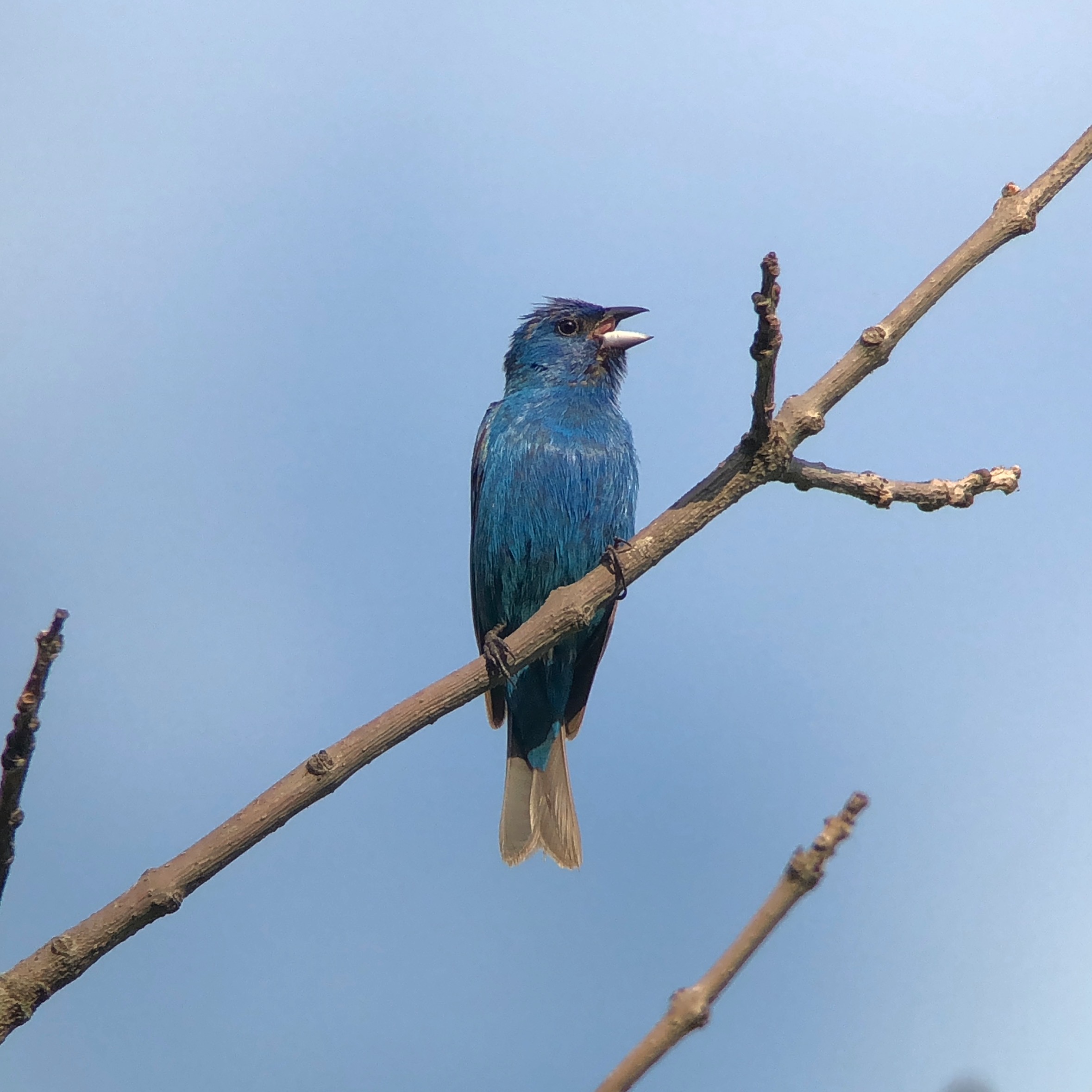
On a recent evening I was still chewing on the "not noticing birds" conversation as I was participating in an Insect Safari as part of my job. Though the focus was insects, there were several birds around and I was watching them. One was a very obliging indigo bunting. I set my scope on it in case anyone wanted to take a peak as they paused in their insect hunt. One man put his eye up to my scope and was shocked. He insisted his wife and kids take a look too. As they did he said to me, "I gotta tell you, I never got birding, it just seems so boring. But that bird, that I can see why you do this."
Not long after my phone buzzed with a text alert. It was my friend who was driving around and found a turkey in the road. They sent a photo.
"You noticed a bird."
"Yes," the replied.
I'll take my victories where I can.
The "Famously" Inconspicuous Henslow's Sparrow
I've really been taking the "Year of the Bird" to heart. This year I decided to carve out some birding just for myself on top of the classes and events I host. It's been one of the best springs (of course, I say that every spring when there are great birds). This week has just been spectacular.
I got my whole birding by ear class on this amazing Henslow's sparrow.
I wasn't going to post this part, but I feel like I should for the sake of new bird guides everywhere...sometimes bird guides make mistakes. Accept it, take responsibility for it, do your best to make it right, learn from it, but most importantly: get over it. In the last two years I have been experimenting leading birding by ear classes and field trips. From a guiding perspective these are great: I'm not guaranteeing that we will see birds, but we will hear them--which is the case for a great many species! We usually see the birds on these outings, but I find this hits the sweet spot of under promise and over deliver.
I was loading my stuff into the car for my 8am birding by ear class. I was going to arrive at 7:30am so I was a half an hour early. As I loaded my car I got a text, "How close are you, everyone is checked in for the class."
"Wow," I thought, "that's great people are so early...oh wait..."
This was my brain:
Yep. I got the times for my class confused. I wasn't set to be early, I was set to be late. I think I need this to happen to me about once every eight years to keep me humble. I arrived and apologized for wasting people's time and promised amazing birds and a binocular cleaning if they needed it.
However the group was forgiving and the weather was wonderful. The birds were incredibly obliging as we heard scarlet tanagers and recently fledged chickadees all around us. Someone even got great looks at their lifer common yellowthroat. When I do these sorts of classes, my brain is constantly listening for what's the next sound to talk about. I try to stick birds singing nearby and ones that I think people remember or have a chance to hear in your neighborhood.
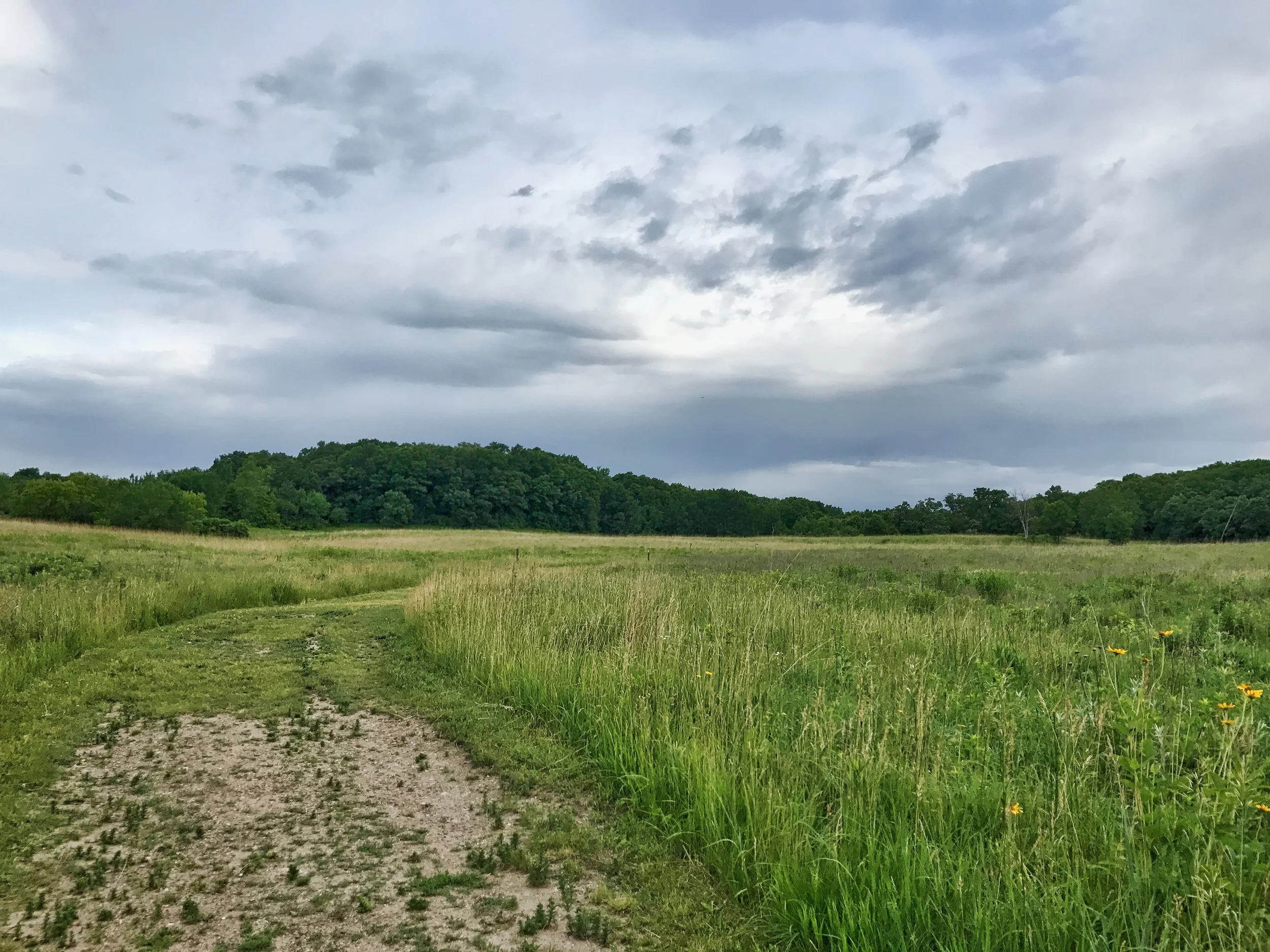
Prairie area around Richardson Nature Center.
Sometimes I can hear a "good bird" but if I know it's a long shot to get the group on it, I'll "pick my battles" and ignore it. If there is an easy to view redstart nest ten feet away and a black-throated green warbler singing very far away, I'll focus the group on the restart. I do sometimes ask the group what they want. I was doing a digiscoping workshop and as the group was practicing on a ring-billed gull, I heard a Le Conte's sparrow on territory. I announced, "Hey, gang, I should tell you, there's a really great sparrow singing behind me. They're really hard to see, super lurky in the grass and we will have to work for it, but if you'd rather do that than take pictures of a gull we can."
They looked at me like I offered them broccoli ice cream and so we ignored the Le Conte's. I, however, went back later and photographed the crap out of it.
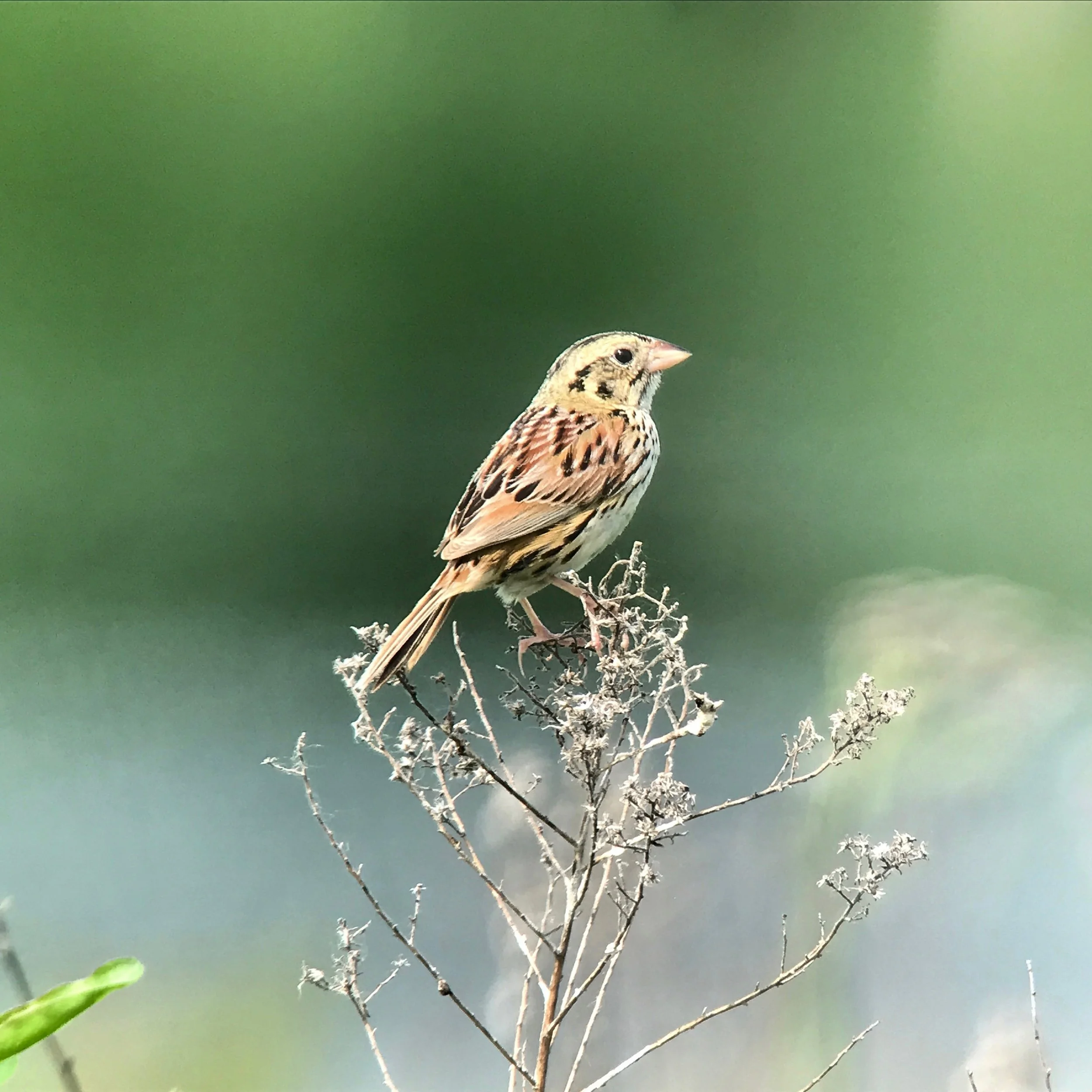
As we walked along I suddenly heard a faint and familiar sparrow sound. It was a Henslow's sparrow, a state-threatened species in Minnesota. Their call is not easy to discern if you aren't familiar with it. In fact, I always notice it because it's so...so...blah. It's kind of like a half-assed house sparrow call. All About Birds notes that these birds are "famously inconspicuous."
I had the group listen and get familiar with the call. I offered to play a taped call once to see if we could get it to pop up, but I warned that they don't always respond to it. Sometimes Henslow's perch just below the grass and you can't see them. The group was curious and we tried it. The bird never popped up. But we got to hear it very well. We continued our way around the prairie and heard a second one singing. I'd never had a Henslow's at Richardson Nature Center, so to get two singing birds was amazing. This time we were able to spot the bird, I got in the scope and it did exactly what I said it would do, perch just below the tops of the grasses. Our binocular and scope views of the bird were obscured by vegetation but people got to see a really great sparrow for Minnesota.
We continued our way around the prairie, got some great looks at bluebirds and indigo buntings when we heard a third Henslow's sparrow. This one was really loud and sounded like it right in front of us. Sure enough someone in my group found it and it was 10 feet in front of us, teed up nicely on some vegetation above the grass.

Everyone got a look and I was able to take photos of the bird for people with their phones through my scope and of course get the video that you see at the top of this post.
I also cleaned a few binoculars as penance for being late.
Reporting Owls

Snowy owl pellets have been documented to contain parts of herring gulls, double-crested cormorants, great blue herons, peregrine falcons, barred owls, mink and house cat...they are badasses who can deal with some of the toughest predators out there. They also can nest on the ground where wolves and polar bears are present.
There was an interesting article about the politics of posting owl locations recently. Each winter I find myself more irritated when large numbers of owls show up and people go bonkers on the Internet arguing about whether or not the locations should be posted, if people are getting too close and whether or not they should be baited. When it comes to snowy owls, I figure this is a bird that nests on the ground and can live where there are polar bears, foxes and wolves. It's learned to live with bigger threats than a photographer. Also I shake my fist and wish all the snowy owls would just go back home.
And my attitude is a shame because...owls are cool. When you get started in birding, finding your first owl is a triumph of the human spirit! And with some practice you can find them more often than not.
One of the things that I love about where I live now is my birding patch. We have a wetland that is an easy 2 mile loop from my back door. I've eBirded the spot so much that it's now a hot spot. It's not the most exciting spot in winter, but I'm always hopeful that one winter I will get a northern saw-whet owl back there and I always watch for them. Last winter when we were having a balmy February, I biked past some cedars and saw the telltale small owl sign: copious amounts of owl poop and pellets.

Owl pellets and poop. Owl pellets are distinctive by having lots of bones in them unlike hawk pellets.
I pulled to a stop and carefully looked over the pellets under the pine tree. I could see some sporadic poop under the cedars but the most accumulation appeared to be under a nearby pine. I tried looking up high in the pine for more poop or even an owl but didn't see anything. Not seeing an owl I thought I would go in and collect the pellets. As I hunched over to avoid bumping into the lowest branches...BAM... perched in an old robin's nest on the lowest branch was an eastern screech-owl. The bird had stretched upward, looking quite skinny and branch-like. I know this is a defense and camouflage posture but the owl's faced almost looked accusatory, "How DARE you come in here!!"
Before I could help myself I said, "Oops, sorry," and hightailed out of there, feeling bad I disturbed it. The owl didn't fly away and I was grateful for that.
I biked by the next day and could make out it's shape in the thick tangles of the branches. This went along for a few more days and I decided to take Non Birding Bill with me and try and get a photo. There was no easy way to get a picture, the bird seemed to have found the perfect spot to communicate, "I don't care to be observed."

Don't worry, this was taken through the scope with my iPhone, I wasn't holding my phone up to the owl's face.
I found the one hole among the branches where you could make out the face of the owl about twenty feet away...where trucks typically park to unload packages for the local businesses. The bird stared at me the entire time I was there (about three minutes). Since the owl didn't seem to relax around me, I kept it brief with a documentation shot.
The next day I biked past and didn't see the screech shape on the usual low branch. I looked around some more and noticed that the bird moved to one of the cedars and was much higher up in the tree. Noted, screech, you don't like the paparazzi, I will leave you alone and keep your location on the down low.

Shrew skull found in one of the screech-owl pellets in my patch.
As winter transitioned to the breeding season, the owl disappeared. Late in summer I found a screech in a mulberry bush right over the trail. I was excited that my neighbor was still around and then realized that the tufts on the bird were downy--screech-owl offspring!
Later in the fall while biking I saw the telltale poop in the pine with the cedars and sure enough, there was the low-roosting screech. I took a moment to welcome it back and noted that once again it chose the roost that was surrounded by the most branches.
All of this bird's behavior has made me reluctant to tell anyone about the screech location. I was reluctant to even enter it in eBird. When screeches have been reported near me, they can attract a lot of photographers. Some don't seem to mind: roosting next to busy tennis courts or streets, but this bird keeps choosing impossible to photograph perches and on the days I bring a scope or a friend, it chooses a much higher roost the next day makes me think that it is not in the mood for disturbance.
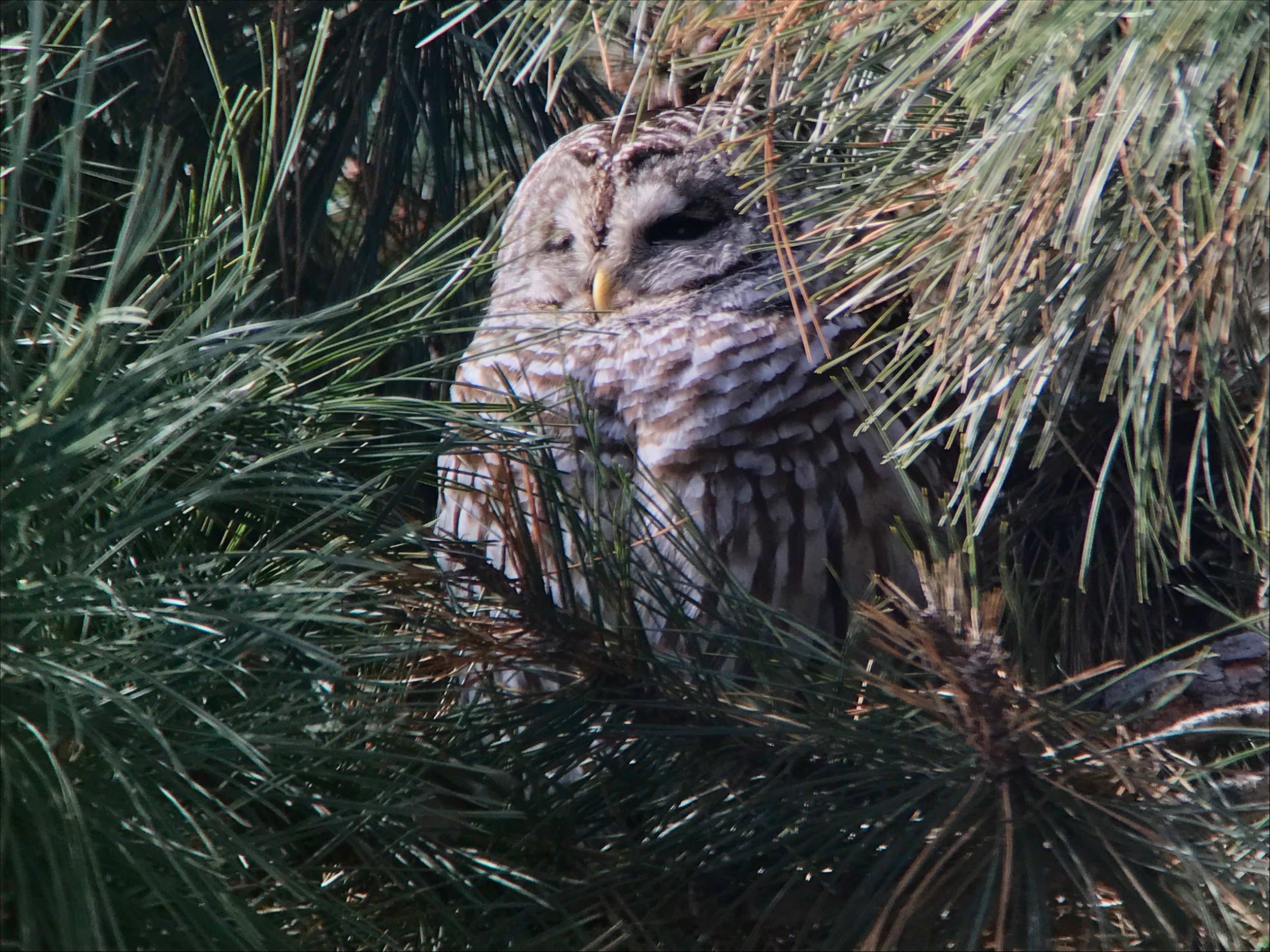
But then there's my neighborhood barred owl. This bird is a bit more...chill. I first noticed it late last summer. NBB has taken to showing movies on our sun roof at night when the weather is warm enough. One night two barred owls flew right over the roof above our heads while we were watching Airplane. Later in the fall I was walking home from the patch and a barred owl was trying to take a grey squirrel off the trunk of a tree. And in early January, I was walking home from the grocery store on the bike trail behind our home and a barred owl flew out of the trees and cruised along the trail towards me. I was excited that it was going to pass by me until the split second I saw the talons start to lower and realized it was going for my grocery bag. I shouted and it veered off to my left. Nothing like an owl about to fly into you to get your adrenaline pumping.

Signs that an owl has been roosting.
I'd been trying to suss out where the barred owl has been roosting and I found some pine trees near some railroad tracks that gave me a clue. I found an accumulation of chalky-textured poop and old pellets. It wasn't in any of the places where I'd seen the screech-owl and it matched up to all the places where I've seen hunting, including the time it tried to kill my grocery bag. The interesting thing is that the roost was right over a social trail people had made in order to get access to the bike trail. I made a mental note of the spot and decided to include it on my walks. And sure enough on a single digit temperature day, I found it in the roost.
The owl took note of me and then went about roosting in the sun. There was a fat tire bike rider slowly moving along the bike trail behind me. They started coughing and that got the owl's attention. The situation reminded me of a quote I saw last year from Andrew Baksh about viewing and photographing owls: "I have had some lucky encounters and in each case the Owls were chill, I was chill."
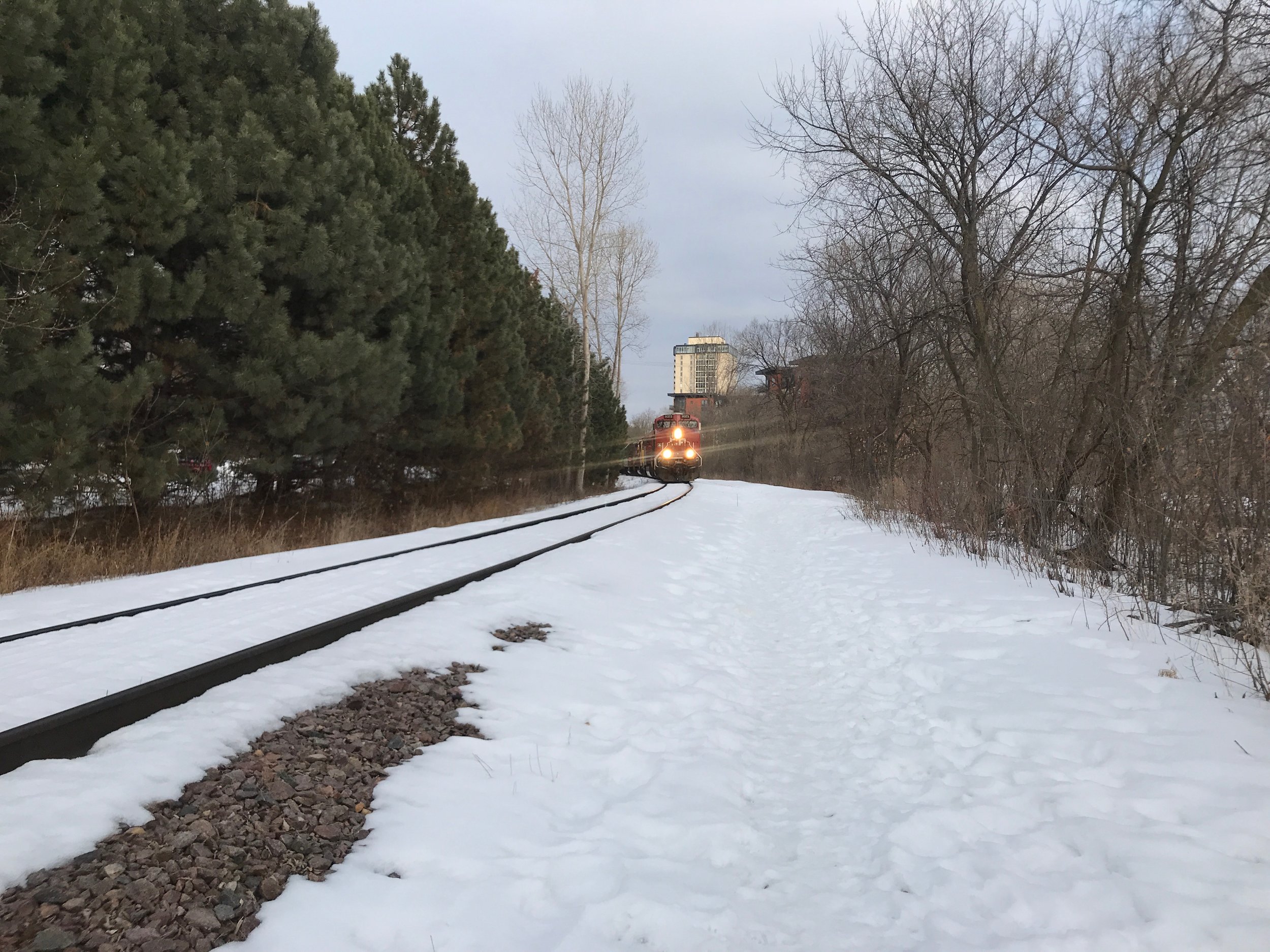
This owl is very different from my neighborhood screech, it is quite chill. It hunts along a heavily used trail, it roosts over places people walk with their dogs and it doesn't seem to mind the occasional train.

Part of a gray squirrel skull found in a barred owl pellet.
So for me, when it comes to reporting owls I'll take it on a case by case basis. Some can handle people and some can't.

Birds In Cages

Home cooked meal in Honduras.
One of the risks of traveling for birding is that sometimes you are going to see birds in cages and it's going to gut you. One of the most brutal examples for me was in Honduras. We had spent the morning in arid and remote habitat looking for the Honduran emerald, a hummingbird only found in Honduras. We saw several other species, but the day was hot and we couldn't get enough water. Because we were far from out lodge and all the villages nearby were small, arrangements had been made to have lunch at a local rancher's house. His wife prepared us a hard meal of chicken, salad, rice, beans and freshly squeezed juice. Her home was lovely and we ate indoors, while her kitchen was outdoors.
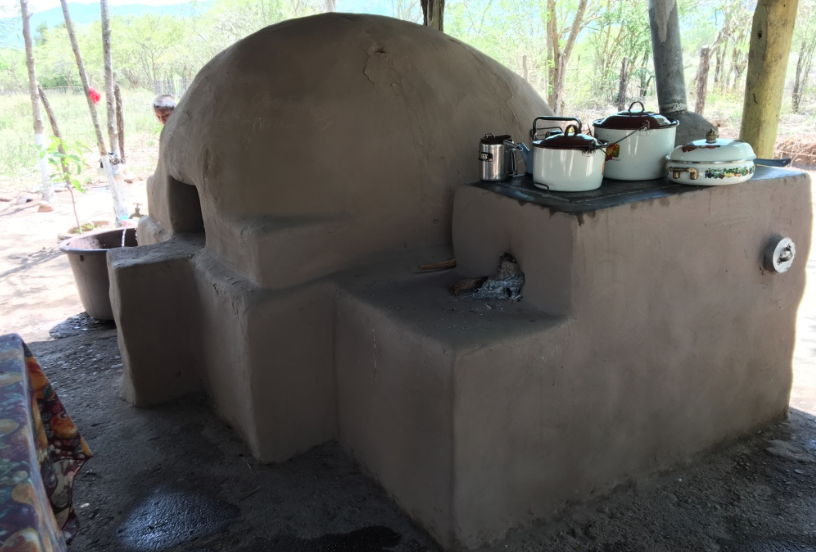
Outdoor kitchen in Honduras.
Afterwards we were allowed to wander the yard, take pictures of her kitchen or nap in her many hammocks. I grabbed a few photos of her stove and then settled in a hammock. I had a vague awareness of her animals around the property, most notably chickens but then I noticed a bird cage leaning against a tree with three white-fronted amazons inside. I tried to will myself to not pay them further attention and to let myself fall into a nap. Then I overheard two women from my group discussing the birds. "Oh, look at that! Mom, dad and a baby!" My brain snapped awake.
"They're not babies," I called over and the women looked confused. I walked to the cage and noted the overturned water dish, the empty food dish and complete and utter lack of toys for the birds to chew. I noted the bark of the tree that the cage leaned against was covered in chew marks. And I noted two birds hunkered together while a third--the odd man out had chewed most of his body feathers away. "That's not a baby, that is a bird bored with it's captivity that is chewing it's feathers because it has nothing to do."

White-fronted amazons in a cage. One is plucking its feathers.
I could feel rage and frustration coming over me...followed by the inevitable welling of tears. We'd seen these parrots throughout our trip living in the wild. There's nothing like seeing the parrot brain and beak navigate in the wild. They're so smart at figuring out how to crack open hard nuts for finding food and establishing long term pair bonds. After seeing them in the wild that morning and now to see three bored in a cage was gut wrenching. I noted the chickens freely roaming the yard--soon to be food. The food chickens had a better life than the three birds living in bored torture that were kept out of love.
I walked around the yard trying to force the emotion back. This was a birding tour, not my time to be some white lady telling a woman trying to get by in Honduras on how to raise her pets. But I also thought of the bird I had at home and how miserable he'd be in cage with nothing to chew and no water on a miserably hot day.
I went back into the home and grabbed a napkin from my lunch to try and hide what I'd been thinking. I decided to force myself back to the cage and confront the situation. I wanted to look the plucked bird in the eye and just acknowledge that I see the life it's living and I know that it sucks. As I looked at the plucked bird, it walked over to where my hands were and its beak reached through the bars toward my hand holding my slightly damp napkin...it wanted to chew it.
My Spanish is terrible so I asked my local guid to ask the woman if she'd mind if I gave her bird a napkin to chew. She nodded it was ok. I brought it forward and the bird greedily snatched the napkin away and started tearing it apart. Its cage mates came down to explore as well.
I asked my guide to translate for me. "This bird needs a job. This bird sees how hard you and your family works and it wants to work too. Because it has nothing to work on, he gets bored and plucks his feathers. If you give him some rope or coconut husk to chew on, it might stop chewing its feathers and be beautiful again."
She seemed to consider the suggestion, but I have no idea of it worked and left embarrassed that I'd gotten emotional in front of the group. I especially don't enjoy being the person visiting and learning about another country and telling people how to live their lives. I've built a thick skin when it comes to nature. Life in the wild is brutal. Most animals don't die quiet deaths in their sleep, they're eaten alive, they can live for days starving after receiving a crippling injury, babies are plucked from their nests...it's horrifying. When I see animals in awful domestic situations I try to remind myself that life may not be much better for them in the wild. But a parrot that can live for decades sitting bored in a cage...that torture seems far too long.
And this doesn't only happen to parrots. It happens to birds we can see in our backyards..

An indigo bunting for sale outside of my hotel in Havana. One of many seen on my trip to Cuba last year.
Our first day walking around Old Havana, I heard an indigo bunting singing. It didn't seem to be the right habitat but maybe it was a bird caught in the city during migration. We looked for the source of the song and found a balcony covered in bird cages full of illegal birds: Cuban bullfinch, indigo buntings and painted buntings. We would end up seeing wild birds illegally kept in cages every day. The most common was the painted bunting. To learn more about the bunting trade in Cuba, read this fascinating article the bunting black market.
Part of our trip included a visit to a tobacco farm. As the farmer explained his process for trying leaves, a painted bunting new to captivity frantically flitting around the cage looking for an escape. We also passed a mocking bird which sat with its foot tucked, a relaxed posture. It had seemed to accept its place in a cage. The farm was huge and there were several other buntings in cages.

A caged mocking bird and caged painted bunting on a tobacco farm in Cuba.
I took our cultural guide aside and said, "Look, if you are going to bring birders here, you should maybe tell the farmer to at least hide his illegal birds."
She looked surprised and I explained that even in Cuba, buntings were not allowed as pets. I also explained that while our group was chill, some birding groups would raise a big fuss and get angry at seeing that. Our guide marched right up to the farmer and started yelling at him. He smiled, answered her and walked away.
"What did you tell him," I asked.
"I told him that birds do not belong in cages and he needs to let them go," she said angrily.
"What did he answer," I asked.
"He said how can he see them otherwise," she replied.

Painted bunting.
Indeed, how could he? The concept of watching birds in the wild as well owning binoculars and spotting scopes is not a thing in Cuba--yet. And when the painted bunting are there, they are secretive, hidden in grasses feeding. Not the flashy bird on a perch singing his beautiful song.
That night at the bar we were having drinks with our ornithologist guide Hiram. We were discussing all the illegal birds and in cages. I mentioned how it was clear from the bunting's frantic hopping in the cage that it was a recent capture, but the mockingbird had clearly accepted its captivity. It seemed very relaxed and even at one point tucked its foot--something birds do when completely relaxed.

The Cuban trogon cannot be caged.
Hiram said that it's custom to take mockingbirds from the nest when they are young and then teach them the Cuban anthem making them a beloved bird. The Cuban people love their birds. They want them nearby and singing all the time. Hiram also mentioned that people have tried caging the Cuban trogon and it dies in captivity...which is why it's so beloved and a national symbol. Like the Cuban people it cannot be contained. It prefers death to life in captivity.
These are not problems I can fix. People love birds. Sometimes that translates into living conditions that aren't the best for the birds. This is not a problem that can be fixed today, next week or even next year. Maybe over time with some education this might be minimized. But for the current time many of the bird species we know face odds and dangers we can't imagine.
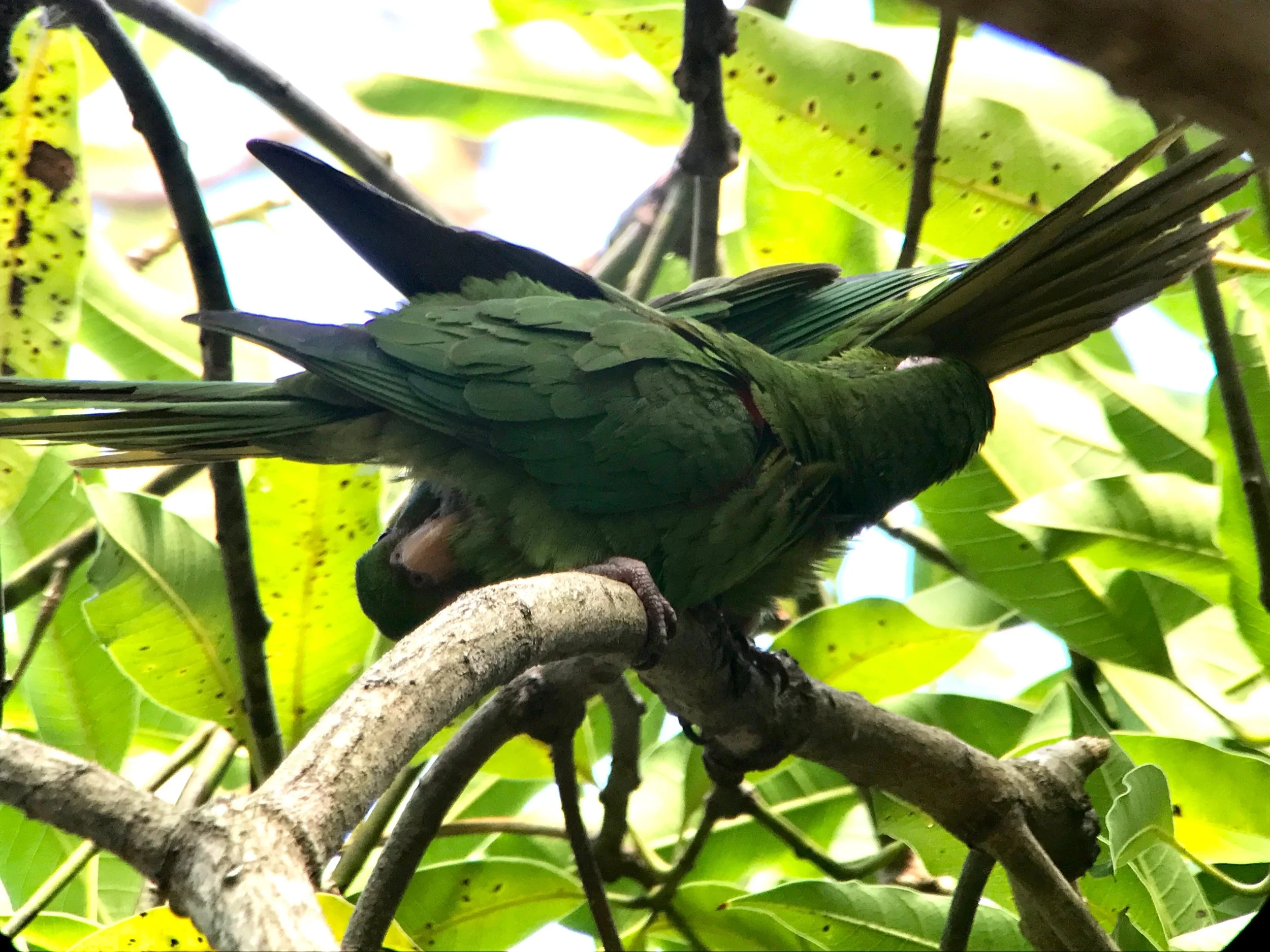
Cuban Parakeets Go Full 69

Cuban parakeet in Playa Larga.
I've said it before and I'll say it again and again, there is nothing like seeing parrots and parakeets live and function in the wild--especially if you have ever been crazy enough to share your life with one in your home. Their bright colors, incredible brain and ability to mimic often overcomes our good sense to not have one in your home because of their destructive tendencies and incredibly loud, screechy calls. But seeing that all come together as a means to find food and shelter in their environment is such a beautiful thing, especially when we see recognizable human behaviors.

Allopreening parakeets.
So it was quite the treat when our guide got us on a flock of Cuban parakeets in the general neighborhood of our hotel. It was getting close to noon and the light wasn't great. Our group struggled to get the birds in the dappled canopy. I gave up on getting a "magic shot" and thought I'd just find a bird or two and get some bird behavior shots and video...and boy howdy did I. The above pair started by sitting side by side and preening their own feathers. Then as pairs frequently do, they started allopreening or grooming each other's feathers. This can be a way to woo a new partner and once your partnership is solidified, it's a way to reinforce the pair bond...then things got weird. The birds soon went from, "Here, let me nibble that hard to reach part of your face..." to "let's get busy."

Yep. That is indeed what it looks like. And it went on for several minutes.
Then one bird flipped around on the perch (I refer to that one as Bird A) and started preening the vent and cloaca area of Bird B. The other bird followed suit. This went on for several minutes. Having the brain of a 15 year old, I was delighted by this turn of events. They kept macking on those areas for so long, this was no longer about, "Let me just clean up the feathers in this area for you" but more like, "Wow, this feels great, don't stop, for the love of all things holy, YES!"
There's something about psittacines (parrot order) that really appears to have a thing for sexual pleasure, beyond just the cloacal kiss for mating you see in most wild birds. When our cockatiel was alive, masturbation was an important daily ritual...and he would take his own sweet time about rubbing his cloaca on his chosen item all while huffing and puffing and squeaking. I especially found it amusing when his favorite area was next to a mirror and he clearly watched himself at the same time. Was it another bird in his mind, or was he watching himself? Who knows, but he had a great time.
After several minutes of 69ing each other, Bird B had enough and tried to go back to preening other areas of Bird A. However, Bird A was having none of it and kept thrusting it's cloaca in Bird B's face.

"Pardon me, I'm not done."
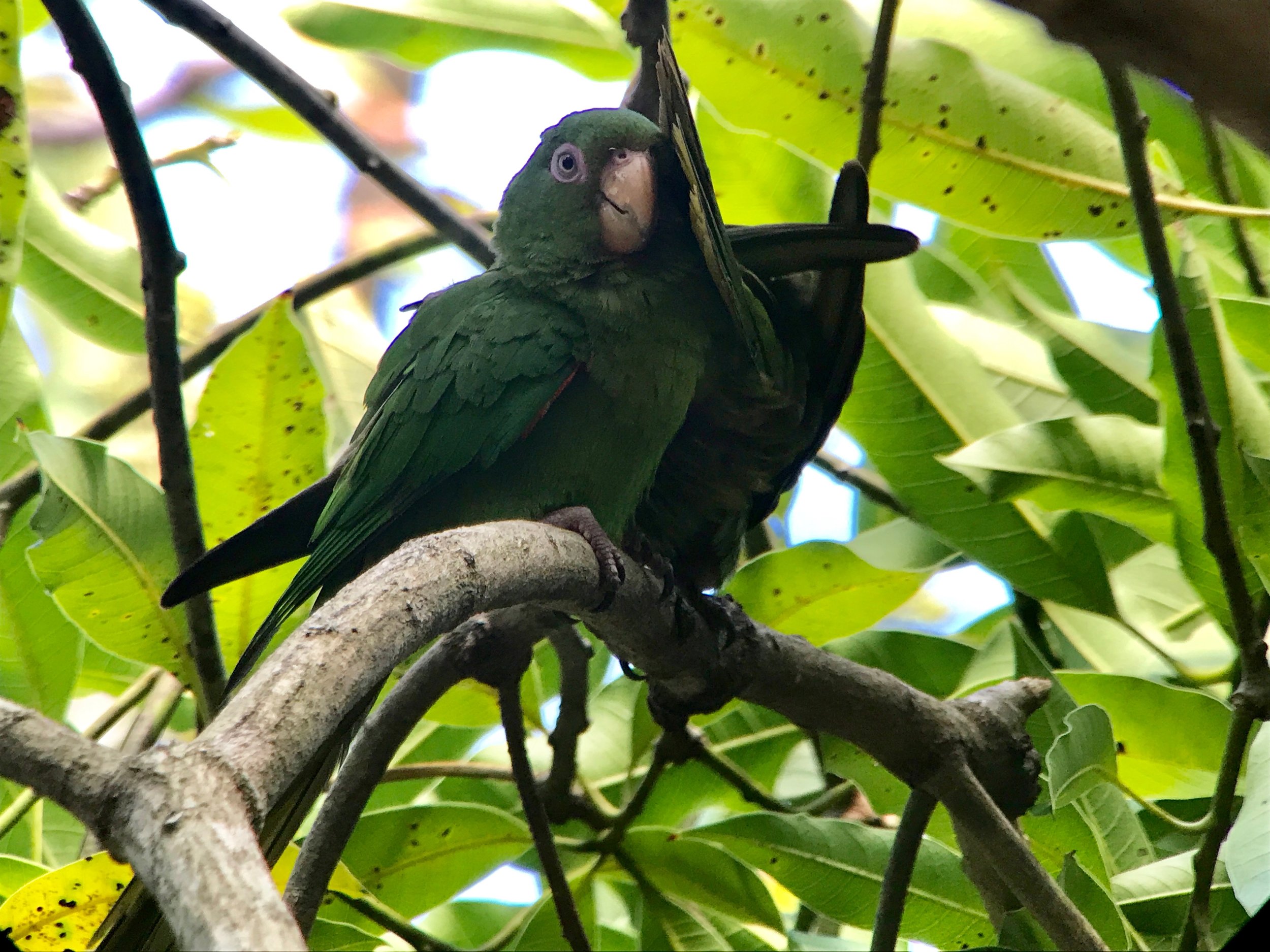
"No seriously. You need to get in there and finish that."
And they went back to it for another five minutes and then Bird B clearly had enough and flew off to another perch to forage in the trees.
Birds, man. Always keeping things in the field interesting. Here's some video of the allopreening...and beyond.
Birding In Troubled Times
I'm not racist.
I never imagined I would need to make a statement like that, but when the leader of your country says words and supports groups that blatantly are, I feel I need to make sure people know this. Especially the many friends I’ve made all over the world.

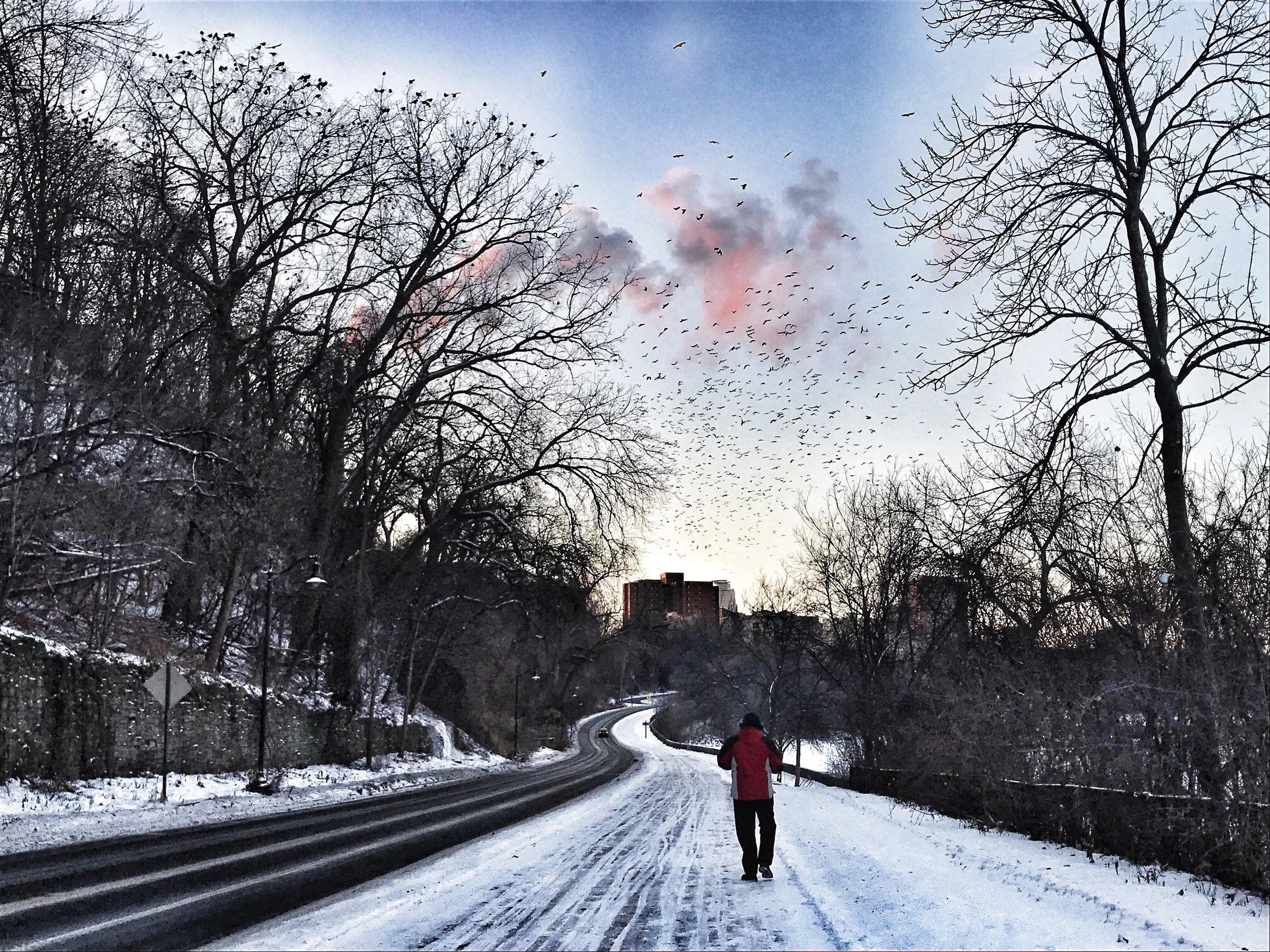
The chestnut-sided warbler migrates to the United States to raise their chicks, then heads to "shithole" countries like Haiti and El Salvador every year.
I hesitated to put this up because I was worried about starting a political argument in the blog, something I try to avoid. And then I thought…since when is stating clearly that you believe in equality for all people a political statement?
Countries, like people are complex AF. They can show unknown beauty, teach you things that cannot be learned in a book or classroom, they can bring you unimaginable joy and they can make you irrationally angry. They can also break your heart.

I’ve been in countries that I’m sure the current President of the United States would term “shitholes.” Though I have not been to the countries he specifically stated were "shitholes" many of the countries I've been to share some particular characteristics with his list: people of color and for some, extremely poor living conditions. I generally like to keep things neutral in the blog because I want to focus on birds and wildlife and I think no matter how much we disagree with each other politically, we can find commonality in nature. In the past when I see things I struggle with while out birding, I tend to leave that as a story I only tell friends over dinners and drinks. I think I need to stop that.

For example, Honduras was one of the most beautiful countries I’ve ever been too. I loved the people I met, the terrain was breathtaking (literally and metaphorically) and the birds were outstanding. However, the poverty was overwhelming. Every animal I saw was emaciated. You could see the rib cages of dogs, horses, cows—even pigs. Imagine that, my fellow US citizens, pigs so thin you could see their ribs.

While I would stay in my cozy lodges where my daily choice was bird watching, a massage, reading in a hammock, writing, sketching, or snorkeling, some families around us were living in shacks with tarp roofs struggling to survive. Children were out there who couldn't go school because they were needed to go through the streets and search garbage bins to find scraps to sell or eat just so their family can survive. Yes it can be argued that the tourism dollars I bring with me helps, but will it help the individuals I saw? Highly unlikely.
And this is not the only country that has that kind of “shithole” existence going on. Perhaps you’re thinking I might next bring up Cuba or Guatemala living conditions I witnessed. Nope. I’ve seen similar shithole existences right here in the United States. I saw it right in our capital of Washington, DC last October—people living in tents around monuments or within site of the White House itself. I see it daily in Minnesota. Right now, someone is living in a tent on property adjacent to my apartment building’s complex. The current temperature outside as I write this is -13 degrees Fahrenheit. He is a white male living in that tent in the United States.
If you’re reading this and you voted for Trump, I don’t care what policy or tax break or health plan you thought he would fix for you. Can’t we agree that this overtly racist attitude is intolerable, unacceptable and a total embarrassment? And if you think it’s ok, I would encourage you to book a trip somewhere out of your comfort zone. Learn more about the countries you don’t understand. Most people aren't out to "get us." They want a little piece of stability to spend time with family and friends and pursue their happiness.
The thing that’s incredibly frustrating for me is that the news gets overwhelmed with these immature comments and we are missing actual changes that affect us all right now: Santa Ana National Wildlife Refuge could be taken from us for a useless border wall that is for show and not action. The Eminent Domain process was ignored on private property when the federal government started work on the wall on private property owned by the National Butterfly Center in Texas. The Migratory Bird Treaty Act has been relaxed a bit so killing birds for construction is ok. The Bundy family who tried to take federal land away from the US people by high jacking Malheur National Wildlife Refuge is free because federal prosecutors botched their case. As of today the federal government is about week away from a shutdown…something that almost happened right before Christmas. The government was less than 48 hours from a shutdown but no one noticed because, “Oh hey, the president said something insane again.”
So, in case it wasn't obvious...I'm not a racist and I don't think any of what is going on right now is ok. And as I struggle with daily outrage fatigue, the thing that is getting me through this is watching birds. And Jameson.
Che Guevera's Cave and Ant Hatches

Cueva de los Portales in La Guira National Park
One of the places I was most excited about visiting in Cuba was Cueva de los Portales in La Guira National Park. This was the headquarters of the Western Army and the hideout of Che Guevara during the Cuban Missile Crisis in 1962. I was curious to see something that I'd read about so much in school. This is also the spot to get Cuban solitaire. I have fallen head over heals in love with the solitaire family, their songs are haunting. I can send you to Xeno Canto so you listen to them, but computer speakers are a poor comparison to the real thing. If you do go there, put in your headphones at least. The true solitaire song in the wild echoes off the sides of mountains and sounds other wordly. So far Brown-backed solitaire is my favorite bird song ever, but I was very curious to hear how the Cuban solitaire sounds different.
The Cuban solitaire did not disappoint. As we explored this beautiful cave and heard the patter of rain and the chittering of bats that haunting song bounced off of the cave walls. I could have sat and listened for the entire day.

Inside Che Guevara's cave which was also loaded with bats and swallows.
The cave is definitely worth exploring, but if you go in with cameras (or spotting scopes and binoculars) you will be charged a "camera fee." Make sure to have Cuban Convertible Pesos handy.
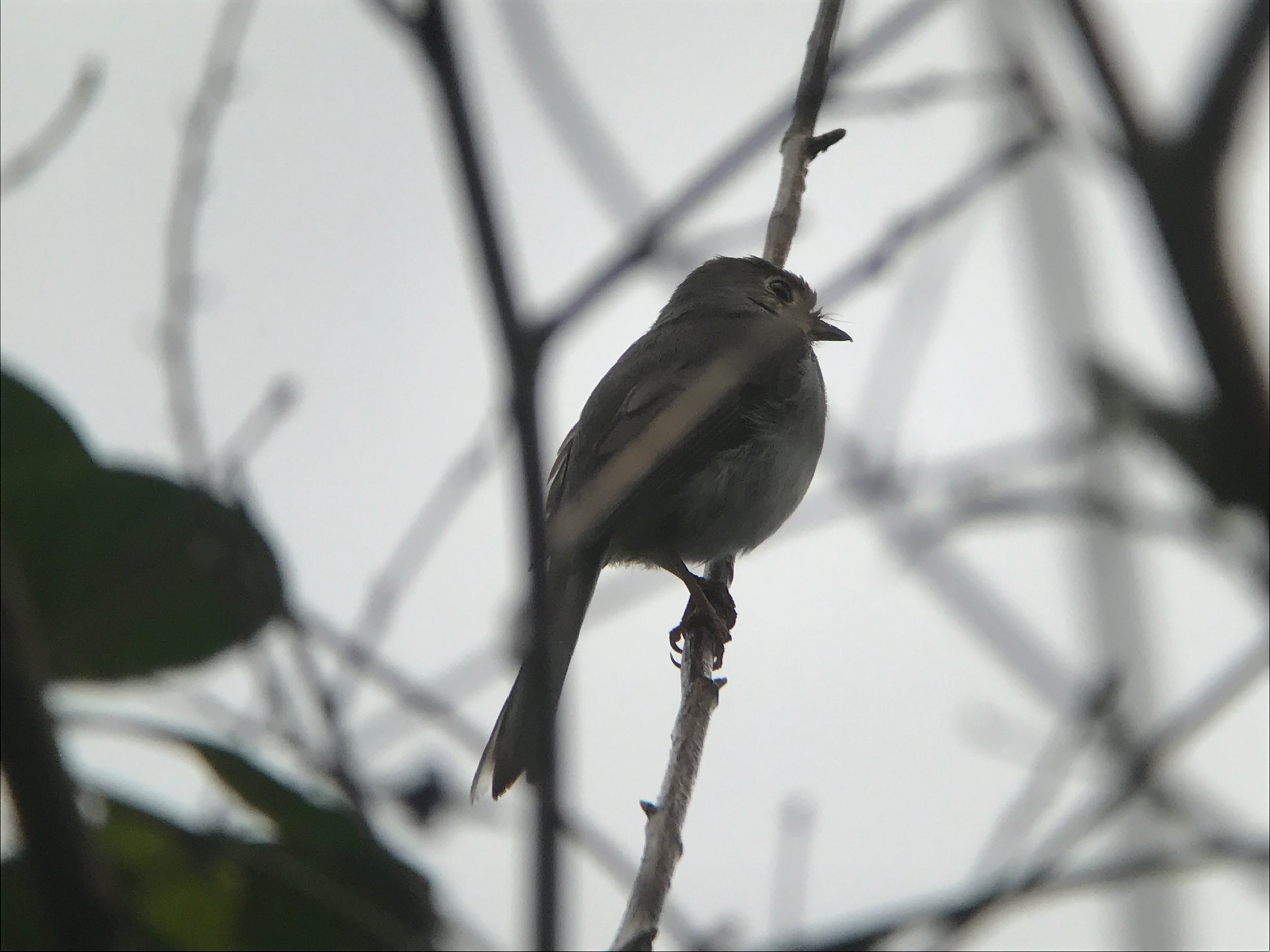
The Cuban solitaire was not easy to see, but I was more interested in listening to it.

American kestrels are very pale in Cuba.

La Guira National Park is a good spot to see yellow-headed warbler too.
If you travel into Central America enough, it is inevitable you will experience an ant hatch...in your hotel. Previously, I wrote about experiencing an ant hatch that happened in my room at Panacam Lodge in Honduras (this is not a knock against that lodge, this is just part of life in the tropics). Hotel Islazul Mirador (also called Hotel Islazul San Diego de los Banos) was our base for this stretch of our trip because it was near the cave. Most of the occupants at the hotel appeared to be residents enjoying some weekend fun. Two of the men on our trip took a stroll outside the hotel and within a few blocks met a local teacher who gave them a tour of the town. He had started a personal library for the town from books he collected from foreigners. Incidentally, if you wanted to take something to Cuba for the people, I highly recommend bringing along copies of your favorite books to read in Spanish and leaving them behind.
I shared a room with my friend Sue and the morning routine was that I would wake up first and as I moved around, Sue would gradually wake up. One morning I woke and went into our bathroom. As I was gradually gaining consciousness, I heard a clicking sound. I looked down and noticed a large insect crawling under the door into the bathroom. Then a second. When both were inside, they fluttered their wings and made the clicking sound..."Oh no," I suddenly realized: ant hatch.

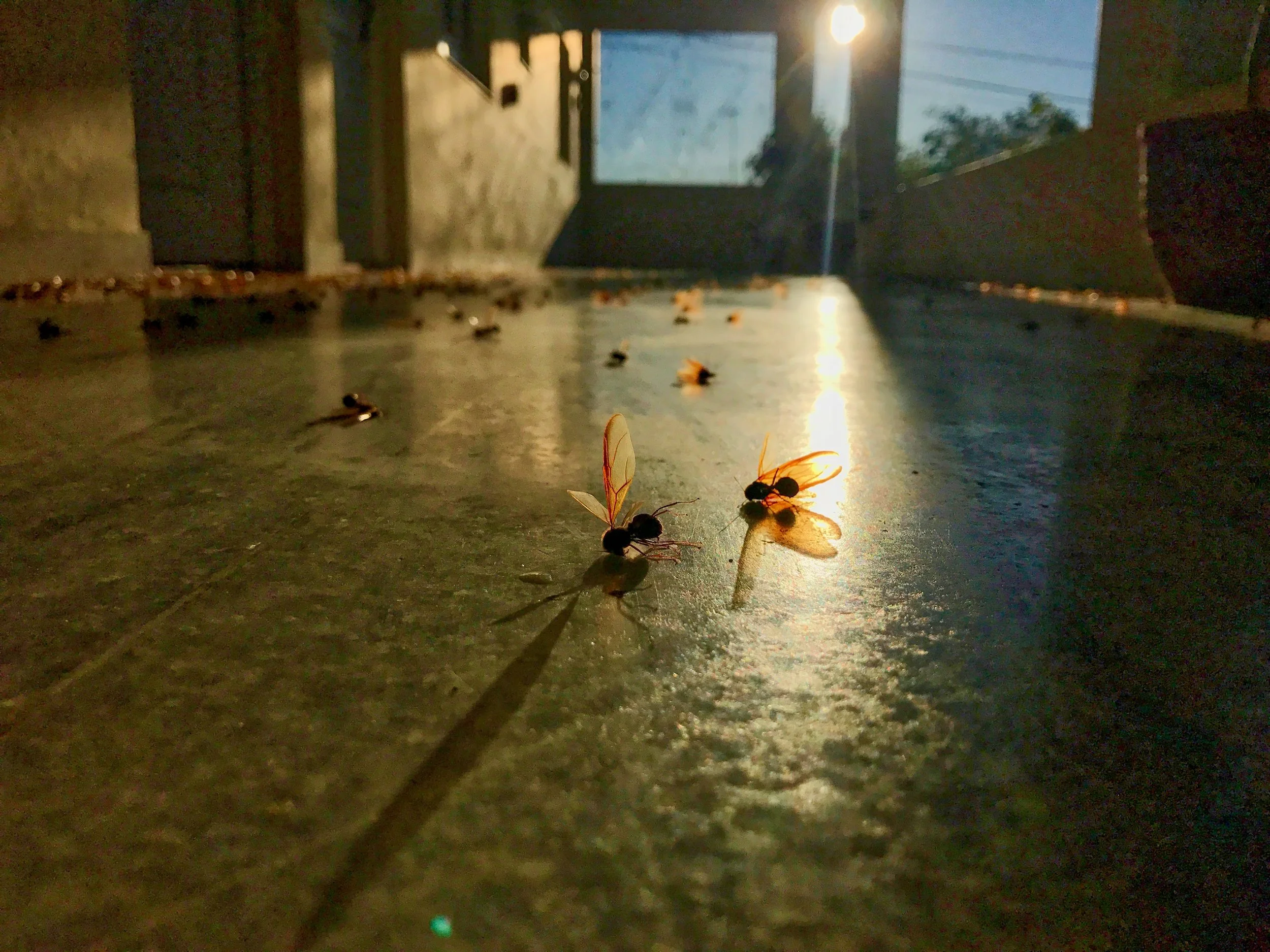
Winged ants crawling around the bathroom.
I brain sprang into action, I didn't have ants on me so the hatch must have just started. I needed to close up our suitcases so we wouldn't have them in our clothes. I needed to wake Sue but not panic her. I stepped out of the bathroom and noted a few more ants on the floor.
"Sue," I said in steady but firm voice. "Sue, you need to get up and close your suitcases. I need to turn on the lights."
I flipped on the lights to see where the ants were coming out. I looked for any kind of gap along the ceiling and walls. I couldn't see ants. Sue was getting out of bed and thought our room was flooding in her half awake state. I was trying to carefully explain the hatch because I wasn't sure how she would feel about thousands of large, winged ants crawling all over us. There were some more winged ants on the floor and then I noticed the clicking sound was louder just outside our room door. I realized with some relief that it wasn't in the room, but outside. When I turned on the bathroom lights, that must have gotten their attention and the ants were crawling from under our room door and a gap from our shutters. What a relief that it wasn't inside!
I turned off the lights in our room and decided to take a peak outside.
The light just outside our room was out so we didn't have that many ants outside of our door. However, walking down the corridor you could see that our neighbors' rooms were all covered in dying ants that were attracted to their lights. It had been raining most of the day before. When the rains stopped, queens hatched to go on their mating flights with males. After the mating the wings on the queen fall off and she goes to start a new colony. But all of these ants got distracted by the lights and spent all their energy around it, exhausting themselves. As morning was approaching they were dying and their wings were falling off.
I wondered about people coming out of their room barefoot to have coffee, only to step in and slide through ant guts. I went back to my room to finish prepping for the day's adventures grateful to not be dealing with ants in our room.

When I headed down to breakfast the sun was bright and the dead ants looked quite beautiful in the light. While we were eating, the hotel staff went through and swept them away. I looked down at the pool and it was a different story. A layer of drowned ants covered the surface. The pool boy would have his work cut out for him this morning.

Jellied papaya...with cheese.
One of the specialties our cultural guide Claudia told us to try at the hotel was jellied papaya. If you think papaya is ok but could do with more sugar then this is right up your ally! It was far too sweet for me but it was an interesting flavor. Make sure to give it a try.
Digiscoped Images
Fresh Tweets
Would you like to hire me as a speaker for your event?
Email sharon@birdchick.com