A Day In Frank Taylor's Blind
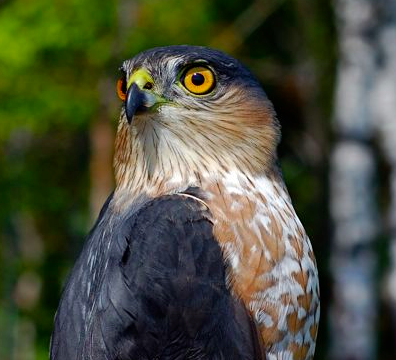
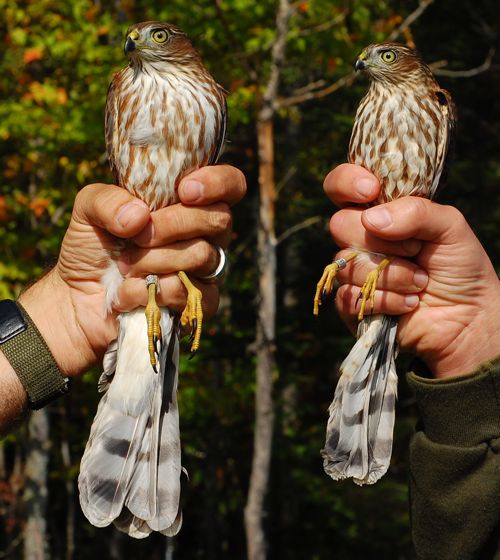 A photo of a pair of hatch year sharp-shinned hawks (the female is the larger bird on the left, the male is smaller and on the right) means that it's that special time of year for me. That special time when I try to cut back on where I travel to so I can have time to help out with some hawk banding. To those who have ever participated in a well run and a good banding station, it's not only scientific research, but it's part hunting and part sports game. You scan the skies looking for a hawk that might be in a good position to see your bait, if it comes down, it could at the last minute dart off, if it does hit the net, you have to make sure the bait bird doesn't get nailed, then you have to dash out of the blind before the hawk gets out of the net. After all of that research, you take notes on the bird and let it go, hoping for it to be recovered again when even more valuable information can be garnered.
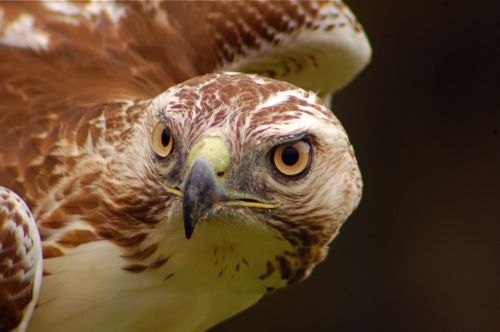
Sunday was the first day I was able to go up. I hit the road dark and early. Watching the forecast, I wasn't sure what to expect. Websites predicted a 40% chance of rain all day, but the winds would be west in the morning, northwest in the afternoon--promising. And at the end of the day, a slow day in the blind, is better than any day away from it. And even to have the chance to watch the hawks on part of their journey is a treat. No worries, it was not a disappointed day in the least, note the above red-tailed hawk--oh, what a flight to watch come in to the net.
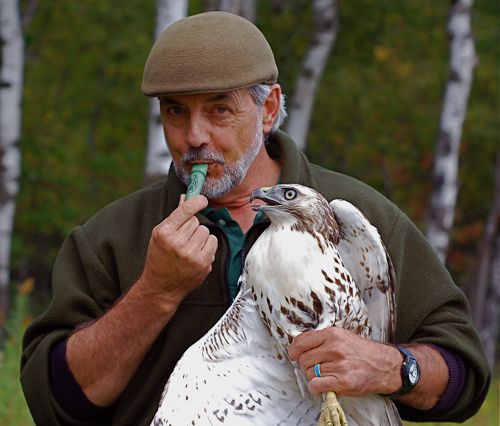
Above is my buddy Frank Taylor posing with a hatch year (passage) red-tailed hawk we got in the nets. He's also posing with his wounded rabbit call, which I must admit, I was skeptical about it. But it totally worked! This young red-tail flew up to catch a thermal. Rick, our master pigeon yanker, pulled the pigeon to flap a few times, and the red-tail showed no interest. Frank grabbed his wounded rabbit call, blew loud and blew hard and the bird flapped, came out of the thermal and set towards the pigeon--it was beautiful. It came in from far, set its wings, slowly lowered the talons and flew right into the net! The call of the wounded rabbit was just enough to get the red-tail's attention to see the bait bird.
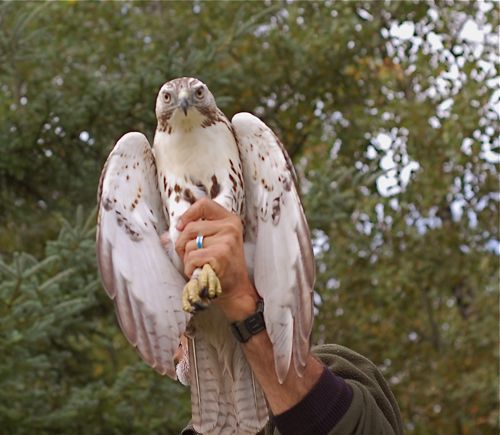
After we band the birds and are about to let them go, I like to try and get photos of them taking off. My favorite way is to lay on the ground. Normally, the birds are looking to get away. Not this red-tail, it watched me to the whole time.
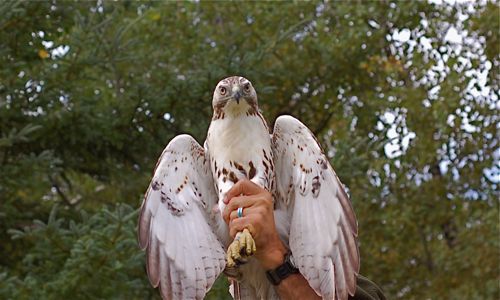
It was not interested in anything else. I even said to Frank, "I really don't like the way this one is looking at me." It was not looking away.
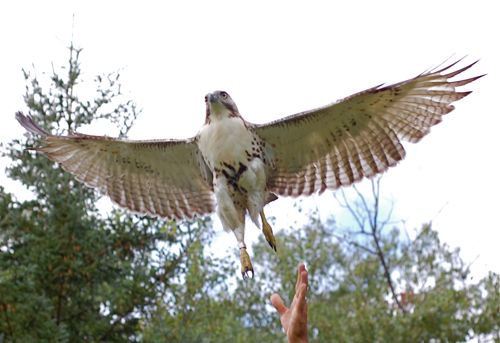
Yet, when the hawk was released, it lost complete interest in me. Whew. When I showed this photo to Non Birding Bill, he said the hawk looked like it was auditioning for Fame and trying to light up the sky like a flame.
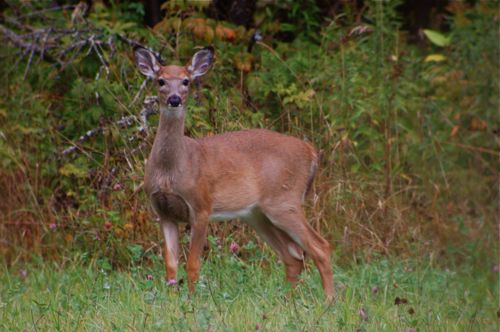
One of the fun parts of the blind is getting to see the local wildlife come out, not knowing that we are there. This was a doe who came out to browse. Although, her interest was piqued when she heard all of the camera clicks.
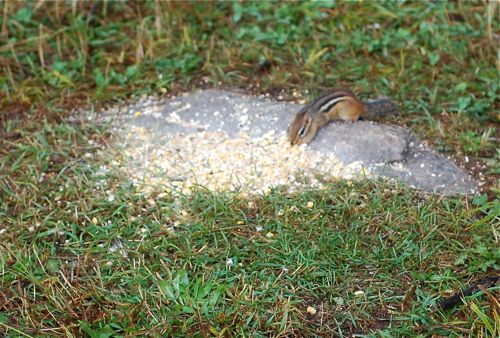
We had a very ballsy chipmunk come out to gather some of the leftover pigeon food to its winter stores, seemingly oblivious to the potential predators we were trying to draw in.
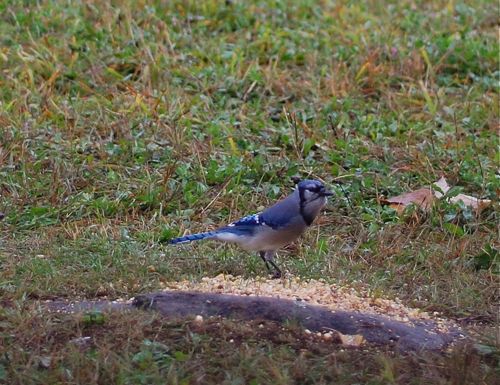
Blue jays also came in for the spilled food and periodically competed with the chipmunk. This bird was really loading up on food--look how full the crop is. Early in the morning when fewer hawks were moving, we had time to watch the chipmunk and the hawk, but by 10am, the hawk faucet was turned on and we were too busy catching hawks and watching others fly over to pay attention to the others.
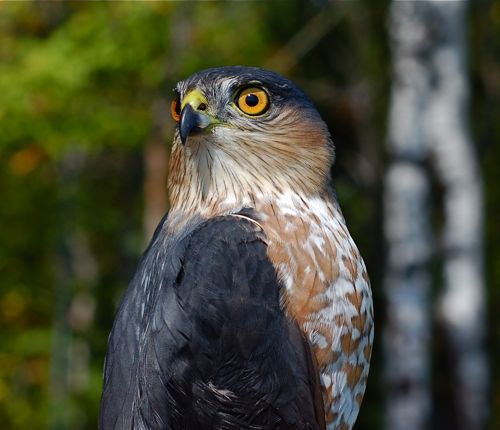
We got in quite a few haggard (after hatch year) sharp-shins. Normally, we don't get too many of those until later the season. It was such a great day of watching hawks of all sizes from far off spot the pigeon and then come in for it.
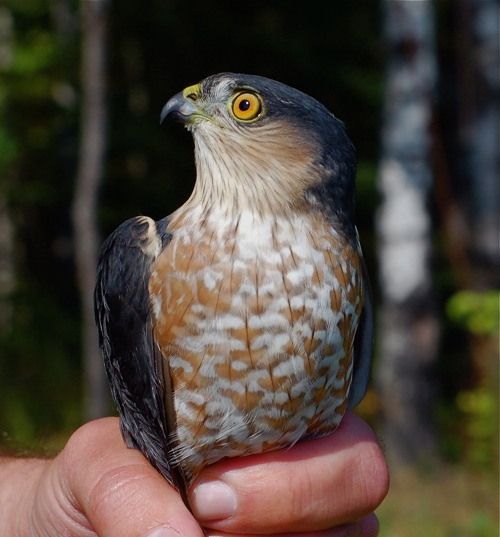
One particular adult had us wondering about his past. As soon as my friend Amber took him out of the nets, she noted that he had a Cooper's hawk look about him with his head. It did look a bit flat, but he was sharpie in size and dainty bill. As she banded the sharp-shin, he did what many hawks typically do--open its mouth and stick its tongue out. Only, when this hawk did it, the tongue veered sharply to the right (not unlike someone with a neurologic disorder). While Amber banded this bird, more hawks came into the nets and Reier held the hawk. The hawk turned it's head this way and that. When it would strain too far to the left or right, it would shake. Reier noted that it was like someone with nerve damage. Between the flatness of the head and the abnormalities, I wondered if this bird had flown into a window or some other blunt trauma? It was a chunky bird, so it felt as though it had been eating well, but something happened to it somewhere.