
I was trying to get a video of this poor downy woodpecker trying to eat peacefully from the suet feeder, but ended up getting some interesting nuthatch footage instead. Watch the white-breasted nuthatch in the upper right corner. It goes through a series of displays to drive off the rose-breasted grosbeak. I was impressed: [youtube]http://www.youtube.com/watch?v=e76E9b4JOnE&feature=player_embedded[/youtube]
Happy, Happy Bees
We had the coolest birds fly over the hive today. As we were suiting up in the bee yard and stoking our smoker, I heard a familiar gurgling trumpet call--distant sandhill cranes. Lorriane and Hans were with me and I asked if they heard it too, they did and this time, they sounded a bit closer. We watched the sky and about 30 seconds later, a pair of sandhills flew right over our hives. How cool. We have American redstarts, house wrens, and indigo buntings nesting at the bee yard, which are cool, but a sandhill crane flyover was just the icing on the cake. Lorraine and Hans both smiled at my complete abandon of all things beekeeping to catch a glimpse of the sandhills. Lorraine blogged our bees here.
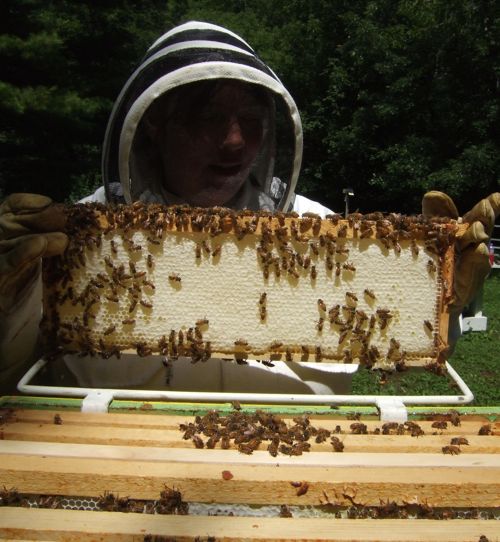
The nectar flow is on! After a slow and easy start with our hives, they are going gang busters now! The yellow Hannah hive which stared off as kind of the stoner/do nothing hive has become the hardest working. She was the first to need a honey super and when we looked in today, she was ready for a second.
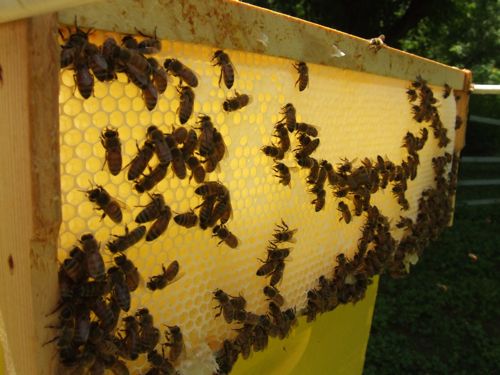
Here's a frame we took from the current super to put in the new super to encourage the girls to climb up and build further. The purple Yvaine hive and the red Juliet hive were both ready for honey supers, so we put boxes on top of them as well.
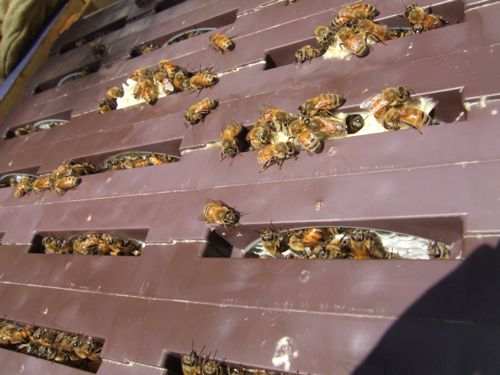
The green Wendy hive was given a Ross Rounds honey super a week ago and that is a bit of a gamble--but she had just about filled it completely up. I've been told that new bees don't do comb honey, but we always try with a new hive and they always make it. It's trickier, because with regular wooden honey supers, I just put in a small frame in a big brood box, wait for them to draw out comb on the frame and then include that frame in the honey super, they smell the drawn out comb and it encourages to climb up. Ross rounds fit differently and you cannot just slide one easily into a brood box. I usually wedge a piece of feral comb at the top to get a little bee smell in. Anyway, if you are a first time beekeeper and you have new bees, don't be afraid to try Ross Rounds comb honey supers, your bees may surprise you and fill them up.
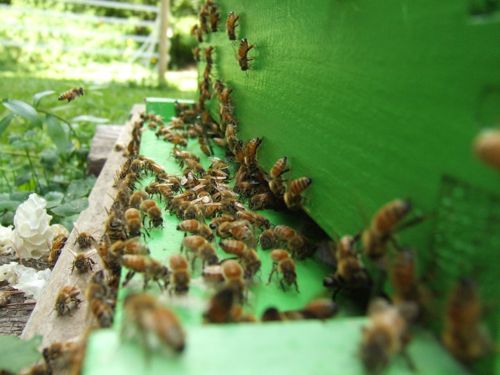
It was interesting to note that almost all the foragers came back with very little pollen, they were focused on gathering nectar for honey. They don't carry nectar on their back legs like pollen, they have a special stomach for carrying nectar that they gather for creating honey. All these are returning, fat and full of sweet sugary nectar.
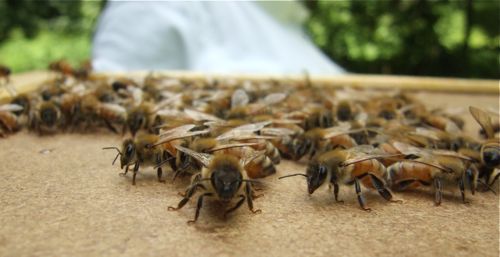
There was no bonking or stinging at the hives today (except for poor Cabal, one bee did sting him in the paw), otherwise, all the bees were very mellow and Lorraine and I just watched them work. It's such a pleasure to have happy bees this year. Last year, the Kitty hive was so angry and always so much work. This year, all seems to be going swimmingly, no one seems to be in the mood to swarm...and even if they did, I would let them go. We did take the extra step of setting up a small, empty hive on the off chance one of our hives swarms (or a neighbors' hive swarms) and hopefully, they will decide on that box for a home.
I had another cool sign at the end of the day. As I was walking to my car, I looked up and saw a small blob of red hurtling through the air, right at my head. At first, I thought cardinal, but the bird suddenly shifted left, and I saw it was a scarlet tanager. I'm not sure if it was chasing a bug or what, not sure why it would fly at my head like that, but I enjoyed the view and felt relief that it didn't actually make contact with my head. Wonder what that dud was doing so slow, usually they are higher int he trees.
After dodging the tanager, Lorraine and I headed out for dinner at quite possibly one of the worst restaurants ever. We had eaten there before last year and it was a decent Italian place, but things have greatly shifted. The best part was the desert. Here's a link to a photo of a piece of pecan pie that was served to us at the restaurant. That was before we even tasted it, the piece was that small. That set off a wave of giggles. Lorraine had a piece of cheesecake and we both took bites of our respective desserts at the same time. There was a pause and we just started giggling. I suggested we trade desserts and believe it or not, her cheesecake was worse than my pie size issues. What my pie lacked in size, Lorraine's made up with salt...that's right salt. It was very apparent that whoever made the cheesecake switched the amounts of sugar and salt. I'd never had such salty cheesecake. We were laughing so hard as we paid the bill, I'm sure our server suspected we were high on the wacky tabbacky.
Red-bellied Woodpecker
I'm testing out some video footage in the blog. This is a female red-bellied woodpecker going for a sunflower in nut mix in a copper mesh feeder. Note how she uses both her beak and her tongue to get the food out. [youtube]http://www.youtube.com/watch?v=IoPjrrDzi8c[/youtube]
Saturday Digiscoping Workshop
If you are looking for more information on the Digiscoping Workshop that we talked about on KARE 11's Showcase Minnesota this morning, click here. To learn more about the Digiscoping Contest, click on the Digiscoper of the Year button ad at the top of this page.
Hot Toucan News
There's some exciting research coming out about toucans and why they have those big crazy bills.
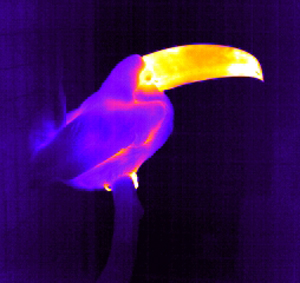
According to the research detailed today in the U.S. journal Science the toucan's beak may be a sort of thermal radiator, releasing body heat when the bird needs to cool down--kind of the way rabbits release heat through their ears. The photo above is supposed to show how hot that bill is compared to the rest of the body.
"By altering blood flow to the bill's surface, toucans can conserve body heat when it is cold, or cope with heat stress by increasing blood flow," said study lead author Glenn Tattersall of Brock University in Ontario, Canada.
You can view a video of the thermal temperature change here.
I've Seen Some Inaccurate Bird Movies...
But this one takes the cake. It's a preview for Birdemic and I think it's on the top of the list the next time Non Birding Bill and I have a Bad Movie Party: [youtube]http://www.youtube.com/watch?v=qrw2FQ7mLyQ&eurl=http%3A%2F%2Ffilmdrunk.uproxx.com%2F2009%2F07%2Fbeware-the-birdpocalypse&feature=player_embedded[/youtube]
Birding The Tien Shan Mountains Part 2
If you'd like to read the first part of this leg of our Kazakhstan trip, visit here.
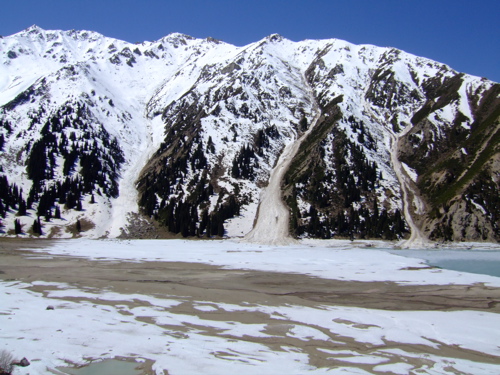
I think the Tien Shan Mountains were my favorite, check it out in the above photo--glaciers! One of the people in our group had been to this area before. He said that his group started earlier than ours and he knew of where we should be and at what time. After we spent the morning enjoying great birds like brown dipper, Eurasian hobby, and Himalayan rubythroats, it was time for lunch. Our guide found a nice clearing in the sun with a great view and not so much snow. However, the other birders wanted to go higher and staged a bit of a mutiny.

We drove up to a higher elevation that was covered in snow. If you were willing to walk up a very vertical and rocky ledge, you wound up at this abandon research station. And this was where other birds like white-browed tit-warbler. All the birders scattered in various directions. I tried, but there weren't very many clear paths. The few that were there, were covered in very deep water. I opted to walk through the snow and discovered that in some parts, it wen all the way up to my hips. I think I have said it before in the blog and I'll say it again, I have a new appreciation and respect for the REI convertible pants. I stayed fairly warm and the material dried out quickly. It was hard work toting my scope, pack, recently acquired bagged lunch through such deep snow and rather than struggle to keep up with the tenacious long-legged birders in hot pursuit of tit-warblers and accentors, I decided to answer the call of my stomach and eat. I trudged my way to the building's steps.


Above is my provided bag lunch. The food in Kazakhstan was not what I would call exciting--edible, yes. A sensation for the taste buds, not so much. What struck me most was that every single meal (even breakfast) included cucumbers and tomatoes. Usually in the form of a salad with a light dill vinaigrette, but in the bagged lunches, we got a whole tomato and a hunk of cucumber. The above lunch included a boiled potato, apple, hard boiled egg, a chicken thigh with a lot of paprika, and four rolls (one of which reminded me of the female anatomy). Breads were common at meals too. The favorite to eat was a fried bread, kind of like a donut with out the sugar, which is a good way to describe a lot of the Kazak food. At some meals a plate of rice and meat would be in front of you and being fairly close to China, you expected it to be spicy. Not the case, it was quite bland, but if you wanted fuel to keep going, then this food did accomplish that goal.

This was my view during lunch. I could hear several Himalayan snowcocks singing all around me in the crisp mountain air. It was nice to take a break from the birding and just admire the beauty of the remote region I was in. I thought about what I would be doing if I were home, what others were doing. I thought about how huge and beautiful our planet is despite what we hear in the news and how little time any of us have to see it. Sometimes I get to a location and realize that my chances of ever being here again are next to impossible, I want to burn them into my brain. It was already pretty amazing I had made here in this lifetime.
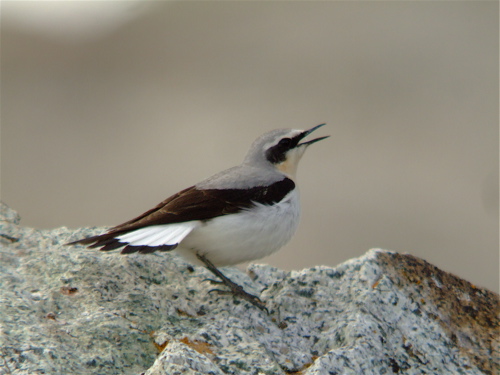
Northern wheatears were all around too. What a treat to see this bird up close! Rarely, one will come down out of Alaska and hit the very northern tips of Minnesota, but never in sleek breeding plumage. And what funny noises they made! This one made sounds like a camera shutter going off. I don't know much about wheatears to know if they are a mimic species. I do know that they make all sorts of crazy sounds, but this one really had my attention. I did manage to get some video with my digiscoping equipment, you may have to crank your volume to hear it:
[youtube]http://www.youtube.com/watch?v=91JBg6ZzJog[/youtube]
My buddy Clay came over and digiscoped it too. He pointed to the mountain side behind the wheatear where we could hear snowcocks chasing each other and said, "See the Batman?
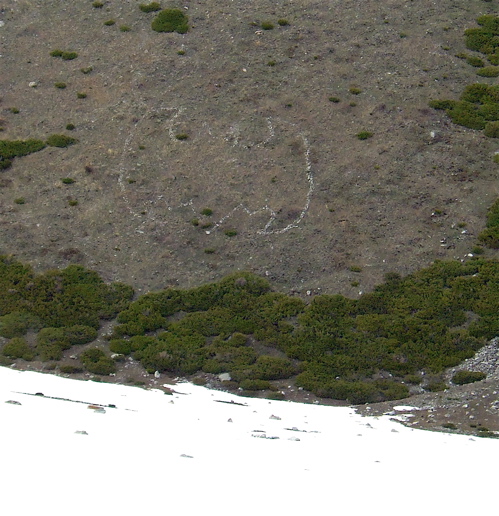
And there it was, the Batman Insignia made of a collection of fairly large mountain rocks. If I had to guess, it was about 40 feet long. Those researchers at the abandon station must have gone pretty darned stir crazy sometimes. I love how I'm in one of the most remote regions on the planet and yet, cannot escape Western culture.

Much to the reluctance of our group, we had to begin the slow decent down the mountains. It was early afternoon and we had to get down to the bottom in time for dinner and for part of our group to leave. I stayed for a couple more days, but most of our group was leaving that night and getting a large group of birders to move, especially in a place where once in a lifetime birds are packed, is no easy feat. Above was one of our target birds called a black-throated accentor. This little bird just refused to perch in better light, but you can see a photo of it here. The higher we went, the less variety we had, but still cool birds nonetheless. I don't think anyone in our group got the tit-warbler, so I do have some excuse to come back.


This was lovely little bird that we saw flitting about called a blue-capped redstart. I'm not sure where the redstart comes from, but at least it had a blue cap.
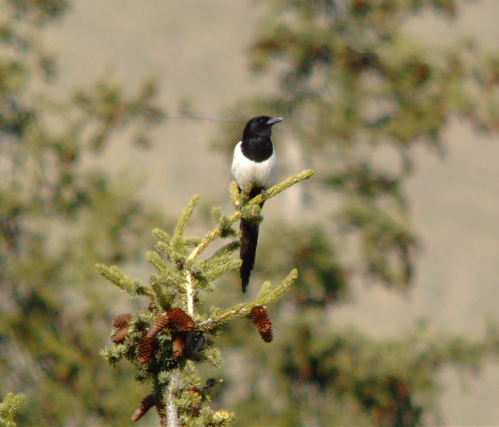
Magpies were common on the Steppes in Kazakhstan and common in the trees in the mountains.
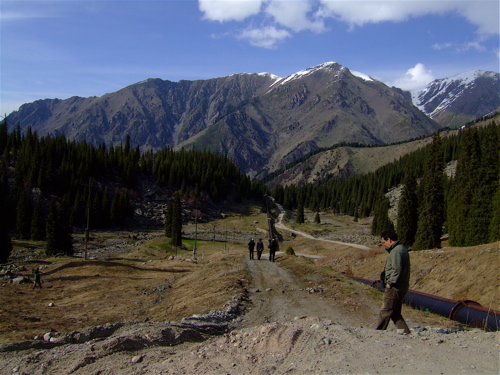
As the day became later, the light became perfect. We saw less and less snow and our faster pace made us warm up.

Tim Appleton (the guy who started the British Bird Fair) and is one of the most interesting birders I have ever met) came over to us and said, "There's a ruddy shelduck in perfect light for a photo." He was correct, what lovely color this duck was. We had seen them earlier on the lake, but they were very far away, this one was much closer and Tim was correct, in perfect light. It was about this time that I was starting to fade. Kazakhstan is about eleven hours ahead Minnesota and we'd been hitting hotel beds at midnight and getting up by 5am pretty regularly. Fortunately, Corey Finger became my pusher man with his oh so tasty cappuccino caffeine pills--bless that man. They did have some coffee in Kazakhstan but it was more int he form of NesCafe.
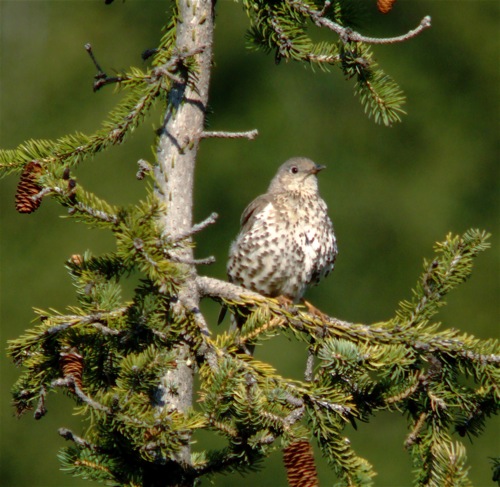
After perking up, I was able to enjoy the birds, like this mistle thrush perched in perfect view taking a preen. You can view a video of this large robin like bird here. We eventually made our way down the mountain, but moving a group of birders is like herding cats, we made it to the restaurant late and many of the people taking flight that night had to change clothes and repack carry on luggage in the parking lot.

The restaurant had all kinds of Kazakh symbols around, even part of a replica of the Independence Monument found in Independence Square in Almaty. The full monument is a golden man holding what I think is supposed to be a golden eagle and the golden man is riding a flying snow leopard. I know the bird is dinky for a golden eagle, but hey, this is a golden man, chances are if a dude is made of gold, he's going to be bigger than your average male. When I told people that I couldn't believe I had the chance to go to Kazakhstan, one of the first reactions was, "No one ever goes there." The truth is that I have always wanted to go, ever since I had read about tours to see Kazakh tribesmen hunt with golden eagles. We didn't get to do that on this trip, but we did see wild ones flying over.

Here is one of the dining rooms at the restaurant. We didn't get this one, our room had chairs, but it's basically the same decor and color in a huge outdoor gazebo. All of our chairs had blankets we could drape over ourselves as the darkness brought with it the cold mountain air.
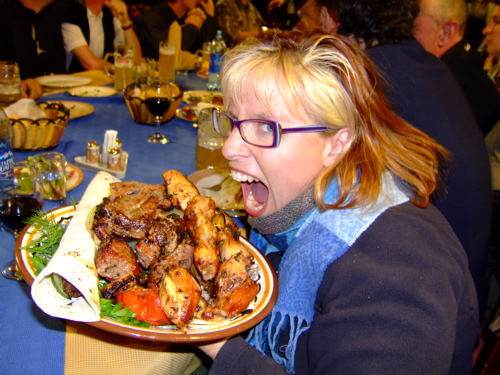
By the time the food arrived, I was so hungry that I could eat a horse, which was fortunate, because that's some of what they served us. They also had chicken, beef, and something tougher that I suspect was goat, but the horse was a surprise. It was mixed in with a cucumber and tomato salad (again with the cucumbers and tomatoes) but it was pleasantly marinated and was quite possibly the tastiest thing I had the whole week (outside of the odd pizza that had no sauce but had carrots as as a topping).

After is was quite dark, one of my favorite bird names dropped in to our gazebo--a great tit. The bird fluttered right over us and began hawking for insects attracted to the light bulb. Clever bird, ignoring the usual convention of roosting at night and taking advantage of an abundant food source.
Have You Seen The Ohio Pink Katydid?
Check out Jim McCormack's blog, they were out on a birding trip when they found a pink morph katydid! Cheryl Harner has photos of it where she found this dynamite insect. I have always wanted to see one of those, ever since I first got my copy of Lang Elliot and Wil Hershberger's Songs of Insects and saw a photo of one in there. The insect is apparently going to be on display this weekend at the Midwest Native Plant Conference. If I were anywhere near this, I would make a special trip to look at this amazing creature. Not much is known about pink katydids apart from knowing that they exist and it's darn cool when you see one. I found this article from the Chicago Gardener on the subject:

Katydids are green (usually) to hide among the leaves from predators such as birds. But scientists say that there is a certain amount of normal variation in katydid colors, and pink is one of the possibilities. Speculation is that this variation might allow katydids to extend their range -- from living in trees, say, to moving out into a prairie where there are pink flowers in late summer.
It's an example of the genetic variation that drives natural selection and the continuing evolution of every species. And without that, we would not have the fabulous array of forms, shapes and colors we love in our gardens.
If you want to have some fun, just type in "pink katydid" on Google's image search and you'll find all kinds of crazy photos. I even found a link to a yellow katydid.
Now That's Some Hardcore Birding!
Talk about tenacious. According to a story from NPR, two guys are trying to identify a bird, quite possibly a new species, based on a wing found 20 years ago: Their subject is a bird Gerry Nicholls says no birdwatcher has ever seen. Twenty years ago a researcher found it dead and decomposing in a remote Ethiopian plain and brought back just a wing to the Natural History Museum in London.
"Halfway up the wing is a big, beige patch, so it was very distinctive," Nicholls says. "And on the basis of just one wing, it was described to science as a new species, Caprimulgus solala — solala meaning 'only a wing.'"
Now that is an interesting story in and of itself. It's my kind of birding: find a big piece of a dead bird and realize that it doesn't match anything in the field guides--how cool a mystery is that? But then the story takes an odd turn:
Nicholls, 61, grew up in England, but now lives in Connecticut, where he works as a nurse. He's been all over the world trying to get a glimpse of rare species. His fellow adventurers included Ian Sinclair, a South African author of several bird field guides, and buddies Vernon Head and Dennis Weir — whom Nicholls mostly refers to by their nicknames, Winky and Fruitcake. They knew finding the bird, which is more commonly called the Nechisar nightjar, was a long shot.
Winky? Fruitcake? This so does not help the cause of birding being for the nerdy/geeky. Although, I've been a little irritated that the American Ornithologists' Union is changing some bird names because of the widespread dislike of long cluncky names like Nelson's sharp-tailed sparrow (it is now just Nelson's sparrow). I'd like to know who is this huge population of birders who can't handle six syllables? Most of the birders I know don't care or actually liked the name Nelson's sharp-tailed sparrow. I don't know, perhaps the AOU is in collusion with field guide publishers so new guides can be published. Or perhaps they are odd little people.
Anyway, I digress. If this piece of wing turns out to be a new speices of bird, I think they should abandon Nechisar nightjar and just go for Winky's beige-patched nightjar. You can read the full story and see photos of the wing, Winky, and Fuitcake here.
Man Saves Osprey With "Mouth To Beak" Resuscitation
From the Columbian (as in Washington state) comes the story of a man who went the distance to save an osprey tangled in fishing line (this is also a good reminder to all who enjoy fishing to not leave their old line behind): When Chuck Needham waded into Lacamas Lake and saved an osprey that was tangled in another fisherman's line and drowning, it felt like a mystical connection with animal spirits and his ancestors.
"To me, it was a little miracle," said Sue Cappoen, Needham's girlfriend.
It happened about 5:30 p.m. on July 6, a Monday, as the two were fishing for trout on the north side of the lake. Using worms and marshmallows flavored with anise, they were at a spot called "the rail."
Looking to their left, Needham suddenly told Cappoen, "Look at that bird!"
The osprey, with striking golden eyes and a wingspan estimated at 5 feet, had dived into the murky lake, possibly for a perch. But the raptor was trapped in the water, tangled with another fisherman's line. The line was wrapped around its neck, the hook embedded in its wing, and some discarded fishing line was tangled around its legs.
"I saw it flapping," Cappoen said. "It was trying to keep above water with its wings. It couldn't go forward and it couldn't go back. We said, 'Oh, God!' We couldn't let it die."
"I just jumped into the water in my cowboy boots," Needham said. "It was up to my knees."
Seizing the large bird, Needham used nail clippers to cut the line away from the osprey.
"It was dead by that time," Needham said. "It was gone. It just had no life to it."
So he decided to try some mouth-to-beak respiration while massaging the bird's throat and chest.
"I cupped its head in my left hand and turned its beak toward me and breathed into its beak. I gave it about five or six deep breaths and, all of a sudden, it started coughing up water and foam and perked up a little bit.
Carrying the bird closer to shore, Needham said, he put it on a rock. Wary of the dazed bird's powerful talons and razor-sharp beak, he gently poked it with a stick to see if it would move.
"It just pecked at the stick, and it just turned around on the rock and took off."
You can read the whole story and see photos of Needhan and the osprey here.