Aerial Waterfowl Surveys

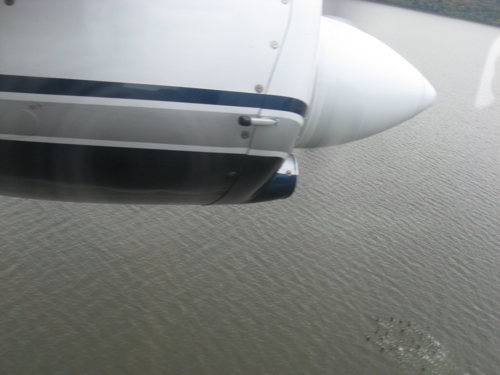
So, once a week throughout the fall I will be going up in a plane to do aerial waterfowl surveys for the National Park Service.  It is equal parts fun and frustration.  For one thing, ring-necked ducks look very snazzy in profile, but from above, they're very dull looking and hard to id from scaup, especially if they don't fly!  I've been trying to take some photos and video with a little point and shoot to give you an idea of what it's like, but the camera has trouble picking up the birds. ducks

Although, here is a small flock of ring-necked ducks to count--so you can kind of get an idea of what I see.  It's hard, especially when we get in the rice fields and you realize how hidden coots, teal, and gadwal can be.  If they fly, it's a bit easier to try and id them.  Our pilot is fantastic, (for one thing, he resembles Aaron Eckhart) he flies waterfowl all the time and all over the country and has some great tips, like green-winged teal have a two toned look compared to blue-winged teal form overhead.  The head looks darker than the body--that's helpful.  He will also call out what he sees from the window.  When I listen to my digital recordings of my observations the next day to enter the numbers on the data sheets, I'll hear my voice give a little excited, "YES!" That means that I heard the pilot confirm my id through my headset as we went.

Here's a quick video that I took below.  This little camera only picks up the the gulls which I don't need to count, but you can get an idea of how fast we're flying.  I'm hopeful once the common mergansers show up that I'll be able to take an HD camera and get some better footage.

[youtube]http://www.youtube.com/watch?v=ncWb8bTEIAc&feature=channel_page[/youtube]

Fall Birding At Bruce Vento Nature Sanctuary

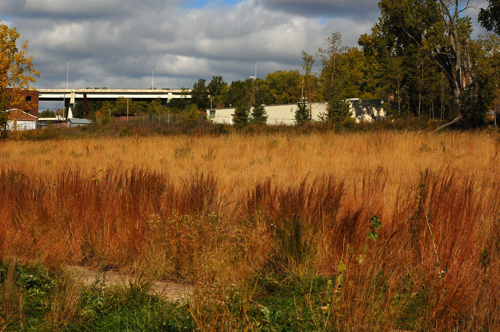
Bruce Vento Nature Sanctuary Saturday I had to go put in a ranger appearance at an event at Bruce Vento Nature Sanctuary for an open house they were holding.  It's a great little park that still needs some work, but as more people hang out there, cool things will be found.  This park has such interesting features--a closed up cave that is of spiritual significance for Native Americans, caves that used to store beer for the North Star Brewery built in the 1850s (the brewery was later bought by Jacob Schmidt). In the late 1880s the area was used as an industrial area and rail yard.  It was turned into a park in 2005 and yes, it needs some work--buckthorn and garlic mustard city and the old railroad yard has left all kinds of nasty things in the soil, but a dedicated group of volunteers has been working hard to turn it around and over the years, this will be a bright gem in the Twin Cities park system.

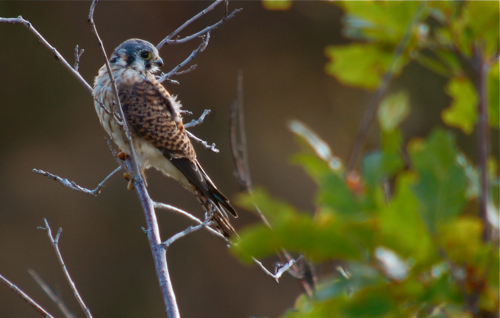
Male kestrel.

Here's a young male kestrel who was on patrol for food in the area.  He was mobbed by a few goldfinches but he mobbed a Cooper's hawk when it flew through--no one is going to partake of his food source!  I spent most of my time with local birder and excellent bird guide for St Paul Audubon, Julian Sellers.  I noticed he had photos of an orchard oriole out and I remembered that this past spring when I was Bruce Vento, we heard an orchard oriole singing on territory.  Julian said that he and his wife saw the male this summer feeding three young!  That's a great bird for an urban area and for this new park.

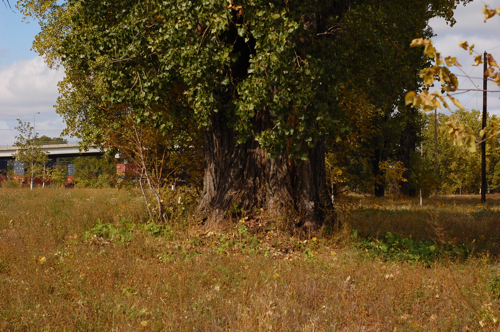
Tree

At first, we didn't see too much in the way of birds, which surprised me since Carpenter Nature Center was so full of migrants on the move the day before.  But between the nearby highway and active railroad tracks, hearing chip notes is a challenge.  I walked over towards the tracks and found this grassy area to be CHOCK full of birds.

Eastern Bluebird

Mostly eastern bluebirds--they were all over and scattered about.  Not sure if they were after grasses or lethargic grasshoppers hidden amidst the grass and low to the ground.

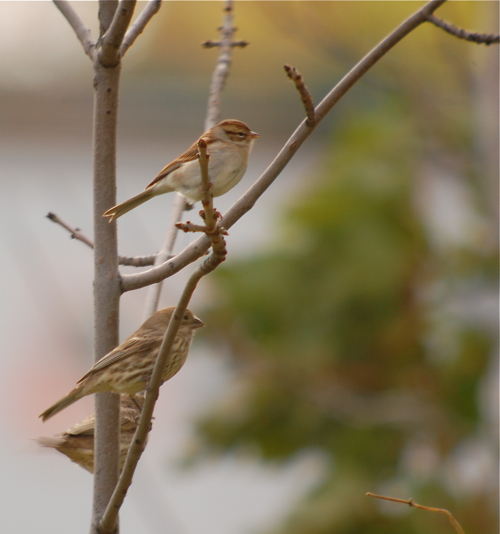
Chipping Sparrow and House Finches

House finches and sparrows were mixed in with the bluebirds.  Above are a couple of female sparrows and a chipping sparrow.  You may be saying to yourself, "Hey, that chipping sparrow doesn't look like the ones I see at my feeder in the summer." But they change color and kind of look like clay-colored sparrows in the fall.  There were also white-throated sparrows, Lincoln's sparrows and fox sparrows mixed in.

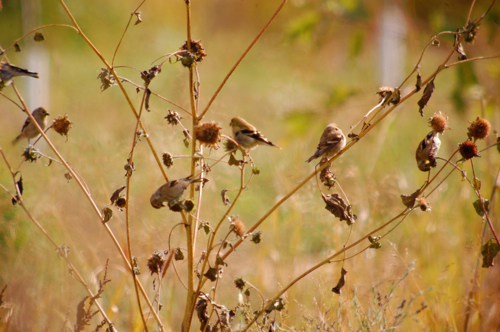
Goldfinches Chowing Down

The real fun were all the goldfinches.  And boy do they hide well in their brownish plumage!  I would walk down a path completely unaware and then a big flock would explode out of the grasses around me.  But soon enough, one finch would return to the food source and others would follow.

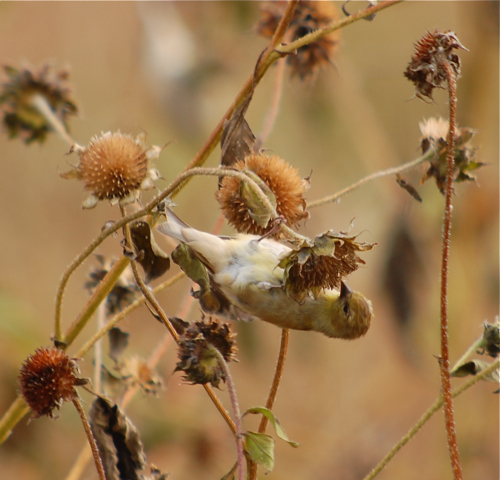
Upside down finch

I think these are common sunflower heads, but I'm not sure.  Whatever they were--the goldfinches were digging it.  If you didn't know they were there, they totally blended in despite their furious feasting.

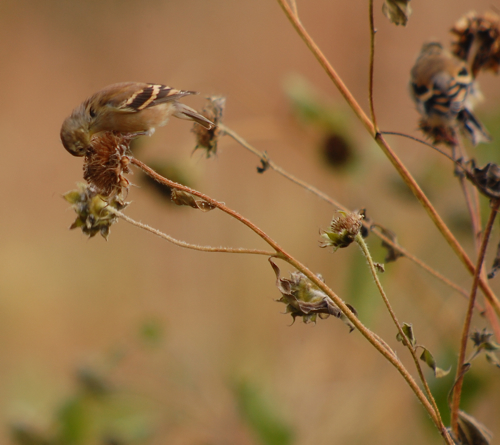
Goldfinch feeding

It's a great little park and again, I think we're going to see some great birds there the more people check it out.

Flickers & Bluebirds At Carpenter Nature Center

Fall at Carpenter Nature Center. Friday was an unbelievably beautiful day at Carpenter Nature Center.  I ended spending way more time out there than anticipated.  It ended up being a perfect day and now as I look outside my window to see TWO inches of snow with more on the way, I'm glad I took advantage of the fall color and sunlight even if it never made it to 40 degrees.  And yes, I did just type two inches of snow.  That's a bit insane even for Minneapolis standards.  I'm prepared for snow when Halloween hits.  But not on October 12.  Sigh, if you take into account that five inches in April is a normal occurrence, that means that we have six months of winter ahead.

Mental note: Plan a trip to Panama and possibly Peru this winter--who is in with me on this?

We haven't even gotten our full fall color in the Twin Cities yet.  You can see in the above photo that we are right on the cusp.  I think all this snow will make all the leaves say, "Screw it!" and just drop off the trees.

brown creeper

Banding was awesome--I got to band a brown creeper--who make sad little chirps in hand.  It was a hatch year bird, hope it finds a way to survive the winter and is recovered by another bander some day. We also got in our first junco of the season.  We normally get those in little Potter traps.  It was weird taking one out of the mist nest (we only use mist nets in warmer weather at Carpenter).

downy fall

My buddy Larry processed a downy woodpecker that I originally banded in May.  That was exciting.  When I banded it him in May, I aged him as a second year bird but according to Pyle and his fall plumage he was resembling an after second year bird.

downy bite

Part of it was his eyes.  In the sun, they looked very red.  Although this photo shows them to be more brown than red.  It's always nice to find an older bird and to have it surviving well.

carpenter birds

As Larry and I walked around checking the nets, we watched a fascinating interaction among the birds.  Migrants like the above northern flicker and yellow-rumped warbler were all over.  We heard some blue jays and crows crabbing at each other.  The crows were half heartedly mobbing something, but the blue jays sound a bit more on alert...a bit more like they do at the hawk blind when a sharp-shinned hawk is perched nearby.  Then Larry and I heard a flicker give a distress call.  We walked over to investigate and sure enough, a shin was actively hunting among the trees.  He perched in the open momentarily and is was a juvenile male shin (barely the same weight as a flicker).  He was in hot pursuit of flickers, but all of them were on to him and could out fly him.  Shins, especially larger females can nail a flicker, but they need element of surprise.

The male shin would chase a flicker, it would give the distress call while the shin chased.  As soon as the shin would perch, another flicker would fly right in front of it--almost taunting it.  The blue jays would scream and yell like townies at a bar encouraging a fight.  What was really interesting was a pileated woodpecker flew into the scene and perched near the shin, keeping a close eye.  I've seen this before.  I've seen pileateds creep towards a shin and even a male Cooper's hawk that is on the same branch and in both instances chase it away (it's a big woodpecker and I think it's size and bold approach freaks out smaller hawks).  The pileated flew off and the shin gave chase--I don't know what it thought it would do if it actually had a pileated in its teeny talons.  The pileated easily out flew the shin and perched in a tree. A second pileated hidden nearby gave a soft call, almost as if asking, "You still there?"  The chased pileated called back and then took flight, circling the tree that the shin was perched in.

The poor male shin finally gave up and took to a thermal and circled high and out of view.  My advice small male sharp-shin?  Stick to sparrows and warblers.

Yellow-rump vs Bluebird

A lot of birds were crabby--perhaps they knew better than I did that snow was on the way?  Above a yellow-rumped warbler was trying to drive an eastern bluebird out of a tree.  The bluebird crabbed back at it.  The yellow-rump still mobbed the bluebird and eventually the bluebird lunged and chased it off.

carpenter bluebird

I spent the better part of the afternoon with the bluebirds.  They have a great palette to begin with, but I wanted to try and get a picture of that beautiful bird with the fall colors behind it.  This bird was most uncooperative.  Okay, so perching withe the blue sky behind it does make a statement.

bluebird tongue

But it kept coughing up berries.  I'm not sure what's going on with that.  I've seen berry eating birds like robin, waxwings and thrashers do that when they are in the midst of chowing down on a bunch of berries.

bluebird

The bluebird were raiding the larder of fruit on the dogwood.  It's funny, a fellow birder on Facebook had announced on this status the day before that a great front had moved in so watch the dogwood bushes for birds.  I love hanging out around dogwood in the fall.  Tons of birds eat the berries and all kinds of sparrows will pop out from beneath them.  While chasing bluebirds I saw chipping sparrows, Lincoln's sparrows, fox sparrows, field sparrows, and one robust Harris sparrow mixed in among them.

Eastern Bluebird

The flocks of bluebirds would drop down and hover over the dogwood and then disappear in the foliage looking for berries.

Bluebird in fall colors

It was a perfect day for digiscoping.

Prepping The Bees For Winter

Ah, where did the summer go?  I ask that on October 10 when we have had our first snow of the season--that's a little insane, even for the Twin Cities.  I'm prepared for snow by Halloween, this is too early.  We have barely taken the full measures to get our hives ready for winter and already the snow has hit.  We only got a dusting and most of it melted but is was a brutal reminder nonetheless. Making Bee Nectar
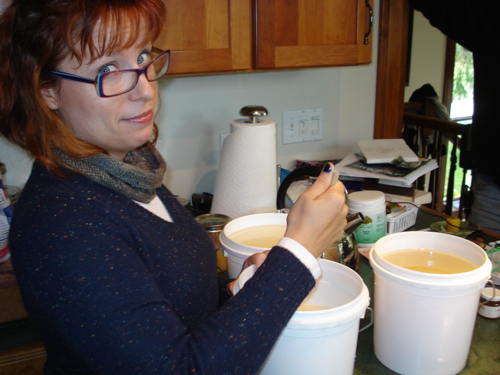
Kitty was in town and snapped most of the photos in this entry.  Above, I'm making fall nectar to help our bees get a little extra food stores in place before winter hits hard.  This concoction is even too much for hummingbirds.  Basically, I fill one of those pails with table sugar to the top and then add enough water to dissolve it.  It's a heavy duty nectar recipe to fortify the hives for winter.  I mostly posted this photo to drive my mother crazy.  She's not a fan of my recently acquired red hair, she feels that blond suits me better.
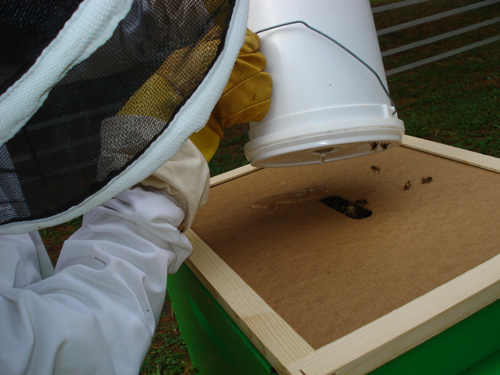
Fall Feeding

The pails go on the tops of the hive, above the ceiling so the workers can have easy access to the food.  As you can see from the above photo, the nectar is a hit with the girls.  They fly right to the pail even as we place it on the top of the hives.  So much is uncertain with the hives in the winter. You can have a seemingly healthy hive in the fall and then something unknown can go wrong over winter like too much moisture or the hive cluster travels too far from the stores starving to death because its too cold and slow to move to food elsewhere in the hive.  We hope all will go well and all will survive, but there's a good possibility we could lose some, if not all of them.
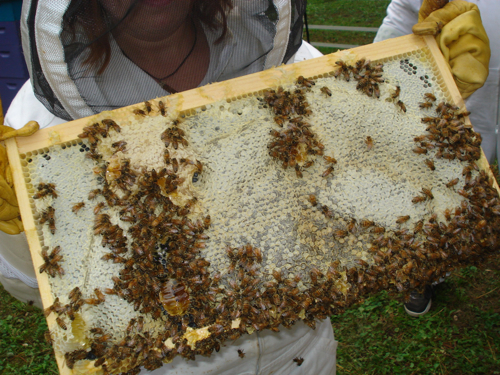
Frame Full of Honey

All of the hives look like they have good stores.  Above, Kitty got a shot of a frame full of honey stores.  We like to see lots of this in the fall.  There was some concern that our red hive was failing, she was much quieter than our other hives and bee wolves were going into the hive.  It was by no means a dead hive, there were many workers, but I would say half the work force of our other hives.  This one had swarmed, had made a new queen and was producing larvae.  But half the hive was elsewhere in the woods starting a new colony.  Each brood box has a few empty frames in each box.  We rearranged the frames so that the the bottom two boxes were chock full and the top box had the empty frames.  Hopefully with the nectar pail up there, they will finish filling the top box and be good to go for the winter.
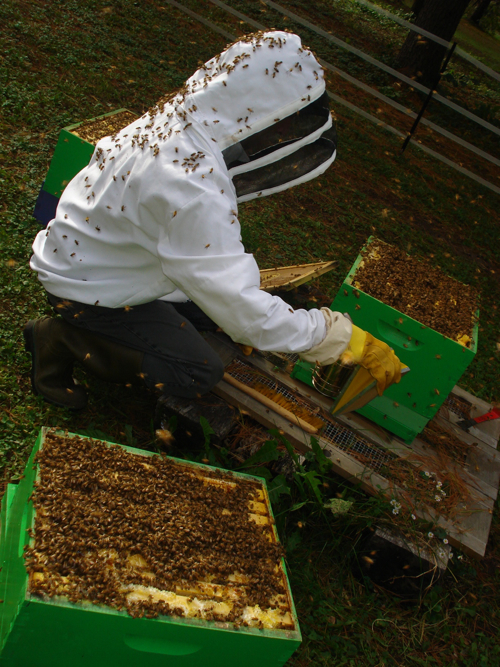
Neil surrounded by angry bees

Some of the hives had some moisture in the top--deadly to a hive in winter.  We took those hives completely apart and put a ventilation base at the bottom to see if that would help.  From the massive amount of bees around and on Mr. Neil, you can see that they really were not too thrilled about the situation.  Here's a video to give you an idea of the mood of the hive, we had just bumped the bottom box and the hive had gone from mildly irritated to PISSED.  You can hear me announcing how angry the hive was (I sound like Robbie the Robot, "Danger, Will Robinson, Danger!"  You can also hear bees bonking the camera warning they are about to sting.  Mr. Neil remains in a zen like trans:

[youtube]http://www.youtube.com/watch?v=PB2yMOnPpZo[/youtube]

Mr. Neil opted to without the full bee suit, going for the half bee suit, regular trousers with wellingtons.  This worked surprisingly well around the angry bees...even when I accidentally dropped a frame so full of bees that we could barely see the capped honey underneath right on his boot.  Half the bees fell to the ground, the other half landed somewhere on his person...mostly in the trouser region.  I froze like Ralphie in a Christmas Story when he looses the nuts for the spare tire, "Oh Fuuuuuuuuuuuuuuuuuuuuuuuudge," I said in my hand.  Everyone else assessed the situation and the amount of bees gathering in a rather unfortunate area on Mr. Neil's pants.

Mr. Neil quietly requested assistance, Hans (our muscle in the beekeeping operation) looked away.  Kitty just stared in wonder at all the bees around her.  I looked at Lorraine and said, "You're the personal assistant, you can brush the bees away from his pants."

He came out unscathed and all I can say is thank goodness for smokers and bee brushes.
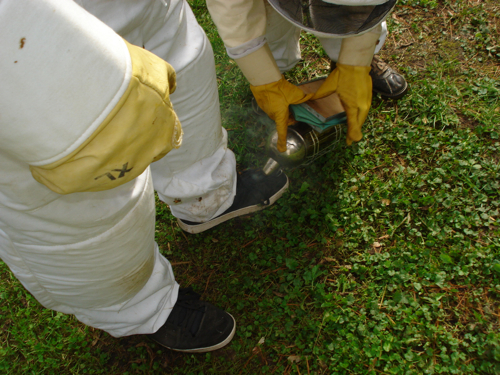
Smoking Hans's foot after a sting

Hans had a breech of security in his bee suit.  I felt bad, especially since before we walked to the hives, we were tossing around Letterman jokes and I threatened to create a hostile work environment for him.  Little did I know I would do that, but not in a wacky sexual way, more with a few thousand angry worker bees kind of way.  A worker found her way to the tender region between the bottom hem of his bee suit and the top of his shoe.  I tried to puff some smoke on the area to prevent the stinging bee's pheromone from alerting others to sting the same area.  Alas, it was in vain, more bees rushed to Hans's shoe and I think he got stung about five or six times.  Two bees got caught in his shoe laces and I think they attracted more angry workers.  Way more hostile than I intend.  I also got stung in the same area and learned that it's true, the more I get stung, the less it hurts.  It's still not pleasant, but it's not the pulsating ouch fest like the first sting.
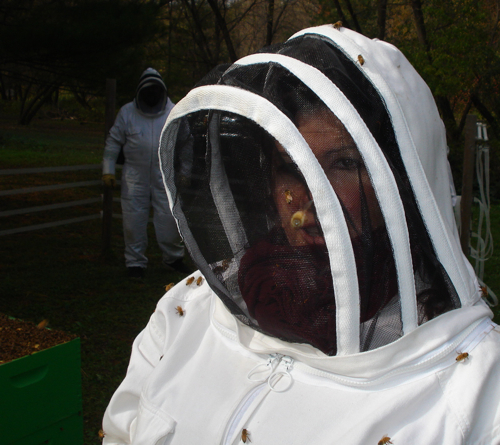
Kitty

I love this shot of Kitty.  She's covered in bees, getting the full experience but you can also see a couple of angry bees going right in to bonk her on the front screen of her bee suit.  She got some lovely photos.  Besides rearranging the hives, we took the last remaining honey supers back for extraction.  A few stragglers hid among the frames and followed us into the house.
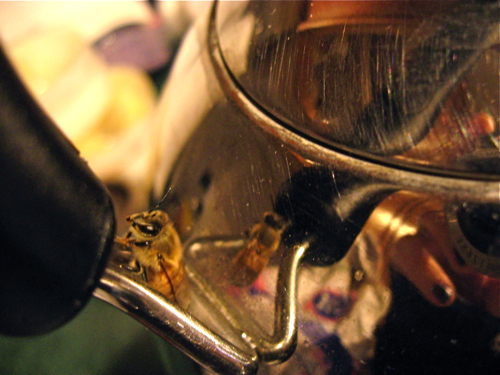
Teakettle Bee Hides

One hid surreptitiously on the tea kettle.  What a clever girl!  The Englishman likes his tea and many people would prepare hot water throughout the day.  They would grab the handle to pour and then she would be ready to make her move and strike upon the unsuspecting fingers.
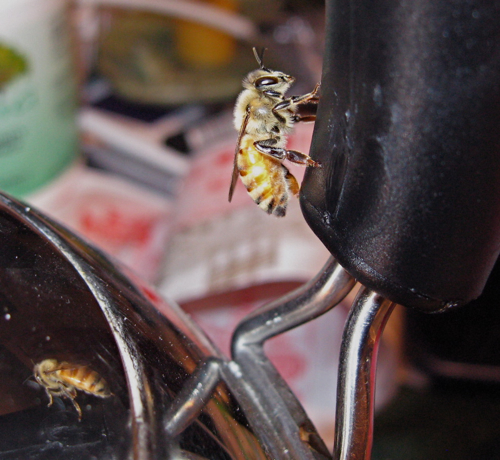
Teakettel Bee

However, she was discovered and many photos were taken of her.  After a few rounds of the flashes of the camera she flew off to unknown regions of the house.  We hoped that like the rest of her friends that she found a way outside.  At the end of the day, I gathered all of my stuff to head home.
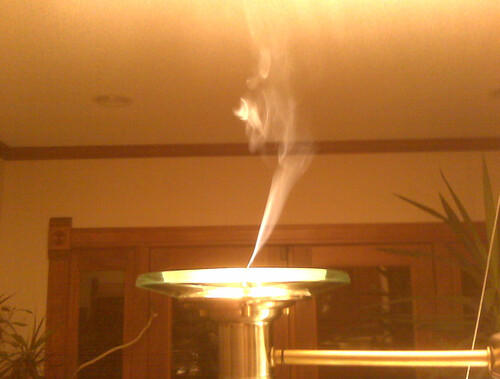
End of Teakettle Bee

I turned to say goodbye and noticed a steady stream of smoke coming from the light above the kitchen table.  "Um, Kitty? Should that light be smoking?"

We stood on chairs to assess the situation.  I was still too short to see the cause, but Kitty looked inside and said that it was a honey bee.  It was at that point you could get a faint whiff of something smoky sweet.  Poor, tea kettle bee!  Her plans thwarted, she took the noble end of a fiery death in dining room light fixture.

I can't end this on a Viking Bee Funeral.  So, I end this post with a video of Neil demonstrating his mad bee flicking technique.  He was taking frames from our honey supers and flicking all the bees off to go back into their hives.  He's quite good at it:

[youtube]http://www.youtube.com/watch?v=aJI5wqHiEnQ[/youtube]

There you have it.  Neil Gaiman, talented bee flicker.

It's Dark-eyed Junco Time

After we did some work at the beehives I took a few moments to get some photos at the bird feeders.  I scattered a little bit of millet since I've seen juncos flitting around on the Twin Cities bike trails and along the country roads near Mr. Neil's.  Sure enough, a junco hopped on the stump with the millet...as did a hairy woodpecker.  The suet feeders were full and I even put some old mixed nuts out and still this woodpecker went to explore the millet pile.  There were some black oil sunflowers mixed in with this, so I'm sure that's what the hairy was after.  It was fun to watch the two species interact.  The hairy doesn't appear to care about the junco.  The junco doesn't mind the hairy, but does keep a close watch on the larger bird and seems to make sure that the woodpecker does not violate his personal space. [youtube]http://www.youtube.com/watch?v=yYXhW2WN1EI[/youtube]

I love the nuthatch that sneaks in at the end.

Petting A Honey Bee

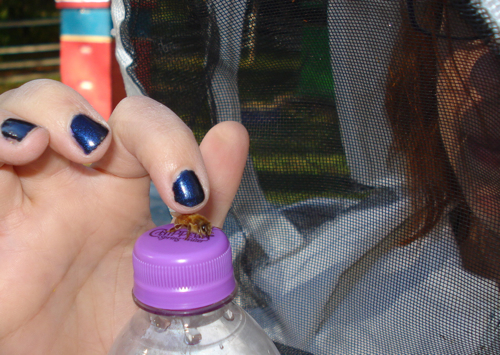
We did some work out at the hives today.  Kitty came along and got a photo of me petting one of our bees. petting a bee

This bee was from our oh so mellow Lebowski Hive.  Not all were so mellow.  I got stung on the ankle (and it's true, the stings hurt less over time).  Poor Hans got stung 5-6 times on the ankle.

Charyn Canyon, Kazakhstan Winds Dangerous For Life!

I found another Kazakhstan entry from when I was there last May!  Whoot! Kazakhstan

One of the coolest places that Swarovski took us to test out their new magnesium scopes was Charyn Canyon in Kazakhstan.  It's so huge that you can barely see the people in the distance in the above photo.  I think the only bird we got here was the alpine swift because we were so overwhelmed by the breathtaking views...and the dangerous winds.

Coming Storm

We had been birding other areas and we were fortunate that for the most of our trip we avoided rain.  But a storm was coming and our van driver was doing his best to get us to the canyon before the storm hit.  The dark clouds swallowed the huge mountains as it caught up to our van.

Ranger Station

We made it to the canyon with the storm still at bay.  We had to check in at the ranger station...wow, I feel like some of my local parks are neglected when it comes to funding, but all this ranger had was a trailer.  That's our guide Sergei entering to make sure our bus could pull through.  I think the ranger was just excited to see people.

Swarovski Birders

Our bus took the narrow gravel roads as high as it could and we were let out to take in the view.  Above is Dale from Discovering Alpine Birds and Corey Finger of 10,000 Birds (and my buddy Clay Taylor is lurking behind them).  I think this was a little prayer sanctuary right above the canyon.  Knowing that we had limited time before the storm hit, we left all of our scopes there to take a few moments to explore the trails.

Charyn Canyon 2

The canyon was like a mini version of the Grand Canyon, but no less spectacular.  The locals refer to it as "Dolina Zomkov" which translates to "Valley of Castles" and it's easy to see where that folk name came from.  Even with the approaching clouds, the color of the rocks were a lovely palette.

approaching storm

The canyon was formed over over centuries with the Charyn River, a large river that runs through the Tien Shan Mountains.  In a short amount of time, we had managed to work our way down the trails and the wind hit and it hit hard.  As I took this photo, a fellow traveler who was much taller than me was literally knocked over by the wind.  He wisely hightailed it back towards the vehicle.  My low center of gravity kept me fairly upright and I explored a bit further down the trails.

Dale

I could see Dale off in the distance.  His defense to get the perfect photo was to lay flat on the ground, which is close to the position he remained in on his way back up the trail.

crouching corey

Here's Corey and Sergei working their way back up the trail.  The wind eventually was so strong that I crouched too.  It was simultaneously exhilarating and scary.  We would crouch and work our way up, then periodically hold on to one of the larger boulders when the wind would gust harder.  If I stood straight up, I could feel my body being moved as my shoes slid over the loose gravel.  Getting knocked over by an invisible force larger than myself and plummeting to the canyon below became a real possibility.   While we were down the trail, we had left our magnesium scopes up at the top--the wind blew them all over.  Fortunately, Swarovski scopes can take a beating, so they all survived, but Clay and some of the others gathered the scopes and loaded them into the van so they would blow over the side of the canyon.

Sergei The Bird Guide

I have to say that up until this point, our guide Sergei had been a very serious man.  As soon as the wind hit, he laughed and howled like a wild man, it energized him like a thousand cups of coffee.

Stop Dangerous For Life

This sign wasn't kidding, this canyon is Dangerous for life when the wind hits.  Dale put up a YouTube video of his shots that he got when the wind first hit.  There's also a bit of me demonstrating what it was like to walk to walk in that wind.

[youtube]http://www.youtube.com/watch?v=LflDWa8csRY&feature=player_embedded[/youtube]

When I walked into our van, Clay snapped a photo:

shaz in kaz

My hair that morning started out wavy and ended up stick straight after that wind.  All in all, one of the highlights of the trip even though we didn't see much in the way of birds.

Mesh Tube Bird Feeding Video & Links

There are some way cool links out there.  One is over at Round Robin Blog and it's all about an Albatross Cam!  It is so cool.  One of the photos from the albrotross backpack cam shows them feeding along with killer whales--how cool is that?  Sigh, I would love to hang out at an albatross colony for a day.  I may never see one, but I love knowing they are out there. Another fun link is about a satellite transmitter on a whimbrel and another is a person's photos of a great horned owl rescue.  The owl is apparently doing fine, but the photos are awesome, especially just the one eye staring at the photographer from the box.  Sinister box indeed.

Bill and I also completed another video for OpenSky about one of the mesh feeders I really like.  You may recognize it from some of the photos in the blog over the years.  Why even Mr. Neil has taken photos of birds on it.

[youtube]http://www.youtube.com/watch?v=I7ozd6dQiwQ[/youtube]

If you like the feeder, you can get it here.