
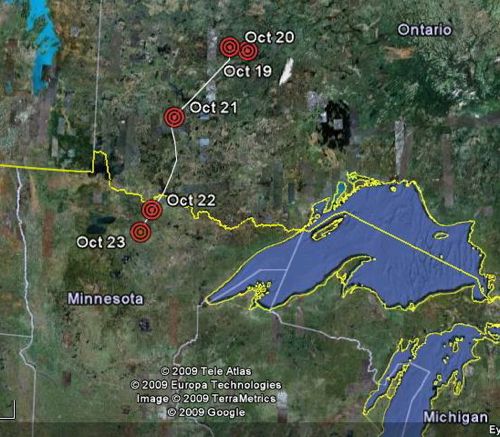
 Golden Eagle 42 has crossed the Canada/Minnesota border! Alas, this bird appears to be bypassing the Lake Superior Shoreline and probably won't go over Hawk Ridge. Our bird is currently in Koochiching County, MN. What route will he take to get to Wabasha? To follow more of Golden Eagle 42's story, check out Audubon Minnesota.
Bird Banding Lowry Nature Center, Carver Park
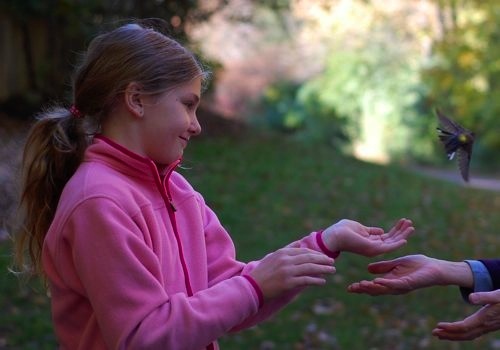 I had a rare free morning last Saturday and I realized that it was the third Saturday of October and that meant my friends Mark and Roger would be banding birds at Lowry Nature in Carver Park. When I arrived, there were dozens of bags full of small songbirds and my friend Amber was helping some Lowry volunteers process birds while Mark and Roger were out closing the nets to have time to work on the birds they had. The best part was that the kids observing the banding far out numbered the birds. They were excited to see the birds and have a chance to release them like the girl releasing the butterbut (aka yellow-rumped warbler) above.
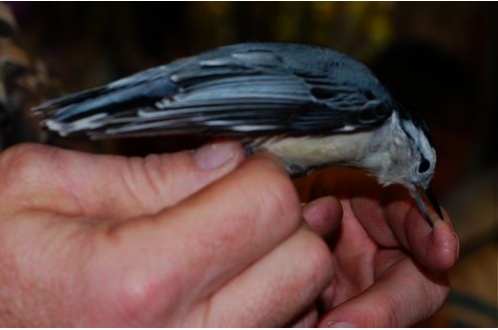 The did get in a few retraps like this nuthatch...or should we call it a fingerhatch? Most of the birds they got in were new and most were migrants.
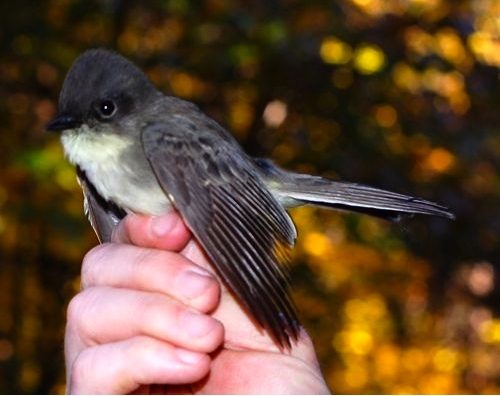 I was surprised that they got a an eastern phoebe in the nets. It was a good example of the mix of migrants we got in that day. There were quite a few insect eating birds and even though I was wearing gloves, they were still able to find some. On my way home I did observe some lingering tree swallows and chimney swifts so there must be some sort of insect population holding on despite the snow we've already had.
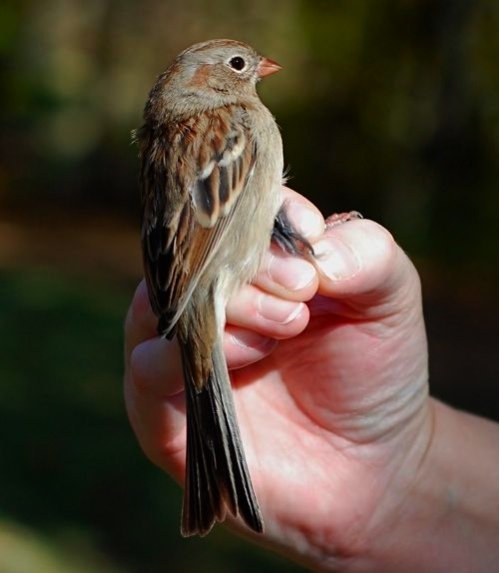 Sparrows are still around in good numbers, this is a field sparrow. These guys do not have to migrate as far as some. They spend the winter in the central and southern United States. I recall seeing them a few times in winter in my native Indiana. I will miss them while they are out of Minnesota and look forward to hearing the male's song on territory in the spring. The cool thing of banding records with tree sparrows is that we've learned based on banding that males who survive the winter, will return to almost the same territory...females do not.
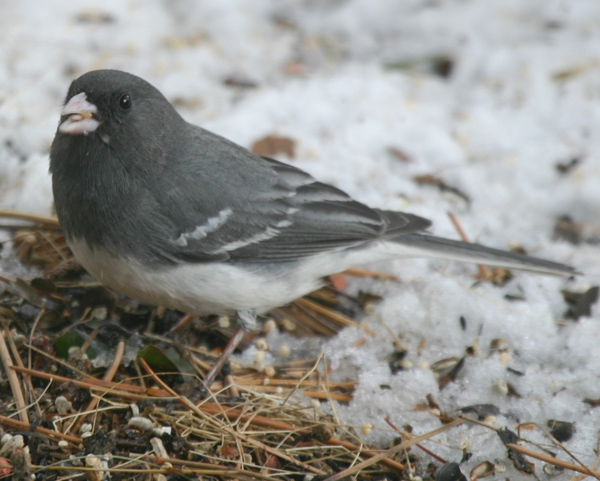
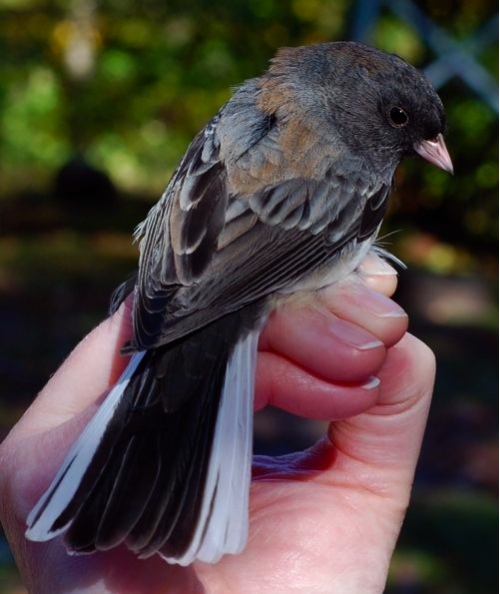 Lots of juncos were moving through (as well as white-throated sparrows mixed in with them).
 This junco was interesting. It showed hints of white wing bars. These juncos get in to a whole weird area for me. There are juncos that are called "white-winged juncos" but they are not the same as slate-colored juncos with white wing bars (I know, I know it's confusing). I'm not sure what's going on with the above bird. Mark and Roger wondered if it's some hybrid of slate-colored and white-winged junco, but tough to say. Note the white feathers around the eye--odd hybrid plumage or just lack of pigmentation?
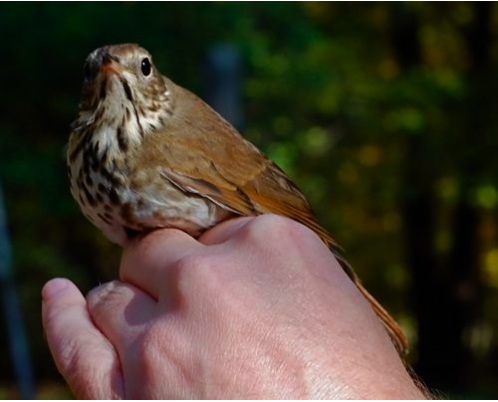 Hermit thrushes are still moving through along with tons of their cousins--robins. These birds have a bit further to go than the field sparrows. Some will spend the winter in the southern US, while others go all the way down into Central America.
 The big treat of the day in the nets for me were kinglets. Check out this male ruby-throated kinglet teasing us with a slight flash of his crown. These birds are so small, it's like taking a dust bunny out of the nets, I mean really, apart from hummingbirds, they just don't get much smaller than ruby-crowned kinglets.
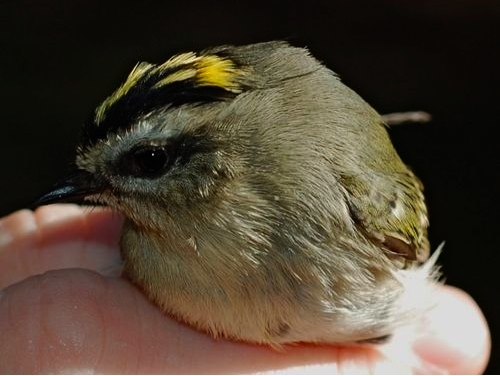 We also got in a female golden-crowned kinglet, another treat to see in the nets up close. She was soon followed by a female ruby-crowned...
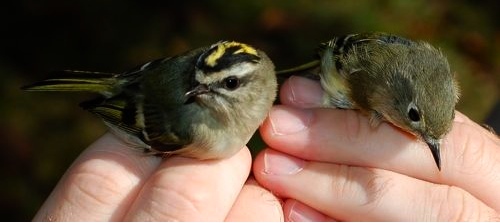 So we were able to get some comparison shots. Females of both species are different than males. The female golden-crowned lacks a bit of orange in the center of her crown and the female ruby-crowned lacks the ruby.
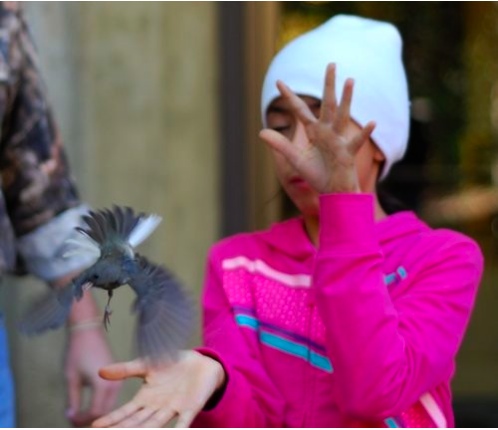 All in all it was an action packed morning. I heard Mark and Roger warning a few families who were visiting their banding operation for the first time that it's not always this busy, it's was combination of migration and a good weather front. I was just glad I had a chance to watch it. The next Carver banding day will be November 14, 2009 which is a week earlier than usual, but it's safer. The following weekend is the deer opener.
Hear About Birding & Digiscoping In Kazakhstan!
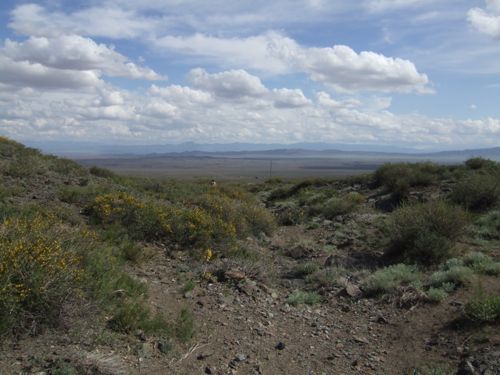 Tonight is my program at REI in Blooming on Birding in Kazakhstan for the MN River Valley Audubon Chapter and it's free. This is an excellent group to meet up with if you are new to the Twin Cities birding scene. It's a fun an eager group of birders. You don't have to be a member to attend tonight's event. Some of what I'll be showing has not been in the blog yet, so you'll get to see some new stuff!
Also, just a reminder, the next Birds and Beers is October 29. Click on the Birds and Beers tab at the top of the blog page to learn more.
Another Day Of Waterfowl Surveys

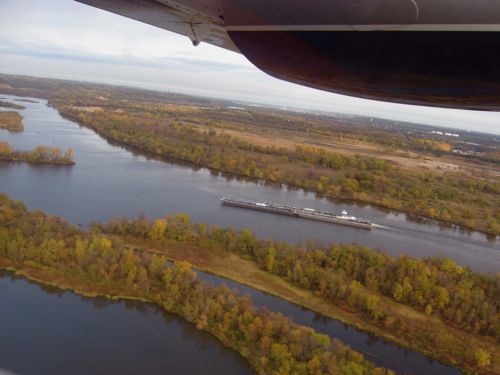
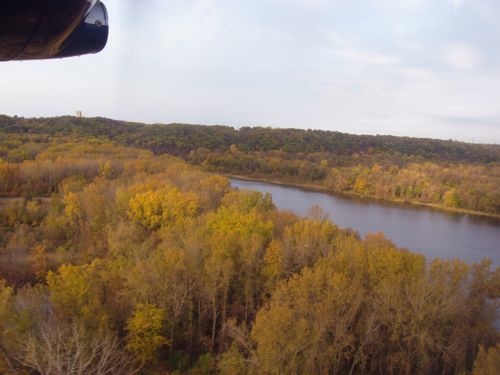
We did another aerial survey of the Upper Mississippi yesterday. It was beautiful morning to fly over the river. We still are not seeing huge amounts of ducks and our pilot who is flying surveys all over the places said that Pool 9 to the south of us is just packed with ducks and even a few tundra swans already. I'm hopeful that as it gets later we'll see more waterfowl, but this all part of a long term study--how and why is this area being used by waterfowl and if it's not being used...what could be the reason?

We passed quite a few duck hunters and again, we were so low that the hunters waved at us and we gave them a friendly wave back. One area was so full of duck hunters, I had to be very careful that I was not counting decoys. Our pilot mentioned today that it's very difficult to train people to aerial surveys--especially birders. He said that they lose most who try for two reasons: 1. Motion sickness (which as long as I don't drink too much alcohol the night before and have some snack crackers to eat if I feel a slight tinge of nausea, I'm good). 2. Most birders can't handle the speciation and counting at the same time from this angle and going that fast. I told the pilot that this reminded me a lot of shorebird id--using movement, shape, comparative size, and not using color too much to id birds. This is very much birding by "GISS Birding" (general impression of size and shape) or "Jizz Birding" as birders have a tendency to use the unfortunate slang spelling.

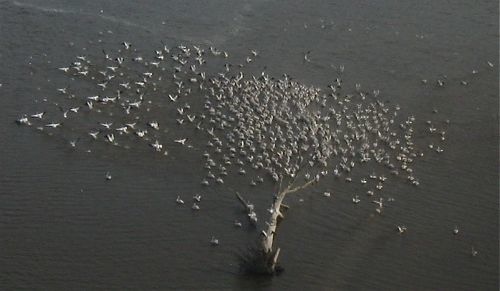
There are still many American white pelicans around. I love this shot of some loafing pelicans spreading out onto the water as we fly over. There were a few in the air and it's fun to watch the pelicans and the eagles soaring at eye level...so long as they are a good distance away. And again, the pilot had to veer to stay out of a soaring eagle's way--they don't move.

Ring-billed gulls on the other hand fly all over and all around our plane, easily dodging as we go by. Gulls are hands down the dominant species we are seeing on the survey, but we're not counting those. I get a kick out of identifying other bird species as we go over like the large flocks of red-winged blackbird (SO fun to look down and see hundreds below and their red should patches flashing--what a cool view), cedar waxwings, robins, and flickers--lots and lots of flickers.

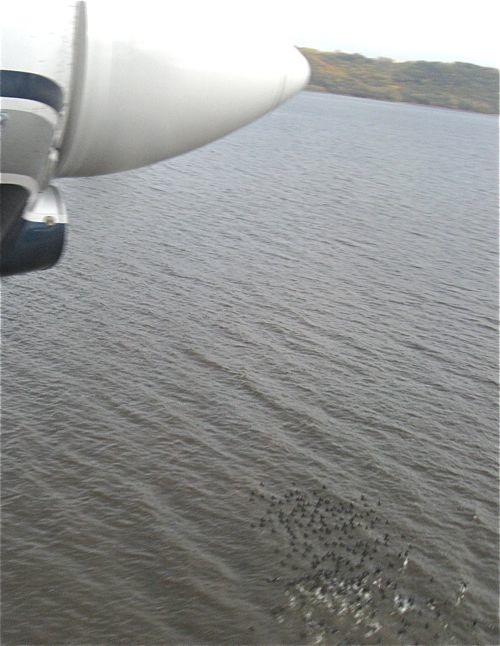
We're still seeing good numbers of coots, this was a raft out on Lake Pepin. I was very excited that we did see a few of our first divers--common mergansers finally. Their numbers should be huge in November. I've seen thousands in and around Pepin in late fall and have always wondered what it would be like to be over the river where they are. We also flew over some ducks that I was going to call mergs and the pilot called goldeneye. He saw the white patch on the face and I did not. I thought it would be more obvious to see the goldeneye white patch from overhead, but you're going so fast and your eye is drawn to their backs, I'm going to have to make a conscious effort to look at the heads.

Towards the end of the survey, we could see the coming rain. I was glad we were able to get our counts in before the weather got nasty. It was cool to see the sun trying to creep though the gathering clouds over Lake Pepin.

The rain hadn't quite hit when we were finished with the surveys, so I stopped at Black Dog Lake before going home to see if I could see some sparrows and to also just enjoy birds in the way that I'm used to--on the ground.

As usual, bald eagles were all over the places, including this young bird--so dark it looks like it was hatched this summer. When they are young like this, they look like disaffected youth who don't know what to do with their bodies yet...with really big noses. That beak almost looks too big for his face. Why does it look more streamlined when the head turns white and the beak turns yellow?

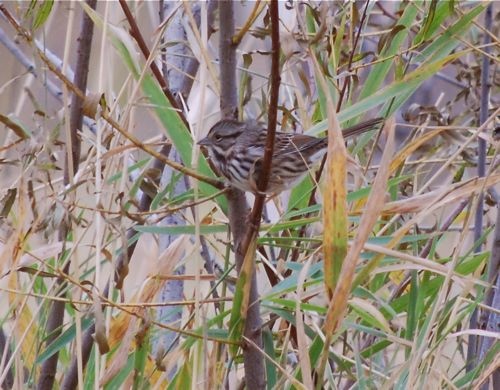
There were quite a few sparrows, but only this song sparrow was brave enough to pop up from the grasses. What could have been the reason to lay low?

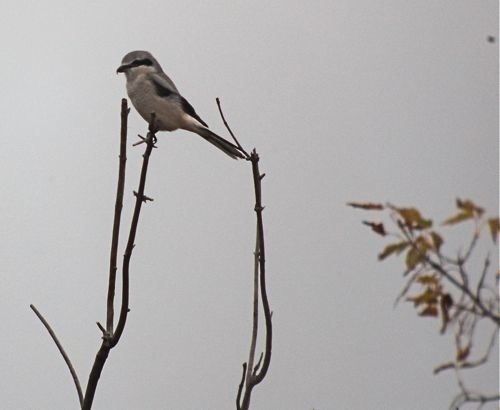
A shrike. I had to think a minute because loggerhead shrikes nest in Minnesota in summer and then migrate out. Northern shrikes come to Minnesota in winter...I had to take a look and remember which one has the thinner mask and thicker bill--it's a northern shrike. This is a fairly reliable spot in the Twin Cities for a shrike in winter.
Hot Kingfisher Shots
If you have a hankering to see some cool photos, check out the Kingfishers article from National Geographic Magazine. The underwater shots are unbelievable!
Warblers In Hand
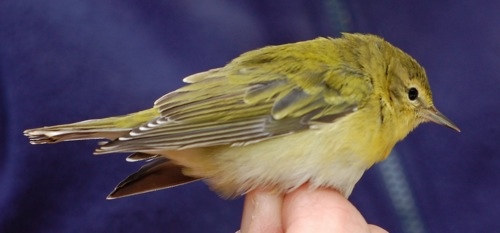
Here's another fall warbler that we still having hanging around in the Twin Cities. This bird hit the nets a few inches from a yellow-rumped warbler. When Amber arrived to take them out, she had to separate them--they were fighting each other! I wonder if they chased each other in? I wasn't sure what this bird was, but suspected orange-crowned warbler. However, Mark and Roger were not so sure and we had to go through a couple of different field guides to figure it out...it didn't help that the bird did not match exactly any description. Even using the vent key in the Peterson warbler guide wasn't 100%. But after a series of "if this than that" we narrowed it down to Tennessee warbler. Whew.
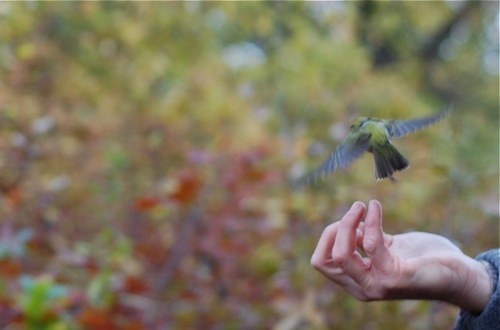
So take heart new birders, even in hand fall warblers can be difficult to id.
Golden Eagle 42 Is Getting Closer
Here's this morning's update on Golden Eagle 42!

Mark Martell reports: "Our bird continues to move south although he slowed down a bit over the weekend (don’t we all). He spent last night in Ontario at approx. 52 N. Lat and 91 W. Long."
To read more about Golden Eagle 42, check out Audubon Minnesota.
Testing

Testing out an application for loading photos. Here's a yellow-rumped warbler that was banded yesterday. There are still quite a few warblers to be seen around Minnesota!
Fall Robins
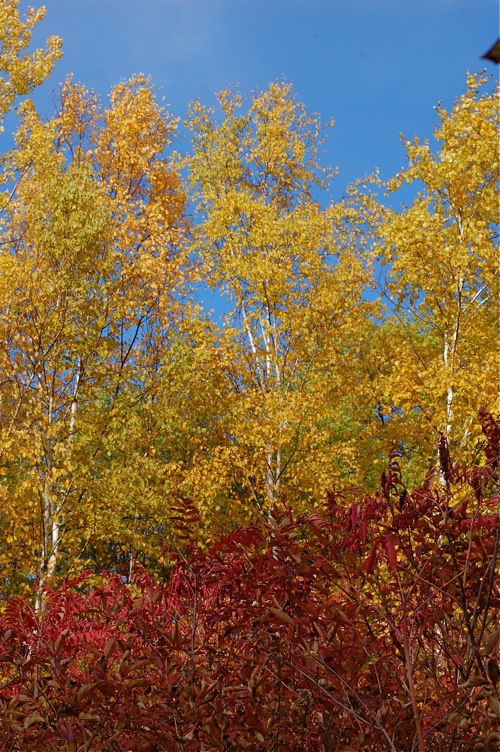
Despite the snow we had in earlier in the month, the autumn appeared to really itself this weekend and give a couple of days of proper October weather. Fall color peak is creeping into the Twin Cities, especially along the Mississippi River. I had the fortune of being able spend a couple mornings around my banding buddies Mark Newstrom and Roger Everhart so expect a few entries about bird banding this week.
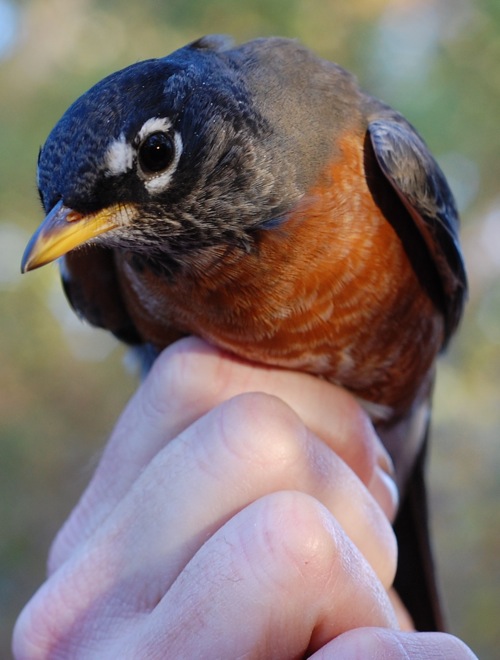
Robins are definitely on the move and the northern robins have moved in to the area. When I left this morning, I could hear them all over in the tops of trees in my neighborhood. Mark and Roger got a few in the nets.
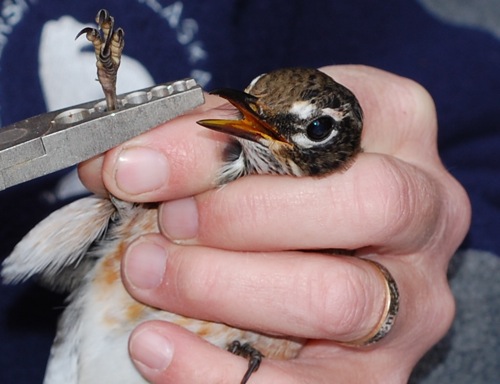
Robins put up quite a fuss when handled, trashing about and squealing. They even try to peck at you, but with that softer bill, they are nothing compared to your hard pecking chickadee or titmouse (birds who also have an instinctual knack for nailing your cuticle). Robins sound loud and squeaky but are in the end about as threatening as a kinglet.
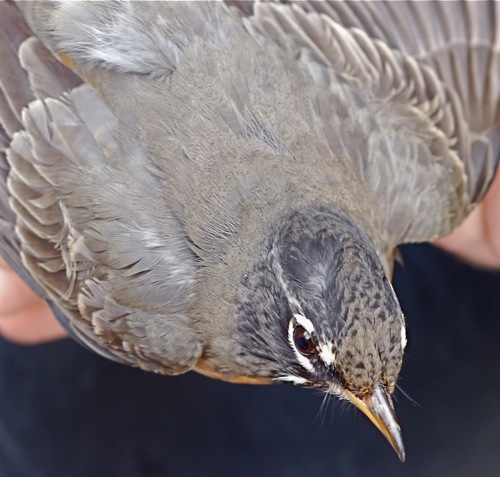
I think all the robins I watched them process where hatch year birds but some looked older than others. Roger pointed out that some hatch year birds could have hatched in April, others as late as August. Some would almost look like an adult, while others like the above bird with a combination of of immature lighter feathers and darker adult feathers.
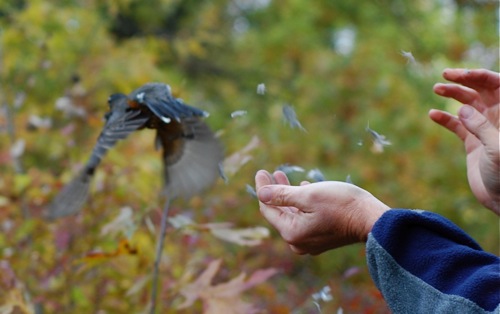
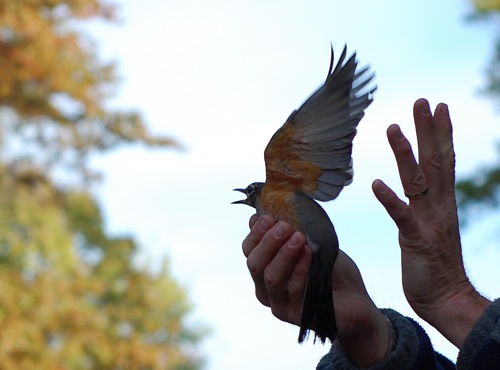
The other thing that is tricky with robins is that they seem prone to "fright molt" or dropping a bunch of feathers when freaked--as evidenced in the poof this one leaves behind as Roger releases it--almost looks as though the bird is releasing one heck of a fart as it takes off. It's believed that birds evolved to lose feathers especially around the rump and tail as a way to escape predators--a predator is more likely to grab in the back and grab feathers first. Doesn't always work, but sometimes birds do get away.
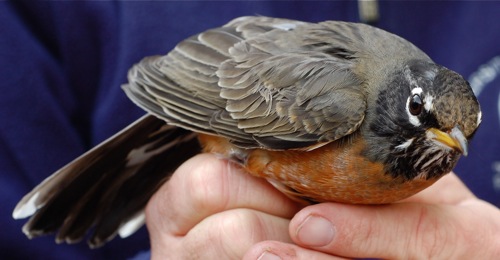
More bird banding tales coming, I leave you with a few random photos of robin releases:
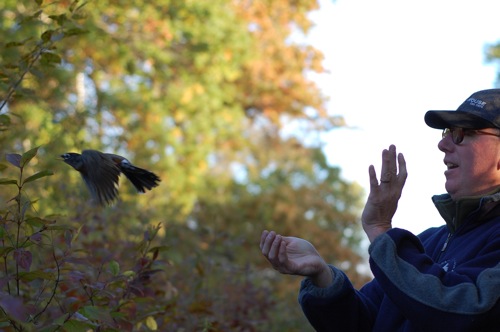
.
Golden Eagle 42 Could Be In MN Soon
I've had a few odd raptor moments in the last 24 hours. Yesterday, I came home from the grocery store I just happened to be facing the right direction and noticed a red-tailed hawk perched high in a neighbor's tree. As I was calculating if I had time to run upstairs and get my scope, I noticed a gray squirrel with trashing tail working its way up to the hawk. The red-tail watched the squirrel with intense interest. Before I knew it, the squirrel charged the red-tail and drove it off! Huh? And then--I saw a gray squirrel do it to a Cooper's hawk outside my living room window this morning! What is going on in my neighborhood? Have the hardened urbanized squirrels declared war on raptors? Crazy.
Speaking of raptors, remember Golden Eagle 42, the eagle my buddy Mark Martell has been tracking as part of the study on golden eagles that winter along the Mississippi in winter? Well, the bird is booking a hasty retreat back to Minnesota. After recovering from a leg hold trap injury at The Raptor Center, the eagle was released last spring. He took his time heading north and arrived to late for breeding. He didn't appear to set up a nesting territory, but rather lived the free wheeling life of a bachelor eagle in Nunuvaat--north of the Arctic Circle. As of September 21, the golden was still in Nunuvaat, Canada hanging around Franklin Lake.
A report came out that the golden eagle was showing a definite movement away from Franklin Lake, covering about 400 miles between October 7 and October 11! According to Mark, the eagle is not retracing his spring path but basically taking a compass heading south.


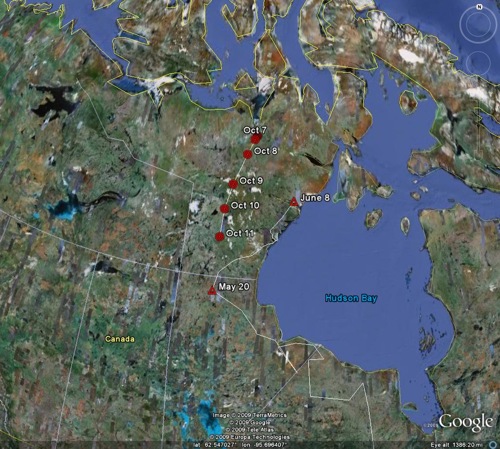
Here's a copy of the map of Golden Eagle 42's movements sent today! Look at him go. This map shows that between Oct 6 - 15 the golden has traveled 926 miles (1,444.23km) and the last reading had him at 54degrees lat. The distance he covered in any single day varied from 14 (first day) to 170 miles (23 – 274km)! Mark said that if he continues this rate of travel he should be in Minnesota by the beginning of next week--holy cow!
I wonder if he will fly over Hawk Ridge? If you would like to learn more about Golden Eagle 42, check out Audubon Minnesota's website.