
Birdchick Blog
Some Winter Bird Feeding
I'll be heading to Atlanta for the birding trade show called Bird Watch America tomorrow looking for the latest and greatest in new birding products. I'll also dip my toe into the ginormous AmericasMart because I suspect quite a few birding vendors are hiding there. I'll probably do quite a bit of preview photos through Twitter if you would like to follow or check that out between blog posts.
My buddy Kirk who is behind the blog Twin Cities Naturalist and I were talking bird feeders last night. I was out getting photos of some of the feeders in my OpenSky store. We started talking about the Yankee Whipper, a feeder I've had great success with that he said had a design flaw. Surprised, I asked what he meant and he sent me this video he aptly titled: Squirrel Abs of Steel.
I think if that's how I had to eat, my abs would rival Shakira's. Yikes.

I had a meeting yesterday morning and while I was out and about, I stopped at Elm Creek Park for a few minutes just to soak up some birds. I won't have time to do much of any birding in Atlanta--it's all about the bird product. The tree sparrows were the largest numbers I've seen all winter.

And boy were they feisty with each other. The nature center does a good job of putting food out, but with our sub zero temperatures freezing the snow solid, easily available food is rare and birds will fight for the best access to the food source.
Speaking of winter survival, Cornell's Celebrate Urban Birds is hosting a contest. They are asking for people to send in photos, drawings, sculpture, video, story, poem--or anything creative to show how birds survive winter in urban environments.
What are you seeing in your neighborhoods?
This Hawk Is So Tiny!
How tiny is it?
How about this: it preys on hummingbirds! Below is a video from the FatBirder Channel on YouTube. It's a bird called a Tiny Hawk (Accipiter superciliosus) and it is about 8 inches long. To give you an idea, a robin that you would see in your backyard in North America averages about ten inches. Cardinal average about 8.75 inches. To give you an even bigger idea, the hawk in the video below is eating a hummingbird called a white-necked jacobin!
Don't worry, the video is not that gross and is very cool. Be sure to check out the other videos at FatBirders's YouTube Channel.
CUTE! Owl Goes For Shuttlecocks!
Here is a link to a story of an adorable owl called a brown hawk owl (which looks like a cross between a boreal owl and a sharp-shinned hawk) that was photographed going after the shuttlecock from a badminton game.
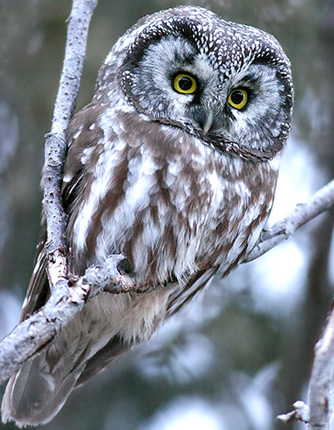

I especially love the photo of the owl trying to eat the shuttlecock--I'm sure after that non taste sensation, it won't be trying that again.
Gulls Want In On The Whaling Action
Well here is a strange bit of video from the BBC:
1. Strange because the newscaster refers to the birds as seagulls (oh BBC, I expected so much more from you).
2. It's a story about gulls tearing pieces of flesh of the backs of live whales that surface the water.
On the one hand, you have to admire a creature's ability to be adaptable and find an ample food source, especially such a comparatively small aerial animal feeding off of such a large marine mammal. But on the other had, it's a scary testament of how imbalances occur at the expense of other creatures by human habits.
Loring Park Crow Roost
A big thanks to Non Birding Bill for filling for a day. I had a moment of panic. Every year, my agent sends me a nice card with a note of a charity that received a donation in my name for Christmas. This year, I didn't get a card. I kind of panicked. I have an author friend who had a GREAT book agent. She wrote a very successful book that won awards and then began working on her next book. Working on that next book went one year, into two years, well on it's way into a third year. And then one day, her agent dropped her. I had no idea an agent could drop you. When I didn't get a card, I had a moment of, "Oh crap, I'm gonna get dropped!"
I buckled down and worked a fourth draft of the bee book I've been working on the last year and a half. In the middle of all of this on Christmas Eve, we received a lovely box from my book agent that included lots of lovely cookies. I suspect that I'm not getting dropped, but nothing like a healthy dose of fear to get a writer to finish something. I suspect I have more tweaking to do with this draft, but it's shaping up to be quite the story and incredibly different than anything I've written before.
I finished the draft right before New Year's and decided I needed to do some birding New Year's Day. For the past few years, we have camped out at Mr. Neil's for New Year's and I have a leisurely morning of watching winter birds from the kitchen window on January 1. This year, Mr had incredibly exciting plans for bringing in the New Year in Boston with his special lady friend (as opposed Doctor Whoing in the New Year with NBB and myself) so we chilled with friends in our neighborhood (and I mean chilled literally, I don't think it's been above zero since the New Year began--on the upside, lots of coffee and snuggling for me--whoot).
I thought I would start the New Year with an owl and headed to the screech-owl spot but that bird was tucked someplace warmer. I've tried several times for a snowy owl at the Minneapolis/St Paul Airport and have come up empty every time, it was no different January 1, perhaps no snowy there this year? I then went to Big Willow Park which has been good for northern saw-whet owls in the past and could find no sign of an owl. It was not the most pleasant temperature for hiking so perhaps I wasn't giving it the try I normally would. I finally decided to go for some birds that I know I would see--the crow roost in Loring Park. I texted Non Birding Bill and asked if he wanted to come with me (the crows meet his requirements: big, obvious, easy to see). I grabbed him and we followed the lines of crows heading towards the roost in late the afternoon.
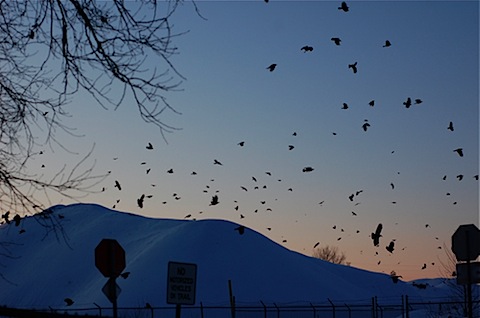
In the winter, as afternoons start to fade, you might notice lines of crows flying towards a central location. The lines will come from all directions towards a central spot. Crows are flying from all over to a central night roost location. Studies suggest that crows will fly as far as 20 miles from their roost spot foraging for food during the day. Then in late afternoon, they fly back to the roosting spot. A roost could have literally thousands of birds gathering to it. I'm not sure of the exact numbers of the Minneapolis roost, but it would not surprise me if it went past 100,000 crows.
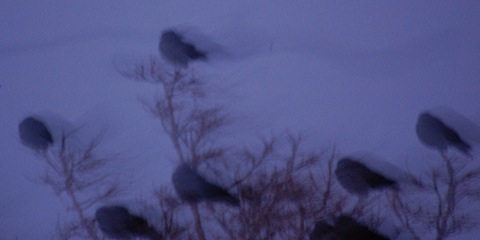
The crows are all over Loring Park and along the bike path near the new Twins Stadium. I think the crows chose the southern part of downtown Minneapolis for a roost because there would not be as many natural predators. Also, an irritated farmer couldn't shoot at any of the crows to drive them away. This roost still has at least one predator to worry about--great horned owls. They start their breeding season in Minnesota now. You can bet your bippy that a great horned will take a crow or two on the outside of the roost this time of year. It's one of the reasons they attack owls during the day.
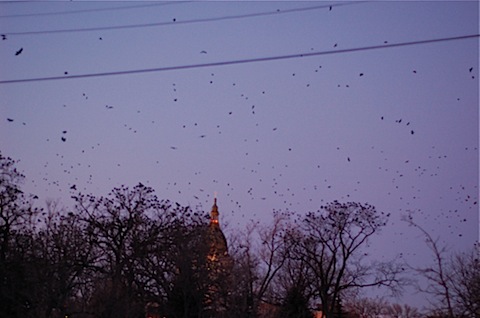
As we watched the amazingly huge sheer number of crows, it struck me that this was incredibly similar to watching the sandhill cranes coming in to roost on the Platte River in Nebraska. I wonder why some birders (including myself) place such a mystical value on cranes but not crows. I'm not anti-crow, but I've noticed this roost before, have always that, "Yeah, I need to check this out," but never do. Yet, I've invested a lot of money in 9 or 10 trips to Nebraska--I've even taken others. I've frozen my tookus off at dawn in a blind and yet, here's this cool gathering of birds practically in my backyard that I can watch from the warmth of my vehicle or from one of the many eateries or bars in downtown Minneapolis. Perhaps I am like the locals in Kearney, NE who smile thinly and say, "Oh, yeah," when you tell them how excited you are about their 40,000 sandhill cranes.
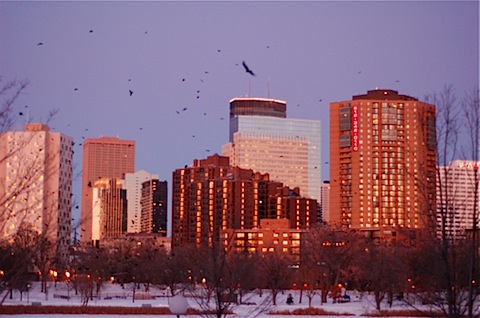
I think I'll schedule the January Birds and Beers someplace in Loring Park so we can watch the roost. The parking might be a bit trickier, but we'll have one heck of a show with all the crows coming in. They should keep coming until their breeding season kicks in in March. I've never paid attention, but I wonder if the roost gradually disperses over a period of weeks or if the break up of the winter roost happen rather quickly as pairs set up territories?
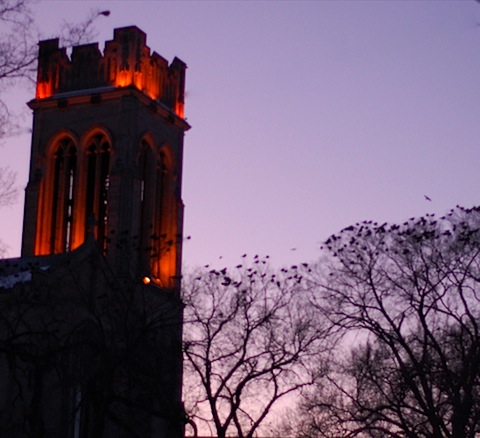
NBB and I tried to get some video of the crows so you could hear them (and the traffic) and get an idea of the size of the roost. This isn't even half of the roost:
Here's another video near Dunwoody of crows staging. It's the sound of all the crows that you can't see that amazes me:
l
UPDATE: Commenter Ren has this video of the same crows flying in to the roost. This video was taken from an apartment building looking down on the crows coming in to the Minneapolis Roost. It's a very cool view!
NBB's New Year's Eve Post
Hello all, NBB here. Sharon's been furiously finishing the latest draft of her next book, and that, combined with the Christmas Bird Count and the holiday season, she's run out of time for blogging. So we're stuck together. I don't like it any more than you, but here we are. I was going to do a post about my year in birding, but that wouldn't fill a Twitter post. In fact, I think my life list shrank in 2009. I started writing a Year's Best Bird list, but only got as far as:
Pigeons Coming off the bird flu scare a few years ago, pigeons are back in a big, big way, lead in no small part by the Feral Pigeon Twitter feed, with such thrilling posts as Shifty look and Slow walk ... bob ... bob ... bob. Pigeons are on track to meet or beat the end of year records, but don't listen to the naysayers: you have to see a pigeon in 3-D to get the full effect.
But then I think I've made my affection for the Rock Dove well known.
So instead, here are my hopes for the new year, as relates to birding.
- Panama. Sharon's going on a trip to Panama that's she very excited about, something about the canopy tower where I gather she's going to cavort with Ewoks while watching birds with binoculars made out of coconuts. While I'm certain she'll have a good time and take great pictures, my hope is that the time passes quickly.
- Camping. Three years ago Sharon got me a tent which we've never so much as taken out of the carrying case. I really hope to get some use out of it in the coming year, especially since my own personal Ranger knows so much more about our local parks, and so I can also make use of my latest Christmas gift, a Titanium Spork.
- Conservation. You want to help birds? Do something for conservation of habitat. An easy way to do that is to buy a Federal Duck Stamp. They're $15 bucks (that's three cups of fancy coffee) and 98% of it goes directly to maintaining habitat.
And that's it. Have a safe and happy New Year's, everyone!
Birds of Snowpocalypse
For those like my mother who lives in Indianapolis (who are getting Rainmageddon) and cannot experience the white Christmas we are enjoying in the Twin Cities, I thought I'd put out my Wingscapes cam to get some photos of birds and the falling snow. I forgot that I had it set to take video, so here is a cardinal in the snow:
I love the crow who seems to be on cue giving periodic two caws for ambient noise. Love the little dome over the tray to keep the seeds dry and uncovered.
Happy Holidays to everyone--however you celebrate it.
Thank you so much for taking the time to visit my blog throughout the year and a special thank you to everyone who sends to that read, "I've never really noticed birds before reading your blog, but..." and then you send me your bird story. That's what makes sharing my bird stuff so fun.
Screech Owl Kind Of Day
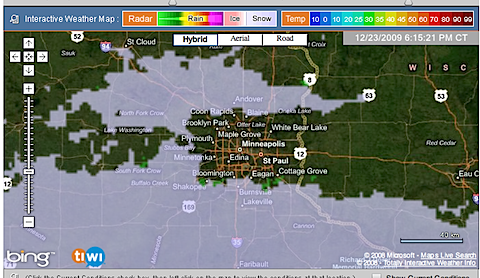 As I type this entry, this is what the snow cloud RADAR looks like from KSTP. Non Birding Bill and I live in Minneapolis. The surrounding clouds kind of look like Oogie Boogie Man from The Nightmare Before Christmas about to nom us up. We may also be feeling the benefits of the bubble effect, sometimes big storms pass around the Twin Cities rather than right through. I am suspicious of the hype with this storm. Suspicious that we will not get the 24 inches predicted all week. NBB says I'm crazy to doubt this, but I'll believe Snomaggedon when I see it.

I thought I'd go out and do some birding before the pending Snowpacolypse today. I wanted to see if I could find a snowy owl at the Minneapolis St Paul Airport but did not--got totally skunked. All I found were eagles and a few snow buntings. I ran into my buddy Linda and her husband and she told me about an eastern screech-owl that was visible from one of the trails at Minnehaha Park.
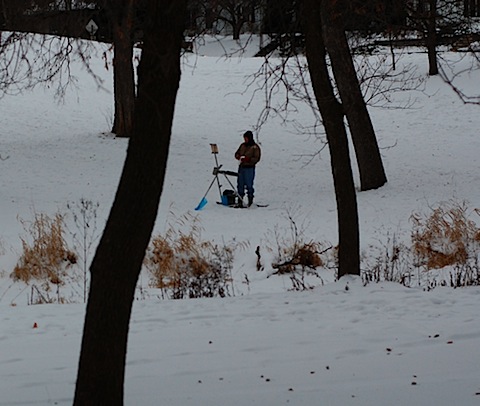
When I arrived at the park, I could see the true spirit of the Minnesota. There was an artist out with his easel set up and all his layers appropriately applied so he could do a landscape in oils of the frozen creek. It was twenty-nine degrees, so with some well placed SmartWool socks, he could be quite comfortable while he painted the landscape with the snow that we have already accumulated this month. I searched the surrounding tree based on Linda's instructions. I scanned for every potential cavity then was surprised when I found the owl roosting in a cavity up above the artist! The artist's back was to the owl, he had no idea of the tiny silent sentry keeping watch while he worked his oils.
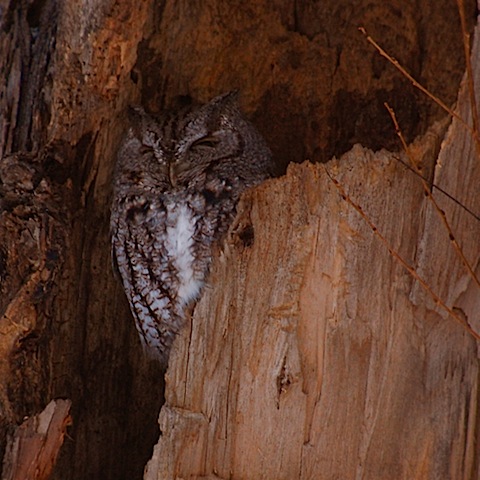
I got a few photos of the gray phase eastern screech-owl (I even took a photo with by hand holding my Blackberry to my scope and sent it to Twitter), then went over to the artist to point out the owl. I think he was expecting something larger, but still found it cool. I know screeches are urban owls, years ago there was a pair of red phases nesting a few blocks from our apartment. This bird seemed very used to this spot, I noted the well worn sledding tracks right beneath and around the tree with the owl's roost--this owl is very used to people.
Trees aren't the only place to look for screech-owls. Yesterday, I got a photo in my inbox. Someone had a surprise roosting in the slot for their daily newspaper below the mailbox:
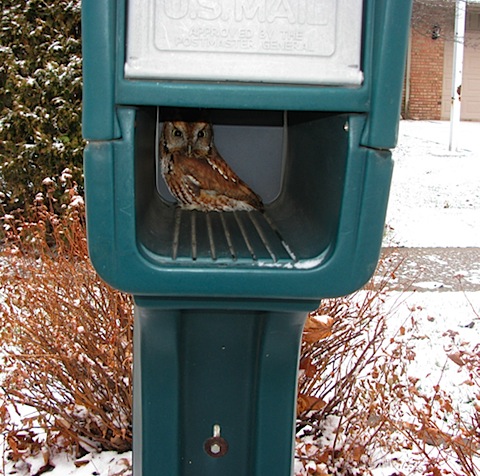
A red phase eastern screech-owl (the same species I saw, but just a different color variation). I did not take this photo. The photographer lives in the Midwest but would prefer that their name not show up on the Internet. Screech owls naturally nest and roost in old woodpecker cavities, kestrel boxes or wood duck boxes. Sometimes, if they can't find a cavity, they make do with an unusual structure. Another reason to put up a wood duck box or let old trees with cavities stay up if they are in a spot that won't risk damage to your home.
Now to watch and see if we get any of the snOMG!
snOMG!

I love this female hooded merganser. I caught her the other day as she was splashing around Point Douglas.
I guess the Minnesota weather elves heard all about the two feet of snow had by Washington DC last week and we're supposed to get a storm starting tonight. I have my doubts...when storms are over reported and the weather peeps say we are getting "the snows to end all snows," we tend to only get a dusting. So this soul crushing White Christmas that will snarl last minute holiday travel may end up being a few friendly flakes. And if you doubt that they are hyping this storm, here's a screen shot from one of our local station WCCO:

WCCO cracks me up. They are the alarmist weather station. Whenever you want to know the most extreme version of Twin Cities weather--check them out. They will really take on the storms and give you the worst possible scenario. KSTP will give you the skeptical view of the storm, maybe even an expose of how it's trying to swindle Minnesotans. KARE gives you the story behind the storm, the human and emotional aspects of the storm. FOX delivers it like it's TMZ.
Lilydale Christmas Bird Count

Last Saturday I helped out with the St. Paul Christmas Bird Count. I love the above photo, that's two of our team members standing on the frozen Mississippi River counting ducks with the downtown St. Paul skyline behind them. My original intent was to just be part of a team, but St. Paul Audubon needed someone to lead the count and I thought it would be fun to do a section that was part of the National Park that I work for. We mainly worked the Lilydale Park section. I had great volunteers and it was a treat to meet some new local birders. It was an easy going group and I am so grateful to John who introduced me to Jerabek's Bakery (my new favorite bakery and a must visit if you are in St. Paul). I requested that we meet before dawn at 6:30am and everyone did. We tried to do an owl survey and got completely skunked. I played calls for saw-whets, eastern screech, barred, and great horned (keep that in mind for later in this post). However, even though we were nooged on owls, we were rewarded with excellent views of river otters rolling around in an open patch of water on Pickerel Lake--bonus! It was too dark for photos, but man what cool mammals to watching through the scope in the dark (thank you Swarovski for that most excellent light gathering ability).

Lilydale is an interesting little park in our metro area and one that I'm loving more and more. For one thing, you can get permits to go fossil hunting there--how cool is my town? You can go fossil hunting in the Twin Cities metro area! The bluffs at Lilydale are chock full of St Paul brickyard history as well as geologic history. You can see three distinct layers of rock from when this used to be part of an ocean: sandstone, limestone and shale. Many come to look for the fossils of ancient sea life in the shale and limestone. Water trickles through and creates lovely ice falls which attracts a few climbers in winter. We were lucky to get a day for our count that had temperatures in the teens and twenties. When we stood still it felt chilly, but as we climbed the hill in Lilydale, we stayed warm.

Robins were our most common species (if you don't count the ginormous flock we tallied in downtown St Paul). This interesting Robin was found in a yard by one of my team members--it's lacking pigment in some of its feathers. It's not leucisitic--the colors are not washed out, it's just some of the feathers are white. Scientifically, something cannot be a partial albino--it's one or the other, there is no in between. There are a lot of names tossed around out there, but no one has come up with an easy term to call a bird with patches of pure white, other than to say that the bird lacks pigment in some feathers.

Here is the front of the robin--you can see it was lacking some pigment on its breast feathers as well.

We did see quite a few red-tailed hawks like the above immature bird. I was surprised that we did not get any Cooper's hawks, I usually see one at Lilydale, but they remained hidden. This bird was actively hunting the field near the boat launch off of Shepherd Road.

One of our goals was to get the down St. Paul peregrines included on our count. I chuckled as I scanned a peregrine box on the Landmark Center that had a red-tailed hawk perched on it.

We did eventually find some peregrines, so I was happy we kept up that goal.

While we were out documenting as many bird species as we could, we were surprised to find a muskrat out and about on the ice. This little mammal should be tucked away in a little mound in a marsh, sleeping away the winter. This one was on ice right in downtown St Paul, not near too many places for a muskrat den.

Just as I was thinking, "Wow, that's an easy target for an eagle," one showed up. The blue arrow is the muskrat, the red arrow is a bald eagle. Can you see the eagle's landing gear down? The muskrat saw the eagle and smartly slid into the water.

The bald eagle landed on the ice and watched the edge where the muskrat dove into the Mississippi River. Then a moment later--the muskrat popped back up on the ice. The eagle stared, almost as if assessing the situation. The muskrat behaved as though the eagle was not there. The watched intently. I wondered if it realized that if it spread its wings and went for the muskrat, that it would easily see the predator and have time to dive back into the river. The muskrat trundled along, turned and suddenly seemed to notice the eagle. It hopped a little (almost as if it said, "DOH!") and plopped again into the river and hightailed it towards a separate piece of ice. The eagle remained on the ice for quite some time. So long, that we had to leave to count other birds.

After we did Lilydale Park and downtown St. Paul, some of my group went home (understandable, it was a long day). The remaining group went out to cruise the neighborhoods for bird feeders and a few species we missed at the park--like turkeys. We found a huge flock of 12 marauding a rather upscale neighborhood. By the end of the afternoon, I looked at the time, I only had about an hour before I had to work an evening shift at the park service and the light was fast fading. We made one more pass at the park.
We passed some trees that I thought looked good for saw-whet owls. A cedar and a pine. I left my scope in the trunk and said, "That will guarantee we'll see something good." We walked underneath the trees and there was quite a bit of small owl poop. I was convinced if we stared at the cedar long enough, a saw-whet owl would materialize. Suddenly, we heard a flock of very angry chickadees. I looked in the direction of the sound...I saw a lone cedar tree. "That's where the saw-whet is, let's go," I said.
We crossed the street and approached the tree surrounded by alarmed chickadees. We were within about 30 feet of the cedar and a medium sized owl flushed from the cedar. I saw distinct buff panels on the wings and realized instantly what we flushed--a long-eared owl. It perched in some thick branches nearby, I got a quick look at the slender bird and it flew further away. DOH!
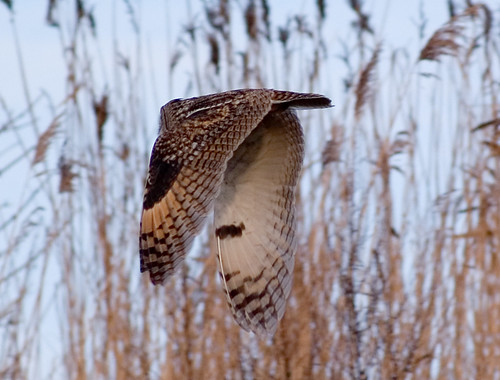

I wasn't expecting a long-eared. If I had, I would have approached that cedar in a different way, they are so cagey. We looked at the base of the cedar it was perched in and found much larger poop marks and a fresh pellet. I have Tuesday off, I might head back to Lilydale and see if I can get it in the scope and take a photo.
All and all, it was a great day. I was lucky to have such a great group to count birds with and I appreciated all of their help. One was even a fellow beekeeper--loved to meet someone else working the hives.
Digiscoped Images
Fresh Tweets
Would you like to hire me as a speaker for your event?
Email sharon@birdchick.com