Peregrine Falcons At The Colonnade

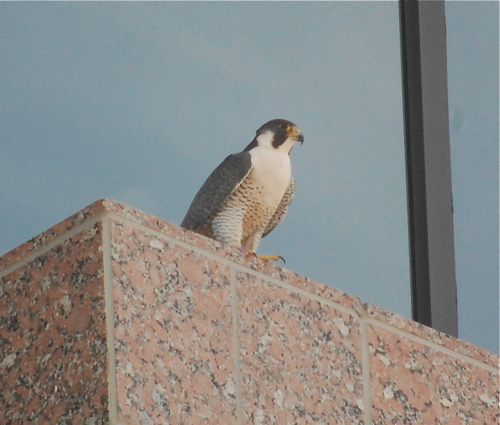
I was out at the Colonnade to check out the peregrine falcons that nest on that building.  I had a KARE 11 segment this week and when I drove by the tall building, I could make one of the birds perched on the nest box ledge.  When I returned with my digiscoping equipment that male visible.  This is a nesting territory that I've blogged about before and some very interesting prey items have been found in their nest box.
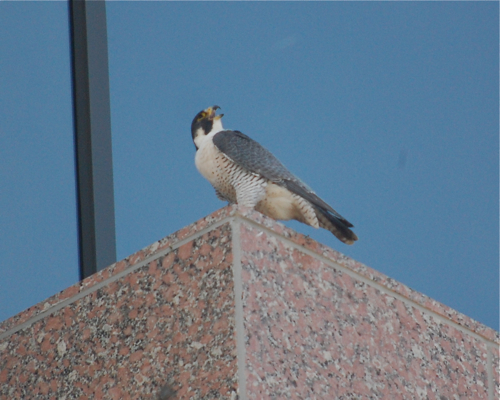
As I watched him for a bit, I wondered if he had a female laying eggs or incubating.  Then he kept looking up and soon began to vocalize.  When I volunteered at The Raptor Center and we would be outdoors with the education birds, we learned that if they looked up, you should look up, they saw an aerial raptor--sometimes it would be a mere pepper speck to me.  I tried to follow the male's gaze skyward but could not see any other raptors flying over.
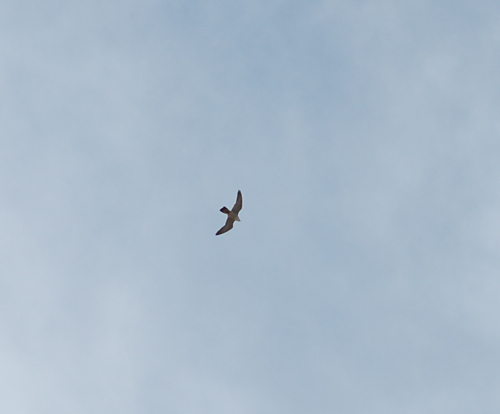
Then I saw her.  A big female circling...and then I saw a second one (who was too fast for a photo).  An aerial battle between two females was underway.  Look at those distinct pointed wing tips that separates a falcon from a red-tailed hawk! In raptors, females are larger than the males (especially with peregrine falcons) and the females will engage in bloody battles to the death for prime territory.  There's an infamous story from the Colonnade in the 1990s of 2 females who battle for over 2 and a half hours for the nest box--one losing an eye and eventually her life.  Excited at my discovery of an aerial battle, I texted my buddy Mark Martell who has been involved with banding the birds at this building.  He immediately replied, "I can just see you out there shouting, 'Chick fight!'"

He wasn't too far off in his guess.  The best part of it was as the females circled the building and chased each other, the male remained at his perch screaming...perhaps he too was calling, "Chick fight...over MEEEEEEEEEEE!"
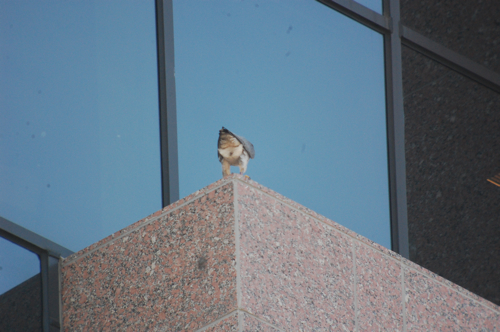
Actually, he did something kind of interesting.  As the females duked it out in the air, he hunched over, fluffed his feathers and appeared to flash his cloaca.  I wondered if this was some sort of display of encouragement to his mate or he was just flashing the goods to the females, "Yes, ladies, this is what I have to offer the winner of this display!"

The battle was probably more about the territory than the male.
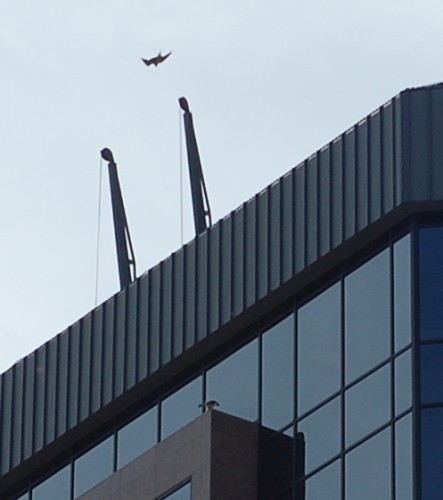
It wasn't a very serious battle and it soon ended.  The other female was chased off and the remaining female circled the building and flew to the ledge where the next box it tucked away.  Mark said that the people who monitor the falcons from inside the Colonnade report there is one egg in the nest.
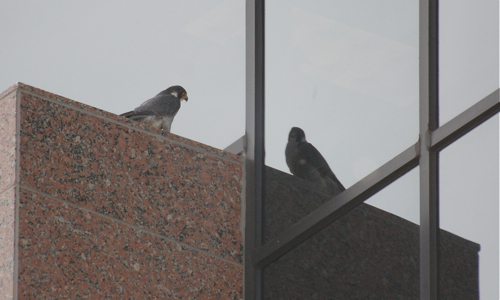
After all settled down, the male continued his watch of their skies from a nearby ledge.  Then he walked towards his reflection on the windows.  If one were to attribute human emotions to this bird, he could be thinking, "Yeah, boy, you are the total package.  They wanted you, my man."

But who knows what drew this bird to the window.
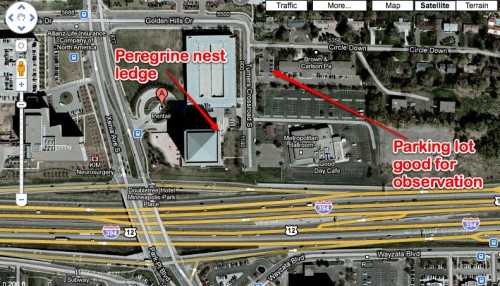
If you want to watch the peregrines at the Colonnade there is a small parking lot to the northeast of the building--just to the east of the parking garage for the Colonnade.  You could also try driving to the top of the Colonnade's parking garage and watching from a scope there but I'm not sure how the building's security team feels about that.  The Colonnade is on the northeast corner of hwy 394 and the Xenia Ave & Park Place exit on the west side of Minneapolis.
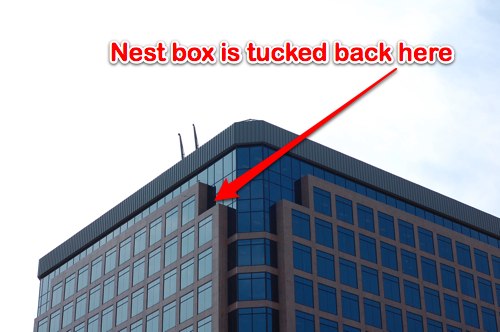
If you know what to look for, you can usually make out one of the adults perched on the ledges of the building.  But to see the falcons well, you will need to have a scope or at the very least some binoculars to get a better look.
Cat vs Fox While Eagle Watches

This is from the same YouTube Channel that I posted earlier of the eagle contemplating the tastiness of a cat: [youtube]http://www.youtube.com/watch?v=V63-jJknM9A[/youtube]

I think putting scraps on your deck to attract foxes and bald eagles and allowing that wildlife to mingle with your cat is a risky proposition. One day there will be a larger fox who will not be so started by that cat.  Or maybe the local food will not be enough and the usually satiated predators will try for the cat.

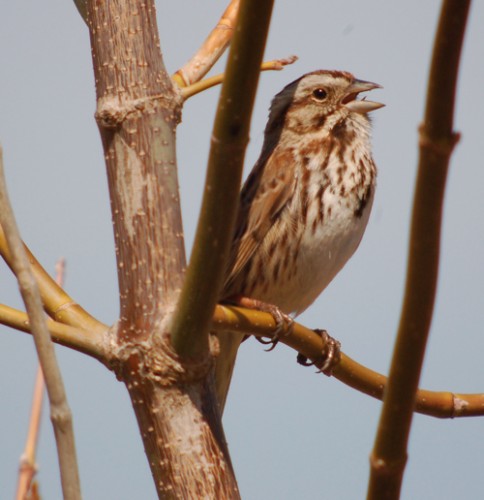
Random Song Sparrow

Holy cow I saw a lot of migrants back today!  Some like the above song sparrow were singing right on the same spot they were singing the year before.  Today was full of first of the year birds for me including pelicans, phoebes and tree swallows.  I hope we don't five inches of snow in the next month that puts a hitch in their arrivals.

Bald Eagle Ponders Eating Cat

This is a young bald eagle working out whether this furry creature is potential food.  The cat is lucky.  Had this been a golden eagle...it would have been toast. [youtube]http://www.youtube.com/watch?v=X1baqLbmqaQ[/youtube]

North Mississippi Park Heron Rookery


This is the week to check out the great blue heron rookery at North Mississippi Regional Park (or the one at Coon Rapids Dam too).  I headed out to the North Mississippi rookery yesterday to take a look, right now the nests are very visible--even without binoculars.

You can get a great view of all sorts of behavior including nest building as the herons are coming in from migration.  Some have been at this rookery for a few weeks already.

Quite a few of the herons were perched on or near a nest and not moving.  I read on Cornell's Birds of North America Online that like many migratory bird species, males arrive to the nesting grounds first and establish who is taking what nest.  From there, when not foraging for food, a male will spend all his time at the nest.  Perhaps these were males waiting for a female to court or hoping to prevent other males from stealing sticks for their nests.

A few herons were already incubating eggs.  These nests will either be way ahead of the game with chick rearing or have to start over in a few weeks.  We are heading out of an unusual March--no snow in the Twin Cities at all.  This is highly irregular, March is technically our snowiest month.  It's not out of the realm of possibility for us to get snow in April.  I'm loving the opportunity to bike on the trails a whole month early, but I'm not going to hold my breath and say that we are totally free of snow for the rest of the spring.  If we get a cold snap, these already incubating herons may risk losing young and have to start over.  But that's what birds do.

So, take a moment to head to one of our heron rookeries before the leaves are out.  You can always somewhat see the nests at North Mississippi Regional Park and Coon Rapids Dam but it's ten times easier to point them to kids before the leaves are out.  If this 70 degree weather keeps up, that could be rather soon...aw man, that means that leaves will be well out when warblers get here in May.  That's going to make warbler watching a challenge.

UPDATE 2011: This heron rookery was destroyed by a tornado that ripped through Minneapolis in May, 2011.  All the nests were destroyed.  The birds did renest, some up river at Coon Rapids Dam and others at a new site at the Riverside Power Plant near the Head of Navigation on the Mississippi River. Most of the young did not survive, but the few that were rescued were eventually released later in the summer.


Dealing With Grackles At The Feeder

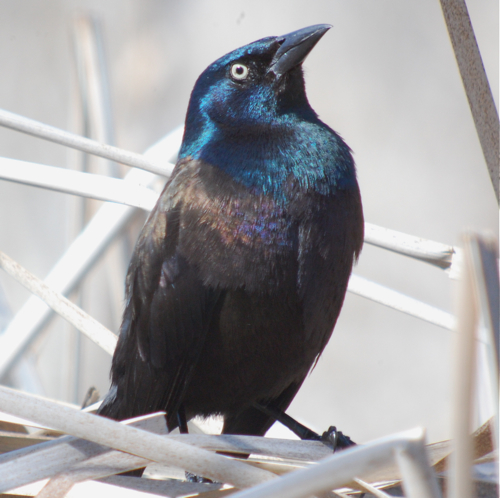
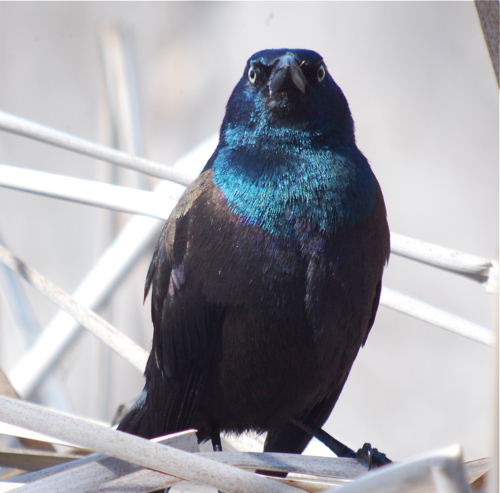
It's that special time of year when migration is in the early stages and any sign of spring is a welcome sign--even the first few small flocks of common grackles like the one above.  They really are a pretty bird in the right light.  But soon, grackles will be driving people who feed birds a little crazy.  They big dark birds fly in with their ravenous appetites and large flock numbers during migration and need the extra fuel to make it to their breeding grounds.  Those who have enjoyed chickadees, cardinals and titmice all winter will find the feeders crowded with these aggressive blackbirds.  Once insects are out in full force, grackles will go for those, but in the meantime they can be a bit irritating as they crowd out some of the smaller birds.  When I worked at the bird feed store, grackles were welcome because that always meant a bump in seed sales because the grackles eat so much.
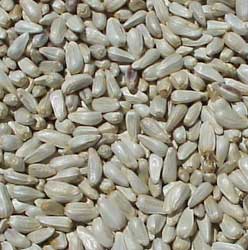
You do have some options in dealing with grackles.  One is to feed safflower.  There's a method to feeding safflower.  I've said it before and I'll end up saying it a thousand times but you usually have to introduce your feeder birds to safflower.  Sometimes when you have been feeding black oilers all winter and then make the sudden switch to safflower, the usual feeder crowd quits coming.  It's like going to your favorite burger joint only to discover that has turned to a Mexican restaurant.  It's not that you do not like Mexican food, but when you arrived there, you were expecting to get a hamburger, not a bean burrito.  Birds are the same way.  They flew in expecting black oil sunflower and find something else.  Switching cold turkey could take a few weeks to get regular bird activity back to "normal."

It works best if you can gradually increase the safflower in your mix so that the birds get used to the change.  If you start this after you already have grackles coming to the feeders, they will kick out safflower in favor of the seed they prefer.

You can also have one feeder that is all safflower.  The grackles may go after the other feeders, but the cardinals, rose-breasted grosbeaks, chickadees, nuthatches, titmice, house finches and mourning doves have a place to go.  I usually offer safflower in a tray feeder since cardinals tend to feed more readily in that.  There are some good tray feeders in my OpenSky shop (if you purchase from there, 20% of the profits to go kid programming at the American Birding Association).

You can also try weight sensitive feeders with grackles--at least weight sensitive that have a way to adjust the setting.  I've use the Squirrel Buster II with fairly good results at keeping bigger birds out--it especially works well if you are having problems with rock pigeons.

Spring Signs: Blackbirds & Merganser Style

Friday, I had a meeting in Eden Prairie, MN--the southwest side of the metro Twin Cities.  As I  traveling on the highway, I noticed a large group of gulls loafing on a pond off the highway.  I made a mental note of the exit and decided to stop there on my way back home after the meeting.  When I pulled down the street, I noticed the ponds were almost completely ice free and could have some bird potential.

When I stepped out of my car, I could smell what had the gulls excited--a fish kill.  The unmistakable aroma of dead fish hung in the air.  The gulls were a mixture of ring-billed and herring and they were so chatty, you almost thought you were at a beach.  A few crows joined the gulls in the rancid feast.

A couple of bald eagles made some passes over the gulls--spooking them a few times.  The eagles flew low but did not land on the ice.   I'm not sure if the eagles were uncertain about the quality of dead fish or the amount of people walking around the lake.  The eagle pictured above eventually perched on top of a tree and watched the gulls for quite some time and never flew to the ice. I got the sense that the bird wanted its share of the dead fish but felt unsure of the situation.

I've heard red-winged blackbirds on and off the last week or two and their call was unmistakable around the fish kill lake.  We still don't have any female red-wings here yet, so the early arriving males still have some time to negotiate their territories.

There was a pond on the other side of the parking lot that was completely ice free and I noticed some splashing sounds.  A quick scan with the scope revealed about 3 pair of hooded mergansers engaging in some mating displays.  Love these little ducks!

Hooded mergansers will use wood duck boxes for nesting--I had one use a nest box at the bird store a few years ago.  It's cool to see this fish eating duck move further and further into the Twin Cities metro area for breeding purposes.  Check out that male's bill above with that dainty little hook on the end of his beak.  One of my favorite illustrations from the duck stamp contest I judged last week was of a male hooded merganser fishing underwater.

The males seemed to have each found a female and the settled down by the time I got close enough for some photos.  I was hoping I could hear their mating call but I think even if they had been giving it, the close by highway would have made it hard to hear.  You can listen to hooded merganser mating calls at Xeno Canto--I love that little croaky call.  I checked over at Cornell's Birds of North America Online for what entails the mating ritual for hooded mergansers and it reads, "Males have elaborate courtship behaviors which include Crest-raising, Head-shaking, Head-throws with Turn-the-back-of-the-head, Head-pumping, Upward-stretch, Upward-stretch with Wing-flap, and ritualized Drinking."

Not unlike humans.  BNA says that you can distinguish "ritualized drinking" from "normal drinking" in male hooded mergansers by the strongly depressed crest and almost vertical orientation of the bill.  So, if you're at a bar and a guy is trying to impress you with his drinking ability--perhaps he is trying to woo you with a merganser flirting strategy?  If you suspect that is the case and you would like to take him up on his advances, you can respond by moving your head up and down in a rapid, jerky motion with your bill (or chin) pointed downward, uttering a hoarse gack.

Here's a video that I got at Wood Lake a couple of years ago of a little hooded merganser display:

[youtube]http://www.youtube.com/watch?v=AeG5KKa539A&feature=player_embedded[/youtube]

Red-tailed Hawk Live Cam

There's a very cool red-tailed hawk live cam at the Franklin Institute (as in Ben Franklin) in Philadelphia.  Kind of a fun change of pace from the owl owl cams and falcon cams.

Also, here's an interesting news story about bald eagles taking heron chicks from a rookery in western Washington state.  The article brings up an interesting conflict: those who love powerful eagles vs those who love elegant herons.  There are those who want to help the rookery and those who think that the eagles and herons need to work it out for themselves.

Heron chicks are certainly something bald eagles would eat and speaking as someone who has visited several rookeries--it's amazing that any heron chick ever survives a rookery.  Herons are not the most attentive parents.  For example, if a blue jay chick, great horned owl chick or crow chick falls out of the nest and begs, the parents will make a reasonable effort to continue to attend to the chick and feed it.  Herons?  If the chick falls out of the nest, it's toast.  It will not be fed and it will either starve or be preyed upon by any enterprising predator.

It will be interesting to see if this rookery ultimately fails, the herons start a new one elsewhere or if the eagles will find more tasty prey.

Endangered Species Condoms

Yes, you read that subject line correctly: Endangered Species Condoms.

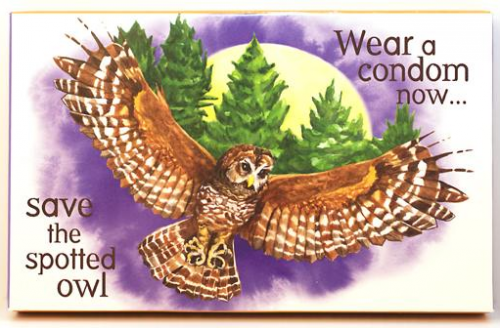
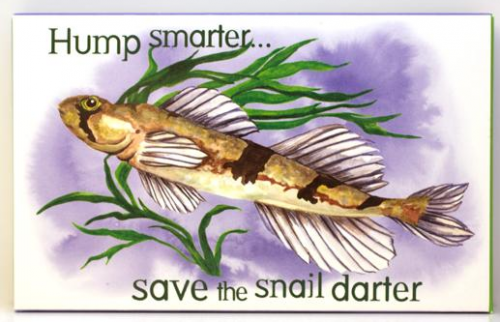
And no, they are not for the endangered species themselves, they're for one of the most over-populated species out there. Susan Gets Native posted a link on Facebook about the Center for Biological Diversity is "distributing 100,000 free Endangered Species Condoms in all 50 states to highlight how unsustainable human population growth is driving species extinct at a cataclysmic rate."

According to the press release, "the goal is to help people understand the impact of overpopulation on other species, and to give them a chance to take action in their own lives, the Center is distributing free packets of Endangered Species Condoms depicting six separate species: the polar bear, snail darter, spotted owl, American burying beetle, jaguar, and coquí guajón rock frog."

So, it's a creative project that hopes to engage the general masses in real conversation on over opulation not about coming up with a wacky idea to get bloggers like me to talk the Center for Biological Diversity to you.

Oh, and if you are looking for something to do, you can sign up to be an Endangered Species Condom Distributor--which would look so awesome on a resume!  I wonder if any wild bird retail stores will take advantage of this for free promotion in their stores?  Buy 20 pounds of Finch Feast and get a free condom!

Also, I would think there could have been some better slogans than what they came up with.  Say:

If you love her, cover your piping plover.

Before they howl, hood the spotted owl.

Can't wait to see what spam comes into the comments filter with this post.