
Birdchick Blog
Twitter Digiscoping Duel #birding
I love digiscoping and I love blogging. After you've had a blog for awhile, you try to think up ways to keep it interesting for you and for your readers--otherwise it will just fall apart. As Facebook and Twitter have grown, my time spent blogging is now spent interacting with folks online. I try to divide up my time to upload posts, Tweet and Facebook, but still go outdoors.
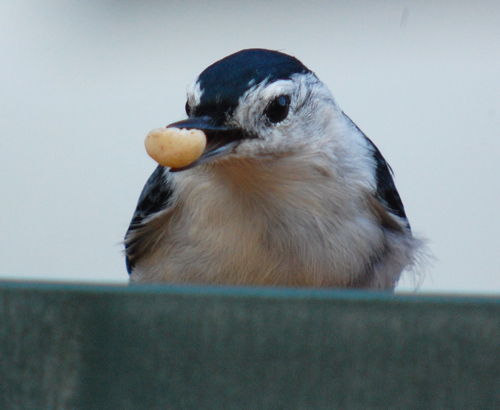
I love to digiscope my feeder birds, but how many photos of white-breasted nuthatches can I post before readers go, "Oh, wow, another nuthatch photo. They eat nuts just like she says...all...the...time." I wondered how could I channel my love of digiscoping, birds and social media...then it hit me--I challenged my fellow digiscoper--Clay Taylor to an online digiscoping duel tomorrow on Twitter.
Clay lives in Texas, I will be at Mr. Neil's house. I set a challenge to see who can take the most photos of birds with digiscoping and post them to Twitter from their respective yards before 4 pm Central Time. You can follow this contest online if you have a Twitter account by following me @Birdchick and Clay @CTaylorBirder. If you used an application for managing your Twitter follows, we will also use the hashtags #digiduel and #birding as we upload photos of birds. Feel free to retweet photos you like them. With fall migration, we should get some interesting shots.
I love this idea because Clay and I can kind of bird together but in different parts of the country and we can share our birds for a compare and contrast for others to see--and we don't have to fly in a plane. I'll be curious to see how this pans out. Since he's in Texas, he could have more birds...but if the winds are weird or his online connection is wonky, I could post more photos before he can. Either way, there will be some awesome birds on Twitter tomorrow.
Friendly Hummingbird Reminder
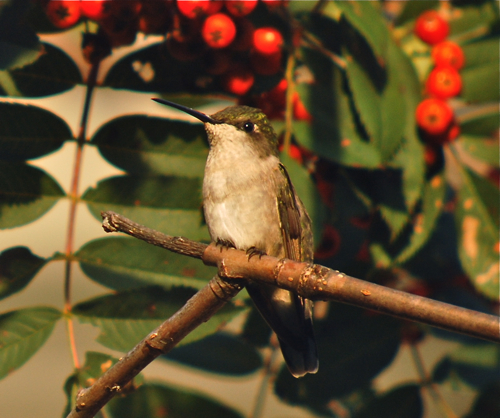 Here is a female ruby-throated hummingbird that I digiscoped today. She was perched in a showy mountain ash tree and it reminded to me put in the blog: DO NOT TAKE YOUR HUMMINGBIRD FEEDERS IN ON LABOR DAY!
Well, you can take your nectar feeders in if you are tired of watching hummingbirds. However, if you have heard or read some where that if you leave your feeder out, it could prevent the birds from migrating south, that is not true. It's possible to see hummingbirds heading south all the way into early October up here in Minnesota--even later the further the south you live in the US. They can take the cooler temperatures--even a few nights below thirty degrees. Those later birds will appreciate the extra nectar sources if you keep your feeder out.
To track the southward migration of ruby-throated hummingbirds, visit here.
Oh and speaking of hummingbirds, check out this lighter colored one found in Ohio!
Cormorant vs Gull
 Amidst all the staging, a double-crested cormorant captured a fish. The bird had pierced the body of the fish clean through. When it surfaced and tried to reposition the fish for better swallowing, a young ring-billed gull thought, "Hey, cormorant, your fish is relevant to my interests."

The cormorant struggled with the fish and the gull jockeyed for position and a game of bird and fish ensued.


Finally, the cormorant dove below the surface and waited for the gull to lose interest. Then resurfaced and swallowed the fish.
Coolest Bird Job Ever?
I am a happily married woman. I LOVE Non Birding Bill with all my heart and treasure the adventures we have together. Yet, every now and then, I see bird job opportunities come along and I think, "If I were single...I would totally apply for that job!" Usually it's a position of monitoring birds in the Carribbean for a few months or spending a few weeks in some remote lodge in Ecuador. But today, I found the mac daddy of all cool-ass-adventure-birding-jobs. This job is so cool, that it sounds like it was made up by an 11 year old: Parahawking Team in Nepal is looking for a new assistant. Based on a photo from their website, here's what that might look like:

Are you kidding me?? It's a company that trains birds of prey and vultures to fly along with you while paragliding over Nepal! Remote gorgeous country, vultures and flying--my head just imploded a little at the awesomeness of it.
Based on what the job description reads for Parahawking, the job opening is not for a falconer or a paraglider, but someone to do the grunt work (who cares, the grunt work is in freaking Nepal):
"As the 5th member of the team, your role will be varied but your priorities are to take care of the birds, feeding, weighing, cleaning, general husbandry, preparing for daily flights etc. Parahawking tandem flights are the mainstay of our business, we are busy all of the time. The operation must run like clockwork and each team member has their role to play. You will also be responsible for giving presentations to small groups of American tourists several times a week. These presentations form part of our contribution to the the vital conservation work we do. They normally last for no longer than 1 hour, they are informal and fun and a good opportunity to raise awareness and funds for Himalayan Raptor Rescue and vulture conservation."
So you'd get to do programs and take care of birds of prey (in Nepal). So, since I can't apply for this, someone out there needs to for all of us who fantasize about working cool remote areas with cool birds.
And now I need to find a way to get to Nepal and take one of these trips. I think my aerial waterfowl surveys have mellowed my fear of heights. And if I had a cool old world vulture to focus on, I'd not care about heights.
*I'd like to say that I find what this company is doing fine for the birds involved. It looks like the birds are trained to fly along the gliders and land. The birds are doing it of their own accord with positive reinforcement (if they weren't trained well, they would never fly to the gliders). The birds are in great feather condition and look well cared for. I find this a safe and okay environment.
Completely the opposite of what I think of the dude who flies around with the injured eagle in the hang glider so it can experience flight again. Honestly, I think that is schmaltzy and stressful to the eagle. That bird is completely bound up and has no control of the situation (unlike the birds at the above job that can choose to fly to the glider or ignore it. I think it's dangerous to fly with the bird wrapped up like that where if something goes wrong, the pilot can do little to help it. Quite frankly, I'm surprised US Fish and Wildlife allows it. But that's another blog entry.

Staging Birds

I've been out at the state fair this week doing different things and mostly answering bird questions. Although, there was a minor foray into bird rescue. A young cowbird was lurking around the DNR stage and during a rather long and arduous pan pipe concert, it was weaving in and out of the bleachers. People kept asking us to rescue it but every time I checked on it, the bird was taking advantage of the ample supply of fair food droppings under the bleachers and would fly away irritated when humans would try to grab it.

Many people had questions about pelicans. Quite a few are staging or gathering in larger flocks for fall migration around the Twin Cities--you might see some birds staging for migration where you live. This can include all sorts of species like swallows, blackbirds or waterfowl. The above photo is a flock of American white pelicans that were circling over the Mississippi River last week. I've seen quite a few gathering along the river on our park's canoe trips. I got a slight pang of excitement when we canoed a section that was loaded with birds during our aerial waterfowl surveys...which start at the end of this month.

Here are some pelicans and double-crested cormorants staging on Lake Vadnais--based on the pelicans and cormorants in this photo alone, I would say this might be an ideal spot for fishing...although, I don't think fishing is allowed on this side. The part of staging is that gives you a chance to see large concentrations of birds or...

...odd groupings of birds. Above is a great blue heron, some mallards, a couple of cormorants and a ring-billed gull. Since they aren't breeding, there aren't too many territory squabbles. It's interesting to see that when one bird starts preening (putting feathers in place and conditioning with oil from a gland on their back with their beaks) the rest soon follow suit.

Even great egrets are staging (every white thing in the above photo is an egret). But they do not appear to allow the closeness that pelicans and cormorants allow with each other. Even if a bird flew too close, you could hear their belchy cloaks in protest.

It's interesting to watch these groups when they are not feeding or preening. They all seem to be waiting for something, for some cue. Perhaps it's combination of signs: feeling a certain heft to their bodies from all the fat put on for a marathon flight along with the length of daylight and winds out of the north to help them push south.
Mississippi Birds to Beers Event @MerlinsRest
I am so excited about this event!

I have organized an event for my park called the Mississippi National River and Recration Area at Merlin's Rest on September 11, 2010 from 2pm - 4pm. You can come for the whole thing or just part of it. It's going to be a great way to get to know others interested in enjoying the outdoors in the Twin Cities as well as learn the History of Beer along the Mississippi River (my boss, Ranger Dan is doing this and he is HILARIOUS--really a good program giver and knows his beer). Rangers will also be on hand to answer questions about boating, fishing, birding, biking or whatever you'd like in the park and you can enjoy the fun atmosphere at Merlin's Rest.
I'm very excited that we will have a special Mississippi River themed pub quiz to round out the event! Perhaps I'll bring some of our award winning honey along as a prize for the winners?
Here is the tentative schedule--which may change slightly as we may have a few surprises.
2:00 pm Arrive for fun, get a beer
2:15 pm Opening Remarks from MNRRA Superintendent Paul Labovitz
2:25 pm Movie: Mississippi National River & Recreation Area
2:45 pm Ranger Dan's History of Beer on the Mississippi River
Break for mingling
4pm Mississippi River Pub Quiz!
Here is the Facebook Page for the event which will also have the most recent updates on the events. Tell your friends and join the event.
Owen Wilson Toting Zeiss Binoculars in Big Year
 I must admit, I secretly hoped we'd be sharing the same binoculars, but alas, Owen Wilson is sporting Zeiss binoculars in The Big Year movie. Still, I do like the wardrobe shots I've seen so far...and the fact that he's not in a Tilley Hat.

I can at least content myself that Steve Martin and I are wearing Swarovski binocualrs...now what brand will Jack Black be sporting?
Rough Song Sparrow
 Migration is upon us. Not everyone enjoys birding in the fall, some species can look different in the fall since they aren't in breeding plumage. Young birds haven't grown into their adult plumage yet. Birds usually don't sing their territory song on the way south, but rather chip notes that can sound the same among several species--it can be more of a challenge.
I found one bedraggled looking sparrow the other day. Song sparrows usually have a very long tail which makes them easy to pick out, even if you only see the profile. When I saw this bird hopping in some bushes, I was interested. I made the pishing sound and it popped right up just like a song sparrow should and it appeared to be lacking a tail. Who knows what happened--an overzealous molt? An failed grab from a sharp-shinned hawk? But it's all part of the fun of weird birds on the fall migration.

Coming Attractions
(Not really!) While playing around with MoType, a titles plugin, I whipped this up to amuse Sharon: [youtube]http://www.youtube.com/watch?v=J9cS1_0D83g[/youtube]
The music is from World of Goo, a fantastically fun game which you should totally buy, I think.
Digiscoped Images
Fresh Tweets
Would you like to hire me as a speaker for your event?
Email sharon@birdchick.com