
Birdchick Blog
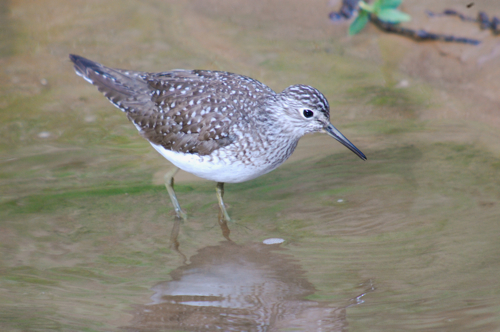 Solitary sandpiper lurking around Mr. Neil's creek.
Oh Snap!
 I think this is something Non Birding Bill and I will address on the next podcast but check out this photo that Paul Baicich sent out to a listserv intended for promoting the Duck Stamp to birders. He wrote that it was seen in northwest Ohio during the "Biggest Week in American Birding" along State Route 2, west of Ottawa NWR and a few miles from Magee Marsh WA.
Baby Owls Branching Out
I'm in the midst of my busies month. If I'm not at the National Park Service engaged in ranger work, I'm on the road at a bird festival, birding the crap out of whatever state I'm in. It's a horrific schedule but it's loads of fun. And at the end of the month of May, I get a weekend off to celebrate my wedding anniversary with Non Birding Bill (we'll be on year lucky 13--boy, why did I think it would be a good idea to get married in May?). A friend of mine who is new to birding asked if I'd like to go out next week. My first answer was that I was too busy. But then I saw on Tuesday that it was supposed to be 80 degrees and I just couldn't say no. So we did some birding near my apartment. It's warbler season and they are dripping off the trees. The few days I was home, I had a golden-winged warbler outside my bedroom window ever morning!
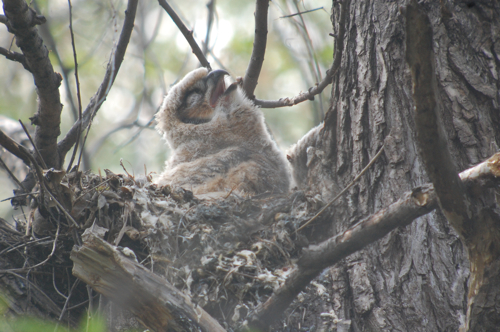
I showed him the owl nest and boy the two young owls were panting like crazy. Birds don't sweat like humans and pant like dogs when their hot. The young owls still have some of their thick down that protects them in snow storms when they hatch earlier. Doesn't it look like it's saying, "Oh man, I'm so hot, ugh."

I didn't see either adult and figured that since the young were so large, they were tucked in a nearby conifer for shade from the warm sun. As I looked at the nest from this angle, I realized how trashed it is. Check out these photos from an earlier entry when the female was still incubating. Note how the nest material was all the way to to the stick. In the above photo, it's well below that now. I thought to myself that these owls have to be in the brancher phase. That's when they are still downy but their feet are very strong and they begin to venture out of the nest. The young birds can even be blown out of the tree, yet their feet are strong enough to enable them to climb back up.
It looks like they have some feather development on their wings and back. I got confirmation on this a few days later from another nearby resident who has been watching the nest and he confirmed that babies had crawled out and were on branches 10 feet from the nest. Our little guys grow up so fast.
Year of the Sora
Someone asked on Twitter if this was the year of the sora because the seem to be EVERYWHERE.
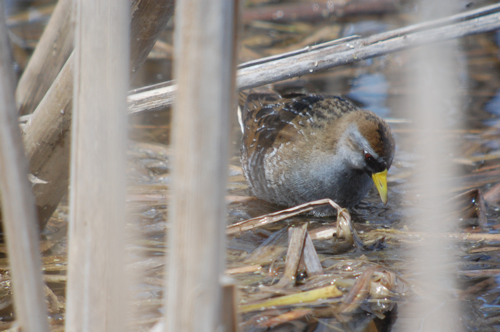
This is a sora that was very cooperative at the Minnesota Valley National Wildlife Refuge. I took this before I left for Horicon. I was walking by the Bass Ponds and I could hear several soras when I noticed this bird out and about in the open, not skulking among the vegetation like most soras do.

Here is where the sora was in relation to my scope. Here's what the sora sounds like. Here are some more calls on the Cornell All About Birds page.

Horicon Marsh was loaded with them too. I didn't get any photos of the little water chicken, but I heard them every stop I made that had any sore of marsh. Right now I'm in Utah for the Great Salt Lake Bird Festival. When I arrived, I went straight from the airport for some birding at Bear River Migratory Bird Refuge and it was sora city there as well. I don't remember hearing so many soras all the time--I'll take it. Must mean they found some great breeding habitat and great places to over winter the last few years.
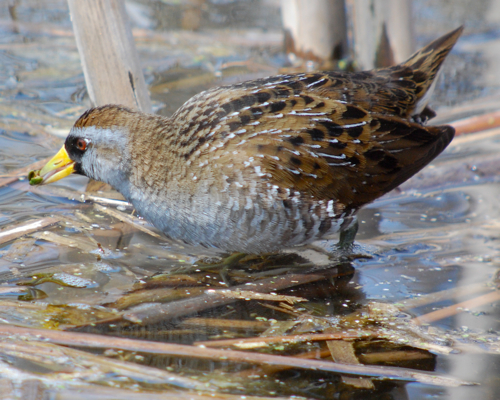
They eat vegetation and invertebrates. This bird was too fast for me to capture it, but I watched it down a few small snails including shell. I wondered if this was a female, snail shells provide calcium for egg laying.

Those these birds are timid, the curve of the beak always gives them a contented look.

Keep your eyes and ears open for these mysterious little water chickens.
Redhead Shenanigans
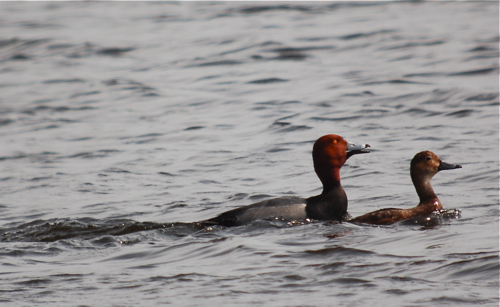 This is a pair of redheads (a type of duck) seen during last weekend's Horicon Marsh Bird Festival. Horicon Marsh is over 33,000 acres in size and at first glance it may appear to be managed for Canada geese and muskrats, but redheads are one of the main targets for optimizing habitat.
If you are not familiar with any other duck but mallards, you should really get to know the redhead. Rather than the usual green head of male mallards, they have a gorgeous rusty red head. And they don't quack...they kind of sound like crows that have swallowed helium--what's not to love?
Check out the above photo, that is some serious redhead flirting going on--that kind of "my head is higher than your head" posture. Don't worry if you are reading this at work, that's not the hardcore flirting. For that they completely throw their heads back.
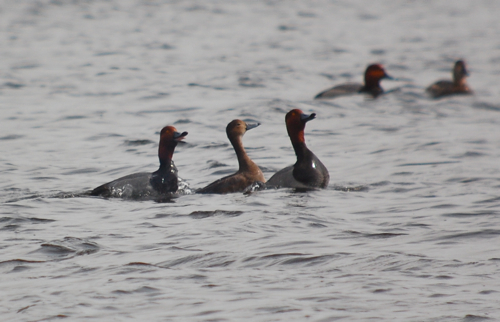
Here's an example of a couple of male redheads competing for the attention of a female. I love this look of who can raise their head the highest in the above photo. For some reason, it reminds me of Kanye West.
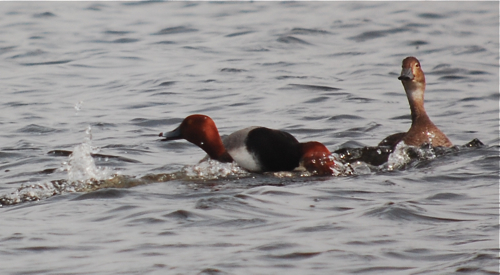
But then things can get heated between 2 males. Note how the female is observing the fight.
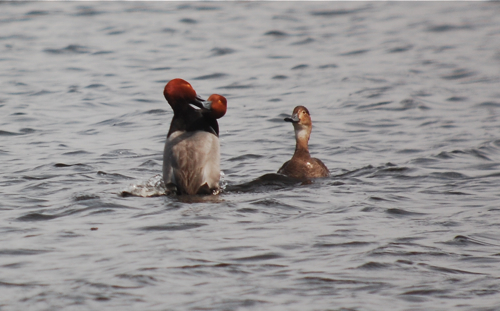
The redhead with 2 backs! (How many times am I going to make that joke this week?). Two males duking it out.
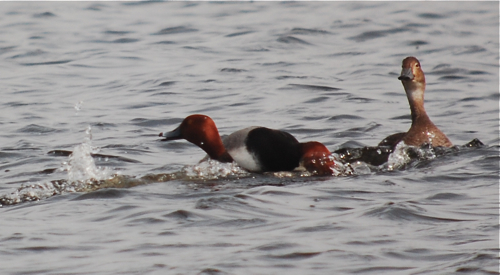
Oh no, redhead body slam! Again, note how the female is watching with a discernible eye.
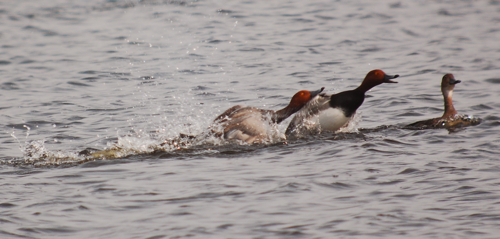
Oh no, redhead chase!
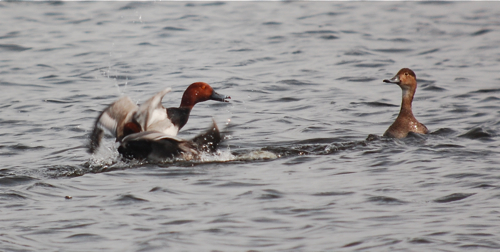
Uh oh, is that a redhead goose? Is that allowed?
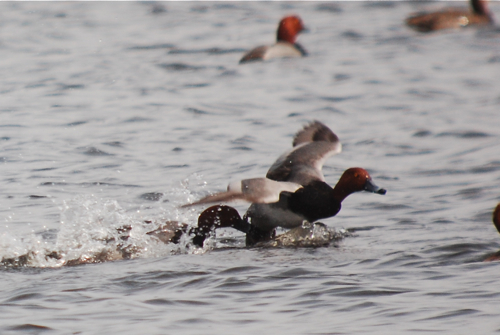
Oh man, that is a total redhead goosing.
All part of the mating shenanigans you can see at Horicon Marsh!
Why I Shouldn't Go Birding Without Coffee
Last week, before I headed to Horicon Marsh, I stopped at Mr. Neil's house to check our bees and some warbler watching. The plan was to check the bees Thursday afternoon, spend the night, bird in the morning and then hit the road to Horicon. Being British, there's not a lot of coffee around the house. I thought this would be a good motivator--if bird watching is awesome, I will linger and be late. If I don't have coffee, the withdrawal will force me on the road. The birding was awesome and one of the things I did was check out a red-tailed hawk nest that's across a ravine from the house. The leaves were quite out and if I positioned my scope in just the right way, I could look directly into the nest:
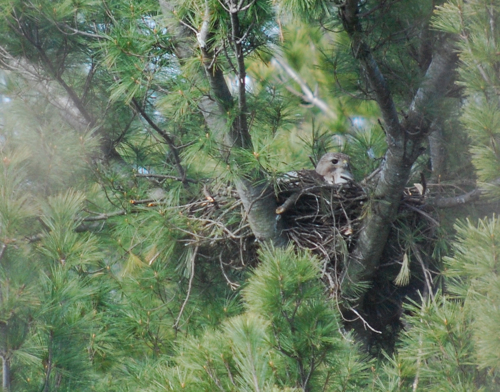
That's the nest visible through my spotting scope. It looks like the female has a fairly light head. The male has been very vocal chasing anyone who dares cruise through his patch of sky. Thanks to his vocal and merry chases, I've discovered that a red-shouldered hawk sometimes glides through (new hawk for Neil's yard). To give you an idea of how well hidden the nest is, here is where my scope is aimed:
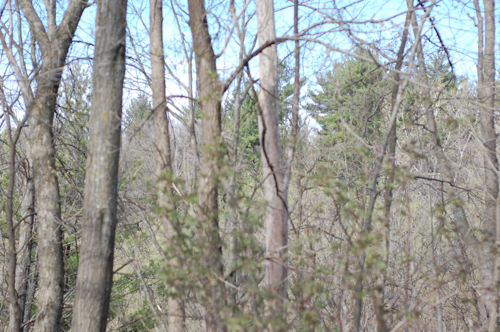
Here is an arrow for guidance:
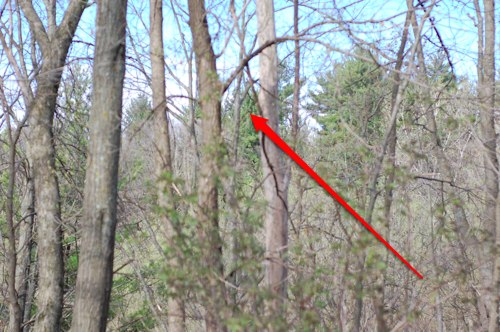
Neil's house is on top of a ravine, down below is a creek and the red-tailed hawk nest is in a tall pine on the other side. Since the nest is a challenge to actually get in the scope, I left it set up there while I gathered my things and repacked them in the car. I showed groundskeeper and the housekeeper the nest and continued gathering my stuff.
When I was about about an hour of away from Horicon, I received a call from Neil, "I was just looking through your scope that you have set up on the nest, it's lovely. But don't you need this for the festival."
I pulled over and realized my error and shouted a loud, "BLERG!" Figuring that shipping it overnight it would be impossible, I decided to drive back. Neil's assistant Lorraine gave the groundskeeper her car and he drove and met me halfway--which was quite nice as he had plans to go the opening of Thor that day. But thanks to all, I got the scope and made it to the festival and learned that coffee is a good thing for me to have when birding in the morning.
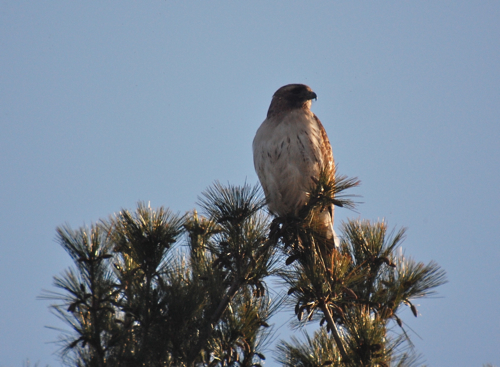
Sometimes I think it takes a village to manage a Birdchick.
Warblers Eating Honey
I'm in a quandary with my beehives and my love of birds.

On my way out to the Horicon Marsh Bird Festival, I stopped at Mr. Neil's for a quick check of our new beehives and some birding. The warblers have arrived and the cool weather has forced those who arrive early in migration to search for alternate sources of food. Yellow-rumped warblers like these would prefer insects. Far too cool and far too few available, so the enterprising early migrants explored the bird feeders.

Despite the fact that Baltimore orioles are in the area and singing, none came to the feeders. Yellow-rumps gladly took advantage of the grape jelly.

The warblers even jockeyed for position at the suet feeder among the four species of woodpecker that normally feed here.

Pine warblers are also hitting the feeders. Whereas the yellow-rumps go for the suet and jelly, the pine goes for sunflower hearts. It will also go for the suet, but seems content to eat the seeds.

While I was working around the garage, I noticed Neil's groundskeeper Hans had put out some old bee frames. We do this so the bees from active hives will fly in and clean out the old honey. These frames were from the hives that died over the winter. The bees found it. While I was working around the garage, I noticed warbles hanging out in the area. At first, I thought the warblers were after the live bees and even said allowed, "I know you're desperate for insects, but you're far too small for eating bees."

Then, right about dusk when the honeybees were all tucked in their hives for the day, I noticed the warblers on the frames, pecking at them. The light was dim but thanks to the auto timer on my Nikon D40 I was able to digiscope a Nashville warbler and a yellow-rumped warbler on the frames.

Based on the holes in the frame it looked like the warblers were going for dead bees. Some of the frames had capped larvae that never hatched, so I figured the warblers were after the protein of old squishy non-hatched larvae. We had more frames of dead larvae and honey in the garage so I set more out. I figured the warblers could clean out the larvae and the bees could clean out the honey and help get a head start on their hives for the season.

The next morning when I went out for some birding, I checked the frames, they were covered in warblers. Above are two yellow-rumped warblers and one Nashville warbler. These were a small cross-section of about two dozen warblers waiting in line to feed off of my old beehive frames. There were at least four species in the flock, the above two and pine warblers and orange-crowned. I didn't get photos of the other two species, but got plenty of shots of the feeding frenzy.

Here are four warblers on one frame. As I took pictures and watched them feed, it became clear that old bee larvae was not the only sustenance they were after. They were very certainly eating honey. I had a moment of panic...should birds be eating honey? Honeybees are a fairly new species to North America, they came over with the early settlers. Warblers did not evolve with honeybees. Could they safely process honey and still migrate?

As I watched them I noticed that they tugged and chipped at wax foundation too. Is that safe? I've seen honeybees that have built comb out in the open on a bare branch, I remember seeing some abandon ones in Arizona and Texas...perhaps warblers have had exposure to this.

The air was so cold and their food scarce, I didn't want to take this source of food away if they were still trying to load up for their journey north. I couldn't find anything about it on the Internet other than not using honey as a means to make nectar. I wanted to plant myself in front of the frames all day long see how many species of warbler would come in but I had to go.

I also noted that as the sun got higher in the sky and our honeybees became more active, the bees didn't tolerate the warblers in close proximity and chased them off. A few warblers still came in for the bounty but not four on a frame like at dawn.

I'm not sure if this is a good thing but if the warblers figured honey out, no doubt other birds will and I don't know if they should. We already had one casualty of a tufted titmouse getting covered in honey while it explored some of our dead beehives. I'm going to have to seek out an avian nutritionist to find out if this is a safe thing to offer birds. If it is, this may be a new way to enjoy birds and bees and a new product to offer at bird stores.

Random Rose-breasted Grosbeak
 It's always a good day when I see these guys come back to the feeder.
Random Nuthatches
 Well this was a pleasant surprise. After months of being AWOL, a red-breasted nuthatch returned to the feeders today...much to the chagrin of the white-breasted nuthatch.
Digiscoped Images
Fresh Tweets
Would you like to hire me as a speaker for your event?
Email sharon@birdchick.com